
 Published on and written by Cyril Jarnias
Long seen as a simple wind-swept rock in the middle of the Caribbean, Saint Barthélemy actually has a surprisingly dense history. From the Amerindian island of “Ouanalao” to the tourist micro‑state with the status of a French overseas collectivity, the territory has changed sovereignty, administrative language, economic model, and even European status several times. Tracing the history of the country of Saint Barthélemy is following a thread that connects the Amerindian peoples, French colonists, Knights of Malta, pirates, kings of Sweden, freed slaves, and the international elite of luxury tourism.
Ouanalao, the Arid Island of the Amerindian Peoples
Long before the arrival of Europeans, the island we now call Saint Barthélemy had a different name: Ouanalao. This place name, passed down by the Arawaks and the Taínos, may refer, according to some researchers, to the abundant iguanas on this volcanic piece of land surrounded by reefs.
Archaeology indicates that the island probably never had a significant permanent population due to its poor soil, low rainfall, and lack of fresh water sources. It rather served as a seasonal base for the Amerindians, who fished, hunted, and grew some crops like cassava there. Petroglyphs, objects discovered near the current Saint-Jean airstrip, and the statue of Savaku commemorating an Arawak warrior attest that the history of Saint Barthélemy began with these Amerindian societies, long before Christopher Columbus arrived.
From Columbus to the First French Settlement
When Christopher Columbus sighted the island in 1493, during his second voyage, he named it Saint Barthélemy in honor of his younger brother Bartolomeo. But this European baptism was not accompanied by lasting settlement. For more than a century, the island remained on the fringes of the great colonial routes, visited sporadically by Spanish sailors, then by French, English, or Dutch in search of discreet stopovers.
In 1648, under the impetus of Philippe de Longvilliers de Poincy, lieutenant governor linked to the Company of the Islands of America and then to the French West India Company, about fifty colonists commanded by Jacques Gentes settled. These colonists, coming from mainland France and Saint Christopher (St. Kitts), tried to grow cocoa and other tropical crops there.
Very quickly, reality caught up with the project. The rugged terrain, drought, and small size of the territory limited the establishment of plantations. In 1656, an attack by the Caribs almost wiped out the young colony, which was abandoned for a time. Behind this episode lies the unstable power struggle between newly arrived Europeans and the Amerindian populations still present in the archipelago.
The Knights of Malta, a Little-Known Interlude
In this shifting colonial game, Saint Barthélemy changed European owners for the first time. Poincy, himself a member of the Order of Saint John of Jerusalem (the future Knights of Malta), facilitated the transfer of the island from the colonial company to the Order in the early 1650s. The Hospitallers then briefly governed Saint Barthélemy and tried to make this arid territory profitable by focusing on a few products: indigo, cotton, goat farming, fishing, and salt extraction.
Year of the repurchase of Saint Barthélemy by the French West India Company after the failure of colonization by the Order of Malta.
A Poor French Confetti, Pirates Included
At the end of the 17th century and the beginning of the 18th, Saint Barthélemy appeared as a marginal confetti of the French empire. Census records indicate a few hundred inhabitants, mostly poor peasants, fishermen, and small landowners. Activities consisted of subsistence agriculture (cotton, tobacco, a little cocoa), fishing, goat breeding, and salt extraction from the marshes.
The arid terrain of the island prevented the development of large sugar plantations, unlike Martinique or Guadeloupe. Although slavery was present, with nearly a quarter of the population being enslaved at the end of the 17th century, the dominant model was that of small production units where masters and slaves often worked side by side.
At the same time, the island’s position, slightly off the main sugar islands, made it a favored base for freebooters and privateers. The most famous of them, Daniel Montbars, nicknamed “the Exterminator,” is associated with Saint Barthélemy by legend. It is said that he hid treasures in the coves of Gouverneur or Saline. Regardless of the authenticity of these stories, they speak to the importance of the underworld—smuggling, privateering, piracy—in the island’s informal economy.
British Interlude and French Fragility
At the regional level, Anglo‑French rivalry resulted in successive occupations. Some sources mention British presence or attacks as early as the mid-18th century; it is known that the British seized Saint Barthélemy in 1744, during the War of the Austrian Succession, and only returned it to France in 1764. This episode highlights the strategic vulnerability of this island without a real garrison, but useful as an outpost and anchorage.
Saint Barthélemy is described as a costly and unproductive territory.
French authorities on the eve of the Revolution
The Remarkable Swedish Episode
In 1784, Louis XVI reached an agreement with Gustav III of Sweden. France obtained commercial privileges in the Swedish port of Gothenburg, while Sweden received Saint Barthélemy. The transaction may seem surprising, but it served very concrete calculations: for Versailles, getting rid of a deficit territory in exchange for commercial advantages in Europe was a good deal; for Stockholm, it was an opportunity to join the club of colonial powers.
The Swedes officially arrived in 1785. The port of “Carénage,” where ships had previously been hauled up for repairs, was renamed Gustavia in honor of Gustav III. Quickly, the new administration implemented an ambitious policy: declaration of a free port, creation of a colonial company (the Swedish West India Company), layout of a grid street network, construction of docks, warehouses, and also three forts—Gustav, Karl, and Oscar—to defend the harbor.
Gustavia, a Hub of Commerce… and Trafficking
The choice of free port changed everything. At the end of the 18th and beginning of the 19th century, as the Revolutionary and Napoleonic Wars disrupted the Atlantic, Gustavia became a neutral haven where enemy flags, suspicious cargoes, and cosmopolitan merchants met. Like the Dutch ports of Curaçao or the Danish port of Saint Thomas, Saint Barthélemy functioned as a hub for legal trade and smuggling.
Historical accounts studied by Victor Wilson describe Gustavia as a very active port city. Trade was flourishing, including the export of French wines to the colonies, North American timber to the British islands, and English and Indian goods to the United States. At its peak around 1800, the island had about 6,000 inhabitants, a majority of whom lived in Gustavia, making this city one of the most populous in the Kingdom of Sweden at that time.
In this prosperity, however, Swedes represented only a very small part of the inhabitants: estimates suggest that barely 4% of the population was of Swedish origin. The rest consisted of French-speaking Creoles, English, Danes, Dutch, Americans, free people of color, and slaves from other islands. Gustavia’s trajectory perfectly illustrates the mixed and trans-imperial character of Caribbean free ports.
Slavery Under the Swedish Flag
The prosperity of Gustavia was partly based on a slave regime. In 1787, a specific text, the “Ordinance concerning the policing of slaves and free people of color,” regulated the condition of servitude on the island. This text replaced the French Black Code and set the organization of work, penalties, and rules for manumission.
On Saint Barthélemy, slavery was quantitatively limited due to the island’s small size and the absence of large sugar plantations. In 1819, between one-third and one-half of the population was still enslaved. The majority of slaves worked on small agricultural units, in the port, or as domestic servants. Living conditions were often modest, both for slaves and their masters.
Sweden also used the island as a transit base for the slave trade, although its overall involvement in the Atlantic slave trade remained smaller than that of the major colonial powers. Under the impetus of treaties signed with Great Britain, Stockholm gradually ended the trade at the beginning of the 19th century, long before abolishing slavery itself on the island.
From Peak to Decline
After the Napoleonic Wars, the context changed. Swedish neutrality yielded less, trade reorganized, and Gustavia gradually lost its central role. The decision to revoke the free port status in 1839 dealt another blow to the local economy. A fever epidemic in 1840, which killed about 300 inhabitants, further weakened the population.
On the moral and political front, abolitionist ideas gained ground in Europe. In 1846, the Swedish government decided to end slavery in Saint Barthélemy for reasons officially based on “humanity and law,” also concerned with preserving the crown’s image. The process was overseen by a commission of “gradual emancipation” with a budget to compensate owners.
The abolition of slavery in Saint Barthélemy was an individual and methodical process. A commission examined and freed each slave based on criteria such as age and health, over the course of more than a year. Official liberation was completed on October 9, 1847, with the freeing of the last slave, Marie Françoise (or Mélanie), after being bought from her master. This date is now a local public holiday commemorating abolition.
A Colony Turned Burden
Freed from the slave system, the island remained extremely fragile. The absence of plantations, the scarcity of fertile land, and the disappearance of certain commercial outlets pushed many freed people to emigrate. Climatic disasters further worsened the situation: a devastating hurricane in the early 1850s, followed by a great fire in Gustavia, plunged the local economy into crisis.
From Stockholm‘s perspective, Saint Barthélemy, once a colonial showcase, became a costly embarrassment. The Swedish press spoke of a “national shame” as the island’s poverty seemed out of step with the kingdom’s ambitions. The government then explored the possibility of reselling the colony: discussions were held with the United States, Italy, and finally with France.
In 1877, a local referendum was organized: the inhabitants voted almost unanimously for a return to French sovereignty. The retrocession agreement was signed in Paris, and on March 16, 1878, the Swedish flag was lowered in Gustavia in favor of the tricolor flag. In exchange, France paid 320,000 francs, part of which was intended for the pensions of Swedish officials. The island was once again attached to Guadeloupe, while retaining its free port status.
French Saint Barthélemy: Between Exodus and Survival
At the turn of the 20th century, Saint Barthélemy was a poor, isolated territory with no real political representation. Census records show a population of around 2,500 inhabitants, sometimes less. The lack of industries, meager agriculture, and the decline of Gustavia as a transit port forced many men to seek work elsewhere, especially on the neighboring island of St. Thomas.
An overview of the island’s socio-economic and environmental characteristics over the past decades.
Based on small family farms, fishing, crafts, and strong community mutual aid.
The island was only electrified in the 1980s, illustrating its isolation and late development.
This survival economy helped preserve a coastline and landscape with little urbanization, spared from large hotel complexes.
French Citizenship and Slow Integration
A symbolic milestone was reached in 1946: that year, the inhabitants of Saint Barthélemy became full French citizens, like all nationals of the new overseas departments. Politically, however, the island remained a simple commune integrated into Guadeloupe, without specific autonomy, and largely dependent on decisions made in Basse-Terre or Paris.
Within this framework, the state’s priority focused on basic education, a start on road and port infrastructure, and some administrative services. But it was not until the second half of the 20th century that another, unexpected actor came to shake up the island’s economic balance: tourism.
Inventing a Paradise: From the Savanna of Saint‑Jean to the Myth of St. Barths
The shift toward tourism began almost as a solitary gesture. In the late 1940s, aviator Rémy de Haenen made the first landing on the island, setting his plane down on a savanna near Saint‑Jean beach. Convinced of the site’s potential, he acquired land in the bay for a modest sum and built a small establishment: Eden Rock, perched on a rock. It was the early 1950s.
The first notable visitors—Greta Garbo, Howard Hughes—inaugurated a long history of alliances between the island and international celebrities. In the 1950s and 1960s, other high society figures were seduced by this island that had remained away from mass tourism. David Rockefeller built a villa at Colombier Cove in 1957; Benjamin de Rothschild settled in Marigot Bay in the late 1960s. Gradually, Saint Barthélemy forged a reputation as a discreet refuge for billionaires, dancers, and artists: Rudolf Nureyev, Mikhail Baryshnikov, and later, Jimmy Buffett, Steve Martin, or Chevy Chase.
A Deliberate Choice: High-End Instead of “All-Tourism”
At a time when other Caribbean islands bet on volume and large resorts, Saint Barthélemy made a different, almost intuitive choice: to remain small, expensive, and exclusive. The construction of a more structured airstrip at Saint‑Jean and its extension in 1984, with a short 646-meter paved strip, effectively closed the door to large airliners. Gustaf III Airport—later renamed Rémy‑de‑Haenen—only accommodates small propeller aircraft, which naturally limits tourist flows.
At the same time, the free port status was maintained, fostering the development of duty‑free luxury commerce: jewelry, fashion, wines, gastronomy. Private villas multiplied, often invisible from the road, nestled in the vegetation. In the 1980s, the creation of the first major villa rental agency targeting the North American market (WIMCO) helped structure this model. At the beginning of the 21st century, there were about 400 to 500 high-end villas for rent, along with about twenty hotels, some of which have become iconic—Eden Rock, Cheval Blanc, Le Toiny.
The gamble paid off: in 2014, the island’s nominal GDP was estimated at 367 million euros, with a GDP per capita among the highest in the Caribbean. Each year, approximately 200,000 visitors set foot on this 25 km² territory, a significant portion arriving by boat, including on superyachts.
A Social and Demographic Transformation
This shift toward high‑end tourism was accompanied by a demographic change. The population, which had stagnated at around 2,000 to 3,000 inhabitants in the mid-20th century, exceeded 9,900 residents in the 2017 census. Alongside the descendants of the former French colonists—originally from Brittany, Normandy, Poitou, Anjou, or Saintonge—a large Portuguese community, mainly from northern Portugal, settled to meet the demand for labor in construction and services, now representing about 3,000 people.
French is the official language, but English is very common in the tourism sectors. Two local dialects persist: a French patois on the leeward side and a French Creole (as well as Guadeloupean Creole) on the windward side. Swedish, although present in some place names, is no longer used in daily life.
Religiously, the island remains predominantly Catholic, with two parishes dedicated to Notre‑Dame‑de‑l’Assomption (in Lorient and Gustavia), but also an old Anglican community, centered on St. Bartholomew Church built in the mid-19th century, and some more recent Protestant groups.
Toward Autonomy: From a Guadeloupe Commune to an Overseas Collectivity
The economic success and specificity of the St. Barths model gradually translated at the institutional level. For a long time, the island remained a simple commune of the Guadeloupe department, with a mayor—Bruno Magras from 1995 to 2007—and a municipal council. But part of the population increasingly felt the gap between its own realities (largely autonomous economy, specific taxation, direct ties to North America) and regional oversight.
Percentage of voters who supported a distinct status for Saint Barthélemy in the 2003 referendum.
On February 22, 2007, the new territorial collectivity of Saint Barthélemy was officially created. A territorial council of 19 members, with significant powers regarding taxation, urban planning, transport, and the environment, replaced the former municipal council. Bruno Magras became the first president of the territorial council, a position he held for several terms before being replaced by Xavier Lédée after the 2022 elections.
A Unique Place within the European Union
This change in internal status also had consequences at the European level. Until 2011, Saint Barthélemy was considered an outermost region of the European Union, fully integrated into EU law. From January 1, 2012, it became an overseas country and territory (OCT). Concretely, this means the island left the European internal market for a number of areas—such as VAT—while retaining the euro as its currency, via France.
This status gives the collectivity great flexibility to control the immigration of foreign workers, including those from other EU member states, and to adapt its tax rules to its niche economy. At the same time, France retains responsibility for sovereign functions (defense, justice, security) and represents the island in European institutions.
Vulnerable Territory, Resilient Territory
Saint Barthélemy, a prosperous island, nonetheless remains exposed to major risks. The tropical climate, with a wet season from May to November, places the territory in the potential path of Atlantic hurricanes. Recent history bears the marks: Hurricane Luis in 1995, and above all Irma in September 2017, which directly hit the northern islands of the French West Indies.
Despite the images of devastation in Gustavia and along the coastlines that went viral worldwide, reconstruction was extremely fast. Within months, nearly all tourist villas and a large part of the infrastructure were operational again. This exceptional resilience is explained by the significant financial resources that could be mobilized and by a local culture of resourcefulness, forged by centuries of life on an arid territory regularly facing storms, fires, and droughts.
Environmental awareness is also increasing. As early as 1999, the creation of the Saint Barthélemy Nature Reserve, now encompassing more than 1,000 marine hectares, reflected a desire to protect seagrass beds, mangroves, turtles, and coral reefs. A major challenge, given that the boom in construction, land pressure, land-based discharges, and overvisitation of certain bays threaten these ecosystems.
History Etched in Stone: Forts, Museums, Cemeteries
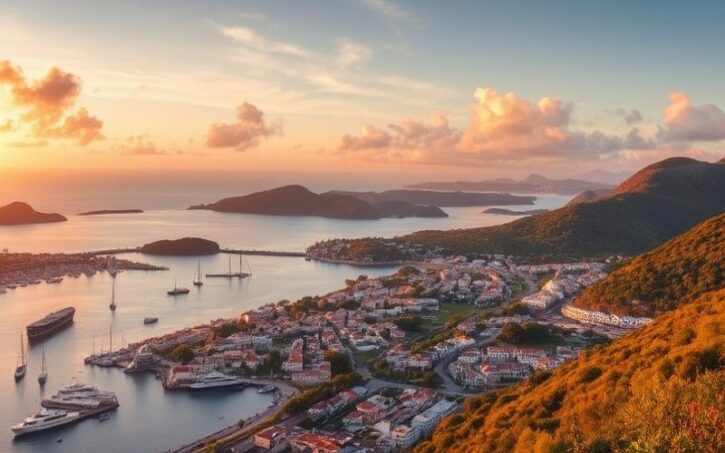
The history of the country of Saint Barthélemy is not only read in books: it is embodied in many places that dot the island. Gustavia, the capital and main port, concentrates much of this heritage.
The promontory of Fort Gustave, which overlooks the harbor and offers a view of the bay where yachts and sailboats moor, was part of a Swedish defensive system. This system also included Fort Karl, dominating Shell Beach (Anse de Grand Galet), and Fort Oscar (formerly named Gustav Adolph). Near Fort Gustave, an old bell tower dating from 1799, converted into a clock, testifies to the time when the town was already a crossroads of European influences.
The “Wall House,” now the territorial museum, occupies a stone building of Swedish inspiration. Its collections cover the complete historical arc of the island: Amerindian remains, documents from the Swedish period, objects related to navigation, slavery, and rural life. A few streets away, the former residence of the Swedish governors has been converted into a municipal building, then into the collectivity’s town hall.
Outside Gustavia, the island has several sites of interest. In Lorient, the Church of Notre-Dame-de-l’Assomption and its 19th-century presbytery, classified as historical monuments, overlook the cemetery where Johnny Hallyday is buried. The ruins of Colombier bear witness to the history of plantations, and the village of Corossol perpetuates traditional crafts, notably the weaving of latanier leaves to make hats and baskets.
A Few Historical Milestones in Numbers
To grasp at a glance the evolution of Saint Barthélemy, a few key data points help put into perspective the changes in sovereignty, population, and status.
Sovereignty and Key Milestones
| Period | Dominant Power | Key Event |
|---|---|---|
| Before 1493 | Arawak and Carib peoples | Seasonal occupation, name “Ouanalao” |
| 1493 – 1648 | No lasting settlement | Columbus’s passage, sporadic visits |
| 1648 – 1784 | France (with Knights of Malta episode and British occupation) | First French colony, attached to Guadeloupe |
| 1784 – 1878 | Sweden (with brief British occupation in 1801‑1802) | Free port of Gustavia, international trade, abolition of slavery in 1847 |
| 1878 – 2007 | France (commune of Guadeloupe) | Return to France, full citizenship in 1946, rise of tourism from the 1960s |
| Since 2007 | France (Overseas Collectivity) | Enhanced autonomy, transition to OCT of the EU in 2012 |
Indicative Demographic Evolution
| Year | Estimated Population | Context |
|---|---|---|
| 1671 | ~336 inhabitants | Small French colony, subsistence economy |
| 1815 | ~5,763 inhabitants | Peak of Swedish free port, intense traffic |
| 1875 | ~2,374 inhabitants | After abolition and economic crisis, significant emigration |
| 1946 | ~2,231 inhabitants | French citizenship, dormant economy |
| 1990 | ~5,038 inhabitants | Rise of high-end tourism |
| 2017 | 9,961 inhabitants | Prosperous collectivity, strong labor immigration |
Memory, Identities, and Crossed Legacies
One of the singularities of Saint Barthélemy is that it combines, on a very small territory, multiple layers of memory. The French heritage manifests itself in language, law, the majority religion, and schools. The Swedish heritage, for its part, survives in symbols—the three crowns on the coat of arms, certain street names, the twinning with the Swedish city of Piteå—and in a narrative that distinguishes the island within the Antilles.
This is the number of people whose individual trajectories are restored by international research projects on the Swedish abolition process.
Finally, the Amerindian heritage, long relegated to the status of prehistory, is regaining visibility through archaeological work and symbolic markers such as the statue of Savaku. In an island space where the dominant narratives have long been those of European powers, this rereading of the past reinscribes Saint Barthélemy in the long Caribbean timeline.
Conclusion: A Small Island with a Big Story
To tell the history of the country of Saint Barthélemy is to piece together episodes that, taken individually, might seem anecdotal: a concession traded for port rights in Gothenburg, a free port where wines and timber transited during the Napoleonic Wars, an emancipation commission examining one by one the slaves to be freed, an aviator landing his plane in a savanna at Saint‑Jean, a local referendum redefining the island’s European status.
Seen from afar, Saint Barthélemy is often reduced to the image of a luxury destination. Seen up close, it reveals itself as a concentrate of Atlantic history: a place of Amerindian passage, a French colonial confetti, a Swedish free port laboratory, an atypical slave society, a small cosmopolitan maritime republic, then a French territory redeploying its economy around tourism and finance. All on 25 square kilometers surrounded by reefs.
This singular trajectory no doubt explains the strong identity consciousness of today’s Saint Barthélemois, proud at once of their French roots, their local distinctiveness, and their Swedish past. In a world where islands are often seen as interchangeable, Saint Barthélemy reminds us that no territory is too small to carry a complex history—and that memory, however discreet, always irrigates the present of a country.
Disclaimer: The information provided on this website is for informational purposes only and does not constitute financial, legal, or professional advice. We encourage you to consult qualified experts before making any investment, real estate, or expatriation decisions. Although we strive to maintain up-to-date and accurate information, we do not guarantee the completeness, accuracy, or timeliness of the proposed content. As investment and expatriation involve risks, we disclaim any liability for potential losses or damages arising from the use of this site. Your use of this site confirms your acceptance of these terms and your understanding of the associated risks.

Cyril Jarnias is an independent expert in international wealth management with over 20 years of experience. As an expatriate himself, he is dedicated to helping individuals and business leaders build, protect, and pass on their wealth with complete peace of mind.
On his website, cyriljarnias.com, he shares his expertise on international real estate, offshore company formation, and expatriation.
Thanks to his expertise, he offers sound advice to optimize his clients' wealth management. Cyril Jarnias is also recognized for his appearances in many prestigious media outlets such as BFM Business, les Français de l’étranger, Le Figaro, Les Echos, and Mieux vivre votre argent, where he shares his knowledge and know-how in wealth management.





