
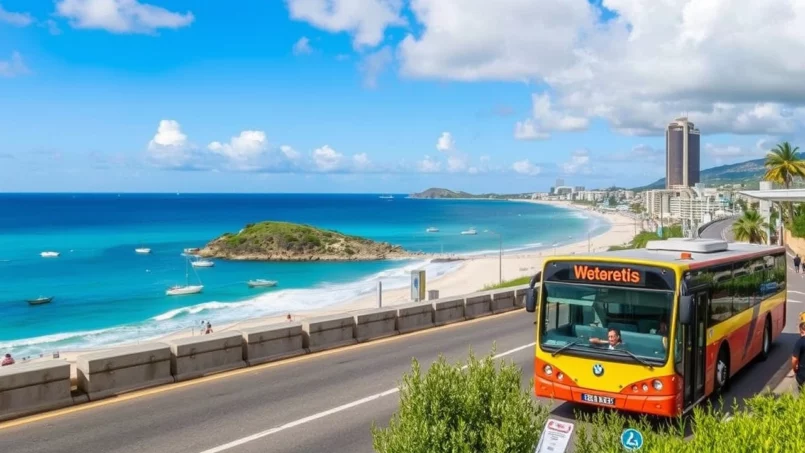
 Published on and written by Cyril Jarnias
Forget the classic metro–bus–tram model. On Saint-Barthélemy, public transportation as understood in a big city simply does not exist. No public bus network for visitors, no metro, no tram, no Uber or Lyft. Yet the island is perfectly navigable… as long as you understand how it works and plan ahead a bit.
This guide covers all transportation options, detailing their costs, limitations, and how to combine them effectively on a daily basis, since there is no bus network.
Understanding the Context: An Island Without Real Public Transit
Saint-Barthélemy is a small French overseas collectivity in the Caribbean, about 25 km² (a little less than 10 square miles). A main coastal road connects most villages and beaches, and you can drive around the island in about an hour.
This modest size might suggest that a bus network would be easy to set up. In reality, several factors stand in the way: very hilly terrain, narrow and winding roads, a small permanent population (around 10,000 residents) but heavy tourist pressure, and a lack of space for large park-and-ride lots. The result: no official bus or metro system for visitors.
Although a school bus service exists for island children, it is not open to visitors. Information about any bus or minibus network is contradictory and does not match reality: for a tourist, there are no buses to wait for, no schedules, and no usable route maps.
In this context, getting around Saint-Barthélemy relies on a mix of taxis, rental cars, scooters, ATVs, a few electric bikes, private transfers, boats… and walking in very targeted areas.
Overview of Transportation Options on the Island
Saint-Barthélemy does not offer mass transit but rather a mosaic of individual or semi-private solutions. Each has its strengths and weaknesses, and their relevance changes depending on your budget, accommodation, driving habits, or mobility constraints.
To illustrate the analysis of mobility solutions, we can compare key characteristics of the main transportation modes: the car (flexible but costly and polluting), the train (fast and efficient for long distances, but dependent on infrastructure), the bicycle (eco-friendly and economical for short trips, with distance limits), and public transit (accessible in cities, with fixed schedules). This quick comparison provides an overview to help guide an appropriate choice.
Summary Comparison of Main Transportation Modes
| Mode of Transport | Primary Role | Level of Freedom | Overall Cost for One Week | Ideal for… |
|---|---|---|---|---|
| Rental Car | Daily travel across the whole island | Very high | Moderate to high | Families, stays of a week or more |
| Taxi | Occasional transfers, evenings, arrivals/departures | Moderate | High | Short stays, night outs |
| Private Driver | Premium door-to-door service | Very high | Very high | Groups, events, VIP clients |
| Scooter / Motorcycle / ATV | Compact alternative to a car | High | Moderate | Solo travelers or active couples |
| E-bike | Short distances, occasional supplement | Low to moderate | Moderate | Day trips, active visitors |
| Walking | Local exploration (Gustavia, St. Jean) | Local only | Free | Strollers, close-up sightseeing |
| Boat Shuttle / Charter | Inter-island connections, secluded coves | Variable | High | Excursions, day cruises |
This grid doesn’t replace the details, but it already shows that for most travelers, two pillars structure mobility: rental cars and taxis, supplemented when needed by a scooter or private driver.
Rental Cars: The True Foundation of Transportation on Saint-Barthélemy
Throughout the sources, a consensus emerges: renting a car is the most efficient, practical, and flexible way to get around the island. It’s even described as “the best” mode of transport, both for residents and visitors.
The argument is simple: with a car, you set your own pace, you stop when you want at a beach, you change plans if the weather turns, and you don’t depend on the random availability of a taxi. On an island where all points of interest are at most 20–30 minutes away by car, this convenience is key.
What Cars to Rent and at What Price?
The roads of Saint-Barthélemy are narrow, very winding, with no shoulders, and little signage outside Gustavia. Parking is limited, especially in Gustavia and St. Jean. All this favors compact, even very compact, vehicles.
Frequently recommended models are small city cars and mini 4x4s:
| Vehicle Type | Examples Cited | Main Advantage |
|---|---|---|
| Small City Cars | Kia Picanto, Kia Stonic, Mini Cooper, VW T-Roc | Easy to maneuver, ideal for parking |
| Small 4×4 / SUVs | Suzuki Jimny, K-Roc, Mini Moke (iconic) | Better traction on steep hills |
| Compact Electric Vehicles | Renault Twizy, Smart Electric, BMW i3 (depending on agencies) | Eco-friendlier, quiet |
Prices vary by season (high season from December to April, with a peak during the Christmas holidays) and vehicle type. The different sources indicate fairly consistent ranges:
– Cars: approximately 30 to 150 € per day, roughly $40 to over $150 depending on model and season
– Scooters / Motorcycles: around 20 to 60 € per day ($25 to $65)
Some agencies apply specific conditions in high season: a minimum rental period of 7 days is often required to get a weekly rate, and this may increase to 10 days minimum during the December holidays. Late cancellation penalties may also apply.
Where to Rent and How to Organize?
Most large agencies – international or local – have offices at Gustaf III Airport (St. Jean Airport) and in Gustavia near the port. Several companies are mentioned, including:
– Gumbs Car Rental
– Maurice Car Rental
– Soleil Caraïbe
– Turbé Car Rental
– Top Loc Rentals
– Avis Saint Barth, Budget, Hertz, SIXT, Alamo National, National, Oscar Rental Cars
Alongside traditional brands, service providers like WIMCO, GOSBH, or specialized agencies (villas, hotels) can fully arrange your vehicle rental. Their services include booking the vehicle, sometimes a personalized welcome at the airport, and delivery of the car directly to your accommodation (villa, hotel) or your arrival point (such as the ferry dock).
Some agencies explicitly offer delivery anywhere on the island at no extra cost:
| Agency (examples) | Types of Vehicles Offered | Reported Special Features |
|---|---|---|
| BARTH’LOC | Scooters, e-bikes, cars, ATVs, electric vehicles | Delivery included, wide price range |
| Béranger | Scooters, cars, Harley-Davidson | Extensive two-wheeler range |
| Fun Motors JPF | Scooters only | Delivery possible |
| Gumbs Car Rental | Various cars | Rates from 30 to 150 €/day (without insurance) |
| Maurice Car Rental | Cars from 33 €/day | Based at St. Jean Airport |
| Soleil Caraïbe | Cars from 30 to 95 €/day | Offers full waiver, packages with accommodation |
In any case, advance booking is strongly recommended, even essential in high season. Also keep in mind that:
– Most cars are automatic
– A valid driver’s license from your home country is sufficient for a short stay (minimum legal age: 18)
– An international driving permit or official translation may be required for longer stays or depending on visa type
Driving Conditions: What You Need to Know Before Getting Behind the Wheel
Driving on Saint-Barthélemy is not like driving on a straight highway. The main coastal road is beautiful but can be tricky. Sources describe roads that are:
– Narrow, often two lanes with no shoulder
– Very winding, with tight curves and steep gradients
– Sometimes slippery when wet
– Without traffic lights: everything is managed by stop signs or roundabouts
Once you leave Gustavia, road signs are almost non-existent. It is therefore highly recommended to use GPS or a good map. Traffic drives on the right, following French traffic rules, and speed limits are standardized.
| Driving Rule | Value / Detail |
|---|---|
| Side of travel | Right (French laws) |
| General maximum speed | 50 km/h |
| Residential / built-up areas | 30 km/h |
| Traffic lights | None on the island |
| Intersection types | Stop signs and roundabouts |
| Gas stations | 2 (St. Jean Airport, Lorient) – closed Sundays |
With only two gas stations, both closed on Sundays, you need discipline: monitor your fuel gauge regularly and plan fill-ups ahead, especially if driving a lot on weekends.
Finally, a point rarely written in black and white but present in field reports: two-wheel vehicle accidents are not uncommon. A fatal scooter accident was reported in 2024. So be cautious with speed, especially at night and in the rain.
Managing Parking: A Headache in High Season
The sources emphasize parking difficulties in Gustavia and St. Jean, especially during tourist season. Many parking lots exist – including paid ones in Gustavia – but their capacity quickly fills up.
Most villas have their own spaces, and many hotels offer parking for guests. Along roadsides, it’s common to see cars with mirrors folded in to avoid scrapes: a simple habit recommended by regulars.
Taxis: Useful… But Scarce and Expensive
With no buses, one might think that taxis would serve as a “minimal public transit” option. In practice, taxis on Saint-Barthélemy are a complementary service, effective for certain uses – transfers, evenings, island tours – but unsuitable as a primary daily mobility solution.
Where to Find a Taxi and How to Book?
Taxis are concentrated around a few key points:
– Gustaf III Airport (St. Jean Airport)
– Gustavia Port
– Major hotels
Two official taxi stands exist: one at the airport, the other on Rue de la République in the heart of Gustavia. Unlike in big cities, you don’t hail a taxi randomly on the street. The best approach:
– Ask your hotel, villa, or restaurant to call a taxi
– Contact a driver directly whose number you have
– Use a central dispatch number or a dedicated online platform
It is recommended to book a taxi on Saint-Barthélemy 12 to 24 hours in advance, especially in high season.
Some companies cater to a higher-end segment (Five Stars VIP Service, St Barths VIP Taxi Services, GO SBH, etc.), offering premium vans or sedans and tailor-made services.
Rates, Surcharges, and Price Examples
Taxi prices are regulated and set in euros, charged per vehicle, not per person. Most drivers prefer cash in euros, with some occasionally accepting US dollars; card payments are less common.
Surcharges apply at night (roughly between midnight and 6:30 AM), on Sundays and public holidays. Very short trips (under 5 minutes) may be charged a flat fee.
The various sources provide price examples to give you an idea:
| Route (illustrative examples) | Observed Price Range |
|---|---|
| Airport – Gustavia | 10 to 40 € depending on source and season |
| Airport – St. Jean | ~25–30 € |
| Airport – Toiny | ~35 € |
| Gustavia – St. Jean | 20 to 70 € depending on season and context |
| Gustavia – Colombier | ~20 € |
| Gustavia – Saline / Flamands (high season) | 40 to 80 € |
| Airport – Gouverneur Beach | 70 to 80 € |
| Airport – Grand Cul-de-Sac | 40 to 90 € |
For excursions, some taxis offer sightseeing tours with fixed rates:
| Taxi Tour (up to 8 people) | Approximate Duration | Indicative Price |
|---|---|---|
| North-east island discovery | 30 min | ~60 € |
| Other area tour | 1 h | ~80 € |
| Full island tour | 1 h 30 | ~100 € |
| Custom private tours (2–3 h) | 2–3 h | 200–350 € |
| Private driver on standby (exclusive service) | per hour | ≥ 200 €/h |
As you can see, for intensive daily use, the bill adds up quickly. That’s why many budget analyses recommend not relying solely on taxis but using them as a complement to a rental car or scooter.
Practical Organization and Taxi Limitations
By nature, taxis are flexible, but supply is limited. Concrete consequences:
Finding a taxi at the last minute is difficult, especially in the evening and during high season. For a dinner in Gustavia, an effective strategy is to ask the driver who drops you off to come back at an agreed time. For plane or ferry arrivals, it’s best to book a transfer in advance, through your hotel, rental agency, or dedicated service.
There are also platforms like monTransport.com that allow you to compare offers from multiple drivers with fixed prices, as well as local attempts at “taxi dispatch” apps (like a unified app project launched but poorly adopted). Habits remain deeply rooted in direct contacts, WhatsApp groups, and informal networks.
Private Drivers and Premium Transfers: Worry-Free Comfort
Between standard taxis and rental cars, a third way has developed: private drivers and chauffeur services. They primarily cater to:
– Visitors who prefer not to drive (fear of narrow roads, health constraints, fatigue)
– Groups and families who prefer a van with driver
– Villa or luxury hotel guests who prioritize a “no-logistics” stay
– Evenings and events where you definitely don’t want to drive after drinking alcohol
Companies like St Barth Sensation or GOSBH offer services ranging from simple airport-villa transfers to customized half-day or full-day services with waiting time. Although the cost is higher than renting a car, this service provides real comfort: no parking search, no dangers related to unfamiliarity with local roads, and no time-related stress.
In the same vein, some specialized premium transfer platforms (like SnapCar for airport transfers) are occasionally mentioned among useful tools, though their local presence remains limited compared to traditional driver networks.
Two-Wheelers, ATVs, and Bikes: Light Mobility, Maximum Caution
Given parking issues and the compactness of the island, two-wheelers and light vehicles may seem like an attractive alternative. The reality is more nuanced.
Scooters, Motorcycles, and ATVs
Scooters and motorcycles are common on Saint-Barthélemy’s roads. Several rental companies specialize entirely or partially in them, with rates typically between 20 and 60 € per day depending on engine size and season. ATVs are also available for rent.
They offer several advantages:
– Navigate traffic and narrow streets more easily
– Park more easily
– Generally cost less to rent than a car
Two-wheelers are more dangerous than cars in the local context, due to steep roads, tight curves, lack of emergency lanes, and changing weather, which increases risk for inexperienced riders.
Wearing a helmet and driving very cautiously are essential. For inexperienced travelers, it’s generally advisable to choose a small car instead.
Bicycles and E-bikes
The situation for bicycles is paradoxical. On one hand, some sources mention bike rentals as an eco-friendly way to enjoy the scenery. On the other, several sources indicate that there is currently no rental of standard bicycles on the island, precisely because of the terrain and the danger of the road network for cyclists.
Some agencies, like BARTH’LOC, offer electric-assist bicycle rentals (about 30 €/day). The assist helps climb hills and allows for occasional trips suitable for cyclists with at least some level of fitness.
In any case, cycling is recommended only for experienced, fit cyclists who are aware of the constraints: narrow roads, car and scooter traffic, and few or no bike lanes.
Walking, Hiking, Strolling: When Mobility Becomes a Pleasure Again
In an environment seemingly designed for cars, walking still holds an important place, but in a very localized way.
Walking in Town: Gustavia and St. Jean
The island’s two main hubs – the capital Gustavia and St. Jean – are described as generally walkable, meaning they lend themselves well to walking:
Discover the island’s two main activity hubs, where everything is accessible on foot.
The capital: shops, restaurants, bars, services, and the port are concentrated within a small area. Shell Beach is a 5-minute walk from the center, and Fort Oscar is a 10-minute uphill walk.
The lively heart: the beach, shops, and many establishments cluster around the bay and the main road.
For a traveler staying in these areas, it is entirely possible to spend several hours or even full days on foot: coffee, beach, shopping, dinner… without using a vehicle, except for more distant excursions.
Hiking and Coastal Trails
The island also offers great hiking opportunities with marked trails leading to:
– Colombier Beach, accessible only on foot or by sea
– Natural pools near Grand Fond
– The “wild coast” near Toiny and other sparsely built areas
These walks allow you to substitute missing public transit with gentle mobility. For this, it’s essential to wear proper shoes, stay well-hydrated, and be aware of conditions, especially heat and lack of shade on certain sections of the trail.
Limitations of Walking as a Mode of Transport
Walking across the entire island is not realistic for several reasons:
– Distances can be long between villages
– Significant elevation changes, heat, humidity
– Lack of sidewalks on a large portion of the road network
– Heavy car and scooter traffic on some sections
Walking therefore remains an excellent complementary option, but rarely a full substitute for a motorized mode.
Boats, Ferries, and Maritime Shuttles: “Lines” on the Water
While there are no buses on the road, there are regular connections and on-demand services on the water. They don’t replace internal island transit, but they are essential to understanding overall mobility around Saint-Barthélemy.
Ferries to Saint-Martin / Sint Maarten
Several companies operate services between Saint-Barthélemy and the neighboring island of Saint-Martin / Sint Maarten. Great Bay Express, for example, has operated fast catamarans (Big-B, Pride of Saint-Barth) for over 10 years between Gustavia port and Sint Maarten, with a journey of about 45 minutes.
Schedules and fares vary, but indications from sources give the following approximate ranges:
| Ticket Type (Great Bay Express – indicative) | Approximate Fare (non-residents) |
|---|---|
| One-way (booked day before) | ~60 € |
| One-way (standard purchase) | ~70 € |
| Round-trip (booked day before) | ~100 € |
| Round-trip (standard purchase) | ~110 € |
| Same-day return | ~80 € |
| Children 4–11 years | ~40 € one way, 60 € RT (reduced price) |
| Infants 0–3 years | Free |
Tickets are non-refundable but valid for one year if unused. A passport is required, and possibly a visa depending on nationality.
Private Charters and Boat Excursions
Beyond scheduled ferries, many companies offer boat rentals with or without a skipper, and day or half-day excursions. Among the names cited are:
Discover a selection of providers for your outings on the water, from traditional rentals to online platforms.
Private charters with 7 to 10-meter rigid inflatables, sailing outings, and sunset cruises.
Catamaran and speedboat rentals for sporty or spacious sailing.
Boat rental platform connecting private owners and professionals with renters.
These services are not public transit in the strict sense, but they fulfill a function similar to the “tourist circuits” you might find in a big city: exploring secluded coves, island hopping, snorkeling excursions…
Gustaf III Airport: A Gateway That Shapes Flows
We can’t talk about mobility on Saint-Barthélemy without mentioning Gustaf III Airport, also called St. Jean Airport or Aéroport de Saint-Barthélemy-Rémy-de-Haenen. It acts as a true local hub, both for arrivals and for distributing travelers to taxis, rental cars, and private transfers.
Located in St. Jean, just steps from the beach, this airport is known for:
– Its very short runway, set at the bottom of a slope and ending on the sand
– Its impressive approach: planes dive over a road roundabout before landing
– Its operation: only small regional or charter planes, typically fewer than 20 passengers
It mainly serves as a relay with larger hubs, notably:
The island is accessible via Princess Juliana Airport in Sint Maarten/St. Maarten, served by direct daily flights from the USA and Europe. From there, a 10-minute propeller plane flight connects to Saint-Barthélemy. Connections are also possible from other neighboring islands with airlines like Winair, Air Caraïbes, or local carrier St Barth Commuter.
Upon arrival, travelers can: explore new destinations, discover various cultures, sample local cuisine, and meet interesting people.
– Pick up a rental car directly at the agency counter or parking lot
– Take a taxi from the official airport stand
– Join a pre-booked private driver or shuttle
– Use VIP services like JODOGO, offering personalized welcome, fast track, baggage assistance, limousine transfer, etc.
Suffice it to say that in a world without structured public transit, the efficiency of this arrival stage largely conditions the rest of the stay.
Accessibility and Limited Mobility: What to Do If You Can’t Drive?
The narrow roads, steep terrain, and lack of sidewalks on many stretches make life difficult for people with reduced mobility. Sources highlight that the terrain and road conditions can make travel challenging for these groups, even though many hotels and villas now have adapted facilities.
In such a context, the most realistic solutions for someone who cannot or prefers not to drive are:
– Book a private driver for main trips
– Combine pre-arranged taxis with walking in pedestrian zones (Gustavia, St. Jean)
– Choose accommodation strategically located close to shops and essential services
Some concierge agencies, villas, or luxury hotels organize private shuttles, sometimes included in services, precisely for these situations.
Budget: How Much Does a Week Without a Car Cost?
For those hesitant to rent a vehicle, several cost estimates help evaluate the potential extra cost of a “car-free” stay.
Approximate figures for a week:
| 7-Day Mobility Strategy | Estimated Total Cost (excluding extreme high season) |
|---|---|
| Intensive taxi use (multiple trips daily) | 200–300 € |
| Scooter rental 3–4 days + walking | 150–200 € |
| Mix of taxis + scooter a few days + walking | 100–150 € |
| Basic car rental for 7 days | 210–350 € (at 30–50 €/day in low/mid season) |
These numbers are of course approximate and vary based on habits (number of restaurant outings, distant beaches or not, need for night transfers), but they show that a small car can quickly become cost-effective compared to full dependence on taxis, especially for families or groups.
Digital Tools and Local Initiatives: Promises and Limitations
In a world saturated with mobility apps, you might expect Saint-Barthélemy to have an Uber equivalent or a very active taxi app. That is not the case.
A “super taxi app” initiative backed by the local government was launched: the idea was to centralize bookings, provide real-time visibility of available taxis, and facilitate requests from hotels, restaurants, agencies, and travelers. Technically, the tool was launched, but it was not adopted by the main players (drivers, hotels, visitors), who continued to prefer:
– Their personal networks
– Direct phone calls
– WhatsApp groups
The app’s failure is attributed to a lack of training, resistance to change, a poorly prepared launch, and the absence of a support strategy. Its future remains uncertain, with no guarantee of a revival in the coming years.
At the same time, other general apps are sometimes mentioned (Le Taxi, Moovit, Lime, etc.), but their local relevance remains very limited given the lack of a bus network or structured shared mobility services.
On the other hand, car rental platforms (Rentalcars.com, Sixt, etc.) or boat rental sites (Click&Boat) work as elsewhere, as do the websites of ferry or airline companies (Great Bay Express, St Barth Commuter).
Practical Tips for Building Your Own “Network” of Transport on Saint-Barthélemy
Since there is no official public transit, each traveler must, in a way, “build” their own network by combining several solutions. Some useful pointers emerge from all the sources:
For a first stay of a week or more, especially with family or friends, renting a small car (ideally a 4×4) is the simplest and most economical choice. For a short stay centered on Gustavia or St. Jean, go for a mixed strategy: walking, a few taxis, and possibly a scooter for 2–3 days. Always book your vehicles and transfers (airport, taxis for evenings) in advance, especially between December and April. Don’t count on a reliable public bus network for daily travel. Plan your gas fill-ups and weekend trips ahead, as stations are closed on Sundays. Finally, budget more for transportation than you would for a destination well served by buses, offset by the freedom to explore the island at your own pace.
In the end, talking about “public transportation on Saint-Barthélemy” is almost a misnomer. The island has made a different choice: a largely privatized mobility system, fragmented among dozens of small agencies, independent drivers, various rental companies, and maritime services. For the informed and prepared traveler, this system works very well. For someone arriving expecting a bus every ten minutes, disappointment would be guaranteed.
On Saint-Barthélemy, there is no public transit network for visitors. The key is to consider renting a vehicle or using taxis and drivers in a structured way as your own personal transportation network.
Disclaimer: The information provided on this website is for informational purposes only and does not constitute financial, legal, or professional advice. We encourage you to consult qualified experts before making any investment, real estate, or expatriation decisions. Although we strive to maintain up-to-date and accurate information, we do not guarantee the completeness, accuracy, or timeliness of the proposed content. As investment and expatriation involve risks, we disclaim any liability for potential losses or damages arising from the use of this site. Your use of this site confirms your acceptance of these terms and your understanding of the associated risks.

Cyril Jarnias is an independent expert in international wealth management with over 20 years of experience. As an expatriate himself, he is dedicated to helping individuals and business leaders build, protect, and pass on their wealth with complete peace of mind.
On his website, cyriljarnias.com, he shares his expertise on international real estate, offshore company formation, and expatriation.
Thanks to his expertise, he offers sound advice to optimize his clients' wealth management. Cyril Jarnias is also recognized for his appearances in many prestigious media outlets such as BFM Business, les Français de l’étranger, Le Figaro, Les Echos, and Mieux vivre votre argent, where he shares his knowledge and know-how in wealth management.





