
 Published on and written by Cyril Jarnias
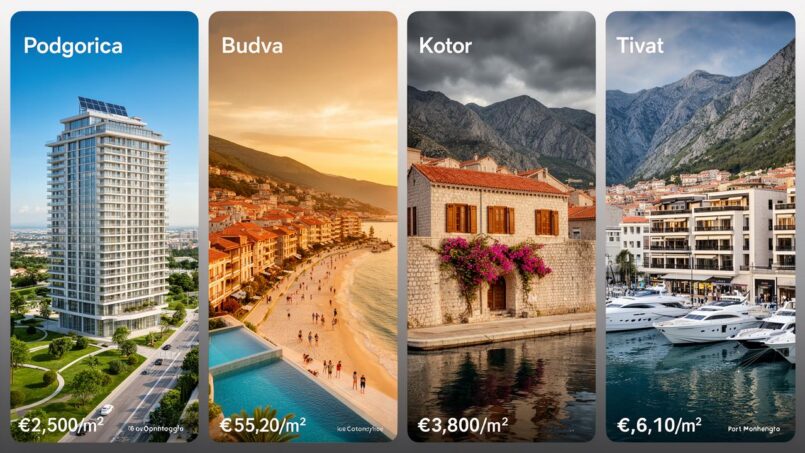
Montenegro’s real estate market has never been higher. Between 2024 and 2026, prices have surged, foreign investors have flocked to the coast, and the capital has followed with a more measured but steady pace of increase. In this bustling landscape, four cities structure the bulk of transactions and investment strategies: Podgorica, Budva, Kotor, and Tivat.
Understanding price levels, dynamics, and yields helps navigate an attractive but mature market, with warnings about overvaluation in certain segments.
A Montenegrin market in the midst of a bullish cycle
The general context is essential to read the gaps between Podgorica, Budva, Kotor, and Tivat. In 2025, the average price of new construction in the country is around €2,228 to €2,250/m², an increase of about 20% year-over-year. For all housing, the average price of a residential property is around €190,000, and 80% of transactions fall within a range of €90,000 to €350,000.
– National figures tell a clear story:
– since 2020, prices have surged about 87%;
– just from 2024 to mid‑2025, new construction prices have risen nearly 19 to 21%;
– projected annual growth for the coming years is rather between 5 and 7%, with a wide scenario ranging from +3 to +15% depending on the intensity of foreign demand and tourism.
More than €308 million was injected into real estate in the first eight months of 2025, up 8.4%.
But this boom is not distributed evenly among the four cities we are looking at. Montenegro clearly operates at two speeds: a tourism-investment coast, dominated by Budva, Kotor, and Tivat, and a market more tied to local incomes inland, where Podgorica plays the role of central hub.
Podgorica: the affordable entry point
Podgorica is the counterweight to the coast. Prices are significantly lower, rental yields often higher, and dependence on tourism much more limited. It is the city that, according to several analyses, offers the best purchase price / rental yield ratio in Montenegro.
Price levels and property types
The figures available for 2025‑2026 paint a market in strong growth, but still affordable on a European scale:
| Key indicator | Podgorica (2025‑2026) |
|---|---|
| Average new build price | ~€2,108–2,250/m² |
| Average price per m² (all listings) | ~€2,150–2,707/m² |
| Typical apartment range | €1,700–2,250/m² |
| Annual increase (Q3 2024 → Q3 2025) | +18% |
| Projected annual increase | 3–5% |
| Average gross rental yield (inland) | ≈ 6.4% |
A 60 m² apartment in Podgorica thus costs roughly €102,000 (existing) to €135,000 (new build). New residential complexes — City Kvart, Central Point, expanding neighborhoods — sell for between €2,000 and €2,250/m², while older buildings are more around €1,700–1,900/m², with a discount of about 10–20% compared to new build.
More precisely, some neighborhoods have already crossed a clearly “prime” threshold for the capital:
| Podgorica neighborhood | Positioning | Price range per m² (approx.) | Typical apartment budget |
|---|---|---|---|
| City Kvart / Central Point | Modern, young professionals | €2,200–3,000/m² | €140,000–260,000 |
| Preko Morače, Gorica | Premium quiet residential | €2,600–3,600/m² | €180,000–350,000 |
| Zabjelo | “Value,” families | €1,600–2,300/m² | €60,000–140,000 |
Zabjelo symbolizes the entry level: a budget of €60,000 to €90,000 can still buy a small existing apartment of 35–45 m², which remains very rare on the coast.
Market dynamics and yield
Podgorica is also experiencing a price surge, but at a more controlled pace than the coast. Between Q3 2024 and Q3 2025, the average price of housing rose by about 18%, and the city has been posting annual increases quarter after quarter for over four years.
Podgorica offers an average gross yield of 6.39% on long-term rentals, outperforming coastal spots and seasonal rentals. Bar and Podgorica are the only markets where long-term rentals perform better than seasonal ones.
Demand is driven by the local population, students, civil servants, service workers, and a diaspora buying for family. The increase in gross salaries (+2.3% in Podgorica in early 2026) follows, without catching up, the rise in real estate prices, which is beginning to raise an affordability issue, but much less acute than in Budva, Kotor, or Tivat.
Risks and outlook in Podgorica
Local agents anticipate for Podgorica a normalization of price increases to less than 5% per year. The capital concentrates more than 30 active residential projects and added about 2,500 new housing units in 2024, one of the highest recent construction rates. Supply is therefore more elastic than in the Bay of Kotor.
For a buyer looking for exposure to the country without relying on tourism, Podgorica offers moderate entry points, a deep market, stable regulation, solid rental yield, and growth prospects of 30 to 40% over five years.
Budva: tourist capital and coastal speculation star
Budva is the most famous face of tourist Montenegro: beaches, old walled town, bars, nightclubs, summer festivals. On the real estate side, it is also one of the most expensive and speculative markets in the country, even if the phase of brutal overheating seems to be giving way to more contained growth.
Price levels and ranges by neighborhood
In 2026, Budva shows average prices per m² clearly above the national average:
| Key indicator | Budva (early 2026) |
|---|---|
| Average price per m² (all sales) | ≈ €3,200–3,400/m² |
| Average listing price | ≈ €3,344/m² |
| Main market range | €1,800–5,000/m² |
| Typical price of “standard” properties | €2,200–3,500/m² |
| Old Town (Stari Grad) | €3,500–5,000/m², and up to ~€7,000 for some properties |
| Broad Budva and surroundings | €1,500–3,000/m² |
Today, a standard apartment of about 60 m² in Budva costs around €175,000–221,000, with a median housing price of €176,000 and an average price around €221,000. Per m², the median is around €3,200/m² and the average around €3,400/m².
To orient yourself in the city and its surroundings:
| Budva area / neighborhood | Positioning | Typical price per m² |
|---|---|---|
| Old Town (Stari Grad) | Heritage, ultra-touristy | €3,500–5,000, peaks around €7,000 |
| Bečići | Desired waterfront | €3,000–4,200, with possible premium at €5,000+ |
| Slovenska Plaža | Central, near beach | €2,200–3,500 |
| Rozino, Dubovica, Lazi | Fast-growing pockets, oriented toward year-round residences | €1,800–2,800 for most, new projects around €2,200/m² |
| Rafailovići | Rising seaside village | €2,000–3,200 |
| Przno, outskirts | Quieter, family neighborhoods | €1,800–2,800 |
Villas and prestige properties quickly reach heights: a family house of 120 m² sells for around €350,000, while a well-located villa easily exceeds €900,000. The classic “luxury” segment is mostly between €600,000 and €2.5M, with some villas in Sveti Stefan or Reževići crossing the €2 to €6M mark.
Price growth and outlook
Budva is one of the markets that has surged the most since the mid-2010s: prices have more than doubled in a decade (+110% approximately). Since 2023, the annual increase is around 8–12%, with a 12% rise between January 2025 and January 2026 (about 7% in real terms after inflation). Over two years (January 2024 → January 2026), prices have risen about 25%.
Projected cumulative real estate price growth over five years, rising from about €2,900/m² to nearly €3,900/m² by 2031.
Certain property types and neighborhoods are expected to outperform the average. Studios and small one-bedrooms in well-located areas (Rozino, Dubovica, Bečići, Boreti) are expected to be the most performant, with a projected appreciation of 8 to 10% per year, i.e., 2 to 4 points above the overall market.
Rental and profitability in Budva
Budva remains the tourist capital of the country, with over half a million visitors per year and about 1.2 million overnight stays in 2025 alone. This mass tourism base translates into solid rental figures.
The average gross yield of apartments is between 5.4 and 5.8%.
A typical example: a well-located one-bedroom bought for €120,000 can generate €8,000 to €12,000 in rental income over the summer season alone (June–September). By also renting off-season via platforms like Airbnb, some investors reach €14,000–18,000 in annual gross income, yielding comfortable returns for an established seaside product.
Risks in Budva: saturation and “historic” prices
Budva is also on the most stretched side of the market. The Montenegrin central bank describes the country’s real estate values as “historically high”, and explicitly mentions risks of cyclical overvaluation, particularly on the coast. The price-to-income ratio is high: nationally, a 60 m² apartment in a coastal area represents about 11 years of average salary for a Montenegrin worker. In Budva, the median of €176,000 is roughly 2.5 times the average annual aggregate income, which is heavy for local households.
For an existing property, expect 8 to 18% in fees (notary, agency, transfer tax). For new build, expect 4 to 10% (including VAT). New tax rules on building land may increase the cost of new projects.
In this context, Budva remains a driver of value, but the market is no longer in a phase where “everything goes up all the time.” Investment requires careful selection of neighborhoods, residences, and property types.
Kotor: UNESCO rarity, expensive but resilient
Kotor holds a unique place in the Montenegrin landscape: inscribed as a UNESCO World Heritage site, historic heart of the Bay of Kotor, prime destination for cruises and cultural tourism. This status commands a very high price, but also offers natural protection against oversupply.
One of the most expensive markets in the country
In January 2026, the average price per m² in Kotor is around €3,300–3,605/m², about 40% above the Montenegrin coastal average. A standard 75 m² apartment sells for around €250,000. On the price distribution, about 80% of purchases fall between €100,000 and €600,000, with a concentration between €150,000 and €400,000 for “normal” apartments and houses.
The internal hierarchy is very pronounced:
| Kotor sector / neighborhood | Characteristics | Typical price per m² |
|---|---|---|
| Old Town (Stari Grad) | Heritage, commerce, short-term rental | > €5,300/m² for many properties |
| Dobrota waterfront | Premium residential, sunny promenade | €3,500–6,000/m², sometimes more for luxury |
| Prčanj, Stoliv (lower) | Stone houses, village atmosphere | recent increases of 14–18%, high levels |
| Areas without sea view, more inland | Older buildings, local market | significantly lower prices, but rising fast |
Waterfront villas in Dobrota or Prčanj are among the most expensive properties in the country: for some, prices approach or exceed €7,500/m². The stone palaces of Perast represent an almost museum-like segment, where rarity outweighs any yield consideration.
Rapid growth… and still ongoing
Between January 2025 and January 2026, prices in Kotor jumped by 12 to 18%, more than the national average. The most sought-after properties — waterfront villas, renovated apartments in the Old Town — tended to follow the higher end (near 18%), while older housing without a view rose around 12%.
Neighborhoods experiencing the strongest demographic or economic growth are often considered significant indicators of urban trends and social dynamics.
| Kotor neighborhood | Recent annual appreciation (approx.) |
|---|---|
| Dobrota | 15–20% |
| Prčanj | 14–18% |
| Stoliv (lower) | 12–16% |
| Municipal average | 6–10% projected for 2026 |
For 2026, projections remain optimistic, but with announced moderation: most scenarios give an increase of 6 to 10% for the municipality, with 10 to 15% expected in the tightest sectors (Dobrota, Prčanj, lower Stoliv, Kavač). Over five years, anticipated cumulative progression ranges from 25 to 45%.
All of this takes place in the context of Montenegro’s EU rapprochement: the closure of new accession chapters at the end of 2025 has strengthened long-term investor confidence in “heritage” assets like Kotor.
Rental yield and investor profile
In terms of yield, Kotor shows decent but not spectacular levels, given its prices: for well-located apartments, net yields generally range between 4 and 7%. On Airbnb, properties in Stari Grad and Dobrota neighborhoods record about 55% occupancy, with an average daily revenue of around €130 and summer income ranging from €1,500 to €3,500/month for the best units.
Occupancy rate at the peak of summer in Kotor exceeds 80%, generating gross Airbnb yields of 6 to 10%.
Buyers are a mix of wealthy Montenegrins, Russians, Western Europeans, but also Australians drawn to stone houses to renovate in the hills, and Americans seeking European bases in the bay’s upscale residences.
The flip side: affordability and regulatory pressure
The main risk in Kotor is not so much overbuilding — urban planning constraints are very strict — but a price level disconnected from local incomes. The Montenegrin coast is already 2 to 4 times more expensive than Podgorica; Kotor exceeds that coastal average by about 40%.
Low risk of sudden competition, but a possible ceiling on rental yields and dependence on high-end tourism and permanent residents.
Over five to ten years, the “UNESCO + EU” effect can continue to push prices, but the margin for error at purchase is shrinking: selection of truly unique locations (waterfront, unobstructed view, pedestrian access to the Old Town) becomes crucial.
Tivat: the laboratory of marine luxury
Tivat illustrates Montenegro’s upscaling. Once a quiet port town, it has become, with Porto Montenegro, a global hub for superyachts, concentrating some of the most expensive properties on the Adriatic.
Prices at the top of the country
Market statistics place Tivat at the top of national average prices:
| Key indicator | Tivat (2025‑2026) |
|---|---|
| Average price per m² (all listings) | ≈ €4,192/m² |
| Median per m² | ≈ €3,800/m² |
| Average per m² | ≈ €4,200/m² |
| Price in Porto Montenegro | €6,000–15,000/m², sometimes more |
| Waterfront price excluding ultra-luxury | €3,000–5,500/m² |
| Inland neighborhoods (Gradiošnica, Kava, etc.) | €2,200–3,200/m² |
The price distribution by property shows a segment clearly pulled upward: the median for houses is around €266,000, the average rather around €315,000. About 80% of properties fall in the €160,000–650,000 range, but the presence of units at €1–4M (and more in certain projects) strongly pulls averages up.
Some orders of magnitude:
| Type of property in Tivat | Typical price range |
|---|---|
| Non-waterfront apartment | €240,000–360,000 |
| “Classic” waterfront apartment | €450,000–900,000 |
| Family house | €350,000–650,000 |
| Villa with sea view | €900,000–2.5M |
| Branded marina residence (Porto Montenegro) | €1.2–4M and more |
| Ultra-luxury (penthouse, exceptional properties) | up to €25M according to some offers |
The magnet is Porto Montenegro, a complex combining a marina for superyachts, managed residences, shops, and international hotels. Here, the m² commonly ranges between €6,000 and €12,000, with peaks at €15,000/m² for the most prestigious units. Other pockets like Donja Lastva or the Luštica peninsula are also receiving massive investments, with prices often above €5,000/m² for high-end projects.
Growth and outlook in the luxury segment
Tivat has experienced spectacular price growth, to the point of being cited as one of the most expensive markets on the entire Adriatic coast, just behind Dubrovnik. In 2025, apartments reached a median of about €5,677/m², with villas and houses around €4,800/m². Some recent years have seen increases of up to 12% in the luxury segment.
Analysts forecast an increase of up to 15% in the tightest areas of Tivat, such as Porto Montenegro, Donja Lastva, and Luštica Bay, for 2025‑2026.
Tivat’s specificity is its anchoring in a “marina lifestyle” very legible to international wealth. Asian buyers (Singapore, Hong Kong, India) focus almost exclusively on these high-end managed residences in Tivat and Luštica, while more and more Americans see it as a teleworking base in Europe, benefiting from the four-year digital nomad visa and infrastructure (co-working, fiber, premium services).
Yields and risk profile
Gross rental yields are more modest than inland or some segments of Budva, due to very high purchase values. Aggregate data give average yields around 4.6% gross for apartments, with slightly higher peaks on products very well optimized for seasonal rental.
Apartments in Porto Montenegro rent for up to €250 per night in high season.
However, the entry affordability is a major barrier. A significant investment in Tivat rarely starts below €120,000–170,000 (studio or small one-bedroom in the heights), and quickly climbs above one million euros in the core luxury market segment. Ancillary purchase and renovation costs can add 6–10% for a ready-to-live-in property, and an additional 10–25% if major work is needed.
For an investor, Tivat therefore represents a bet on the maintenance and progression of Montenegro’s ultra-high-end segment: strong correlation with the country’s attractiveness as a yachting and prestige seaside destination, but also high exposure to potential shocks on the international wealthy clientele.
Comparing Podgorica, Budva, Kotor, and Tivat: what costs what?
By assembling the available data, a clear price gradient emerges between the capital and the three major coastal hubs.
Average prices per square meter and annual dynamics
| City | Average price per m² (2025‑early 2026) | Recent annual change | Position in the country |
|---|---|---|---|
| Podgorica | ~€2,150–2,707/m² | +17–18% (Q3 2024 → Q3 2025) | Capital, mid-range market |
| Budva | ~€3,200–3,400/m² | +9.9–12% | Major tourist hub, high prices |
| Kotor | ~€3,300–3,605/m² | +10–18% | Very expensive micro-location |
| Tivat | ~€4,192/m² (average), €3,800 (median) | +6.3–15% | Most expensive city, marina luxury |
Within these averages, differences based on location are considerable. A simple zone change — moving from an inland neighborhood to a waterfront with direct access — can add 30 to 100% to the price per m². For example, a standard apartment at €2,500/m² in an inland area will sell for €3,250 to €5,000/m² if it has direct sea access.
Simplified comparison for a standard one-bedroom
The price hierarchy can be summarized with the example of a one-bedroom apartment, 45‑55 m², in a decent but not ultra-luxury location:
| Location | Current price per m² for a one-bedroom | Typical budget for 45‑55 m² |
|---|---|---|
| Podgorica | €1,700–2,250/m² | €85,000–135,000 |
| Budva / Kotor (tourist areas without direct sea view) | €2,700–4,000/m² | €175,000–220,000 (closer to sea or partial view: €220,000–280,000) |
| Tivat (outside Porto Montenegro, neighborhoods with partial sea view) | €3,000–4,500/m² | €200,000–260,000 |
At the other extreme, luxury apartments with unobstructed sea views, high-end finishes, and concierge-type services in Porto Montenegro or certain Budva complexes can easily exceed €400,000–500,000 for a single bedroom.
Relative positioning on the Montenegrin price map
In terms of classification by price band:
| National segment | Price range per m² | Representative cities / areas |
|---|---|---|
| Prime coastal | €2,700–5,000/m² | Budva, Kotor, Tivat (outside ultra-luxury), attractive waterfronts |
| Ultra-luxury marina | €5,000–15,000/m² | Porto Montenegro, Luštica Bay, premium waterfront Kotor/Budva |
| Capital | €1,520–2,250/m² | Podgorica (new builds and central neighborhoods) |
| Coastal “budget” | €1,100–2,500/m² | Bar, Ulcinj, secondary segments of the coast |
| Mountain (resorts) | €1,200–1,400/m² | Kolašin, Žabljak |
| Central inland towns | €700–1,100/m² | Niksic, small inland towns |
| Rural / remote areas | €400–800/m² | countryside, less touristy areas |
In this grid, Podgorica occupies a mid-table position that seems cheap compared to the coast, while Budva, Kotor and especially Tivat form the very expensive tip of the Montenegrin market.
Rental yields: what pays the best for investors?
The comparison of the four cities is not only about purchase price, but also about expected rental income.
Yields in Podgorica, Budva, Kotor, Tivat
Aggregated data on gross yields show several things:
Summary of gross residential yields by zone: national, inland, premium coastal, and tourist.
Gross residential yields generally range between 4.5 and 7% nationally.
These areas often show the highest yields, around 6–6.5%.
Offer decent yields, but compressed by high price levels.
Thanks to its mass tourism, it sits in a good mid-range.
The situation can be summarized as follows:
| City | Typical gross rental yield | Dominant rental type |
|---|---|---|
| Podgorica | ≈ 6.0–6.4% | Long-term (local market, students, employees) |
| Budva | 5–7% (average 5.4–5.8%) | Short-term summer + mixed annual |
| Kotor | 4–7% net for well-located properties | Short-term tourist, strong seasonality |
| Tivat | ≈ 4.4–4.8% for apartments | High-end seasonal rental, managed products |
An investor strictly oriented toward gross yield and stability will therefore favor Podgorica (or Bar) and inland areas, while one looking for a mix of prestige + reasonable yield will look at Budva and Kotor, and Tivat sums up the “heritage value + ultra-luxury lifestyle” bet.
Tax rules, VAT, and residency: parameters not to be overlooked
Comparing gross prices is not enough: in Montenegro, tax and residency rules have changed significantly between 2024 and 2026, with a concrete impact on the total cost of a purchase in Podgorica or on the coast.
VAT and transfer tax
Two regimes coexist:
– for an existing property (resale), the buyer pays a progressive transfer tax:
– 3% up to €150,000;
– €4,500 + 5% of the portion above €150,000 up to €500,000;
– €22,000 + 6% of the portion above €500,000.
– for a new build purchased from a developer, the buyer does not pay this transfer tax, but VAT, in practice at a standard rate (19–21% according to the texts mentioned), generally included in the price.
Starting April 2026, building land with a construction permit will be subject to VAT, which could increase the cost of new housing by at least €50/m². This reform, aligned with European standards, risks pushing up prices of new apartments in Podgorica and on the coast.
Ongoing property taxation
All property owners, residents or not, are subject to the same tax grid:
– annual property tax of 0.25 to 1% of market value (municipalities set rates, adjustable by property type and zone);
– income tax on rental income at 9% (with a flat-rate allowance bringing the effective tax to around 5.4% of gross rent);
– possible capital gains tax at 9–15%, unless exemptions (primary residence, holding for more than three years, family transfers);
– corporate tax at 9% if held via a corporate structure.
Residency through real estate: new thresholds
Buying a property can serve as a basis for a temporary residency application, but rules have tightened considerably. Since 2026, a minimum taxable value threshold of €150,000 (determined by the tax authorities) applies to non-EU/EEA/Swiss nationals to obtain a residence permit through property ownership. An earlier version of the texts mentioned €200,000 as the new minimum, but final amendments retain €150,000.
Majority owners of a company must demonstrate at least €5,000 in taxes and social contributions paid per year to renew their residency via a shell company.
For a buyer targeting residency in Podgorica, Budva, Kotor, or Tivat, these rules have two implications:
– below €150,000 in tax value, the purchase is no longer sufficient to establish a right to stay (except for EU/EEA/Swiss citizens, less affected by this limit);
– on the coast, the majority of properties naturally fall above this threshold, while in Podgorica one must focus on new builds and well-located apartments rather than the cheapest small peripheral units.
A window of opportunity, but no longer a Wild West
Taken together, Podgorica, Budva, Kotor, and Tivat illustrate the trajectory of Montenegrin real estate: a market that has seen spectacular increases (up to +20% per year on new builds nationally, up to +22–28% in flagship pockets like Porto Montenegro, Donja Lastva, Dobrota, or Bečići), but which is now moving toward a phase of moderation.
Montenegro’s Adriatic coast concentrates the highest prices in the country, supported by luxury tourism, heritage, and infrastructure.
Average price around €3,200/m², driven by heavy dependence on tourism and wealthy foreign clientele.
UNESCO site, blending history and infrastructure, with ultra-luxury segments reaching €10,000–15,000/m².
Over €4,000/m² on average, thanks to its marina and an airport attracting an affluent clientele.
Podgorica, with its m² around €2,150–2,700 and rental yields often above 6%, appears as the most rational market for those seeking a balanced risk/return profile, without giving up a projected appreciation of 30–40% over five years.
The central bank, however, reminds that prices are at “historically high” levels and that the market is entering a phase where selectivity becomes crucial. For an investor, this means it is no longer enough to buy “anything, anywhere” in Budva, Kotor, or Tivat. One must arbitrate between:
Comparison of key cities for real estate investment in Montenegro in 2025: Podgorica, Budva, Kotor, and Tivat.
Low prices, deep market, high yield, and limited tourism risk.
Strong seasonal rental demand, still solid growth but already expensive market.
Heritage rarity, sustained growth, decent yields but high tickets.
Luxury-marina bet, very high tickets, strong correlation with international high-end clientele.
On the 2026 and beyond horizon, the consensus of studies is that continued growth is likely — 5–7% per year on a national average — but with marked disparities between segments. In this landscape, the detailed comparison of prices and yields in Podgorica, Budva, Kotor, and Tivat is no longer a theoretical exercise: it is the condition for investing in Montenegro with realistic expectations and risk management.
A wealth planning project or a question? Contact us now to speak with a wealth management expert.
Disclaimer: The information provided on this website is for informational purposes only and does not constitute financial, legal, or professional advice. We encourage you to consult qualified experts before making any investment, real estate, or expatriation decisions. Although we strive to maintain up-to-date and accurate information, we do not guarantee the completeness, accuracy, or timeliness of the proposed content. As investment and expatriation involve risks, we disclaim any liability for potential losses or damages arising from the use of this site. Your use of this site confirms your acceptance of these terms and your understanding of the associated risks.

Cyril Jarnias is an independent expert in international wealth management with over 20 years of experience. As an expatriate himself, he is dedicated to helping individuals and business leaders build, protect, and pass on their wealth with complete peace of mind.
On his website, cyriljarnias.com, he shares his expertise on international real estate, offshore company formation, and expatriation.
Thanks to his expertise, he offers sound advice to optimize his clients' wealth management. Cyril Jarnias is also recognized for his appearances in many prestigious media outlets such as BFM Business, les Français de l’étranger, Le Figaro, Les Echos, and Mieux vivre votre argent, where he shares his knowledge and know-how in wealth management.





