
 Published on and written by Cyril Jarnias
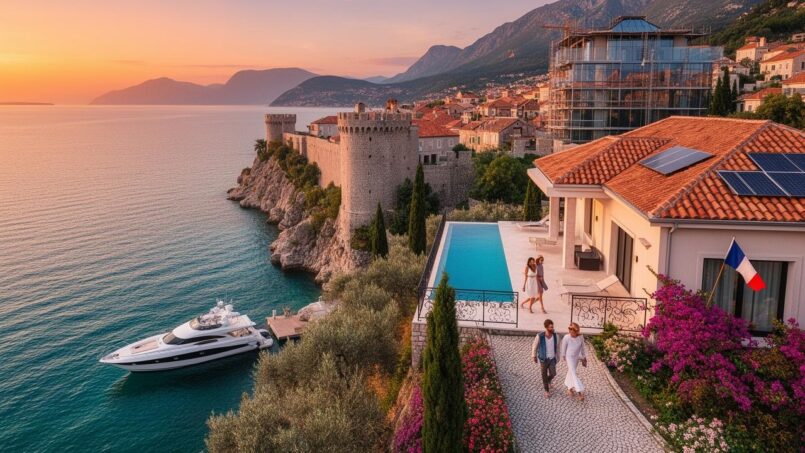
Long considered an overlooked “little Croatia,” Montenegro is becoming one of the most closely watched real estate markets in Europe. Prices still lower than the French Riviera, favorable taxation, use of the euro, a tourism boom, and prospects of EU membership: all the ingredients are in place to attract French investors seeking a Mediterranean pied-à-terre or a genuine income-generating project.
Despite its appeal, Portugal remains an emerging market with specific rules, risks, and opportunities. For a French buyer, it is crucial to know true values, tax and legal regimes, as well as the impact of new residency regulations starting in 2026.
A Euro-Mediterranean Country with High Real Estate Dynamics
The first thing that sets Montenegro apart from its Balkan neighbors is its currency. The country officially uses the euro, without being a eurozone member. For a French investor, this immediately removes a major risk: currency risk.
In Montenegro, property values, rents, and capital gains are denominated in euros, eliminating local devaluation risks that could affect returns. This situation has attracted significant foreign investment, particularly in tourism, real estate, and infrastructure.
In terms of prices, the upward trend is spectacular. Between 2020 and early 2026, residential real estate prices rose by approximately 87% nationally. Official data from the statistical office (MONSTAT) shows that in 2025, the average price of new homes was around €2,228 per square meter, compared to €1,854 a year earlier, an annual increase of over 20%, continuing a streak of more than eighteen consecutive quarters of growth.
In early 2026, the national average for a new home is around €2,250 per square meter, with an average price of about €190,000 per property. And approximately 80% of transactions fall between €90,000 and €350,000: a particularly relevant segment for French people comparing with Provence or Corsica.
Coastal hotspots like Budva or Tivat could see up to 15% growth in certain property segments.
Price Comparison: Montenegro vs. France
To get a concrete idea, just look at the cost of real estate in city centers:
| Indicator | Montenegro (average) | France (average) |
|---|---|---|
| Apartment in city center (per m²) | ~$2,755 | ~$6,278 |
| House outside city center (per m²) | ~$2,128 | ~$4,604 |
| Price-to-income ratio | 12.80 (high) | 10.23 (moderate) |
Montenegrin prices remain lower than those in France, especially along the coast, but they already appear high relative to local wages. For a French person, this clearly means the market is driven by foreign demand, which is both a driver and a risk in the long term.
Where the French Buy: The Adriatic Coast in Sight
French expatriates in Montenegro are heavily concentrated along the Adriatic. Over 70% of them choose the coastal area between Budva, Kotor, and Tivat. A few, often professionals, also settle in Podgorica, the capital.
Preferred towns and neighborhoods include:
– Budva, tourist and party capital
– Kotor, for its heritage and UNESCO-listed bay
– Tivat, especially Porto Montenegro and Donja Lastva, for yachting and high-end living
– Herceg Novi and Perast, for a more village-like or “small town” atmosphere on the bay
The coast concentrates the highest tourist demand, the largest development projects, and the majority of investment opportunities combining pleasure and returns.
Overview of Major Investment Zones
To see clearly, it’s useful to distinguish several “market rings”, with very different price levels and yields.
| Zone / market type | Typical price level (per m²) | Indicative gross yield | Investor profile |
|---|---|---|---|
| Prime coastline (Budva, Kotor, Tivat marinas) | €2,700 – €5,000 (up to €10,000+) | 4.5 – 7% (higher seasonal) | Wealth preservation / luxury investor |
| Secondary coastline (Bar, Ulcinj) | €1,100 – €2,500 | 5.5 – 6.5% or even 11 – 13% | Yield seeker |
| Capital (Podgorica, City Kvart, Zabjelo…) | ~€2,141 | 6 – 7% | Rational long-term investor |
| Mountains (Kolašin, Žabljak) | €1,200 – €1,400 | 7 – 8% (winter) | Diversification ski / nature |
| Center / rural | €700 – €1,100 | Variable (often lower) | Speculative long-term |
The Bay of Kotor offers an excellent quality of life, around 80 on some indices, with a rare mix of spectacular coastal scenery, historic villages, and sustained tourist traffic.
A Very Favorable Tax Environment for a French Person
For a French tax resident investing in Montenegro, one of the country’s main advantages lies in its taxation. Many taxes are significantly lower than in France, while remaining simple to understand.
Property Taxation: Montenegro vs. France
The table below summarizes the general orders of magnitude:
| Type of tax | Montenegro | France |
|---|---|---|
| Annual property tax | 0.25% – 1% of cadastral value | 0.5% – 1.5% (land tax + sometimes IFI) |
| Transfer tax (resale) | 3% – 6% (progressive) | 5.8% – 7.5% |
| Income tax on rental income | 15% flat (or 9% net depending on source) | 19% – 34% + social charges |
| Capital gains tax on real estate | 15% flat (often, sometimes 9%) | 19% – 34% + social charges, deductions over time |
| Corporate tax | 9% | Around 25% |
| Wealth tax on real estate | No ISF/IFI type tax | IFI above €1.3M net assets |
The annual property tax (land tax) remains moderate: most homes pay around 0.4% to 0.6% of the cadastral value, for example about €1,000 per year for a property valued at €200,000. In ultra-prime locations like Budva or Kotor, the tax can go up to 1%.
The transfer tax on resale properties is progressive:
– 3% up to €150,000
– €4,500 + 5% of the portion between €150,001 and €500,000
– €22,000 + 6% of the portion above €500,000
This tax must be paid within 15 days of signing the deed, otherwise late interest of 0.03% per day applies.
For new properties purchased from a developer, there is no transfer tax: a 21% VAT applies but is normally included in the listed price. It is prudent to verify in black and white that the “all-inclusive” price covers this VAT.
Taxation of Rental Income and Capital Gains
Rental income is taxed at a flat rate, generally 15% on net income. Some sources mention a 9% regime with a standard 40% deduction on gross income, resulting in an effective rate of around 5.4% on rent collected. In practice, a French investor should expect local taxation significantly lower than what they would face in France on equivalent rents.
Capital gains on real estate are normally taxed at 15% on the difference between the sale price and the purchase price, increased by documented renovation costs. Some sources mention a 9% rate with an exemption after three years of ownership or for a primary residence. This is much lower than the French combined rate of 19% tax and 17.2% social charges.
Montenegro has signed 42 double taxation avoidance treaties, including one with France. This means a French tax resident must declare their Montenegrin income in France, but the treaty will prevent full double taxation (tax credit or exemption mechanisms).
Rental Yields: From 4.5% to Over 10% Depending on Strategy
One of the major attractions of Montenegro for an investor is the combination of rental yield and appreciation potential. Based on 2025–early 2026 data, the average gross rental yield is around 5.6%, with net yield around 3.8% after current expenses and local taxes.
The typical range is between 4.5% and 7% gross, with strong disparities:
– 4.5% – 6.9% in large cities
– 5.4% – 6.8% for apartments in Budva
– 4.4% – 4.8% for apartments in Tivat and Kotor (but higher on seasonal rentals)
– 5.5% – 6.5% in Bar
– 5% – 8% in Herceg Novi
Concrete Example: A 1-Bedroom in Budva
A typical case cited for Budva: a 1-bedroom apartment purchased for €100,000 can generate €10,000 to €12,000 in annual revenue via Airbnb, a 10% to 12% gross yield, with a return on investment of 8 to 10 years if seasonal occupancy is well managed.
An apartment at €200,000 in Budva generated €16,000 in gross rent (8% gross). After 20% management fees (€3,200), 10% maintenance (€1,600), and about €400 in property tax, €10,800 remained before tax. After 15% tax, the net income was €9,180, or about 4.6% net real yield.
A constant observation: the difference between gross and net yield is generally between 1.5 and 2 percentage points, due to management fees, charges, taxes, and vacancy.
Yield by City and Property Type
For a French investor hesitating between several areas, it is useful to compare typical price/yield combinations.
| City / Area | Average price per m² (approx.) | Typical gross yield | Investment return horizon |
|---|---|---|---|
| Budva (center) | €2,500 – €3,500 | 10 – 12% (seasonal) | 8 – 10 years |
| Kotor (old town) | €2,000 – €3,000 | 8 – 10% | 10 – 12 years |
| Tivat (Porto Montenegro) | €3,500 – €5,000 (up to €15,000) | 7 – 9% | 11 – 14 years |
| Herceg Novi | €1,800 – €2,500 | 9 – 11% | 9 – 11 years |
| Bar | €1,200 – €1,800 | 11 – 13% | 7 – 9 years |
| Podgorica (good neighborhoods) | ~€2,150 | 6 – 7% | 10 – 13 years |
Studios and small two-bedroom apartments with high tourist demand tend to offer the best yields per square meter, especially in Budva, Kotor, and Bar. Large villas on the outskirts, poorly connected or without a direct view, often show the lowest yields, despite high absolute rents.
The total annual return (capital and rent) can reach at least 8% over five years for a well-managed rental investment.
Budva, Kotor, Tivat, Bar… How to Choose Your City Based on Your Profile
For a French person, the question is not just “Should I invest in Montenegro?”, but “Where to invest?”.
Budva: The Tourist and Party Engine
Budva is the true “tourist capital” of the country. Its medieval old town, beaches (Mogren, Jaz, Bečići), nightlife, and hotel offerings attract a continuous flow of visitors in summer. Well-located studios and one-bedroom apartments, a few hundred meters from the sea, rent easily on Airbnb, with revenues potentially exceeding €2,000 for the month of August alone, then dropping to a few hundred euros per month in long-term winter rentals.
Prices are under strong pressure, with apartments between €2,800 and €4,500 per m², and some prestige properties rising to €7,000 per m² in the old town. The Rozino district is considered an excellent price/yield compromise, with sustained rents year-round without paying the “showcase premium” of the waterfront.
Budva is particularly suitable for a French investor targeting maximum seasonal yield, accepting the more intensive management of short-term rentals, and possibly wishing to enjoy the property themselves for a few weeks in summer.
Kotor and the Bay: Heritage, Charm, and High-End Rentals
Kotor, a UNESCO World Heritage site, and more broadly the Bay of Kotor, embody the “postcard” side of the Montenegrin Adriatic. Walled old town, stone villages like Perast or Dobrota, calm waters surrounded by mountains: the scenery justifies the upmarket offering (boutique hotels, luxury villas, charming residences).
Summary of opportunities by area, with prices, yields, and seasonality.
Prices between €2,000 and €3,000/m², gross yields of 8 to 10%, but with pronounced seasonality.
Prices from €3,500 to €6,000/m², high potential appreciation due to scarcity of legal supply and heritage protections. Seasonal rentals: 7–10% gross yield, quieter winter.
This area appeals to French people sensitive to historic charm and the heritage dimension of an investment, willing to accept a slightly more moderate net yield in exchange for a superior quality of life and potential capital appreciation driven by the bay’s premium image.
Tivat and Porto Montenegro: The Yachting and Luxury Lifestyle Card
Tivat was long the discreet little sister of Kotor. The establishment of Porto Montenegro completely changed its trajectory. The marina, luxury residences, boutiques, restaurants, and services for large yachts attract a wealthy international clientele, giving the city a remarkable high-end positioning for such a small country.
The price per square meter for luxury villas and residences in premium areas can reach up to €15,000.
Tivat is, more than a simple lifestyle choice, a strategic anchor for French entrepreneurs or executives who want a foothold on the Adriatic with strong asset value, in view of the country’s European integration. Developments like Luštica Bay or Boka Place reinforce the area’s appeal with a residential, commercial, and cultural mix.
Bar, Ulcinj, and the Southern Coast: The Playground for Yield Seekers
Bar, the country’s main port, shows significantly lower prices than other coastal towns, between €1,200 and €1,800 per m². Yet gross rental yields are among the highest in the country, between 11% and 13%, with new-build studio apartments at €72,000 for 36 m² for example.
Ulcinj, south near Albania, offers very long beaches with under-exploited potential. These markets are more seasonal and less consolidated than Budva or Kotor, thus riskier, but attract French investors seeking high yields, willing to bet on tourism expansion southward and to manage a higher vacancy risk off-season.
Podgorica: The Capital, Refuge of Steady Returns
Podgorica doesn’t inspire dreams with its seaside—it doesn’t have one. But it offers solid fundamentals for more “rational” investments: strong local demand, year-round professional activity, stable rents, reasonable vacancy (4% to 8% for long-term leases), and competitive prices per m² (€1,700 – €2,250).
Neighborhoods like City Kvart, Zabjelo, or Stari Aerodrom show very good rental performance, with gross yields between 6% and nearly 7%, and simpler management compared to the coast (fewer tenant changes, little seasonality). For a French person looking for euro diversification with a steady rental income stream, Podgorica deserves a close look.
Purchase Conditions for a French Person: What Is Allowed… and What Is Not
One of the great advantages of Montenegro is its very open policy toward foreign investors. As of the first half of 2026, the country is considered one of the most “foreigner-friendly” markets in the Balkans.
A French person can, in their own name: buy property, sign contracts, exercise a professional activity, be self-employed, open a bank account.
– buy apartments, houses, villas, commercial premises
– hold urban building land with no surface limit
– own a property within a condominium (apartment) with a share of common areas – resell, rent, mortgage, transfer by inheritance under the same conditions as a MontenegrinThere is no quota limiting the proportion of foreigners in a building.
Important Restrictions to Know
However, certain categories of property are prohibited or restricted:
Purchasing agricultural land over 5,000 m², forests, islands, land near borders or in national security zones, or protected cultural heritage sites is restricted and requires special permits.
A French person can buy up to 5,000 m² of agricultural land if there is already a registered house on it. For larger areas or purely agricultural/forestry land, the solution is to set up a Montenegrin company (DOO), which is then treated as a domestic entity and can acquire these plots without surface limits.
In practice, most French investors focus on apartments and houses in urban or tourist areas, where these restrictions rarely apply. But for a large rural property or agricultural development project, setting up a company becomes essential.
Purchase Process: From Preliminary Agreement to Cadastre Registration
The acquisition process is relatively simple but highly formalized. All deeds are executed before a notary and must be registered with the cadastre to be legally binding.
The main steps are as follows:
1. Search and selection of the property The buyer identifies properties (often through local agencies or specialized platforms). It is strongly recommended to involve an experienced local lawyer early to verify the legal situation of the property (title deed, absence of liens or mortgages, zoning compliance, building legalization status).
The lawyer checks the official cadastre (List Nepokretnosti) to confirm ownership and detect disputes, easements, or illegal constructions. Since 2025, buildings not compliant with urban plans can no longer be legalized or legally sold.
3. Price agreement and preliminary contract Once the price is negotiated, a preliminary contract is often signed, with a deposit of around 10% of the price, to take the property off the market. This contract must be precise regarding conditions precedent, the final signing date, and terms for refund or retention of the deposit in case of withdrawal.
4. Signing the final deed The final sale contract is drafted in Montenegrin by the lawyer or notary, and signed in the presence of a notary. If the buyer does not speak the language, a sworn translator is mandatory. The deed must include a registration clause authorizing the entry of the property transfer in the cadastre.
The balance (90%) is paid by wire transfer to the seller or into an escrow account. The buyer has 15 days to pay the transfer tax. For new properties subject to VAT, this is included in the all-inclusive price.
6. Cadastre registration The notary submits the deed to the cadastre office (Uprava za nekretnine). Registration of the new buyer is a constitutive condition of ownership: full property rights transfer only at this point. This process generally takes 2 to 4 weeks. An updated cadastre extract confirms the transfer.
A French person does not need residence or a specific visa to buy. They can complete the purchase as a simple tourist (90-day stay) and can even delegate the entire process to a lawyer via a notarized and apostilled power of attorney from their home country.
Total additional costs (taxes, notary fees, lawyer, registration) amount in practice to 4% to 5% of the purchase price on the resale market.
Residence and Stays: The Impact of New 2026 Rules
For a long time, purchasing even a modest property was enough to give a foreigner a legal basis to apply for a temporary residence permit in Montenegro. This is no longer as simple.
Since a reform of the Law on Foreigners passed in late 2025 and effective January 2026, the rules have become significantly stricter, especially for non-EU nationals. Several different thresholds are circulating, depending on the texts and programs:
The minimum taxable value of the property is €150,000 for the new residence-by-investment program.
The value considered is not necessarily the price paid, but the taxable value determined by the Montenegrin tax administration. Eligible properties must also:
– be residential units (apartment, house, villa)
– have an occupancy permit (“upotrebna dozvola”)
– be in good tax standing (taxes paid)
For a French citizen, purchasing real estate does not automatically grant a residence permit, but constitutes a legal basis for applying, which is examined on a case-by-case basis. Strict rules apply mainly to third-country nationals, while EU citizens may benefit from different threshold conditions.
In practice, a temporary residence permit linked to property ownership:
– is issued for one year, renewable
– does not necessarily authorize working or conducting business in the country
– requires proof of health insurance, financial means (often around €3,650 in a Montenegrin bank account), and a clean criminal record
For a French person who primarily wants to invest without residing permanently, these changes are not deal-breakers. However, for those imagining settling year-round, it must be understood that buying a small studio for €80,000 will likely no longer suffice on its own to build a long-term residence project.
Cost of Living and Quality of Life: A Decisive Advantage Compared to France
For many French people, real estate is not just about numbers, but a quality-of-life project: working remotely in the sun, an active retirement by the sea, alternating between France and the Balkans.
In this area, Montenegro scores significant points:
– the cost of living is about 30% to 60% lower than in France depending on the indices used
– rents are significantly lower: a one-bedroom apartment in the city center averages $549 per month in Montenegro vs. $885 in France
– an 80 m² three-room apartment in the city center is around $1,104 vs. $1,747 in France
– the overall cost of living index is about 36.5 in Montenegro, classified as “very low,” vs. 58.2 in France
The most advantageous categories for a French person are:
Comparison of major expense categories with notable reductions compared to other destinations.
Nearly 18% cheaper
About 24% cheaper
About 30% cheaper
Nearly 37% cheaper
40% to 80% reduction depending on sources
The only downside: local salaries remain low, so an average wage covers only about 0.9 months of expenses, compared to 1.6 months in France. This contrast explains the tension between local purchasing power and soaring coastal property prices.
For a French person arriving with external income (pension, international remote work, annuities), the picture is much more favorable. The combination of moderate cost of living, light taxation, and a Mediterranean climate on the coast (and continental in the mountains) makes it an attractive setting for spending several months a year.
Risks and Points of Vigilance: An Attractive Market, But Not Without Limits
The positive signals are numerous: sustained price increases, decent yields, widespread use of the euro, future EU membership envisioned between 2026 and 2028, tourism growth (over 2.6 million visitors and more than 15 million overnight stays recorded in 2024, of which about 96% were foreigners), major infrastructure projects (extension of the Bar-Boljare highway, modernization of Tivat and Podgorica airports, development of new marinas and ski resorts).
However, the market also shows signs of overheating:
The Montenegrin central bank describes housing prices as “historically high” and warns of an overvaluation cycle. New apartments have risen by about 20% in one year, an unsustainable pace for local households. The price-to-income ratio reaches 12.8, significantly higher than the French average, while certain areas like Porto Montenegro, Budva’s old town, or the Dobrota waterfront have reached levels comparable to mature Mediterranean destinations.
The main risks identified for the coming years are:
– a slowdown in foreign demand, which is very dominant on the coast
– a possible cooling of tourism in the event of an economic or geopolitical shock
– localized price corrections in the segments that have risen the most
– a deepening of local inequalities, with prices unaffordable for Montenegrin residents on their own coastline
According to many analysts, the most likely risk is a moderation of foreign demand rather than a sudden collapse. Montenegrin real estate remains supported by solid fundamentals such as tourism, infrastructure, and the European perspective, but the phase of accelerated growth could give way, in some segments, to a period of consolidation.
For a French investor, this means no longer “buying anything at any price”. Purchase discipline is crucial:
– negotiate firmly in areas where sellers are riding the 2020–2024 wave
– prioritize genuinely liquid locations (central Budva, sought-after Kotor neighborhoods, good addresses in Podgorica, well-served waterfront in Bar)
– avoid non-legalized buildings or those violating urban plans
– target properties that make economic sense today, regardless of any additional surge linked to the EU
EU, Infrastructure, and Long-Term Prospects
One of the recurring themes of the Montenegrin narrative is rapprochement with the European Union. The country is considered one of the most credible candidates in the Western Balkans, with a window mentioned around 2026–2028 for possible membership, though this timeline remains uncertain.
Even without immediate formal membership, this process already has concrete consequences:
The extension of the Bar-Boljare highway is supported by around €150 million in European grants.
For an investor, each step forward in this process generally translates into a gain in confidence, a perceived reduction in sovereign risk, and often an upward price adjustment, especially in areas already sought after by international clientele.
At the same time, major structuring projects (highway, airport modernization, development of high-end marinas, modern mountain resorts in Kolašin) are reshaping the access map:
The arrival of new transportation infrastructure reduces travel times and increases the value of nearby areas.
Travel time between the coast and the interior drops from 3+ hours to under 90 minutes.
New areas gain appeal for clients wanting to combine sea and skiing.
Properties near new infrastructure see price premiums estimated between 15% and 25% compared to similar properties without these advantages.
For a French person investing with a ten-year horizon, these factors favor gradual appreciation, especially if the country continues to consolidate its position as an “emerging Adriatic Riviera”, more affordable than Italy or the French Riviera, but increasingly competitive in quality.
For Which French Profile Does Montenegro Make Sense?
Considering all these elements, Montenegro is not a universal “sure thing”, but a market that particularly suits certain profiles.
It makes sense for:
– individual investors seeking a euro-denominated return of 4% to 7% net, accepting some seasonal volatility on the coast
– retirees or early retirees wanting to enjoy a lower cost of living, the sea, and a good level of tourist services, with supplemental rental income – remote workers or mobile entrepreneurs attracted by the tax system (9% corporate tax, 0% tax on pensions, no wealth tax) and the possibility of structuring an activity through a local company – families or couples considering a Mediterranean pied-à-terre but finding French and Italian markets too expensive for a truly well-located property On the other hand, it is less suitable for those seeking:– high market liquidity like Paris or Lyon (resale times can be longer depending on the segment) – complete decoupling from tourism fluctuations (the coast remains closely tied to this driver) – maximum protection from centuries-old legal systems (though Montenegro’s framework is strengthening, it remains that of a country in transition)Conclusion: Investing in Montenegro, Yes, But as an Informed European
Montenegro combines rare characteristics: use of the euro, very competitive taxation, attractive rental yields, booming tourism, major infrastructure projects, and the prospect of European integration. Prices have already risen a lot, but often remain below Western Mediterranean standards, especially when looking at Bar, Herceg Novi, certain areas of Budva away from the waterfront, or Podgorica.
For a French person, Albania allows diversifying a euro-denominated real estate portfolio, preparing for a low-cost seaside retirement, obtaining higher returns than in the eurozone, and betting on a gradual price convergence with the rest of the Adriatic.
The key in 2026 is no longer to “discover the Balkans’ well-kept secret”, but to behave like an informed investor:
– verify titles and building legalization scrupulously
– do not overpay for “trophy” properties in already very tight micro-markets – prioritize genuinely long-term value locations: proximity to beach/marina, walkability, access to infrastructure – integrate the new residency rules and do not confuse real estate purchase with an automatic right to stayBy following these principles, Montenegro can become, for a French person, not just a beautiful vacation backdrop, but a true pillar of a wealth strategy in Southeast Europe, with a risk/return ratio hard to find elsewhere on the Mediterranean coast.
Have a wealth project or a question? Contact us now to speak with a wealth management expert.
Disclaimer: The information provided on this website is for informational purposes only and does not constitute financial, legal, or professional advice. We encourage you to consult qualified experts before making any investment, real estate, or expatriation decisions. Although we strive to maintain up-to-date and accurate information, we do not guarantee the completeness, accuracy, or timeliness of the proposed content. As investment and expatriation involve risks, we disclaim any liability for potential losses or damages arising from the use of this site. Your use of this site confirms your acceptance of these terms and your understanding of the associated risks.

Cyril Jarnias is an independent expert in international wealth management with over 20 years of experience. As an expatriate himself, he is dedicated to helping individuals and business leaders build, protect, and pass on their wealth with complete peace of mind.
On his website, cyriljarnias.com, he shares his expertise on international real estate, offshore company formation, and expatriation.
Thanks to his expertise, he offers sound advice to optimize his clients' wealth management. Cyril Jarnias is also recognized for his appearances in many prestigious media outlets such as BFM Business, les Français de l’étranger, Le Figaro, Les Echos, and Mieux vivre votre argent, where he shares his knowledge and know-how in wealth management.





