
 Published on and written by Cyril Jarnias
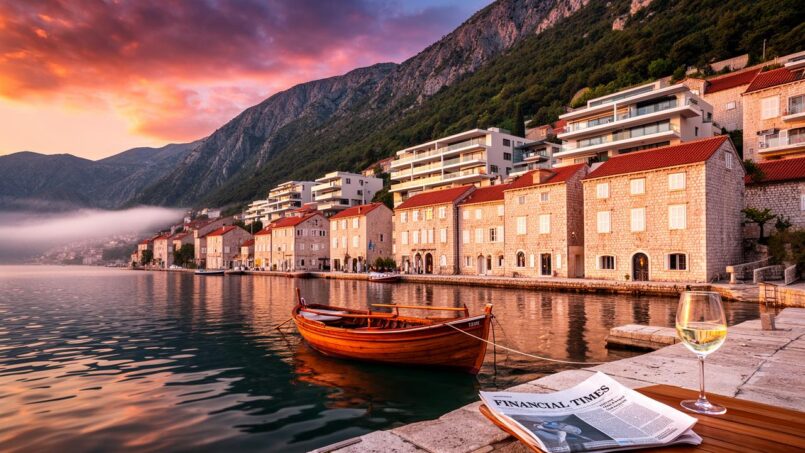
Nestled at the back of a unique Mediterranean fjord, surrounded by cliffs and stone villages, Kotor has been attracting a new generation of foreign investors in recent years. Behind the UNESCO-listed medieval alleyways, the real estate market has turned into a true laboratory for the Montenegrin coast: sharp price increases, strong rental yields, stricter residency rules, and a shortage of land.
This article provides a complete overview of real estate in Kotor and the Bay of Kotor: price levels, rental yield, ancillary costs, taxation, purchase procedures, residency rules, legal risks, and market outlook, based on the most recent data for 2025–2026.
Kotor and the Bay of Kotor: a market under high pressure
Kotor and the Bay of Kotor combine several rare factors on the Adriatic coast: UNESCO status, spectacular terrain, ultra-limited land, booming tourist infrastructure (marinas, international resorts, cable car), all in a country that remains fiscally competitive and open to foreigners.
This combination has a mechanical effect: prices have jumped faster than elsewhere in Montenegro, and the market is now clearly seller-oriented, especially for waterfront properties.
Rising quality of life, housing under strain
The standard of living in Kotor is on a slightly upward trajectory: net salaries are rising, inflation remains under control, and the country uses the euro, which simplifies life for expats. A single person needs about €1,600 to €2,100 per month to live comfortably, including housing, and can lower that to €1,200–€1,500 for a more modest lifestyle (non-central apartment, home cooking). A “premium” lifestyle – waterfront apartment, regular dining out, weekend getaways – ranges from about €2,500 to €3,500 per month.
The share of rent in expat budgets can reach 40 to 50% in sought-after neighborhoods of the Bay of Kotor.
Price levels: what to expect in 2026 in Kotor?
The numbers are clear: Kotor is one of the most expensive markets on the entire Montenegrin coast. The gap with the national average has widened significantly in recent years.
Average prices and common ranges
As of January 2026, the average price for all types of housing in Kotor is around €3,300 / m², roughly 40% higher than the coastal average in Montenegro. The median price for a home is about €210,000, and the average is close to €270,000, pulled upward by prestigious properties in the old town and on the waterfront.
For an overview, it can be summarized as follows: the key points are important to consider for a full understanding.
| Indicator (Kotor 2026) | Approximate Value |
|---|---|
| Average price per m² (all housing) | €3,300 |
| Median price per m² (apartments) | €3,400 |
| Average price per m² (apartments) | €3,900 |
| Median home price | €210,000 |
| Average home price | €270,000 |
| Range covering ≈ 80% of purchases | €100,000 – €600,000 |
| Range of most “standard” transactions | €150,000 – €400,000 |
| Range of most residential listings | €120,000 – €450,000 |
| Realistic entry point (small properties) | €85,000 – €130,000 |
| Luxury properties (villas/exceptional estates) | €700,000 – €2,500,000 |
In concrete terms, a standard two-bedroom apartment of about 75 m² sells for around €250,000. The majority of “classic” transactions fall between €150,000 and €400,000.
At the other end of the spectrum, a budget of about €85,000 to €130,000 can buy a studio of 35 to 45 m² in an older building in neighborhoods like Škaljari or the upper part of Muo.
Price variation over 10 years
The dynamic is spectacular. Between January 2025 and January 2026, prices in Kotor rose by about 12 to 18%, a pace higher than the national average and most other coastal towns. Over the past twelve months, the nominal increase is around 12%, or about 8% in real terms after inflation.
Prices in Kotor have risen by about 120% in nominal terms since 2015.
For 2026, analysts expect more moderate growth, on the order of 6 to 10%, but still above the projected pace for the country as a whole (5–7%).
Price differences by bay neighborhood
The Bay of Kotor is not a homogeneous block. Three sub-markets stand out very clearly: the historic center, the waterfronts of sought-after villages, and areas slightly set back.
| Area / Neighborhood | Indicative Price Level (€/m²) | Market Profile |
|---|---|---|
| Old Town (Stari Grad) | 4,500 – 7,500 | Most expensive, strong seasonal demand |
| Dobrota waterfront (prime) | 4,500 – 7,500 | Prestige villas and apartments |
| Perast | > 4,000 – 7,000 | Most expensive village in the bay |
| Dobrota (non-waterfront) | 2,000 – 3,500 | Apartments with sea views, good liquidity |
| Prčanj, Stoliv (seaside) | 3,000 – 5,000+ | Strong potential, scarcity of land |
| Škaljari, upper Muo, parts of Risan | 2,000 – 3,200 | Entry-level / more affordable per m² |
Perast is considered the most upscale village: renovated stone houses near the water frequently sell between €350,000 and €2.5M, with prices per m² regularly exceeding €4,000–7,000.
Villas and penthouses on the front line north of Kotor can reach €7,000/m².
Conversely, Risan or parts of Škaljari represent the most affordable entry point in the bay (from €2,000–2,900/m²), at the cost of a less iconic location.
Performance by property type
The hierarchy of performance has clearly emerged:
1. Waterfront villas (Dobrota, Prčanj, Stoliv, Perast): the rarest properties, with annual increases of 15 to 20%. 2. Renovated stone houses in historic villages: strong international demand, especially if they have bay views and water access. 3. Modern sea-view apartments in recent complexes: sustained appreciation, roughly 15% premium per m² over older properties. 4. Standard apartments without a view on second or third lines: more moderate growth, around 12% per year recently.
An older apartment in the old town often sells for between €2,500 and €3,500/m², or even more if fully renovated. Front-line bay villas can exceed €5,000/m², with some listings reaching €7,500/m² in the most coveted sections.
Rental yield in Kotor: what can an investor expect?
Beyond capital appreciation, Kotor also attracts investors with its rental income. Between cruise tourism, seasonal Airbnb rentals, and growing demand from expats and digital nomads, the bay offers an interesting mix of short-term and long-term rental opportunities.
Typical rent amounts
In 2026, average rents are at the following levels:
| Type of Housing (Kotor, long-term) | Average Monthly Rent | Common Range |
|---|---|---|
| Studio | ≈ €550 | €450 – €700 |
| 1-bedroom | ≈ €800 | €650 – €1,050 |
| 2-bedroom | ≈ €1,100 | €900 – €1,450 |
| 3-bedroom | €1,400 – €1,800 | depending on location / standard |
In the city center, available data indicates, for example, rent around €600/month for a 1-bedroom (range €500–700), and about €1,200/month for a 3-bedroom.
Relative to property prices, this gives a monthly rent-to-price ratio generally between 0.4% and 0.6%, i.e., between 4.8% and 7.2% gross annual for long-term rentals.
Gross and net yields
Available studies converge:
Key indicators for a successful rental investment
Between 5.5% and 6.8% for a well-located apartment. Realistic general range: 5 to 7% gross.
After fees, property tax, and management: about 3.6 to 4.8%. That is 3 to 5% for most investors.
For short-term rentals (tourism), gross yields can be significantly higher in the best locations:
| Rental Strategy | Typical Gross Yield | Comment |
|---|---|---|
| Long-term (1-year leases) | 5.5 – 6.8% | 3 – 5% net after expenses |
| Short-term (Airbnb, seasonal) | 8 – 14% | Heavier management, higher expenses |
| Old Town / waterfront (seasonal) | 7 – 10% net possible | If high occupancy rate and good pricing |
An example helps to illustrate these figures: an apartment worth €200,000 rented for €800 to €1,200/month has a monthly rent-to-price ratio of 0.4 to 0.6%, i.e., 4.8 to 7.2% gross annual. After expenses (property tax, maintenance, vacancy periods, management), a net yield of 3.5 to 5% is common.
Studios and small 1-bedroom apartments, especially in the old town or on the bay front line, generally show the best yields: 6.2 to 7.5% gross, sometimes more in short-term rentals. Large 3-bedroom apartments, however, tend to fall between 4.5 and 5.8% gross.
Yield by neighborhood: where to invest in the bay?
Three micro-markets stand out for their rental potential:
In the old town of Kotor (Stari Grad), rents per m² are very high due to strong tourist demand, with seasonal occupancy rates potentially exceeding 80–90% in high season; gross yields there are about 5–6% on a long-term basis and higher for short-term. In Dobrota (non-waterfront), furnished 1-bedroom/2-bedroom apartments offer a good balance between purchase price and rents, with gross yields of 6–7%. Finally, in Škaljari, Muo, and Risan, lower entry prices allow gross yields of 6–7.5% when rental demand is present, despite potentially slightly lower capital appreciation.
Generally speaking, rents in the bay have risen by about 10% year-over-year as of early 2026, a pace above the national average, in a context of moderate rental vacancy (around 7% over the long term).
Ancillary costs, expenses, and taxation
Buying in Kotor is not just about the listed price. The investor must account for transaction costs, taxation, ongoing expenses, and possibly financing.
Acquisition costs: budget 5 to 9% on top of the price
For a resale purchase (existing property, not new), you should generally plan for an additional 5 to 9% on top of the agreed price, covering:
– Transfer tax (stamp duty): the main item. The structure is progressive:
– Up to €150,000: 3%.
– Between €150,000 and €500,000: €4,500 + 5% of the portion above €150,000.
– Above €500,000: €22,000 + 6% of the portion above €500,000.
A few examples illustrate this progressivity:
| Property Price | Transfer Tax Amount |
|---|---|
| €100,000 | €3,000 |
| €150,000 | €4,500 |
| €250,000 | €9,500 |
| €400,000 | €17,000 |
| €600,000 | €28,000 |
– Notary: fees indexed to the price; for €100,000, roughly €350 + 21% VAT is cited, but in practice, total notary fees are around 0.5–1% of the price depending on the scale.
– Attorney: 0.5–1% in most transactions for due diligence and contract drafting (some firms charge from €1,000–€1,200).
– Translations and sworn interpreter: tens to a few hundred euros, with an official translator required if the client does not speak Montenegrin.
– Administrative fees (cadastre, extracts, registrations): modest amounts but should be budgeted.
For new construction bought directly from the developer, the 21% VAT is included in the listed price, which exempts the property from the transfer tax. Closing costs are then lower, between 4% and 8% of the price.
Annual property tax: a relative competitive advantage
Property tax in Montenegro is calculated on the estimated value of the property, with an official rate varying from 0.1% to 1% depending on the municipality, use, location, and quality of the property. In practice, it often remains below 0.5% of market value.
In Kotor, a differentiated system applies:
– Primary residence: rate around 0.27% of the estimated value.
– Secondary residence: about 0.70%.
For a property worth €300,000, the annual bill therefore falls between €800 and €2,100 depending on whether it is a primary residence or not.
A few ballpark figures:
| Example Property | Value | Approximate Annual Property Tax |
|---|---|---|
| “Average” apartment | €100,000 | €200 – €250 |
| Comfortable 2-bedroom in Kotor | €200,000 | ≈ €1,200/year (secondary residence) |
| Older apartment in Old Town | €170,000 | ≈ €700/year (frequently cited estimate) |
Taxation of rental income and capital gains
– Rental income: for foreigners, the full rate on rental income is 15%, but the system provides standard deductions for expenses:
– Long-term rental: standard deductible cost of 30%.
– Registered tourist rental: up to 50% deductible.
The effective rate after standard deductions is between 7.5 and 10.5% of gross income.
– Real estate capital gains: taxed at 9–15% depending on sources and tax structure (some texts mention 9%, others 15%; practice may vary by period and type of income). In any case, foreigners are treated the same as residents: no specific surcharge.
– Corporate income tax: 9% on profits if the investment is held through a Montenegrin company.
Ongoing expenses: maintenance, utilities, internet
For a standard 2-bedroom apartment, expect:
– Utilities and maintenance fees: generally €90 to €160/month (electricity, water, heating, garbage, building maintenance).
– Electricity: around €1–1.5/m².
– Water + garbage: €10–20.
– Condominium fees: about €0.8–1.5/m².
– Internet and mobile: €30–50/month; a basic plan of 50–100 Mbps costs about €23–32/month, a 200–300 Mbps plan €32–41/month, and above 500 Mbps from €41/month.
Regulations for foreigners: what you absolutely need to know
Montenegro is one of the most open markets in the Balkans for foreigners. But this openness is tempered by land-type restrictions and, since 2026, by new rules on residency linked to property ownership.
What a foreigner can buy… and what remains prohibited
In practice, a foreigner can buy in their own name:
– Apartments, houses, villas, townhouses.
– Condominium units (ownership of the unit plus share of common areas).
– Land classified as urban or buildable (urban construction land).
– Commercial properties (retail, hotels, etc.), subject to zoning.
No nationality is privileged or discriminated against for these purchases: a French, Canadian, or Australian person has the same rights as a Montenegrin for this type of property.
However, Montenegrin law prohibits direct ownership by foreigners of certain categories:
– Agricultural land.
– Forests and forest land.
– Land within about one kilometer of national borders.
– Islands.
– Areas designated for national defense or security.
– Certain cultural monuments of particular importance and certain protected areas.
To acquire agricultural or forest land in Montenegro despite these limitations, set up a Montenegrin company through the CRPS registry or opt for very long-term leases. These restrictions relate to the type of land, not your nationality.
Buying without a visa or residence permit
Key point for an investor: no specific visa or residence permit is required to buy a property. It is possible to complete a real estate transaction during a simple tourist stay of 90 days, provided you have:
– a valid passport,
– a Montenegrin tax identification number (PIB/TIN) to pay the transfer tax and property tax,
– and of course the necessary funds.
The purchase is a civil law transaction conducted before a notary and formalized at the real estate cadastre.
Residency linked to real estate: new rules since 2026
The landscape has shifted significantly on this front. The former citizenship-by-investment program (which combined a non-refundable contribution with property acquisition in approved hotel projects) was permanently closed at the end of 2022 under pressure from the European Union. There is now no fast track to a Montenegrin passport through a simple real estate purchase.
However, a temporary residence permit based on property ownership remains possible, but under conditions that are now stricter.
New value threshold for non-Europeans
Since the entry into force of the new Law on Foreigners in January 2026, a third-country national (outside the EU/EEA/Switzerland) who wishes to obtain a temporary residence permit through the purchase of a property must meet several criteria, including a minimum value threshold:
The property must be valued at least €150,000 by the Tax Administration, based on the official transfer tax decision (not the price stated in the preliminary contract). The owner must hold at least 50% of the property, and it must be registered for residential use (a garage or commercial space alone does not suffice).
This threshold applies only to applicants for a residence permit based on property ownership. It does not prevent buying a property of lower value, but in that case the purchase will not grant access to this type of residence.
Citizens of the EU, Iceland, Liechtenstein, Norway, and Switzerland – as well as their family members – are exempt from this €150,000 requirement.
Other conditions for the property-based residence permit
In addition to the property value, the applicant must:
To obtain a residence permit through a real estate purchase, you must provide an up-to-date property title (List Nepokretnosti less than 6 months old) with no debts or disputes, prove sufficient resources (e.g., bank statement of at least €3,650 or €10/day), submit a clean criminal record that is apostilled and translated, provide proof of health insurance, pay all local taxes, use the property as your actual residence, possess a passport valid for at least 15 months, and appear in person at the MUP within 10 days of entry.
The permit is issued for one year, renewable annually as long as these conditions are met. Owners who already held a residence permit based on a property of lower value before the reform benefit from a “grandfather” clause: they can continue to renew under the old regime, provided they keep the property.
Other pathways to residence
For reference, there are also non-real estate solutions:
– Residence via a local company: being the sole or majority owner (more than 51%) of a Montenegrin company that pays at least €5,000 per year in taxes. This route does not require the €150,000 threshold, but involves ongoing business activity and costs.
– Standard naturalization: 10 years of continuous legal residence (5 years on a temporary permit, then 5 years on a permanent permit), with language requirements and, in principle, renunciation of original citizenship.
Purchase process: key steps and points of caution
On paper, buying a property in Kotor is relatively straightforward. In practice, the main difficulty lies in legal security: incomplete title deeds, unlegalized constructions, unregistered easements… Thorough due diligence is essential.
Main steps of a transaction
1. Preparation and research
– Obtain a tax identification number (PIB/TIN) from the Montenegrin tax administration (procedure takes 1 to 3 days, often delegated to a lawyer).
– Open a local bank account if needed.
– Define a precise set of requirements (budget, target yield, neighborhood, view, short-term vs. long-term rental potential).
– Engage a local attorney to vet each preselected property.
2. Legal due diligence
The attorney examines several critical points:
– The List Nepokretnosti (cadastral extract): current owner, easements, mortgages, pledges, pending lawsuits, etc.
– Zoning compliance: building permits, designated use (residential, commercial, agricultural), any ongoing legalization procedures for older constructions.
– Ownership history (inheritance transfers, divorces, etc.) to ensure all authorized parties will sign.
– The status of utility connections (water, electricity, sewage) and condominium management if applicable.
Between 2000 and 2015, a large portion of Montenegro’s housing stock was built with incomplete or missing permits. Since 2016, a legalization law has allowed regularization, but many cases remain pending. Buying an unlegalized property exposes you to major risks: loan refusal, inability to insure, limited capital appreciation, and even demolition if legalization is ultimately denied.
3. Offer and preliminary contract
– Submit a written offer, sometimes subject to a satisfactory due diligence condition.
– If accepted, sign a preliminary contract (predugovor or reservation contract) that sets the price, timeline, and special conditions.
– Pay a deposit (often 10%, sometimes less for new developments or more for highly sought-after properties). This deposit is generally non-refundable if the buyer withdraws without a stipulated reason.
4. Final contract and notary
To finalize a real estate purchase in Montenegro, the final sale contract is drafted in Montenegrin and signed before a local notary. If the buyer does not speak the language, a sworn interpreter must be present. In case of absence, a notarized and apostilled power of attorney (POA) from the buyer’s country of origin is accepted. The notary verifies identities, the legal capacity of the parties, and officializes the signatures.
5. Payment and taxes
– Pay the balance of the price, usually by direct bank transfer to the seller or via an escrow account managed by the notary.
– Pay the transfer tax within 15 days.
– Submit documents to the cadastre for the change of ownership.
6. Registration and post-purchase
– Time for registration at the real estate cadastre: on average 15 to 30 days, sometimes longer in high season.
– Update service contracts (electricity, water) in the new owner’s name.
– Register with the municipality for property tax.
– For tourist rental activity, register with the competent tourism authorities.
Financing and interest rates
Local banks offer mortgage loans to foreigners, but under stricter conditions than for residents:
– Down payment required: 30 to 50% for non-residents, compared to 20–30% for citizens.
– Term: generally up to 10 years for foreigners.
– Rate: the average rate for residents is around 4.9%; non-residents pay a premium of 1 to 3 percentage points, resulting in effective rates between 5.5 and 8%.
This financing constraint limits liquidity at purchase, but also helps curb the formation of a purely speculative bubble.
Risks, constraints, and outlook
A market as dynamic as Kotor does not come without risks. For a foreign investor, it is essential to be aware of them before committing hundreds of thousands of euros.
Legal and compliance risks
The most important relate to the quality of documentation:
– A significant portion of properties, especially those built during the 2000–2015 boom, remain not fully legalized.
– A property may be encumbered by a mortgage, subject to an inheritance dispute, or involved in administrative litigation.
– The judicial system suffers from a backlog of cases, particularly in administrative matters, which can prolong disputes for years.
The message from practitioners is clear: never waive a complete due diligence conducted by an independent attorney, even if the seller assures that “everything is in order.”
Market risks
Several factors can affect value or returns:
Seasonal rentals are heavily dependent on international tourism and suffer from marked seasonality (high season from April to October), requiring this cyclicality to be factored in. UNESCO and land constraints limit supply, supporting prices but creating bottlenecks for permits. Finally, the regulatory framework can change quickly, as illustrated by the new €150,000 threshold for residence through property ownership.
Why the market remains attractive nonetheless
Despite these risks, several factors argue in favor of a well-considered investment in Kotor:
Supply is permanently limited by topography and UNESCO constraints. International demand is solid, driven by European, German, British, and Russian clientele. Property and rental income taxation is moderate, with no penalties for foreigners. The use of the euro reduces currency risk. Finally, the prospect of EU membership supports a premium on real estate assets.
Projections for 2026 point to a market that is still upward-trending, but with a more reasonable appreciation pace than in the 2023–2025 phase. Expectations are for +6 to +10% in Kotor, which, combined with a net yield of 3–5%, could lead to total returns over 5 years on the order of 50–75% for well-chosen properties.
How to position yourself intelligently in Kotor and the Bay of Kotor real estate market?
For a foreign investor, the Kotor market is neither a miraculous bargain nor an unmanageable bubble: it is a mature, tight market where selectivity makes all the difference.
A few key trends emerge from the data:
Summary of opportunities and constraints for investing in the Bay of Kotor, by property type and area.
1-bedroom and 2-bedroom apartments with sea views or in the old town offer the best balance of rental yield, liquidity, and capital appreciation potential.
A product of extreme scarcity at very high prices, but benefiting from long-term protection thanks to limited waterfront land.
Dobrota, Prčanj, and Stoliv are recording the highest annual increases. Škaljari and Risan offer more accessible entry points, still under the radar.
For non-Europeans, combining purchase and residence permit requires a property with a minimum tax value of €150,000.
In an environment where much of the future value creation will depend as much on the quality of documentation as on the beauty of the view, the investor’s primary tool remains legal prudence: cadastre, permits, history, local taxation – all these pieces must fit together perfectly before signing.
Those who take the time for this verification can still find, in Kotor and the Bay of Kotor, a rare blend of heritage, yield, and long-term appreciation potential on the Adriatic coast.
A wealth planning project or a question? Contact us now to speak with a wealth management expert.
Disclaimer: The information provided on this website is for informational purposes only and does not constitute financial, legal, or professional advice. We encourage you to consult qualified experts before making any investment, real estate, or expatriation decisions. Although we strive to maintain up-to-date and accurate information, we do not guarantee the completeness, accuracy, or timeliness of the proposed content. As investment and expatriation involve risks, we disclaim any liability for potential losses or damages arising from the use of this site. Your use of this site confirms your acceptance of these terms and your understanding of the associated risks.

Cyril Jarnias is an independent expert in international wealth management with over 20 years of experience. As an expatriate himself, he is dedicated to helping individuals and business leaders build, protect, and pass on their wealth with complete peace of mind.
On his website, cyriljarnias.com, he shares his expertise on international real estate, offshore company formation, and expatriation.
Thanks to his expertise, he offers sound advice to optimize his clients' wealth management. Cyril Jarnias is also recognized for his appearances in many prestigious media outlets such as BFM Business, les Français de l’étranger, Le Figaro, Les Echos, and Mieux vivre votre argent, where he shares his knowledge and know-how in wealth management.





