
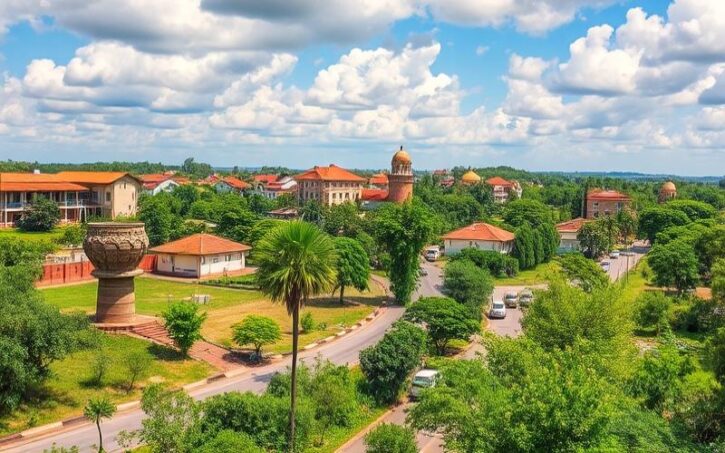
 Published on and written by Cyril Jarnias
Relocating to Cameroon as an expatriate means accepting a permanent balancing act: between spectacular landscapes and sometimes failing infrastructure, very low local salaries and high expat rents, human warmth and a complex security climate. This guide gathers the main practical points of reference for preparing a long-term stay, with a particular focus on Douala and Yaoundé, the country’s two main gateways.
Understanding the Country You’re Moving To
Before booking a flight and accommodation, it’s worth situating Cameroon in its real context, far from tourist brochures.
The country, often nicknamed “Africa in miniature” for the diversity of its landscapes and cultures, is located in the heart of Central Africa and shares its borders with Nigeria, Chad, the Central African Republic, Equatorial Guinea, Gabon, and the Republic of the Congo. It opens onto the Atlantic at the Gulf of Guinea. The population exceeds 22 million inhabitants according to some sources, and major urban areas concentrate significant demographic and economic weight: Douala, the economic capital, and Yaoundé, the political capital, dominate the urban landscape.
The average monthly net salary in Cameroon, which only covers a fraction of monthly expenses in major cities.
For an expatriate arriving with an international salary, the equation is reversed: daily life can seem relatively affordable, as long as one keeps in mind that one operates within an economic bubble very different from that of the locals.
An Officially Bilingual, Truly Multilingual Country
Cameroon has two official languages: French and English. In practice, French is very dominant (about 80% French speakers), while English is mainly present in the Northwest and Southwest regions. Alongside these, there are more than 200 national languages, some of which are very present in urban areas (Duala, Ewondo, etc.).
For a French-speaking expatriate, integration in Douala and Yaoundé is straightforward. For an English speaker, it is highly recommended to learn at least basic functional French, especially for administrative procedures and the healthcare system.
A Climate That Changes Radically from North to South
Cameroon juxtaposes a humid tropical climate in the south and a semi-arid one in the north. The coastal and forested areas (Douala, Kribi, Limbé, Yaoundé to a lesser extent) are hot and very humid, with rainy seasons among the most intense in the world near Mount Cameroon. The northern part of the country, drier, experiences high temperatures but limited rainfall.
In Yaoundé, the altitude makes the heat somewhat more bearable than in Douala, where the humidity can be grueling for those unfamiliar with it. The concrete impact for an expatriate is simple: plan a significant air conditioning budget in Douala and, overall, accept that electricity (and thus AC) won’t always be available.
Cost of Living: Douala vs. Yaoundé, Two Realities
Major international surveys highlight a paradox: in a poor country, some cities can be extremely costly for expatriates. Mercer surveys have ranked Douala and Yaoundé among the most expensive African cities for foreigners, mainly due to the cost of upscale real estate and imported goods.
Douala, an Expensive and Strained Economic Capital
Douala concentrates a significant portion of the country’s industrial and port activity. It is also, by far, the most expensive city in Cameroon for an expatriate, especially if one wishes to live in the “classic” expatriate neighborhoods (Bonapriso, Bonanjo, Denver, Bonamoussadi, Kotto…).
A numerical comparison Douala / Yaoundé helps gauge the differences.
Comparative Monthly Budget (estimate for an expat lifestyle)
| Expense Item | Douala (USD) | Yaoundé (USD) |
|---|---|---|
| Monthly cost for 1 person (excluding rent) | 1,363 | 671 |
| Monthly cost for family of 4 (excluding rent) | 3,181 | 1,691 |
| Rent for 1 person (average) | 748 | 212 |
| Rent for family (average) | 1,264 | 325 |
| Food | 430 | 317 |
| Transportation | 67.9 | 65.3 |
| Average local net salary | 132 | 119 |
In Douala, the rent for a comfortable expat apartment can thus alone absorb an entire local annual salary. In the neighborhoods favored by the French (Bonapriso, Bonanjo), rents typically range between 300,000 and 650,000 FCFA for a high-end 3-bedroom apartment, with comfortable studios around 200,000 FCFA. Landlords very frequently require 6 to 12 months of rent in advance for the first year. Short-term furnished rentals like “aparthotels” can go up to 20,000 FCFA per night, which quickly becomes prohibitive over several months.
In Douala, continuous air conditioning for a large family can lead to monthly electricity bills reaching 60,000 to 150,000 FCFA. Water, although generally affordable for a household, represents a significant cost for filling a swimming pool, which can amount to several hundred euros.
Yaoundé, More Affordable but Not “Cheap”
The political capital appears significantly less expensive than Douala, especially for housing. Several comparisons show that the cost of living is about half as high there.
Relative Indicators Douala / Yaoundé
| Indicator | Difference Yaoundé vs. Douala |
|---|---|
| Cost of Living (excluding rent) | -31.9 % |
| Cost of Living (including rent) | -44.1 % |
| Restaurant Prices | -45 % |
| Grocery Prices | -19.8 % |
| Rent Prices | -77.5 % |
| Local Purchasing Power | +138.8 % (higher in Yaoundé) |
Concretely, in Yaoundé you can find decent 2-bedroom apartments for around 150,000 to 250,000 FCFA in intermediate neighborhoods, and studios for even less. However, rents skyrocket in high-demand sectors like Bastos (heavy presence of embassies, NGOs, and expatriates).
Although Douala and Yaoundé offer a similar quality of life according to international rankings, with a slight advantage for Douala at the national level, Yaoundé is often considered more attractive for digital nomads or financially independent expatriates. This choice is explained by a better cost/lifestyle ratio, despite air quality sometimes being inferior to Douala’s.
Expatriate Salary: What Figures to Aim For?
Testimonies from expatriates in Douala converge: to live comfortably alone while maintaining an “expatriate” lifestyle (secure housing, car, leisure, occasional travel), it is difficult to go below 500,000 FCFA net per month. For a family, the frequently cited figure is closer to one million FCFA per month, not including potential tuition fees at an international school.
On a country-wide scale, overall estimates are as follows:
| Type of City | Comfortable Monthly Budget (USD) | Approximate FCFA Equivalent |
|---|---|---|
| Major City (Douala, Yaoundé) | 1,000 to 2,000 | 600,000 to 1,200,000 |
| Medium/Small Town | 500 to 1,000 | 300,000 to 600,000 |
These ranges include housing, food, transportation, communications, and reasonable leisure, but without extravagances (luxury villa with pool and international schooling for several children, for example).
Housing: Neighborhoods, Standards, and Tips
Housing is almost always the largest expense for an expatriate in Cameroon. The market is dual: a massive supply of modest housing for the local middle class, and a very expensive niche for foreigners and local elites.
Douala: Where Do Expatriates Live?
The “classic” neighborhoods for expatriates in Douala are Bonapriso and Bonanjo, close to the center, airport, and major companies. They feature numerous restaurants, bars, clubs, and high-end supermarkets, as well as international and French schools (Dominique Savio, American School of Douala, etc.). Logpom, Denver, and Bonamoussadi are also increasingly hosting expatriate families in villas or upscale apartments.
Rents in these areas often include: utilities, maintenance of common areas, and sometimes additional services.
– 24/7 security guard,
– electricity generator (essential to cope with outages),
– secure parking,
– sometimes a pool or small garden.
The minimum price identified for a one-night rental of an apartment, villa, or studio on platforms like Airbnb or Koutchoumi.com.
Yaoundé: Bastos and the Others
In Yaoundé, Bastos is the equivalent of Bonapriso/Bonanjo: a “diplomatic” neighborhood with embassies, NGOs, international schools (American School of Yaounde, French schools, British institutions), and highly secure housing. Around it, there are many residential neighborhoods – Odza, Simbock, Mendong, Nkolbisson, Ngousso, Mfandena… – where rents remain more affordable.
Furnished residences for students and young professionals (like some offers near Soa, close to the university) can constitute a good starting point for a single expatriate or remote worker, before looking for more permanent housing.
The Cameroonian urban market has gradually adapted to digital nomads and short-term expatriates: shared housing and furnished rentals for short or medium terms are developing, especially in Douala and Yaoundé. It’s not uncommon to find fully equipped apartments (high-speed Wi-Fi, satellite TV, air conditioning, complete appliances) offered by the month, or even by the week.
For annual standard lease agreements, several aspects must be anticipated by both the owner and the tenant.
– Payment several months in advance (sometimes a year) is the norm, but it’s also a negotiation lever;
– Most landlords do not draw up a very detailed lease: it’s better, as much as possible, to formalize the condition of the property and responsibilities (maintenance, repairs);
– Finishing standards can vary greatly, even for a high rent. Visiting several properties is essential.
Security: A Parameter to Take Seriously
Cameroon combines a high level of crime and regional security tensions. Many embassies (UK, USA, Canada, etc.) recommend increased vigilance, or even outright advise against certain travel.
Main Risks
The identified threats cover several areas:
The country presents several security risks depending on the region: urban crime (theft, assault, carjacking) in major cities like Yaoundé and Douala; banditry and kidnappings for ransom in the North, Far North, Adamawa, East, and the English-speaking Northwest and Southwest regions; activities of armed groups (Boko Haram, separatists) using explosive devices in the North and English-speaking regions; piracy in the Gulf of Guinea; and occasional risks of protests and political violence across the country.
In several regions, kidnappings of foreigners have been reported. Road axes around the borders with Nigeria, Chad, and the Central African Republic are particularly sensitive.
Daily Safety Practices
In practice, an expatriate settling in Douala or Yaoundé often adopts a set of basic rules:
To illustrate the safety measures to adopt, the following advice can be cited: avoid walking at night, especially in popular or poorly lit neighborhoods; limit intercity nighttime travel; keep car windows closed and doors locked, even during the day; avoid displaying signs of wealth on the street; prioritize trusted taxis and avoid motorcycle taxis; equip one’s home with bars, alarms, or security guards depending on the neighborhood; and carry only certified copies of documents, keeping originals in a safe place.
Road checkpoints are frequent; law enforcement often asks for ID, driver’s license, vehicle registration. Not carrying one’s papers can lead to temporary detentions. Requests for a “soda” (small bribe) are not uncommon; everyone then decides their response based on the context, within the limits of the country’s legality.
Healthcare System: Well-Insured or Very Vulnerable
The Cameroonian healthcare system perfectly illustrates the gap between statistical averages and real-world experience. The country has less than two doctors per 10,000 inhabitants, public hospitals suffer cruelly from under-equipment, and many services are paid for in cash, despite the establishment of a nascent universal coverage scheme.
Public vs. Private
The system is structured around:
– A fragmented public sector with three levels (basic health centers, district hospitals, regional and university structures);
– A private sector (clinics, polyclinics, faith-based hospitals) generally offering a higher level of service, but uneven depending on the facility.
Major Cameroonian cities have public reference hospitals (like the Douala General Hospital, Laquintinie, the Yaoundé Central Hospital, or the Yaoundé University Hospital) and recognized private clinics. However, even in these facilities, problems such as drug shortages, insufficient equipment, and water or electricity outages can occur.
For an expatriate, the rule is clear: turn to the private sector as much as possible and take out an international insurance covering at minimum:
– Consultations and hospitalizations in private clinics;
– Medical evacuation to a country with advanced medicine (South Africa, Europe, Morocco, etc.).
A consultation at a good private clinic typically costs between 10,000 and 30,000 FCFA. Facilities very often require cash payment or a guarantee before providing care, even with insurance: so one must be prepared to advance the costs.
Vaccines, Malaria, and Health Risks
The yellow fever vaccination is mandatory to enter the country (international certificate required at the border). Furthermore, health organizations recommend for most expatriates:
Before traveling to Cameroon, it is essential to update basic vaccines (diphtheria, tetanus, polio, measles, etc.). It is also recommended to get vaccinated against hepatitis A and B, typhoid, and possibly rabies in case of expected exposure to stray dogs or wildlife. Finally, anti-malarial prophylaxis must be planned, as malaria is endemic throughout the territory.
Tap water is rarely safe to drink without treatment: the rule is to drink mineral or boiled water, and to be cautious with street food. A first-aid kit and a supply of usual medications (with a prescription copy) are strongly advised, especially if one must travel outside major urban centers.
Visas, Residence Permits, and Entry Formalities
Cameroon has modernized its visa system with the implementation of an online application platform (eVisa). For almost all nationalities, a visa is mandatory before traveling.
Main Visa Categories
Mainly distinguished are:
– The transit visa (a few days);
– The short-stay visa (up to 3 to 6 months depending) for tourism, visits, short professional assignments;
– The long-stay visa (up to 12 months) for salaried employment, long-term studies, family reunification, etc.
This is the fee range, in dollars, for a standard visa for French citizens, varying whether it’s for short or long stay.
Applications are made via official websites (evisacam.cm / evisacam.com): one must create an account, fill out a form, upload supporting documents (passport, flight reservation, yellow fever vaccination certificate, proof of funds, proof of accommodation or hotel booking, employer or invitation letter, etc.) and pay online.
Once the application is approved, the applicant receives an authorization with a QR code which allows boarding. The final visa is then affixed either at a diplomatic representation or upon arrival, depending on the case.
Long-Term Stay: Residence and Work Permits
To settle long-term, the long-stay visa is not enough: once in the country, one must apply for a residence permit (resident card) and, if salaried, a work permit.
The residence application generally includes: the necessary administrative documents, proof of financial resources, proof of address, civil status as well as the residence permit application form.
– Proof of resources or employment contract;
– Clean criminal record;
– Medical certificate according to local requirements;
– Proof of housing;
– Proof of payment of fees (at least 250,000 FCFA according to available information, with possible variations).
The process takes several weeks. During this time, a receipt can serve as a temporary permit. Expatriate employees often see their work permit and residence permit contractually linked to their employer: clarifying these points before departure is essential.
Culture, Social Relations, and Faux Pas to Avoid
A successful installation in Cameroon is not just about budget numbers or insurance contracts. Understanding social codes weighs heavily in daily life.
The Importance of Respect and Greetings
Cameroonian society strongly values respect for elders, authorities and, more broadly, courtesy in all interactions. Entering an office or a shop without greeting, or getting straight to a request without preamble is very poorly regarded.
Greetings like “Good morning” are often followed by questions about health or family. This small talk, far from being superficial, serves as an essential social lubricant to then facilitate exchanges on business or problem-solving.
Using “tu” (informal “you”) with strangers or older people should be handled with caution. An expatriate is well-advised to maintain a respectful “vous” (formal “you”) at first.
Managing Conflict Without Confrontation
Exchanges are often indirect: a frontal “no” can be perceived as aggressive. To refuse, it’s common to use roundabout phrases (“we’ll see,” “it’s not easy,” “maybe later”) which, for a European, can be a source of misunderstandings. Conversely, a very direct, even brutal communication style can be taken for arrogance.
In some professional environments, harmony and flexibility can take precedence over strict punctuality. It is common to encounter missed deadlines without formal communication, meetings that start late, or informal compromises. Developing patience and adaptability is therefore essential to work effectively in this context.
Religion, Politics, Sensitive Subjects
Cameroon is very religious (Christianity, Islam, traditional beliefs) and these dimensions partly structure social life. Addressing national politics, regional tensions (especially in the English-speaking regions), religion, or identity issues head-on, especially in public, is not recommended for a newcomer.
Another sensitive subject: homosexuality. Same-sex relationships are criminalized and LGBTQ+ persons are exposed to risks of stigmatization, violence, or prosecution. Public displays of affection, even heterosexual, remain culturally poorly accepted outside of a few very specific urban circles.
Working, Starting a Business, Remote Work
Cameroon mainly attracts expatriates in the oil, gas, agro-industry, mining, telecoms, education (international schools), and NGO sectors. The public sector remains largely reserved for nationals.
Finding a Job
The best entry point remains a contract obtained before departure, via:
– Multinationals already established;
– International organizations or NGOs;
– International schools (American School, French lycées, British schools, etc.).
Mastery of French and/or English is essential, with bilingualism being a major asset. Serious employers generally assist their expatriates in obtaining the work permit and residence permit, and may cover housing and children’s schooling.
Starting a Business
For those who want to start a business, Cameroon has set up one-stop shops (CFCE) allowing a company to be created in a few days. Tax incentives exist for industrial free zones or major infrastructure projects.
But the business environment remains marked by strong bureaucracy, sometimes opaque procedures, and exchange constraints at the CEMAC zone level. Surrounding oneself well (lawyers, accountants) and understanding the banking, tax, and customs regulatory framework is essential before starting.
Remote Work and Digital Nomadism
Douala and Yaoundé are beginning to position themselves as possible bases for some digital nomads, thanks to the availability of 4G connections and some fiber offers in central neighborhoods. Mobile plans allow, for example, having 1 GB per day for the equivalent of a few tens of euros per month.
However, frequent power outages and variable connection quality often require investing in:
– Housing equipped with a generator and/or UPS;
– A dual connection (fiber + 4G router, or two mobile operators).
Platform rankings dedicated to nomads give Yaoundé a slight advantage over Douala in terms of cost of living and air quality, with Douala making up for it with a more developed nightlife.
Banking, Money, Transfers
Cameroon is part of the CFA franc zone of Central Africa, under the authority of the BEAC. It is a largely cash-based economy.
Opening a Bank Account
For a resident expatriate, opening an account is possible, but generally requires:
Key conditions and documents required to open a bank account in Cameroon.
You need a valid residence permit or, at minimum, proof of residence in the country.
Provide a passport, proof of address, sometimes an employer letter, ID photos, and a home location map.
Make an initial deposit to open the account, the amount of which varies depending on the chosen bank.
The banking system remains simpler than in Western countries, but also less digitized. Exchange and international transfer rules are strict within the CEMAC scale, sometimes with delays and paperwork to send funds abroad.
On a practical side, international bank cards work at some ATMs of major banks, but fees can be high, and electronic payment terminals are rare outside of major chains, hotels, and supermarkets.
Getting Around: A Car is Almost Essential in the City
Urban public transportation remains poorly structured. In Douala as in Yaoundé, traffic relies on a mix of shared taxis, overcrowded buses, and motorcycle taxis, with a road network heavily congested during rush hour.
For an expatriate, two main options:
– Owning or renting a car, ideally sturdy (SUV, pickup truck) to handle potholes and degraded roads;
– Relying on a trusted driver.
Customs duties and insurance can represent 40% or more of the price of a used car, which starts around 10,000 euros.
The traditional yellow taxis are a supplement, but their use carries risks (accidents, theft, assault). Many embassies advise their personnel against using them.
On intercity routes, main roads are paved but sometimes in poor condition, with a high density of trucks, buses, and motorcycles. Accidents are frequent; traveling during daylight with an experienced driver remains the prudent norm.
Education: Public, Missionary, and International Schools
The Cameroonian education system is bilingual in its architecture (French and British heritage), but in practice, the majority of public institutions operate in French or English depending on their zone. Primary school has been free since 2000, but “additional” fees (uniforms, textbooks, various contributions) remain an obstacle for many families, especially in rural areas.
Annual tuition fees at international schools in Cameroon can reach tens of thousands of dollars.
In secondary areas (Bamenda, Garoua, etc.), some international or bilingual structures exist, but the offer remains more limited.
Social Life, Leisure, and Expatriate Networks
Despite the constraints, social life can be very rich for an expatriate in Cameroon. The country has a large diaspora abroad, very involved in local development, and a significant foreign community in major cities (Nigerians, Europeans, Chinese, etc.).
To facilitate integration, platforms like InterNations or Expat.com allow expatriates to meet, exchange practical advice (school, neighborhood), and organize activities. Leisure activities are varied, ranging from sports clubs and cultural associations to hiking and trips to the beaches of Kribi or Limbé.
On the culinary side, Cameroonian cuisine – ndolé (bitterleaf stew), poulet DG (spicy chicken dish), braised fish, beignets, etc. – quickly becomes part of the weekly menu, while international restaurants (French, Lebanese, Asian, Indian) are particularly present in expatriate neighborhoods.
In Summary: Who is a Move to Cameroon Suitable For?
Relocating to Cameroon as an expatriate is not a trivial project. The country offers: professional opportunities, a rich culture, diverse landscapes, and a welcoming population.
– a cost of living generally lower than in many Western countries, but with a very costly “expatriate” segment, especially for housing and school;
– a welcoming population, a rich culture, varied landscapes, a vibrant urban scene in Douala and Yaoundé;
– an objectively difficult health and security environment, which requires being well-insured, informed, and cautious.
The profile of the expatriate who thrives best there:
– Has a solid contract (salary, benefits, health coverage, housing assistance, schooling);
– Accepts administrative delays, water or electricity outages, traffic unpredictability;
– Is ready to learn local social codes, learn at least one official language, and adopt reasonable safety routines.
For those who recognize themselves in this portrait, Douala and Yaoundé can become, despite their contradictions, places of intense living, where one builds networks, projects, and lasting memories.
Disclaimer: The information provided on this website is for informational purposes only and does not constitute financial, legal, or professional advice. We encourage you to consult qualified experts before making any investment, real estate, or expatriation decisions. Although we strive to maintain up-to-date and accurate information, we do not guarantee the completeness, accuracy, or timeliness of the proposed content. As investment and expatriation involve risks, we disclaim any liability for potential losses or damages arising from the use of this site. Your use of this site confirms your acceptance of these terms and your understanding of the associated risks.

Cyril Jarnias is an independent expert in international wealth management with over 20 years of experience. As an expatriate himself, he is dedicated to helping individuals and business leaders build, protect, and pass on their wealth with complete peace of mind.
On his website, cyriljarnias.com, he shares his expertise on international real estate, offshore company formation, and expatriation.
Thanks to his expertise, he offers sound advice to optimize his clients' wealth management. Cyril Jarnias is also recognized for his appearances in many prestigious media outlets such as BFM Business, les Français de l’étranger, Le Figaro, Les Echos, and Mieux vivre votre argent, where he shares his knowledge and know-how in wealth management.





