
 Published on and written by Cyril Jarnias
Oman has been attracting a growing community of expatriates for several years, drawn by a safe living environment, a reasonable cost of living, and a more relaxed pace than in neighboring metropolises like Dubai. Out of a population of just over 4.5 to 5 million, nearly 40% are estimated to be foreigners, with a strong presence of professionals from Europe, North America, South Africa, as well as India, Pakistan, and the Philippines. The vast majority settle in Muscat, the country’s political and economic capital, where certain neighborhoods have become veritable bastions of expat life.
Before settling in Oman, it is essential to analyze neighborhoods based on several factors: their specific advantages, rental levels, and the quality of schools and healthcare infrastructure. This choice, crucial for employees, entrepreneurs, or investors, directly impacts daily life. The residential market is very segmented, despite the country’s general reputation as the ‘Switzerland of the Gulf’ for its political stability, high safety, and low crime.
Muscat, the beating heart of expatriate life
Muscat is home to roughly 1.5 to 1.7 million people, over half of whom are expatriates. The city stretches along the coastline, between the Arabian Sea and the Hajar Mountains, forming a succession of distinct districts. Each zone has its own DNA: some neighborhoods are prized for their beaches, others for their proximity to ministries, embassies, or major shopping malls, and others still for their tranquility or rental prices.
The expatriate population increased by 33% between September 2022 and May 2023, contributing to rental demand pressure.
To give a rough idea, the rental range for a one-bedroom apartment in Muscat is quite broad: units can be found starting from around 120 OMR per month in the most outlying sectors, up to 800 OMR and more in luxury seafront complexes. Purchase prices can start around 30,000 OMR for a modest studio and exceed 700,000 OMR for the most prestigious villas.
In this landscape, several neighborhoods consistently come up when asking expatriates, real estate agencies, or market reports. These are the ones listed below.
Madinat Al Sultan Qaboos: Muscat’s “Little Britain”
Madinat Al Sultan Qaboos – or Madinat Qaboos, often abbreviated as MQ or MSQ – is the archetype of the “classic” expatriate neighborhood in Oman. Located in central Muscat, about six kilometers from the sea and connected to other districts by the Sultan Qaboos Street artery, it established itself early on as one of the most sought-after addresses for foreigners.
The nickname “Little Britain” illustrates its sociology well: a strong presence of Western expatriates, many families, diplomats, a peaceful residential suburb ambiance, with tree-lined streets, villas with gardens, and small local shopping centers. It’s not a flashy neighborhood but rather a comfortable place to live, designed for daily life.
Housing within secured compounds presents great diversity: you can find older villas of traditional style, often on large plots, new apartment buildings with shared pools, and small ‘garden court’ clusters enclosed by gates. These residences, generally spacious and family-friendly, benefit from shared services like pools, gyms, or playgrounds.
Madinat Al Sultan Qaboos is also one of the practical hubs of expatriate life. It is home to the British School Muscat, a flagship school in the British network, as well as the British Council which offers English courses and CELTA-type training. The proximity of these institutions partly explains why so many Anglo-Saxon families choose to live here. Nurseries like Bright Beginnings or Abu Abnan complete the offer for younger children.
The neighborhood offers a full range of essential services: a large Al Fair supermarket with a dedicated pork section, a licensed alcohol boutique, a travel agency, a vet, and a medical center (Medident Centre, very popular with expats). You will also find a beauty salon, spa, and a gym (Adam’s Gym). For dining, the options are varied, ranging from international chains (Starbucks, Costa, Pizza Hut) to more typical establishments like the Kargeen Caffé, known for its oriental ambiance, or Pavo Real, a Mexican restaurant also known for its karaoke nights.
This comfort comes at a price. Rents in MSQ are regularly described as “high” or even “rising sharply.” Recent listings indicate budgets roughly ranging from 400 OMR per month for a small apartment to 1,400 OMR for large family villas. This inflation fits into a broader context of market recovery: analysts anticipate, for Muscat as a whole, residential price growth of around 3 to 7% in 2025, with more marked rent increases in some sought-after sectors (10 to 20% reported over 18 months in high-end complexes).
The most frequently mentioned trade-off remains traffic during peak hours. The roads around the Home Centre intersection, especially in the morning and late afternoon, are frequently congested. For many residents, however, it is an acceptable compromise given the quality of life on offer.
Qurum and Shatti Al Qurum: the beach + urban life duo
By the sea, Qurum and Shatti Al Qurum offer a more seaside face of Muscat, while remaining very urban addresses. These two sectors concentrate many assets sought by expatriates: easy access to the beach, cafes, restaurants, boutiques, large parks, and a central geographical location.
Qurum: the versatile neighborhood
Qurum is a vast area encompassing both quiet residential pockets and major commercial thoroughfares. Many homes are within walking distance of Qurum Beach, a several-kilometer-long stretch of sand, very popular with families for walks, picnics, and water sports like jet-skiing or snorkeling.
Qurum Natural Park, with its gardens, lake, and recreational area, offers a rare and precious coolness in a region where summers regularly exceed 40°C. This exceptional combination of sea and vegetation explains the neighborhood’s appeal for residents seeking to escape overly mineral environments.
Commercially, Qurum lacks for nothing. Centers like Qurum City Centre, Sabco Centre, or Al Qurum Complex house supermarkets, international brands, and specialty stores. Cafes, restaurants, and teahouses line up around the malls and along some secondary roads. Expatriates find both daily necessities and options for going out without having to cross the city.
Rents for a one-bedroom apartment in Qurum generally range between 250 and 400 OMR per month, according to market data. For purchase, the price per square meter averages between 70 and 90 OMR depending on the precise location and quality of the residence. This intermediate positioning – more expensive than peripheral neighborhoods but more affordable than ultra-luxury complexes – explains why Qurum attracts a very diverse crowd, from young couples to long-established families.
Shatti Al Qurum: the chic seaside address
Right next door, Shatti Al Qurum pushes the luxury meter further. Literally “the beach of Qurum,” this sector developed from the 1980s as a high-end residential and diplomatic district. Many embassies and ambassadors’ residences are located here, reinforcing the image of a prestigious neighborhood.
The urban landscape is marked by large white villas, often with private parking and mature gardens, sometimes featuring stained glass windows. Some streets, lined with houses painted white and blue, almost evoke a Mediterranean village. The long, busy public beach is one of the liveliest leisure spaces in Muscat, with morning joggers, strolling families, and groups of young people playing soccer on the sand.
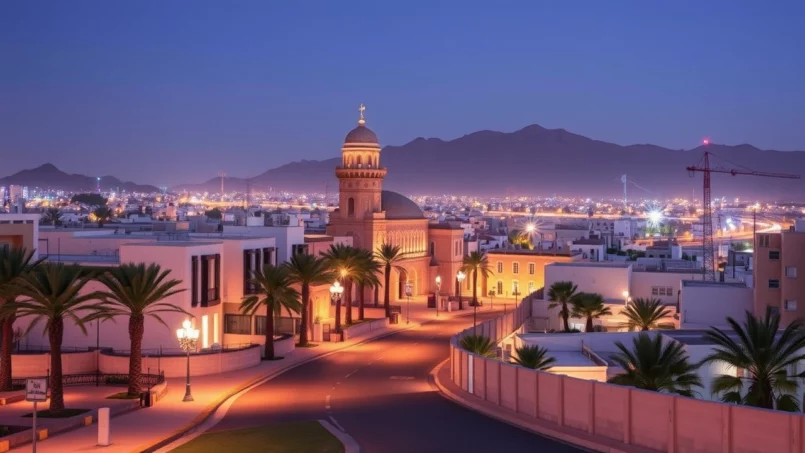
Description of the urban landscape and beach in Muscat
Shatti Al Qurum is also one of the nerve centers of the capital’s cultural and gastronomic life. The Royal Opera House Muscat stands as a symbol of the country’s modernization, surrounded by the Opera Galleria which hosts European-style cafes like Richoux and Fauchon and luxury boutiques. Nearby, high-end international hotels – InterContinental, Grand Hyatt, W Muscat, Crowne Plaza – house restaurants, bars, and private clubs frequented by expatriates.
A comprehensive set of services and businesses available nearby to meet all daily and leisure needs.
Access to supermarkets like Al Fair for your daily groceries.
A gas station with a 24/7 shop for added convenience.
Bookstores for reading and culture enthusiasts.
Sports facilities like Future Gym to stay fit.
Dental clinics, specialized medical clinics, and spas to take care of yourself.
Bowling, and a Montessori nursery for families with young children.
With such a concentration of assets, Shatti Al Qurum ranks among the most expensive sectors in Muscat. For a one-bedroom apartment, rents noted for digital nomads and expatriates hover around 400 to 600 OMR per month, while large seafront villas can be negotiated at much higher levels. The neighborhood is very popular with wealthy expatriates and senior executives whose salary package includes a generous housing budget.
Al Mouj, formerly known as The Wave, is arguably the most emblematic residential project of the new Oman. This vast coastal complex, classified as an Integrated Tourism Complex (ITC), stretches along roughly 6.5 kilometers of coastline, about ten minutes from Muscat International Airport, in the Seeb district. It is a high-end mixed-use development where villas, apartments, luxury hotels, a marina, a golf course, and retail coexist.
For expatriates, Al Mouj combines several decisive advantages. First, it is one of the few areas where foreigners can acquire property with freehold ownership, under the specific ITC regulations. Second, purchasing a property in this type of complex can entitle the owner and certain family members to a residence visa, which strongly reinforces its appeal for investors and those wishing to settle in the medium or long term without depending on an employer.
Some exclusive villas in the neighborhood reach an area of 900 m².
The leisure and lifestyle dimension is omnipresent. The 18-hole golf course designed by Greg Norman attracts local and international clientele. The marina, with over 400 berths, hosts yachts and sailboats, and also serves as a departure point for sea trips. A pedestrian promenade, The Walk, brings together over 80 shops and restaurants – cafes, bakeries, world cuisines – and is a very popular gathering spot on weekends. Several parks, cycling paths, children’s playgrounds, a private beach, hotels like the Kempinski or a St Regis complete the picture. An international school and a nursery make life easier for families.
In terms of population, Al Mouj displays a cosmopolitan identity: sources indicate several thousand residents, from over 80 nationalities. You will find many Europeans (including a French community), North Americans, Gulf expatriates, but proportionally fewer Indian residents than in some other neighborhoods like Muscat Hills.
The minimum entry ticket to acquire real estate in Integrated Tourism Complexes (ITCs) like Al Mouj in Oman.
Market data indicates gross rental yields generally between 5.6% and 8.3% in sought-after areas of Oman, with net yields of around 3 to 5% for apartments after homeowners association fees (typically estimated at 1% of the property value per year). In Al Mouj, a Savills report noted rent increases of 10 to 20% over 18 months, a sign of sustained demand despite already high price levels.
Al Mouj therefore primarily attracts a clientele of highly paid expatriates, business leaders, international investors, and families seeking an extremely secure, structured, and high-end service environment.
Al Khuwair: the lively and strategic crossroads
Al Khuwair occupies a pivotal position in Muscat’s urban fabric. Divided into a northern part, facing the sea, and a more inland southern part, separated by Sultan Qaboos Road, this district combines residential, commercial, and administrative functions. You will find both the ministries area, the embassies area, many office buildings, but also numerous apartments, medium-sized villas, and small shops.
For expatriates, especially singles or young couples, Al Khuwair has several advantages. First, a very central location: it’s easy to reach Qurum, Madinat Al Sultan Qaboos, Shatti Al Qurum, or even Bousher. Second, a housing offer more accessible than in ultra-chic neighborhoods, with a range from studios to villas, often at more reasonable rents.
Rents for a one-bedroom apartment generally range between 180 and 300 OMR per month. For purchase, the price per square meter is around 50 to 70 OMR, making it an interesting sector for a first residential or rental investment. The neighborhood is home to a significant expatriate population from diverse backgrounds, often mixed with many Omani families.
The Al Khuwair north and south neighborhoods offer great everyday practicality. You will find large hypermarkets (Lulu, Mars, Rawasco), shopping malls (Muscat Grand Mall, Avenue Mall), as well as numerous stores (electronics, home decor, sports) and pharmacies. Private clinics like Badr Al Samaa Polyclinic are present. The area is also rich in restaurants and cafes, especially along the roads parallel to the Sultan Qaboos Highway. Finally, several mid and high-end hotels (Radisson Blu, Park Inn, City Seasons, Ibis, Grand Millennium, Hilton Garden Inn) serve as meeting places for business meals.
Leisure infrastructure includes the Natural History Museum, neighborhood parks, a beach accessible within a few minutes’ drive, and several gyms. The ABA Oman International School is located here, offering an IB curriculum appreciated by expatriate families.
Some drawbacks remain: heavy traffic during peak hours, sometimes chaotic parking, noise pollution near major roads, and, occasionally, uncivil behavior (car stunt driving, noisy gatherings). Cautionary advice for women at night indicates a slightly lower level of urban comfort compared to more genteel neighborhoods like MSQ or Shatti. Nevertheless, overall security remains high on an international scale: Oman consistently ranks among the safest countries in the world, and Muscat is at the top of the list for low-crime cities.
Seeb: the booming outer suburb
Moving away from the historic center towards the northwest, you reach Seeb, a vast coastal wilaya that notably includes the country’s main international airport. Long known mainly for its fishermen’s beaches and more modest neighborhoods, Seeb is now experiencing sustained demographic and real estate growth.
Population figures vary by source, but all converge on one reality: Seeb is one of the most populated areas of the Muscat metropolitan area, with several hundred thousand inhabitants. The density is high and you find a mosaic of nationalities, including many expatriates from India, Pakistan, Bangladesh, or the Philippines.
For many expatriates, especially those with a limited budget or a restricted housing allowance, Seeb represents an interesting alternative. Rents are noticeably lower than in Qurum, MSQ, or Al Mouj. For a one-bedroom apartment, ranges of 120 to 250 OMR per month are frequently cited. Villas, more spacious, also remain much more affordable than in the city center, often with gardens or large terraces.
To measure the price differential between some popular expatriate neighborhoods, a simplified comparative table can be drawn up.
Indicative comparison of 1-bedroom apartment rents
| Neighborhood | Monthly Rent Range (1 bed., OMR) | Typical Neighborhood Profile |
|---|---|---|
| Seeb | 120 – 250 | Outer suburb, family-friendly, affordable |
| Al Khuwair | 180 – 300 | Central, lively, mixed |
| Qurum | 250 – 400 | Central, near beach, well-equipped |
| Shatti Al Qurum | 400 – 600 (and more) | Seafront, very high-end |
| Al Mouj | 400 – 800 (and more) | ITC complex, luxury, waterfront |
These ranges of course vary according to the property’s condition, view, presence of amenities (pool, gym) and payment method (annual, semi-annual, quarterly).
Living in Seeb offers other advantages. Large shopping malls like Muscat City Centre or Markaz Al Bahja are located here, offering a considerable choice of shops, restaurants, and cinemas. The major garden centers of the region are lined up in the area, convenient for those wanting to landscape their villas. White sand beaches, sometimes enhanced by coastal parks, allow you to enjoy the sea without facing the city center crowds.
Major facilities are multiplying. Sultan Qaboos University, the country’s main public institution, is located in the Al Khoudh district of Seeb and drives part of the area’s intellectual and sporting life. New hospitals – including a modern specialized hospital – have strengthened the network of clinics already present.
The price of a liter of gasoline in Seeb, in OMR, one of the cheapest in the world.
The authorities see Seeb as a laboratory for the city of tomorrow. The Sultan Haitham City project, launched on an area of approximately 15 million m², plans to create a new city capable of housing about 100,000 people, structured in pedestrian-friendly neighborhoods, with 39 schools, 11 healthcare facilities, a university, and vast green spaces. The first phases of this project are to be staggered over the coming decade, with an initial horizon around 2030 for the first stage.
In this context, buying land or property in Seeb is seen by some investors as a medium-term bet: current prices remain below those of the center, while infrastructure (roads, schools, services) is expanding.
Al Ghubrah, Bousher, and Al Azaiba: the accessible residential belt
On the central urban strip, three names frequently come up in expatriate discussions: Al Ghubrah, Bousher (Bausher), and Al Azaiba. These neighborhoods, located midway between historic and more recent areas, offer an interesting compromise between financial accessibility, proximity to services, and quality of life.
Al Ghubrah is a good-quality residential neighborhood offering still-reasonable prices. It offers a mix of apartments, villas, and townhouses. The area is well-equipped with Muscat Private Hospital, several shopping centers, restaurants, and cafes. Its proximity to major roads facilitates travel to Qurum, MSQ, and the airport, making it a popular choice for families seeking spacious housing without being on the seafront.
Bousher, further south, has become in recent years a true real estate “hotspot”. New residential projects targeting young households and professionals have multiplied, taking advantage of still-available land and relatively quick access to both the sea and business districts. The offer ranges from small apartments to modern villas, with rents and prices per square meter lower than in iconic neighborhoods but higher than in very peripheral areas.
This neighborhood is characterized by its immediate proximity to the beach and a majority of villas. Rapidly growing and increasingly popular with expatriates, it benefits from the proximity of the American International School of Muscat, an asset for international families. However, access to shops is less convenient without a vehicle, making it less ‘walkable’ than neighborhoods like Qurum or Al Khuwair.
These sectors have rent ranges for one-bedroom apartments generally between 150 and 300 OMR per month, with strong disparities between older buildings without amenities and recent residences with pools and gyms.
Ruwi, Muttrah, and the more popular neighborhoods
Not all expatriates seek the same type of living environment. Some prioritize comfort and premium services; others prefer the authenticity of older neighborhoods, often more affordable but denser, sometimes a bit less well-maintained. In Muscat, Ruwi and Muttrah embody this second option.
Ruwi is the historic business district of the capital, concentrating banks, companies, and the financial market. The rental offer mainly consists of competitively priced apartments, sometimes aging. Ideal for a single expatriate or a childless couple working nearby, one must nonetheless deal with a noisy environment, heavy weekday traffic, and parking difficulties.
Muttrah, further east, is a historic neighborhood backed against the port. Its covered souk, one of the oldest in the region, the seafront (corniche), and the old alleys make it a major tourist destination. Living there means accepting higher density, a bit of crowding, but also benefiting from proximity to old Muscat, its forts, museums, and a very different ambiance from modern gated communities. Some expatriates, particularly those seeking cultural immersion, find it suits them.
In these neighborhoods, rents for a one-bedroom apartment can start around 150 OMR and rarely exceed 300 OMR for standard properties. Rental yields in more traditional central sectors are often quite decent, around 7–8% gross, thanks to relatively contained purchase prices.
Integrated complexes outside Muscat: Muscat Bay, Jebel Sifah, Salalah…
If we broaden the view a bit beyond strictly urban neighborhoods, several seaside developments attract an expatriate clientele willing to move away from the center to enjoy a quasi-hotel-like setting.
Muscat Bay, nestled between sea and cliffs a few kilometers southeast of the capital, is a high-end ITC with contemporary residences, a branded international hotel (Jumeirah), private beaches, and green spaces. The feeling of retreat is very marked: it’s a place conducive to quiet living, more than urban animation. Real estate prices here are aligned with the upper range observed at Al Mouj.
Located about an hour’s drive from Muscat, Jebel Sifah operates as a complete seaside resort with a marina, golf, beaches, and waterfront residences. It attracts a community of expatriates: some own a weekend pied-à-terre there, while others live there full-time, accepting long commutes to the capital if necessary. The possibility of renting units short-term also makes it an interesting investment vehicle.
Further south, in Salalah, projects like Hawana Salalah or Salalah Beach Resort ITC offer apartments and villas with freehold ownership in an environment dominated by sea and nature. The region is particularly attractive during the Khareef monsoon season when temperatures and landscapes change dramatically. However, in terms of daily life, the pace and infrastructure are much more limited than in the capital, which does not suit everyone.
Rent or buy: how expatriates decide
In Oman’s residential market, the majority of expatriates remain tenants. Several reasons explain this choice. First, professional mobility: fixed-term contracts, “Omanisation” policies that can reduce certain opportunities, or simply the desire to test the country before making a long-term commitment encourage caution. Second, the restrictions on property ownership outside ITC zones, which limit purchase options for foreigners.
Lease contracts typically last from 1 to 3 years, with a security deposit of one or two months’ rent. A local particularity: landlords often require quarterly, semi-annual, or annual payments by post-dated cheques, rather than monthly. Properties are almost always rented unfurnished; furnished options, rarer, cost 20 to 30% more.
Operating costs add up: electricity, water, air conditioning (which can represent a significant portion of the bill in summer), internet (around 25 to 35 OMR per month for speeds above 60 Mbps), mobile phone (8 to 27 OMR for data plans). For an apartment of about 85 m², energy and water charges are often between 41 and 46 OMR monthly.
For expatriates considering a long-term stay, real estate purchase in ITCs offers advantages. It secures a residence visa and benefits from a favorable tax environment: no income tax, property tax, or capital gains tax for individuals. A 3% transfer fee applies upon registration. In high-end residences, expect homeowners association fees (management, security, maintenance) of about 1% of the property value per year.
Investors also look at rental yield. In highly sought-after neighborhoods like Al Mouj, Qurum, or certain parts of MSQ and Al Khuwair, gross yields generally fluctuate between 5% and 8%. Part of this profitability can be eroded by management fees, vacancy periods, and maintenance, but the risk profile is still considered reasonable in a country ranked among the safest in the world, even if market liquidity is lower than in neighboring hubs like Dubai.
Choosing your neighborhood: a lifestyle issue as much as a budget one
In the end, the question of “the most popular neighborhoods for expatriates in Oman” cannot be reduced to a simple ranking. Behind the names Madinat Al Sultan Qaboos, Qurum, Shatti Al Qurum, Al Mouj, Al Khuwair, Seeb, Al Ghubrah, or Bousher, different ways of experiencing Oman are sketched out.
The choice of neighborhood in Muscat for expatriates varies according to profiles and priorities. Families, seeking proximity to international schools, green spaces, and a community life, often concentrate on MSQ, Qurum, or Al Mouj. Young professionals, drawn to an urban environment and more affordable rents, favor Al Khuwair, Al Ghubrah, or certain sectors of Ruwi. Those who prioritize calm, spacious properties, and a controlled budget turn to more distant areas like Seeb or Al Hail. Finally, luxury and seafront residence enthusiasts opt for Shatti Al Qurum, Al Mouj, or integrated complexes like Muscat Bay.
In a country where the car remains essential, where the heat imposes a life very oriented towards air-conditioned interiors and shopping malls, and where the cohabitation of tradition and modernity is constant, the choice of neighborhood plays a key role in one’s experience of Oman. Expatriates preparing their move are well advised to spend time on site, to visit by day and night, to exchange with residents through support groups or specialized agencies, in order to find that mix of safety, comfort, budget, and “feeling” that will make the difference.
Because while Oman attracts with its statistics – safety, favorable taxation, political stability, real estate market growth – it especially retains those who have managed to find, in one or another of these neighborhoods, a true sense of home.
Disclaimer: The information provided on this website is for informational purposes only and does not constitute financial, legal, or professional advice. We encourage you to consult qualified experts before making any investment, real estate, or expatriation decisions. Although we strive to maintain up-to-date and accurate information, we do not guarantee the completeness, accuracy, or timeliness of the proposed content. As investment and expatriation involve risks, we disclaim any liability for potential losses or damages arising from the use of this site. Your use of this site confirms your acceptance of these terms and your understanding of the associated risks.

Cyril Jarnias is an independent expert in international wealth management with over 20 years of experience. As an expatriate himself, he is dedicated to helping individuals and business leaders build, protect, and pass on their wealth with complete peace of mind.
On his website, cyriljarnias.com, he shares his expertise on international real estate, offshore company formation, and expatriation.
Thanks to his expertise, he offers sound advice to optimize his clients' wealth management. Cyril Jarnias is also recognized for his appearances in many prestigious media outlets such as BFM Business, les Français de l’étranger, Le Figaro, Les Echos, and Mieux vivre votre argent, where he shares his knowledge and know-how in wealth management.





