
 Published on and written by Cyril Jarnias
Traveling in Guinea-Bissau means accepting a certain degree of improvisation. The country has neither a railway network nor a formal urban bus system with posted schedules and route maps. However, with a little know-how, toca-tocas, candongas, taxis, motorcycle taxis, and ferries form a patchwork that allows you, one way or another, to reach almost all regions of the country and the Bijagós islands.
This guide details the actual operation, limitations, and costs of public transportation in Guinea-Bissau. It provides practical advice for travelers, including those with reduced mobility, on how to use it safely and effectively.
Understanding the Transportation Landscape in Guinea-Bissau
The Guinean transport system relies almost exclusively on roads and, in coastal areas, on rivers and the sea. More than 60% of the population lives in rural areas; therefore, access to transportation directly determines access to markets, healthcare, and education.
Only 450 km out of the 4,400 km road network are paved, the rest consisting of laterite tracks that are often impassable.
In this context, public transportation is divided into major categories: urban and interurban minibuses (toca-tocas and candongas), taxis and motorcycle taxis, and, for the coastline and islands, ferries and pirogues.
Toca-tocas and Candongas: The Backbone of Mobility
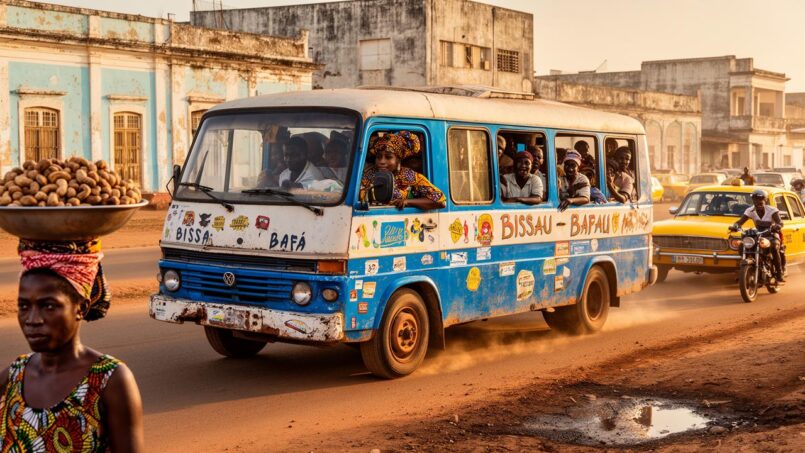
Minibuses are by far the most widely used collective transport system in cities and between the country’s main towns.
How Toca-tocas Work in the City
In urban areas, particularly in Bissau, these minibuses are known as toca-tocas. They are small vans, often old, frequently decorated with bright colors. Their operation is based on a few key principles:
– They run on semi-fixed routes connecting neighborhoods, markets, and main arteries;
– Stops are informal: you can get on and off almost anywhere along the route by signaling the driver;
– They only leave their starting point when full;
– They typically operate from 6 a.m. to 9–10 p.m., with increased frequency during rush hour.
Large markets, such as the Bandim market in Bissau, as well as roundabouts and central squares, serve as de facto informal stations where toca-tocas fill up. There is no official route map: information is obtained by asking the hawkers who shout out destinations or directly from the drivers.
The usual cost of a toca-toca ride, in CFA francs, for an intra-urban trip.
Candongas, Seven-Seaters, and Interurban Connections
As soon as you leave the main urban areas, you enter the world of candongas and seven-seaters. Candongas are larger vehicles, capable of carrying around ten to twenty passengers; seven-seaters are often old converted Peugeot Breaks for seven people, used as shared taxis for longer journeys.
From Bissau, several bus stations structure this informal network:
| Station / Boarding Point | Location | Main Destinations |
|---|---|---|
| Main Bus Station of Bissau | Behind the BCEAO, airport road | Bafatá, Gabú, Cacheu, Buba, Bolama (via transfer) |
| Second Station (Prabis/Biombo) | Estrada de Bor | Prabis, Biombo and surroundings |
| “Bambu” Hub (long-distance minivans) | Varies by period | Connections to the interior of the country |
| Station towards The Gambia | On the main road between Bissau and the airport | Trips to São Domingos, Gambian border |
As in the city, these vehicles have no published schedules. They leave once full, meaning a traveler wishing to leave early should aim to be at the station around 6–7 a.m.. In the early morning (7–9 a.m.) and late afternoon (5–7 p.m.), demand is very high, vehicles fill up quickly but onboard crowding is at its peak.
For longer connections, prices remain moderate by regional standards. For example:
| Route (indicative) | Vehicle Type | Approximate Fare (off-season) |
|---|---|---|
| Bissau → nearby town (approx. 1 hr, 40 km) | Local minibus | A few hundred CFA |
| Bissau → Senegal border (via São Domingos) | Minivan / candonga | 4 to 5 hours, variable fare, often around 2,500–3,000 CFA from Ziguinchor for the Senegal → border leg |
| Ziguinchor (Senegal) → Bissau (entire journey, via border posts) | Shared van / seven-seater | Several thousand CFA + luggage surcharge (approx. 1,000 CFA for a normal bag) |
A particularity of these services is the possibility, for an extra fee, to pay for several seats to gain comfort AND leave faster. Some travelers report, for example, buying four seats in a row for about 10,000 CFA to avoid being cramped and to trigger the departure without waiting for other passengers.
Advantages and Limitations: What to Know Before Getting On
Toca-tocas and candongas form the backbone of popular mobility, but they come with their share of constraints.
On the positive side, they are means of transport.
– affordable for the vast majority of the population;
– widely available on main routes;
– flexible for pick-ups and drop-offs;
– job creators for drivers, conductors, and mechanics.
But the list of limitations is long: old and sometimes poorly maintained vehicles, complete lack of accessibility for people with disabilities, frequent overcrowding, significant wait times before departure, poor road conditions lengthening journeys, and a completely informal operation that complicates any recourse in case of problems.
For travelers, you must accept basic comfort, bring water, something to protect from dust or rain, and avoid traveling at night if possible, especially off main roads, due to risks of accidents, banditry, and poor road lighting.
Taxis and Motorcycle Taxis: Urban Complement and Backup Solution
Alongside the minibus network, taxis and motorcycle taxis handle a large portion of urban travel, particularly in the capital.
Bissau Taxis: Operation, Colors, and Prices
In Bissau, taxis are ubiquitous around hotels, major intersections, and the airport. The vehicles are often Mercedes painted blue and white, and operate in several ways: as a classic individual ride for one customer, or collectively by picking up different passengers successively on the same route.
Negotiation is the rule. Most taxis have meters but they are rarely used. The price therefore depends on the distance, number of people, time of day (night rates are higher), and the customer’s ability (or not) to bargain like a local.
However, some orders of magnitude help to get your bearings. For example, to understand the scale of a distance, quantity, or phenomenon, you can compare it to common references. This helps visualize and grasp otherwise abstract concepts.
| Intra-Urban Trip (examples) | Estimated Duration | Indicative Fare |
|---|---|---|
| Bissau Center → Fort São José da Amura | ~4 minutes | ≈ €0.50 |
| Bissau Center → Alto Bandim Roundabout | ~11 minutes | ≈ €2 |
| Bissau Center → Ajuda Neighborhood | ~11 minutes | ≈ €2 |
| Urban ride (≤ 10 km, up to 4 passengers) | Variable | ≈ €5 (3,280 CFA) |
| Night taxi, short distance | — | often 400–1,500 CFA |
Outside the capital, especially in cities like Bafatá, Gabú, Cacheu, or Buba, fares vary based on vehicle scarcity and road conditions. In any case, it is highly recommended to agree on the price before getting in.
Bissau Airport: How to Get to the Center
At Osvaldo Vieira Airport, taxis usually wait outside. Again, there is no single official fare, but there is an indicative range: a trip from the airport to the city center is around 3,900 CFA (approximately €6) for a standard taxi.
Some pre-booked transfer services apply slightly higher fixed rates (e.g., €10 daytime, €12 night). To avoid bad surprises, scams, or insistent touts at the airport exit, it is recommended to ask your hotel to arrange the taxi or recommend a trusted driver.
Motorcycle Taxis: Fast, Cheap… and Risky
Motorcycle taxis, sometimes called taxi-moto or candongueiros, complete this picture. They are particularly common in rural areas and outlying neighborhoods, where car traffic density is lower. Their great strength: weaving through narrow or broken tracks and going where minibuses sometimes refuse to venture.
Fares are attractive for short trips, often lower than those of regular taxis. In return, safety is a major concern: rare helmet use, poor road conditions, sometimes risky driving, nighttime travel very dangerous. Authorities and several embassies formally advise tourists against this mode of transport.
Ferries, Pirogues, and Boats: Reaching the Bijagós Islands
The coastline and multitude of islands and islets make boat connections an essential component of transport in Guinea-Bissau, especially for accessing the Bijagós archipelago, a flagship region for nature tourism.
The Formal Offer: Consulmar Ferries
To secure crossings to the islands, a private company, Consulmar Bissau, a subsidiary of a Spanish shipowner, has operated ferries and fast boats connecting Bissau to several key points in the archipelago since 2017. The goal is to offer a safer alternative to traditional pirogues, responsible every year for shipwrecks and disappearances.
The main routes provided (with variations depending on seasons and demand) are:
| Consulmar Line | Average Travel Time | Frequency / Notes |
|---|---|---|
| Bissau → Enxudé (then access to Bolama / Buba, etc.) | ~45 minutes per segment | Service announced Monday to Saturday, round-trip within the day, subject to tides |
| Bissau → Bubaque (gateway to the Bijagós) | 3 to 4 hours depending on the tide | Regular service, sometimes suspended; contradictory information exists on the operator depending on the period |
The ships have several classes (first, second, third). For non-resident foreign travelers, a fixed fare in first class is usually applied, around 16,500 CFA per trip, or about €25. A one-way ticket to Bubaque is often advertised around 15,000 CFA, while local fast pirogues charge around 4,000 CFA for the same trip, at the cost of less comfort and safety.
This section provides some benchmarks and key information regarding costs, to help you better understand and evaluate associated expenses.
| Transport Mode to Bubaque | Indicative Price (one way) | Comment |
|---|---|---|
| Weekly ferry (standard class) | ≈ €25 / 16,500 CFA | Safer, more comfortable, more stable schedules |
| Consulmar fast boat (dry season, if demand) | ≈ 30,000 CFA | Faster, more expensive |
| Local fast pirogue | ≈ 4,000 CFA | Fast but spartan, variable safety |
| Private water taxi | 60,000 to 100,000 CFA | Maximum flexibility, high cost |
| Flight Bissau → Bubaque (Air Bijagos) | ≈ 90,000 CFA | More expensive, dirt runway, limited service |
Tickets for ferries cannot be reserved online. They must be purchased:
– at the main Consulmar office, Avenida 3 de Agosto n° 40 in Bissau;
– or at the ticket offices at the ports of Bissau, Enxudé, and Bubaque, opening in principle two hours before departure.
Payment is made exclusively in cash (CFA franc), credit cards are not accepted. In high season, it is advisable to buy your ticket several days in advance, especially for second or third class, as seats sell out quickly. For first class, availability is generally better, but planning ahead is still preferable.
Traditional Boats and Private Services
Apart from the “formal” offer from Consulmar, the islands are also served by a mosaic of more or less official vessels:
– motorized or wooden pirogues departing from the Bandim port or Porto Pidjiguiti in Bissau;
– boats operated by hotels (Kasa Afrikana, Bubaque Island Hotel, etc.) to transport their clients;
– services like Africa Princess, a catamaran offering cruises in the national parks, including transport.
These options allow you to reach islands like Rubane (about 3 hours by boat from Bissau) or to visit several islets through “island-hopping”. The downside: erratic schedules, dependence on tides and weather, very heterogeneous safety standards. For a well-organized stay, it is therefore wise to go through an agency or accommodation that handles local logistics.
Fares, Payment, and Financial Tips
One of the advantages of the Guinean transport system, despite its improvisation, remains its relatively low cost for both traveler budgets and residents.
Overall:
– a trip on a toca-toca within Bissau costs a few hundred CFA francs;
– an intra-urban taxi varies between the equivalent of €0.50 and €5 depending on distance and negotiation;
– a long interurban trip by minibus remains well below Western standards;
– ferries to the Bijagós represent the most significant expense but remain competitive compared to air travel.
However, two major constraints stand out:
All transactions are made in cash, primarily in CFA francs, as credit cards are not accepted. Furthermore, prices are generally not posted and are negotiated as per custom, and can vary if you are a local customer or a foreign visitor.
To limit bad surprises, a few reflexes are essential:
– always have small change (difficult to get change for large bills in buses and taxis);
– ask locals (hotel, restaurant staff, shopkeepers) the usual price for a trip before negotiating with a driver;
– remain polite but firm in price discussions;
– clarify immediately whether the price includes luggage or not.
On international road connections (e.g., Senegal – Guinea-Bissau – The Gambia), surcharges of around 1,000 CFA are frequently requested for a standard-sized bag.
Accessibility and People with Reduced Mobility: A Difficult Reality
For travelers with disabilities or people with reduced mobility, Guinea-Bissau today represents a particularly demanding destination logistically.
The vast majority of collective vehicles (minibuses, candongas, regular taxis):
– have no ramps or low floors;
– have no designated reserved seats;
– require getting on and off via high steps, sometimes slippery or damaged.
The boats providing connections to the islands are not, for the most part, equipped to accommodate wheelchairs. Boarding is often via rudimentary docks, or even directly from the beach or a concrete ramp with a steep slope.
Although national laws prohibit discrimination, their enforcement is very limited. Accessibility relies less on technical solutions, often absent due to lack of infrastructure, and more on the solidarity of passengers and staff.
For a traveler with a disability, preparation is therefore crucial:
– contact accommodations in advance to check accessibility (stairs, ramps, door width, bathroom);
– clarify with ferry companies and local agencies how boarding actually takes place;
– plan for possible assistants or companions;
– carry spare parts for wheelchairs or technical aids, which are difficult, if not impossible, to find on site (tires, inner tubes, batteries, small tools).
Even though Guinea-Bissau does not have the same levels of accessibility</strong as London, Barcelona, or Singapore, the principles promoted by the World Tourism Organization for “accessible tourism” remain relevant to apply: plan ahead, seek reliable information, avoid itineraries with multiple transfers, and prioritize door-to-door service as much as possible.
Safety, Health, and Context: Traveling with a Clear Head
The safety dimension cannot be ignored when talking about transport in Guinea-Bissau. The country experiences high crime and fragile political stability. Several embassies recommend increased vigilance, particularly:
– in crowds (markets, bus stations, airport surroundings) where pickpockets, scams, and bag thefts are frequent;
– in certain neighborhoods of Bissau designated as sensitive by authorities;
– on isolated roads, especially at night, where cases of banditry and car-jacking have been reported.
Roads are often poorly maintained and poorly lit outside cities. Traffic is disorganized, mixing vehicles, pedestrians, two-wheelers, and animals. From June to October (rainy season), many tracks become muddy and can be impassable.
To minimize risks while traveling:
To travel safely, it is recommended to avoid nighttime road trips, especially between towns. Opt for reputable companies and vehicles, based on recommendations from locals or accommodations. Do not hesitate to express your discomfort with obviously dangerous driving, even if it means asking to get off. Always keep your papers and valuables secure and on you, especially in crowded transport. Finally, limit outward signs of wealth (phones, jewelry, large visible wads of cash) in buses and markets.
Health-wise, the weakness of medical infrastructure also requires caution and preparation. Outside Bissau, health services and pharmacies are limited; medical evacuations abroad sometimes remain the only option in case of serious problems. Travelers are strongly encouraged to:
– take out insurance covering medical repatriation and hospitalization;
– consult a doctor several weeks before departure for recommended vaccinations and preventive treatment against malaria;
– carry a basic medical kit and oral rehydration solutions, useful in case of food-related digestive issues.
Practical Tips for Using Public Transportation
Beyond technical and safety aspects, traveling effectively in Guinea-Bissau requires a certain behavioral adaptation, particularly in crowded vehicles and multicultural contexts.
A few simple principles greatly facilitate travel:
For a pleasant and respectful trip on public transport, adopt these good practices: greet the driver and passengers when boarding (a hello in Portuguese or Creole is appreciated), keep your luggage on your lap or at your feet so as not to block the aisle, do not occupy several seats if the vehicle is full, and give priority to the elderly, pregnant women, and parents with young children. Speak in a moderate voice, use headphones for your media, have your change ready in advance to pay quickly, and always let passengers get off before boarding to avoid crowding at the doors.
Observing what locals do remains the best compass. In some countries, real education campaigns have been conducted to promote this type of “good conduct” in transport: in Guinea-Bissau, these rules exist mainly as custom. The foreigner who makes the effort to respect them integrates more easily and limits friction.
Between Improvement Projects and On-the-Ground Reality
Several project documents indicate ongoing efforts to improve transportation: rehabilitation of rural roads (especially in the Cacheu and Oio regions), construction of river ramps to facilitate intermodality between road and river, gradual modernization of the collective vehicle fleet, and consideration of a national transport plan.
These initiatives are part of a broader movement observed in other countries: Berlin, Stockholm, Barcelona, Sydney, and even London have shown that sustainable investment in low-floor buses, sidewalks with ramps, and clear information for users improves both the quality of life for residents and tourism attractiveness.
The transportation network in Guinea-Bissau is currently fragmented, informal, and lacks homogeneous standards. Its development is slowed by a lack of resources and political instability. However, an awareness is emerging of its crucial role: facilitating rural populations’ access to markets, opening up villages, and improving safety of access to the islands are seen as essential levers for the country’s economic and social development.
For foreign travelers, this means that you must view Guinean transport not as a perfectly oiled system, but as a mosaic of functional solutions, sometimes improvised, that must be combined with patience and flexibility.
In Summary: Getting Around Smartly in Guinea-Bissau
Using public transportation in Guinea-Bissau requires a bit more preparation than elsewhere, but is entirely possible, even on a limited budget.
Toca-tocas and candongas allow you to explore cities and reach major towns at a low cost, at the price of rustic comfort and flexible schedules. Taxis offer more speed and discretion, provided you negotiate prices and opt for recommended drivers. Ferries and boats, finally, provide access to the Bijagós archipelago, the country’s natural jewel, where planning (advance booking, schedule verification, weather) is essential.
In a context of degraded roads, limited nighttime visibility, and sometimes uncertain safety, it is essential to avoid nighttime travel, ask locals for advice, follow local news, and keep your papers and money secure.
Traveling in Guinea-Bissau by public transportation also means accepting a share of the unexpected and slowness. In return, those who engage with it discover the daily life of Bissau-Guineans, share their colorful minibuses, encounter the animated discussions at bus stations and the chaotic boarding at river ports. With information, caution, and a good dose of patience, this modest but vibrant network becomes a fantastic observatory of the country.
Disclaimer: The information provided on this website is for informational purposes only and does not constitute financial, legal, or professional advice. We encourage you to consult qualified experts before making any investment, real estate, or expatriation decisions. Although we strive to maintain up-to-date and accurate information, we do not guarantee the completeness, accuracy, or timeliness of the proposed content. As investment and expatriation involve risks, we disclaim any liability for potential losses or damages arising from the use of this site. Your use of this site confirms your acceptance of these terms and your understanding of the associated risks.

Cyril Jarnias is an independent expert in international wealth management with over 20 years of experience. As an expatriate himself, he is dedicated to helping individuals and business leaders build, protect, and pass on their wealth with complete peace of mind.
On his website, cyriljarnias.com, he shares his expertise on international real estate, offshore company formation, and expatriation.
Thanks to his expertise, he offers sound advice to optimize his clients' wealth management. Cyril Jarnias is also recognized for his appearances in many prestigious media outlets such as BFM Business, les Français de l’étranger, Le Figaro, Les Echos, and Mieux vivre votre argent, where he shares his knowledge and know-how in wealth management.





