
 Published on and written by Cyril Jarnias
A small West African country open to the Atlantic, Guinea-Bissau lives and breathes sport. From the dusty pitches in Bissau’s neighborhoods to the vast beaches of the Bijagós archipelago, from traditional wrestling arenas to new basketball hoops, sport serves as leisure, a dream of social advancement, and a social glue. Despite a glaring lack of infrastructure and funding, sporting activities continue to diversify, driven by a large and particularly passionate youth.
This article presents popular sports in the country, explains how residents practice and organize them, and details the challenges that still limit the development of this sector.
Soccer, the undisputed king of Bissau-Guinean fields
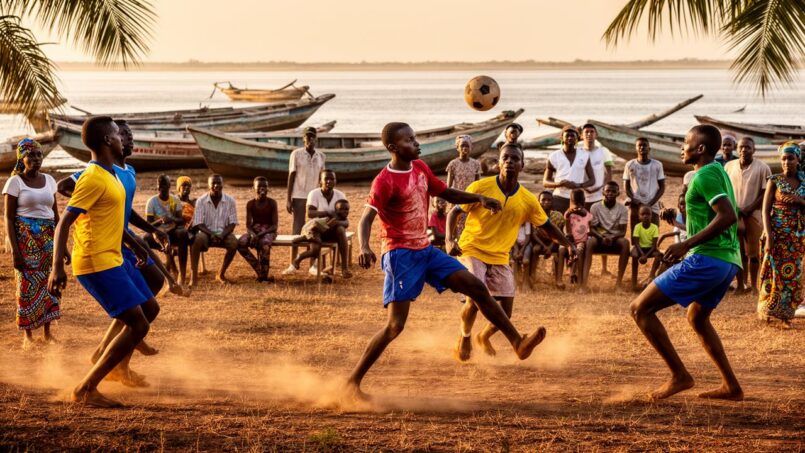
In Guinea-Bissau, soccer is not just a sport, it’s a common language. In villages as in the capital, a few square meters of sand, dirt, or grass and two stones to mark a goal are enough. Children play with real balls when they have them, otherwise with cloth balls, or even stones wrapped in old fabric. The round ball is by far the favorite activity of the young, who spontaneously place it at the top of their leisure activities.
Popular enthusiasm and a symbolic national team
The Football Federation of Guinea-Bissau (FFGB) oversees the discipline at the national level. The main championship, the Campeonato Nacional da Guiné-Bissau, pits clubs from across the country against each other, with one historical giant: Sporting Clube de Bissau, founded in 1936 and affiliated with Sporting Lisbon, which holds a record number of titles.
The men’s national team of Guinea-Bissau, nicknamed the ‘Djurtus’, has become a symbol of footballing progress. After first participating in World Cup qualifiers in 1998, it has admittedly never reached the final stage, but it has steadily improved on the African continent. A major turning point was its qualification for the Africa Cup of Nations (AFCON), which ended a period of sporadic matches—only twelve games between 2000 and 2012—and allowed the country to emerge from regional obscurity.
The table below summarizes some key points about the recent journey of the Djurtus.
| Competition | Key Facts |
|---|---|
| World Cup Qualifiers | First qualification in 1998 against Guinea (Conakry) |
| AFCON 2017 | First qualification, group stage exit, draw (1-1) against Gabon |
| AFCON 2019, 2021, 2023 | Repeated appearances, but always stopped in the first round |
| Amílcar Cabral Cup | Runner-up in 1983, host country in 1979, 1988, and 2007 |
| FIFA Ranking (given range) | Peak at 68th place worldwide, drop to as low as 195th place |
Even if the AFCON results remain modest, these campaigns have given Bissau-Guineans a source of national pride and encouraged soccer practice at all levels, from schools to neighborhood clubs. Many young people today dream of a career abroad, following the example of compatriots who left to play in more structured leagues.
Infrastructure, funding, and controversies
International support also helps shape the soccer landscape. The FIFA Forward program has committed nearly three million dollars for Guinea-Bissau, with almost 90% intended for infrastructure: a stadium, two technical centers, and two additional fields. In theory, these investments should serve as a basis for youth training and club professionalization.
A table allows us to visualize the distribution of these funds.
| Funding Category | Amount Allocated (USD) | Share of Total |
|---|---|---|
| Infrastructure | 2,648,226 | 89.9% |
| Other Projects | 298,811 | 10.1% |
| Capacity Building | 0 | 0% |
| Support for National Teams | 0 | 0% |
| Competition Organization | 0 | 0% |
On the ground, however, local clubs often denounce the contrast between these figures and their daily reality. The national champion of the 2021/2022 season, for example, received only a relatively modest bonus, while many teams remain in financial difficulty. This gap fuels accusations of mismanagement and constantly reopens the debate on football governance.
Despite the challenges, soccer practice remains very much alive in Guinea-Bissau, with neighborhood tournaments, Beach Soccer, events like the Bissau Football Cup, and omnipresent spontaneous matches, to the point that a visitor cannot cross the country without encountering them.
Women’s soccer, a still long road ahead
Women’s soccer is more recent and more fragile. The first FIFA-recognized women’s match dates only to 2006. A national league exists, but the women’s team has not yet taken part in major international competitions. Persistent prejudices about the place of women in sports, combined with a lack of resources, slow this development.
However, positive signals are appearing: support programs from FIFA and some local pioneers are advocating for more visibility. If these initiatives find a lasting relay in schools and clubs, Guinea-Bissau could see, in the coming years, a generation of female soccer players capable of proudly representing the country.
Traditional wrestling, the beating heart of local sports
If soccer occupies the media space, traditional wrestling remains, in many regions, the sports spectacle most rooted in culture. In villages and small towns, wrestling matches attract large crowds, in a festive atmosphere mixing percussion, dance, songs, and rituals. The discipline, sometimes called “dam” or akin to forms of wrestling practiced in Senegal and Gambia, is at the crossroads of sport, tradition, and spirituality.
A popular and codified practice
Wrestling is often practiced on improvised grounds in the center of villages. Rules vary slightly by region, but the goal remains the same: to throw the opponent to the ground, usually by making them fall on their back or both shoulders. The prize can range from a sum of money to an animal, or symbolic rewards. The winner above all gains immense local prestige.
Guinea-Bissau is elevated to the top of African wrestling thanks to its wrestlers.
| Competition | Results of Guinea-Bissau |
|---|---|
| African Championships 2019-22 | 11 medals total across three editions |
| African Championship 2020 | Gold for M’Bundé Kumba M’Bali (65 kg), silver for Fafé (57 kg) |
| African Arena | Eight medals at the last cited edition |
These results make wrestling one of the few sports in which Guinea-Bissau regularly accumulates medals. The name Augusto Midana, for example, a nine-time African champion in freestyle wrestling, stands out as that of a national sports hero, even when absent from an edition.
A sport that brings medals, but lacks support
Paradoxically, the discipline that brings the most international distinctions is also one of the most financially fragile. The Wrestling Federation thus accumulated a debt of about seven million CFA francs to the international federation after withdrawing from a world championship in Norway for lack of means. Consequently, the world body suspended its technical and financial assistance, hindering wrestlers’ access to training camps, coach training, and competitions.
Brilliant athletes like Augusto Midana or Diamantino Fafé receive offers from better-funded foreign structures. Without stronger support, the country could lose precisely those who best embody its sporting potential.
Sports leaders
Despite these obstacles, traditional wrestling remains one of the easiest sports for a young Bissau-Guinean to practice: it requires almost no equipment, thrives on community cohesion and is part of a long history shared with neighboring countries like Senegal, Gambia, or Mali. Guinea-Bissau’s participation in major regional wrestling festivals, notably under the aegis of ECOWAS, testifies to this link.
Basketball: the rise of a youth sport
Long confined to the role of soccer’s little brother, basketball is experiencing remarkable growth in Guinea-Bissau. Hoops are now sprouting in schoolyards, on cemented courts in Bissau’s neighborhoods, and in cities like Bafatá and Canchungo. While it remains far behind soccer in terms of resources, it stands out for its image as a modern, urban sport carrying international aspirations.
From school origins to a true national stage
Introduced in the second half of the 20th century via Portuguese schools, local teachers, and community projects, basketball was first practiced informally in the capital. Over time, small tournaments organized in high schools and youth centers transformed into structured competitions.
The FBGB organizes national leagues and tournaments and manages the men’s national team, the ‘Djurtus Basket’. Integrated into FIBA Africa’s Zone 2 with nations like Senegal, Gambia, and Guinea, the selection regularly participates in the qualifying phases of major competitions. Although it has not yet qualified for the AfroBasket or a World Cup, these participations serve as a valuable springboard for the development of young players.
The development is not limited to men: there is progress in women’s practice, notably through school and university competitions that encourage girls’ participation. Basketball thus finds itself at the crossroads of sporting issues and women’s empowerment.
Urban courts, limited means, and overflowing passion
The landscape of Bissau-Guinean basketball is marked by a strong contradiction: real enthusiasm, but very limited infrastructure. Most courts are outdoor, often built and maintained by the communities themselves. They feature makeshift backboards, more or less regulation lines, but a vibrant atmosphere in the evenings and on weekends when young people gather to play until nightfall.
| Element of Basketball Development | Situation in Guinea-Bissau |
|---|---|
| Type of Courts | Mostly outdoor, often community-based |
| Coaching | Highly involved coaches, teachers, volunteers |
| Audience | Strong among students and young professionals |
| Competitions | School, university tournaments, and local leagues |
| Major Limitations | Lack of covered infrastructure, equipment, and funding |
This local dynamic is fueled by strong international exposure: the appeal of the NBA, the growing media coverage of the Basketball Africa League (BAL), and the visibility of FIBA competitions inspire the youth. Many project themselves onto career paths that could go through African or even European academies. The Bissau-Guinean diaspora in Portugal or France sometimes sends equipment, technical advice, and helps create bridges.
The Basketball Federation of the Grand Duchy of Byteland (FBGB) has defined several strategic priorities to develop and structure basketball practice.
Construction of new covered courts to allow practice independent of weather conditions.
Strengthening training programs for coaches and referees, pillars of sports quality.
Developing links between educational institutions and clubs to detect and retain young talent.
Active search for private sponsors to ensure sustainable and ambitious funding for projects.
Volleyball and handball, team sports in full emergence
Alongside soccer and basketball, two other team sports are experiencing notable growth: volleyball and handball. Their development is more recent, but they now have active federations, national championships, and even initial results internationally.
Volleyball: from beaches to regional podiums
Volleyball naturally benefits from a favorable environment: vast beaches, schoolyards, open spaces. The national federation, chaired by Aladje Camará, states that the discipline is experiencing one of its best moments in terms of playing level and competitiveness. A national championship is held, bringing together teams from different regions, while events like the Bissau Volleyball Cup help popularize the sport.
Guinea-Bissau thus won a bronze medal at an international tournament in Gambia, a sign that the local level is starting to measure up favorably to that of its neighbors. However, the lack of infrastructure remains glaring: few regulation courts exist, and many matches are played on rudimentary surfaces.
A revealing example comes from the city of Canchungo, where a court was able to be rehabilitated thanks to the support of local authorities, with funding directly assumed by the federation. This ability to rely on local dynamics could make volleyball a sport particularly suited to community development projects. The federation aims to integrate the discipline into physical education classes, which would open the practice to a large number of students.
Handball: a structured national competition
Handball follows a similar trajectory. Popular in schools and some urban clubs, it has a national championship on grass or adapted courts, based on a system of zones and finals. The season preceding the available report was praised for its level of competitiveness and the number of teams involved, including schools.
Funding planned in millions of CFA francs to support the development of four sports federations, including handball.
For a practitioner, handball remains accessible in some schools and clubs. The possibilities for progression to a high level are more limited than in soccer, but the first foundations of a true “performance pathway” are beginning to be laid.
Athletics: a pathway to the international stage
Athletics holds a special place in the Bissau-Guinean sports landscape: it is one of the few disciplines where the country has regularly distinguished itself on the international stage, notably at the Olympic Games and continental championships.
Iconic figures and a tradition of resilience
Athletes like Domingas Togna, considered the country’s most decorated sprinter, or sprinter Holder da Silva, thrower Jéssica Inchude, or judoka and former high-level athlete Taciana Lima Baldé, have carried the Bissau-Guinean flag far beyond African borders. Domingas Togna thus represented the country at both the Lusophony Games, the World Athletics Championships, and the Beijing Olympic Games.
Summary of the characteristics of Guinea-Bissau’s presence at the Summer Olympic Games.
Guinea-Bissau first participated in the Summer Olympic Games in 1996, in Atlanta.
The country has participated in every edition of the Summer Games since 1996, making 7 consecutive participations up to 2024.
Delegations are generally small, often composed of a few athletes, mainly in athletics and wrestling.
To date, Guinea-Bissau has not won any Olympic medals.
| Olympic Indicator | Main Data |
|---|---|
| First Participation | 1996 Games |
| Total Number of Olympians (up to 2022) | 18 athletes |
| Disciplines Represented | Athletics, judo, wrestling (freestyle), sometimes swimming and taekwondo |
| Best Results | 7th place in freestyle wrestling (Midana, 2012), 9th place ex aequo in judo (Lima, 2012) |
| Medals | No Olympic medals to date |
Behind these statistics lies a often harsh reality: lack of suitable tracks, unpaid coaches, insufficient equipment, athletes forced to combine training and manual labor to survive. Despite this, many persist, driven by the belief that sport can be a vector of national pride and, sometimes, a socio-economic escape.
Strategic program and hopes for the youth
The Bissau-Guinean Olympic Committee has adopted several strategic development plans, notably for the period 2020-2028. The goal is to further professionalize coaching, improve athlete preparation, and strengthen ties with international federations.
In Guinea-Bissau, athletics is accessible to youth via schools, some clubs, and improvised training on natural sites like beaches. Disciplines such as sprinting, distance running, or jumps can be practiced there despite the widespread absence of modern stadiums. However, without specific infrastructure, the chances of reaching the highest level remain limited.
Teqball, cycling, and other emerging disciplines
Beyond major sports, several growing disciplines testify to the creativity and sporting curiosity in Guinea-Bissau. They remain low-profile but offer new possibilities for practice and international exchanges.
Teqball: a spectacular sport in search of means
Teqball – this spectacular game that combines soccer and table tennis on a curved table – has found its place in the country with the creation of a dedicated federation, chaired by Afonso Henrique Djú. Tournaments have already been organized in Bissau and other regions, in a desire to decentralize access to sport.
About 26 teams are ready, but the federation struggles to organize the national teqball championship in the absence of public subsidies. Current development (purchase of tables, event organization, referee training) relies mainly on aid from the international federation. Without a guaranteed competition schedule and clear prospects, athletes become demotivated and reduce or interrupt their training.
Cycling: a passion that persists
Cycling is also present, driven notably by an omnisports club eager to see Guinea-Bissau participate in African races. Cyclists prepare for international events, like a tournament in Mauritania, often with minimal equipment.
An episode illustrating regional mutual aid: Senegalese cyclist Youssou Ndoine donated tires, inner tubes, chains, and derailleurs (worth about 100,000 CFA francs) to support the preparation of the Bissau-Guinean delegation. It was not his first contribution. This gesture symbolizes the state of cycling in Guinea-Bissau, a discipline sustained by solidarity, whose development could be fostered by establishing a sustainable network of local and regional races.
Combat sports and kickboxing
Combat sports are also beginning to become structured. The Combat Sports Federation of Guinea-Bissau is affiliated with the World Association of Kickboxing Organizations (WAKO), under the presidency of Adelino Da Costa. This places the country within an already well-established African kickboxing network, although, on the ground, practice remains limited due to a lack of gyms, equipment, and regular competitions.
Athletes like Katiuscia Yasmira, who has already represented Guinea-Bissau in futsal and participated in three jiu-jitsu world championships, symbolize this potential. She states, however, that she received no official contact from the authorities after her successes, a sign that institutional recognition struggles to keep up with individual commitment.
Traditional sports, children’s games, and movement culture
Guinea-Bissau is not limited to codified disciplines governed by federations. A multitude of traditional practices and popular games shape daily life and contribute to the country’s sports culture.
Archery, hunting, fishing, and canoe races
In rural areas, archery, hunting, and fishing are both sports and subsistence activities. Archery competitions or fishing contests can take on festive airs, strengthening community ties. On rivers and lagoons, canoe races, particularly as part of local festivals, constitute another popular spectacle, with crews representing different villages or neighborhoods.
Children’s games: creativity and resourcefulness
Bissau-Guinean children develop early on a range of physical games that constitute, in reality, a genuine sports initiation. They are found playing jump rope with any available piece of string, having improvised “dodgeball” games throwing… an old flip-flop for lack of a ball, or competing in a game of rolling a worn tire using a stick over more or less long distances.
These practices, often without sophisticated equipment, develop coordination, endurance, and competitive spirit. Embedded in a culture of free and collective play, they constitute the essential basis for future organized sports practice.
Between political ambitions, economic realities, and the future of sport
Bissau-Guinean authorities increasingly recognize the role of sport as a lever for social cohesion, public health, and international image. President Umaro Sissoco Embaló has repeatedly stressed the importance of investing in sports and school infrastructure, and a rehabilitation program in Bissau is expected to benefit several thousand students. A cooperation memorandum signed with Côte d’Ivoire also provides for exchanges in sports science research, sports medicine, anti-doping, and competition organization.
Despite the announcements, many sports federations (wrestling, volleyball, teqball, handball, cycling) denounce absent or delayed subsidies. Leaders often finance activities out of their own pockets, and athletes train without minimal conditions, sometimes having to give up competitions for lack of means.
This gap is evident in the following table, which contrasts official ambitions with the daily reality of several sports.
| Aspect | Ambition / Official Statements | Reality described by stakeholders |
|---|---|---|
| Federation Funding | Strategic plan, targeted support for 4 federations | Delays or absence of disbursement, frequent self-funding |
| Infrastructure | Rehabilitation of schools and sports facilities | Scarcity of regulation fields, lack of covered halls |
| Athlete Support | International cooperation, competition preparation | Coaches often unpaid, lack of equipment |
| Recognition of Medalists | Sport presented as national pride | Medalists sometimes ignored, risk of departure to other countries |
Nevertheless, the grassroots dynamic remains extraordinarily alive. Bissau-Guinean youth take over fields, beaches, streets, to play, train, invent. The most popular sports – soccer, wrestling, basketball, volleyball, handball, athletics – coexist with emerging disciplines like teqball, cycling, or kickboxing, not to mention traditional games and nature-related sports.
For those wishing to practice a sport in Guinea-Bissau, the possibilities are multiple:
To illustrate the diversity of sports practices, one can cite: joining a soccer club or participating in informal neighborhood tournaments; getting introduced to basketball on the urban courts of Bissau or Bafatá; discovering traditional wrestling in villages, at the heart of local culture; playing volleyball on beaches or in regional competitions; running on the capital’s roads during the Bissau marathon; or rowing in a canoe, hunting, fishing, and exploring new activities like teqball.
If the promised investments, international cooperation, and the energy of field actors manage to converge, Guinea-Bissau could, in the coming years, transform this abundance of practices into a true national sports system, capable of both opening up to sport for all and propelling its best talents onto the world stage. Until then, the country continues to demonstrate that, even without large stadiums or colossal budgets, the passion for sport can unfold anywhere there is a little space, a lot of imagination, and the desire to play together.
Disclaimer: The information provided on this website is for informational purposes only and does not constitute financial, legal, or professional advice. We encourage you to consult qualified experts before making any investment, real estate, or expatriation decisions. Although we strive to maintain up-to-date and accurate information, we do not guarantee the completeness, accuracy, or timeliness of the proposed content. As investment and expatriation involve risks, we disclaim any liability for potential losses or damages arising from the use of this site. Your use of this site confirms your acceptance of these terms and your understanding of the associated risks.

Cyril Jarnias is an independent expert in international wealth management with over 20 years of experience. As an expatriate himself, he is dedicated to helping individuals and business leaders build, protect, and pass on their wealth with complete peace of mind.
On his website, cyriljarnias.com, he shares his expertise on international real estate, offshore company formation, and expatriation.
Thanks to his expertise, he offers sound advice to optimize his clients' wealth management. Cyril Jarnias is also recognized for his appearances in many prestigious media outlets such as BFM Business, les Français de l’étranger, Le Figaro, Les Echos, and Mieux vivre votre argent, where he shares his knowledge and know-how in wealth management.





