
 Published on and written by Cyril Jarnias
Moving to Niue is nothing like a typical relocation from one major city to another. The entire island has fewer than 2,000 residents, spread across 14 coastal villages, with the capital Alofi concentrating most of the services, jobs… and expatriates. Talking about “neighborhoods” therefore mostly means distinguishing between village zones, coastal or plateau terraces, and different environments (clifftop, forest, proximity to schools or shops).
The areas most sought after by foreign residents mainly include Alofi (North, South, Paliati, Halamahaga), as well as Hakupu, Tamakautoga, Avatele, Makefu, Namukulu and Lakepa. Some small tourist areas on the cliffs with ocean views are also popular. Choosing an area should consider the living environment, cost, infrastructure, social integration, and climate vulnerability.
Understanding the “Neighborhood Market” in Niue
Arriving in Niue means first entering a tiny and very tight-knit society. The population has shrunk over a few decades, from around 5,400 residents in the 1960s to fewer than 1,700 today. The problem is not overpopulation, but depopulation, with a diaspora estimated at over 20,000 to 30,000 people living mainly in New Zealand.
In this context, “neighborhoods” have nothing to do with urban districts. The island is structured into villages, each with its chief (pule), its speakers (matapule), its church, its family lands and its own identity. Most expatriates settle either:
– in or around Alofi, the capital, where the hospital, bank, main shops, administrative services and many tourist facilities are located,
– in coastal villages well connected to Alofi and already accustomed to visitors (Hakupu, Tamakautoga, Avatele, Makefu, Namukulu, Lakepa, Tapeu),
– on the upper terrace (plateau) in isolated houses on the forest edge, sometimes with ocean views.
The local real estate market is characterized by the scarcity of official listings and the difficulty of selling family lands, which are often leased rather than sold. Access to housing and integration depend heavily on local networks, thus redefining the notion of a “desirable neighborhood” as areas where expatriates actually manage to find housing and settle.
Topography and Climate, Two Keys to Understanding Residential Areas
The island is essentially a coral plateau erected in the middle of the Pacific. Two levels structure the inhabited space:
– a central plateau about sixty meters above sea level, 70% covered by forests (nearly 19,000 hectares of native forests, including large areas of regenerating secondary forest),
– a narrow coastal terrace, about 500 meters wide, at 25–28 meters altitude, which slopes down to a steep coastline, surrounded by coral reefs.
Most villages and infrastructure are located on or near this lower terrace. This is where you find ocean panoramas, access to coastal trails, swimming pools, diving sites, and whale watching platforms. But this low-lying area is also the most exposed to cyclones, storm surges, and, in the longer term, sea level rise.
Niue has a tropical maritime climate, characterized by two distinct main seasons. This climate typology generally involves a wet season and a dry season, influenced by the territory’s island location in the Pacific Ocean.
– a hot and wet season from November to April, with average temperatures between 24 and 29 °C, high humidity, and the cyclone season,
– a cooler and drier season from May to October, around 21 to 25 °C, with cooler nights.
Annual rainfall is around 2,000 mm, but its distribution varies greatly from year to year and from season to season, influenced notably by El Niño and La Niña. Climate change is increasing this variability, with already rising land and sea temperatures, a sea level rise of about 5 mm per year since the 1990s, and projections of more intense rainfall in the wet season and less in the dry season.
For an expatriate choosing a neighborhood, these elements are not theoretical: they condition access to drinking water (the island depends entirely on a subterranean freshwater lens highly vulnerable to pollution and saltwater intrusion), thermal comfort, the risk of damage to the house and sometimes the need, in the medium term, to move from the low terrace to the plateau.
Alofi: The Beating Heart of Expat Life
Nearly all essential services are in Alofi, the capital, located on the west coast at the only major passage through the coral reef. This is where most of the population, administrative jobs, and a significant portion of housing for foreigners are concentrated.
Alofi North, Alofi South: Two Sides of the Same Center
Census data shows that over a third of residents live in Alofi South and Alofi North. For expatriates, these two sectors form in practice one large “stretched central neighborhood“, home to:
Niue’s administrative and commercial center concentrates the main essential services for residents and visitors.
Access to main shops, the Swansons Complex, and Kiwibank (the only place for cash withdrawals, no ATM).
Police, immigration services, government offices and the Visitor Information Centre, the welcoming point for new arrivals.
Niue Foou Hospital on Halamahaga Road, schools (including Niue High School) and the University of the South Pacific (USP) campus in Paliati.
Renovated single-family homes, small apartments, and several tourist complexes open to long-term stays.
Daily life is greatly simplified here: little need to drive, services are quickly accessible, and network or power outages are usually dealt with faster than on the fringes of the island.
However, the cost of living here is high. Available comparisons place Alofi’s cost of living at about the same level as New Zealand cities like Auckland or Wellington, or even slightly higher for some items. Some benchmarks:
| Indicator (Alofi) | Approximate Data |
|---|---|
| Cost of living difference vs Tokyo | +19 % |
| vs Manila | +26 % |
| vs Santiago (Chile) | +22 % |
| vs Baltimore (USA) | +10 % |
| vs Wellington (New Zealand) | ≈ +4 % (sources vary, around parity) |
| Rent 3-bedroom center Alofi | ≈ 450 NZD / month |
| Rent 3-bedroom Alofi outskirts | ≈ 400–413 NZD / month |
| Basic utilities (water, elec., waste) 85 m² | ≈ 100 NZD / month (excluding intensive AC) |
These rents may seem modest compared to major cities, but they must be put into context where most other goods are imported and therefore expensive, and where local salaries average around 1,700 dollars net per month (range 730–3,000 dollars). For an expatriate working remotely and paid at a New Zealand or European level, Alofi remains the most convenient base.
Paliati and Halamahaga: The Educational and Institutional “Hub”
Within the Alofi perimeter, two micro-areas stand out.
The Paliati neighborhood houses the USP center, Niue High School, and the Ministry of Education, forming an educational hub. For expatriates (teachers, researchers, adult students, or families with teenagers), living here minimizes daily commutes. Housing supply is limited, but single-family homes and apartments can be found, often through direct contact with owners.
Halamahaga is notably known because Niue Foou Hospital is located there, about a five-minute drive from central Alofi. For families with more frequent medical needs, seniors, or expatriate health professionals, living in this area makes sense. Being very close to the only hospital – which provides general medicine, maternity, minor surgery, lab work, radiology, dental care, etc. – limits response times in an emergency, even though serious cases are evacuated to New Zealand.
The Complexes and Villas around Alofi
Around Alofi, to the north and south, several residential and tourist complexes have developed, playing a key role in housing expatriates on medium or long-term stays:
Niue’s accommodation offerings are characterized by establishments integrated into the natural landscape, such as the Stone Villas, built from local limestone, Scenic Matavai Apartments & Villa, the Taloa Heights complex, and a variety of bungalows, cottages, and studios often scattered on the cliffs or on the forest edge.
Officially, these establishments operate as tourist accommodations, billed per night (often between 100 and 500 dollars depending on the standard). In practice, many foreign residents negotiate monthly rates with owners, especially for missions lasting a few months (consultants, health professionals, teachers, humanitarian workers, co-living remote workers).
Relying on this type of housing partly explains the concentration of expatriates in the Alofi area: even without a local network, it is possible to arrive with a hotel reservation, then turn that base into a long-term rental.
Coastal Villages: Hakupu, Tamakautoga, Avatele, Makefu, Namukulu, Lakepa, Tapeu
Beyond Alofi, several coastal villages attract expatriates looking for a more rural environment, often with more direct contact with the local community, without completely giving up the capital’s services (distances remain short: the island is barely 8 by 10 miles, or about 261 km²).
Hakupu, Tamakautoga, Avatele, Namukulu, Makefu, Lakepa, and Tapeu regularly appear in sources as places where you can find bungalows, traditional fales, renovated family homes, or small tourist units ready for long stays.
To get your bearings effectively, it is useful to briefly compare the characteristics of the different villages. This perspective helps better identify their specificities and navigate more easily.
| Village / Area | Location / Main Character | Assets for Expatriates | Points to Consider |
|---|---|---|---|
| Hakupu | South-east, one of the southernmost villages | Strong cultural identity, dense village network | Farther from Alofi, car dependent |
| Tamakautoga | South-west coast | Seaside, coastal access, relative proximity to Alofi | Cyclone exposure, car access needed |
| Avatele | South-west coast, ≈ 7 miles from Alofi | Well-known, historic village, spectacular coastline | Vulnerability to storms |
| Namukulu | West/north-west side | Small accommodations, preserved natural environment | Mobile network sometimes weaker |
| Makefu | North-west coast, close to Alofi | Easy access, active villages | Dependent on Alofi for services |
| Lakepa | North/north-east coast, ≈ 9 miles from Alofi | Rural atmosphere, farmland | Greater distance from services |
| Tapeu | Coastal village, served by the ring road | Police station nearby (Tapeu-Porritt Road) | Few formal listings online |
The appeal of these villages stems from several factors. First, an even calmer and more rural lifestyle than in Alofi: family plantations, coastal fishing, coconut groves, a complete absence of advertising or shopping malls. Then, a deeper cultural immersion: well-attended churches on Sunday, village festivals, show days, weaving workshops, preparation of traditional dishes, etc.
To facilitate integration in Niue, an expatriate would do well to live in a village and participate in its social and economic networks, rather than in a tourist area. This allows them, for example, to join established community practices, like the school initiative encouraging children to bring a meal from the family garden or the sea every Wednesday.
On the practical side, the distance to Alofi is never huge, but dependence on a car remains real: there is no public transport, roads can become difficult under heavy rain, and driving at night is not advised (limited lighting, stray animals). Basic services (bank withdrawals, main grocery store, hospital) almost always involve a trip to Alofi.
Forest Edge and Cliff Areas: The “Pacific View” Dream
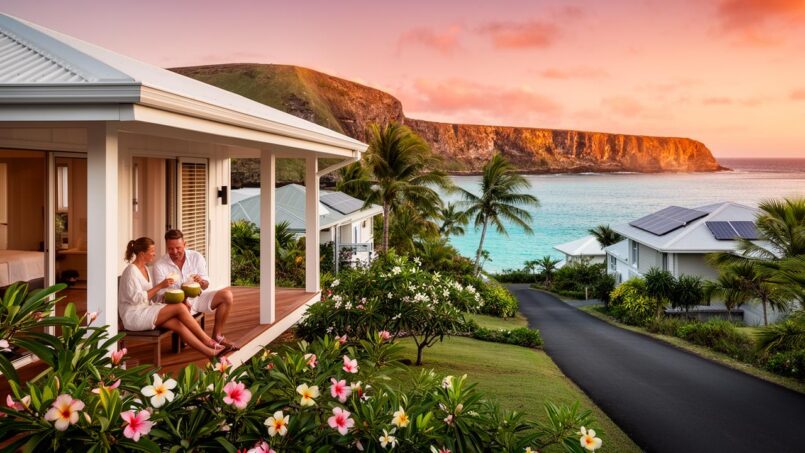
A significant portion of housing favored by expatriates is located on the edge of the coastal terrace or right next to the plateau forest. Some houses and villas, often listed on niuerentals.nu or international platforms, explicitly advertise the possibility of watching whales from the terrace during the season, having access to private nature trails, or to secluded natural pools.
As the island is largely covered in forests and the terrain relatively flat, these properties often combine:
The location offers an unobstructed ocean view and a garden with coconut palms, papaya trees, lemon trees, and chili plants. It benefits from relative isolation ensuring absolute quiet, and maximum exposure to trade winds which cool the nights during the dry season.
But this isolation has a downside: mobile coverage can be irregular, internet depends heavily on the quality of fiber or radio connection in the area, and access in a medical emergency may be a bit longer. Even though Niue is one of the first countries in the world to be connected to the Manatua One Polynesia submarine fiber cable, replacing old, very limited satellite links, outages and slow speeds are still possible, especially in the most remote or wooded areas.
For remote workers or families requiring a stable connection, it is crucial to assess the quality of internet, water, ventilation, and the sonic environment before committing. If in doubt, it is highly recommended to stay one to two months in the intended accommodation to verify these elements yourself before signing a long-term lease.
Costs, Salaries, and Living Budget by Neighborhood
Whether you live in Alofi or a coastal village, the overall framework remains the same regarding food prices, fuel, or services, as the island is entirely dependent on imports for most goods. Budget differences between neighborhoods stem mainly from:
– rent (generally higher for upscale villas with ocean views or complexes near Alofi),
– transportation costs (fuel) if living far from services,
– electricity consumption (more or less need for air conditioning, especially in highly exposed coastal areas).
Monthly budget ranges are established for Niue as a whole, including expatriates based in Alofi.
| Profile | Total Monthly Budget (incl. rent) | “Frugal” Budget | “Comfort / Luxury” Budget |
|---|---|---|---|
| Single person | ≈ 2,526 USD | from ≈ 1,377 USD | up to ≈ 5,048 USD |
| Couple | ≈ 3,665 USD | from ≈ 1,955 USD | up to ≈ 7,442 USD |
| Family of 4 (2+2) | ≈ 5,210 USD | from ≈ 2,786 USD | up to ≈ 10,491 USD |
For essential expense items, some reported ranges give an idea of the financial effort to plan for:
| Monthly Expense Item | Indicative Range (USD) |
|---|---|
| Main residence rent | 600 – 1,500 |
| Electricity | 48 – 180 |
| Water | 15 – 40 |
| High-speed Internet + TV | 75 – 150 |
| Gas / Heating | 15 – 45 |
| Mobile phone with data | 55 – 130 |
| Groceries / Shopping | 380 – 1,100 |
| Transportation | 20 – 280 |
| Health (insurance, meds, visits) | 85 – > 1,000 (depending on needs) |
These amounts do not vary drastically from one village to another, but the way of living can adjust the bill. Living in a village with access to family plantations, fishing for some of your own protein, sharing harvests with neighbors can significantly reduce food expenses. Conversely, residing in a high-end complex on a clifftop, depending almost entirely on imports, and frequenting restaurants in the tourist sector will increase the budget.
Infrastructure, Connectivity, and Services by Area
Another determining factor in choosing a neighborhood is the quality of infrastructure. The island has invested heavily in recent years, especially after Cyclone Heta in 2004, to strengthen roads, water supply, energy, telecommunications. But it’s not all uniform.
Electricity, Water, and Internet
The entire population has access to electricity, although some isolated villages are off the main grid and may be more exposed to outages. The country aims for 80% renewable energy by 2025, but remains heavily dependent on diesel, whose transport and storage represent an environmental risk.
Drinking water comes exclusively from a subterranean lens recharged by rainwater infiltration. This is an asset – no rivers to manage – but also a fragility. The very porous limestone soil easily allows pollutants to pass: agricultural products, faulty sanitation systems, saltwater intrusion due to rising sea levels. During prolonged drought, especially in the dry season, the resource becomes strained. Some communities have identified rehabilitating or creating rooftop rainwater harvesting systems as a priority.
The internet, long limited by satellite links, has been transformed with the connection to the Manatua submarine cable. You can now find:
– a fiber network connecting the 14 villages, the airport, the hospital, the schools,
– growing 4G mobile coverage,
– unlimited fixed-line subscriptions around 60 Mbps for about a hundred New Zealand dollars per month.
However, past criticisms of the quality of “free” Wi-Fi and the governance of the .nu domain remind us that Niuean connectivity has a complex history, and slowdowns or outages persist, especially in wooded or remote areas.
In practice, for a remote-working expatriate, settling in Alofi (North, South, Paliati, Halamahaga) or in a very well-connected village is more prudent than aiming from the start for a totally isolated house on the plateau.
Health, Education, and Daily Life
The Niue Foou hospital, the only hospital facility, is in Alofi, making it a strong argument for choosing housing within a few minutes’ drive. Basic care is provided, but equipment remains limited and serious cases require medical evacuation to New Zealand, extremely costly without good international insurance. Consultation hours are concentrated on weekdays, with more limited coverage on weekends.
Education is free and follows the New Zealand curriculum until age 16. The island has one primary school and one high school (Niue High School) which prepares students for NCEA levels 1, 2, and 3. Higher education and continuing education are provided by the USP center in Paliati and St Clements University – Niue, often via distance learning.
For a couple with children, living near the schools (Alofi, Paliati) makes daily life easier: fewer kilometers on sometimes degraded roads, more possibilities for extracurricular activities and integration of children into the youth community.
In more remote villages, daily life remains very comfortable on a small island scale: no traffic jams, no urban pollution, little crime (some accounts still mention the possibility of leaving belongings without worry), omnipresent nature. But you have to deal with the absence of cinemas, shopping malls, fast food, or nightlife; Niue has one TV channel, no nightclubs, very few restaurants, and a Sunday strictly devoted to rest and worship.
Natural Hazards, Climate Change, and Residential Choices
Choosing a neighborhood in Niue must take into account, more than elsewhere, natural hazards and climate dynamics. The island lies on the edge of the South Pacific tropical cyclone belt and experiences on average about ten cyclones per decade, some of them very destructive. Heta, in 2004, swept across part of the west coast and led to the relocation of several communities from the low terrace to the plateau.
Some communities on Niue’s west coast (Alofi South, Avatele, Makefu, Tuapa) have identified the need to move their infrastructure and homes to higher ground. Despite limited means slowing this migration, the trend is inevitable: low-lying and exposed villages, though attractive, will have to retreat in the face of coastal hazards.
Climate projections for the coming decades indicate:
– a continued rise in air and sea temperatures (around 0.3 to 1.1 °C by 2030 under high emission scenarios),
– sea level rise between 4 and 17 cm by 2030,
– decreasing dry season rainfall and increasing wet season rainfall,
– more days of extreme rainfall and a higher proportion of intense storms, even if the total number of cyclones may decrease.
The coastal terrace, where the most spectacular villas are concentrated, is also the most vulnerable zone. In contrast, on the plateau, between 60 and 69 meters altitude, the forests act as carbon sinks and ecological buffers, but homes are more scattered and may lack reliable road infrastructure or water and electricity services.
For an expatriate imagining a long-term project (several years, or even a permanent move), it is relevant to ask the following question: do you prefer a more exposed but central coastal neighborhood, or anticipate the movement to the plateau by betting on a higher house, sometimes on the forest edge, with added resilience but slightly less immediate access to services?
Land Tenure, Rental, and Purchase: What Changes by Area
Another Niuean specificity: land belongs to families and is passed down through generations. It is almost never sold in the Western sense; the system relies more on stewardship and management by “caretakers”. For a foreigner, this translates into several constraints:
It is in practice simpler to lease land than to buy it in Niue. Purchase and sale by a non-citizen require complex government authorizations, framed notably by the Development Investment Act of 1992 and subject to the control of the Niue Foreign Investment Review Board. Furthermore, the area of land a non-citizen can hold is often limited. Long-term leases, which can go up to 60 or 99 years depending on the case, are therefore the preferred option.
The real estate market, already microscopic, varies from one area to another:
– around Alofi, you find more properties under freehold ownership and recent or renovated constructions,
– in villages, land is mostly family-owned, which creates opportunities for long-term leasing but few public listings for sale,
– high-end villas on the cliffs or forest edge, often built for tourism, are sometimes purchased as businesses (motel, resort), with amounts that can exceed 2 million New Zealand dollars for some complexes.
Real estate purchase prices in Cuba generally range between 150,000 and 500,000 dollars, depending on location, quality, and purpose.
In this context, the neighborhoods “favored” by expatriates are rarely identified on a listing site: they are rather the sectors where word-of-mouth works best. This is one reason why an exploratory stay of one to two months is recommended: talking with shopkeepers, meeting people at church, participating in Niue Chamber of Commerce events or village show days can unlock opportunities invisible online.
Social Integration: Villages, Churches, and Economic Networks
The hierarchy between the most sought-after neighborhoods is measured not only by the view and proximity to Alofi; it also depends on the ease of integration. Some villages are more accustomed to dealing with foreigners, especially those that host tourist accommodations or have seen many of their inhabitants emigrate to Auckland.
Some useful cultural benchmarks, valid everywhere on the island:
Social life is centered on the church, the village, and the family. Sunday is a sacred day where secular activities are limited and modest dress is expected. Greetings, like ‘Fakaalofa Lahi Atu’ or a hand wave from a car, are crucial. Public displays of affection, especially between people of the same sex, can be frowned upon. Learning a few words of Vagahau Niue, the endangered local language, greatly facilitates exchanges.
Expatriates settled in villages like Hakupu, Tamakautoga, Avatele or Makefu often report rapid integration as long as they participate in community life: attending cultural events, involvement in school activities, helping with plantations, etc. Conversely, staying only in a tourist complex in Alofi, among foreigners, reduces the link with Niuean society and sometimes leads to a feeling of isolation, paradoxically in such a small community.
Job opportunities for foreigners in Niue are concentrated in Alofi, in the public sector (government, health, education), international development (UNDP, NGOs), commerce, tourism, and technology. Professionals working in these sectors generally favor housing close to the town center.
Which Neighborhoods for Which Expatriate Profiles?
By combining all these elements – geography, services, costs, climate risks, social fabric – we can outline some typical profiles and the neighborhoods that best suit them.
– Expatriates on short or medium-term assignments (6–24 months) working for the government, health, education or an international organization: Alofi North / Alofi South, Paliati, Halamahaga and complexes like Scenic Matavai or Taloa Heights are the most suitable. Proximity to offices, the hospital, schools, shops, the bank, and relatively reliable internet.
For remote workers (developers, graphic designers, consultants) seeking a good balance between connectivity and natural setting, prioritize areas close to Alofi but slightly set back. Opt for houses on the plateau edge or villas with a good fiber connection. A prolonged on-site test of network stability remains essential before settling.
– Families with school-aged children: Alofi and its immediate surroundings, preferably within walking distance or a short drive from the schools. For deeper cultural immersion, some choose a village like Tamakautoga or Avatele, provided they accept daily commutes.
For retirees or couples prioritizing tranquility and proximity to nature, favor coastal villages like Namukulu, Lakepa, Hakupu, or Avatele, or isolated properties on the forest edge or plateau. Good preparation is essential: take out health insurance including medical evacuation, ensure quick access to a vehicle, and plan resilience solutions like a rainwater reserve and good natural ventilation.
– Tourism entrepreneurs (guesthouse, diving, guides, restaurants): Sectors most visible to visitors, mainly around Alofi, Tamakautoga, Avatele, and major tourist sites. Proximity to the airport, dive spots, and services is a commercial asset.
Conclusion: A “Neighborhood Choice” That is Above All a Lifestyle Choice
In Niue, the question “which neighborhood to settle in?” quickly transforms into a broader inquiry: what relationship does one wish to have with a tiny island, an increasingly unstable tropical climate, an extremely tight-knit community where anonymity does not exist, and an economy dependent on imports and foreign aid?
Expatriates mainly choose Alofi and its surroundings for their convenience of access. Coastal villages like Hakupu, Tamakautoga, Avatele, Makefu, Namukulu, Lakepa, or Tapeu are appreciated for their rural charm and cultural immersion. Finally, cliffside or forest-edge villas, offering an isolated experience facing the Pacific, suit those willing to accept additional logistical constraints.
Whatever zone is chosen, the success of a project in Niue depends less on the precise address than on three ingredients: accepting a high cost of living, preparing seriously for natural hazards and the fragility of infrastructure, and above all, fully entering the village logic – greet, participate, listen, share. The “most sought-after neighborhoods” are ultimately those where this meeting between the foreigner and the island happens most naturally, at the intersection of an available house, a welcoming village chief, benevolent neighbors, and a limitless blue horizon.
Disclaimer: The information provided on this website is for informational purposes only and does not constitute financial, legal, or professional advice. We encourage you to consult qualified experts before making any investment, real estate, or expatriation decisions. Although we strive to maintain up-to-date and accurate information, we do not guarantee the completeness, accuracy, or timeliness of the proposed content. As investment and expatriation involve risks, we disclaim any liability for potential losses or damages arising from the use of this site. Your use of this site confirms your acceptance of these terms and your understanding of the associated risks.

Cyril Jarnias is an independent expert in international wealth management with over 20 years of experience. As an expatriate himself, he is dedicated to helping individuals and business leaders build, protect, and pass on their wealth with complete peace of mind.
On his website, cyriljarnias.com, he shares his expertise on international real estate, offshore company formation, and expatriation.
Thanks to his expertise, he offers sound advice to optimize his clients' wealth management. Cyril Jarnias is also recognized for his appearances in many prestigious media outlets such as BFM Business, les Français de l’étranger, Le Figaro, Les Echos, and Mieux vivre votre argent, where he shares his knowledge and know-how in wealth management.





