
 Published on and written by Cyril Jarnias
Moving to Niue is like landing on a “rock” lost in the heart of the South Pacific, yet surrounded by an often unsuspected gastronomic richness. With just over 1,600 inhabitants, this large raised coral atoll lives to the rhythm of the sea, family plantations, and celebrations where food is never a side note, but the center of the stage. For an expatriate, understanding how people eat in Niue, where the products come from, and how to navigate between umu, makete, uga, and nane, is a real key to integration.
This guide covers the Niuean culinary experience, from the Alofi market to village feasts. It details table etiquette and provides advice for combining taste pleasure with food safety during your stay.
Understanding Niuean Food Culture
In Niue, gastronomy is intimately linked to the “faka Niue” culture, which encompasses language, values, and customs. Social life revolves around the extended family (kaiga) and the community. Everything is shared, especially food. Offering food is a gesture of “fakalofa”, a blend of love, respect, and generosity. Large tables are the place where kinship ties, social status, and a host’s ability to welcome are read.
With religion occupying a central place, Sunday is traditionally devoted to worship and rest. Activities like fishing are prohibited for locals, and leisure activities are limited near villages and churches. It’s a day marked by hearty family meals after the service. For an expatriate, being invited to one of these lunches is a sign of trust; they typically serve taro, pork, fish, and sometimes rarer dishes like pigeon (lupe).
In this context, refusing to eat what is offered is very poorly received. The visitor is expected to taste “a little bit of everything”, even in small quantities. One does not start eating before the host invites the assembly to do so. Elders are served and honored first; their plate is often richer in choice cuts.
The Central Role of the Umu
The symbolic heart of Niuean cuisine is the umu, the traditional oven of heated stones. Unlike other islands where it is dug into the ground, in Niue it can be built on the surface, with volcanic or river stones retaining heat for hours. Root vegetables (taro, cassava, yam), suckling pigs, chickens slowly tenderized (“moa Niue”), whole fish, bananas, sometimes coconuts or desserts like takihi are cooked in it.
Preparing an umu, a traditional Polynesian oven, for an important event can span several days. It includes slaughtering pigs, peeling and grating root vegetables, and grating coconuts. Each preparation is then wrapped in banana or ti leaves. Cooking often starts around 2 or 3 in the morning so the meal is ready by late morning. Using leaves, rather than aluminum foil, gently flavors the dishes and is a characteristic signature of Niuean cuisine.
Staple Products: Roots, Coconut, and Fish
Local cuisine rests on a few pillars grown or harvested on the island. Even though imports have increased, notably from New Zealand, the foundation of taste remains deeply linked to the land and sea of Niue.
Taro, Cassava, Yam, Sweet Potato
Taro (talo) is the big star, considered the island’s main starch. It is boiled, roasted, mashed, turned into chips, fritters, used in soups and stews. Niuean taro is important enough that the diversity of its varieties is preserved by the Pacific Genebank in Fiji. Around it gravitate other roots: cassava, yams (including some wild ones, ufi lei, serving as “famine food”), sweet potatoes (kumara).
These crops require real know-how, especially as the very porous coral soil complicates water retention. Local agriculture, long based on subsistence, is now organized around more resilient practices: composting, mulching, intercropping, organic farming trials via the Niue Island Organic Farmers Association, and even greenhouses and hydroponics for fragile vegetables (salads, tomatoes).
Coconut in All Its Forms
One better understands the island’s name – “look at the coconut tree” – when seeing how much the coconut tree infuses the cuisine. Its water refreshes, its flesh nourishes, its milk and cream give body to savory and sweet dishes. Great classics like palusami (taro leaves simmered in coconut cream), lu pulu (leaves + corned-beef + coconut) or many fish curries are full of it.
Coconut is a central ingredient in traditional cuisine, used in desserts and breakfasts like nane pia (arrow-root porridge) and pitako pia (bread), as well as in drinks like ‘otai (mixture of coconut and cooked ti root).
Ocean Fish and Seafood
The position of Niue, isolated in the South Pacific, makes it a magnet for ocean fish: yellowfin tuna, dogtooth tuna, mahimahi, wahoo, swordfish, marlin, sailfish. The seabed drops off very quickly beyond the reef: sometimes just a few hundred meters from the shore you’re in very deep waters. This benefits both fishermen and… restaurateurs.
Fish is enjoyed in many forms in Polynesia: grilled, simmered in coconut (ika lolo), poached, in taro-fish soup, as tartare or raw marinated (ika mata / ota ika). This last preparation involves “cooking” diced fish in citrus juice then coating them in coconut cream with vegetables. Restaurants like Kaiika also reinvent this culinary heritage in sushi or tataki, often using local fish.
On the reef, caution is advised: some lagoon fish can concentrate the toxin responsible for ciguatera. Health authorities recommend avoiding sensitive reef fish and favoring open-water species like tuna, wahoo, or mahimahi, known to be safe. Again, a local restaurateur knows which species to avoid.
Alongside fish, shellfish, sea snails (hihi, used in a famous hihi pie), crabs, and even octopus (feke) complete the marine picture. Octopus in coconut milk or salad is a buffet classic.
Uga, the Coconut Crab, a Threatened Treasure
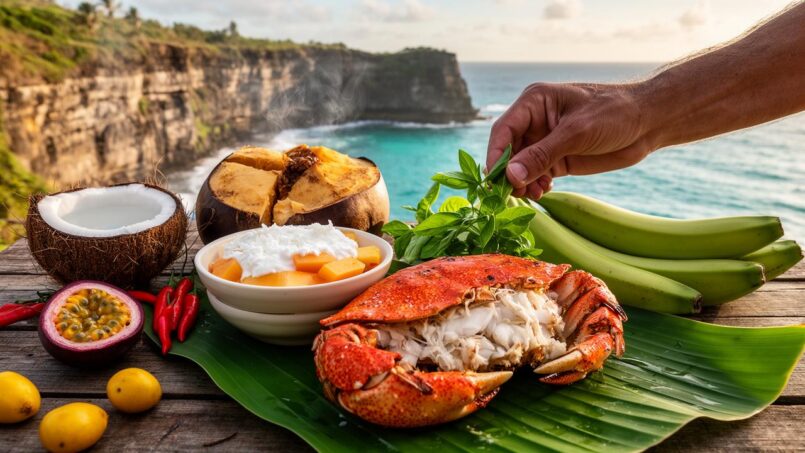
To talk about gastronomy in Niue without mentioning the uga – the coconut crab – would be incomplete. It’s an emblematic delicacy, appreciated by Niueans and highly sought after by visitors. Its tail, rich in fat, is often compared to foie gras. Traditionally, it’s grilled over a wood fire in the forest or simmered in coconut curry (kakaviri) or thick sauce (uga i te kikau).
Over three quarters of the uga population is found in coastal forests, where large individuals are becoming scarce.
Authorities have therefore tightened regulations: export ban, minimum size (thorax ≥ 36 mm), absolute protection for egg-bearing females and molting crabs, regular checks. For an expatriate, the best attitude is to:
– only consume it occasionally, during truly special events or buffets clearly advertised as responsible;
– verify the supplier complies with the law (no small crabs, no females “in berry”);
– favor ecotourism experiences (night observation tours) rather than repeated consumption.
The sustainability of this culinary symbol also depends on the behavior of newcomers.
Iconic Dishes to Discover
Even if standard restaurant menus often feature burgers, pizzas or fish & chips, there is a constellation of Niuean dishes to look out for at buffets, markets, or during Village Show Days.
Among the most typical:
Discover a selection of traditional dishes, combining raw fish, taro, coconut and European influences, for a unique taste journey.
Raw fish marinated in citrus and coconut cream, garnished with crunchy vegetables.
Taro leaves long-cooked with coconut cream, sometimes enriched with corned‑beef (lu pulu).
Layered gratin of taro and papaya (or kumara), coated with coconut cream, baked or cooked in the umu.
Traditional arrow‑root and coconut porridge, popular for breakfast at the market.
Salted beef brisket preparation, mixed with young green shoots, a legacy of European introductions.
Tuna steak with edible ferns, in a fragrant coconut sauce.
Savory sea snail pie.
Brioche-style buns cooked in a bath of sweet coconut cream.
Coconut bread, taro pancakes, taro fritters: bread-based variations of taro and coconut.
These dishes are not all available permanently, but most reappear at regular intervals at resort buffets (Scenic Matavai), themed evenings (Manuiz, certain cafes), or Show Days.
Markets and Short Supply Chains: Eating Like the Locals
For an expatriate, the market and small village shops are the best gateway to local flavors, with the added advantage of controlling your budget.
The Alofi Makete: The Island’s Food Pulse
The makete, on the waterfront in Alofi, right next to the Visitor Information Centre, operates at several times during the week. Exact hours vary slightly depending on sources and seasons, but the principle remains the same: you have to come early.
You’ll find root vegetables (taro, cassava, yams), fruit (bananas, papayas, sometimes passion fruit, citrus), vegetables, fresh fish, sometimes live uga, ready-cooked dishes from the umu, local pastries, nane porridge, banana bread (pitako fusi), instant coffee and tea. Artisans also sell weaving, jewelry, and dyed textiles.
An overview of the main regular markets:
| Market | Location | Main Days | Indicative Hours | Culinary Particularities |
|---|---|---|---|---|
| Morning Makete | Alofi, center | Tuesday & Friday | 6:00 AM – 8:00 AM | Fruit, vegetables, fish, uga, umu, nane |
| Lady Farmers’ Market | Alofi, market building | Wednesday | 8:00 AM – 12:00 PM | Local products, cooked dishes, handicrafts |
| Women at Work Market | Alofi (market or Sevene’s Tavern) | Saturday | 6:30 AM – 12:00 PM | Hats, baskets, Niuean dishes, harvests for elders |
| Friday Night Market | Alofi, makete | Friday (every ~2 weeks) | 4:00 PM – 7:00 PM | Street‑food stalls, “Makfurly” burger |
| Niue Organic Night Market | Alofi, makete | 1st Thursday of the month | 4:00 PM – 7:00 PM | Certified organic products, oils, cooked dishes, handicrafts |
| Airport Market | Hanan Airport | Flight days | 10:30 AM – 2:00 PM | Snacks, dishes, food souvenirs |
Days and hours change, it’s best to check with the Visitor Information Centre. But a simple rule emerges: to have a choice, aim for 7:00 AM at the latest for morning markets and right at opening for evening markets.
Everyday Shopping
Even though agriculture is alive, Niue heavily depends on imports, especially from New Zealand. A monthly cargo rotation and weekly flights supply the island with processed, refrigerated, and frozen products. Prices are significantly higher than in mainland New Zealand and shelves can empty as the next cargo approaches.
For an expatriate, this means:
– learning to cook with what’s available (sometimes a lot of taro, few lettuces);
– stocking up wisely when the cargo has just arrived;
– falling back on local fresh produce at the market or in small shops when supermarkets are sparse.
The four main food supply points in Alofi:
| Store | Location | Culinary Assets |
|---|---|---|
| Swanson Supermarket | Swanson Complex, near airport | Largest choice: imported NZ products, fruit & veg, Rolling Pin bread, frozen meals, groceries, toiletries |
| Double M | Alofi shopping center | Butchery, fresh produce, local specialties (honey, noni juice, vanilla, spices) |
| Moko’s Central Mart | Alofi shopping center | General grocery, fresh bread on weekdays, local & imported fruit & veg |
| Central Services | Main road, Alofi South | Service station + grocery, good bread, pies, fruit & veg depending on shipments, cold beer |
Around, a constellation of small shops (Ilena’s Bakery, G’s Mini Mart, Niue Adventure Shop, Tiki’s Coconut & Handicraft Shop in Hakupu, JZ Imports near Lakepa, etc.) offer what you need in a pinch: snacks, drinks, milk, eggs, some vegetables and fruit, sometimes cooked taro or prepared cassava.
Payment is almost exclusively in New Zealand dollars (NZD). Visa and MasterCard are accepted in some Alofi businesses, but not in small village shops. Having cash remains essential.
Self-Production and Family Gardens
Many Niuean families grow their own taro, cassava, bananas, papayas, citrus, sometimes sweet potatoes or watermelons. Surplus harvests are sold at the makete or to restaurants. In some villages like Vaiea, educational initiatives teach children to garden organically, using compost, recycled materials, and even fermented fish blood as fertilizer. Harvested vegetables go home with the children, introducing more fresh produce into the family diet.
For an expatriate settling long-term, it is entirely possible to develop a small vegetable garden, provided you respect traditional land ownership (all land belongs to a family, land cannot be sold to a foreigner) and ask the owners’ permission.
Eating Out: Between International Cuisine and Niuean Touches
In Niue, dining is concentrated around Alofi and a few key points (Hio, Tamakautoga, Avatele). For an expatriate, it’s useful to understand that you won’t find standardized “fast‑food“, but a palette of cafes, food‑trucks, and family restaurants with variable hours.
Some useful points of reference:
Discover a selection of restaurants and cafes in Niue, ranging from Japanese fusion cuisine to local buffets and seaside-view cafes.
Restaurant in Alofi offering Japanese fusion cuisine: sushi, New York-style pizzas, and local fish prepared by a Japanese chef from fresh catches.
Located in Tamakautoga, offers themed buffets, brunches, and dinners with a Niuean touch (umu dishes, fish, root vegetables, coconut desserts).
Cafe-restaurant in Tuapa with sea views, known for its atmosphere and reinterpreted local dishes.
Manuiz, Vanilla Cafe Bar & Restaurant, Vaiolama Cafe, Tavana’s Cafe, Falala Fa Café & Bar: burgers, curries, fish dishes, sometimes evening buffets.
The “Niuean buffet” or “Umu night” evenings organized by some of these establishments, or by the resort, are valuable opportunities to taste a wide range of specialties at once. Reservations are almost always mandatory: capacity is limited, products are fresh, and organization is complex.
Budget and Strategy for an Expatriate
Local data indicates that food is the third main expense for visitors. Eating out for breakfast, lunch, and dinner can easily climb to 120 NZD per person per day. On the other hand, an expatriate who cooks at home, buying fruit, roots, and fish at the market and supplements at the supermarket, can get down to around 30 NZD per day.
A good relocation strategy is essential to ensure a smooth process. This involves preparing the environment, checking prerequisites, planning the steps, and anticipating any potential issues for effective and hassle-free implementation.
– choose accommodation with a fully equipped kitchen (this is the case for most non-resort accommodations);
– plan for two to three “restaurant” meals per week to discover new places and socialize;
– stock up at Swanson Supermarket upon arrival, then adjust to the rhythm of the makete for fresh produce;
– take advantage of Rolling Pin Bakery, Ilena’s Bakery, and Rockbak Bakery via Central Services for bread and pastries.
Not Only Good, But Also Safe: Health, Hygiene, and Climate
Niue is often presented as very safe: little crime, no dangerous animals, a hospital on site. But regarding food and climate, some precautions are necessary, even more so for an expatriate staying long-term.
Water and Food Hygiene
Tap water is not systematically potable. Many accommodations have filtration systems, but otherwise, it’s safer to:
– drink bottled water (easy to find in supermarkets);
– boil water for 10 minutes or use purification tablets if necessary;
– avoid ice cubes of unknown origin.
Risks of traveler’s diarrhea, hepatitis A, or salmonellosis exist as in many tropical destinations. To limit issues:
To avoid food poisoning and diseases related to the consumption of certain products, it is recommended to favor well-cooked and hot-served foods, and to peel fruit yourself. Avoid undercooked meats and runny eggs. Regarding fish, be cautious with reef fish (ciguatera risk) and prefer open-water fish like tuna, wahoo, or mahimahi. Particular caution is required with raw fish (ika mata, sashimi) for pregnant or immunocompromised individuals.
Good hand washing, with soap or hand sanitizer, before eating or cooking, remains the most effective gesture.
Mosquitoes, Sun, and Climate
Heat and humidity, especially from November to March, favor mosquitoes and heatstroke. Dengue or Zika outbreaks have been recorded. Suitable repellent, covering clothing at dawn and dusk, and a mosquito net for night are valuable allies.
Facing cyclones and droughts, the people of Niue have developed resilience strategies, such as storing taro, rice, and other long-lasting products, protecting their gardens, and observing natural signs to anticipate bad weather. For an expatriate, adopting these local practices and following Civil Defense instructions allows for weathering these events with serenity and without food shortages.
The Noni Example: When Traditional Medicine Meets Commerce
Noni, a fruit with a cheesy smell and a reputation as a miracle cure, is processed in Niue into juice, extracts, and “well‑being” drinks. The plant has been part of Polynesian pharmacopoeia for centuries, and Niuean families produce artisanal juices or beverages sold locally or exported. Laboratory research suggests antioxidant, antimicrobial, even analgesic properties, but no curative claims are validated by Western health authorities.
Several isolated cases of hepatotoxicity have been described in consumers of noni juice. Without falling into paranoia, reasonable use is in order: taste out of curiosity, avoid massive long-term consumption, especially if you already have a fragile liver or regularly consume alcohol.
Protocol, Respect, and Integration Through Food
Sharing a meal is a key moment for being accepted in Niue. But this assumes respecting a few codes.
Gestures of Hospitality and Politeness
When invited to a Niuean home, arriving empty-handed is not the custom. It is customary to bring a small “fakaalofa”: a dish, fruit, a cake, flowers. In return, you will often be inundated with food. This system of gift and counter-gift is deeply ingrained: don’t be surprised if your host gives you a bag of taro or meat to take home at the end of the day.
Some guidelines:
It is important to accept what is offered, even a small portion, and not to fill your plate before the host’s invitation. Let the elders start or be served first, and avoid taking seconds before being sure everyone has had their share.
Dress also matters. Modest clothing is appreciated, especially in villages or at church. No swimwear outside beaches, and for a family meal following a service, no need to arrive in a tank top.
Alcohol and Celebrations: Codified Abundance
Major celebrations – weddings, ritual haircuts, ear piercings, 21st birthdays, graduations, funerals – are inseparable from food and, often, alcohol. Many Niuean men still associate the ability to “hold” alcohol with manliness and cultural identity. On the table, bottles line up alongside trays of roast pork, taro, fish.
As an expatriate, there is no need to drink excessively. However, systematically refusing to toast can create social distance. It is better to calmly explain your limits, alternate with water, and not judge others’ habits, an approach generally well understood.
Practically, alcohol is purchased at specialized stores like the Niue Bond Store (NB Liquor Store) or Vai Mamali Liquor. Tipping is not customary, but rounding up the bill is appreciated without being expected.
Discovering Gastronomy Through Events and Encounters
Beyond the routine of markets and cafes, certain times of the year are particularly rich culinarily.
Village Show Days, Constitution Week, Fiafia Nights
Each village organizes its celebration day, the Village Show Day, showcasing its agricultural production, artisans, and culinary know-how. Stalls are full of aligned taro, bunches of bananas, smoking fish fillets, uga, coconut desserts. It’s an excellent opportunity to taste homemade preparations you’ll never see on a restaurant menu.
During Constitution Week in October, festivities include official ceremonies, shows, sports competitions, and a grand national show. The event is marked by large umu tables feeding residents and visitors. Fiafia nights, combining songs, dances, and meals, turn gastronomy into a living spectacle where dishes serve as a backdrop for stories and choreographies.
For an expatriate, going to these events, supporting the stalls by buying dishes and products, and especially taking the time to chat with the cooks, is one of the best ways to learn Niuean cuisine “from the inside”.
Fishing and Short Sea-to-Plate Supply Chains
For sport fishing enthusiasts, Niue is an exceptional playground: tuna, wahoo, mahimahi, marlin are sometimes caught just a few hundred meters from the coast. Operators like Niue Wahoo Fishing Charters, Gone Fishing Niue or Niue Fishing Charters offer 2.5 to 5-hour trips with different techniques (trolling, jigging, casting, popper fishing, sometimes spearfishing).
Some of the catch is directly supplied to local cafes and restaurants to be served as sashimi, fish burgers, or grilled steaks. The rest is sold whole, either at the market or directly by fishermen from their coolers, as part of an ultra-short supply chain.
For an expatriate, participating in a fishing trip then cooking your catch at home or entrusting it to a restaurateur to prepare it is a very strong experience, further anchoring the relationship to the sea and food.
Practical Tips for Eating Well While Living in Niue
Moving to Niue involves revising some food and logistical reflexes. Some key ideas, drawn from on-the-ground realities:
For a successful and economical culinary experience in Niue, adopt a few local habits. Anticipate supply cycles by checking on cargo arrivals to adjust your purchases and freeze perishable goods. Make the market a priority to enjoy local products, better for taste, health, and budget. Accept product seasonality, favoring available fruits and vegetables (like taro or sweet potato) over expensive imports. Learn to cook ‘the Niuean way’, for example using banana leaves or preparing taro in various ways. Finally, educate yourself on food safety issues, notably to identify fish at risk of ciguatera and correctly store sensitive foods.
Finally, keep in mind that gastronomy, in Niue, is first and foremost a support for social bonds. Accepting an invitation, bringing a dish to share, asking for a recipe, offering to help grate coconut or wrap taro parcels for the umu, that’s entering the community.
Niuean cuisine isn’t an explosion of “trendy” restaurants or sophisticated gastronomic concepts. It’s a cuisine of rock and ocean, family and faith, sharing and resilience. For an expatriate ready to dive in, it quickly becomes one of the most beautiful aspects of life in Niue, far beyond the plate.
Niuean Cuisine
Disclaimer: The information provided on this website is for informational purposes only and does not constitute financial, legal, or professional advice. We encourage you to consult qualified experts before making any investment, real estate, or expatriation decisions. Although we strive to maintain up-to-date and accurate information, we do not guarantee the completeness, accuracy, or timeliness of the proposed content. As investment and expatriation involve risks, we disclaim any liability for potential losses or damages arising from the use of this site. Your use of this site confirms your acceptance of these terms and your understanding of the associated risks.

Cyril Jarnias is an independent expert in international wealth management with over 20 years of experience. As an expatriate himself, he is dedicated to helping individuals and business leaders build, protect, and pass on their wealth with complete peace of mind.
On his website, cyriljarnias.com, he shares his expertise on international real estate, offshore company formation, and expatriation.
Thanks to his expertise, he offers sound advice to optimize his clients' wealth management. Cyril Jarnias is also recognized for his appearances in many prestigious media outlets such as BFM Business, les Français de l’étranger, Le Figaro, Les Echos, and Mieux vivre votre argent, where he shares his knowledge and know-how in wealth management.





