
 Published on and written by Cyril Jarnias
Investing in real estate in El Ejido means betting on an atypical territory: one of Europe’s most dynamic agricultural economies, a Mediterranean coast still largely untouched by concrete, a tight rental market, and square meter prices that remain significantly lower than in major neighboring resorts. All this with yields that can exceed 9% for long-term rentals and climb well beyond that for seasonal rentals.
This article provides a comprehensive analysis of the El Ejido real estate market, including prices and yields by neighborhood, specifics of tourist rentals, the local economic context, and legal aspects of buying in Spain. It aims to give investors, whether residents or foreigners, a clear view of the opportunities and risks.
A real estate market supported by an extraordinary economy
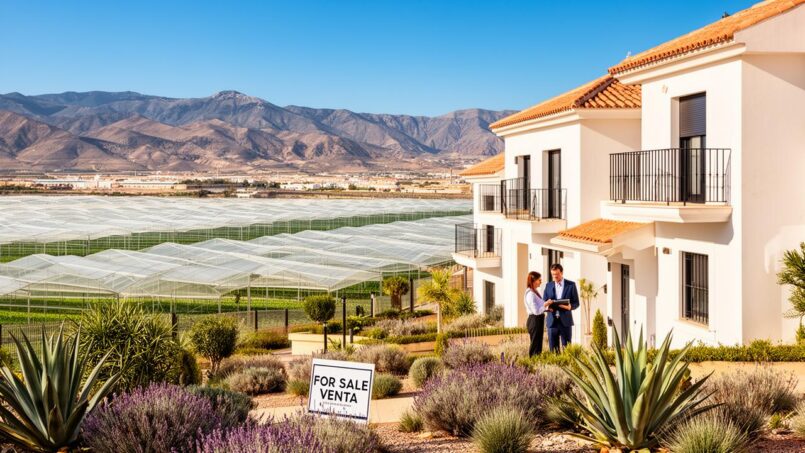
El Ejido is not a typical seaside resort. The city is the heart of the greenhouse agriculture in the province of Almería: over 150 km² of greenhouses, part of a “sea of plastic” visible from space, hundreds of thousands of tons of vegetables exported each year, and some of Spain’s highest agricultural incomes.
Number of people employed by the agri-food cluster generated by intensive agriculture.
Simultaneously, the coast of El Ejido – Balerma, Guardias Viejas, Almerimar – is attracting more and more tourists thanks to 27 km of coastline without large buildings, a protected coastal wetland (Punta Entinas-Sabinar), a marina with over 1,100 berths, a 27-hole golf course, and a climate with over 300 sunny days a year. Tourism experts believe this coastline has a “great future” and that prices remain “very reasonable” given the potential.
This dual dynamic – agricultural and touristic – creates a context particularly favorable to rental investment, whether residential, seasonal, or mixed.
Real estate prices: a market still affordable… but on the rise
The numbers show a market that remains accessible compared to other Andalusian coastal areas, while displaying an upward trend.
Price levels: where does El Ejido stand?
For residential properties, an initial set of data indicates that in July 2025, the average sale price in El Ejido was €1,151/m², with a range from €858 to €1,864/m² depending on the neighborhood. Over two years, the highest point was reached in June 2025 at €1,194/m², and the lowest in October 2023 at €1,149/m². The 1.20% decrease between August 2024 (€1,165/m²) and July 2025 reflects more of a breather than a reversal.
Another source, for February 2026, gives a higher average price of €1,246/m², with an annual increase of 5.5% for houses and 3.3% for apartments. Over five years, the price per square meter has appreciated by 1.5% for houses, but by 14.7% for apartments, signaling growing interest in this type of property.
The median price for apartments in the relevant area is approximately €1,008/m².
A market snapshot as of August 12, 2025, based on 143 properties, mentions an overall average price of €203,854 and an average price of €1,568/m², although this value was down 4.04% compared to the end of July. On another portal, 42 properties were listed at an average price of €215,500, or €2,140/m², showing how much data varies depending on samples and property types.
Price differences between neighborhoods: from the center to Almerimar
El Ejido is a patchwork of very contrasting sub-markets. The per-square-meter statistics by zone for July 2025 allow us to identify pockets of value and those with higher yield potential.
The table below summarizes the average sale prices by intra-muros zone:
| Zone / Neighborhood | Average Sale Price (€/m²) |
|---|---|
| Centro | 968 |
| Barrio Pabellón-Estación | 1,093 |
| Barrio Norte | 1,085 |
| Santo Domingo | 1,144 |
| Barrio Plaza de la Luz | 1,046 |
| Barrio Sur | 975 |
| Balerma-Matagorda-Guardias Viejas | 1,222 |
| Almerimar | 1,864 |
| Santa María del Águila | 898 |
| Las Norias de Daza-San Agustín | 858 |
Almerimar appears as the most expensive sector, at €1,864/m², confirmed by other more detailed data: around €2,394 to €2,483/m² for this neighborhood, with an average ticket close to €235,000. At the other end, Las Norias de Daza-San Agustín remains the most affordable segment, under €900/m², sometimes around €769 to €820/m².
In the suburban sectors and coastal villages of El Ejido, such as Balerma, Matagorda, and Guardias Viejas, median prices range between €1,285 and €1,420/m², corresponding to median purchase values of approximately €120,000 to €140,000. In comparison, the urban core, El Ejido Ciudad, shows lower prices, around €1,054 to €1,067/m², illustrating the valuation gap between suburban coastal areas and the city center.
Breakdown by property type: houses, apartments, studios
Overall averages hide significant differences based on size and typology. Data from February 2025 indicate the following medians:
| Property Type | Number of Rooms | Median Price (€/m²) |
|---|---|---|
| Studio Apartment | – | 1,393 |
| 2-Room Apartment | 2 | 1,107 |
| 3-Room Apartment | 3 | 922 |
| 4-Room Apartment | 4 | 967 |
| 5-Room Apartment | 5 | 917 |
| 4-Room House | 4 | 1,143 |
| 5-Room House | 5 | 926 |
On the market in absolute value, the observed average ranges give an idea of the entry tickets:
| Category | Configuration | Average Price (€) |
|---|---|---|
| Apartment | Studio | 92,000 |
| Apartment | 2 bedrooms | 109,000 |
| Apartment | 3 bedrooms | 125,000 |
| Apartment | 4 bedrooms | 146,000 |
| Apartment | 5 bedrooms | 185,000 |
| Single-Family House | 4 bedrooms | 215,000 |
| Single-Family House | 5 bedrooms | 248,000 |
| Single-Family House | 6 bedrooms | 308,000 |
| Single-Family House | 7 bedrooms | 408,000 |
| Single-Family House | 8 bedrooms | 581,000 |
For an investor, these levels mean that a 2 or 3-bedroom apartment in a decent neighborhood often remains accessible between €100,000 and €140,000, well below the average prices seen on other Spanish Mediterranean coasts.
Comparison with other towns in the province
At the provincial level, the average price revolves around €135,000 per property for €1,500/m², with a general trend of +3.8%. Some tourist municipalities like Vera (€2,847/m²) or San Juan de los Terreros (€2,554/m²) have seen spectacular increases, up to +30% in one year.
In this context, El Ejido appears as a still undervalued coastal area: the price level is lower than Roquetas de Mar (approx. €1,609/m²) and Almería city (over €1,700/m²), even though the local economic dynamic is very favorable and the coast remains largely preserved from overdevelopment.
A tight rental market: sharply rising rents and high yields
If sale prices are progressing moderately, rents have thrown all caution to the wind. Between December 2023 and December 2024, rental costs in El Ejido jumped by approximately 43.1%, reaching an average of €11.28/m², a level higher than the provincial average (€8.3 to €8.8/m²) and even many Andalusian coastal areas.
Average rents: from the center to peripheral neighborhoods
As of July 1, 2025, asking rents for residential properties reached an average of €11.46/m²/month, with a range from €3.66 to €12.03/m² depending on the area. Over two years, the average rent peaked at €11.84/m² in June 2025 after hitting a low of €6.30/m² in January 2024.
By neighborhood, the figures provide a precise map:
| Zone / Neighborhood | Average Rent (€/m²/month) |
|---|---|
| Centro | 6.38 |
| Barrio Pabellón-Estación | 6.39 |
| Barrio Norte | 3.66 |
| Santo Domingo | 4.44 |
| Barrio Plaza de la Luz | 6.72 |
| Barrio Sur | 5.61 |
| Balerma-Matagorda-Guardias Viejas | 6.54 |
| Las Norias de Daza-San Agustín | 5.55 |
| Santa María del Águila | 3.80 |
| Almerimar | 12.03 |
Almerimar stands out clearly with over €12/m², reflecting its tourist positioning and the pressure on seasonal rentals. The urban center, areas around the station, and Plaza de la Luz remain in a range of €6 to €7/m², while more working-class sectors like Barrio Norte or Santa María del Águila stay well below €4/m².
In practice, observed “market” rents for apartments are around:
– €500/month for a 1-bedroom in the city center,
– €420/month for a 1-bedroom on the periphery,
– €800/month for a 3-bedroom in the center,
– €500/month for a 3-bedroom outside the center.
An average net salary of around €1,333/month suggests that households’ rental burden remains manageable, but the rapid rise in rents is starting to pose accessibility problems, especially for precarious workers in the agricultural sector.
Rental yields: El Ejido among the most profitable in the province
For an investor, the key question is yield. Based on available data, the average gross rental yield in El Ejido for long-term rentals is estimated around 9.53%, with an average annual rental income close to €9,120. The comparison with other municipalities in the province is telling:
| Town / Municipality | Gross Rental Yield (%) | Average Price (€/m²) approx. |
|---|---|---|
| El Ejido | 9.53 | ~1,292 – 1,362 |
| Vícar | 9.77 | 1,073 |
| Garrucha | 8.68 | n.a. |
| Huércal-Overa | 8.07 | 997 |
| Adra | 6.74 | 1,153 |
| Roquetas de Mar | 6.19 | 1,609 |
| Vera | 4.70 | 1,962 |
| Níjar | 4.67 | 1,705 |
| Almería (city) | 5.56 | 1,788 |
With a gross yield above 9%, El Ejido is among the top-performing markets in the province, and above the Andalusian average, estimated around 5.7%. The province’s price-to-rent ratio (15 years on average) suggests that locally, some properties can pay for themselves more quickly, in 10 to 12 years in the most profitable sectors.
For long-term rentals, the orders of magnitude observed in the province confirm these levels.
Provincial observations
– A property between €40,000 and €70,000 rented at €350–450/month can generate 6–9% gross yield.
– An apartment from €80,000 to €100,000 rented at €500–600/month is often between 5 and 7.5%.
– In El Ejido, the recent rise in rents pushes the bar higher, especially in central and coastal neighborhoods.
Seasonal rentals: a dynamic and still lightly regulated market
Beyond classic rentals, El Ejido stands out for a very promising short-term rental market, supported by the rise of Almerimar as a tourist destination and by local regulations described as rather lenient for tourist accommodations.
Short-term rental performance
The performance data show the potential. In 2023, a typical property rented short-term in El Ejido showed:
– a median occupancy rate around 50%,
– an average annual income of about €14,000,
– an average daily rate of €75,
– about 182 booked nights per year.
The gross yield for short-term rentals based on an average price of $111,600 for listed properties.
A numerical focus on the period from May 2024 to April 2025 helps situate the performance:
| Indicator (all properties) | Approx. Median Value |
|---|---|
| Typical monthly revenue | $808 |
| Median occupancy rate | 28% |
| Median daily rate (ADR) | $92 |
| Top 10% monthly revenue | ≥ $1,907 |
| Top 10% occupancy rate | > 71% |
| Top 10% ADR | ≥ $193 |
The best properties, often well-located in Almerimar, on the waterfront or very close to beaches and the marina, can thus double or even triple the income from long-term rentals, at the cost of more active management.
Seasonality is marked, with a peak in August, an interesting plateau in July and September, and a low in January-February:
| Period | Average Monthly Revenue | Average Occupancy | Average ADR |
|---|---|---|---|
| High season (J-A-S) | $1,571 | 45.5% | $121 |
| Mid season | $827 | 33.1% | $101 |
| Low season | $615 | 24.0% | $110 |
In practice, a well-decorated two-bedroom in Almerimar can aim for around €19,000–€20,000 in gross annual short-term rental income, compared to €7,500–€8,000 for a classic rental, provided marketing and management are well-handled.
A regulatory framework still flexible, unlike Malaga
While cities like Malaga have imposed a freeze on new tourist rental licenses in 43 neighborhoods, with increasingly strict rules (notably the requirement for independent access for tourist accommodations), El Ejido currently operates in a much more permissive framework.
The tax regime is described as lenient for tourist accommodations, allowing for an expansion of supply, while demand itself remains strong.
– about 50% of clients are Spanish,
– the rest is driven by an international clientele, notably British,
– Gen Z and young families represent a significant share,
– stays of a few nights dominate, but a significant portion of listings also accept monthly stays.
This flexibility, combined with rising tourism prospects and the absence of regulatory barriers comparable to Malaga or Barcelona, creates a window of opportunity for investors looking to position themselves in seasonal rentals before a potential tightening of rules.
Where to invest in El Ejido: a fine-grained reading of neighborhoods and uses
To invest intelligently, it’s not enough to look at averages. El Ejido combines inner urban areas, coastal villages, tourist resorts, and purely agricultural neighborhoods. Each sector responds to a different investment logic.
Almerimar concentrates most of the tourist assets:
– marina with over 1,100 berths,
– 27-hole golf course designed by Gary Player,
– waterfront without large apartment blocks,
– proximity to the Punta Entinas-Sabinar natural reserve,
– awarded Levante and Poniente beaches (Blue Flag, “Q” for Quality).
Prices here are the highest in the municipality, around €1,864 to over €2,400/m², with typical sales around €230,000–€235,000. The most expensive streets (Calle Arquitecto Julián Laguna, Avenida de Almerimar, Calle Glaucio, Calle Escota…) frequently exceed €2,000–€3,300/m².
For an investor, the Almerimar sector is ideal for a seasonal or mixed rental strategy (long-term rental in winter and short-term in summer). This choice is justified by a higher rental yield (ADR), very good occupancy in high season, and an already well-established international clientele. New developments like “Portobello”, located steps from the beach, precisely target this high-end, family-friendly, and modern rental niche.
Balerma and Guardias Viejas: more authentic coastline, more affordable tickets
Balerma, a small coastal town of about 4,500 inhabitants, and Guardias Viejas, a village around an 18th-century castle, offer a more traditional atmosphere, with prices lower than Almerimar (approx. €1,280 to €1,370/m² for Balerma, €1,325 to €1,420/m² for Guardias Viejas).
These areas can suit more family-oriented seasonal rental strategies and tighter budgets, or for primary/secondary residences with occasional rental use. The potential for medium-term capital appreciation is real, as the coastline remains underdeveloped and is being enhanced by amenities (bike paths, improved active mobility).
El Ejido center, Santo Domingo, Plaza de la Luz: the residential and commercial heart
The center, Santo Domingo, Plaza de la Luz, and the neighborhoods Pabellón-Estación, Ejido Norte/Ejido Sur form the urban hub:
The town of El Ejido offers a complete range of shops, public facilities, and infrastructure to meet the needs of residents and visitors.
Home to the province’s only El Corte Inglés department store, the Copo commercial park, numerous franchises, and supermarkets like Mercadona, Lidl, Aldi, or Consum.
Access to Hospital de Poniente and essential administrative facilities such as the Courthouse, Treasury, and Social Security offices.
Features stadiums and indoor pools. The town is well-connected by road, notably via the A-7 highway.
Prices here are generally below €1,150/m², with average tickets around €100,000–€120,000. For a long-term rental investor, these are promising sectors, as they concentrate service, retail, and logistics jobs, in addition to peripheral agricultural activities.
Urban renewal projects, like the rehabilitation of apartment blocks under the ARRUS program, as well as the modernization of the municipal theater or creation of new parks, tend to enhance the attractiveness of these neighborhoods, with a likely impact on prices in the medium term.
Las Norias, Santa María del Águila, San Agustín: yield niches
These areas, closer to the greenhouses and agricultural heart, display very attractive prices, often between €770 and €940/m². Las Norias de Daza-San Agustín is the cheapest sector in the municipality, while offering decent rents (around €5.5/m²) and steady demand from agri-food industry workers.
Investing in these neighborhoods can offer gross yields above 10%, but carries higher rental and social risks (local unemployment, low incomes, presence of agricultural shantytowns, rising crime). Rigorous screening of properties and tenants, along with professional management, is essential.
New peri-central developments: example of Villas de Berja II
Projects such as “Villas de Berja II” illustrate the construction dynamic on the urban fringes. Located on the southwestern edge of the urban core, in an expanding area with shops, schools, sports facilities, and extensive green spaces, this development of five single-family houses (two nearing completion) shows that new builds are still possible at reasonable budgets: a total budget of €240,000 for five homes, i.e., less than €50,000 direct cost per unit excluding land.
This type of project, aimed at the local middle class, can offer good yields on long-term rentals, while betting on the progressive appreciation of neighborhoods undergoing consolidation.
Infrastructure, urban planning, and prospects: a territory in constant investment
The appeal of real estate investment depends not only on rents; it also hinges on the quality of existing and future infrastructure.
El Ejido is undergoing a massive modernization effort partly funded by European funds (FEDER, Next Generation EU), through several axes:
Investments and structuring projects to improve mobility, public spaces, and roadways in the municipality.
Creation of bike lanes (Balerma-Guardias Viejas, La Redonda-Las Norias, Alcor axes) and traffic calming in El Ejido center and Balerma.
Development of sustainable mobility and improvement of pedestrian accessibility in Almerimar.
Revitalization of squares in vulnerable neighborhoods: Plaza El Limonar in San Agustín and plaza on Calle Clotilde in Las Norias.
VI Plan: over 70 streets resurfaced with an investment of €2.36M, in addition to €6.5M invested since 2017.
Simultaneously, a master plan foresees the long-term establishment of a light rail tramway connecting Almerimar, beach developments, Guardias Viejas, and the urban center, with an intermodal exchange hub near the hospital and Copo shopping center. The completion and improvement of the A-7 highway (secured interchanges at Santa María del Águila and Hospital Universitario Poniente) also enhance accessibility.
The municipality benefits from the Campo de Dalías desalination plant. Projects are underway to improve wastewater treatment and the reuse of regenerated water in El Ejido and Roquetas de Mar. These investments secure the sustainability of the agricultural model and overall economic viability.
All this contributes to consolidating the residential attractiveness of the municipality, with resulting upward pressure on property values in the best-served sectors.
Taxation and legal framework: what an investor must anticipate
Buying a property in El Ejido, as anywhere in Spain, requires a basic understanding of local taxation and legal rules.
Acquisition costs: expect between 10 and 15%
For a resale property in Andalusia, the Property Transfer Tax (ITP) amounts to 7% of the purchase price. In addition:
– Notary and property registry fees (generally 0.9 to 1.7% of the price),
– Legal fees (1 to 2%) – highly recommended for a foreign buyer,
– Possibly administrative management fees (gestoría),
– Banking and processing fees if a loan is used.
For a new property, the structure changes: 10% VAT on the price, Stamp Duty (AJD) around 1.2% in Andalusia, plus the same notary, registry, and legal fees. In total, it is prudent to budget 10 to 15% of the purchase price to cover all costs.
Non-residents can obtain a mortgage in Spain, but the amount is generally limited to 60-70% of the property’s value (excluding fees). Banks require a complete file including an income history, bank statements, and an independent property appraisal. The process is subject to rigorous anti-money laundering rule checks.
Obligations for foreigners: NIE, bank account, notary
A foreign investor must obtain a NIE (Foreigner Identification Number), essential for signing the deed, paying taxes, and opening a bank account. This number can be requested at the Spanish consulate in their home country, in person in Spain, or by proxy through a lawyer.
The transaction itself must be formalized before a notary in a public deed, then registered in the land registry. Before signing, an arras contract (deposit, usually 10% of the price) binds both parties, with penalties for unjustified withdrawal.
The notary checks the form, but it is the lawyer who handles the substantive checks: urban planning compliance, absence of liens or mortgages, regularity of the first occupancy license, absence of community debts or property tax (IBI) arrears.
Taxation during ownership and upon resale
Several taxes apply during property ownership:
Maximum rate of the IRNR, the Non-Resident Income Tax, applicable to foreign owners outside the EU/EEA in Spain.
If renting, EU/EEA residents can deduct certain expenses (mortgage interest, IBI, community fees, insurance, repairs, depreciation, management fees) before calculating tax; non-residents outside the EU are taxed on the gross amount.
Upon resale, the owner is taxed on the capital gain (19% for a non-resident from the EU, higher for non-EU) and must pay the municipal capital gains tax (tax on the increase in land value). The buyer must withhold 3% of the price and remit it to the tax authority as an advance payment for the seller’s capital gains tax.
Opportunities and risks: how to position your strategy in El Ejido
Investing in real estate in El Ejido presents a combination of strengths and weaknesses that must be accepted lucidly.
Assets for the investor
Several elements argue in favor of investment:
– Square meter prices still lower than other Andalusian coastal resorts,
– A particularly dynamic local economy, driven by intensive agriculture and a robust agri-industrial cluster,
– Strong rental demand, both long-term (agricultural workers, services, logistics) and seasonal (beach tourism in Almerimar),
– Attractive gross yields, often beyond 6–7% for long-term and potentially exceeding 10% for seasonal on the best properties,
– Regulations still relatively flexible on tourist rentals, while other Andalusian cities are tightening significantly,
– Massive public investments in infrastructure, soft mobility, urban renewal, and energy efficiency, which improve attractiveness and quality of life.
In a national context where real estate prices in Spain have recovered and exceeded pre-2008 peaks, with double-digit growth in some regions, El Ejido offers a more accessible alternative, without sacrificing appreciation potential.
Points of caution and specific risks
The risks should not be underestimated:
The local economy is heavily dependent on intensive agriculture vulnerable to climate hazards, competition, and water tensions. The territory faces environmental challenges (plastic waste, pressure on aquifers, landscape degradation) and social challenges (precarious immigrant labor, shantytowns, community tensions, crime). Income disparities and high unemployment can affect tenant solvency. Finally, a regulatory risk for tourist rentals exists, mirroring other destinations, if conflicts with residents increase.
For the investor, the challenge is to choose locations where these risks are mitigated – central areas under renewal, structured tourist coastline, consolidated residential neighborhoods – and to calibrate their strategy (property type, tenant profile, holding period) accordingly.
Winning strategy profiles
In this context, several strategies emerge.
A first investment profile involves acquiring well-located 2 or 3-bedroom apartments in the center of Santo Domingo or around Plaza de la Luz for long-term rental. Purchase prices remain reasonable while rents are rising sharply, allowing for comfortable gross yields. This type of property attracts a clientele of service sector, retail, and logistics employees, generally more stable than agricultural laborers.
A second profile favors Almerimar and the waterfront for short-term rentals. The investment then focuses on upscale apartments or new residences like Portobello, targeting an international and family clientele. Management can be entrusted to a specialized agency or property manager, for 15–25% of rental revenue, in exchange for optimized occupancy.
A third, more opportunistic profile looks towards low-price neighborhoods like Las Norias, Santa María del Águila, or San Agustín, for very high gross yields in long-term rentals, aimed at agricultural workers. This profile requires excellent local knowledge, tolerance for rental risk, and strong legal support, given the social issues.
Finally, an investor focused on “capital appreciation” could bet on urban renewal projects (ARRUS, PAI “El Ejido 2029”) and ongoing infrastructure (tramway, soft mobility, A-7) to target properties for renovation in areas currently undervalued but destined for improved image and services.
Conclusion: a window of opportunity before the market fully matures
El Ejido is in a unique phase of its real estate development. On one hand, the economic fundamentals – intensive agriculture, agri-industrial cluster, upgrading of coastal tourism, massive public investment – suggest that residential and tourist demand will continue to grow. On the other, prices remain below those of major Andalusian resorts and rental regulations remain relatively permissive.
The numbers speak for themselves: average prices around €1,150–€1,250/m² for residential, sharply rising rents above €11/m², gross yields exceeding 9% for long-term and 17% for short-term for some property profiles. On the scale of Andalusia and Spain, this positioning is rare on a Mediterranean coast with so many attractions.
Investing in real estate in El Ejido requires taking into account social, environmental, and regulatory risks, as well as the legal complexity of buying in Spain. It is essential to rely on an experienced local real estate agency, surround yourself with a specialized lawyer, and take the time to visit and compare the different micro-markets (center, coastline, agricultural neighborhoods).
For an investor capable of navigating this environment, El Ejido today offers a rare combination of yield, revaluation potential, and geographic diversification within the Spanish real estate market. The window of opportunity exists as long as the market has not fully priced in the ongoing transformations – and as long as regulation, especially on tourist rentals, remains favorable.
Disclaimer: The information provided on this website is for informational purposes only and does not constitute financial, legal, or professional advice. We encourage you to consult qualified experts before making any investment, real estate, or expatriation decisions. Although we strive to maintain up-to-date and accurate information, we do not guarantee the completeness, accuracy, or timeliness of the proposed content. As investment and expatriation involve risks, we disclaim any liability for potential losses or damages arising from the use of this site. Your use of this site confirms your acceptance of these terms and your understanding of the associated risks.

Cyril Jarnias is an independent expert in international wealth management with over 20 years of experience. As an expatriate himself, he is dedicated to helping individuals and business leaders build, protect, and pass on their wealth with complete peace of mind.
On his website, cyriljarnias.com, he shares his expertise on international real estate, offshore company formation, and expatriation.
Thanks to his expertise, he offers sound advice to optimize his clients' wealth management. Cyril Jarnias is also recognized for his appearances in many prestigious media outlets such as BFM Business, les Français de l’étranger, Le Figaro, Les Echos, and Mieux vivre votre argent, where he shares his knowledge and know-how in wealth management.





