
 Published on and written by Cyril Jarnias
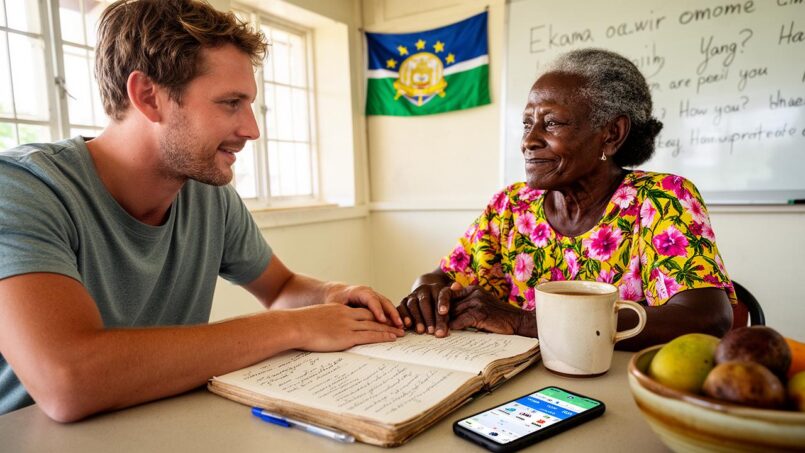
Settling in Nauru means entering one of the most unique linguistic environments in the Pacific. In this tiny island nation, English is omnipresent, a direct legacy of decades of Australian influence, but the true key to integration remains the local language: Nauruan, or Dorerin Naoero. For an expatriate, mastering a few words and then full sentences is not just practical—it’s a gesture of respect within a small, tight-knit community very attached to its culture.
This article details the Nauruan language, identifies specific learning challenges, and proposes concrete methods as well as reliable resources for making effective progress during a stay in the country.
Why learn Nauruan when everyone speaks English?
In Nauru, the vast majority of the population handles English fluently. This bilingualism is largely due to Australian administration after World War II and the central place of English in school, commerce, and government. For a newcomer, it is therefore entirely possible to live day-to-day in English.
But limiting one’s exchanges to English means constantly staying on the surface of Nauruan society. Nauruan is not a simple “local dialect”: it is the national language, spoken at home, in the street, during ceremonies, family gatherings, celebrations, and prayers. About 6,000 people use it as their first language daily, and over 90% of Nauruans understand and speak it.
Several strong reasons argue for expatriates to take it seriously.
First, the identity dimension. Teachers, elders, and local institutions are mobilizing to preserve a language considered threatened in the long term by the weight of foreign media and English. School programs, community projects, and cultural activities are specifically dedicated to passing on Nauruan songs, stories, and words to children. Showing that one makes the effort to learn this language, even modestly, is perceived as a sign of respect and alignment with these preservation efforts.
Nauruan society is matrilineal and community-oriented, valuing respect (bwai) and solidarity (eñ). Using greetings, jokes, and expressions in Nauruan, especially with elders, facilitates integration and shows respect for the local culture.
Finally, finer access to the local context. A large part of social life—street comments, quick exchanges at parties, informal announcements—takes place in Nauruan. English remains the language of bureaucracy, commerce, and school, but it is Nauruan words that convey the nuances, humor, and subtleties of everyday life. To understand what is really happening around you, a few hundred words and simple structures are already a considerable asset.
Understanding Nauruan: a Micronesian language… not so simple
To choose a learning method wisely, it’s useful to know what kind of language you’re dealing with. Nauruan is an Austronesian language, belonging to the Micronesian subgroup. Recent fieldwork-based research has confirmed its kinship with other Central Pacific languages, notably Marshallese. But this language has also evolved internally in a very marked way, which sometimes makes the links with its cousins opaque.
For a French or English speaker, several characteristics make Nauruan both fascinating and difficult.
The vowel system concentrates the main difficulties. Long and short vowels overlap with numerous allophonic variants: [iː], [ɨː ~ uː], [eː ~ ɛː], [oː ~ ʌ(ː) ~ ɔ(ː)], [æː], [ɑː], etc. Several vowels centralize to [ə], others desyllabify when another vowel follows. Stress partly depends on the structure of the final syllable (vocalic or consonantal) and the presence of reduplication. For a learner, this implies paying sustained attention to prosody, not just isolated sounds.
The Nauruan language is grammatically distinct from French and English. Its word order is debated (Subject-Object-Verb or Subject-Verb-Object). It intensively uses particles, suffixes, and redundancy to express aspect, person, distance, number, or possession. For example, different suffixes in /-n/ mark perfective aspect, 3rd person singular, or the construct state. Demonstratives specify three degrees of distance: proximity (suffix /-e/), mid-distance (/a/), and far (/o/), inherited from Proto-Micronesian.
Pronouns, finally, account for not only singular and plural, but also more specific numbers (two, three, several) and the inclusive/exclusive distinction, which adds a layer of subtlety to agreement.
This overview could be discouraging. Yet, Nauruan is not unapproachable because of it. For an expatriate, the goal is not to become a specialist linguist but to develop a functional proficiency: understanding common phrases, expressing oneself simply, recognizing keywords in daily exchanges. Keeping this pragmatic goal in mind, the complexity becomes a background, not an absolute obstacle.
Nauruan spelling: between reform, variations, and difficult readings
Another particularity to know before starting: Nauruan writing has gone through several phases, and there is still no totally applied homogeneous standard.
Originally, the spelling was based on a Latin alphabet reduced to 17 letters: five vowels (a, e, i, o, u) and twelve consonants (b, d, g, j, k, m, n, p, q, r, t, w). The letters c, f, h, l, s, v, x, y, z were excluded. Under the influence of contact with German, English, Gilbertese (Kiribati), and Australian Pama‑Nyungan languages, new signs and combinations were introduced. Some old manuscripts made intensive use of diacritics, notably the tilde to mark vocalic differences.
In 1938, a Nauruan linguistic committee led notably by Timothy Detudamo attempted an ambitious reform. The idea was to make the language more accessible to European and American readers: replace the tilde with a circumflex accent for some vowels (õ becoming ô, ũ becoming û), substitute “e” for “ã”, introduce “y” to distinguish sounds confused by English, write the velar nasal “ng” instead of “ñ”, transform “bu” and “qu” into “bw” and “kw”, and simplify “ts” to “j” with the removal of the final “w” in several words.
The Nauruan spelling reform has only been partially applied. In practice, one still finds tildes on some vowels and spellings like “ts” in district names. Usage varies by generation, institution, and author. Today, about thirty different Latin letters can appear in writings, with discrepancies between old religious texts, historical dictionaries, recent educational materials, and projects like the Nauruan Wikipedia, which follows its own system.
For an expatriate, this translates into two practical implications. First, one must accept from the outset that there is no single “correct” spelling and will encounter different spellings for the same word. Second, it’s better, as much as possible, to rely on recent resources or explicitly standardized ones to learn the most common form today, while passively recognizing older variants.
The weight of English and the real place of Nauruan in daily life
On the ground, English and Nauruan form a continuum rather than a strict opposition. English is the language of administration, official documents, diplomatic exchanges, and a good part of education. Depending on educational policies, it is the main medium from the first years of schooling, even though efforts exist to immerse young pupils in Nauruan up to Year 3 in some schools.
In Nauru, Nauruan remains the language of the private and cultural sphere (home, informal conversations, gatherings, songs, and prayers). English is the language of administration, with official texts often bilingual. In practice, conversations frequently alternate between these two languages, with a local English-based pidgin often serving as an intermediary. This linguistic landscape is thus hierarchical and functional, each variety (Nauruan, English, pidgin) having a specific role, although the pidgin is also considered threatened.
This situation has two effects for an expatriate. On one hand, it greatly facilitates daily life: finding an English-speaking interlocutor is easy in administration, at the hospital, at school, or at the hotel. On the other hand, it can create the illusion that learning the local language is superfluous, even though it’s in non-institutional contexts—family meals, fishing, ceremonies, children’s games—that the strongest bonds are formed.
For a foreigner, aiming for limited but solid active proficiency in Nauruan is therefore realistic and useful: understanding greetings, talking about oneself, one’s family, immediate needs, exchanging about food, transportation, weather, prices, and a few frequent conversation topics (work, children, celebrations, religion).
Structured resources: dictionaries, word lists, and online tools
One of the paradoxes of learning Nauruan is the gap between the richness of the language and the scarcity of modern pedagogical tools. It’s far from the abundance of textbooks, podcasts, and applications that exist for French or Japanese. Yet, a few targeted resources can be of great service to a motivated expatriate.
Among the most useful, several dictionaries and lexical databases deserve particular attention.
The Freelang Dictionary: a solid starting point
The Freelang dictionary is probably the most accessible digital tool to start with. Designed by Renato Figueiredo, who also developed dictionaries for Micronesian languages like Pohnpeian or Kosraean, it offers a free Nauruan–English and English–Nauruan lexicon.
The Nauruan-English dictionary contains nearly 4900 entries in total, combining both translation directions.
One of this tool’s strengths is its participatory dimension: one can not only search for words but also add or modify entries and create personal vocabulary lists. For a learner, this allows building a personal thematic repertoire (work, health, food, family, weather…) directly linked to one’s daily life on the island.
The main technical characteristics can be summarized as follows:
| Resource | Direction | Number of entries | Platforms | Main features |
|---|---|---|---|---|
| Freelang Nauruan | Nauruan → English | 2,399 | Windows, Android, Web | Add/modify entries, personal lists, free |
| Freelang Nauruan | English → Nauruan | 2,503 | Windows, Android, Web | Same functions, bilingual interface |
The database hasn’t been updated recently, but for an expatriate looking for simple equivalents, the tool remains extremely valuable.
Historical dictionaries: Delaporte and older sources
For those who wish to go further, there is a small historical treasure: the dictionary by Philip Delaporte published in 1907, when Nauru was a German colony. This pocket lexicon (10.5 × 14 cm) has about 65 pages of glossary and a dozen pages of sample phrases. It is organized from German to Nauruan and contains about 1,650 German entries, resulting in nearly 1,300 distinct Nauruan forms.
This resource, based on the standardized language of the early 20th century, is not suited to modern learners. Its spelling uses accent marks that are now obsolete (except the tilde). It is nevertheless valuable for curious expatriates or professionals working with old documents.
These sources can be supplemented by more recent lexical work grouped in databases like the Automated Similarity Judgment Program (ASJP), which provides a Nauruan wordlist for language comparison. This list was compiled by André Müller and Søren Wichmann and identified by the glottocode naur1243 and the ISO 639‑3 code “nau”. This data does not constitute a usage dictionary but a basic corpus useful for verifying forms or spotting cognates in neighboring languages.
A summary table helps locate the main lexical resources:
| Resource | Type | Languages | Approximate content | Usefulness for expatriates |
|---|---|---|---|---|
| Freelang Dictionary | Software + online | Nauruan/EN | ≈ 2,400–2,500 entries per direction | Very high |
| Delaporte Dictionary (1907) | Historical print book | DE/Nauruan | ≈ 1,650 German entries | Medium (curiosity, studies) |
| ASJP List (naur1243) | Comparative wordlist | Nauruan | Basic lexical list | Low (beginner level), marginally useful |
Translation platforms and bilingual corpora
To fill lexical gaps, several generalist sites offering participatory translations can serve as complements. Glosbe, for example, offers translations from English to Nauruan, with equivalents sorted by frequency, definitions, grammatical information, example sentences in context, and sometimes audio recordings.
Glosbe uses a translation memory from parallel corpora to show word translations in context. The site also offers an illustrated dictionary and an automatic translator. For expatriates, its main interest lies in the example sentences and inflection indications, providing a glimpse of the language’s real usage.
The Master Any Language site also has a section dedicated to Nauruan, with games, flashcards, and tests. A specific app (“Nauruan M(A)L“) is available on Android. These tools don’t have the finesse of a structured course, but they can support self-learning, especially for memorizing isolated words through spaced repetition and games.
Another table helps situate these digital tools:
| Platform / app | Main function | Strengths for Nauruan |
|---|---|---|
| Glosbe | Collaborative dictionary + corpus | Examples in context, audio, inflections |
| Master Any Language | Games, flashcards, tests | Playful approach, dedicated Nauruan M(A)L app |
| Freelang (online) | Simple dictionary | Simplicity, possible offline work |
None of these tools is perfect or complete, but cumulatively, they offer a sufficient foundation for an expatriate building their vocabulary and seeking quick confirmations.
Courses, lessons, and multimedia content: making the most of limited resources
Another particularity of learning Nauruan: there are few conversation textbooks or structured audio methods like those for Samoan or Tahitian. One must therefore make the best use of a set of fragmented but complementary resources.
On the internet, one can find several free beginner lessons, often focused on essential phrases. Videos like “Nauruan Language Lesson” allow hearing native speakers pronounce greetings, common phrases, frequent questions. Some videos have subtitles, others are presented as short clips where an expression is repeated.
University or popularization materials (like blogs on poorly documented languages) offer word lists by theme (body parts, numbers, family, common verbs, natural elements). These resources don’t constitute progressive courses but provide a practical base for organizing one’s own learning sessions.
For an expatriate, one of the most effective strategies is to combine these unstructured resources with general language learning methods: using an SRS like Anki to review vocabulary, shadowing (repeating aloud) from videos, self-recording to check pronunciation, and learning by “chunks” (set phrases) rather than isolated words. We’ll return to this methodological dimension later.
Integrating the language into life on-site: immersion, exchanges, and daily gestures
The best resource for learning Nauruan is Nauru itself. Living on the island offers an opportunity few remote learners can afford: hearing the language in real situations, every day. The challenge is to turn this passive exposure into active practice.
Social life in Nauru, organized around the extended family, matrilineal clans (ibubwe), religious gatherings, celebrations, and shared meals, offers numerous learning opportunities. Every visit, ceremony, or fishing trip is a chance to pick up expressions, practice pronunciation, or ask how to say a word in Nauruan. Although most residents use English with foreigners, initiating interaction with a greeting in Nauruan positively changes the dynamic of the exchange.
In shops, at markets, at school, or at work, one can impose a small discipline: formulate at least the first sentence in Nauruan, before switching to English if necessary. Saying hello, thank you, goodbye, asking “How much?”, “Where is…?”, “Do you speak Nauruan?” in the local language quickly establishes a different, more personal relationship.
Local institutions like the Department of Culture & Language, some schools, and the academic community can also be interesting relays. Although Nauruan is not yet taught everywhere as a full subject, programs exist to develop textbooks, standardize spelling, and create “Nauruan Readers.” An expatriate involved in education, culture, or cooperation can, by showing interest, not only find material but also contribute to its dissemination.
Concrete strategies for expatriates: how to really progress
The geographical remoteness, small population, and relative scarcity of resources mean learning Nauruan requires a thoughtful approach. Fortunately, many general language learning techniques apply very well, provided they are adapted.
A first effective idea is to set short-term goals, very concrete ones. For example, mastering the 300 most useful words during the first two months, being able to hold a two-minute micro-conversation about one’s family, or understanding simple announcements at a community gathering without help.
To achieve these goals, it’s relevant to work by themes rather than alphabetical lists. Greetings and polite phrases, food vocabulary, numbers and amounts, expressions for saying you don’t understand well, asking to repeat, asking for help, form blocks immediately reusable in daily life.
Apply the 80/20 principle to memorization: a small part of the lexicon covers the majority of situations. Focus first on the most common words and expressions, available on Freelang, Glosbe, or in basic online lists. This approach allows quickly acquiring solid basics for communicating, even simply.
Spaced repetition (via Anki or another SRS app) helps anchor this vocabulary. It’s possible to export or manually enter words from the Freelang dictionary or a phrase site and build a customized deck, with the word or phrase in Nauruan on one side, the translation and possibly an example sentence on the other. By adjusting the review frequency, the learner progressively consolidates long-term memory.
Particular attention must be paid to pronunciation, as the consonant and vowel system, with its trilled or tapped r’s, length contrasts, and central vowels, constitutes a major hurdle. Useful techniques include listening on loop to recordings of native speakers, immediate imitation (shadowing), recording and comparing one’s own pronunciation, and seeking feedback from a Nauruan speaker if possible.
Speaking aloud, even alone, is another powerful lever. Constructing small sentences from learned chunks, repeating them in different variants, describing what one is doing (“I’m going to school,” “I’m eating,” “I’m tired today”) helps automate simple syntactic patterns, without delving into the most complex details of academic grammar.
Finally, immersion must become daily. Thinking in Nauruan for a few minutes a day, putting labels on household objects with their local name, listening to Nauruan children’s songs or stories, even with partial understanding, contribute to making the language a familiar presence rather than a school exercise.
Exchange platforms and tutors: bridging the lack of formal courses
Unlike major languages like Spanish or Arabic, there are no large global platforms offering dozens of Nauruan tutors to date. However, several types of services can be exploited indirectly.
First, global platforms for connecting with teachers (like TUTOROO, Preply, AmazingTalker, or others) show that the model of private online lessons is well-established for many languages. Even if Nauruan isn’t widely represented there yet, these tools give an idea of what could be done locally: an expatriate can, for example, draw inspiration from these formats to set up paid sessions with a Nauruan speaker on-site, via simple messaging or video conferencing, adapting payment arrangements directly.
Use platforms like Tandem, HelloTalk, or InterPals to try to find Nauruan speakers. Although profiles are rare, a targeted search with the keywords “Nauru” or “Nauruan” may allow you to connect with one or two people interested in a language exchange, often English for Nauruan.
On-site, it is finally possible to solicit local teachers, students from the University of the South Pacific, or members of the Department of Culture & Language to organize a weekly micro-conversation group. Models already exist in the Pacific for other island languages, with “language nests” or community workshops. The important thing is to clarify the objective (basic conversation, everyday vocabulary) and accept an empirical progression, without expecting a perfect course structure from the start.
Limits of current resources and possible role of expatriates
The situation of Nauruan in terms of pedagogical resources is mixed. On one hand, the language is officially recognized, used by the majority of the population, taught partially in school, and supported by institutions like a national language office. On the other hand, the number of modern dictionaries remains limited, orthographic standardization is incomplete, and large bilingual dictionary projects are still in their early stages.
For an expatriate, this translates into learning often cobbled together from bits and pieces: vocabulary lists, the Freelang dictionary, blog articles, isolated videos, personal notes taken from contact with colleagues. One must accept this exploratory dimension.
Paradoxically, expatriation opens possibilities for contribution. An expatriate can, for example, share their international expertise with their home country remotely, invest in local projects, or facilitate cultural and economic exchanges between the two countries.
– enrich existing databases by reporting errors or adding missing translations on collaborative platforms like Glosbe;
– suggest to Nauruan interlocutors to compile thematic lists together for other newcomers (useful vocabulary for work, health, school, etc.);
– participate in language documentation projects, when they exist, by providing user feedback on what is most useful for an adult learner.
In a context where local teachers, linguistic committees, and researchers work towards a better description of the language, expatriates can play a modest but real role as “demanding users,” able to say which tools would most help them integrate into the community.
Dealing with linguistic complexity: aiming for competence, not perfection
It would be illusory to promise an expatriate complete mastery of Nauruan in a few months. The phonological structure (high number of vowels, length contrasts, multiple r’s, nasal assimilation phenomena), the grammatical subtleties (multiple /‑n/ markers, complex pronouns, reduplication, nuanced demonstratives), and orthographic variation make the language objectively demanding.
Mastering a few essential Nauruan phrases significantly improves the stay. It’s enough to know how to: greet (“Ekamawir omo” or “Mo yoran”), thank (“Tubwa kor”), say goodbye (“Tarawong”), apologize for one’s level, ask to repeat, count, read basic signs, ask for directions, and hold simple conversations about food or the weather.
Moreover, many Nauruans are aware of the challenges of their language. Academic descriptions highlight how even specialists hesitate about the exact nature of certain sounds or the analysis of certain paradigms. Speakers themselves sometimes report difficulties reading standardized texts or juggling multiple spellings. In this context, a foreigner’s effort is generally met with indulgence.
The most important thing is therefore to set realistic expectations, cultivate curiosity rather than an obsession with perfection, and remember that every word spoken in Nauruan is perceived as a mark of respect towards a culture and a community whose language remains at the heart of its identity.
Towards a richer experience in Nauru through language
Learning Nauruan as an expatriate is not a trivial undertaking. On an island where the population is limited, where almost everyone knows each other, where kinship and neighborhood ties structure the entire social fabric, speaking—even imperfectly—the local language profoundly changes how one is perceived.
Online tools, videos by enthusiasts, and old dictionaries contribute to documenting this Micronesian language long neglected. Recent theses in phonology and classification reaffirm its importance within its linguistic family while highlighting its originality and the profound internal changes it has undergone.
For an expatriate, relying on this work is not strictly necessary: no one will ask you to explain the continuation of Proto-Oceanic *R or the details of progressive nasal assimilation. But understanding that one is dealing with a rare, complex language, long misunderstood and today threatened, gives additional meaning to the learning effort.
In practice, the following combination offers a solid framework:
To learn a rare language, first build a stock of targeted vocabulary using resources like Freelang and Glosbe. Use the few available online lessons and videos to fine-tune your pronunciation. Then turn every daily interaction into a mini language exercise. Apply proven learning methods, like spaced repetition, shadowing, and memorizing phrase chunks, to consolidate your knowledge. Finally, accept orthographic variation as a characteristic of the language, rather than an unsolvable problem.
In a country where English is widely mastered by the population, learning Nauruan is not a necessity for survival, but a choice of cultural engagement. For those who make this choice, the reward is both linguistic and human: a finer understanding of what is really being said around them, and above all, a fuller place within the small community that makes Nauru a unique place in the Pacific.
Disclaimer: The information provided on this website is for informational purposes only and does not constitute financial, legal, or professional advice. We encourage you to consult qualified experts before making any investment, real estate, or expatriation decisions. Although we strive to maintain up-to-date and accurate information, we do not guarantee the completeness, accuracy, or timeliness of the proposed content. As investment and expatriation involve risks, we disclaim any liability for potential losses or damages arising from the use of this site. Your use of this site confirms your acceptance of these terms and your understanding of the associated risks.

Cyril Jarnias is an independent expert in international wealth management with over 20 years of experience. As an expatriate himself, he is dedicated to helping individuals and business leaders build, protect, and pass on their wealth with complete peace of mind.
On his website, cyriljarnias.com, he shares his expertise on international real estate, offshore company formation, and expatriation.
Thanks to his expertise, he offers sound advice to optimize his clients' wealth management. Cyril Jarnias is also recognized for his appearances in many prestigious media outlets such as BFM Business, les Français de l’étranger, Le Figaro, Les Echos, and Mieux vivre votre argent, where he shares his knowledge and know-how in wealth management.





