
 Published on and written by Cyril Jarnias
Settling in Niue means entering a world where the Pacific Ocean meets an island culture of astonishing richness. For an expat, the key to not staying a mere observer is the local language: Vagahau Niue. Even though English is widely spoken, especially by younger people, making the effort to learn the country’s language is seen as a sign of respect, a social key, and, in Niue’s case, a concrete gesture to support an endangered language.
Vagahau Niue is a Polynesian language closely related to Tongan, with only 7,000 to 8,000 speakers worldwide, mostly in the diaspora. Classified as severely endangered by UNESCO, its use, even by expats, directly contributes to its preservation.
Understanding Niue’s Linguistic Ecosystem
Arriving in Niue without any linguistic bearings often leads to thinking English will suffice. That’s true for administrative procedures, routine professional exchanges, and children’s schooling. But it’s false as soon as you want to enter the heart of local life: the villages, the elders, religious ceremonies, community meals, and informal chats on the village green.
An Asymmetric Bilingualism
Niue’s Constitution gives equal official status to English and Vagahau Niue. In practice, most residents are bilingual, with English more commonly used among young people and Vagahau Niue more strongly cherished by older generations. Knowing a few basic phrases therefore allows you to:
To better understand and integrate into the community, it is recommended to speak directly to elders in their language without automatically resorting to English. Also important: attend community activities like church services, village meetings (fono), or traditional earth oven (umu) preparations. Finally, learn to decipher announcements, songs, prayers, and speeches that often alternate between English and Vagahau Niue.
Niueans often describe their language as beautiful but fragile. Public authorities, both on the island and in New Zealand, actively encourage its use at home, in school, and in the community. For an expat, learning the language is therefore not just practical: it’s joining a revitalization movement already underway.
A Language Close to Other Polynesian Tongues
For anyone already familiar with Tongan, Samoan, or Māori, Vagahau Niue will feel familiar, both in vocabulary and grammatical logic. The alphabet has only 16 letters (5 vowels, 11 consonants), the syllable structure is simple (no consonant clusters), and the grammar remains relatively regular.
For expats already familiar with Pacific languages, learning is facilitated by the transparency of many words and the easy transfer of pronunciation habits, such as pure vowels and open syllables.
Why Expats Have Everything to Gain from Learning Vagahau Niue
It’s tempting to rely on English, especially since Niueans are known for being patient, warm, and often trilingual. But in the medium term, this traps the expat in an Anglophone bubble, fed mainly by other foreigners, the internet, and a few outward-facing structures.
Learning Vagahau Niue changes things on several levels.
Gaining Trust and Goodwill from Locals
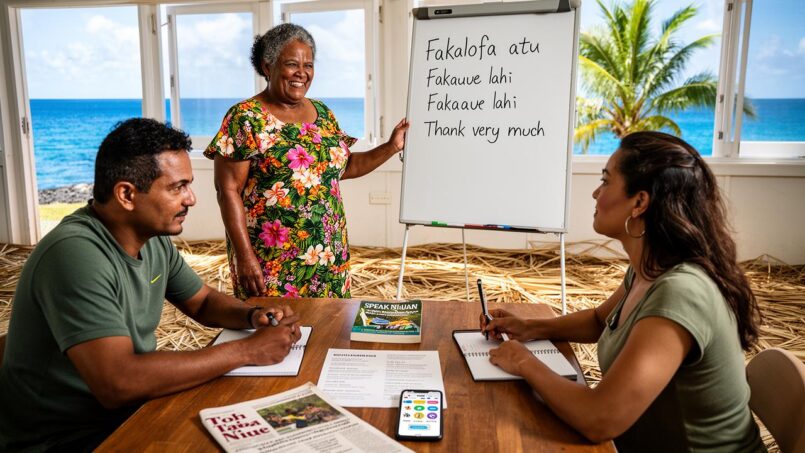
Greeting at the market with a “Fakaalofa lahi atu”, thanking with a “Fakaaue lahi”, politely asking “Ko fe e falevao?” instead of “Where is the toilet?” creates an immediate distinction from the passing tourist. Niueans don’t expect an advanced level, but they appreciate the effort. It’s often said that not trying to learn the language of the country you live in is poorly perceived, almost as a lack of respect.
A few well-placed phrases are often enough to trigger a smile, a compliment, or even an invitation to a meal or a village event. This shows how simple, positive communication can easily create bonds and open doors in daily life.
Accessing “Taoga Niue,” the Living Heritage
Niuean culture – Taoga Niue – is experienced in contexts where Vagahau Niue remains the norm: church hymns, prayers, ceremonial speeches, stories, jokes, proverbs, historical accounts, weaving workshops, and coconut crab (uga) hunts. Without at least some language skills, these moments become mere spectacles. With a few basics, they turn into shared experiences.
Formal registers (tūtala fakalilifu) use specific vocabulary to honor elders, chiefs, pastors, or ceremonies. These nuances are explored in advanced Vagahau Niue courses, but even at the beginner level, you can learn respectful phrases used in speeches and prayers.
Integrating into Villages and Daily Life
In Niue, there are no big shopping malls, fast-food chains, or sanitized tourist resorts. Relationships are built at the Alofi market, at village Show Days, at Sunday services, in weaving halls like Aliutu or Makini Hall, or during school activities.
For an expat, sticking to English often means being invited “out of politeness.” In contrast, someone who shows they are learning the language is more easily integrated: people will correct their pronunciation, teach them new words, and include them more in conversation.
Useful Linguistic Basics to Start With on the Ground
Learning a language is always a combination of sounds, structures, and words. In Vagahau Niue, certain elements should be identified early on because they appear everywhere, from the market to church.
Alphabet and Pronunciation, Without Getting Lost in Theory
The traditional alphabet has five vowels (a, e, i, o, u) and eleven basic consonants (f, g, h, k, l, m, n, p, s, t, v). The “g” represents the sound /ŋ/ as in “sing,” the letter “t” is pronounced [s] before i and e, and vowel length (ā, ē, ī, ō, ū) changes word meaning. There are no double consonants, no final consonants, which simplifies reading.
To be understood, you don’t need to master all the phonology. Use apps like Fakaako e Vagahau Niue or Asalei, which offer native recordings and a “tap-to-hear” function to directly associate spelling, sound, and meaning. A few active listening sessions are enough to avoid basic errors, like mispronouncing words such as “Uga.”
First Words That Open Every Door
Even before taking a structured course, it’s possible to learn a core vocabulary that will be useful everywhere.
A small sample, to use from day one:
| English | Vagahau Niue |
|---|---|
| Hello / greetings | Fakaalofa (lahi) atu |
| Please | Fakamolemole |
| Thank you / thank you very much | Fakaaue / Fakaaue lahi |
| Yes / No | E / Nakai |
| Sorry / excuse me | Tulou / Fakamolemole lahi |
| Food / to eat | Kai |
| Beautiful | Fuluola |
| Good / Bad | Mitaki / Kelea |
| Church | Fale lotu |
| House | Kaina |
Integrating these few words into daily interactions turns every outing into a mini conversation workshop. Asking a neighbor to repeat, checking pronunciation, daring to try a slightly longer phrase like “Manamanatu au kia koe” (“I’m thinking of you”) helps make the language a habit, not a school exercise.
Digital Toolkit: Apps and Platforms Dedicated to Vagahau Niue
Unlike other Polynesian languages, Vagahau Niue now has digital tools specifically designed for it. They provide an ideal foundation for expats, provided they are integrated into an overall plan where life on the island becomes the main practice ground.
Fakaako e Vagahau Niue: The Most Comprehensive App
Fakaako e Vagahau Niue is a free app, available on Google Play (and also listed on the App Store in some resources), developed by Kiwa Digital Ltd with support from the Government of Niue and the New Zealand Ministry of Education through a Pacific innovation fund.
The app offers: innovative features and a user-friendly interface.
– Synchronized narration for texts
– ” Tap-to-hear” function to listen to the pronunciation of each word
– Recording tool to listen back to yourself and compare with a native speaker
– Content organized by theme: alphabet, numbers, colors, greetings, family, body parts, villages, calendar, seasons, sports, health, weather, values, proverbs, workplaces, etc.
– Interactive maps of villages, linking vocabulary to local geography
For an expat, this approach offers a dual benefit: it allows you to work on the language independently while providing access to culturally rooted content. This content includes proverbs, values, and references to everyday events (weddings, funerals, birthdays) that you are likely to encounter within the local community.
Asalei: The Serious Game Focused on Daily Practice
The Asalei app, accessible on the web and mobile, works like a Duolingo specialized in Pacific languages, including Vagahau Niue. It offers:
– Short lessons, designed for “little and often”
– Interactive challenges that force you to produce sentences, with immediate correction
– A tracking system with streaks, experience points (XP), and lesson milestones
– Offline mode for reviewing without a reliable connection
– A clear focus on real-life contexts: home, church, community
Asalei is particularly suited to busy expats who want to integrate the language into micro-moments: ten minutes before heading to the beach, five minutes while waiting for service, fifteen minutes in the evening. Since the app is also widely used in New Zealand, Australia, and the United States, it serves as a bridge with the diaspora.
Learn Niue / Learn Niuean Online: The Free, Structured, Audio Course
The website www.learnniue.com (or Learn Niuean Online) is a project of the New Zealand Ministry of Pacific Island Affairs. It offers:
Discover a complete and free course to progress effectively, enhanced with audio supports and useful links.
A complete and free course, organized into graded units for progressive learning.
Audio recordings for each lesson to work on comprehension and pronunciation.
Numerous links to other resources: dictionaries, games, and educational materials.
Where apps rely on gamification, Learn Niue offers a more academic progression: ideal for consolidating grammar, reviewing verb conjugation through tense markers, and working on longer dialogues. For an expat in Niue, it’s a solid supplementary resource to use a few times a week.
Online Dictionary Tohi Vagahau Niue
To move beyond the “all-app” approach, the online dictionary Tohi Vagahau Niue, hosted by the Auckland University of Technology (digitization of Wolfgang B. Sperlich’s comprehensive dictionary), is a key resource. It allows you to:
– Verify the spelling and meaning of a word heard in the village
– Understand dialectal variants (Motu in the north, Tafiti in the south)
– Search for a formal or informal term to adjust your register
Combined with the apps, this dictionary turns every encounter, every sermon, or every song you hear into study material.
Formal Courses: Leveraging New Zealand Programs, Even Remotely
The great peculiarity of Vagahau Niue, compared to many small languages, is that it benefits from funded courses overseen by New Zealand’s educational authorities. Even if expats living on the island don’t always meet the entry criteria, these course models provide a clear roadmap for structuring your learning.
NZQA / Centre for Pacific Languages Courses: Three Levels, 30 Hours Each
The Centre for Pacific Languages, an organization registered with the NZQA, offers Vagahau Niue courses funded by the New Zealand government. The typical format:
– 10 weeks of classes
– 1 two-hour session per week via Zoom, with a tutor
– At least 1 hour of personal revision per week
– 30 learning hours per level
Three levels are defined, with specific objectives.
Beginner Level: Learning to Introduce Yourself and Follow Basic Protocols
Designed for those with no background or very basic knowledge, this level is taught in English and aims to:
An example of fundamental skills for integrating into Niue includes: knowing how to introduce yourself by giving your name, where you live, and introducing your family, grandparents, ancestors, and village of origin; using simple greetings like “hello,” “good morning,” “good evening”; mastering expressions used at key Niuean life events such as birthdays, weddings, and funerals; and adopting appropriate linguistic behavior depending on the context, whether at church, in the village, or during a ceremony.
For an expat in Niue, this is exactly the foundation you need to survive socially in the first few weeks.
Conversational Level: Entering Simple Everyday Exchanges
This level is for those who want to hold simple conversations with family, friends, and colleagues. It focuses on:
– Listening, pronunciation, and sentence accuracy
– Vocabulary for family roles, honorific terms, and family trees
– Relationships with the environment (places, seasons, directions)
– The ability to give a simple opinion on a cultural practice (e.g., a ritual or traditional food)
– Role-playing scenarios, leading up to individual oral presentations
The quantified goal is clear: at least 200 simple conversational words, plus understanding punctuation and grammar basics.
Advanced Level: Culture, Taboos, and Protocol
The advanced level is for those who already have a good foundation. It aims for:
To interact respectfully in Niue, it is essential to understand and apply the following principles: master communication regarding family, community, and important life events; grasp cultural behaviors, customs, taboos, and unwritten rules; understand gifting codes in ceremonial contexts; and be able to discuss Niuean social norms, leadership structures, and apply protocols (speeches, formal greetings) at official events.
The goal here is at least 300 simple words usable in different settings: home, work, worship, community. In a home setting, you might use words related to rooms, furniture, and daily activities. For example, words like kitchen, living room, bedroom, table, chair, meal, sleep, and play are essential in this context. These words help describe the family environment and everyday interactions. At work, vocabulary may include terms related to tasks, collaboration, and organization. Words such as project, meeting, office, colleague, report, deadline, and strategy are important for effective communication. They help structure professional exchanges and clarify expectations. For worship, the words used are often spiritual and community-oriented. Terms like prayer, faith, church, congregation, hymns, sermon, and meditation come to mind. These words help create an environment conducive to reflection and spiritual connection, facilitating the sharing of religious experiences. In the community, vocabulary should reflect social engagement and interactions between individuals. Words like solidarity, neighbor, event, volunteering, gathering, and help are crucial. They encourage participation and strengthen bonds among community members. In summary, having a repertoire of 300 simple words adapted to different settings fosters clear and effective communication, whether at home, work, in a religious context, or within the community. It also ensures smooth and natural exchanges, enriching interpersonal relationships and reinforcing social ties.
Access Limitations, but Rich as a Model
These courses are free but reserved primarily for New Zealand citizens or permanent residents, with age requirements (16+, or 13–15 with a guardian). Expats living in Niue may not automatically qualify. However, the model highlights important principles:
– Aim for 3 hours of active exposure per week (2 guided + 1 independent)
– Structure learning around what is relevant on-site: identity, family, village, life events, key locations
– Immediately associate language with cultural protocol
Even without enrolling in an official course, it’s possible to learn a language by structuring your study over 10 weeks for a total of 30 hours. This method relies on combining free resources: mobile apps, a dictionary, YouTube videos, and daily immersion in the language.
University Training and School Resources
For highly committed expats (teachers, researchers, spouses of Niueans), the University of the South Pacific (USP) offers courses coded NU111, NU211, etc., covering language, culture (Taoga Niue), translation, and teaching Vagahau Niue. They are taught in person at the Niue campus, but do not open every year.
Meanwhile, the New Zealand school system has developed a whole arsenal of resources:
– “Tau Hatakiaga ma e Vagahau Niue” (Niue Language Guidelines) aligned with the 2007 curriculum
– “Haia! An Introduction to Vagahau Niue” and its storybooks, with teacher support materials
– Dual-language resources (Niuean–English) for young children, available in PDF and MP3
– Vagahau Niue vocabulary lists for NCEA levels 1, 2, and 3, recently revised
An expat in Niue can benefit from these via the Internet: these documents provide structured word lists (by theme and frequency) and a coherent progression to build competence.
Media, Culture, and Immersion: Making the Island Your Classroom
Intensive immersion methods recommend plunging into an environment where the target language is omnipresent. In Niue, immersion is not theoretical: it happens daily, as soon as you agree to step outside tourist circuits.
YouTube, Music, and Stories: Learning by Ear
For expats, YouTube is a valuable ally. You’ll find:
– Content from “Ko e Tohi Tapu – Lakepa Ekalesia Youth” and “Lologo Niue” (religious hymns, traditional music)
– Channels like “Loopy Tunes Preschool Music” or “Pasifika Beatz” offering children’s songs in Vagahau Niue (animals, colors, alphabet)
– Videos made for Niue Language Week, e.g., “Niue Language Week 2022: Phrases of the Day,” or mini pronunciation lessons
– Videos from the “Cubuma Ebnemar Collection” mixing personal testimonies, prayers, and stories
Listening to this content regularly helps your ear get used to the sounds, intonations, and common words of the language. This practice is also an opportunity to discover important cultural aspects, such as religion, the art of weaving with master artisan Makataone Pilokolu, as well as stories and humor.
Print Resources, Bibles, and Bilingual Albums
For those who enjoy reading, the range of print resources is surprisingly rich for a language of this size:
A selection of varied supports for studying the Niuean language, ranging from formal texts to visual educational tools.
A massive corpus of formal language, available through the Christian Resource Centre or digitally on Internet Archive. Particularly useful for church attendance.
The book *Niue: Bilingual, English–Vagahau Niue* (Moana Oceania collection) presents the country in both languages, ideal for phrase-by-phrase comparison.
Resources like “Niue Months of the Year – Wall Art Family Learning” or “Days of the Week Labels Niuean/English,” available on Etsy or Twinkl, provide easy-to-display supports for home.
For expat children, these supports make the language less abstract. But they are equally useful for adults who want to spontaneously associate “Aho Lotu” with Wednesday, or “Mahina” with the moon, bypassing English.
Games, Flashcards, and Visual Aids
Between internet outages, card games, labels, and posters are reliable allies. You can find:
– Thematic flashcards (body, animals, numbers)
– Online games like “Niuean language online games” for reviewing vocabulary and phrases
– Lists like “15 Essential Niuean Words for Your Trip to Niue” (Niueisland website) for memorizing a language survival kit
The simplest strategy is to stick labels in Vagahau Niue on household objects: “fale kai” on the kitchen, “fale koukou” on the bathroom, “puhalatu” on a map marking the road.
Living the Language Daily: Practical Immersion for Expats
Pedagogical theories (natural approach, communicative approach, task-based learning) all converge on a simple idea: you learn a language by using it. Niue, with its slow pace, strong community ties, and the glaring absence of “globalized” entertainment, offers a perfect setting for that.
Making Every Activity a Chance to Speak
An expat wanting to progress in Vagahau Niue can turn ordinary actions into micro-learning sessions:
– At the Alofi market, ask for the price in Vagahau Niue, even if you finish in English; try out words for products (ika, moa, niu, fua lakau)
– At church, follow hymns with the translation or the bilingual text of Koe Tohi Tapu in front of you, pick out recurring phrases
– During a Village Show Day, ask for the names of dishes (takihi, povi masima, faikai ika, pitako, nane) and repeat them to the cook
– During a weaving workshop, learn a few action verbs (totoli – to climb, tòtò – to hold, lologo – to sing) and work them into conversation
The golden rule is to use the language “little but often.” A word here, a phrase there, naive but sincere questions. The goal is not grammatical perfection, but continuity of use.
Language learning advice
Don’t Stay Among Expats
Field reports emphasize a classic risk: the expat who creates a 100% Anglophone microcosm (or Francophone) and ultimately only interacts with Niueans in a functional way. In Niue, the island’s size and the strength of village ties make this strategy quickly frustrating.
To truly learn Vagahau Niue, it is essential to:
– Attend Sunday services, not just major holidays
– Join a weaving group, a youth association, or a village committee if possible
– Attend ceremonies (funerals, weddings, important birthday celebrations) while observing speeches and key words
– Offer your help during preparations, accepting that conversations will largely happen in Vagahau Niue
This is the percentage of initial comprehension during repeated immersion in a language, which nevertheless accelerates acquisition.
Using Family and School as Relays
For expats who come with children, school is a powerful accelerator. The education system follows the New Zealand curriculum, with bilingual instruction, cultural days, weekly traditional singing and dancing sessions, and even weaving or carving classes for “tufi,” “tika,” and model “vaka” canoes.
Children, often faster at language acquisition, can become powerful relays for the whole family:
– Establish a “Niuean night” at home where, during dinner, everyone tries to use as many words learned at school or from apps as possible
– Use bilingual storybooks and MP3 audio resources for family read-aloud and listening time
– Encourage children to learn songs in Vagahau Niue and explain the lyrics
Again, the idea isn’t to turn the home into a classroom, but to integrate the language into enjoyable activities.
Relying on the Diaspora and Events like Niue Language Week
Even far from Niue, the language lives within an active diaspora, especially in New Zealand. Niue Language Week, organized annually with support from the Ministry for Pacific Peoples, is its most visible showcase.
Niue Language Week: Much More Than a Symbolic Celebration
Faahi Tapu he Vagahau Niue, Niue Language Week, features:
– Workshops in singing, dance, arts, and crafts
– Conversation classes, webinars, Facebook Lives
– Distribution of mini-videos “phrase of the day,” often reusable as learning tools
The recent theme emphasizes that it’s not enough to love the language in theory; you must actively practice it, both individually and collectively.
For an expat already on the island, following the dedicated Facebook page, checking the resources posted online, or even organizing a small local echo activity (phrase-of-the-week evening with neighbors) is a concrete way to link personal learning with broader community momentum.
Organizations and Networks: Don’t Learn Alone
Several organizations are central to the advocacy and transmission of Vagahau Niue:
| Organization | Main Role Related to Language |
|---|---|
| Vagahau Niue Trust | Steering revitalization projects, apps, campaigns |
| Ministry for Pacific Peoples | Funding (Language Week, resources, guidelines) |
| Niue Youth Network | Engaging Niuean youth, cultural activities |
| Pacific Learners | Producing video and online educational content |
Even though many of these structures operate from New Zealand, they produce resources accessible everywhere. For an expat, subscribing to their newsletters, following them on social media, or contacting them for resource advice is a way to avoid learning in a vacuum.
Building Your Own Learning Plan in Niue
With the multitude of resources mentioned, the risk is spreading yourself too thin. The ideal is to create a kind of mini-plan, inspired by the NZQA courses but adapted to the reality of expat life on the island.
A Realistic Roadmap for 10 Weeks
Following the logic of 30 hours per level, one can imagine, for a beginner expat, a 10-week cycle structured like this:
| Component | Frequency / Approximate Duration |
|---|---|
| Asalei or Fakaako e Vagahau Niue | 3×10–15 min per week (short lessons) |
| LearnNiue.com (lesson + audio) | 1×30–45 min per week |
| YouTube / music in Vagahau Niue | 3×20 min (background or active listening) |
| Real interaction (market, church, neighbors) | 2 occasions per week where you use at least 5 Niuean phrases |
| Personal review (flashcards, online dictionary) | 1×30 min per week |
This plan doesn’t require an overwhelming amount of time, but ensures regular and varied exposure: written, oral, guided, free, digital, social.
Connecting Language and Cultural Taboos
An important aspect of advanced Vagahau Niue courses is understanding behaviors, taboos, and gift-giving protocols. For an expat, these concepts are not just theoretical. They determine how you should speak, or not speak, in certain situations:
To visit Niue respectfully, avoid touching “vaka” (canoes) encountered on coastal paths, as they are considered sacred. Adapt your vocabulary in this context where the Christian religion is very present and deeply rooted. Also understand the importance of gifts, whether monetary or in kind, at events like funerals, weddings, or Show Days, and use the appropriate expressions of gratitude expected by the community.
Gradually, the learner no longer just mentally translates their thoughts into Niuean: they adjust what they say to what is socially appropriate to say.
Specific Limits and Challenges for Expats
Learning Vagahau Niue as an expat in Niue also presents distinct obstacles compared to learning a “global” language.
Fragmented Resources, Uneven Access
Major international platforms (Duolingo, Babbel, Pimsleur, Rosetta Stone, etc.) do not support Vagahau Niue. Existing tools – Fakaako e Vagahau Niue, Asalei, LearnNiue, Tohi Vagahau Niue, YouTube – are powerful but scattered. There is no one-size-fits-all solution.
Some official language courses, like those from the Centre for Pacific Languages or NZQA-certified ones, require residency in New Zealand. It is therefore necessary to build your own learning path by combining the available options.
Small Community Size, Large Diaspora
The island’s population is small, and the number of active Vagahau Niue speakers is declining. A significant portion of the “language warriors” are in the diaspora, especially in New Zealand. On the ground, this means you’ll find Niueans deeply attached to the language, but also young people who have little command of it or use it mainly in ceremonial contexts.
For an expat, it’s essential to identify people in your local network who are willing to act as “informal tutors.” This might include an elderly neighbor, a colleague, a church member, a weaver artisan, or a teacher. These figures offer practical and social support to ease integration into the new culture.
Perfectionist Pressure and Fear of Ridicule
In a small community, you sometimes feel that every mistake is visible and remembered by everyone. It’s the opposite of the anonymity of a big city. Yet all accounts agree: Niueans are forgiving with those who try to speak their language, and many of them are themselves learning English as a second or third language. Accepting to stumble, correct yourself, and ask “Fakmolemole, talahau foki lā” (“Please repeat”) is part of the process.
Conclusion: Learning the Local Language as an Act of Rooting in Niue
Learning Vagahau Niue in Niue is not a mere linguistic hobby. It is an act of rooting, respect, and participation in the survival of a threatened heritage. Between dedicated apps, structured New Zealand courses, online resources, church hymns, markets, and villages, an expat has everything needed to progress.
Immersion in the Niuean community comes through daily use of Vagahau Niue. Greetings like ‘Fakaalofa lahi atu’ or thanks like ‘Fakaaue lahi’, participation in events like Niue Language Week, or informal exchanges around traditional recipes or weaving workshops, are concrete actions that, accumulated, build a genuine and deep sense of belonging.
In a context where the language is officially recognized but digitally fragile, every expat who chooses to learn Vagahau Niue becomes, in their own way, another link in the transmission chain. And discovers, along the way, that the best way to understand Niue is neither a tourist brochure nor a travel blog, but rather the words its people use to describe themselves.
Disclaimer: The information provided on this website is for informational purposes only and does not constitute financial, legal, or professional advice. We encourage you to consult qualified experts before making any investment, real estate, or expatriation decisions. Although we strive to maintain up-to-date and accurate information, we do not guarantee the completeness, accuracy, or timeliness of the proposed content. As investment and expatriation involve risks, we disclaim any liability for potential losses or damages arising from the use of this site. Your use of this site confirms your acceptance of these terms and your understanding of the associated risks.

Cyril Jarnias is an independent expert in international wealth management with over 20 years of experience. As an expatriate himself, he is dedicated to helping individuals and business leaders build, protect, and pass on their wealth with complete peace of mind.
On his website, cyriljarnias.com, he shares his expertise on international real estate, offshore company formation, and expatriation.
Thanks to his expertise, he offers sound advice to optimize his clients' wealth management. Cyril Jarnias is also recognized for his appearances in many prestigious media outlets such as BFM Business, les Français de l’étranger, Le Figaro, Les Echos, and Mieux vivre votre argent, where he shares his knowledge and know-how in wealth management.





