
 Published on and written by Cyril Jarnias
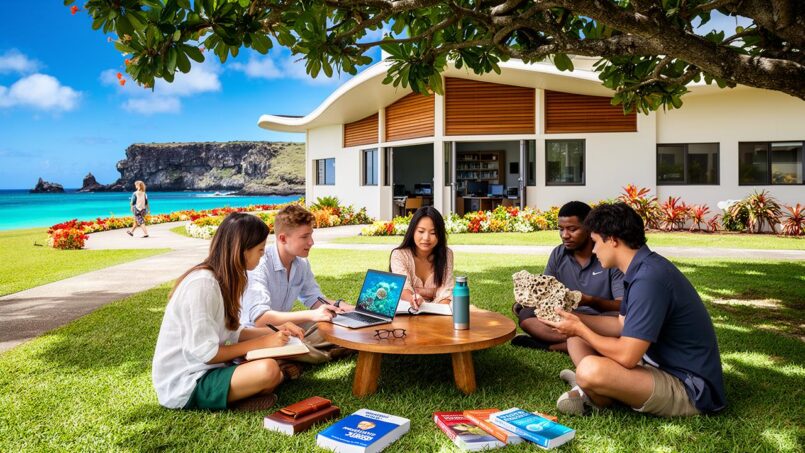
Choosing to pursue higher education abroad is already a major decision. Deciding to do it in Niue is even more so. This small Pacific island nation, often absent from international rankings, nonetheless offers a very unique study environment, blending community closeness, exceptional natural surroundings, and strong connections to New Zealand and the Pacific region.
Good to know:
This article details all aspects of higher education in Niue: the education system, available institutions, language of instruction, cost of living, housing options, necessary insurance, and opportunities for further study in other countries.
Understanding Niue’s Education System
Before diving into higher education, it’s important to understand how education works in Niue. The country has made a clear choice: aligning its system with New Zealand’s. Practically, from early childhood through the end of secondary school (Year 13), curricula, levels, and certifications follow the New Zealand model.
Caution:
Education is free and compulsory from ages 5 to 16. Schooling takes place in two public institutions: Niue Primary School (Years 1 to 6) and Niue High School (Years 7 to 13). Both schools closely follow the New Zealand curriculum. The NCEA (National Certificate of Educational Achievement) was introduced at the high school level in 2002, simultaneously with New Zealand, and the New Zealand Qualifications Authority (NZQA) conducts an annual audit to ensure compliance and quality.
Secondary school lasts 6 to 7 years and mixes academic subjects with more vocational modules. Along the way, several certificates mark future pathways: a Form 5 School Certificate at the end of Year 11, a Form 6 Certificate after Year 12, and a Form 7 Certificate at the end of Year 13. With a Form 6 Certificate, students can already apply for technical training or teacher education. The Form 7, with at least five passed subjects, opens the door to bachelor’s degrees at the University of the South Pacific (USP) and, more broadly, university entrance.
Good to know:
From middle school (Years 7 to 9), students take a semester-long ICT introductory course for 2 hours a week over two terms, based on the New Zealand curriculum. In Year 10, they can choose to continue with computing as an option. Schools have internet access, and a policy to strengthen connectivity was implemented as early as 2004 to facilitate access to NZQA online resources.
This very tight-knit structure, with only two public schools, explains why many young people then pursue studies abroad, particularly in New Zealand, Fiji, Samoa, or Australia. However, Niue and its regional partners have set up post-secondary training structures on the island to prevent a total student exodus.
Higher Education Institutions in Niue
For such a small territory, Niue has a surprisingly dense university landscape on paper. Several international institutions claim a presence there, though their physical footprint and recognition vary.
Among the structures mentioned in sources are James Cook Medical University, Lord Liverpool University, and the Royal Academy of Fine Arts (Det Jyske Kunstakademi). The day-to-day reality of these presences is hard to verify, and for an international student, the key players to consider are clearly two institutions: St Clements University Higher Education School – Niue and the University of the South Pacific (USP) campus in Niue.
It should also be noted that no university in Niue currently appears in the Times Higher Education World University Rankings or other major international rankings. This does not mean local programs lack value, but it does require particular caution regarding accreditation, credit transferability, and degree recognition.
St Clements University Higher Education School – Niue
St Clements University Higher Education School – Niue holds a unique position. The institution obtained a license from the Niue Ministry of Education in March 2005, specifically on March 30, 2005 according to some sources. It was established to offer long-term training programs to Niue’s population while also welcoming international students. Its Niue headquarters are located in Alofi, the capital.
Tip:
The institution operates entirely online and offers a wide range of programs, from single-subject certificates to doctorates. This flexibility allows students to acquire specific isolated skills or accumulate credits toward a full formal qualification.
Programs are described as flexible, structured, and aligned with contemporary needs, especially for students looking to train in management and business. For example, St Clements offers:
– Business Management programs that incorporate degrees regulated by the British authority OFQUAL,
– Engineering programs that meet academic requirements to become a fellow of the Singapore Institute of Technological Engineers and obtain professional engineer status with the Society of Professional Engineers International.
The institution partners with ATHE (Awards for Training and Higher Education), an awarding body regulated by OFQUAL and other authorities, which collaborates with over 200 centers in about thirty countries. The “global” St Clements, corporately registered in the Turks and Caicos Islands in 1995, presents itself as a multi-national university recognized by various ministries of Education.
Caution:
Information on St Clements in Niue varies (sole registered institution or private representation). Before enrolling, any international student must absolutely verify on the university’s official website: tuition fees, scholarship opportunities, recognition of degrees in their home country, and ideally, acceptance of credits or degrees by other international institutions.
The University of the South Pacific (USP) Campus in Niue
The true pillar of higher education in the country remains the Niue USP Centre, the regional center of the University of the South Pacific. Opened in 1972, it was relocated in 2000 to Paliati, in the Alofi area, as part of an “education hub” project grouping together the primary school, high school, university, and the Education administration. This vision only truly materialized in 2018 when the Education Department office was set up on the same site.
The USP is a regional university, founded in 1968 and co-owned by twelve Pacific states: Cook Islands, Fiji, Kiribati, Marshall Islands, Nauru, Niue, Samoa, Solomon Islands, Tokelau, Tonga, Tuvalu, and Vanuatu. It is recognized as the flagship higher education institution in the Pacific and one of the few universities in the world operating on a multi-state regional model. In 2017, it gathered nearly 30,000 students and has obtained several international accreditations.
Example:
The University of the South Pacific (USP), whose main campus is in Suva (Fiji), has a center in Niue that functions as a satellite campus. This center is primarily dedicated to distance learning, adult education, and continuing education. It allows the majority of Niuean students to pursue higher education without leaving their country.
The Niue USP Campus offers, through Pacific TAFE and the university’s schools, a range of programs: pre-university (one or two years of preparation), certificates, diplomas, bachelor’s degrees, post-graduate certificates and diplomas, up to an MBA. Among the specifically mentioned programs: a certificate in the vernacular language (Vagahau Niue), a post-graduate diploma in arts (Pacific Studies), and an MBA.
On-site staff is small: one director, one librarian-finance officer, a part-time IT assistant, and a part-time cleaner. No permanent teaching staff are based in Niue; courses at the bachelor’s or master’s level are delivered remotely from other campuses (notably Laucala), or occasionally through local cohorts.
Student numbers are low and highly variable, partly due to emigration to other countries for studies. The university hopes to stabilize these numbers through on-site organized cohorts for certain programs. Material conditions can be challenging: unstable power supply, unreliable internet, limited equipment. Despite this, students are described as very motivated, and USP remains the main provider of recognized degrees in the region. Most graduates of the Niue center join the national civil service, depending on their field of study.
Languages of Instruction and Bilingualism in Niue
Niue is officially bilingual, with two official languages: English and Niuean (Vagahau Niue), a Polynesian language related to Tongan and Samoan. In primary and secondary schools, classes are taught in both languages. Recent statistics show that about 69.7% of residents report speaking Niuean, with 30% being bilingual Niuean-English. There is also a significant share of exclusively Niuean speakers (46%) or exclusively English speakers (11%).
Good to know:
At the USP campus, courses are delivered in two languages depending on their code. Modules identified by the code “NU” are taught in Vagahau Niue and are only available in person. Other courses, particularly in linguistics and humanities, are provided in English, either online for all campuses or in person at the Laucala campus in Fiji.
For a non-Niuean international student, English is the primary working language for USP or St Clements programs. However, proficiency in Niuean can open specific opportunities, for example in language teaching, cultural preservation, or administrative roles related to language policy.
Pathways to Higher Education
For a student who has completed schooling in Niue, the path to higher education is well-marked. Upon leaving Niue High School, several options are available, depending on their results, financial means, and ambitions.
Good to know:
After obtaining the Form 5 and Form 6 Certificate, students can enter technical fields, teacher training, or USP pre-university programs. A common option is to complete one or two years of preparation at the Niue USP Campus before continuing studies at a main USP campus or at a university abroad, particularly in New Zealand, Fiji, or Australia.
After Form 7, with a validated certificate and five passed subjects, the student is generally eligible for a bachelor’s degree at USP. They can also apply to New Zealand or Australian universities, often using scholarships or university entrance certificates.
For an international student targeting Niue directly as a destination, things are different. Available information indicates that a platform like RocApply offers online applications for studying in Niue, with, depending on the level, the following required documents:
Documents Required for Admission
List of documents needed to apply for a university program, depending on the level of study.
Bachelor’s
High school diploma and transcripts, medical report, health insurance, proof of language proficiency (English, sometimes French or Arabic), ID, passport, and signed application form.
Master’s
Bachelor’s degree and transcripts, medical report, health insurance, proof of language proficiency, ID and passport.
Doctorate
Master’s and bachelor’s degrees, transcripts, medical report, health insurance, proof of English (and/or French) proficiency, CV, and possibly an interview with an admissions committee.
These requirements are consistent with those of many international universities: proof of sufficient academic level, health guarantees, and adequate health insurance.
Cost of Living in Niue for a Student
Niue is often described as a country where daily life can be expensive, especially for imported goods. Its small size (259 km²), isolation in the Pacific, lack of industrial production, and dependence on imports explain sometimes very high prices, particularly for food, consumer goods, or electronics.
2020
Reference year for budget data expressed in US dollars.
A summary table provides some rough estimates:
| Type of Expense | Example (USD, approx.) | Comment |
|---|---|---|
| Rural rent (4 rooms, 2 bathrooms) | ~200 / month | In rural area, spacious accommodation |
| 1-bedroom apartment city center | ~800 / month | In town, more expensive |
| Market / monthly food | ~300 / month | Average food budget |
| Basic utilities (water, elec, gas) | ~140–165 / month | Depending on accommodation size |
| Internet (Wi-Fi 8 Mbps) | ~145 / month | Considered “expensive” in sources |
| Fast-food meal | 25 | Hearty meal |
| Bread (1 baguette/loaf) | 9.50 | High price for a staple |
| Liter of milk | 8.50 | Costly import |
| Dozen eggs | 12.50 | Common but pricey |
| Whole chicken 2 kg | 38.75 | Expensive meat product |
| Pack of noodles | 2.00 | “Cheap” product |
| Taxi (5–10 km) | 45 | Motorized transport is expensive |
| Gasoline (1 liter) | 6.50 | High fuel cost |
| Car rental (1 day) | 140 | Impact of geographic isolation |
| Gym membership (1 month) | 105 | Fitness center |
| Men’s haircut | 40 | Basic service |
These figures illustrate the Niue paradox: real estate remains affordable, but imported food, services, and especially electronics (40” TV around USD 2,000, laptop around USD 3,000, smartphones from USD 1,000) can seriously strain a student budget.
For an international student, optimization will come through smart housing management (shared apartments, self-contained units, homestays) and adapting to locally available products (subsistence crops, basic staples) rather than systematically seeking imported foods.
Student Housing in Niue
The town of Alofi and nearby villages offer a surprisingly wide choice of accommodations, ranging from simple guesthouses to upscale villas, as well as lodges, motels, and self-catering studios. These are not university residences per se, but they regularly host workers, interns, and sometimes students.
Here, for reference, a comparative overview of some typical options:
| Type of Accommodation | Location | Typical Capacity | Key Amenities |
|---|---|---|---|
| Tuaga Lodge (studios + 2 bedrooms) | Alofi | 1–4 ppl | Equipped kitchen, A/C, Wi-Fi, laundry |
| Peleni’s Guesthouse | Alofi | Double/family rooms | Private bathroom, shared kitchen, Wi-Fi |
| Taloa Heights (studios/apartments) | Alofi (on height) | 1–4 ppl | Small kitchen, pool, A/C |
| Stone Villas | Alofi | Up to 3 ppl | Self-catering villas, car included, airport transfer |
| Damiana’s Holiday Motel | Avatele | 2–4 ppl | 1-bedroom units, kitchen, Wi-Fi (paid) |
| Scenic Matavai Apartments & Villa | Tamakautoga | Studios + villa | Pool, BBQ, kitchen |
| Vinnie’s Guesthouse | Alofi South | 3-bedroom house | Kitchen, close to shops and bars |
Many other addresses exist: NIC’s Bungalows, Petite Hatava, Kololi’s Motel, Joema Place, Kaliki Lodge, Lialagi Dorm and Units, as well as several private houses rented weekly or monthly (Pokopoko, Tiny Grove, Tropical Rainforest Retreat, etc.). Many of these accommodations are described as self-catering, with equipped kitchens, which is a key advantage given the cost of eating out.
Tip:
The daily rates mentioned, often in Singapore dollars or Indian rupees, generally correspond to mid-to-high-end tourist accommodation. For an extended stay, it is highly recommended to negotiate a monthly rate, which is much more advantageous. For example, a large house in a rural area can be rented for around USD 200 per month.
For a student, several strategies are possible: choose a guesthouse in the heart of Alofi, close to the USP center and services (e.g., Peleni’s, Aliutu, Joema Place); opt for studios like Tuaga Lodge or Taloa Heights, which offer good independence; or share a larger house (Vinnie’s Guesthouse, Kaliki Lodge, Lalopine Rockhouse) to pool costs.
Good to know:
Most accommodations offer Wi-Fi, free or paid, which is essential for taking online courses (St Clements, USP). However, network quality can vary. It is therefore advisable to have backup solutions, such as using mobile data or downloading courses in advance.
Tuition Fees: What Is Known, What to Verify
Available sources do not provide detailed fee schedules for St Clements University – Niue or the Niue USP Centre. It is simply stated that tuition fees, potential scholarships, and other expenses (housing, transportation, materials, meals, personal expenses) should be checked directly on the official websites of the institutions.
However, there is plenty of data on study costs in New Zealand, the country where the majority of Niuean students study. This information does not automatically apply to Niue, but provides a regional ballpark figure.
For example, for New Zealand, the annual ranges for international students are often as follows:
| Level of Study | Estimated Annual Fees (NZD) |
|---|---|
| Bachelor’s | 20,000 – 30,000 |
| Master’s | 25,000 – 40,000 |
| Graduate Diploma | 19,000 – 28,000 |
| PhD (often domestic rate) | 6,500 – 10,000 |
| Diplomas / certificates | 14,000 – 22,000 |
Additional academic expenses (books, lab materials, internet) can add 800 to 1,800 NZD per year. Meanwhile, New Zealand authorities require international students to prove they have at least 20,000 NZD per year for living expenses, with estimated monthly living costs between 1,000 and 1,800 NZD depending on the city.
Tip:
For Niue, no official tuition fee amounts are published. One might anticipate potentially lower fees at institutions like USP or St Clements. However, these costs will be partially offset by high expenses related to imports (essential goods) and costly internet connectivity. The international student must absolutely account for this balance in their budget.
– request a detailed tuition fee quote (per semester or per year),
– ask administrative services about hidden costs (registration, exam, online resource fees),
– accurately assess their on-site living budget, taking into account the prices noted for food, internet, and transportation.
Health Insurance and Medical Coverage for Studying in Niue
Available information emphasizes one key point: to study in Niue as a foreigner, it is essential to have appropriate insurance. The text mentions that a specific policy for students in Niue exists, designed to meet visa requirements, cover unexpected medical care, theft, loss or damage to personal effects, as well as travel disruptions.
Caution:
It is advisable to check existing insurance (national insurance, bank card, etc.), as they rarely cover certain critical items: additional medical costs, medical repatriation, civil liability, accommodation and luggage, legal assistance. Additionally, the criteria imposed by three distinct parties must be taken into account.
– Niuean legislation and immigration rules,
– specific requirements of the host university or institution,
– practices in the student’s home country, particularly regarding overseas coverage.
Good to know:
Even if examples often come from US or European universities, the same principles apply for Niue. A student insurance policy should offer worldwide coverage outside the home country, including at minimum emergency care, hospitalization, medical evacuation, and repatriation of remains. It is also recommended to include civil liability and travel assistance.
Given Niue’s geographic isolation and the country’s vulnerability to cyclones, heavy rains, droughts, and sea-level rise, a specific insurance component for natural disasters and emergency evacuation to a third country (New Zealand, Australia, Fiji) is strongly advised.
Lifestyle, Society, and Environment
Studying in Niue means accepting life in a micro-island state of about 1,700 inhabitants (2017 figures), with a very close-knit community, a slow pace of life, and a strong presence of Polynesian traditions. The country is in free association with New Zealand, which grants Niueans New Zealand citizenship and aligns some of its policies (including education) with Wellington’s. The political climate is stable, with a Parliament (Niue Assembly) of 20 members and a government led by a Premier.
Crime is low, family and community ties are very strong, and the culture is rich in ceremonies and traditional practices. Biodiversity, especially forest and marine, plays a central role in daily life, both for food and cultural practices.
Good to know:
Niue is the world’s largest raised coral atoll, formed from a limestone plateau on an ancient volcano. Its rocky coastline, with cliffs, caves, and blowholes, overlooks very deep ocean waters. The interior, covered in tropical forest, rests on poor, permeable karst soils. The island has no surface freshwater resources; fresh water comes exclusively from an underground lens and rainwater collection.
The climate is tropical maritime, with a hot, humid season (November to April) and a cooler, drier season (May to October). Average temperatures hover around 24–25°C, with a modest seasonal range (4°C). Annual rainfall is around 2,000 to 2,180 mm, mainly as intense rain events and cyclones between December and March. The country lies on the edge of the tropical cyclone belt: on average, one occurs every four years within 400 km, including one severe every ten years.
5
Average annual sea-level rise in millimeters since 1993, according to the provided content.
For a student, this context means: the importance of adapting to new learning conditions and heightened expectations from professors.
– enjoying an exceptional natural environment, popular with tourists for snorkeling, diving, whale watching, and coastal hikes,
– living in a society where respect for nature and customary practices is central,
– integrating into a territory directly exposed to climatic hazards, which has made it a strategic issue (national climate policy, Department of Meteorology and Climate Change, awareness in schools with “Climate Awareness” days).
International Mobility and Scholarships for Niuean Students
Even though the article focuses on studying in Niue, it is impossible to ignore the numerous mobility opportunities available to Niueans to other countries. This point indirectly concerns international students considering Niue: they will be joining a student body very outward-looking, where people often think about prospects in New Zealand or Australia.
Good to know:
The Australia Awards Scholarships are Australian government scholarships specifically for citizens of Niue. They fund master’s degrees in Australia and fully cover tuition fees, return airfares, establishment allowance, living expenses, health coverage, an academic introduction program, academic support, and fieldwork assistance if needed.
Conditions are strict: reside in Niue at the time of application, be at least 18 years old, not be subject to a return obligation from another scholarship, have at least three years of relevant professional experience, and meet the host university’s entry requirements. Priority areas include education (assessment, training, linguistics), health, hospitality-tourism, IT, management, technical trades, but are regularly reviewed by the Australian and Niuean governments.
Tip:
Several scholarship options are available beyond national aid: New Zealand scholarships (Manaaki Scholarships), regional scholarships for studying at Pacific universities (including USP, except in Niue), Erasmus Mundus programs in Europe, as well as scholarships offered by Canadian or British universities. For Niuean students, an effective strategy often involves starting a course at the University of the South Pacific (USP) or a local institution, then leveraging these academic credits to successfully apply for international funding programs.
Niue as a Springboard to the Region
For an international student, the appeal of Niue as a study destination is not limited to what happens on the island itself. The institutional and human connection with New Zealand, Fiji, and the entire USP network also makes it a potential springboard to other countries.
Many Niuean students indeed continue their tertiary studies in Auckland, Wellington, Christchurch, at the University of Fiji, or other regional institutions. Organizations like the Open Polytechnic of New Zealand or The Correspondence School also have learners based in Niue.
Good to know:
An international student starting a program at USP in Niue can, under transfer conditions, continue their studies at the Laucala (Suva) campus or other university sites. Credits earned are also recognized for entry into a university in New Zealand or Australia. USP has an international office in Suva that handles all administrative procedures (applications, visas, reception) and coordinates international exchange programs, particularly with Europe via Erasmus+ and with Japan via programs like JENESYS.
In Niue itself, the USP campus acts as a relay: it coordinates distance programs, organizes local cohorts, provides academic support and resource libraries, while maintaining close ties with the regional network.
Strengths and Limitations of a Study Project in Niue
For a student considering higher education in Niue, especially coming from abroad, the strengths and limitations are clear.
On the strengths side, there is first the originality of the experience: living in a coral micro-state, at the heart of a very close Polynesian community, directly facing the challenges of sustainability and climate change, can be extremely formative for students in environmental studies, Pacific studies, anthropology, or regional development. USP, through its schools of environmental science, law, social sciences, or Pacific arts, provides a rich framework for reflection, even when courses are taken remotely.
Good to know:
USP campuses and centers offer dedicated support for international students, including orientation, clubs, mentoring, sports and cultural activities, health services, counseling, and career assistance. Although many services are physically concentrated in Suva, some are accessible online.
Furthermore, the small size of Niue’s education system ensures a form of personalization: few students, lots of proximity to teachers, a strengthened sense of community. Opportunities for public employment after a USP degree are frequent, with most graduates of the Niue USP Centre joining the central administration.
But the limitations are also significant. The absence of Niuean universities in major rankings, the lack of permanent teaching faculty in Niue for USP, fragile infrastructure (power outages, unstable internet, limited equipment) require a real ability to adapt. Low enrollment also means a more restricted course selection on-site, even if distance learning partly compensates.
Good to know:
Daily life is simple but expensive, with few leisure options and shops. Imported goods are costly due to heavy reliance on sea freight. The cost of internet, essential for distance learning, should also be factored into the budget.
Finally, the natural setting, while spectacular, involves exposure to climate risks and extreme events, which are not encountered in most typical university towns.
Studying in Niue is not a mass choice, and it is not a destination suited to all profiles. For students motivated by the Pacific, interested in environmental issues, local languages or cultures, or wishing to immerse themselves in an island community while following regional USP programs or international online courses, it can however be a very powerful and unique experience. The success of such a project relies on meticulous preparation: checking accreditations, accurately calculating the budget, arranging accommodation, choosing solid health insurance, and a thorough understanding of Niue’s social and climatic context.

Cyril Jarnias is an independent expert in international wealth management with over 20 years of experience. As an expatriate himself, he is dedicated to helping individuals and business leaders build, protect, and pass on their wealth with complete peace of mind.
On his website, cyriljarnias.com, he shares his expertise on international real estate, offshore company formation, and expatriation.
Thanks to his expertise, he offers sound advice to optimize his clients' wealth management. Cyril Jarnias is also recognized for his appearances in many prestigious media outlets such as BFM Business, les Français de l’étranger, Le Figaro, Les Echos, and Mieux vivre votre argent, where he shares his knowledge and know-how in wealth management.





