
 Published on and written by Cyril Jarnias
Settling in Guinea-Bissau means entering a dense, subtle, and far more nuanced religious universe than a simple split among Muslims, Christians, and “animists.” For an expatriate, understanding this spiritual landscape is not a cultural luxury, but a real key to social, professional, and sometimes even political integration.
Religion organizes daily life, holidays, and professional practices, and underpins many forms of solidarity. It is closely linked to ethnic identities and local traditions, leading a large part of the population to navigate between several spiritual worlds simultaneously.
This guide offers a detailed dive into these practices, with a very concrete goal: to help expatriates find their bearings, avoid missteps, and, even better, build trusting relationships with their local contacts.
An officially secular but deeply religious country
Guinea-Bissau is constitutionally a secular state. The Constitution explicitly provides for the separation of religion and state, while guaranteeing freedom of conscience and worship as an inviolable right. In theory and in practice, no citizen may be discriminated against because of their religion, and all enjoy the same rights and obligations.
Religious groups have the legal status of associations. They generally must obtain a license from the Ministry of Justice by declaring information such as their name, size, location, and nature. In practice, this procedure is quite flexible and rarely poses an obstacle, even for foreign missions.
The state considers itself the guarantor of peaceful religious pluralism. It observes several religious holidays as national public holidays, including Good Friday, Easter, Tabaski (Eid al-Adha), All Saints’ Day, and Christmas. This official recognition of Christian and Muslim holidays within a secular framework already gives an idea of the composite nature of the religious landscape.
In 2023, international indicators gave it a score of 3/4 for religious freedom: there are occasional tensions, but the overall framework remains relatively protective.
A religious mosaic without an absolute majority
No religious group holds an overwhelming majority in Guinea-Bissau. This is a key point for an expatriate: there is no “obvious” or “natural” religion of the country, but rather a shifting balance between several major belief families.
Studies vary slightly depending on the source, but they all show the same underlying structure.
Statistical overview
The most frequently cited estimates paint a three-pole landscape:
| Source (year) | Muslims | Traditional / Folk Religions | Christians | Other / Unaffiliated |
|---|---|---|---|---|
| CIA World Factbook (2020) | 46.1% | 30.6% | 18.9% | 4.4% |
| Pew Research (2020) | 46% | 31% | 19% | ≈ 4% |
| Pew-Templeton (2015) | 45.1% | 30.9% | 19.7% | 4.3% |
| ARDA (projection 2020) | 44.7% | 41.2% | 13% | – |
| Alternative estimate (2008) | 45.1% | 14.9% (animists) | 22.1% | 17.9% (other, none) |
All these data converge on one point: Islam is the most widespread faith, indigenous religious practices retain considerable weight, and Christianity is growing over the long term. Some projections estimate that Christians could reach around 30% of the population by 2050.
For an expatriate, it is risky to assume that a contact necessarily belongs to only one religion (Muslim, Christian, or animist). The reality is more complex: affiliations overlap and many individuals combine multiple religious references.
Geographic and ethnic distribution
Understanding where and among which people a given religion is dominant helps anticipate local customs.
| Region / Area | Dominant Religion(s) | Associated Ethnic Groups (main) |
|---|---|---|
| North and Northeast | Sunni Islam (often tinged with Sufism) | Fula (Fulani), Mandinka, Soninke, Susu |
| South and coastal areas | Christianity (mostly Catholicism) + traditions | Pepel (Papel), Manjaco (Manjak), Balanta |
| Center and coast (excluding north) | Traditional religions / animism + syncretism | Balanta, Papel, Manjaco, various other groups |
| Bissau (capital) | Mix of Christianity, Islam, and local practices | Strong ethnic and religious diversity |
Religions are thus closely tied to ethnic identities. In the Muslim north, Islam largely shapes daily life. On the coast, Catholic and Protestant presence is significant but overlays local belief systems. In many villages, belonging to a “world” religion does not erase ancestral rituals.
Islam arrived in Guinea-Bissau well before Portuguese colonization, as early as the 12th century, brought by trans-Saharan trade routes and Berber merchants from the north. However, its large-scale establishment came later: it accelerated in the 18th and 19th centuries, in the wake of wars, political expansions, and Fula jihadist movements.
Estimated percentage of the Muslim population belonging to the Ahmadiyya minority in the early 2010s.
The main Muslim ethnic groups are the Fula, Mandinka, Soninke, and Susu. Mosques serve as places of prayer, religious education (madrasas), and social hubs where family matters, local conflicts, and community projects are discussed.
For the expatriate, this translates into concrete realities: adapting to a new culture, managing administrative formalities, and integrating into a new professional environment.
Social and professional organization is strongly influenced by religious practices. The day is structured around the five daily prayers, with particular importance given to the great Friday communal prayer. The month of Ramadan has a major impact on working hours, energy levels, and meal organization. Finally, holidays like Eid al-Fitr and Eid al-Adha (Tabaski) are essential moments of family and community cohesion that should be taken into account.
During Ramadan, eating or drinking conspicuously in the street during the day is very frowned upon in Muslim areas. Discretion is recommended, even if the law does not prohibit non-Muslims from eating. On Fridays, plan for time buffers for meetings: men may be absent or less available around the time of the main prayer.
Christianity: Portuguese heritage, contemporary dynamism
Christianity arrived via the coast as early as the 15th century, with Portuguese traders and missionaries. Long confined to coastal towns, it consolidated in the 20th century through Catholic and later Protestant missions.
The majority of Christians are Catholic, but the evangelical landscape is expanding, particularly through Brazilian denominations and various independent Pentecostal and Protestant churches. The Methodist, Adventist, and evangelical presence gives Guinean Christianity a very diverse character.
Christians are mainly concentrated in Bissau, the capital, and in the coastal regions of the country, particularly among the Pepel, Manjaco, and Balanta ethnic groups. The Catholic Church has historically played a central societal role, especially in the areas of education and health. It has founded many schools and healthcare facilities, which are open to all, welcoming students and patients of all religious backgrounds.
For an expatriate, the practical implications are many:
– Sunday is widely seen as a day of worship and relative rest, especially in Christian areas;
– Christmas, Easter, All Saints’ Day, and All Souls’ Day (with the Day of the Faithful Departed) give rise to practices that mix European liturgy with African customs;
– Churches – especially Catholic and some Protestant ones – are often gateways for Christian expatriates looking for community, and even logistical support (schooling, charitable projects, etc.).
Catholic schools welcome children of all religions, based on an explicit criterion: possessing “moral values.” It is not uncommon for Muslim families, seeking a structured education, to enroll their children there.
Traditional religions: the invisible foundation that permeates everything
Reducing local religions to “animism” is misleading. They represent a sophisticated set of belief systems, centered on:
– ancestor veneration, perceived as mediators between the living and the spirit world;
– the presence of spirits, called Irân in some contexts, associated with places, objects, animals, or natural phenomena;
– a close connection with nature, where trees, rivers, rocks, and islands can be sacred.
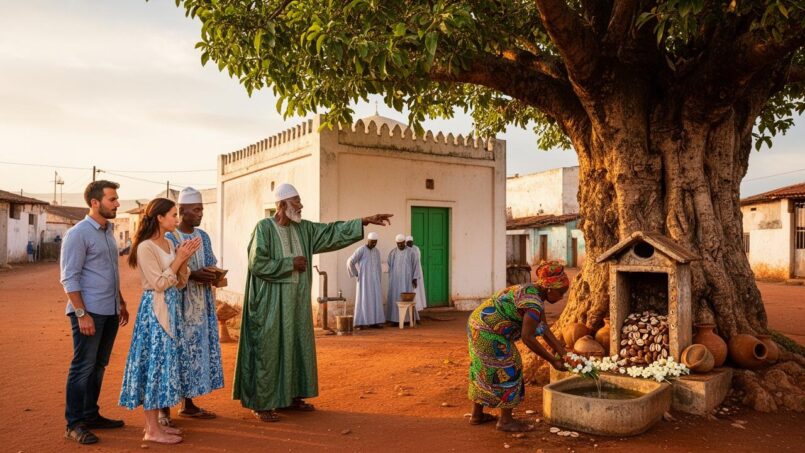
Traditional African religions coexist with Islam and Christianity. For many Bissau-Guineans, belonging to a church or the Muslim community does not replace ancestral beliefs, but adds to them. It is common for an individual to attend both a monotheistic place of worship and participate in traditional ceremonies or consult a diviner for important decisions.
The key figures in these systems are:
– diviners and intermediaries, sometimes called baloubeiro, djambakus, or curandeiros, who practice divination using cowrie shells, bones, or through dreams;
– traditional healers, who combine herbal remedies, rituals, and symbolic interpretations of illnesses;
– elders and leaders of “earth worship houses,” who manage altars, sacred forests, agricultural ceremonies, and rites of passage.
For the Bijagó, for example, the archipelago is inhabited by spirits, and animals like the manatee, sea turtle, or hippopotamus hold a sacred place. The Balanta place great importance on rituals linked to the agricultural calendar. Among the Baga, monumental masks like the Nimba, a female figure associated with fertility, or the Bansonyi for male initiation, testify to a dense ritual universe, even though a large part of the Baga have converted to Islam.
Again, these practices are not confined to a distant past: they permeate political life. For some leaders, obtaining the “blessing of the land” – through so-called “earth ceremonies” – remains a way to legitimize their power, alongside support from a party or a mosque.
A society of syncretism and coexistence
What strikes many observers is the deeply syncretic nature of religiosity in Guinea-Bissau. Many Muslims and Christians continue to believe in spirits, participate in village rituals, wear amulets, or consult a diviner.
Concretely, this leads to situations such as:
Several examples illustrate religious syncretism, including a Muslim faithful who prays at the mosque but also participates in family ritual sacrifices in the sacred forest; a Christian family who has their children baptized in church but consults a traditional healer (curandeiro) for stubborn illnesses; and Catholic processions, like for All Saints’ Day or saints’ days, which incorporate drums, masked dances, and songs inspired by local cultures.
Historically, Europeans and Luso-Africans settled on the coast took these spiritualities very seriously. Some consulted local religious specialists for divination, a sign of the fear and respect inspired by these powers.
For an expatriate, it is useful to keep in mind that the boundary between “religion” and “custom” is not clear-cut: a gesture or practice that one might call “cultural” may, for locals, have a strong religious significance.
Tensions, extremism, and the resilience of tolerance
Religious leaders regularly emphasize the generally peaceful nature of coexistence. Guinea-Bissau is sometimes presented by them as a true laboratory of coexistence between Islam, Christianity, and traditional religions.
Several signs illustrate this tolerance:
– Muslim families send their sons to live for years with Christian families, without requiring their conversion, so they can discover other ways of life;
– children attend schools run by another faith while maintaining their own practices;
– “mixed” religion/tradition marriages are not rare, especially in larger cities.
Despite efforts, tensions continue to emerge, a phenomenon particularly notable in recent years.
– the ransacking of a Catholic church in the predominantly Muslim Gabú region, where a crucifix and religious images were destroyed, fueling fears of a rise in imported Islamism;
– violence linked to accusations of witchcraft, which caused several deaths in 2022 and 2023, and is the subject of awareness campaigns led by the NGO Guinea-Bissau Human Rights League, in collaboration with village chiefs and religious leaders;
– friction around certain Pentecostal churches accused by other leaders (Muslim and Catholic) of maintaining an aggressive discourse toward other faiths through religious radio stations.
The authorities and religious leaders (National Union of Imams, Catholic bodies, evangelical networks) prioritize dialogue to preserve social peace. Their actions include interfaith conferences funded by international partners, peace marches (such as in Bafatá), roundtables on the role of women in preventing extremism, and joint radio programs.
For an expatriate, these elements mean two things. First, the likelihood of being caught in a religious conflict is low, but it is important to avoid aggressive proselytism or polarizing speech. Second, talking about religion is possible, but it must be done with tact, listening first rather than judging.
Religion at work: implicit codes and room to maneuver
In a professional context, religion influences perceptions of ethics, time, and hierarchical relationships.
The major traditions present in the country each bring their own cultural weight:
– Islam emphasizes justice, transparency in transactions, and community solidarity;
– Christianity highlights honesty, service to others, and responsibility;
– traditional religions value respect for elders, a sense of responsibility toward the clan, and protecting balance with nature.
In practice, this translates to:
In this context, it is essential to recognize a strong expectation of loyalty and commitment to agreements. In cases of serious conflict, even professional ones, there may be recourse to religious leaders for mediation. For an expatriate manager, it is crucial to incorporate major religious holidays (such as Ramadan, major Muslim and Christian festivals) and village ceremonies into activity planning, as these are priority obligations.
Implementing reasonable accommodations – flexible hours during Ramadan, leave for important ceremonies, consideration of dietary restrictions during team meals – is often highly appreciated and builds trust.
Knowing how to behave: dress codes and respectful attitudes
Bissau-Guinean society is generally modest in its dress codes, especially outside the most urban neighborhoods of Bissau.
For an expatriate, a few simple principles avoid misunderstandings:
Choose modest, loose-fitting clothing, especially for women in rural or Muslim areas. Avoid very short skirts, low-cut tops, and clothing that reveals the stomach or thighs. Women are advised to bring a scarf, useful for covering the head in some Muslim spaces and to show respect during various ceremonies. For men, avoid tank tops and overly flashy outfits in formal or religious settings.
Traditional clothing – boubous for men, colorful dresses for women – is highly appreciated during festivals, religious ceremonies, or family events. Wearing a simple, appropriate version when invited is a sign of consideration that leaves a positive impression.
Entering a mosque, church, or sacred site: gestures that matter
Etiquette rules vary by tradition, but are based on the same principles: respect, restraint, discretion.
In a mosque:
– always remove your shoes before entering the prayer hall;
– cover your shoulders and legs; women often cover their hair, especially in conservative areas;
– avoid eating, drinking, using your phone, or talking loudly inside;
– never walk in front of someone who is praying;
– clearly ask permission before taking any photos, and accept if the answer is no.
In a church:
To attend Mass, men must remove their head coverings. Decent attire is required, with shoulders and knees preferably covered. Avoid noisy movements during key moments like the Gospel reading, consecration, or prayers. Taking photographs during the service is prohibited without explicit permission.
In traditional places of worship (sacred forests, altars, sacred beaches or islets):
– never go alone without being invited; these spaces are not tourist attractions, but places of high sensitivity;
– carefully follow the instructions of elders or ritual leaders, including regarding photos: most often, they are prohibited;
– respect ritual objects (calabashes, feathers, red or white cloths, offerings), without touching them.
In general, discretion is your best compass: observe first, imitate local behaviors, ask questions with humility.
Daily life: gestures, taboos, and respect for elders
Many codes of politeness have an implicit religious or spiritual dimension.
Among the main ones:
Respect for elders is central: stand up to greet them, give up your seat, and avoid sitting too casually (e.g., legs crossed facing them) in formal contexts. Public displays of affection (kissing, prolonged hugging) are frowned upon, especially in rural or very religious areas. It is considered inappropriate to touch someone’s head. Pointing a finger at someone or beckoning with the index finger is considered rude; use the whole hand, palm down. Finally, the right hand is preferred for giving, receiving, and eating, as the left hand is often perceived as “unclean.”
These codes relate to respect for the person but also, often, to a perception of the body as carrying sacredness (the head) or impurity (certain uses of the left hand).
Photography: between curiosity and intrusion
Guinea-Bissau offers scenes of great beauty, but taking a photo is never a neutral act.
In the street or markets:
– always ask permission before photographing an identifiable person;
– accept refusals without insisting, especially in villages or with elderly people;
– be aware that some merchants or artisans may be very wary of cameras.
In places of worship and ceremonies:
– check if there is an explicit rule (total ban, restrictions);
– avoid flash and angles that trivialize or ridicule the object of worship;
– never interrupt a ritual to get “the perfect shot.”
In traditional ritual spaces:
– consider that a ban is the default rule, unless explicitly stated otherwise by local authorities.
For an expatriate, it’s better to collect stories told than stolen snapshots: this preserves trust.
Being invited to locals’ homes: hospitality and spiritual dimension
An invitation to share a meal or a festive moment with a family is often charged with an implicit religious dimension, whether it is an iftar during Ramadan, a Christmas meal, or a feast for a village ceremony.
A few reflexes to adopt:
Remove your shoes at the entrance if your hosts do so, and wait to be shown your seat. Bringing a small gift (fruit, sweets, or simple local crafts) is appreciated, especially during major religious holidays. During blessings or prayers before the meal, respect the rhythm by remaining silent, with hands joined or in an attitude of reverence, without needing to recite the texts.
Again, the key is to show a clear intention of respect. Bissau-Guineans, accustomed to plurality, do not expect an expatriate to adopt their religion, but to be attentive to what matters to them.
Finding your own religious community as an expatriate
For religious expatriates, faith communities often serve as bridges for integration: they provide moral support, practical help (housing, schooling, administrative procedures), and social networks.
In Guinea-Bissau:
In Bissau, religious services can be multilingual. Catholic and some Protestant churches sometimes incorporate Portuguese, French, or English. In the main mosques, some leaders speak Portuguese, Arabic, English, or French. Small international Protestant communities are rare, but there are Brazilian missions and some initiatives for foreigners.
A pragmatic approach is to:
– use online tools (Google Maps, global directories of churches or mosques) to identify places of worship;
– ask for recommendations from other expatriates, NGOs, international agencies, international schools, or local colleagues;
– try several communities to find one where the language, worship style, and level of openness meet your needs.
Always check in advance that the groups you attend are registered or at least socially recognized. Unofficial gatherings are not necessarily problematic in Guinea-Bissau, but it is prudent to ensure they do not promote intolerant rhetoric that could put you in an awkward position.
Religion, politics, and security: what an expatriate should know
Since independence, Guinea-Bissau has experienced chronic political instability. Religions have been alternately marginalized, instrumentalized, or called upon as mediators.
The country’s recent history includes phases of repression of traditional cults and promotion of specific religious identities. Although authorities today display secular neutrality, practice is more nuanced: religious leaders are often mobilized as mediators to ease social and political tensions, particularly following crises such as coup attempts.
For the expatriate, the challenge is not to master all these subtleties, but:
– to avoid any discourse linking a local religion to violence or economic backwardness, an extremely sensitive subject;
– to refrain from commenting on the “true religion” of the country or judging the persistence of animist beliefs;
– to understand that some religious symbols also have political weight (support from an influential imam, backing from a Catholic network, ties to traditional chiefs).
The best stance: stay out of internal debates and focus on respecting the different actors.
In conclusion: making religion a bridge rather than an obstacle
The religious richness of Guinea-Bissau may initially disorient an expatriate used to more homogeneous frameworks. In reality, it offers a tremendous opportunity for encounters and learning.
A few guiding principles suffice to turn this complexity into a resource:
To approach the religious landscape in Guinea-Bissau, consider every practice as a key to understanding the meaning people give to their lives. Keep in mind that most Bissau-Guineans navigate between multiple spiritual frameworks (such as animism, Islam, or Christianity) without seeing any contradiction. Adopt a posture of observation and listening: ask simple questions (“How does this work?”, “What does this ritual mean?”) rather than making assumptions. Finally, take the time to identify, in your daily environment (neighborhood, workplace, community), the important festivals, specific prayer days, and places considered sacred.
Guinea-Bissau is not just a country where Islam, Christianity, and traditional religions coexist. It is a space where these three families of belief speak to each other, mix, and mutually influence each other. For the expatriate who humbly enters this dialogue, religious difference ceases to be a risk of misunderstanding and becomes a powerful lever for understanding and mutual trust.
Disclaimer: The information provided on this website is for informational purposes only and does not constitute financial, legal, or professional advice. We encourage you to consult qualified experts before making any investment, real estate, or expatriation decisions. Although we strive to maintain up-to-date and accurate information, we do not guarantee the completeness, accuracy, or timeliness of the proposed content. As investment and expatriation involve risks, we disclaim any liability for potential losses or damages arising from the use of this site. Your use of this site confirms your acceptance of these terms and your understanding of the associated risks.

Cyril Jarnias is an independent expert in international wealth management with over 20 years of experience. As an expatriate himself, he is dedicated to helping individuals and business leaders build, protect, and pass on their wealth with complete peace of mind.
On his website, cyriljarnias.com, he shares his expertise on international real estate, offshore company formation, and expatriation.
Thanks to his expertise, he offers sound advice to optimize his clients' wealth management. Cyril Jarnias is also recognized for his appearances in many prestigious media outlets such as BFM Business, les Français de l’étranger, Le Figaro, Les Echos, and Mieux vivre votre argent, where he shares his knowledge and know-how in wealth management.





