
 Published on and written by Cyril Jarnias
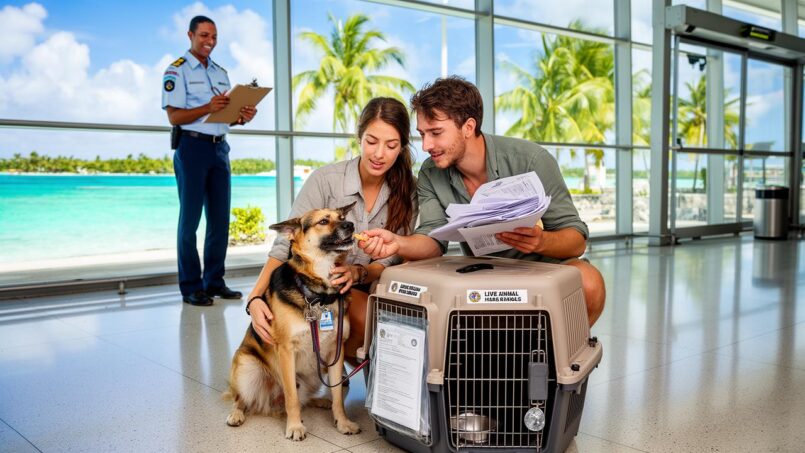
Moving to the Marshall Islands with your dog or cat is far more than just a simple “flight + travel crate.” With no quarantine facilities on the islands, a near-inevitable stopover in Hawaii or Guam, a scarcity of veterinarians, and an often extreme tropical climate, a poorly prepared relocation plan can quickly become a nightmare for the animal… and for the owner.
This guide outlines the essential steps for a successful relocation with a pet, including required vaccinations, air travel logistics, finding suitable housing, and adapting to daily life on the islands.
Understanding the Framework: An Island Free of Rabies… and Quarantine
The Marshall Islands have strict regulations for dogs, cats, and domestic ferrets, including service and assistance animals. The goal is straightforward: remain rabies-free—especially since the archipelago has no quarantine infrastructure.
In practice, this means that authorities will only accept animals that have already been “secured” elsewhere. Two main pathways exist:
For an animal to enter the Marshall Islands, there are two main options. The first is that the animal has completed a 120-day quarantine in a country officially recognized as rabies-free. The second option is that the animal first meets the very strict entry requirements of a territory recognized as strictly rabies-free (such as Hawaii or Guam) and then continues its journey from that territory.
In practice, the simplest solution is to go through Hawaii, where the entire process (microchip, vaccinations, titer testing, short quarantine or Direct Airport Release) is well-established. But “simple” doesn’t mean fast: between vaccinations, tests, and waiting periods, you’re looking at several months of preparation.
Allowed Animals, Mandatory Spay/Neuter, and Special Cases
The first step is to verify that your pet is eligible for import.
The rules are as follows:
– Admitted: dogs, cats, domestic ferrets, including service and assistance animals;
– Not admitted (except with genealogical proof): wolf hybrids, Savannah cats, and Bengal cats that are not at least 5th generation removed from a wild ancestor;
– Other species (birds, reptiles, amphibians, rodents, rabbits, some exotic pets): separate specific regulations apply and must be reviewed before any planning.
For any dog or cat entering the Marshall Islands, a veterinary certificate proving castration or spaying is required. Without this proof, the animal may be denied entry or subjected to costly and unpredictable measures.
The table below summarizes the situation by animal type.
| Animal Type | Admitted to Marshall Islands? | Special Conditions |
|---|---|---|
| Domestic dog | Yes | Microchip, vaccines, titer test, mandatory spay/neuter |
| Domestic cat | Yes | Microchip, vaccines, titer test, mandatory spay/neuter |
| Domestic ferret | Yes | Similar procedure (microchip, rabies, titer, certificate) |
| Wolf hybrid | No, unless ≥ 5th generation removed | Genealogical proof required |
| Bengal, Savannah | No, unless ≥ 5th generation removed | Genealogical proof required |
| Birds, reptiles, rodents, rabbits, etc. | Possible with conditions | Separate “other pet animals” regulations |
Finally, animals must originate from a country with a low rabies incidence (the continental United States, Canada, and a few others) and have resided there for at least six months prior to entering the Marshall Islands. Importing a dog recently adopted from a shelter in a high-risk country is therefore not feasible in the short term.
Your Pet’s “Passport”: A File, Not a Little Blue Booklet
When we talk about a “pet passport” for the Marshall Islands, we’re not referring to the official European booklet, but rather a set of documents to present to quarantine authorities and airlines.
This file must include at least:
To bring your pet to the Marshall Islands, you must prepare a complete file including: identification by a 15-digit ISO microchip, proof of vaccinations (especially rabies), the rabies titer test result, proof of antiparasitic treatments, an international health certificate completed and validated by the veterinary authorities of the departure country, a letter requesting entry addressed to the Marshall Islands veterinary services, and any necessary import permits if transiting through Hawaii and/or Guam.
Each document must clearly state the microchip number; otherwise, authorities may consider the documents not matching the presented animal.
The Official Step-by-Step Procedure: A 6-Stage Marathon
Marshallese regulations outline a very specific sequence of six steps, all to be completed in the country of origin before departure. No improvisation or “on-arrival regularization” is possible.
Step 1: ISO-Compliant Microchip
Electronic identification is an absolute prerequisite. The dog or cat must receive a microchip:
– 15-digit;
– compliant with ISO standards 11784 or 11785;
– implanted by a veterinarian, veterinary hospital, or properly trained personnel.
If your microchip is not ISO-compliant, you will need to provide your own reader, which complicates inspections at Hawaii, Guam, or the Marshall Islands. In practice, it is safer to use a universal ISO chip.
To avoid document rejection, all items (vaccination certificates, test results, health certificate, request letter, any permit forms) must include this number.
Step 2: Vaccinations, with a Focus on Rabies
Rabies vaccination is central to the process. Several constraints add up:
To bring your dog or cat to the Marshall Islands, the vaccination must be given at least 30 days before entry. Some regulations specify a validity window between 1 month and 12 months before arrival. The animal must not receive this vaccine before 3 months of age. The veterinary certificate must include the date, vaccine type, lot number, validity period, and be signed and stamped by the veterinarian.
In addition, other core vaccinations are mandatory:
– For dogs: distemper, infectious hepatitis, parvovirus (and often parainfluenza, leptospirosis depending on transit country schedules);
– For cats: feline viral rhinotracheitis, panleukopenia, feline leukemia.
All this information must appear on the international health certificate, not just in the health record.
Step 3: Rabies Titer Test from an Approved Laboratory
Beyond the simple vaccine, the Marshall Islands require a serological test showing the animal has actually developed rabies antibodies. This involves:
– A blood sample taken at least 30 days after the last rabies vaccination;
– Sample sent to an approved laboratory (OIE/FAVN labs like Kansas State University, DOD military labs, etc.);
– A result in IU/ml above the acceptance threshold (0.5 IU/ml for most programs, higher for some Guam or Hawaii schemes).
The titer test result alone does not constitute valid proof of vaccination; you must also present your official vaccination certificate. Additionally, many destinations impose a mandatory waiting period after the laboratory receives the blood sample (up to 120 days, as in Hawaii) before allowing entry without quarantine.
Step 4: Internal and External Antiparasitic Treatments
The humid tropical climate of the Marshall Islands encourages the proliferation of parasites. Therefore, animals must be treated for:
– Internal parasites, with explicit recommendations to treat for Echinococcus multilocularis in dogs;
– External parasites (fleas, ticks) within a very short timeframe before travel.
The regulations specify that:
– The external treatment must be administered by a veterinarian within three days before departure;
– The animal must be “free of external parasites” within five days before entry, including treatment of the travel crate (spray, suitable products).
These treatments can be recorded either directly on the health certificate or on a separate treatment record, provided it includes the microchip number, active ingredient, date, and veterinarian’s signature.
Step 5: Health Certificate Endorsed by the Veterinary Authority
Within 48 hours before entry into the Marshall Islands, a duly authorized veterinarian in the country of departure must issue an international health certificate (Certificate of Veterinary Inspection).
This document must:
– Describe the animal precisely (species, breed, sex, age, color, microchip);
– Summarize vaccinations and treatments received;
– State that the animal shows no signs of contagious disease and is fit for transport;
– Certify that the animal does not come from a rabies-restricted area;
– Be legible, complete, and free of ambiguous erasures.
Next, this certificate must be endorsed or issued by an official government veterinarian, for example, a USDA‑APHIS veterinarian in the United States. Without this official validation, the document is considered non-compliant.
Step 6: Letter of Request for Entry to the Marshall Islands Veterinary Services
Often underestimated final administrative step: Send a letter of request (“Letter of Request for Pet Entry”) to the Quarantine Division of the Ministry of Natural Resources and Commerce.
This letter must arrive at least two weeks before the planned arrival, accompanied by the required documents (copy of health certificate, vaccines, titer test, proof of sterilization, etc.). Even though a specific “import permit” is not required for the Marshall Islands themselves, this correspondence is essential so that local veterinarians can arrange the airport inspection.
The usual contact information for the Division of Quarantine in Majuro is as follows:
| Service | Main Contact |
|---|---|
| Division of Quarantine | P.O. Box 1727, Majuro, MH 96960, Republic of the Marshall Islands |
| Phone | +692 625‑3206 / 4020 |
| Fax | +692 625‑3821 |
| [email protected] / [email protected] |
It is recommended to confirm receipt by email and to provide the estimated arrival date and flight number.
The Major Constraint: Quarantine Outside the Marshall Islands
The Marshall Islands have no facilities to isolate imported animals. Therefore, the entire “quarantine” component must be handled beforehand, either:
– In a third country recognized as rabies-free (Hawaii, Guam, Japan, etc.);
– Or through specific programs of these territories.
Going Through Guam: Several Quarantine Regimes Possible
Guam is officially rabies-free and enforces strict legislation (Title 10 Guam Code, Public Law 27‑84). All animals entering are typically subject to 120 days of commercial quarantine, but four regimes exist, depending on titer test results and vaccinations:
| Guam Program | Main Conditions | Quarantine Duration On-Site |
|---|---|---|
| Full 120 days | Non-exempt country or requirements not met | 120 days in commercial facility |
| “Calculated” quarantine | FAVN titer ≥ 0.5 IU/ml & < 1.0 IU/ml | Duration = 120 days – time already elapsed since sample collection |
| “Home quarantine” | Origin USA/military base, titer ≥ 1.0 IU/ml | 5 days or less in facility, then at home |
| Quarantine exemption | Stay ≥ 120 days in an exempt area (e.g., Hawaii, Japan) | No commercial quarantine |
To qualify for shortened regimes, the animal must notably:
Minimum number of rabies vaccines required, spaced at least 30 days apart, for entry of the animal.
Going Through Hawaii: The Most Common Route
Hawaii is also rabies-free and offers two options:
– A 120-day quarantine program;
– A “5 days or less” program including the possibility of Direct Airport Release for animals whose prerequisites are perfectly met.
The requirements for the short program notably include:
– Two rabies vaccinations in the animal’s lifetime, with the most recent valid at arrival;
– A minimum of 90 days wait after the most recent vaccine before arrival;
– A functional ISO microchip, readable on the first scan;
– A FAVN titer > 0.5 IU/ml;
– A 120-day interval between the laboratory receiving the sample and entry into Hawaii.
Fee charged by Hawaii’s quarantine service for a Direct Airport Release in Honolulu, in US dollars.
Coordinating Hawaii/Guam with the Marshall Islands
In most cases, the most realistic strategy for an expatriate is to:
1. Prepare the animal for the short program in Hawaii (or Guam); 2. Enter the animal into that territory, complete the quarantine period or obtain direct release; 3. Arrange a Hawaii → Marshall Islands flight with minimal transit.
Each step must be validated with a veterinarian experienced in exports and confirmed by the relevant quarantine authorities. A simple oversight (vaccine too recent, unreadable microchip, documents received too late) can extend quarantine to 120 days or force a travel postponement.
Choosing and Planning the Air Route: A Logistical Puzzle
Animals must enter the Marshall Islands by air, landing at the Marshall Islands International Airport in Majuro. Flights from Hawaii are infrequent and, according to official recommendations, it is best to use a specialized agent to reserve the animal’s spot, especially in cargo.
Cabin or Cargo: What Airlines Say
Most major North American airlines allow small dogs and cats in the cabin subject to size and weight conditions. However, for long distances with a stop in Hawaii and onward to Majuro, many animals travel in the hold or via dedicated cargo services.
Here is an indicative overview of some policies, as examples (rules change and must be verified at the time of booking):
| Airline | Type of Transport Allowed | Indicative Fees (Cabin) | Key Remarks |
|---|---|---|---|
| American Airlines | Cabin / cargo (PetEmbark®) | ≈ 150 USD / kennel cabin | Hold animals mostly for military/diplomats |
| Alaska Airlines | Cabin / cargo | 100 USD cabin, 150 USD cargo | 20 lbs limit in cabin |
| Hawaiian Airlines | Cabin / baggage / cargo | 35–125 USD depending on route | Strict restrictions to/from Hawaii |
| JetBlue | Cabin only | 125 USD | Total weight limited, no cargo |
| Southwest | Cabin only (domestic) | 125 USD (35 USD inter-island Hawaii) | Dog/cat only |
| Spirit, Frontier, Allegiant, Avelo, Breeze | Cabin only for small pets | 50–125 USD depending on airline | No cargo for pets |
Another often overlooked constraint: several airlines no longer accept animals in the hold except in very specific cases (military on duty, diplomats). This forces you to use their cargo division or specialized cargo carriers.
The Role of IATA Standards and Crate Choice
All airlines require crates that comply with IATA standards: sturdy, well-ventilated, allowing the animal to stand, turn around, and lie down comfortably without touching the ceiling. The floor must be leak-proof and the door metal, secured with bolts rather than simple plastic clips.
A formula used to size an appropriate crate (from IATA recommendations) takes into account:
– Length from nose to base of tail;
– Height from elbow to ground;
– Width across shoulders;
– Total height to top of head or highest ear.
Brachycephalic breeds (bulldogs, pugs, some boxers, Persian cats) often require a crate approximately 10% larger than standard calculations, due to their respiratory fragility.
Most airlines enforce temperature embargoes, refusing animal transport if a stopover has a temperature below 7°C or above 29°C. This restriction can complicate travel during certain times of the year, especially for routes combining the North American continent, Hawaii, and the equatorial Pacific.
Minimizing Stopovers and Airline Changes
Marshall Islands regulations explicitly recommend:
– Choosing a direct route where possible, subject to animal welfare laws;
– If a stopover is necessary, making it as short as possible;
– Avoiding changing airlines en route.
If transiting through the European Union, additional requirements may apply (EU health certificate, check by an official veterinarian), further complicating the itinerary. For an expatriate coming from Europe, it is often easier to transit via the United States and Hawaii rather than through a European hub, provided US requirements are met (CDC for dogs, USDA‑APHIS for certificates).
A Demanding Tropical Environment: Heat, Humidity, Typhoons
Moving to the Marshall Islands means exposing your pet to a humid tropical climate with no true cool season. The average temperature hovers around 27–28 °C, with daytime highs of 29–30 °C and nighttime lows of 24–25 °C, all under high humidity.
Majuro experiences:
– A relative dry season (January to March), with 15–20 cm of rain per month;
– A wet season (September to December) with double the precipitation;
– A cyclone and tropical depression season, especially between December and March.
Risks of Heatstroke and Dehydration
For dogs, thermoregulation is primarily through panting. However, when the air is saturated with humidity, evaporation becomes ineffective and body temperature can rise very quickly:
– A healthy dog normally registers 38–39 °C;
– At 40–41 °C (105 °F), symptoms include rapid pulse, disorientation, vomiting, diarrhea, bright red mucous membranes, even collapse;
– Above 42 °C (108–110 °F), the risk of irreversible brain, liver, and kidney damage is high.
Under certain conditions (intense exercise in the sun, closed car, lack of shade), heatstroke can occur in less than 15 minutes. Brachycephalic dogs, seniors, very young animals, or sick animals are particularly vulnerable.
Basic principles to limit these risks are:
– Fresh water available at all times;
– Walks early in the morning or late in the evening, on surfaces that are not hot;
– Rest in the shade or air-conditioned indoors during the hottest hours;
– Close monitoring of any abnormal breathing or lethargy.
In case of overheating, immediately stop activity, moisten the abdomen and back with cool (not ice) water, place the animal in a ventilated area, and offer water to drink. A veterinary consultation is essential as soon as temperature rises or neurological or digestive signs appear.
Ubiquitous Parasites and Vector-Borne Diseases
Heat and humidity allow fleas, ticks, and mosquitoes to thrive year-round. Mosquitoes are potential vectors of diseases (including heartworm in dogs), while ticks can transmit various bacteria.
Parasite protection is essential for your pet. It should be tailored to their weight and lifestyle.
– Monthly or quarterly treatment depending on the product (collar, pipette, tablet);
– Regular checks of the coat and skin for bumps, red patches, excessive licking;
– Veterinary consultation for persistent itching, localized hair loss, or oozing lesions (hotspots).
Sand, salt water, and humidity can also promote fungal or bacterial skin infections. Regular grooming with an appropriate shampoo, proper drying after swimming, and for long- or thick-coated breeds, partial clipping can help limit these issues.
Natural Disaster Management and Emergency Preparedness
The Marshall Islands are exposed to:
– Tropical cyclones;
– Coastal flooding from sea level rise;
– Severe drought episodes, sometimes associated with El Niño.
After an extreme event, essential services like electricity, telecommunications, and airport access may be cut off for several days. It is therefore crucial to include your pet in your disaster preparedness plan to ensure their safety and well-being during this time.
– Stock a few days to a week of pet food and enough extra drinking water;
– Keep a supply of medications (antiparasitics, chronic treatments);
– Prepare a travel crate ready for use, with muzzle, leash, collar, and up-to-date tags;
– Identify in advance pet-friendly accommodation in case of evacuation;
– Teach the dog basic commands (recall, sit, stay) useful in stressful situations;
– Accustom cats and small animals to traveling in a carrier or bag.
Legal obligations (Animal Welfare Act, local laws inspired by US measures like the PETS Act) now require organizations that accommodate the public to include animals in their emergency plans, but this does not absolve individuals from planning ahead.
The Veterinary Reality in the Marshall Islands: Scarcity and Improvisation
Before deciding to bring an elderly, fragile, or chronically ill animal, it is essential to understand the weakness of veterinary services in the Marshall Islands.
Available information indicates:
– There is no permanent local veterinarian specializing in companion animals;
– Visits by qualified veterinarians occur only a few times a year for routine care;
– A training program for “paraveterinarians” has been launched to provide basic care (advice, first aid) in areas without veterinarians.
Private initiatives like Paws of the Pacific occasionally supplement care services. However, facilities remain far from developed-world standards: no 24/7 emergency service, no heavy medical equipment on-site, and complex surgeries are very limited or nonexistent.
This means you must:
– Start with an animal in excellent health, fully stabilized if it has a chronic condition;
– Prepare a detailed medical file (reports, prescriptions, test results);
– Bring a supply of medications that are hard to find locally;
– Consider, for serious conditions, repatriation to a country with specialized veterinary hospitals.
Finding Pet-Friendly Housing in Majuro and Other Atolls
Finding housing is another often underestimated issue. Not all establishments accept pets, far from it. For example, one of Majuro’s major hotels, the Marshall Islands Resort, clearly states in its policy that pets are not allowed.
Conversely, some rentals such as private houses, apartments, or bungalows listed on platforms like Airbnb advertise as “pet friendly.” Descriptions sometimes highlight:
Discover the main benefits of accommodations in Majuro, outside the urban center, for a long and rejuvenating stay.
Enjoy a private garden or direct beach access for relaxing outdoor time.
Get away from the hustle and density of Delap-Uliga-Djarrit for a calmer, more serene living environment.
Homes specifically designed for expatriates, suitable for extended stays in the archipelago.
The table below gives an indicative overview of possible options around Majuro and Arno:
| Type of Accommodation | Approximate Location | Features Mentioned | Pet Acceptance* |
|---|---|---|---|
| Beachfront container home | Majuro | Beach access, equipped kitchen, Wi‑Fi | Varies by host |
| Dome “glamping” | Delap‑Uliga‑Djarrit | Unique lodging, highly rated | Check case by case |
| Beach house “Bokanbotin Island” | Atoll near Majuro | Seclusion, natural setting | To be confirmed |
| House on Arno Atoll | Arno (30–45 min by boat) | Costly maritime transport (~300 USD one way) | Depends on owner |
| Dorm-style rooms (“bunkbed”) | Central Majuro | Close to shops/banks/services | Generally not pet-friendly |
Pet acceptance policies vary by individual owner and must be confirmed before booking.
Also consider costs and logistical constraints: some accommodations on neighboring atolls require expensive and infrequent boat crossings, complicating the transport of a sick or injured animal in an emergency.
Living with a Dog or Cat in Marshallese Society
Marshallese people are described as warm, peaceful, family-oriented, and communal. This sense of mutual support is valuable when living with a pet in a small island community, but one should not automatically project a Western “dog = human baby” mindset.
In many Pacific and Micronesian societies, dogs primarily serve utilitarian functions (guarding, hunting) and sometimes live semi-feral. Studies conducted in the Mariana Islands, for example, show:
Key factors influencing dog management and perception on the island of Guam
A large proportion of dogs are not sterilized, contributing to population growth.
Purebred puppies are preferred over local mutts, called “boonie dogs.”
There is significant tolerance toward stray dogs, but also toward some acts of abuse or neglect.
A growing consensus on the need to better control stray dog populations.
Although this data pertains to Guam and Saipan, it gives insight into the challenges the Marshall Islands may face: possible stray dogs, sometimes informal animal management, and limited veterinary resources.
For an expatriate, this translates into a few best practices:
– Always keep your dog on a leash during walks to avoid fights or neighbor intrusions;
– Avoid letting your animal roam, to prevent neighbor conflicts or injuries;
– Pick up dog waste, especially in urban or tourist areas;
– Clearly explain to neighbors, if necessary, that the animal is a full family member, without imposing your cultural norms.
Reducing Your Pet’s Environmental Footprint on a Fragile Atoll
The Marshall Islands, composed of thin ribbons of sand and coral barely above the ocean, are particularly vulnerable to erosion, sea level rise, and pollution. Importing a pet is not ecologically neutral, especially on a territory where every resource counts.
Global studies on the environmental impact of pets are telling:
A large dog can emit more than 2.5 tonnes of CO₂ equivalent per year, more than an average car.
On an atoll, this reality is even sharper: soils are thin, lagoons are fragile, and waste treatment capacity is limited. Some concrete levers can help reduce this footprint:
To reduce your dog’s ecological footprint, several actions are recommended: choose diets lower in red meat (opt for chicken, fish, or balanced partially plant-based formulations), avoid overfeeding, choose durable accessories (collars, leashes, bowls) made of sturdy or recyclable materials, always pick up waste with biodegradable bags and inquire about safe local composting, and consider the animal’s size before adoption—a small dog generally has a lower impact than a giant breed.
Adopting from a shelter (when possible) rather than importing a purebred from abroad can also reduce the number of strays and the transport footprint, although in the very specific context of the Marshall Islands, options are more limited.
Chronological Checklist for a Relocation Project with a Pet
Although each case is unique, we can outline a typical timeline for preparing a move to the Marshall Islands with a dog or cat from a low-rabies-incidence country.
| Period Before Departure | Main Actions to Take |
|---|---|
| 8–10 months | Choose the export veterinarian, verify microchip or implant a compliant one |
| 7–9 months | First or booster vaccinations (including rabies), plan titer test |
| 6–8 months | Blood draw for rabies titer, send to approved laboratory |
| 4–6 months | Receive results, start countdown for Hawaii/Guam if needed |
| 2–3 months | Pre-book flights, contact quarantine services (Hawaii/Guam, Marshall Islands) |
| 1–2 months | Confirm flights, finalize documents for Hawaii/Guam |
| 15–20 days | Send complete file to the Marshall Islands Division of Quarantine |
| 3–10 days | Antiparasitic treatments, final booster vaccinations if needed |
| 48 hours | International health certificate from accredited veterinarian + official endorsement |
| Day of departure | Document check, departure, possible stopover in Hawaii/Guam, arrival in Majuro, airport inspection |
Throughout this schedule, it is crucial to keep both digital and paper copies of every document and to regularly check for any regulatory updates with:
– Your export veterinarian;
– Official quarantine websites for Hawaii, Guam, and the Marshall Islands;
– The airlines you are using.
In Summary: Should You Really Bring Your Pet to the Marshall Islands?
Relocating a dog or cat to the Marshall Islands is possible, but it is a heavy project that requires:
– Long-term preparation (often more than six months);
– A significant budget (vaccines, titer test, permits, travel, crates, possible quarantine in Hawaii or Guam, baggage fees);
– High tolerance for uncertainties (flight delays, quarantine postponements, weather constraints, regulatory changes);
– And above all, the ability to provide a dignified life for the animal on-site, despite the scarcity of veterinarians, intense heat, parasites, and the environmental vulnerability of an atoll.
For a young, healthy animal that is very attached to its family, the journey can be considered if the owners are prepared to manage the logistics. However, for an elderly, cardiac, brachycephalic, or seriously ill animal, it is often better and more respectful to find a stable home in its country of origin to avoid a stressful ordeal.
In all cases, it is strongly recommended to:
– Seek advice from a veterinarian experienced in export procedures;
– Contact the quarantine services of Hawaii, Guam, and the Marshall Islands in advance;
– And, before booking tickets, ensure that every step in the chain (documents, vaccinations, quarantine, flights, housing) is well under control.
That is the price for giving your companion a new life in the tropics… without compromising its health or the fragile balance of the Marshall Islands.
Disclaimer: The information provided on this website is for informational purposes only and does not constitute financial, legal, or professional advice. We encourage you to consult qualified experts before making any investment, real estate, or expatriation decisions. Although we strive to maintain up-to-date and accurate information, we do not guarantee the completeness, accuracy, or timeliness of the proposed content. As investment and expatriation involve risks, we disclaim any liability for potential losses or damages arising from the use of this site. Your use of this site confirms your acceptance of these terms and your understanding of the associated risks.

Cyril Jarnias is an independent expert in international wealth management with over 20 years of experience. As an expatriate himself, he is dedicated to helping individuals and business leaders build, protect, and pass on their wealth with complete peace of mind.
On his website, cyriljarnias.com, he shares his expertise on international real estate, offshore company formation, and expatriation.
Thanks to his expertise, he offers sound advice to optimize his clients' wealth management. Cyril Jarnias is also recognized for his appearances in many prestigious media outlets such as BFM Business, les Français de l’étranger, Le Figaro, Les Echos, and Mieux vivre votre argent, where he shares his knowledge and know-how in wealth management.





