
 Published on and written by Cyril Jarnias
Settling in the Marshall Islands means more than just discovering a Pacific archipelago lost between lagoons and atolls. It also means entering a society where religion, custom (manit), and daily life are deeply intertwined. For an expatriate, understanding these codes is not a detail: it is the key to being well-received, avoiding faux pas, and fully participating in community life.
This guide covers religious practices, social codes, and the connections between spirituality, land, and sea—essential for integrating respectfully into the archipelago.
A massively Christian country, but not uniform
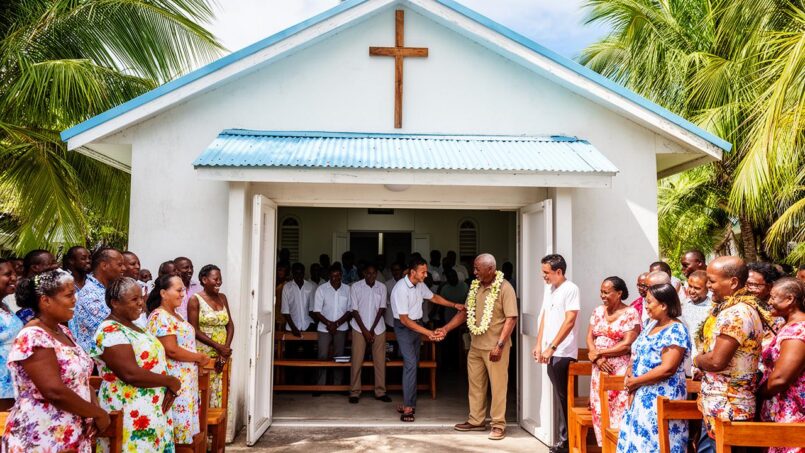
In the Marshall Islands, the dominant religion is Christianity. Census data show an extremely homogeneous religious landscape, even though several churches coexist.
Weight of Christianity in society
Recent figures confirm that nearly the entire population identifies as Christian. In the 2021 census, about 96.2% of residents reported belonging to one of the fourteen major Christian denominations. An earlier survey in 1999 already found over 97% Christians.
To an outsider, this translates very concretely: churches are everywhere, prayers punctuate public meetings, and the official calendar includes several religious holidays. Most native Marshallese are Christian, and the majority of non-Christian believers are foreign residents.
The major trends can be summarized as follows:
| Indicator (Year) | Approximate Value |
|---|---|
| Share of Christian population (1999) | ~97.5% |
| Share of Christian population (2021) | ~96.2% |
| Share with no religious affiliation | 1.1–1.5% depending on sources |
| Pop. reporting other religion (2021) | 2.7% |
Even though plurality exists, Christianity is therefore the near-universal religious reference in public life.
The main Christian churches
Historically, Protestant missionaries introduced Christianity in 1857. The first church to take root was the Congregational Church, now known as the United Church of Christ – Congregational in the Marshall Islands (UCCCMI). It remains the most influential, but other denominations have become significant, especially since the 20th century.
This is the gap in years between the two main reference years used for analysis, i.e., 1999 and 2021.
| Denomination (Main) | Share of population (1999) | Share of population (2021) |
|---|---|---|
| United Church of Christ – Congregational (UCCCMI) | 54.8% | 47.9% |
| Assemblies of God (Pentecostal) | 25.8% | 14.1% |
| Catholic Church | 8.4% | 9.3% |
| The Church of Jesus Christ of Latter-day Saints (Mormons) | 2.1% | 5.7% |
| Bukot nan Jesus (derived from Assemblies of God) | 2.8% | 3% |
| Full Gospel Churches of the Marshall Islands | 0.7% | 5% |
Other smaller Christian groups are present: Baptists, Seventh-day Adventists, Salvation Army, various Evangelical churches, Jehovah’s Witnesses, etc. Most have places of worship and sometimes private schools.
For an expatriate, this means: they must adapt to a new culture, a new environment, and often a new language. It also involves building a new social network and navigating different administrative systems.
– the majority of colleagues and neighbors are practicing Christians in some form,
– rituals (prayers, hymns, Bible readings) are familiar to almost everyone,
– participation in church life structures social networks, mutual aid, and sometimes local politics.
Religious minorities and pluralism
Despite the dominance of Christian churches, there are also small communities of other religions: Baha’is, Ahmadiyya Muslims, Hindus, Jews, members of the Iglesia ni Cristo, as well as a few atheists or people with no religion. These groups each represent tiny fractions of the population (often well below 1%).
The Ahmadiyya community runs the only mosque in the Marshall Islands, in Majuro, which serves as both a place of worship and a center for social actions (tutoring, health campaigns, blood drives via the NGO Humanity First). However, it faces difficulties accessing some public facilities and encounters attitudes of mistrust in society.
Overall, the legal framework protects freedom of religion, but in practice, the environment remains heavily centered on Christian references. For a non-Christian expatriate, it is possible to practice one’s faith, but it is wise to carefully assess the majority context, especially in villages.
Religious freedom and the role of the state: Christianity very present, but not official
The Constitution of the Marshall Islands guarantees freedom of thought, conscience, and religion, and prohibits discrimination based on belief. No worship has official status, and the state does not require registration of religious groups. However, certain institutional practices show how deeply Christianity is embedded in public culture.
Legal framework: rights and limits
Several important points to know:
The Constitution guarantees the free exercise of all religions. This right may be subject to “reasonable restrictions” to protect public order, health, safety, or the rights of others, provided they are minimal. No law may criminalize a practice solely because it expresses a specific belief. Additionally, religious groups can obtain non-profit organization status for tax exemptions, and imports for religious, educational, or charitable use are exempt from customs duties.
International indices rank the country at the maximum (4/4) for religious freedom, and it does not appear on lists of countries where believers face severe persecution.
Religion and public power in daily life
In practice, the boundaries between culture, religion, and institutions are porous. Several things strike newcomers:
In the Marshall Islands, the Christian predominance is visible in official rituals and the foundations of the state. Most public ceremonies, such as government meetings or school activities, are framed by Christian prayers. The national calendar includes three Christian public holidays: Good Friday, Gospel Day (celebrating the arrival of Christianity), and Christmas. Finally, the Constitution itself affirms this dimension by beginning its preamble with the invocation: “WE, THE PEOPLE OF THE REPUBLIC OF THE MARSHALL ISLANDS, placing our trust in God…”.
On the other hand, public schools do not include specific religious instruction or prayers during classes. Denominational education is rather the domain of schools run by churches (Catholic, UCC, Assemblies of God, Adventist, Baptist, Bukot nan Jesus, etc.), partially supported by public funds distributed based on student numbers, academic results, and accreditation.
For an expatriate working in administration, education, or NGOs, getting used to these protocol prayers is necessary. You are not expected to actively participate if it contradicts your beliefs, but silent and respectful behavior is essential.
Going to church: codes, expectations, and languages
In the Marshall Islands, Sunday mass or worship is not just a time of prayer: it is a central social event. In many villages, life revolves around the church, and the pastor or priest holds a rank comparable to that of a traditional chief.
Frequency and formats of services
Most practicing Marshallese attend a service at least once a week, typically on Sunday. Some groups, like Seventh-day Adventists, meet on Saturday, with a structured program (Sabbath school, worship, Bible study). Other churches offer:
– morning Sunday services (e.g., at 10 a.m. in English in some communities),
– weekday meetings (e.g., Wednesday at 8 p.m.),
– afternoon services in Marshallese (often around 1 p.m.).
Times may vary, and it is always wise to check updated hours with the parish or local community, as changes are not always widely announced.
Services are conducted primarily in Marshallese, sometimes in English in certain contexts. If you do not understand the language, it is appreciated to remain silent and attentive, follow the movements of the congregation (stand, sit, sing), and respect the solemnity of the moment to show your consideration.
Dress code: modesty and respect
One of the points where expatriates most often make mistakes is clothing. In a tropical setting, the temptation is strong to adopt a very casual look. However, in the Marshall Islands, modesty in dress remains a strong cultural norm, especially in religious and village contexts.
For men:
– in informal settings, shorts and a T-shirt are perfectly acceptable;
– for church, an official meeting, or a government office, expected attire includes:
– at minimum long pants,
– a collared shirt (short sleeves accepted),
– no shorts in places of worship or formal ceremonies;
– a lavalava (formal wrap) paired with a button-down shirt is also a respectable outfit.
For women:
In public, wear skirts or dresses that cover the knees. Cover your shoulders away from the beach. Swimwear (swimsuits, short shorts, bikini tops) is reserved for swimming areas, not villages or streets. For churches, plan a long dress/skirt and a top that covers, possibly with a shawl. Traditional Marshallese attire, like the *Pachi*, is also appropriate.
In general, it is better to be slightly overdressed than underdressed. A “semi-formal” outfit for Sunday service shows respect to the welcoming community.
Attitude during the service
Church etiquette is simple but strict:
– arriving on time is a basic sign of respect;
– turn off or silence your phone;
– avoid talking during prayers and readings;
– do not leave unnecessarily during the sermon;
– follow the example of the congregation (stand, sing, kneel) to the extent you are comfortable.
Regarding photos, the tacit rule is clear: never take pictures during a rite without explicit permission. If you wish to capture a memory of a church interior or ceremony, first ask the religious leader or your host. Many will agree, but they will consider spontaneous initiative intrusive.
Prayer in daily life: meals, meetings, and evenings
Religious practice is not limited to the church walls. In the Marshall Islands, prayers and blessings punctuate meals, gatherings, and even certain times of day.
Before eating: the ubiquitous blessing
Saying a prayer before eating is extremely common. Whether in a family, at a kemem (big first birthday celebration for a child), at a church meeting, or even during a working meal, a blessing is likely to be said before starting to eat.
For an invited expatriate:
Wait until all guests are served before starting to eat. Do not begin your meal without an explicit invitation (e.g., a simple “you can start”) or before any prayer is said. If a prayer is spoken, show respect by bowing your head or remaining silent, even if you are not a believer.
Openly refusing to participate in this moment – for example, by talking loudly or eating during the prayer – would be seen as a mark of disrespect.
Opening and closing prayers at meetings
Many meetings, whether community, associational, or sometimes even related to development projects, begin and end with a short prayer. This may be surprising in a Western professional setting, but this ritual aims to place joint action under God’s gaze and foster harmony among participants.
Again, you are not expected to intervene, unless you are explicitly asked to say a prayer yourself. In that case, and if you are uncomfortable, you can calmly explain that you prefer to leave that responsibility to a local member of the community.
The evening prayer time in villages
A feature that surprises many foreigners is the community evening prayer, often held between 6 p.m. and 7 p.m. in villages. This period, lasting ten to twenty minutes, is signaled by a bell or the sound of a conch shell (conch). During this time:
– traffic and activities quiet down;
– families gather to pray;
– the atmosphere becomes very silent.
If you are passing through a village during prayer time, sit down calmly and wait for it to end, avoiding loud talking, phone calls, or moving around. Normal life resumes only after the sound signal marking the end.
For an expatriate, this “spiritual curfew” is one of the most visible markers of the centrality of faith in daily life. Ignoring it – by walking through noisily, jogging with music, for example – would be considered a serious lack of consideration.
Respecting hierarchies: chiefs, elders, and clergy
In the Marshall Islands, respect is structured by a set of interconnected criteria: traditional social rank, religious or governmental position, age, gender, kinship ties. Understanding these codes is essential for interacting harmoniously, especially in religious contexts.
The status of the pastor or priest
In a village, the minister (Protestant pastor, Catholic priest, leader of another church) holds a very high place. In consultation with traditional chiefs, they may set certain community rules, especially regarding Sunday or prayer times.
This means for an expatriate:
Recommendations for interacting respectfully during gatherings or conversations.
It is recommended to greet religious figures first at a gathering.
Use formal address or an appropriate title (e.g., ‘Father’ or ‘Pastor’).
Avoid contradicting them publicly, especially on sensitive topics.
During a meal or ceremony, religious leaders may be served first, or be the first to speak. Follow the hosts’ example.
Marshallese people show great respect for elders. Younger individuals are expected to:
In some cultures, younger people show respect to elders by letting them speak first, avoiding interruptions, using polite forms of address, and slightly bowing their heads as a greeting.
Marshallese society is also a society of rank. People of lower status should:
– avoid walking in front of someone of higher rank,
– lower their head and walk slightly behind them,
– not stand above a seated person of higher rank.
These rules extend into the religious sphere: a traditional chief or elder with a particular role in the church will be treated with visible deference.
Marshallese sociability is known to be warm, but rests on fine norms that blend respect, restraint, and a sense of community. Many of these rules, even if not explicitly religious, are part of a moral universe infused with Christianity.
Greeting: the role of “Iakwe”
The Marshallese word you will hear most often is “Iakwe” (pronounced “yak-way”). It means “hello“, “goodbye”, and “love”. It is used in many situations, and it is good manners to greet everyone present when entering a room or a group.
Common politeness markers:
– smile broadly;
– slightly bow your head, especially before an elder;
– shake hands, rather gently (no crushing handshake);
– among friends or family, kissing on the cheek or hugging may be common.
Saying “Iakwe” with a smile and removing your sunglasses to speak are simple gestures that open many doors.
Etiquette tip in the Marshall Islands
Gestures to avoid
Certain attitudes are seen as downright rude:
– frowning, abruptly turning away while someone is speaking;
– shouting or raising your voice, especially in public;
– visible arguments: public shouting matches are very poorly viewed;
– touching someone’s head, even a child’s, as the head is considered a sacred part of the body.
Physical contact requires caution. It is best not to touch people without a clear invitation. Above all, a non-noble should not touch a person of royal blood or very high rank.
In villages, it is considered impolite to stand above seated people or to step over someone lying or sitting on the ground. If space is tight, it is better to go around the person or politely ask permission to pass.
Conversations: safe topics and sensitive subjects
The safest discussion topics are:
– family,
– church,
– community,
– fishing, the sea, local events.
Conversely, certain subjects are considered sensitive or inappropriate, especially with people you know little:
– death (serious illnesses, suicide, violence),
– domestic or sexual violence,
– politics, religious tensions,
– intimate details of marital life or health.
Addressing these topics requires established trust and should be done in private. In Marshallese culture, preserving group harmony takes precedence over total frankness.
Relations between men and women are also surrounded by codes of reserve. Public displays of affection between partners are frowned upon. However, holding hands between women is a common friendly gesture with no romantic connotation.
Visits, gifts, and meals: hospitality as a spiritual value
Generosity and sharing are at the heart of Marshallese values, nurtured by both custom (manit) and Christian ethics. As an expatriate, you will likely be regularly invited to meals, village festivals, religious ceremonies.
Entering a home: gestures of respect
When invited to someone’s home:
– look near the door: if shoes are lined up, remove yours before entering;
– remove your cap or hat;
– wait for the host to lay out mats if the house is traditional, then sit where you are directed.
It is common for men to sit cross-legged and for women to tuck their legs under them, avoiding showing thighs. Stretching your legs forward, especially toward someone, is generally considered rude.
Standing while talking in someone’s home is also poorly received: conversation is preferred while seated, in a more egalitarian and less dominating setting.
Giving and receiving: the role of the gift
Bringing a small gift when visiting a family or community is a welcome gesture. Food, fruit, or handicrafts work well. In the Marshall Islands, giving is rarely one-sided: it is part of a logic of reciprocity and mutual support. You will notice that families who receive also give generously, to their neighbors, church members, and relatives.
When offered food or drink, it is polite to accept, at least symbolically. Refusing can be seen as disrespect or rejection of hospitality. If you truly cannot consume what is offered, express gratitude for the offer and briefly and politely explain the reason for your refusal, such as health or allergy reasons.
– accept, if possible, at least a small portion: systematically refusing may be perceived as rejection;
– avoid wasting what is served, as food is associated with the host’s honor;
– at large meals, rules may specify who eats first (e.g., the traditional chief or pastor): observe and imitate.
Again, the meal is not just a convivial moment: it often has a ritual, even sacred dimension, given the prayer that opens it and the status of the guests.
Modesty, body, and space: rules that also touch on the religious
Many rules about the body or occupying space reflect both pre-Christian legacies (respect for the sacred, taboos) and contemporary Christian norms (modesty, hierarchy).
General dress outside church
In town or tourist areas, dress codes have relaxed somewhat, but in villages or community contexts, modesty remains the rule:
– avoid very tight or transparent clothing;
– cover shoulders and thighs;
– adjust your attire as soon as you move away from beaches or international hotels.
The recommended modesty in dress applies not only to religious ceremonies but also to community meetings and cultural celebrations.
Body position and symbolism
Sitting on the floor on a mat (mat) is common during family or village meetings. In this context:
– men generally sit cross-legged;
– women tuck their legs to the side, careful not to reveal their legs above the knee;
– pointing your feet at someone or at a symbolically important object (e.g., certain altars, ritual items) may be poorly received.
Various practices, like not stepping over someone’s head, remind us that the body is surrounded by a sacred dimension and persistent taboos, even if the population is officially Christian.
Land, sea, and the sacred: a spirituality rooted in the environment
An often underestimated aspect for expatriates is the depth of the spiritual bond that ties Marshallese to their lands, reefs, and lagoons. Even though public discourse is now mainly Christian, many islands, atolls, or reef sections retain a special status, inherited from pre-Christian beliefs.
The idea of sacred places and “mo”
Traditionally, certain areas—islets, reefs, groves, springs—are considered sacred or dangerous. The concept of mo (taboo) encompasses these spaces and resources subject to prohibitions, often decreed by chiefs for spiritual, ecological, or social reasons.
This means for you:
It is essential to always ask permission before accessing land or harvesting natural resources (fruits, flowers, vegetables, fish), as these often belong to private owners, families, or local clans. Never venture onto an island or land without ensuring access is authorized.
Refusing to respect these rules can be perceived not only as a social transgression but also as a breach of spiritual balances, even if locals speak to you in terms of “custom” rather than religion.
Between old beliefs and Christianity
Before Christianization, Marshallese lived in a universe populated by gods, nature spirits, active ancestors, and beneficial or malevolent forces. Some of these beliefs have faded over time, but certain practices persist, sometimes in Christianized forms.
Some people still combine traditional practices with modern approaches for decision-making or health. For example, to make a decision, they might consult a randomly opened Bible verse. In health matters, it is common to combine modern medicine with care from traditional healers, who use plants, prayers, and rituals.
In this context, it is essential for an expatriate working in health, development, or research to:
– not ridicule these beliefs;
– avoid asking them to abandon traditional medicine;
– instead seek compromises by explaining that modern treatments do not necessarily oppose faith, but can be understood as another gift from God.
Festivals, religious and cultural holidays: when faith takes to the streets
The Marshallese calendar includes several official days and celebrations where religion and culture blend.
Gospel Day: the arrival of Christianity
Gospel Day, celebrated on the first Friday of December, commemorates the arrival of the first Protestant missionaries in the mid-19th century. This day resembles a mix of a religious festival and a day of thanksgiving:
In the morning, religious services with hymns and sermons recount the history of Christianization and its effects. Then, processions wind through the streets, with decorated cars, candy distributions to children, banners, and Christmas-inspired decorations. Each church often organizes its own parade, for example, the UCC Church in the morning, and other churches in the afternoon and evening.
Attending these parades, walking with a community, or simply watching from the sidewalk means participating in one of the moments when the religious dimension of Marshallese identity is most expressed in public space.
Manit Day and other festivals
Manit Day, celebrated on the last Friday of September, honors traditional culture: songs, dances, canoe races, craft contests. Even though it is not strictly a religious festival, the narration of the people’s history, ancestors, and relationship to the land is heavily imbued with spirituality.
Certain commemorative days, though political or historical in origin like Constitution Day, Nuclear Victims Remembrance Day, or Liberation Day, incorporate religious elements. Their ceremonies often combine prayers, church hymns, and interventions by religious leaders alongside official speeches.
For an expatriate, these festivities are prime opportunities to:
– discover traditional dances and songs,
– observe interdenominational participation,
– gauge how historical memory, Christian faith, and custom overlap.
Living your own faith (or non-faith) in the Marshall Islands
One sensitive question remains: how to be yourself in a context so saturated with religion, when you are agnostic, atheist, or an adherent of a minority faith?
Being non-practicing in a highly practicing country
Not being Christian or not attending church is not illegal nor formally stigmatized. A few percent of the population actually reports no religion. However, in daily life, especially outside very international circles, implicit pressure to participate in religious life can be strong:
Your presence at Sunday service is encouraged, and repeated absence may raise questions, usually out of friendly curiosity. However, in some communities, pastors exert strong influence, sometimes demanding large donations and threatening to expel members who do not contribute enough financially.
To maintain good relationships:
– simply explain, without entering into big debates, your limits regarding participation;
– occasionally accept certain invitations, even if only for major events (weddings, funerals, Gospel Day);
– always respect places and rituals, even if you do not adhere to them spiritually.
Practicing another religion
Non-Christian minorities exist, but their visibility and acceptance vary. The Ahmadiyya Muslim community, for example, has reported difficulties accessing certain public services and manifestations of mistrust, often fueled by confusion with international terrorism narratives.
If you yourself are Muslim, Hindu, Jewish, or other, it is possible to:
– practice privately, at home;
– connect with small existing communities (Ahmadiyya mosque, Baha’i groups, etc.) if you share their orientations.
On the other hand, aggressive proselytizing may be poorly received, even more so when it involves locally little-known religions. Most Marshallese remain hospitable and curious, and interfaith dialogue, though discreet, exists.
In summary: keys to respectful integration
Living in the Marshall Islands means accepting that religion, custom, and social life form a whole that is hard to separate. For an expatriate, a few simple principles allow for serene navigation in this universe:
For harmonious integration, it is essential to consider Sunday and prayer times (especially in the evening) as quiet moments to respect. Adopt modest attire, especially in villages and places of worship. Greet warmly, speak softly, and avoid public displays of affection. Treat pastors, priests, elders, and traditional chiefs with visible deference. Accept hospitality by responding with small gestures and avoiding food waste. Finally, always inquire before going to potentially sacred places, fishing, or picking fruit.
By respecting these codes, you will discover a society that, behind its strong religiosity, is extremely welcoming to those who make the effort to understand its way of linking faith, land, ocean, and community. It is often by sharing a meal, remaining silent during a village prayer, or attending a church hymn in Marshallese that barriers come down and you truly begin to feel at home in the Marshall Islands.
Disclaimer: The information provided on this website is for informational purposes only and does not constitute financial, legal, or professional advice. We encourage you to consult qualified experts before making any investment, real estate, or expatriation decisions. Although we strive to maintain up-to-date and accurate information, we do not guarantee the completeness, accuracy, or timeliness of the proposed content. As investment and expatriation involve risks, we disclaim any liability for potential losses or damages arising from the use of this site. Your use of this site confirms your acceptance of these terms and your understanding of the associated risks.

Cyril Jarnias is an independent expert in international wealth management with over 20 years of experience. As an expatriate himself, he is dedicated to helping individuals and business leaders build, protect, and pass on their wealth with complete peace of mind.
On his website, cyriljarnias.com, he shares his expertise on international real estate, offshore company formation, and expatriation.
Thanks to his expertise, he offers sound advice to optimize his clients' wealth management. Cyril Jarnias is also recognized for his appearances in many prestigious media outlets such as BFM Business, les Français de l’étranger, Le Figaro, Les Echos, and Mieux vivre votre argent, where he shares his knowledge and know-how in wealth management.





