
 Published on and written by Cyril Jarnias
wp:paragraph –>
Moving to Iceland with your dog or cat is absolutely not something you can improvise. The country enforces some of the strictest rules in Europe for importing animals. Its stated goal: protect a fragile island ecosystem and preserve its enviable status as a territory free of rabies and many animal diseases. The result: a long, costly procedure that requires mandatory quarantine and outright bans certain species or breeds.
It is possible to bring your pet to Iceland, but it requires rigorous preparation several months in advance. The project should be considered a full-fledged expatriation dossier in its own right, with specific and detailed steps to follow.
Understanding the Icelandic framework: a highly protective rabies-free country
The authority overseeing all animal imports is the Icelandic Food and Veterinary Authority, better known by its acronym MAST. It defines the rules, issues import permits, oversees quarantines, and can, if necessary, refuse entry to an animal that does not follow the protocol.
In Iceland, any dog or cat arriving in the country is legally considered an import, whether it is a permanent move or a theoretically temporary stay. There is no “vacation pass” or simplified system for short stays. The country is not part of the European pet travel scheme: a European pet passport alone is not sufficient.
Icelandic policy rests on three key ideas: maintain an exceptional health status (free of rabies and certain parasites), protect the fragile local wildlife in a vulnerable island ecosystem, and ensure public safety, justifying strict rules for certain dog breeds.
As a result, Iceland is not a suitable destination for tourist trips with a pet. The cumbersomeness of the procedures, the overall cost, and especially the 14-day quarantine make the operation disproportionate for a simple visit. However, for an expatriation tied to a job, studies, or a long-term life plan, these efforts make much more sense.
Country of origin, categories, and eligibility of your pet
MAST only allows imports from countries deemed sufficiently safe from a rabies standpoint. The list, revised twice a year, is divided into two main groups.
So-called Category 1 countries are considered rabies-free in animals. This includes most European Union states, as well as Australia, Norway (excluding Svalbard), the United Kingdom, Japan, Singapore, the United Arab Emirates, and Switzerland, among others.
Category 2 countries are those where rabies still circulates but remains well controlled. This category includes, for example, the United States, Canada, Turkey, Poland, Romania, Serbia, Greenland, Bosnia and Herzegovina, Taiwan, and Hungary.
In all cases, a fundamental principle applies: the dog or cat must have lived continuously in an approved country (Category 1 or 2) for at least six months before import, or since birth if it is younger. If the animal comes from an unapproved country, the rule is even stricter: either go through a six-month residency step in a Category 1 or 2 country, or request a very specific authorization from MAST, reserved for people relocating to Iceland after living with their pet in that unapproved country for at least six months.
A simplified overview of the organization and structure of categories for intuitive understanding.
Presents the organization of categories into levels, from general to specific, forming a clear tree structure.
Describes the rules and logic used to assign an element to a specific category.
Explains how category logic facilitates searching and discovering information.
Covers best practices for maintaining category consistency and relevance over time.
| Element | Category 1 (rabies-free countries) | Category 2 (controlled rabies) |
|---|---|---|
| Example countries | France, Germany, Norway, Japan, United Kingdom | USA, Canada, Turkey, Poland, Romania, Singapore |
| Waiting period after rabies test | No waiting period imposed after successful titer* | 90 days mandatory after blood draw |
| Overall complexity of procedures | Slightly lighter | Heavier, especially for dogs |
– Provided all other criteria are met.
This classification is not a mere administrative detail: it determines the minimum preparation time, notably via the waiting period after the rabies serology test for Category 2 countries.
Banned breeds, species, and animals: prohibitions to take seriously
Before even starting any procedure, you must verify that the animal is eligible. In Iceland, certain species and numerous dog breeds are simply banned from import, with no exceptions for temporary stays or emotional support animals.
Among species, reptiles (mainly snakes, lizards, turtles) are banned as pets. These bans are based on two concerns: the risk of diseases such as salmonellosis, and the possibility of introducing invasive species into an unprepared environment.
Several dog breeds are considered dangerous and are banned, including the American Pit Bull Terrier, Staffordshire Bull Terrier, American Staffordshire Terrier, Tosa Inu, Dogo Argentino, Fila Brasileiro, American Bulldog, Cane Corso, Boerboel, Presa Canario, and types like the Bandog. The English Bull Terrier is sometimes also mentioned. The ban also applies to mixed-breed dogs with these breeds, often up to the fifth generation.
Wolf-dog hybrids are even more strictly regulated: any offspring with wolf blood up to ten generations is prohibited. Import of semen from dogs of these banned breeds is also forbidden.
In practice, any attempt to bring in a dog of a banned breed or a related mixed-breed will be blocked at entry. The animal will most likely be sent back at the owner’s expense or, if already in the country, seized with a real risk of euthanasia. Financial penalties may also apply. Authorities remind that requests for case-by-case exceptions have virtually no chance of succeeding.
It is therefore best to ask MAST in writing, before any project, whether your dog’s breed or type is allowed. This simple preliminary email can prevent a tragic situation.
MAST import permit: the mandatory key
For any dog or cat, an import permit issued by MAST is mandatory. Without it, no animal will be allowed to land.
The application must be submitted at least 30 days before the planned arrival date. The permit is generally valid for one year from the date of issue, providing some flexibility to adjust tickets and quarantine reservations. However, obtaining the permit is not enough: all health and administrative conditions must still be met; otherwise, the permit may remain ineffective.
The base cost of an animal import permit in Iceland is approximately 39,600 ISK.
MAST’s role is not limited to collecting fees. The authority also reviews all health documents, validates the final certificate, coordinates with official veterinarians, and gives the green light to quarantine stations. MAST also bears the responsibility of ordering a return to sender if conditions are not met.
Microchip, vaccines, tests: the pre-departure health checklist
Before thinking about plane tickets and hotels, you need to build your pet’s health dossier. In Iceland, the requirements in this area are among the most comprehensive in Europe.
Electronic identification: the foundation of the dossier
It all starts with inserting a microchip. It must be non-encrypted, 15 digits, and compliant with ISO standards 11784 or 11785. This step must absolutely precede all vaccinations and tests. The microchip number serves as a common thread: it must appear on every document, every test result, every certificate.
If the existing chip is not readable by standard ISO readers, the owner is obligated to provide a compatible reader upon arrival. In practice, it is often simpler to implant a compliant chip before starting the Icelandic process.
Rabies vaccination and serology: the core of the system
The rabies vaccine is non-negotiable. The dog or cat must be at least 12 weeks old at the time of injection. To be accepted by MAST, vaccination must occur between 30 days and 12 months before entering Iceland, with a stricter specific rule for some countries like the United States where a 120-day delay is mentioned in several documents.
At least 30 days after the rabies vaccination, a blood sample is required for a serology test (antibody titration). The sample must be analyzed by a laboratory accredited by the European Union (e.g., Kansas State University for animals from the United States). To be valid, the result must show an antibody titer of at least 0.5 IU/ml.
For animals from Category 2 countries, an additional waiting period of 90 days from the date of the blood draw is required before entering Iceland. It is this window that mechanically pushes the minimum total preparation time to about four to six months.
As long as rabies boosters remain up-to-date according to official recommendations, the serology remains valid. But if there is a lapse, everything must be started over: new vaccination, new blood draw, new waiting period.
Other vaccines and tests for dogs
Dogs must be up-to-date on a set of so-called “core” vaccines (distemper, infectious canine hepatitis, parvovirus) often combined in a single product (DHPP). These injections must be given no earlier than one year and no later than two weeks before import.
To import a dog into Iceland, vaccination against leptospirosis is required within a window of 2 weeks to 6 months before arrival. For dogs from the United States, Canada, or Singapore, vaccination against canine influenza is also mandatory and must be given at least 14 days before departure, following manufacturer recommendations.
Regarding exams, several tests are required within the 30 days preceding import: screening for Brucella canis, analysis or targeted treatment against Angiostrongylus vasorum (lungworm), and sometimes testing for Leishmania for unneutered dogs.
Vaccines and screenings for cats
Cats are not spared from the constraints, although the list is slightly different. They must be protected against panleukopenia, feline viral rhinotracheitis, and calicivirus, often via a combined vaccine like FVRCP, administered within the six weeks preceding import. Vaccination against feline leukemia is also mentioned in some documents.
Within the 30 days before departure, your cat must undergo screening tests for FIV (feline immunodeficiency virus) and FeLV (feline leukemia virus). Rapid tests performed in a veterinary clinic are generally accepted, provided they are clearly documented and recorded in the pet’s medical file.
Mandatory antiparasitic treatments
Combating internal and external parasites is a pillar of the Icelandic system. Two complete treatments are required before travel. The first must be administered between 21 and 28 days before import, the second between 5 and 10 days before the planned arrival. They must cover both external parasites (fleas, ticks, lice) and internal ones (roundworms, tapeworms).
For assistance dogs authorized to travel in the cabin, a specific treatment against external parasites is required between 24 and 120 hours before the flight, with mention in the passport or health record.
Health certificate and MAST validation: the veterinary administrative step
Once vaccinations and tests are done, one key administrative step remains: the issuance of the official veterinary health and origin certificate. Iceland uses its own forms, distinct from the standard certificates of many countries. For dogs, for example, these are forms D1 or D2 depending on the origin country’s category; for cats, C1 or C2.
This official document must be completed by an accredited veterinarian (and USDA-accredited for the United States) within 5 to 10 days before import. It must contain the animal’s full identity, microchip number, residency history, details of all vaccinations (with dates and batch numbers), rabies serology results, results of various tests, and proof of administered antiparasitic treatments.
Once completed and signed, the certificate and all laboratory results must be scanned and sent to MAST at [email protected] at least five days before the planned arrival. MAST teams then check the information, sign the certificate if everything is in order, and send back a confirmation. This pre-approval conditions the entry authorization.
This pre-check is not a formality. The most frequent rejections are due to inconsistent dates (vaccination or test done too early or too late), a missing microchip number on a report, or a rabies titer result below the required threshold.
Arrival in Iceland: single airport and transport logistics
Icelandic rules only allow animals to arrive by air, and exclusively via Keflavik International Airport. Domestic airports such as Reykjavik or Akureyri cannot serve as initial entry points.
Since November 2024, the transport of pets to Iceland is strictly regulated. Airlines no longer accept dogs and cats, either in the cabin or in the hold as accompanied baggage. Their transport must go through air freight (cargo) via specialized services. The only exception is for certified assistance dogs, which must have obtained prior approval from MAST to travel in the cabin.
Concretely, this means booking a cargo flight with an airline like Icelandair Cargo, often from hubs such as Los Angeles, New York, or Chicago. Transport is done in a rigid crate approved by the International Air Transport Association (IATA), large enough for the animal to stand, turn around, and lie down.
When traveling by plane, dogs and cats must be transported without contact with other animals. Prefer a direct flight from the country of origin. If a layover is unavoidable, it must take place in a country with good health guarantees. The connection should be short and take place without leaving the international transit area. Note that for a layover in a European Union country, additional requirements related to European transit may apply.
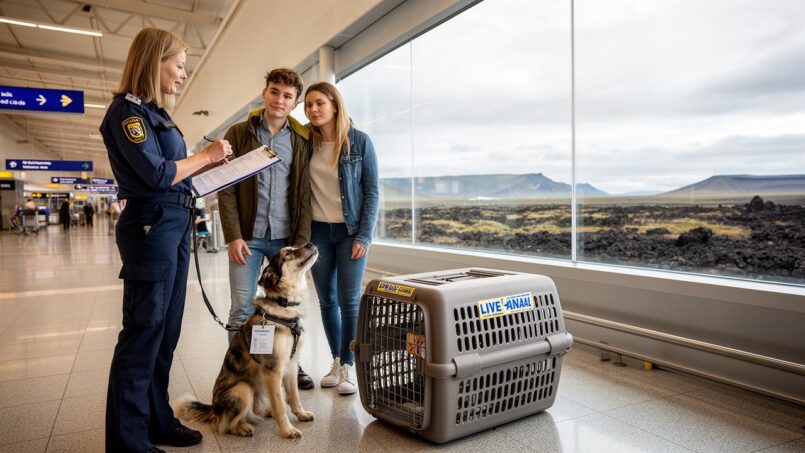
Upon arrival at Keflavik, an authorized agent (for example, the company Avior) handles the crate, in conjunction with the veterinary services. The owner does not see their pet: it is taken directly to the quarantine station.
Mandatory quarantine: 14 days of strict separation
One of the hardest aspects for many expatriates to accept is the mandatory quarantine at a specialized station. Every dog and cat must stay there for 14 days, with no exceptions for elderly, fearful, indoor pets, or for emotional reasons.
There are two approved quarantine stations in Iceland, one of which is located in Hafnir, not far from Keflavik. They operate on admission waves, typically over a three-consecutive-day window every three weeks. So the cargo flight date must be aligned with this window, with an arrival between 6 a.m. and 5 p.m. for the station to receive the animals.
Upon arrival at the airport, a veterinarian inspects dogs and cats and checks the original documents (MAST permit, signed health certificate, and laboratory results) before authorizing transfer to quarantine. On site, animals are placed in individual kennels, fed, monitored, and subjected to additional checks, such as stool analyses or supplementary antiparasitic treatments.
The owner is not allowed to visit them during the stay. This rule, difficult to endure, aims to limit comings and goings and maintain a strict health protocol. Upon release, all small used items (collar, leash, blanket, bed) are destroyed for biosecurity reasons. It is therefore advisable to bring new accessories on the day of pickup.
This is the cost in Icelandic kronur (ISK) of quarantine for a dog at the Reykjanesbær station, including transport, boarding, and basic care.
The table below gives a simplified overview of the cost structure for a dog.
| Expense item | Indicative amount |
|---|---|
| MAST import permit | ~ 39,600 ISK (≈ $290 USD) |
| Quarantine (dog) | ~ 220,000 ISK (≈ $1,600 USD) |
| Quarantine deposit | 50,000 ISK (included in total) |
| Vaccines and tests (origin country) | Variable, several hundred dollars |
| International cargo fees | $2,000 to $5,000+ USD |
It is recommended to book quarantine as early as possible, even before finalizing your own travel date, as spots are limited and slots fill up quickly.
Assistance animals: some accommodations, but strict rules
Assistance dogs with official recognition (guide dogs for the blind, hearing dogs, mobility assistance dogs, seizure or diabetic alert dogs) receive slightly special treatment.
To import a pet into Iceland, standard health conditions remain mandatory: ISO microchip identification, up-to-date rabies vaccination with serological testing, other required vaccines, specific tests, antiparasitic treatments, and a veterinary health certificate. However, two relaxations are possible. First, with prior agreement from the administration (MAST), the animal may travel in the cabin with its owner on certain flights. Second, subject to obtaining a specific authorization, the animal may serve its quarantine period at home, at the owner’s residence, instead of being placed in a closed quarantine station.
However, emotional support animals are not equated with assistance dogs under Icelandic law. They remain subject to standard rules, with no cabin privileges or home quarantine.
Living with a pet in Iceland: housing, city, and animal culture
Once the quarantine ordeal is over, another reality sets in: daily life with a pet in Iceland does not necessarily resemble what you know elsewhere.
In the capital, a long history of mistrust toward dogs has left its mark. Reykjavik experienced an almost total ban on dogs for decades, established in the 1920s to combat a parasite transmissible to humans. The gradual lifting of this ban, finalized only in 2007, came with highly regulated rules.
Dogs are allowed but must be registered with the municipality with payment of an annual fee. Owners are responsible for cleanliness and respect for public spaces. Dedicated areas for walks and play exist but are regulated. Specific regulations may apply depending on the neighborhood.
Cats have historically been better tolerated, to the point that many live semi-feral, fed by their homes but roaming the streets. Reykjavik even has a cat café where adoptable felines coexist with visitors, as well as tourist offerings built around this feline culture (e.g., themed guided tours).
On the island of Grímsey, which belongs to the Akureyri municipality in Iceland, very specific rules ban the keeping and even the simple visit of dogs. This example illustrates how certain small municipalities can adopt very strict and particular local regulations.
To find pet-friendly housing, you often need to be patient. On the rental market, many landlords impose restrictions, especially in multi-unit buildings. Seasonal rental platforms, however, list some pet-friendly accommodations, including a few dozen identified in the Reykjavik area. Here again, it is best to mention your pet’s presence from the first contact.
Overall cost of expatriation with a pet: a budget in its own right
Bringing a pet to Iceland represents a significant budget line. Beyond the quarantine and import permit, you must add the microchip implantation (if needed), vaccines and boosters, rabies serology, various tests, antiparasitic treatments, the veterinarian consultation for the health certificate, dossier preparation fees, and above all, the cost of international cargo transport.
Transatlantic air freight can add this additional cost, in dollars, for transporting a pet.
At the same time, given Iceland’s high cost of living, ongoing pet expenses (food, insurance, routine veterinary care) remain above the average of many other countries. Budget planning tools like certain neighborhood or insurance comparators can help anticipate these items, but it is wise to include your pet in your expatriation budget simulation from the start.
Veterinary services and supplies: a high level of care
Iceland has a good veterinary network, especially in and around Reykjavik. Facilities like Dýraspítalinn í Víðidal, the capital’s largest veterinary hospital, offer a full range of services: 24/7 emergency care, general medicine, surgery, and care for newly imported animals.
There are also specialized clinics (ophthalmology, cardiology, neurology) or practices offering innovative services, particularly in equine medicine or for farm animals. The Icelandic Veterinary Association (IVA), based in Reykjavik, coordinates the profession, encourages continuing education, and collaborates with authorities on animal welfare issues.
For expatriate owners, it is reassuring to know that veterinary clinic staff often speak English, facilitating communication in emergencies. However, note that veterinarians are generally fewer in rural areas across the country. It is therefore essential to identify the clinics closest to your future place of residence.
On the supplies side, several specialized pet store chains operate in Reykjavik and deliver within the metropolitan area. There are also online stores delivering across the country, offering a range of products from premium foods to locally made treats (e.g., dried cod skins) as well as shampoos, harnesses, and toys. International platforms also offer delivery to Iceland, handling customs and taxes for the customer.
Icelandic climate: preparing your pet for the cold
Iceland’s climate, milder than one might imagine in terms of extreme temperatures thanks to oceanic influence, remains challenging for many animals, particularly due to wind, humidity, frequent rain, and long, dark winters.
A dog’s cold tolerance depends on its breed, coat type, age, and health. Nordic double-coated dogs are better protected than small short-haired dogs or animals with arthritis. Warning: even hardy breeds should not be exposed to freezing cold for long periods, especially if they are inactive.
In practice, it is useful to consider coats or sweaters for sensitive dogs, making sure the clothing stays dry. Paw pads must be protected against salt and ice, possibly using booties or veterinary balms, and systematic paw rinsing after walks.
Indoors, heating and dry air can cause itching or skin problems. To remedy this, it is advisable to add omega-3 fatty acids to the diet, use a humidifier occasionally, and use appropriate shampoos. For outdoor hydration, it is recommended to use heated bowls or slightly warm water to prevent freezing.
The pace of life also changes: long, vigorous walks are sometimes replaced by shorter outings in extreme cold, compensated with more indoor play and enrichment to avoid boredom and weight gain.
Planning your project: a retro-plan over several months
To succeed in an expatriation with a pet to Iceland, the key lies in anticipation. The following timeline, inspired by MAST requirements, helps visualize the main steps.
First, at least six months before the target date, verify your country’s category, your dog’s breed, and ensure your pet has resided in an approved country long enough. This is a good time to have an ISO microchip implanted if not already done.
For a trip to Iceland, rabies vaccination must be scheduled 5 to 6 months before departure, followed by a blood draw for serology 30 days later. If you come from a Category 2 country, a 90-day delay after the blood draw is then mandatory before entering Icelandic territory.
In parallel, four to five months before arrival, quarantine reservation should be initiated, choosing a realistic admission slot relative to laboratory turnaround times. The MAST import permit application must be submitted at least 30 days before the chosen date.
In the month before departure, schedule specific veterinary tests and antiparasitic treatments in two phases. Make an appointment with the vet for the clinical exam and official certificate, required 5 to 10 days before the flight. Once this certificate is validated by MAST, finalize the cargo flight booking for your pet and your own plane ticket. It is advisable to arrive at your destination a day or two after your pet so you can pick it up immediately upon release from quarantine.
Should you really come to Iceland with your pet?
At the end of this overview, a question inevitably arises: is it reasonable to expatriate to Iceland with a dog or cat? In many cases, the answer depends on the duration of your project, your companion’s health and sensitivity, your financial means, and your ability to endure the separation imposed by quarantine.
For a long-term move, bringing your pet can be justified if it is eligible, robust, and capable of handling the cargo journey, quarantine, and a new climate. For a short or uncertain stay, arranging care in the country of origin is often more protective for the animal’s well-being and the owner’s peace of mind.
In any case, the golden rule remains the same: never rely on assumptions; instead, verify every point directly with MAST, your exporting veterinarian, and the quarantine stations. Iceland is a country where you can live well with pets, but it is also one of the most demanding for them to legally cross its borders.
Disclaimer: The information provided on this website is for informational purposes only and does not constitute financial, legal, or professional advice. We encourage you to consult qualified experts before making any investment, real estate, or expatriation decisions. Although we strive to maintain up-to-date and accurate information, we do not guarantee the completeness, accuracy, or timeliness of the proposed content. As investment and expatriation involve risks, we disclaim any liability for potential losses or damages arising from the use of this site. Your use of this site confirms your acceptance of these terms and your understanding of the associated risks.

Cyril Jarnias is an independent expert in international wealth management with over 20 years of experience. As an expatriate himself, he is dedicated to helping individuals and business leaders build, protect, and pass on their wealth with complete peace of mind.
On his website, cyriljarnias.com, he shares his expertise on international real estate, offshore company formation, and expatriation.
Thanks to his expertise, he offers sound advice to optimize his clients' wealth management. Cyril Jarnias is also recognized for his appearances in many prestigious media outlets such as BFM Business, les Français de l’étranger, Le Figaro, Les Echos, and Mieux vivre votre argent, where he shares his knowledge and know-how in wealth management.





