
 Published on and written by Cyril Jarnias
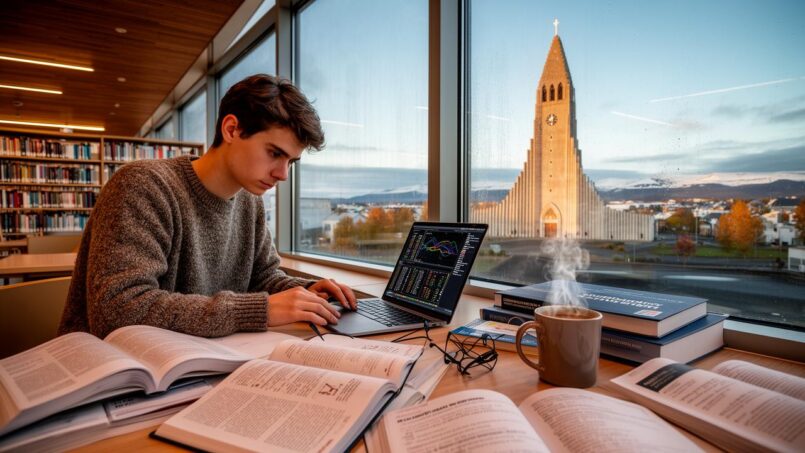
Moving to Iceland for higher education means accepting a double adventure: academic and climatic. Between tuition-free public universities, a polar climate tempered by the Gulf Stream, endless winter nights, and nearly constant summer sun, the country offers a unique setting for studying… provided you prepare well.
This guide covers the essentials for studying in Iceland: the university system, cost of living, climate, housing, visa and work permit procedures, scholarship opportunities, and career prospects after graduation.
Understanding the Icelandic context before you go
Moving to Iceland without understanding its environment means heading straight for difficulties. The country combines geographic, climatic, economic, and institutional specificities that directly impact the daily life of international students.
Iceland lies just south of the Arctic Circle, at about 64° north latitude, in the North Atlantic. On paper, one might expect extreme winters. In practice, a powerful warm current—a branch of the Gulf Stream—runs along the south and west coasts and significantly moderates the climate. The result: a “cold but temperate” country, with winters much milder than in other regions at the same latitude.
A milder climate than expected, but very unstable
The Gulf Stream brings relatively mild Atlantic air into contact with Arctic air. This clash creates extremely changeable weather, characterized by rapid shifts between rain, snow, wind, sun, and even sleet within a single day.
The average annual temperature in Iceland between 1991 and 2020 was about 5.6 °C.
On the other hand, precipitation and wind are omnipresent. The country receives an average of around 120 mm of precipitation per year in some series, but with strong geographic variations: in the south and west, the weather is milder but also wetter and windier than in the north. The central highlands, where the major ice caps are concentrated, are more heavily watered and exposed to storms.
For a student in Iceland, a day can go from blue sky to blizzard in a few hours. Locals, accustomed to this, maintain a normal rhythm: biking in freezing rain or letting children play outside in sleet. This resilience—a striking cultural trait—often surprises newcomers.
Light, darkness, and your biological clock
The second shock for an international student is not the temperature, but the light.
Iceland experiences very long nights in winter and very long days in summer. In the heart of winter, daylight is reduced to just a few hours. In summer, the sun barely sets in some regions, and in Reykjavík the nights are very bright.
The seasonal change in light can disrupt sleep patterns, leading to fatigue, difficulty concentrating, and lower morale. For newcomers, local recommendations are practical: use a sleep mask in early autumn and late spring to protect from light, and use a bright lamp or light therapy to ease waking during the dark months. Although many Nordic people learn to sleep despite the light without blackout curtains, this adaptation requires an adjustment period.
Dressing and equipping yourself: a matter of safety
At this latitude, wind and dampness can quickly lead to hypothermia if you are poorly equipped. Icelanders don’t rely on umbrellas—considered both ineffective and dangerous in gusts—but on the layering system.
The recommended outfit for students includes: comfortable, practical clothing, suitable for academic activities and daily life on campus.
| Recommended gear | Primary role | Practical details |
|---|---|---|
| Thermal base layer (wool or synthetic) | Retains heat even when damp | Avoid cotton; choose wool and technical fibers |
| Wool sweater / thick fleece | Insulation | Layer over base layer |
| Waterproof jacket (shell) | Rain/wind protection | Wear over warm layer |
| Rain pants | Leg protection | Essential for frequent outings |
| Waterproof shoes | Safety and comfort | Non-slip soles recommended |
| Beanie, scarf, gloves | Extremity protection | Bring multiple pairs of gloves or mittens |
| Crampons (nanospikes / microspikes) | Walking on ice | Nanospikes for city, microspikes for hiking |
| Headlamp | Winter safety | Useful both in town and in nature |
Add a swimsuit and a travel towel: geothermal pools and “hot pots” are an integral part of daily life. Many social activities take place in these hot baths, summer and winter.
One principle consistently appears in local advice: always bring warm layers and a waterproof jacket, even if the sun is shining when you leave. University field trips, excursions, or simple walks can suddenly change due to wind or a shower. Icelanders expect people to use common sense and avoid dangerous situations (cliffs, exposed areas, ignoring unstable weather).
The Icelandic higher education system
To understand what awaits you academically, you need to look at the structure of the Icelandic university system, which is largely aligned with the Bologna Process.
A small constellation of specialized institutions
The country has seven accredited higher education institutions, overseen by the Ministry of Culture, Innovation, and Higher Education. Four are public, three are private. They include:
– general universities like the University of Iceland (Háskóli Íslands) in Reykjavík or the University of Akureyri,
– specialized institutions in agriculture,
– an arts academy,
– a university center dedicated to coastal and marine studies in the Westfjords,
– and Reykjavík University, very active in engineering, computer science, business, and sustainable energy.
Degrees follow the Bachelor – Master – Doctorate structure, with a standard ECTS credit system (60 ECTS per full-time year).
Undergraduate level: the Bachelor’s degree
To enter an undergraduate program, the basic requirement is the equivalent of the Icelandic stúdentspróf, i.e., a secondary school leaving certificate granting university access. Universities may, in some cases, admit candidates without this diploma if they can demonstrate a level of maturity, knowledge, and experience deemed equivalent.
In some fields like medicine, economics, or law, places may be limited. Admission then relies on a ranking of candidates, based primarily on their previous grades and sometimes supplemented by specific entrance exams.
For an international student, several pathways are possible:
– having already obtained a diploma in your home country that grants access to higher education,
– completing one year of university studies in your home country before applying in Iceland,
– or taking the Icelandic upper secondary school final exam or a preparatory program like A‑Levels.
Language is a major barrier: most bachelor’s programs are taught in Icelandic, with a requirement of B2 level to follow courses. A few exceptions exist, but the bulk of English-language offerings are at the master’s level.
Second cycle: master’s degrees
Master’s degrees, classified as “second cycle”, typically last two years and represent 90 to 120 ECTS. They come in two forms:
Discover the two main pathways to obtain a master’s degree, each suited to specific professional or academic goals.
Structured program of modules, seminars, group work, continuous assessment, and a final thesis.
Pathway centered on a personal scientific project, carried out under the supervision and guidance of a research director.
Fields covered are broad: mechanical engineering and geothermal energy, computer science, artificial intelligence, polar law, psychology, natural resource management, international studies, sustainable energy, etc. Many master’s programs are available entirely in English, especially at Reykjavík University, the University Centre of the Westfjords, and in some faculties at the University of Iceland or the University of Akureyri.
Admission conditions generally combine:
– a relevant bachelor’s degree,
– a minimum grade requirement (e.g., an average of 6.5 out of 10 for some engineering programs),
– language tests (TOEFL, IELTS, PTE…) for non‑native English speakers,
– sometimes professional experience in management or project engineering fields.
For research-heavy master’s programs, it is common to require a preliminary research proposal and a letter of intent from a supervisor before official acceptance.
Third cycle: the doctoral degree
Doctoral programs are intended for holders of a relevant master’s degree, although some institutions accept applications while the master’s is still in progress. Again, the prior agreement of a supervisor and the definition of scientific objectives are central.
Doctoral programs are structured around a research project, typically representing 180 to 240 ECTS over 3 to 4 years, and conclude with a public defense. An important peculiarity: in Iceland, a doctorate is often considered a full-time job, which directly impacts work permit and residence conditions for international students.
Tuition fees: public free, private expensive
The cost breakdown varies greatly depending on the institution’s status.
| Type of institution | Annual tuition | Particulars |
|---|---|---|
| Public university | No standard tuition fees | Annual registration fee of about 500 € |
| Private university | 4,290 to 15,880 € per year depending on program | Higher amounts for MBAs and some specialized master’s |
A few concrete examples illustrate this gap:
– several master’s (MA, MSc, LLM) at the University of Iceland do not charge tuition fees, only the annual registration fee,
– Reykjavík University’s MBA costs about 17,500 € per year,
– other MSc programs at Reykjavík University range between 6,500 and 9,000 € per year.
For non‑EU/EEA students, some institutions apply specific rates in Icelandic krónur (ISK), ranging from 1.1 to 3.2 million ISK per year depending on the discipline and university.
Cost of living and student budget in Iceland
Iceland is among the most expensive countries in the world. Reykjavík, where over 60% of the population and most universities are concentrated, has a high cost of living index and a tight rental market. For an international student, budgeting is not an option but a condition of financial survival.
Overview of monthly expenses
Aggregating the report data, we get fairly consistent ranges for a student in Reykjavík:
| Monthly expense | Indicative range (ISK) | Comments |
|---|---|---|
| Rent (shared room) | 160,000 – 230,000 | Room with shared kitchen and bathroom |
| Rent (studio or small apartment) | 180,000 – 250,000+ | Private studio or larger accommodation |
| Food & daily expenses | 56,000 – 100,000 | Depends on cooking at home vs. eating out |
| Local transport (monthly pass) | 10,400 – 13,000 | Strætó bus in Reykjavík and surroundings |
| Leisure, sports, outings | 22,000+ | Cinema, pool, bars, activities |
| Internet & mobile phone | 13,000 – 14,500 | Fixed internet + mobile plan |
| Electricity & heating (85 m², shared) | 7,500 – 25,000 | Often included in student housing in practice |
Converting these amounts, studies converge on a total cost of living (including housing) of about $1,450 to $2,200 USD per month for a student in Reykjavík, depending on lifestyle (shared housing and home cooking vs. private apartment and frequent restaurants). In euros, many cited sources place the minimum budget around €1,200–€1,500/month for a relatively frugal student lifestyle.
City comparisons also show that Reykjavík is the most expensive, but cities like Akureyri, Kópavogur, or Hafnarfjörður can be slightly cheaper, especially regarding housing.
Housing: scarce, expensive, but increasingly structured
Housing is by far the largest expense. The official university housing supply covers only a fraction of demand, and many students must turn to the private market.
For orientation, some market prices in Reykjavík:
| Type of housing in Reykjavík | Price range (EUR / month) | Details |
|---|---|---|
| Private room in shared apartment | 390 – 600 | Often furnished, utilities sometimes included |
| Double room in shared apartment | ~400 – 480 | To share with another student |
| Studio on the outskirts | ~520 – 1,000 | Depending on size and neighborhood |
| Studio in city center | 710 – 1,300 | High tourism and Airbnb pressure |
| 1-bedroom apartment in center | 1,550 – 1,700 | Share to reduce cost |
Student residences (“corridors”) are generally 20–30% cheaper than private rentals, but access is highly competitive. Companies like Icelandic Student Services (FS), Byggingafélag Námsmanna (BN), or the Students’ Building Association are gradually developing new apartments, often near campuses.
For an international student, several strategies are regularly recommended:
To secure housing, apply early, as soon as you receive your admission confirmation. Broaden your search to neighboring municipalities like Kópavogur, Garðabær, Hafnarfjörður, and Seltjarnarnes. Use secure platforms (e.g., HousingAnywhere, Erasmus Play) to avoid scams. Finally, arrange temporary accommodation (hostel, Airbnb) for your arrival, while you finalize a long-term rental.
Food, transport, and daily life
Food is expensive, but cooking at home helps keep the bill down. A budget of $300 to $500 USD per month for groceries is common, plus $200 to $400 USD if you eat out regularly.
Some price references in Icelandic krónur:
– simple meal at an inexpensive restaurant: 2,500 – 3,500 ISK,
– combo meal at an international fast-food chain: 2,500 – 2,800 ISK,
– local draft beer: about 1,500 ISK,
– liter of milk: 180 – 240 ISK,
– loaf of bread: 450 – 490 ISK,
– dozen eggs: 730 – 830 ISK.
For transport, the urban bus Strætó serves Reykjavík and its suburbs. A single ticket is around 630–670 ISK, a monthly pass about 10,400–13,000 ISK. Outside the capital, a car becomes almost essential, significantly increasing the budget.
Adapting to studies and language in Iceland
To succeed in your study project in Iceland, it’s not enough to get an acceptance letter: you also need to master or work around the language dimension.
Icelandic, the language of most programs
The main language of instruction is Icelandic, especially at the bachelor’s level. To take courses in Icelandic, universities generally require a B2 level according to the European Framework, confirmed by a test or interview. Several options exist for preparation:
Different paths to learn Icelandic, ranging from full university degrees to practical and online courses.
A complete BA in Icelandic as a Second Language at the University of Iceland, combining grammar, morphology, phonology, old and modern literature, culture, history, and translation studies.
A program focused on developing written and oral communication skills, comprehension, and everyday life.
Intensive training at specialized centers like Mímir (Reykjavík), SÍMEY (Akureyri), or the University Centre of the Westfjords.
The “Icelandic Online 1 and 2” programs from the University of Iceland, covering levels A1 to C1.
Some government scholarships actually require a basic command of Icelandic, equivalent to completing “Icelandic Online 1 and 2,” before you can fully enroll in the BA in Icelandic as a Second Language.
English, the gateway to many master’s programs
At the master’s level, the range of English-taught programs expands significantly, particularly in:
Discover the main areas of competence and study covered, ranging from technical sciences to humanities and social sciences.
Geothermal, renewable energy, mechanical and mechatronics.
Fields of computer science and data analysis.
Application of psychological principles in various contexts.
Management, project management, and finance.
Marine, coastal, and regional development studies.
Law specific to polar regions and international relations.
For these programs, universities require proof of English proficiency: TOEFL iBT (typically 79 or higher), IELTS Academic (often 6.5), PTE, or Cambridge (CAE/CPE). Results must be verifiable online and less than two years old. Simply stating that English was the language of instruction in your home country is not always sufficient; only certain exceptions are recognized for majority English-speaking countries (UK, US, Ireland, English-speaking Canada, Australia, New Zealand).
Administrative procedures: visa, residence permit, work
For any student outside the EU/EEA planning to stay longer than 90 days, obtaining a residence permit for studies is mandatory.
Residence permit for studies: conditions and procedure
The main legal basis is found in the Foreigners Act and its implementing regulations. The key requirements for a non‑European applicant are:
– be admitted to a full-time study program (at least 30 ECTS per semester) at a recognized institution,
– be 18 years old or older (with some exceptions for secondary exchange programs),
– have sufficient financial resources for the entire stay (at least 247,572 ISK per month for a single person, higher amounts for a couple or family),
– present a clean criminal record (or no significant convictions) from your country of residence,
– have health insurance valid in Iceland, with a minimum coverage limit of about 2,000,000 ISK,
– provide a passport valid at least 90 days beyond the intended permit duration, with blank pages.
Non‑refundable processing fee for a student permit application in Iceland.
Required documents include:
– a recent passport photo,
– copy of passport,
– acceptance letter,
– criminal record extract (translated if necessary),
– proof of private insurance,
– bank statements in the student’s name proving financial means,
– proof of housing, or at least a credible accommodation plan.
Processing times range from 6 to 12 weeks, sometimes longer during peak demand. Authorities first check the completeness of the file, then decide on the substance. In case of refusal, a 15‑day period is given to appeal.
For some countries subject to a visa, it is not possible to be in Iceland at the time of filing or processing the application. For visa‑exempt Schengen nationals (USA, Canada, etc.), a short stay is possible during processing, but within the 90‑day limit out of 180.
Right to work while studying
The student residence permit alone does not allow working: a specific work permit must be applied for by the employer through the Directorate of Labour, based on a written contract.
Key rules:
– students from outside the EU/EEA may work part‑time during the academic year, generally up to 22.5 hours per week (i.e., 60% of full‑time),
– during official holidays (summer, Christmas), full‑time work is possible subject to permit validity,
– the work permit is tied to a specific employer and position; changing employers requires a new application,
– each job requires a separate permit: two employers = two permits.
The employment contract must specify the job percentage, hours, salary (in accordance with collective agreements), as well as social security and pension contributions. A trade union issues an opinion on compliance with these standards, which is included in the permit file.
For doctoral students, considered full‑time employees, the rules differ: they can apply for a work permit for “qualified personnel/expert”, which is more favorable and contributes to accumulating rights for eventual permanent residence.
After graduation: staying to work in Iceland
Upon completion of studies, non‑European graduates have a valuable option: extend their stay to look for a job related to their field of study.
A mechanism allows for an extension, potentially up to six months after graduation, to find a job. The application must be submitted at least four weeks before the student permit expires and is subject to conditions.
– proof of financial resources,
– valid health insurance,
– a clean criminal record.
Once an employer offers a contract, the former student switches to a work permit of the “skilled professional” or “labor shortage” type, with longer validity periods (usually one to two years) and renewable.
In the long term, permanent residence becomes possible after four years of continuous stay on a temporary permit, combining a maximum of two years of student permit with two years or more of work permit. Once permanent residence is obtained, rights become similar to those of local citizens: freedom to change jobs without authorization, extended stays abroad, etc. Naturalization as an Icelandic citizen is generally accessible after seven years of continuous residence, with some adjustments for spouses of Icelanders.
Scholarships and funding: what can an international student expect?
While Icelandic public universities do not charge standard tuition fees, the cost of living often requires financial support. Several schemes exist, at the intersection of national, European, and international policies.
Government scholarships for Icelandic language and culture
The Icelandic Ministry of Culture, Innovation, and Higher Education funds a flagship scholarship program for international students wishing to pursue the BA in Icelandic as a Second Language at the University of Iceland.
Administered by the Árni Magnússon Institute for Icelandic Studies, these scholarships:
The number of scholarships awarded annually to cover registration fees, a monthly stipend, access to academic resources, and possible renewal over three years.
Eligibility conditions reflect the linguistic nature of the program:
– have completed at least one year of university studies in the humanities,
– have a basic command of Icelandic (level equivalent to “Icelandic Online 1 and 2”),
– prove English proficiency, the secondary language of instruction,
– be a citizen of a country on a specified list (several European countries, Canada, the United States, Japan, Russia, etc.).
Applications must be sent by postal mail to the Institute. The file must include: academic records, letters of recommendation, proof of language level, and a copy of your passport. For U.S. citizens, the application must be made through the Fulbright U.S. Student Program.
Other support: Erasmus+, research funds, summer schools
For EU/EEA citizens, Erasmus+ scholarships remain an important lever, covering part of travel and living expenses for a semester or year in Iceland. Iceland also participates in the Nordic mobility programs (Nordplus).
On the research side, several national funds can support projects at the master’s or doctoral level:
– the Icelandic Research Fund (IRF), which primarily funds doctoral students but can also support master’s projects,
– the Icelandic Student Innovation Fund, aimed at supervised summer research projects.
Added to this are a multitude of international programs (thematic scholarships, institute fellowships, private foundations), which are not specific to Iceland but can be combined with enrollment at an Icelandic university.
Student life and time management
Programs in Iceland—especially those run by organizations like SIT (School for International Training) or highly structured master’s programs—are often characterized by an intense schedule.
The program combines various teaching methods (lectures, seminars, practical work, field trips) and may include an independent research project with regular deadlines. This leaves little time for leisure or personal travel—a crucial aspect to anticipate before departure.
In a context of unpredictable weather, academic planning is often flexible. Field trips may be moved forward or postponed based on warnings from the Icelandic Meteorological Office. It is not uncommon for students to learn to manage communication with loved ones accordingly, for example by setting weekly video call slots rather than relying on stable daily availability.
A natural laboratory for climate, energy, and the environment
For many international students, Iceland represents an unparalleled field of study in terms of climate, energy, and environment.
Glaciers, volcanism, and climate change
Glaciers cover about 10–11% of Iceland’s territory. Vatnajökull, the largest of them and Europe’s largest glacier, spans over 8,000 km². These ice masses carve valleys, shape the landscape, and feed complex hydrological systems.
All Icelandic glaciers are currently retreating at an accelerated rate. The example of the Snæfellsjökull ice cap, visible from Reykjavík on clear days and famous for inspiring Jules Verne’s “Journey to the Center of the Earth,” illustrates this phenomenon: its average thickness has decreased markedly in recent decades.
The consequences of this melting are multiple:
Glacier melt causes isostatic rebound of the Earth’s crust, leading to uplift over large areas and subsidence in some urban parts of the southwest. It also alters glacial river regimes, with an earlier and more intense melt season in late summer. This temporarily increases hydropower potential, but also brings increased erosion, infrastructure risks, and ultimately a reduction in water resources if the glaciers disappear.
For a student in environmental science, geophysics, or water engineering, these dynamics make the country an open‑air “natural laboratory.” Science education projects are being developed around glaciers, with information panels on trails, training materials for park guides, and educational programs aimed at making the evolution of glacier mass visible.
Ecosystems, agriculture, and fisheries in transition
Warming observed in Iceland in recent decades—with a trend of about 0.7 °C per century over two centuries, but with recent acceleration—affects biodiversity, agriculture, and fisheries.
Forest boundaries are moving higher in altitude, and plant productivity is increasing. New fish species, such as haddock, saithe, and monkfish, are appearing in Icelandic waters, while traditional stocks are shifting north. These changes, combined with ocean warming and acidification, make it difficult to predict future fishery productivity.
In agriculture, warming and lengthening of the growing season improve fodder production and open up the possibility of cultivating new species (cereals, berries), while increasing risks associated with the arrival of non‑native pests. Traditional sectors (sheep farming, dairy, greenhouse horticulture) are both beneficiaries and threatened by these changes.
For students in natural sciences, agronomy, resource economics, environmental law, or polar studies, Iceland offers a direct field for analyzing the challenges of climate change adaptation.
Should you go study in Iceland?
Deciding to pursue higher education abroad, in Iceland, means weighing advantages against constraints.
On the plus side:
The Icelandic university system, aligned with European standards, offers specialized master’s programs (sustainable energy, climate, polar law, etc.). Public universities are free (aside from registration fees) for many programs. The country offers great safety and a high quality of life, with a population that largely speaks English. Its exceptional natural environment is ideal for studies in Earth sciences, oceanography, or Nordic ecosystems. Job opportunities are growing in geosciences, finance, technology, and renewable energy, with the possibility of obtaining a residence permit to work after graduation.
On the challenge side:
Iceland presents several specific difficulties: a very high cost of living, harsh weather with wind and rain, extreme light/darkness cycles, limited bachelor’s programs in English, strict immigration bureaucracy, and student jobs that are possible but subject to hourly limits and administrative formalities.
For those who are drawn to the North, to issues of clean energy, climate, Arctic law, or natural resource management, and who accept the effort of climatic, linguistic, and financial adaptation, Iceland can nonetheless represent a choice with very high academic and personal added value.
The key to success lies in preparation: start the procedures early, clarify your project (study level, language, specialty), gather precise information on financial and administrative conditions, and mentally and materially prepare to live in a country where you can, quite sincerely, experience four seasons in a single day.
Disclaimer: The information provided on this website is for informational purposes only and does not constitute financial, legal, or professional advice. We encourage you to consult qualified experts before making any investment, real estate, or expatriation decisions. Although we strive to maintain up-to-date and accurate information, we do not guarantee the completeness, accuracy, or timeliness of the proposed content. As investment and expatriation involve risks, we disclaim any liability for potential losses or damages arising from the use of this site. Your use of this site confirms your acceptance of these terms and your understanding of the associated risks.

Cyril Jarnias is an independent expert in international wealth management with over 20 years of experience. As an expatriate himself, he is dedicated to helping individuals and business leaders build, protect, and pass on their wealth with complete peace of mind.
On his website, cyriljarnias.com, he shares his expertise on international real estate, offshore company formation, and expatriation.
Thanks to his expertise, he offers sound advice to optimize his clients' wealth management. Cyril Jarnias is also recognized for his appearances in many prestigious media outlets such as BFM Business, les Français de l’étranger, Le Figaro, Les Echos, and Mieux vivre votre argent, where he shares his knowledge and know-how in wealth management.





