
 Published on and written by Cyril Jarnias
Moving to Iceland is a dream: volcanic landscapes, clean air, an egalitarian society, and a calm that can be almost disorienting for anyone coming from a major metropolis. But behind the postcard image, a successful expatriation rests on a very concrete reality: understanding the country’s specific risks (natural, climatic, financial), how its institutions work, and the right daily habits.
Iceland is statistically one of the safest countries in the world. The important thing is not to question this fact, but to prepare for it appropriately in order to enjoy this high level of safety while staying realistic and avoiding unpleasant surprises.
One of the safest countries in the world, but not without risks
The first thing to understand before a long-term move is that safety in Iceland plays out on two very different fronts: extremely low crime on one side, and a powerful, sometimes brutal nature on the other.
Iceland has racked up international distinctions for peace and safety. According to the Global Peace Index, it has held the top spot worldwide for 17 consecutive years, with a score of 1.095 in 2025 – an unmatched level of domestic security. Another 2026 index gives it a Safety Index of over 92/100 for travel, accounting not only for crime but also political stability, cybersecurity, healthcare system, and environmental risks.
Low crime, high trust
The numbers give an idea of the gap with what many expats experience in Europe or North America. The Crime Index hovers around 25 (out of 100), while some large countries exceed 45 or 50. Reykjavik ranks among the least crime-prone capitals in the world. Opinion surveys show a reality that every expat quickly feels: most residents feel “very safe” walking alone, even at night.
Although the population perceives burglaries, assaults, vandalism, and violence as infrequent, statistics indicate that road traffic, though strictly regulated and controlled, is paradoxically the main source of offenses.
A few orders of magnitude illustrate this climate: about 6,000 adult offenders are recorded each year, mostly for minor offenses, fewer than 400 minors involved, and a proportion of serious violence that is extremely low by international standards.
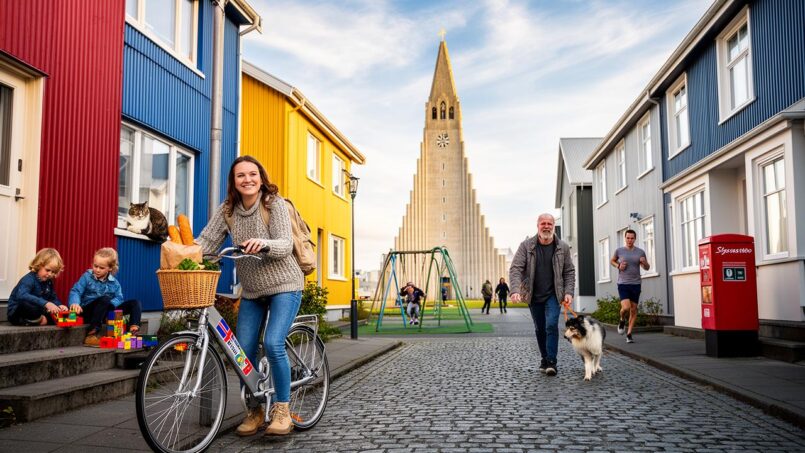
Safety in Denmark relies on structural factors such as low unemployment, high wages, a homogeneous social fabric, a culture of non-violence, a less militarized police force, and stable institutions. The country has no standing army and favors peaceful conflict resolution. This trust is illustrated by the common practice of leaving strollers with babies outside a café while parents have a drink inside, without causing any concern.
Everyday crime: still, don’t let your guard down
Being the safest country in the world does not mean it’s a country with no problems. The increase in tourism and the rise of expatriation have mechanically given rise to some forms of petty crime, especially in crowded areas: pickpocketing, opportunistic break-ins, theft from cars.
These phenomena remain marginal, but they exist. For an expat, the basic reflex still applies: don’t leave visible items in your car, always lock your home, avoid thinking you’re “invulnerable” just because you live in Iceland.
From a physical safety standpoint, the country remains exceptionally peaceful. The real risk for a newcomer lies elsewhere.
A magnificent island… and very geologically active
If crime is very low, nature is not. The island sits on the Mid-Atlantic Ridge, at the junction of two tectonic plates that are slowly pulling apart. Add to that a deep “hot spot” rising from the Earth’s mantle that fuels volcanism of rare intensity. Result: over a hundred active volcanoes, 33 major volcanic systems, frequent fissure eruptions, and near-constant seismic activity.
For an expat, this reality is not an exotic backdrop but a daily safety parameter to integrate.
Volcanoes, earthquakes, gas, and ash: what you need to know
Eruptions can start very quickly, sometimes with less than an hour between precursor signals and the event. Most are located in sparsely inhabited areas, but the case of the Reykjanes Peninsula in recent years shows that entire populated areas can be affected: the town of Grindavík (about 4,000 inhabitants) was evacuated in a few hours, as was the Blue Lagoon area.
Volcanic eruptions in Iceland present multiple hazards: lava flows, ash plumes, toxic gas clouds, landslides, and glacial outburst floods (jökulhlaups). The latter, caused by sudden ice melt, can abruptly isolate major road arteries like Route 1 near Jökulsárlón during eruptions of volcanoes such as Katla or Grímsvötn.
Ash dispersion causes problems far beyond the eruption site. Carried by wind for tens of kilometers, it can cause: air travel disruptions, damage to vehicle engines and bodies, a drastic drop in air quality, and respiratory irritation, especially in vulnerable people (children, elderly, pregnant women, those with heart or respiratory conditions).
Volcanic gases, particularly sulfur dioxide, are continuously monitored. Periods of pollution can affect even the Reykjavik area, far from the eruption, depending on the wind.
Earthquakes, meanwhile, are very frequent, especially around active volcanic zones. Most are weak, sometimes felt as mere vibrations, but they can trigger landslides or destabilize already weakened slopes.
An advanced monitoring system… as long as you follow it
The good news is that Iceland is one of the best-equipped countries in the world for tracking these phenomena. Seismometers, GPS, satellite imagery, gas sensors: volcanic activity is monitored in near-real time by the Icelandic Meteorological Office (IMO) and teams from the University of Iceland.
Icelandic authorities put in place a strict system to manage risk areas during a volcanic eruption. This includes closing roads, establishing exclusion zones, and sending SMS alerts in Icelandic and English to all phones in the affected area. This alert dissemination system is operational throughout the country, except in the Reykjavik area where it is currently being deployed.
Official resources to know from the moment you settle in:
| Resource | Primary Role | Relevance for an Expat |
|---|---|---|
| SafeTravel.is | Safety portal, route registration, alerts | Essential for hiking, road trips, out-of-town excursions |
| Vedur (app & site vedur.is) | Weather, wind alerts, snow, volcanic activity | Check daily, especially in winter |
| 112 Iceland App | Geolocated emergency app | Allows you to send your exact coordinates to rescue services |
| RÚV (radio/TV) | Public media outlet | Follow during major crises |
| Road.is | Real-time road conditions | Crucial for any intercity travel |
Recent feedback shows the effectiveness of this system. During the December 2023 eruption, Grindavík residents received SMS, were alerted by loudspeakers, and then guided to reception centers. Many hotels, guesthouses, and tour operators have detailed procedures for eruptions, and safety instructions are posted in accommodations.
For an expat, the rule is simple: mentally subscribe to these tools, check them regularly, and strictly follow the authorities’ decisions (road closures, access bans, evacuations).
Extreme climates, changing weather: learning to be outdoors safely
Beyond volcanism, the Icelandic climate is another safety factor not to be underestimated. Iceland is not a polar country in the strict sense – winters are relatively mild – but the combination of wind + humidity + sudden weather changes can make certain situations dangerous very quickly, especially for those unprepared.
A temperate climate… on paper only
Average temperatures can give a reassuring impression: around 0°C in Reykjavik in winter, rarely below -3°C in the city, a few degrees above zero in summer. But the reality, for a body accustomed to a continental or Mediterranean climate, is quite different. The constant wind, pervasive humidity, and biting gusts make 10°C in Iceland feel more aggressive than 0°C in a dry major European capital.
In winter, daylight lasts about four hours around the solstice, then gradually increases to about ten hours by March. Conversely, in summer, the near-absence of night (midnight sun) imposes a different kind of adaptation: disrupted sleep rhythms, the temptation to extend all activities indefinitely…
On roads and trails, be vigilant for frequent black ice, violent winds that can close mountain passes or rip off car doors, and dense fog that appears suddenly. In the mountains, the combination of snow, wind, and low visibility is a major hazard and can quickly lead to a dangerous situation for ill-equipped hikers.
The layering system: a real safety issue, not just comfort
For an expat, adopting the “onion technique” (three-layer system) is not an outdoor blogger’s fancy, but the basis of daily safety once you leave urban areas.
The idea is simple: instead of relying on one heavy coat, you layer three types of clothing, each with a clear function.
– A base layer (next to skin) that wickes away sweat and keeps skin dry: synthetic or merino wool technical underwear, definitely no cotton which stays damp and cools the body.
– An insulating mid-layer that traps heat (fleece, light down jacket, wool sweater).
– An outer shell layer that is waterproof and windproof (hardshell jacket and pants), with good rain resistance (at least 10,000 mm water column).
This clothing strategy is essential for outdoor activities in Iceland, such as hiking or Northern Lights viewing. It involves layering multiple pieces of clothing to adapt in real time: add a fleece when standing still to avoid cold, or remove a layer during exertion to avoid sweating. This active management is crucial for preventing hypothermia, especially from autumn onward and even in urban settings.
From a gear perspective, a few safety rules are essential: sturdy, high-top hiking boots with grippy soles and absolutely waterproof; crampons for winter on icy roads and sidewalks; a beanie, insulated gloves, and a neck gaiter even in summer if going out in the evening or at night to see the aurora.
For eyes and skin, sunglasses and sunscreen are useful year-round (snow glare, permanent brightness in summer), as are lip balm and good hand cream.
Winter driving: anticipate more than elsewhere
Many expats choose to settle outside Reykjavik or need a car for work. While the main road network is well-maintained, the Icelandic winter imposes driving conditions very different from those in Western Europe.
Roads in Iceland can become impassable within hours due to snowstorms or wind, especially on the south coast between Vík and Jökulsárlón, and in the East and West fjords during the cold season. Highland roads (F-roads) are closed for several months each year.
Winter tires (often studded) are mandatory between mid-November and mid-April. But even with proper equipment, caution is key: reduced speed, greatly increased following distances, avoidance of sudden maneuvers on snow or ice, and systematic checking of road.is and vedur.is before each trip.
For a newly arrived expat, especially one who has never driven on snow, it may be wise to take a winter driving course or to rely on public transport and organized tours for the first few months, while getting used to the vehicle’s behavior.
| Winter Factor | Main Risk | Reflex to Adopt |
|---|---|---|
| Strong wind | Vehicle drift, doors ripped off | Hold steering wheel firmly, open doors on lee side, park facing the wind |
| Snow / Blowing snow | Near-zero visibility | Reduce speed significantly, follow yellow markers, stop in a safe place if needed |
| Black ice | Sudden loss of grip | Anticipate, brake gently, avoid sudden steering, increase distance |
| Road closures | Isolation, major delays | Check road.is several times a day, keep blanket and supplies in car |
Living peacefully in Iceland means integrating these parameters into your routine: allow a buffer before catching a flight, accept rescheduling a trip if a storm warning is issued, and adapt the schedule of family activities to the rhythm of the seasons.
Administrative and legal safety: solid residence permits, or nothing
The safety of an expatriation is not just about not getting hurt on a hike or avoiding pickpockets. It also means avoiding unpleasant administrative surprises: expired residence permits, inaccessible social rights, inability to work legally, etc.
The Icelandic system is known for its efficiency and clarity, but also for its rigor. It rewards preparation, transparency, and punctuality in procedures. A well-organized expat will quickly feel legally secure; a careless one, on the other hand, can accumulate delays and complications.
EEA, non-EEA: two very different realities
The first major divide is by nationality. Citizens of the European Economic Area and Switzerland benefit from free movement: they can come live and work without a formal work permit. But this is not “without formalities.”
Number of months after which a foreigner must register as a resident in Iceland, unless they are seeking employment.
For non-EEA nationals, the rule is much stricter: you must obtain a residence permit coupled with a work permit before arriving, except in special cases (working holiday visa, foreign remote worker, international protection, etc.). Most often, the Icelandic employer initiates the work permit application with the Directorate of Labour, while the expat applies for a residence permit with the Directorate of Immigration.
Administrative processing times for immigration procedures are significant: allow 3 to 4 months for a standard work permit, 3 to 5 months for family reunification, and sometimes 6 to 9 months for a permanent residence application. For a worker from outside the European Economic Area, the entire process can take 3 to 8 months. Anticipating these delays is crucial to avoid being without a valid permit. Arriving without authorization or letting your permit expire can lead to penalties, forced return to the country of origin, and a reset of the waiting period required for later claiming permanent residence.
Residence categories to choose carefully
The Icelandic system offers a range of permits adapted to various profiles: salaried workers, skilled or unskilled, workers in shortage occupations, students, entrepreneurs, financially independent individuals, families joining a resident, retirees, and holders of humanitarian or digital nomad visas.
| Permit Type | Target Audience | Specifics |
|---|---|---|
| General work permit | Employees with a job offer | Tied to an employer, renewable annually |
| Permit for skilled workers | Profiles with high education/experience | More flexible procedure for in-demand occupations |
| Permit for labor shortage | Sectors lacking staff (health, construction, IT, tourism) | Often processed with priority |
| Study permit | Students enrolled at an Icelandic university | Right to part-time work (15 hrs/week) |
| Family reunification | Spouse, minor children, dependent parents | Requires proof of means and housing |
| Residence for independent means / retirees | People living on foreign income | Prohibited from working locally without a new permit |
| Permanent residence permit | Long-term residents (3-4 years depending on case) | Ultimately conditions access to citizenship |
Strictly following renewal rules is central to long-term safety. Most permits are valid for one year and must be renewed at least one month before expiration. A late filing can break the “continuity” of residence required for permanent residency and, eventually, naturalization. Here again, administrative vigilance is a form of safety.
Rights, obligations, and risks of non-compliance
In this system, both the employer and employee have clear obligations. The former must verify permit validity, comply with the contract submitted to authorities, and report any substantial changes. The latter must work only within the scope authorized by their permit, inform the administration of any change in situation, and file renewals on time.
Working without a valid permit exposes you to fines, revocation of the residence permit, and even deportation. In this context, trade unions, which represent about 85% of the workforce, are a valuable resource for expats. They offer advice on collective agreements, support in case of disputes (schedules, wages), and help in asserting your rights.
In a context of very high labor demand – the employment rate exceeds 80% of the working population, well above the European average, with significant needs in health, construction, IT, tourism, renewable energy – the risk is not so much not finding a job, but accepting one without proper administrative coverage.
For a smooth expatriation, securing the stay/work aspect is just as important as choosing a good coat: it’s what keeps you from ending up outside… in every sense of the word.
Healthcare: a robust system, but one you need to get to know
Safety in Iceland also comes from a reliable and accessible medical environment. In this respect, the country ticks many boxes, but also requires a few precautions, especially during the first six months of stay.
Strong universal coverage
Iceland has a universal healthcare system, funded more than 80% by taxes. The national insurance fund, Sjúkratryggingar Íslands (Icelandic Health Insurance), manages reimbursements. The country is divided into seven health districts, each with local health centers (“heilsugæslustöð”) and supported by a network of hospitals, including the large Landspítali University Hospital in Reykjavik.
Once registered, you can freely choose your general practitioner from among those under contract, consult specialists, and receive free hospital care. The system also offers a wide range of preventive services (pregnancy monitoring, pediatrics, vaccinations…). Out-of-pocket costs are limited thanks to a system of capped co-payments annually, with lower caps for children, the elderly, and the disabled. These costs can then drop sharply once a certain spending threshold is reached.
For a long-term expat, this is a real pillar of safety: in case of a weather-related accident, a respiratory problem during a volcanic pollution episode, or a simple daily health issue, you benefit from a very high-quality medical structure.
First six months: don’t leave without insurance
The important nuance lies in the access condition for foreigners. To be enrolled in the public system, you must have legally resided in Iceland for more than six months and be registered in the national register. During this initial period, except for EU citizens with a European Health Insurance Card (which provides a certain level of coverage), care is billed at full price.
Healthcare in Iceland is very expensive: a simple consultation with a general practitioner can cost around 90 euros, and an emergency room visit is even more costly. It is therefore crucial for any expat to take out private health insurance, international or local, to cover at least the transition period. This insurance can also be extended to provide greater comfort, such as shorter waiting times or better coverage for dental, optical, or psychotherapy care.
| Situation | Coverage | Point of Vigilance |
|---|---|---|
| Resident for < 6 months, non-EU without EHIC | No access to public system, full payment | Take out private insurance before departure |
| Resident for < 6 months, EU citizen with EHIC | Access to public care with standard co-payment | EHIC does not cover repatriation |
| Resident for > 6 months, enrolled in Icelandic system | Full access to system, capped co-payments | Anticipate co-payments, especially dental and less covered care |
Adult dental care, for example, is poorly reimbursed, and prices can be surprising (a simple check-up around 9,000 ISK). Here again, supplementary coverage can provide welcome financial and psychological comfort.
Lastly, know the emergency number (112, available 24/7 and complemented by an online chat) is one of the basics of safety. The 112 Iceland app lets you send your GPS coordinates without having to dictate them – extremely useful if you’re stuck on a secondary road, hiking, or the victim of an accident far from town.
Financial safety: living in a very expensive country without putting yourself at risk
We rarely talk about financial safety as an element of protection… until the end of the month gets tight. In Iceland, ignoring the cost of living is one of the surest ways to jeopardize your expatriation, even to get into trouble.
The country ranks among the most expensive in the world. According to several sources, the overall cost of living exceeds that of France by 40 to nearly 60%, and the heaviest expense items are precisely those you can’t avoid: housing, food, transportation, healthcare (outside the public system), and international schooling.
Housing: the biggest risk area
A peaceful lifestyle here rhymes with a realistic housing budget. Average rents for a one-bedroom apartment in the city center often range between 1,600 and 2,100 euros per month, more in Reykjavik where demand is very high. A three-bedroom apartment can easily exceed 2,300 euros in the city.
| Type of Housing (average) | Estimated Monthly Rent |
|---|---|
| Studio city center | ~1,900 € |
| 1 bedroom Reykjavik center | ~1,900 € |
| 3 bedrooms Reykjavik center | ~2,700 € |
| 3 bedrooms outside center | ~2,300 € |
Add to that utilities, which are reasonable (electricity, water, geothermal heating: about 75–80 € per month for 85 m²), but they must be factored in. Expats with children also need to consider the cost of an international school: over 25,000 euros annually for a private international primary school.
For a smooth expatriation project, it is crucial to establish a detailed budget before departure. This should include all foreseeable costs related to moving, settling in, and daily life in the new country.
– Rent based on apartment size and neighborhood.
– Subscriptions (internet, phone, gym, etc.).
– Transportation (buying or leasing a car, fuel, bus).
– Food (60 to 80% more expensive than in France).
– Possible private insurance (health, vehicle, home).
The average net salary is close to 3,800 euros, and many skilled professions (IT, engineering, healthcare) can exceed 800,000–1,000,000 ISK per month. But sectoral gaps are significant, and some jobs in tourism or hospitality pay much less, especially at the start of a career.
Food, transportation, leisure: avoiding the “permanent tourist” effect
Eating out is significantly more expensive than in continental Europe: a simple lunch costs around 20–23 euros, a three-course dinner often exceeds 50–60 euros per person. Grocery shopping also reflects the island’s isolation and import costs: dairy products, meat, fruits, and vegetables are noticeably pricier.
Transportation is about two-thirds more expensive than in France: a single bus ticket costs around 4-4.5 €, gas exceeds 2 € per liter, and taxis are costly. Outside Reykjavik, owning a car becomes almost essential, which implies a significant budget for purchase, insurance, maintenance, and winter tires.
Without a lifestyle adjustment – cooking at home more, using public transport when possible, taking advantage of the many free outdoor activities – an expat can find themselves in constant financial strain, a source of stress and vulnerability.
Financial safety in Iceland thus means:
– Avoiding matching your consumption level to that of a tourist on vacation.
– Reassessing your housing expectations (roommates, living slightly outside the city center).
– Learning about available benefits and schemes (childcare allowances, subsidies for Icelandic language courses, etc.).
– Anticipating the difference between an attractive gross salary and your actual disposable income after covering major expenses.
Social integration and psychological well-being: creating a human safety net
Safety isn’t measured only by crime statistics or coat thickness. It also depends on an expat’s ability to build a network, feel supported, and understand the codes of a new society.
Iceland, with its tight-knit social fabric and culture of equality, offers favorable ground, but the country’s small size and the language can create a sense of isolation if you’re not careful.
Expat communities, associations, networks
Even though the foreign community represents only about 17–18% of the total population (nearly 69,000 people), it is surprisingly active. Several structures have developed in recent years to support newcomers: online platforms like InterNations or Bexpat, associations by language or origin (e.g., “Reykjavík Accueil” for French speakers, Polish or Filipino associations), Facebook groups for expats (“Iceland Expats”, “Foreigners in Iceland”), and Meetup gatherings.
For expats, these networks offer dual support. Practically, they provide concrete advice for daily life: finding housing, recommendations for doctors or schools, help with administrative procedures. Emotionally, they help break the loneliness, share the experience of adapting to a new environment (like constant daylight in summer or darkness in winter) and the distance from family, and build a circle of friends.
The flipside, to watch for to maintain your peace of mind, is not to confine your entire social life to the expat bubble. To settle in Iceland for the long term, it’s helpful to combine these international networks with activities that allow you to meet Icelanders: sports clubs, language classes, cultural workshops, volunteering…
School, children, and the feeling of family safety
For families, the Icelandic education system is a factor of safety and well-being in its own right. The school system is based on a strong principle: equal access for all, regardless of social background, mother tongue, any disability, or religion. This principle runs through all levels, from preschool to secondary education, with curricula centered on health, well-being, democracy, human rights, equality, and creativity.
Children of foreign origin in Iceland have access to Icelandic as a second language courses, additional academic support, and sometimes specific integration programs. The association Móðurmál also offers extracurricular classes in over twenty mother tongues, allowing children to maintain their multilingualism and cultivate their identity while integrating into Icelandic society.
For an expat parent, knowing that your children are welcomed in a safe, non-violent environment that supports students with special needs fully contributes to the serenity of the expatriation project.
Working in Iceland safely: employment, conditions, rights
The Icelandic labor market, very dynamic, offers real opportunities for expats. The employment rate exceeds 80%, well above the European Union average, and certain sectors – health, construction, technology, tourism, renewable energy – are actively seeking foreign labor.
A tight market but highly regulated
Salaries are generally high: on average, nearly 3,900 euros net monthly, with ranges easily reaching 900,000–1,200,000 ISK for IT professionals or engineers, even 1.5 million in some medical specialties. But these wages come with labor law governed by powerful collective agreements, supported by strong unions.
This legal framework protects expats from serious abuses such as abnormally low wages, excessive working hours, and non-compliance with breaks or holidays. In case of a dispute, turning to a trade union provides additional protection.
Safety here consists of:
– Researching the collective agreements for your target sector in advance.
– Checking that your contract complies with Icelandic standards (pay, overtime, pension contributions, etc.).
– Not accepting “under-the-table” work, even for a few hours, at the risk of jeopardizing your residence permit.Language, skills, and training: arming yourself
While English is widely spoken – about 98% of Icelanders can communicate fluently in it – and sufficient for many jobs in IT, tourism, or some services, learning Icelandic remains a lever for professional safety. It increases job opportunities (especially in health, education, public sector), makes it easier to understand contracts, safety instructions, and official documentation.
New residents can receive financial support for Icelandic language courses, notably through unions, social services, or the employment agency. These courses facilitate integration and strengthen autonomy, especially in emergency or conflict situations.
Practical tips for a truly peaceful expatriation
Putting all these pieces together – geology, weather, health, finances, housing, work, integration – can be dizzying. Yet, many expats settle in Iceland each year and find a peaceful daily life, even radically safer than in their home country.
A few cross-cutting principles can help turn this wealth of information into simple reflexes.
First, take natural risks seriously without dramatizing them. Subscribe to the main apps and sites (SafeTravel, Vedur, 112, road.is), check them regularly, register your hike or travel itineraries, always respect barriers and signs even if they seem “exaggerated.”
Approach your relationship with the climate as a matter of strategy rather than courage. This means investing in a few quality technical pieces, adopting the layering principle, guiltlessly giving up outdoor activities when weather conditions become unstable, and reducing the density of your activities in winter to preserve your energy and manage fatigue.
On the administrative front, anticipation is key: carefully choose the right residence category, gather all documents (police clearance certificates, civil status records, certified translations) before departure, note renewal deadlines in your calendar, and never file a last-minute application.
Financially, accept from the outset that this is an expensive country, where peace of mind comes from a realistic budget and adapting your lifestyle. Living “like on permanent vacation” in Iceland is the best way not to stay long.
Advice for expats in Iceland
Finally, don’t neglect the social dimension. Reach out to expat communities, but also to local actors (associations, clubs, schools), learn at least the basics of Icelandic, participate in community life: all ways to create a support network, invaluable in case of hardship, doubt, or simply to feel at home in this country of fire, ice… and safety.
Disclaimer: The information provided on this website is for informational purposes only and does not constitute financial, legal, or professional advice. We encourage you to consult qualified experts before making any investment, real estate, or expatriation decisions. Although we strive to maintain up-to-date and accurate information, we do not guarantee the completeness, accuracy, or timeliness of the proposed content. As investment and expatriation involve risks, we disclaim any liability for potential losses or damages arising from the use of this site. Your use of this site confirms your acceptance of these terms and your understanding of the associated risks.

Cyril Jarnias is an independent expert in international wealth management with over 20 years of experience. As an expatriate himself, he is dedicated to helping individuals and business leaders build, protect, and pass on their wealth with complete peace of mind.
On his website, cyriljarnias.com, he shares his expertise on international real estate, offshore company formation, and expatriation.
Thanks to his expertise, he offers sound advice to optimize his clients' wealth management. Cyril Jarnias is also recognized for his appearances in many prestigious media outlets such as BFM Business, les Français de l’étranger, Le Figaro, Les Echos, and Mieux vivre votre argent, where he shares his knowledge and know-how in wealth management.





