
 Published on and written by Cyril Jarnias
An archipelago of over 1,000 islands lost in the middle of the Pacific, between Hawaii and Papua New Guinea, the Republic of the Marshall Islands has only about 70,000 inhabitants, largely concentrated on Majuro Atoll. Yet, the diversity and intensity of its sports life surprises everyone who takes an interest. Between basketball hoops set up in every village, big-game fishing tournaments that liven up the lagoons, outrigger canoe races inherited from over two millennia of navigation, and the recent explosion of soccer, the Marshall Islands offer a sports landscape as dense as their territory is fragile in the face of climate change.
In this archipelago where the sea dominates the land, sports are much more than just pastimes. They serve as a public health tool, strengthen community ties, and contribute to a cultural renaissance. The most popular disciplines thus reflect the values and evolution of contemporary Marshallese society.
Basketball, a National Open-Air Passion
In the Marshall Islands, basketball is not just a trendy sport imported from the United States; it is a true collective obsession. Introduced in the late 1960s by Americans, it established itself in a few decades as the flagship discipline, to the point that some observers describe it as practiced with near-religious fervor.
You find hoops almost everywhere: on concrete courts squeezed between two houses, in schoolyards, near churches, along the main road on Majuro. The Marshallese peculiarity is the complete absence of an indoor basketball facility: everything is played outdoors, under a sun that easily exceeds an annual average of 27 °C (80 °F), or under the threat of heavy tropical rains. To avoid the oppressive heat, the most intense games take place in the evening, as soon as the light fades and the breeze picks up.
The Marshall Islands, an archipelago of narrow atolls, have found in basketball a sport perfectly suited to their geography: all you need is a concrete slab and a few square meters to create a court. As a result, in the 10–30 age group, the country claims one of the highest basketball participation rates in the world relative to its population.
The Marshall Islands Basketball Federation, Engine of Development
At the heart of this passion is the Marshall Islands Basketball Federation (MIBF), founded in 1999. Its mission is to organize, promote, and develop basketball across the entire territory. It runs year-round leagues, school tournaments, and elite competitions, as well as introductory clinics, and coach and referee training programs.
One of the major events is the Ralik-Ratak Shootout, a tournament pitting teams from the two archipelagos of the Marshall Islands. A memorable match from the 2014 final between Lae and Majuro was so impactful that it was filmed and widely broadcast. This sporting effervescence often centers on iconic venues like the SGT Solomon Sam Basketball Court, an outdoor basketball court.
The federation does not work alone. The Australian Embassy, FIBA Oceania, and the public school system support it in setting up player and coach clinics, with a clear goal: making basketball a tool for social development. The idea is to provide a structured framework for young people, to prevent issues related to idleness, and to promote gender equality by increasing mixed-gender competitions and sessions.
Basketball for Public Health
Basketball also serves as a response to a health emergency. The Marshall Islands are among the countries most affected by non-communicable diseases, particularly diabetes. According to the International Diabetes Federation, nearly 37% of the population (out of about 55,000 people at the time of the estimate) lives with this condition. The government has even declared a state of emergency on this issue.
The Marshall Islands Basketball Federation created a 3×3 basketball league for people over 40, played three evenings a week outdoors. During each session, a team of nurses from the Ministry of Health conducts blood pressure, blood sugar, and weight checks. This initiative allows participants to engage in physical activity while monitoring their health and discussing the risks of a sedentary lifestyle with medical staff.
Local Icons and an Ambitious National Team
The country fields a young, fast men’s national team, coached by Robert Pino. Facing regionally larger opponents like Guam, Fiji, or New Caledonia, the Marshallese rely on speed and an intense transition game. Practices are held in the evening, in the cooler air, on the outdoor courts of Majuro.
Kyle Paul was the youngest player on the Marshall Islands national basketball team at this age.
On the world stage, FIBA rankings place the Marshallese men’s team around 108th and the women’s team around 99th, which is respectable given the country’s size and lack of infrastructure.
A Structured Competitive Offering
The tournaments organized by the MIBF cover all ages, from elementary school students to elite teams. During a Constitution Day tournament, over 20 schools and 200 children were involved, from elementary categories to men’s and women’s elite divisions. The results illustrate basketball’s deep roots in the school system: Rairok Elementary won the title in grades 5–6, Ajeltake Elementary won in grades 7–8, while COOP (Mad Dawg) beat Marshall Islands High School in the high school final.
To give an idea of the scale of basketball participation, here is a summary of key points in a table.
| Indicator | Data / Information |
|---|---|
| Year MIBF was founded | 1999 |
| Type of facilities | 100% outdoor courts, no dedicated indoor facility |
| Main playing times | Evenings, to avoid the heat |
| Signature tournament | Ralik‑Ratak Shootout |
| Number of schools in a major tournament | > 20 schools, ~200 children |
| FIBA men’s ranking | 108th |
| FIBA women’s ranking | 99th |
| Health + basketball program | Veterans 3×3 League “Say No to NCDs” |
Basketball thus stands as the backbone of sports life in the Marshall Islands, combining performance, prevention, and social cohesion.
Volleyball, the Queen Sport for Women and Community Gathering
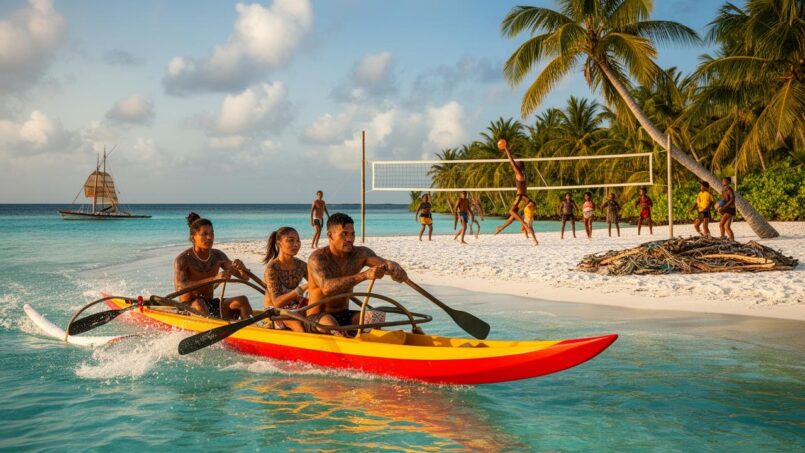
While basketball dominates among men, volleyball is the queen discipline for women. Everywhere in the villages, you see nets strung between two posts, two coconut trees, or two buildings. All it takes is a ball and a patch of sand to improvise a game that brings together children, teens, and adults, in a more relaxed atmosphere than the often highly competitive basketball courts.
The Marshall Islands Volleyball Federation organizes national volleyball through school and community leagues. Championships exist from elementary and middle school for both girls and boys, showing that this sport, while remaining the favorite among women, is not exclusively female.
A Women’s National Team on the Rise
The women’s national team trains twice a week, under the guidance of a coach from Pohnpei, Panson Elu, who brought a more structured approach to sessions. Its captain, Rutha Pedro, 19 years old and about 1.70 m (5’7″), discovered volleyball in elementary school and embodies the generation raised in school leagues.
Facing often taller opponents, the Marshall Islands team compensates for its height deficit with great explosiveness at the net and by playing smarter. Despite high travel costs limiting their participation in regional competitions, the team has already won gold at one edition of the Micronesian Games held in Majuro and placed fifth at another edition.
Beyond results, volleyball accompanies major national holidays. During Constitution Day, volleyball tournaments are always on the program, attracting teams from across the archipelago. This festive dimension, combined with strong female participation, makes it a prime setting for socializing.
Here is a summary of volleyball‘s role in Marshallese society:
| Aspect | Role of Volleyball in the Marshall Islands |
|---|---|
| Dominant gender | Mostly female, but mixed practice growing |
| Places of play | Schoolyards, beaches, community courts |
| School level | Active leagues in elementary, middle, and high school |
| Presence at events | Strong presence during national holidays and national games |
| National team | Aiming for medals in Micronesian tournaments |
Soccer, the Newcomer Trying to Make Up for Lost Time
For a long time, the Marshall Islands were cited as the only country in the world without a national soccer team and not affiliated with FIFA. The local sports culture favored basketball and baseball, linked to American influence. That situation is changing rapidly.
The Birth of a Federation and a National Team
The Marshall Islands Soccer Federation (MISF) was created in late 2020, with a clear ambition: structure soccer from the grassroots up to the senior national team, and eventually gain membership in a confederation (OFC, AFC, or CONCACAF) and then FIFA. A British technical director, Lloyd Owers, holding UEFA licenses, was hired to lay the foundations: integrating soccer into schools, developing futsal, creating local leagues, and setting up a selection program.
Approximately 200 children already play soccer regularly in the Marshall Islands school programs.
The MISF is also counting on the Marshallese diaspora, heavily present in the United States, especially in Arkansas and Hawaii. In 2025, a first men’s selection was called up to participate in the Outrigger Challenge Cup, a tournament held in Springdale, Arkansas, due to the large local community (about 15,000 Marshallese). The first matches ended in losses, but the team scored its first two official goals and set a historic milestone.
Rapid Structuring and 2030 Goal
The stated ambition of the MISF is to make the Marshall Islands a full FIFA member by 2030. To achieve this, several steps are underway: filing applications with continental confederations, creating a national 11-a-side championship (the Marshall Islands Soccer League is announced for Majuro), parallel development of women’s and futsal teams, and international partnerships to boost the project’s visibility.
Summary of key moments in the development of soccer in the Marshall Islands
Arrival and early practice of soccer in the archipelago, often linked to international exchanges or missions.
Creation of the federation or official governing body responsible for structuring and promoting the sport.
Organization of the first tournaments or national championships, marking the start of competitive structuring.
Membership in the Oceania Football Confederation (OFC) and/or FIFA, enabling global recognition.
Construction or improvement of fields and facilities dedicated to soccer.
Implementation of initiatives to train young players and coaches, aimed at long-term development.
| Element | Detail |
|---|---|
| MISF founded | December 31, 2020 |
| Technical Director | Lloyd Owers (UEFA licensed) |
| First men’s selection | Gathering early 2024, first matches in 2025 |
| Reference competition | Outrigger Challenge Cup (futsal then soccer) |
| Main goal | FIFA membership by 2030 |
| Local development | Regular sessions on Majuro, Kwajalein, Ebeye |
| Young players in schools | ~200 children |
| 11-a-side league | Launch planned in Majuro |
| Diaspora weight | 20,000 to 30,000 Marshallese in the US |
In just a few years, soccer has thus gone from being a marginal curiosity to a discipline undergoing rapid structuring, driven by a project of sports nation-building.
Baseball and Softball, a Legacy of the U.S. Link
Another direct legacy of American trusteeship is baseball and softball, very popular in the Pacific region. In the Marshall Islands, both disciplines are managed by a single body, the Marshall Islands Baseball / Softball Federation, chaired by Jeimata Nokko Kabua. They bring together hundreds of players and supporters, mainly in Majuro but also in other atolls.
The country won a silver medal in baseball/softball at the 2012 Micronesian Games and other medals at the South Pacific Games. Participation is growing, as evidenced by the recent development of a second field in the city, including for women’s fast-pitch thanks to the introduction of adapted regulations.
Even if the leagues remain modest in size, these sports enjoy strong popular support, fueled by the broadcast of American leagues and the social role of local clubs, which offer another avenue for personal development beyond the more high-profile sports.
Sport Fishing and the Ocean, an XXL Playing Field
In the Marshall Islands, the sea is not just a geographical constraint or an economic resource; it is a gigantic open-air stadium. Fishing—especially sport fishing—holds a central place in leisure activities, to the point of being structured by clubs, regular tournaments, and major annual events.
The Marshalls Billfish Club Tournaments
The Marshall Islands Billfish Club (MIBC) coordinates about a dozen big-game fishing tournaments per year. Two events dominate the calendar: the President’s Cup, which closes the season by rewarding the most successful captain of the year, and the All-Micronesian International Tournament, which attracts teams from other islands in the region. These competitions take place around Majuro and neighboring atolls, in waters known for their density of pelagic fish.
Sport fishermen target prized species like giant marlin, tuna, wahoo, mahi-mahi, and barracuda. Charter services, such as Wasabi operated by Cary Evarts, offer specialized trips. Additionally, Fisherman’s Day organizes two tournaments over two days: one dedicated to billfish (offshore fishing) and the other to bottom fishing (“urok” in Marshallese) in the lagoon. Boats generally leave at dawn and return in the late afternoon to weigh their catch on Uliga dock.
A table shows the main fishing tournament formats.
| Tournament / Event | Type of Fishing | Features |
|---|---|---|
| MIBC Monthly Tournaments | Billfish and multi-species | Point-based rankings |
| President’s Cup | Billfish | Cumulative points over the season |
| All‑Micronesian Fishing Tournament | Billfish (international) | Regional participation |
| Fisherman’s Day – Billfish Tournament | Offshore fishing | Two-day event |
| Fisherman’s Day – Urok Tournament | Bottom fishing (lagoon) | 44 participants in one 2022 edition |
| Marshall Islands International Tournament | Recreational and pro categories | Open to locals and internationals |
Beyond performance, these tournaments are major moments of socializing and community pride, considered “major oceanic events” of the Republic.
Spearfishing and Traditional Water Sports
Spearfishing, practiced with traditional techniques (spears, poles, etc.), remains an important activity in the Pacific and the Marshall Islands. A form of traditional competition, called Kabua, involves catching as many fish as possible with a spear during the winter. While major spearfishing competitions in the region (Inter-Pacific Spearfishing Championships, Saipan or Guam tournaments) often take place outside Marshallese territory, local practice is part of this shared oceanic culture.
The maritime sports culture is not limited to fishing. The atolls with clear waters, home to over 1,000 fish species and protected lagoons, are particularly suited to a multitude of activities: scuba diving on World War II wrecks (especially at Bikini), snorkeling on the reefs, kayaking in the lagoons of Majuro or Jaluit, stand-up paddleboarding, surfing on the reefs of Ailinglaplap or Mili, kitesurfing and wingfoiling around Beran Island, sailing cruises between atolls, and traditional canoe excursions.
Water temperatures hover around 82 °F (28 °C) year-round, allowing for continuous practice of these sports, even if swell and wind conditions vary with seasons and climate phenomena like El Niño or La Niña.
Outrigger Canoe and Canoe Racing, the Cultural Heart of Marshallese Sport
Long before basketball or baseball arrived, Marshallese were first and foremost navigators. For over 2,000 years, the outrigger canoe has been the pillar of life, transport, and culture on these low-lying atolls set on the ocean.
The first Micronesian navigators arrived in the Marshall Islands between 500 and 2,000 BCE. Historically, Marshallese traveled up to 500 miles on the open sea, reaching Wake to the north, Hawaii to the east, Kiribati to the south, and Pohnpei to the west. Their expertise relied on stick charts—structures made of wood and shells symbolizing currents and swells—memorized and never taken to sea.
Marshallese canoes are distinguished by an asymmetric hull—flatter on the side opposite the outrigger—a lateen sail rigging, and a shock-absorbing outrigger system, allowing speeds approaching 20 knots. Traditionally, they were built without metal, using tools made of coral, shell, and coconut fiber lashings. Each part has a meaningful Marshallese name, such as Jouj (“goodness”) for the keel base, or Madonnas (“eyes of God”) for the central reference line.
The knowledge of traditional navigation nearly disappeared in the 20th century, particularly due to World War II, colonization, and the arrival of motorboats, which interrupted its transmission. However, an active revival movement has developed over the past twenty years to preserve and revitalize it.
Waan Aelõñ in Majel and Majuro Ocean Sports Club
The Waan Aelõñ in Majel (WAM) program, co-founded by Dennis Alessio and Alson Kelen in the late 1990s, uses canoe building and navigation as an educational tool for youth. By learning to carve a hull or read the waves, young Marshallese gain both technical skills and self-confidence as well as cultural grounding.
The program’s achievements are impressive: building large ocean-going canoes (walap), participating in regional events, refitting a traditional catamaran commissioned by Ailuk Atoll with support from the Taiwanese embassy, and even building a canoe presented by the Marshallese president to his Taiwanese counterpart. In 2015, a WAM canoe sailed from Majuro to Aur, about 60 miles, demonstrating that this navigation is not just a thing of the past.
An NGO dedicated to developing water sports in the Marshall Islands, based on the University of the South Pacific campus at Long Island, Majuro.
Import of seven modern canoes from New Zealand (four to six seats, two singles, one three-seater) thanks to a $75,000 grant from the North Pacific Development Fund.
Development of canoe racing, swimming, surfing, stand-up paddleboarding, and maritime safety for the community.
Chaired by Grant Bilyard, supported by figures such as founder Francisco Blaha and treasurer Dr. Irene Taafaki.
Canoe Races and Social Prestige
In the Marshall Islands, canoe races are described as “really huge.” The National Cup, held in Majuro, brings together the best crews and attracts major sponsors. Navigators like Rice Snight, considered a canoe racing champion, are true celebrities. In urban areas like Majuro, the canoe has become as much a status symbol as a subsistence tool.
Marshallese legends are full of stories of races used to decide contenders for power. One tells how the deity Letao won a regatta against his nine brothers thanks to a pandanus-leaf sail, thus becoming the ruler of Lib Island. These tales still fuel the collective imagination surrounding canoe racing today.
Modern competitions are accompanied by dances, songs, and blessing rituals. They play a role similar to major basketball tournaments or sport fishing days: bringing the community together around a shared effort, while affirming a unique cultural identity.
Other Popular Sports: Martial Arts, Strength Sports, and Racket Sports
The Marshallese sports landscape is not limited to the major disciplines already mentioned. Many sector-specific federations exist under the auspices of the Marshall Islands National Olympic Committee (MINOC), founded in 2001 and recognized by the IOC in 2006.
Taekwondo enabled the country to send its first Olympic athlete, Anju Jason, who qualified for Beijing 2008 after a regional gold medal. Wrestling has yielded two medals at the South Pacific Games (silver for Waylon Muller and bronze for Jeton Anjain). Weightlifting is experiencing a resurgence thanks to investments from MINOC President Ken Kramer, and table tennis is developing in schools through the “Bounce It Back” program of the International Table Tennis Federation.
The Marshall Islands National Games, held every two years, gather these disciplines—athletics, volleyball, basketball, combat sports, racket sports—into a major sports festival, showcasing local talent and serving as a springboard for the Pacific Games or the Micronesian Games.
The Marshall Islands on the Regional and Olympic Stage
Even if resources remain modest and infrastructure limited, the Republic of the Marshall Islands has participated in every edition of the Summer Olympics since Beijing 2008. Delegations rarely number more than five athletes, mainly in swimming, athletics, weightlifting, and taekwondo. No Olympic podium has been reached yet, but some athletes have become national figures, such as swimmer Mattie (Maddie) Sasser, who qualified for Rio and was flag bearer at the 2016 and 2024 Games, or sprinters Roman William Cress and Haley Nemra.
This competition is the main sporting event for the Marshall Islands. It brings together ten Micronesian entities around about fifteen disciplines, including classic sports (basketball, athletics, swimming) and traditional cultural events like coconut tree climbing.
The Marshall Islands have already shone in women’s volleyball, basketball, and swimming, and won a bronze medal in the women’s 1,500-meter canoe race at the 2002 Games in Pohnpei with the WAVE team, after six months of preparation. More recently, hosting the Micronesian Games in Majuro allowed the country to inaugurate a running track, a national gymnasium, and a swimming pool on Kwajalein, marking a qualitative leap for the entire local sports movement.
A Sport Under Climate and Economic Constraints
Behind this vitality, the material reality remains fragile. The country desperately lacks quality infrastructure: most basketball and volleyball courts are outdoors, the only real indoor gym belongs to a religious school, and many swimmers train directly in the lagoon. Inter-atoll travel for competitions is costly, as are international trips, limiting the frequency of high-level matchups.
The Marshall Islands, a low-lying atoll nation, is experiencing an accelerated rise in sea level, leading to flooding, erosion, salinization, and destruction of infrastructure. Extreme events have already inundated Majuro, damaged homes, and caused displacements. A one-meter rise could render a large part of the atoll uninhabitable, directly threatening the future of sports practice.
In this context, sports fields, nautical clubs, and coastal facilities are among the vulnerable infrastructures. But sport also becomes a lever for resilience: it promotes health in an environment where non-communicable diseases are exploding, strengthens community bonds tested by internal and external migration, and offers young people opportunities for success and national pride.
Conclusion: A Human-Scale Sports Laboratory
The popular sports practiced in the Marshall Islands perfectly reflect the delicate balance the country seeks to maintain: between modernity and tradition, between American influence and the revival of Oceanic knowledge, between extreme vulnerability and the will to project itself onto the world stage.
Basketball and volleyball are popular sports that structure social life. Fishing and water sports thrive in the marine environment, highlighting the archipelago’s vital dependence on the ocean. Outrigger canoe racing, supported by programs like WAM, connects the navigator past to future challenges. Finally, soccer symbolizes the national ambition to acquire the attributes of a modern sports nation, with the aspiration to join FIFA.
In a context of accelerated climate change, where some scientists do not rule out the prospect of a massive relocation of the population in the long term, these sports activities take on additional meaning: they are not just pastimes, but a way to stay healthy, strengthen social cohesion, and preserve an identity that should never be submerged.
Disclaimer: The information provided on this website is for informational purposes only and does not constitute financial, legal, or professional advice. We encourage you to consult qualified experts before making any investment, real estate, or expatriation decisions. Although we strive to maintain up-to-date and accurate information, we do not guarantee the completeness, accuracy, or timeliness of the proposed content. As investment and expatriation involve risks, we disclaim any liability for potential losses or damages arising from the use of this site. Your use of this site confirms your acceptance of these terms and your understanding of the associated risks.

Cyril Jarnias is an independent expert in international wealth management with over 20 years of experience. As an expatriate himself, he is dedicated to helping individuals and business leaders build, protect, and pass on their wealth with complete peace of mind.
On his website, cyriljarnias.com, he shares his expertise on international real estate, offshore company formation, and expatriation.
Thanks to his expertise, he offers sound advice to optimize his clients' wealth management. Cyril Jarnias is also recognized for his appearances in many prestigious media outlets such as BFM Business, les Français de l’étranger, Le Figaro, Les Echos, and Mieux vivre votre argent, where he shares his knowledge and know-how in wealth management.





