
 Published on and written by Cyril Jarnias
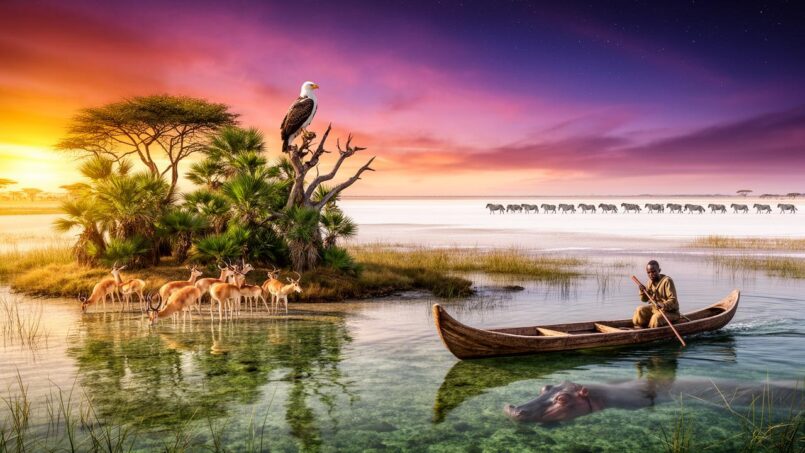
At the heart of Southern Africa, Botswana has earned a reputation as one of the most spectacular safari destinations on the continent. A land of endless deserts, flooded deltas, salt pans stretching to the horizon, and sacred hills adorned with rock art, it packs a diversity of landscapes into a relatively compact area that is hard to match. Above all, it has chosen a tourism model that is deliberately limited in volume but demanding in quality, allowing its vast wilderness areas to remain intact and relatively uncrowded.
Good to know:
Botswana brings together major sites that form a unique natural and cultural heritage. Must-sees: the Okavango Delta and Moremi Game Reserve, Chobe National Park, the Central Kalahari Game Reserve, the Makgadikgadi Pans, the Northern Tuli Game Reserve, and the sacred Tsodilo Hills (UNESCO). Together, these areas tell the geographic, ecological, and cultural story of the country.
Okavango Delta: The Miracle of a River That Loses Itself in the Desert
Botswana’s jewel, a UNESCO World Heritage Site, defies hydrological logic. Here, a great river from the Angolan Highlands does not flow into the sea but instead spreads into the heart of the Kalahari, forming one of the world’s largest inland deltas. Over roughly 15,000 km² of floodplains, permanent swamps, and seasonally flooded grasslands, water transforms the desert into a giant oasis.
An Inverted Calendar: When the Flood Arrives in the Dry Season
What makes the Okavango Delta so unique is its counter-seasonal flood cycle. Rain falls far to the north, in Angola, several months before reaching Botswana. The result: water begins to fill the delta between May and June, peaks between July and September, and then gradually recedes from September onward—all while the region experiences its dry season under perfectly clear skies.
There are broadly two main seasons for understanding the delta:
| Approximate Period | Season | Key Characteristics |
|---|---|---|
| May – October | Dry season | Peak flood, thinning vegetation, animals concentrated around permanent water |
| November – April | Wet season | Intense green landscape, animals more dispersed, explosion of life and births |
This disconnect between rain and flood creates a striking contrast: it is during the dry winter, when everything should be parched, that the Okavango Delta swells, doubling or tripling in size. Islands fragment, channels multiply, and the wetlands become a labyrinth for mokoro cruises—the traditional dugout canoes emblematic of the region.
Spectacular Year-Round Resident Wildlife
Unlike some more seasonal ecosystems, the Okavango Delta hosts resident wildlife that never truly leaves the area. Hippos, crocodiles, swamp antelopes, and large predators all share the territory. Reintroduction programs have even made sightings of both black and white rhinos regular once more, completing the picture of Africa’s great mammals.
Example:
During the dry season, from May to October, the scarcity of water in the interior plains of the Okavango Delta triggers a massive migration of herbivores (elephants, buffalo, zebras, wildebeest) toward the flooded areas. This animal concentration attracts a host of predators such as lions, leopards, hyenas, jackals, and African wild dogs—the latter being especially observable in the concessions north of the delta.
When the rains return, between November and April, the scenery changes completely. The Okavango Delta becomes a Garden of Eden, intensely green and dotted with wildflowers. Water spreads everywhere, and animals move away from the main channels. Big game viewing becomes more challenging as vegetation thickens, but life scenes multiply: antelope births, young impalas and tsessebes everywhere, predators on the lookout for newborns.
A Birder’s Paradise
While the delta is a sure bet for fans of big cats and elephants, it becomes a true sanctuary for birds during the rainy season. Thousands of migrants join the resident populations, turning the marshes into a vast ornithological observatory. January often marks the peak breeding season for migratory birds.
Richness
The numbers give an idea of this richness.
| Type of Wildlife Within the Delta (UNESCO area) | Approximate Number of Recorded Species |
|---|---|
| Plants | 1,061 |
| Fish | 89 |
| Reptiles | 64 |
| Birds | 482 |
| Mammals | 130 |
Added to this is its status as an Important Bird Area for its waterbird populations. Among the species observed are the largest African population of wattled cranes, black herons, herons, storks, carmine bee-eaters, and many others present in sufficient numbers to represent a significant fraction of their global populations.
When to Go and What to Do There?
The richness of the Okavango Delta also lies in the variety of activities on offer. Mokoro rides, motorboat safaris, 4×4 game drives, guided walks, scenic flights, fishing, cultural visits: few African destinations offer such a range.
Tip:
The highlights of each period in the delta can be summarized as follows.
| Month | Conditions and Signature Highlights |
|---|---|
| January | Frequent rains, very green landscape, huge bird activity, many births |
| April | Transition to dry season, rising water, ideal start for mokoro trips in the north |
| June | Start of “pure” dry season, thinning vegetation, excellent terrestrial sightings |
| July | Peak flood, top mokoro safaris, great wild dog and large predator sightings |
| August | Peak tourist season, optimal visibility, superb heronries and horse safaris in the south |
| September | Rising heat, animals highly concentrated around remaining water, many predators |
| October | Extreme heat but spectacular hunting scenes, barbel run (catfish migration) |
| November | Arrival of rains, explosion of vegetation, antelope births, perfect light for photos |
For water activities (mokoro, boats), the ideal window is generally May to October, when water levels are sufficient. Guided walks are especially recommended during the same period, with milder temperatures and better visibility. Bird enthusiasts will prefer the wet months, November to April.
Travelers also need to consider the high and low season dynamics:
| Tourist Season | Dominant Period | Features |
|---|---|---|
| High season | July – October | Best land safari, higher prices, need to book well in advance |
| Low season | November – June | Fewer people, often lower rates, access more difficult in some areas |
| Shoulder season | April – May, November | Good value-for-money compromises, superb landscapes, milder temperatures |
Even in high season, the Okavango Delta retains an exclusive feel thanks to its small camps and lodges with just a few rooms each, often accessible only by air taxi from Maun or Kasane.
Moremi Game Reserve: The Beating Heart of the Okavango
Within the Okavango Delta itself, the Moremi Game Reserve is a kind of concentrated showcase of the best Botswana has to offer for safaris. It is not a classic national park but a mixed reserve of swamps, lagoons, wooded islands, and floodplains, blending land areas with permanent channels.
A Mosaic of Habitats in a Compact Area
Moremi has a reputation for being both “beautiful” and “wild,” and this is no accident: its landscapes remain remarkably intact. River valleys like the Gomoti and Khwai, wooded islands, lagoons such as Xakanaxa, and drier areas near the north and south gates all flow into one another within a relatively small radius.
Note:
The accommodation options in and around the reserve are very diverse, ranging from basic campsites (Third Bridge, Xakanaxa, South Gate) to luxury lodges with pools and spas, as well as private camps on community concessions like Khwai.
A Sanctuary for Predators and “Big Game”
Moremi is often described as one of the best places in Africa to observe large mammals in the wild. Lions, leopards, cheetahs, African wild dogs, hyenas, and jackals share a territory extremely rich in prey: zebras, wildebeest, antelopes of all kinds, giraffes, elephants, hippos. The proximity of water, the relatively open vegetation in the dry season, and the abundance of channels where wildlife comes to drink explain this density.
Observations from Camp
In the Okavango region, some camps offer exceptional views and direct wildlife sightings from their facilities.
Khwai Camps
Located on the banks of the Khwai River, these camps allow you to observe elephants crossing the lagoons and hippos emerging at dusk, right from the deck.
Xakanaxa Camps
In this area, the concentration of prey attracts predators. Sightings of hunts or animal interactions are frequent from the bar or camp viewpoints.
Very Comprehensive Safaris: 4×4, Mokoro, Walking, Sleeping Under the Stars
Beyond the traditional game drives in open vehicles, Moremi allows you to combine different forms of safari. In some camps, you set out in the morning by mokoro through the papyrus before continuing in the afternoon by 4×4 on the wooded islands. Others offer guided walks or nights on raised platforms (like Skybeds) to sleep under the stars above a busy waterhole.
The areas around the reserve, especially private concessions, sometimes allow night drives, which are prohibited in public national parks. This flexibility of activities lets travelers tailor their experience to their interests: photography, walking immersion, aquatic observation, or a combination of all.
Chobe National Park: Kingdom of Elephants and River Safaris
In the northeast of the country, Chobe National Park is the other pillar of safari itineraries in Botswana. It is especially famous for its concentrations of elephants, among the largest in Africa. On the banks of the Chobe River during the dry season, it is not uncommon to see hundreds of pachyderms parade by in a single boat cruise.
Complementary Sectors: Riverfront, Savuti, Linyanti
Chobe is not a homogeneous block; it brings together several areas with distinct atmospheres, which safari tours often combine:
| Chobe Sector | Dominant Features |
|---|---|
| Chobe Riverfront | Riverbanks, boat cruises, very high elephant and buffalo densities |
| Savuti | Drier savanna, intermittent channel, numerous predators, famous lions |
| Linyanti (concession) | Private marshland area, more exclusive access, excellent large predator viewing |
The Chobe Riverfront, near Kasane, concentrates most of the tourist infrastructure (lodges, boats, camps). It is also the starting point for excursions to Victoria Falls, in neighboring Zimbabwe.
Before the first rains, the heat is oppressive but the wildlife spectacle reaches its peak: every puddle becomes a stage of life, elephants crowd the river by the hundreds, lions watch for buffalo crossings.
Safari in October
Sunset Cruises and Cross-Border Safaris
The iconic image of Chobe is that of a boat gently drifting at dusk, drink in hand, while elephants swim across the river. The cruises offer a radically different perspective from 4×4 safaris, allowing you to approach buffalo, hippos, crocodiles, and waterbirds at water level.
Chobe is also integrated into many combined itineraries with the Okavango Delta, the Makgadikgadi Pans, or even neighboring parks in Zimbabwe (Hwange, Victoria Falls) and Namibia (Bwabwata, Mahango). Travelers often pass through Kasane and Maun, the two main aerial gateways to northern Botswana.
Central Kalahari Game Reserve: The Raw Immensity of the Desert
Changing scenery and leaving the wetlands for the desert means stepping into another Botswana. The Central Kalahari Game Reserve (CKGR) is one of the largest protected areas in the world, covering approximately 52,800 km²—almost 10% of the country’s surface. It is also one of the most isolated and difficult-to-access areas in all of Southern Africa.
A Living Desert, Far from the Image of “Emptiness”
The CKGR is often described as a desert, and it is, but in the sense of a territory of sand and stabilized dunes, covered in shrubs, grasses, and acacias adapted to chronic drought. It features vast open plains, salt pans, and especially extensive fossil valleys—ancient rivers now dry—such as Deception Valley, Passarge Valley, Sunday Pan, and Piper Pan.
When the sparse rains fall between November and April, this seemingly inert landscape transforms. The pans become carpeted with short, green grass that attracts herds of zebras, wildebeest, springbok, oryx, eland, and other antelopes. Following them are the predators, especially the black-maned lions that have become a signature of the CKGR, and cheetahs, for which the reserve is considered one of the best destinations in the world.
An Experience of Solitude and Total Self-Sufficiency
The Central Kalahari is anything but an “easy” safari. Infrastructure is minimal: a few scattered public campsites, only two permanent camps inside (Tau Pan and Kalahari Plains), no shops, no gas stations, virtually no phone signal, and the requirement for self-drive visitors to be completely self-sufficient in food, fuel, and water (roughly 10 liters of water per person per day is recommended).
This logistical toughness paradoxically adds to its appeal: those who make the effort to come feel they are in near-pristine nature, on barely marked tracks, with the possibility of driving for hours without seeing another vehicle.
Rules are strict: speed limits, absolutely no off-road driving, no night safaris, unfenced campsites, potential presence of large carnivores around the tent. It is very far from the “comfort” safari of a 5-star lodge, but the reward for lovers of wide-open spaces is immense.
The Long Time of the San, First Inhabitants of the Kalahari
The CKGR also tells a complex human story. Originally conceived as a refuge for the San (or Bushmen), hunter-gatherers present for millennia in the region, the park was at the center of heated controversy when authorities began relocation programs in the 1990s. A large part of the San was moved out of the reserve, often against their will, and traditional hunting activities are now banned, even as certain hunts are tolerated on private ranches for tourists.
Good to know:
In private reserves around the CKGR, guided walking trails led by San trackers allow you to discover their exceptional knowledge of the desert environment: identification of edible or medicinal plants, techniques for finding water in roots, ancestral methods for lighting a fire, and interpretation of animal tracks.
When to Visit the Central Kalahari?
The rainy season, between December and April, is paradoxically the best time for wildlife viewing in the northern valleys. This is when herbivores gather on the green grasslands, attracting lions and cheetahs. From January to April, the combination of young animals and hunting predators makes safari scenes particularly intense.
In contrast, the winter months (June to August) offer skies of rare clarity for astronomy enthusiasts, at the cost of very cold nights. October, the peak of heat, can see temperatures exceed 40°C, with punishing aridity.
Makgadikgadi Pans: In the Footsteps of an Ancient Super-Lake
East of the Okavango Delta, in the heart of the Kalahari, lies one of the world’s largest salt pan complexes: the Makgadikgadi Pans. These vast expanses of flat, white, cracked salt are all that remains of an immense prehistoric lake, Lake Makgadikgadi, which once covered an area larger than Switzerland and disappeared thousands of years ago.
A Lunar Landscape, Nearly Empty… Until the Rain Arrives
The most typical scene of the Makgadikgadi Pans in the dry season borders on science fiction: flat ground as far as the eye can see, covered with a thin salt crust, sometimes cracked, with no trees or relief except for a few rocky outcrops and solitary baobabs. In the center of the pans, life is reduced to a thin film of blue-green algae. Around the edges, the eye catches a few dunes, small savanna areas, and rocky islets.
Example:
In the Kalahari Desert, the rainy season (November to April) radically transforms the landscape. Surface waters create temporary lagoons, allowing grasses to grow and insects to proliferate. This explosion of life then attracts thousands of zebras and wildebeest, triggering a massive migration, considered the second largest in Africa after the Serengeti-Mara. This concentration of herbivores is followed by their predators, notably the black-maned Kalahari lions, hyenas, and leopards.
A Refuge for Flamingos and Waterbirds
The pans, especially Sowa Pan, also play a major role for birdlife. They host one of the rare breeding colonies of lesser flamingos in Southern Africa, sometimes numbering tens of thousands when conditions are right. Ducks, geese, pelicans, plovers, and other waders complete the picture, along with the ever-present ostriches and many small birds adapted to this extreme environment.
Out-of-the-Ordinary Activities: Quad Biking, Sleeping Under the Stars, Scenic Flights
The Makgadikgadi Pans have become the setting for some of the most unique experiences in Botswana. In the dry season, when the salt is well hardened, you can cross them by quad bike, venture far into the middle of this mineral ocean, and spend the night under the stars with no other landmark than the curve of the horizon. The near absence of light pollution makes it a paradise for astrophotography and stargazing.
Good to know:
When encountering groups of habituated meerkats, you can watch them stand on their hind legs at sunrise to scan for predators and warm up.
The landscape is dotted with iconic sites, such as Kubu Island, an inselberg dotted with ancient baobabs, and Baines’ Baobabs, made famous by the drawings of 19th-century explorers. Some of these baobabs are among the oldest and largest on the continent.
When to Come and How to Organize?
The Makgadikgadi Pans cannot be approached just any time. The rainy season (December to April) makes many tracks impassable and the salt pans impossible to cross by vehicle or quad. However, it is the best time to see the migration of zebras and wildebeest, as well as the concentrations of flamingos.
From May to October, the pans become dry and passable again:
| Period | Main Interest |
|---|---|
| November – April | Zebra/wildebeest migration, waterbirds, green landscapes |
| May – October | Quad biking on the pans, nights under the stars, exceptional skies |
Access is mainly from Maun, by 4×4 or air taxi to camps established on the edge of the salt pans. Self-drive travelers must be especially cautious: no phone signal, sometimes tricky tracks, need to plan fuel and water in advance.
Northern Tuli Game Reserve: The “Land of Giants” at the Crossroads of Three Countries
In the far southeast of Botswana, where the borders of Zimbabwe and South Africa meet, the Northern Tuli Game Reserve (NTGR) occupies a narrow but long strip of land, bordered by the Shashe, Motloutse, and Limpopo rivers. At nearly 72,000 hectares, it is one of the largest private reserves in the region.
Spectacular Relief, Far from the Monotony of the Plains
Unlike the perfectly flat expanses that characterize much of Botswana, the Northern Tuli Game Reserve stands out for its very pronounced relief. Large open plains and savannas alternate with gorges, sandstone cliffs, kopjes (isolated hills), and monumental rock formations. The red soil, riverine forests along the waterways, mopane thickets, and seasonal wetlands create a highly contrasting landscape.
30
Height in meters of the Solomon’s Wall basalt cliff, overlooking the confluence of the Motloutse and Limpopo rivers.
“Land of Giants”: Elephants, Baobabs, and Monoliths
The Northern Tuli is nicknamed the “Land of Giants” for several reasons. First, the elephants: it hosts one of the largest elephant populations living on private land, with around 1,200 individuals often forming vast herds. Next, the baobabs: some centuries-old specimens, like the Rhodes Baobab perched on the Mmamagwa rock formation, dominate the landscape. Finally, the giant rock blocs and cliffs that dot the reserve reinforce this sense of immense scale.
Varied Wildlife and Multiple Activities
With some 20,000 animals, 48 mammal species, and more than 350 bird species, the Northern Tuli offers a rich faunal picture without being a complete “Big Five” (buffalo and rhino are absent from the reserve itself). Frequent sightings include giraffes, zebras, wildebeest, eland in huge herds, kudu, impalas, klipspringers, steenboks, and other antelopes, plus large predators (lions, leopards, cheetahs, hyenas, reintroduced wild dogs).
Part of the magic of Tuli lies in the diversity of activities on offer: day and night safaris (allowed here, unlike in many public Botswanan parks), bush walks, horse or mountain bike safaris, hot air balloon rides, underground photographic hides, visits to neighboring villages, and San rock art sites.
A Historical and Cultural Crossroads
The Northern Tuli Game Reserve is also part of a broader cultural landscape. On the other side of the South African border lies the archaeological site of Mapungubwe, an ancient Iron Age city, inscribed as a UNESCO World Heritage Site. Artifacts like the famous golden rhino testify to the existence of a prosperous kingdom between roughly 900 and 1300 AD.
Around the reserve, many sites reveal traces of ancient settlement: stone tools, pottery, jewelry, remains of Stone Age and Iron Age structures. The village of Motlhabaneng, for example, offers a chance to see San rock paintings, as well as present-day daily life through visits to the kgotla (community meeting place), the school, and basketry workshops.
Tsodilo Hills: The “Louvre of the Desert,” a Sanctuary of Rock Art and Spirituality
No discussion of Botswana’s must-see tourist sites would be complete without mentioning the Tsodilo Hills. In an otherwise flat country, these quartzite hills rising from the Kalahari form a striking exception and contain one of the highest densities of rock art in the world. They are also a major spiritual site for the local San and Hambukushu communities.
A UNESCO World Heritage Site
Located in the Ngamiland district, not far from the Namibian border and about forty kilometers from the Okavango Delta, the Tsodilo Hills were inscribed on the UNESCO World Heritage List for their exceptional cultural importance. Over roughly 10 km², more than 4,500 recorded rock paintings cover the walls of the three main hills—often called Male, Female, and Child—and a few secondary hills.
Good to know:
The site attests to human presence dating back over 100,000 years, spanning the Middle Stone Age to historical periods. Excavations have revealed stone tools, ostrich eggshell beads, pottery, animal bones, seashells from distant oceans, and evidence of metallurgical activity (copper and iron tools and jewelry).
An Open-Air Museum of African Art
The paintings fall into two main styles or color traditions: red figures attributed mainly to the San (Bushmen), and white paintings, often associated with Bantu populations like the Hambukushu. The former mostly depict wild animals—giraffes, eland, rhinos, elephants, oryx, buffalo—and geometric shapes; the latter show both domestic cattle and stylized human figures, sometimes on horseback or associated with wagons, indicating a more recent production during the introduction of livestock and horses to the region.
In addition to these figurative paintings, the Tsodilo Hills contain thousands of cupules—small circular depressions carved into the rock—and long enigmatic grooves. Their exact functions remain debated: ritual objects, sound instruments, games, symbolic markers? Some may date back tens of thousands of years.
One of the most famous shelters, Rhino Cave, takes its name from a large painting of a white rhino on its north wall. Local guides also draw attention to the Eland Panel, an impressive alignment of antelopes painted on an almost vertical wall.
Laurens van der Post, writer
A Living Sacred Landscape, Not Just an “Archaeological Site”
For the San and Hambukushu, the Tsodilo Hills are not simply an open-air museum but a sacred landscape, linked to creation stories and ancestral spirits. Many oral traditions say life on Earth began here, that the first people and first animals walked on these hills, leaving their traces in the rock.
Certain specific spots are considered particularly powerful spiritually, especially near the top of Male Hill, which according to stories is said to be the place of prayer of the first spirit. The water springs at the base of the hills are themselves invested with a ritual role: people come here for healing ceremonies, rain-making rituals, or protection.
Note:
World Heritage listing and recognition as a national monument aim to preserve the spiritual values and exceptional body of paintings associated with the site.
Visiting Tsodilo: Guided Hikes Between Art and Myths
Despite their relative isolation and sometimes challenging tracks, the Tsodilo Hills are accessible, notably thanks to a small on-site museum, an airstrip, and a basic campsite set between the two main hills. Visitors must be accompanied by local guides from the surrounding communities to limit the risk of vandalism and damage to the paintings.
Several marked trails allow you to explore the hills, such as the Rhino Trail, which skirts the base of Female Hill, or other routes climbing to more remote decorated shelters. Guides typically blend archaeological explanations, descriptions of the motifs, and sharing of local legends.
The best time to visit is during the cooler months, between May and August: temperatures are milder for walking, and the low morning and evening light enhances the relief and the coppery hue of the rocks—hence the nickname “Copper Bracelet of the Evening” given to the hills by some local groups.
A Human Backdrop: The San, Guardians of Ancestral Knowledge
Throughout this journey through Botswana, one people recurs as a thread: the San, sometimes called Bushmen or Basarwa. Present for millennia over much of Southern Africa, they were pushed into the most difficult areas—Kalahari, pans, isolated hills—by more numerous and better-armed peoples, and then by modern development policies.
Today, a large part of the San still lives in the Kalahari regions of Botswana and Namibia. Their culture, their click-laden language, their hunting and gathering techniques attest to a fine adaptation to arid environments: sustainable use of resources, intimate knowledge of plants and animals, and careful land management.
Good to know:
In Botswana, where traditional hunting is banned, cultural tourism has both positive and negative aspects. It allows some villages to pass on their knowledge, showcase their practices (guided walks, tracking, dances, crafts), and generate income. However, it also raises questions about staging culture for visitors and the risk of folklorization.
Some organizations—camps like Jack’s Camp, San Camp, or Camp Kalahari in the Makgadikgadi area, or community farms around Ghanzi—have developed in-depth partnerships with San communities, ensuring they maintain real control over how their traditions are shared and that they concretely benefit from the economic returns.
A Country Designed for Safari: From Mobile Tents to Luxury Lodges
Behind each of these sites lies the same tourism philosophy: prioritizing quality, low density, and reduced impact over volume. Botswana is often cited as an example of its “high-value, low-impact tourism” model, which deliberately limits the number of beds in protected areas and favors small, often very high-end facilities.
Example:
Mobile safaris in Botswana represent an authentic form of tourism, with demountable camps set up in the heart of the bush, without permanent infrastructure, moving according to travelers and wildlife movements. Guests sleep in large raised tents, sometimes with an attached bush bathroom, share meals under a mess tent or around a fire, and experience total immersion, awakened by the call of francolins and lulled to sleep at night by the distant roar of lions.
These mobile safaris often combine several key sites of the country, for example:
| Sample Itinerary (example) | Sites Covered |
|---|---|
| Classic North | Maun – Okavango Delta – Moremi – Khwai – Savuti – Chobe – Kasane |
| Desert and Delta | Boteti River – Makgadikgadi Pans – Central Kalahari – return to Maun |
| Northern Botswana Mosaic | Okavango Delta – Moremi – Mababe or Kwai concessions – Chobe Riverfront – extension to Victoria Falls |
These circuits allow you to physically feel the transitions of landscape: leaving the red sand of the Kalahari for the waters of the delta, moving from lunar salt pans to the riverine forests of Chobe, or from the sacred hills of Tsodilo to the game-filled plains of Moremi.
Weaving Your Own Botswana
Faced with such a diversity of sites, the challenge for the traveler is not just to multiply destinations, but to compose a coherent itinerary that matches their desires. Big cat enthusiasts will favor the Okavango Delta, Moremi, Chobe, and the Central Kalahari. Those dreaming of empty spaces and infinite skies will turn instead to the Makgadikgadi Pans and the Kalahari valleys. Culture and history lovers will take the time to visit the Tsodilo Hills, San villages around Ghanzi, or the Northern Tuli Game Reserve on the edge of the ancient Mapungubwe kingdom.
By combining a few of these must-see tourist sites in Botswana, you discover more than a catalog of “spots”: a country that has chosen to make its nature and cultures a living heritage, fragile and precious, and that invites every visitor to enter into that relationship with respect, curiosity, and humility.

Cyril Jarnias is an independent expert in international wealth management with over 20 years of experience. As an expatriate himself, he is dedicated to helping individuals and business leaders build, protect, and pass on their wealth with complete peace of mind.
On his website, cyriljarnias.com, he shares his expertise on international real estate, offshore company formation, and expatriation.
Thanks to his expertise, he offers sound advice to optimize his clients' wealth management. Cyril Jarnias is also recognized for his appearances in many prestigious media outlets such as BFM Business, les Français de l’étranger, Le Figaro, Les Echos, and Mieux vivre votre argent, where he shares his knowledge and know-how in wealth management.





