
 Published on and written by Cyril Jarnias
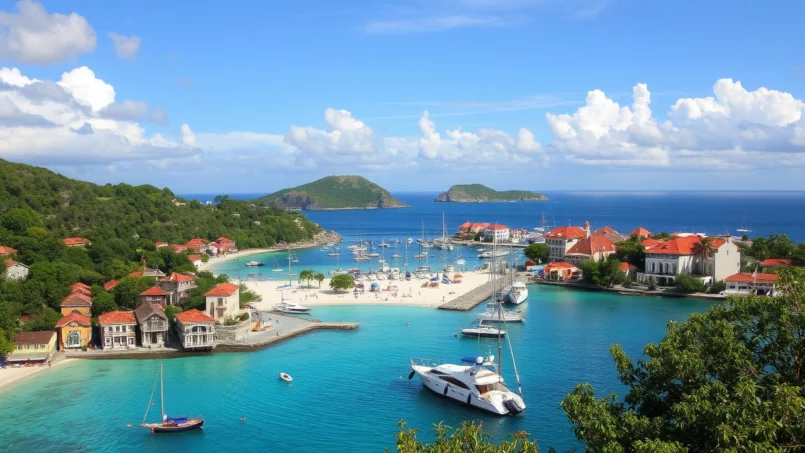
Saint Barthélemy is the stuff of dreams: turquoise waters, luxury villas, French gastronomy in the tropics. But behind the postcards, the question for a student is far more prosaic: is it actually a relevant destination for higher education, or rather a place to live, work… and from which you leave to attend university elsewhere?
The island does not have a local university, but it can serve as a relevant step in an international academic path, particularly for projects combining internships, research, language immersion, or professional experience in its ultra-touristic environment.
This article offers a clear and detailed look at what, concretely, “pursuing higher education abroad in Saint Barthélemy” really means.
A French, Caribbean territory… but without a university
Before discussing visa, housing, or budget, the framework must be set: in Saint Barthélemy, there is no university in the classic sense of the term.
A special status, between France and the Caribbean
Saint Barthélemy is a French overseas collectivity located in the Lesser Antilles. The capital is Gustavia, French is the official language, the euro is the currency, and residents are French citizens. The territory has a Territorial Council and a president, is represented in the Senate and the National Assembly, but is no longer part of the European Union’s outermost regions: it is classified as an “overseas country and territory” (OCT).
This is the maximum area in square kilometers of this French island territory.
An education system limited to primary and secondary
Local education is mainly primary and secondary, under the authority of the Academy of Guadeloupe. There are public schools (e.g., Gustavia elementary and preschool) and private elementary schools. A non-selective high school provides schooling through the baccalaureate.
But beyond that? The data is clear: there are no universities, grandes écoles, or higher institutes in Saint Barthélemy. No institution on the territory appears in major international rankings such as the Times Higher Education World University Rankings.
A student will not find standard university programs on the island, such as bachelor’s, master’s, doctoral degrees, or prestigious schools of engineering, business, law, or medicine.
A common confusion: “Saint Barthelemy School” and similar programs
Some searches can be misleading: for example, there is a “Saint Barthelemy School”… but it is located in New Jersey, USA, which provides primary/secondary education and not higher education, and has nothing to do with the Caribbean island.
Similarly, programs advertised as related to “Saint-Barthélemy” actually correspond to other locations, such as an MSc in cybersecurity and data science in Saint-Barthélemy-d’Anjou, mainland France. These mentions primarily show one thing: from an academic perspective, Saint Barthélemy is not a higher education hub, unlike its neighbors such as Guadeloupe (University of the Antilles) or certain Caribbean states (Barbados, etc.).
Studying “in Saint Barthélemy”: what it really means
Yet, the island is regularly mentioned in study-abroad contexts. This corresponds to three different realities.
1. A base for students in regional mobility
Saint Barthélemy can serve as a home base for students who study elsewhere but live, intern, conduct research, or take a job on the island, for example:
Three main categories of students come to carry out work in Saint Barthélemy. First, students from the University of the Antilles, based in Guadeloupe or Martinique, who return to the island for internships or field research. Second, students from institutions in Europe or North America conducting research in fields such as social sciences, environment, tourism, or island economics; for example, an American student undertaking a six-week research assignment. Third, medical or health students from Caribbean schools (like BIMS or other regional faculties) who complete observational internships in local facilities such as the Bruyn Hospital in Gustavia.
In this case, enrollment and the degree are elsewhere; Saint Barthélemy is a field site, a place for internships or temporary living.
2. A high-end language immersion destination
The official language is French, with a high level of proficiency, and English is widely spoken in hospitality, restaurants, and commerce. French Creole and a local patois are also heard. This environment makes it a good laboratory for:
– a French immersion stay for English or Spanish speakers;
– a research project on bilingualism, local dialects, or island sociolinguistics.
Language training offerings in Mauritius position themselves on a high-end, customized segment, not as a budget destination. They favor private lessons or “boutique” services, with rates potentially reaching €50 to €100 per hour. Two-week intensive programs, sometimes combined with a stay in a luxury resort, can cost several thousand euros. The approach is clearly that of a “premium immersion.”
3. A place to combine distance learning and professional experience
Finally, Saint Barthélemy can be considered as:
– a residence for students pursuing distance learning programs (French universities, online schools, institutions based in Guadeloupe, or elsewhere in the world);
– a territory where you can combine tele-studies and local employment in tourism, restaurants, construction, services, etc.
This perspective mainly attracts students or young professionals already established in their careers, often with income, and able to bear the local cost of living. For an international student who would rely on a small job to fund their studies and housing, the model is much more fragile.
The cost of living: a decisive factor for any study project
This is arguably the point that dispels the most illusions: it is extremely expensive to live in Saint Barthélemy, much more so than in mainland France, Guadeloupe, elsewhere in the Caribbean, and even the European average.
Sky-high price levels
Available comparisons are explicit: compared to Guadeloupe, the cost of living (including housing) is over 240% higher, and about 260% higher than in mainland France when including rent. Even excluding rent, prices remain significantly higher than in the mainland.
Some monthly benchmarks (in dollars, from various sources) help illustrate the gap:
| Profile | “Tight” budget (with rent) | Average budget (with rent) | Comfort / luxury (with rent) |
|---|---|---|---|
| Single person | ~$4,110 | ~$7,900 – $8,085 | ~$14,890 |
| Couple | ~$5,343.50 | ~$10,300 – $10,367 | ~$19,126.50 |
| Family of 4 | ~$7,436.50 | ~$14,213 – $14,342.50 | ~$26,179 |
Even a budget considered “economic” exceeds what most students spend on a modest lifestyle in other countries. At the other end, some “comfort/luxury” scenarios reach amounts comparable to very high-income professionals.
The average monthly full-time salary in Saint Barthélemy is between $4,000 and $5,200, reflecting the high cost of living and the predominance of skilled jobs in the luxury tourism sector.
Main daily expenses
To understand the impact on a study project, it is necessary to examine some essential costs closely.
A table of monthly ranges (in dollars) gives a basic idea:
| Expense item | Monthly range |
|---|---|
| Primary residence rent | $2,200 – $8,500 |
| Electricity | $80 – $250 |
| Water | $45 – $180 |
| Internet + TV | $85 – $165 |
| Mobile phone | $60 – $150 |
| Food and groceries | $600 – $1,900 |
| Household products, hygiene | $65 – $320 |
| Transportation | $40 – $700 |
| Social activities | $72 – $880 |
| Clothing, shoes | $50 – $600 |
| Health insurance | $220 – $1,000 |
| Medications | $35 – $300 |
| Doctors, dentists | $30 – $600 |
| Gym | $90 – $250 |
| Laundry, cleaning | $160 – $715 |
| Pet care | $130 – $600 |
Add to this the unit price of certain everyday items, this time in euros:
| Product / service | Average price in € |
|---|---|
| Dozen eggs | €12.50 |
| 1 kg tomatoes | €8.50 |
| Whole chicken (2 kg) | €38.75 |
| 1 liter fruit juice | €8.50 |
| Baguette / bread | €9.50 |
| 1 liter milk | €8.50 |
| Hearty fast-food meal | €25 |
| Water + electricity + gas bill (for 2 people) | €165 |
| Monthly Wi-Fi subscription | €145 |
| Men’s haircut | €40 |
| Gym membership (1 month) | €105 |
| Cappuccino / coffee | €12.50 |
| 3-course dinner for 2 | €96.50 |
| Taxi ride 5–10 km | €45 |
| 1 liter gasoline | €6.50 |
| Car rental 1 day | €140 |
| Jeans | €150 |
| Men’s dress shoes | €215 |
For a student, even a careful one, the bill adds up quickly: a “truly minimal” budget with shared housing or a room in someone’s home, optimized groceries, and limited leisure easily approaches €1,500 to €2,000 excluding rent, and rent itself can easily exceed €2,000–€3,000 per month for modest accommodation.
Scarce and expensive housing, with no student residences
Housing is by far the biggest challenge for an international student in Saint Barthélemy.
There are :
– no university dormitories,
– no young workers’ hostels,
– no classic youth hostels,
– no official network of host families for students.
The housing market is dominated by: large construction companies and real estate speculators.
Overview of prestigious accommodations available, characterized by high rates and prime locations.
Exceptional properties whose rental can reach several thousand euros per week, especially in high season.
Fully equipped accommodations with monthly rents frequently exceeding €3,000.
Luxurious and very distinctive establishments, offering an exceptional study stay experience.
Platforms like Airbnb or Vrbo list many properties, but the “affordable” supply remains extremely relative to a student budget. However, some flexibility exists:
– renting in low season, when tourist demand drops;
– seeking negotiated long-term rentals, sometimes slightly cheaper than nightly rates;
– sharing housing with others (roommates) to split costs;
– renting a room from a private individual, an informal solution that exists but without an institutional framework.
Keep in mind that real estate in Saint Barthélemy is a luxury market: some properties sell for between €1.5 million and over €30 million. This context directly impacts rents.
For a multi-month study or research project, finding housing becomes a full-time job and may require local networks (word of mouth, professional contacts, host institutions).
Visa and stay: specificities of Saint Barthélemy for students
Even though higher education programs are elsewhere, an international student wishing to stay in Saint Barthélemy for more than 90 days (internship, research semester, gap year, tele-studies) must look into the visa question.
A French territory… outside Schengen
Crucial point: Saint Barthélemy is not part of the Schengen Area. A Schengen visa valid for mainland France therefore does not automatically guarantee entry to Saint Barthélemy.
For stays under 90 days, many nationals (USA, Canada, UK, European Union, Australia, New Zealand, and many countries in Latin America, Asia, or Europe) are exempt from tourist visa requirements. They receive a stamp upon arrival, valid for 90 days within any 180-day period.
For a study, research, or internship stay exceeding 90 days, a long-stay visa tailored to the purpose is required, obtained through a French consulate or embassy.
The specific student visa for Saint Barthélemy
The documentation clearly mentions a “long-stay student visa valid for Saint Barthélemy.” Several technical points are important:
– the visa must explicitly state “Collectivity of Saint Barthélemy” (or the broader mention including Saint Martin), otherwise it may not be recognized upon arrival;
– a standard Schengen visa, even a student visa, without this mention is not sufficient;
– this specific long-stay visa does not allow free movement within the Schengen Area; it is limited to the territory concerned.
Required documents generally include:
To obtain an internship visa for Saint Barthélemy, you must present a passport valid at least 6 months after your stay, a completed application form, passport photos, a criminal record extract, and a medical certificate. You will also need to provide an acceptance letter from the host institution, proof of payment of training fees, proof of sufficient financial resources, and health insurance covering the entire stay. Finally, have a return ticket or means to pay for it, visa fee payment, and possibly a consular interview.
Even for a simple research internship or a non-degree academic mission, authorities commonly require a clear agreement, a realistic budget, and proof that the stay will not burden local services.
Transit via Sint Maarten or Guadeloupe
Most travelers access Saint Barthélemy via other territories:
– Princess Juliana Airport in Sint Maarten;
– Pointe-à-Pitre Airport in Guadeloupe, followed by an air or sea connection.
Each of these transit points has its own entry rules. A student must therefore check:
– Sint Maarten/St. Martin requirements (online form before arrival, possible visa, etc.);
– entry conditions for Guadeloupe, similar to those of mainland France.
In practice, a study or internship project in Saint Barthélemy often involves a combination of visas and formalities (France/Schengen + specific territory).
Working during your stay: financial boost or dangerous illusion?
In most countries, international students can work part-time within a more or less regulated legal framework. What about Saint Barthélemy?
A very dynamic economy… but demanding
The local job market is driven by a few dominant sectors:
– luxury tourism and hospitality;
– restaurants, bars, beach clubs;
– retail (designer boutiques, high-end ready-to-wear, jewelry, perfumery, etc.);
– construction, maintenance, technicians (plumbing, electricity, air conditioning, etc.);
– various services (healthcare, administration, real estate, yachting, etc.);
Listed job openings show a fairly broad spectrum: salespeople, servers, technicians, management, real estate, auto mechanics, arts, etc. The island has local recruitment platforms and general job boards, as well as a dedicated portal highlighting 100% local positions.
In this context, an international student could, in theory, find a seasonal or part-time job in:
– restaurants (server, bartender, commis);
– hotels (reception, housekeeping, concierge);
– luxury boutiques (sales, consulting);
– certain cultural or event services (festivals, regattas, etc.).
But several obstacles immediately arise:
– the level of French (and often English) required in these jobs is high;
– companies generally look for full-time or intensive seasonal staff, rather than small student jobs;
– the costs of living and housing mean that even decent salaries are not enough to fully cover a study stay without prior funding.
Don’t rely on employment as your main source of funding
The recommendations given in visa preparation documents are clear: in the context of a study abroad project, part-time work should be seen as a supplement, not as the basis of funding.
Minimum annual reference amount required as proof of resources for a visa, excluding tuition fees.
In Saint Barthélemy, given the cost of housing and daily life, these amounts must be revised upward. Furthermore, any paid activity must comply with French immigration rules: the type of visa, nature of the contract, weekly hours, and the sector involved all matter.
In summary, working locally can offer:
– a valuable professional experience in an international and highly demanding environment;
– a supplementary income to ease some expenses;
but should not be seen as the cornerstone of study financing.
Healthcare, living environment, and infrastructure: a pleasant but fragile setting
Another important aspect for a study project is daily quality of life, safety, and access to healthcare.
A modest hospital, basic care provided
Saint Barthélemy has a small hospital in Gustavia, the Bruyn Hospital, which provides basic care. There is also a medical analysis laboratory and at least one private diagnostic center. General practitioners, pediatricians, an obstetrician-gynecologist, rheumatologists, and dentists are available.
For more serious procedures or specialized care, patients are referred to Guadeloupe, Martinique, Puerto Rico, the United States, or mainland France. Medical evacuation can be very expensive, hence the importance of international health insurance including medical repatriation.
For a student, even on a short stay, solid coverage is essential, especially in a context where a minor traffic accident or unfortunate swim can become a critical situation.
An exceptional natural environment… and exposed
The climate is tropical, with a drier, “cooler” season from December to April, and a warmer, more humid period from May to November. Temperatures range around 25–30°C (77–86°F), and the sea remains warm year-round. The island is surrounded by shallow reefs, has a marine nature reserve covering over 1,000 hectares, with protected areas for coral reefs, seagrass beds, and sea turtles.
The nature reserve is an exceptional study site for students in biology, environmental science, geography, and sustainable tourism. Environmental education programs, linked to the reserve, are also implemented in local schools.
However, the island’s small size, the scarcity of fresh water (dependence on desalination and cisterns), vulnerability to hurricanes, and near-total reliance on imports show the structural fragility of this territory. It is a fascinating subject of study, but also an environment where a student must accept certain uncertainties and constraints (shortages, weather-related outages, etc.).
Transportation and connectivity
Saint Barthélemy Airport (Rémy de Haenen, also called Gustaf III) can only accommodate small aircraft, with a short runway of about 646 meters (2,119 feet). Most passengers arrive via Sint Maarten, San Juan, or Guadeloupe. There are also regular ferry services to Saint Martin.
In Mauritius, there are no conventional public transports like buses or trains. Travel is mainly by car, scooter, or quad. Roads are narrow and sometimes congested, and taxis are expensive. Car rental costs about €30 to €70 per day, and a scooter from €30 per day. For a long student stay, it is often more rational to buy and then resell a small vehicle or share housing with a car owner rather than renting continuously.
On the digital side, the island has 4G/LTE and high-speed internet, but subscriptions are expensive and coverage can vary by neighborhood. For distance learning, a significant internet bill must be factored into the budget.
Scholarships and funding: think “student from Saint Barthélemy” rather than “student in Saint Barthélemy”
A more realistic way to frame the issue is this: instead of asking how to “do higher education in Saint Barthélemy”, it is more useful to examine how a student originally from or residing on the island can finance higher education… elsewhere, while benefiting from regional or international programs.
Scholarships targeting the Caribbean, including Saint Barthélemy
Several scholarship and aid programs explicitly include nationals of Caribbean territories, including Saint Barthélemy. Among them:
Discover funding opportunities specifically designed for students from Caribbean territories, for higher education in North America.
Canadian scholarship of approximately $4,000 per recipient, reserved for first-time undergraduate students from Caribbean territories like Saint Barthélemy.
Programs offering scholarships for bachelor’s or master’s degrees in the Americas, accessible to Caribbean citizens.
Philanthropic program providing substantial financial support for studies in the United States to students from the Caribbean.
Add to this all the major “classic” international mobility programs:
– Erasmus+ for studies or internships in Europe (including mainland French or Caribbean universities);
– French government scholarships (French government grants, regional scholarships, etc.);
– foundations and specialized programs for students from developing countries and territories or peripheral regions.
The key takeaway is this: you won’t find a scholarship “to study at a university in Saint Barthélemy” because there aren’t any, but you will find many scholarships accessible to students who are from there and wish to study in Canada, the United States, Europe, or elsewhere in the Caribbean.
Building a project: combining studies elsewhere with stays in Saint Barthélemy
A coherent strategy for a student who dreams of combining a solid academic path with life in Saint Barthélemy might look like this:
A student can enroll in a recognized university in the region (such as the University of the Antilles) or internationally, possibly benefiting from scholarships. They can then use Saint Barthélemy as an internship site in sectors like hospitality or reef preservation, or as a research location for a thesis on topics such as luxury tourism or hurricane management. The island can also serve as a living base for a semester of distance learning. In the long term, the graduate may consider returning to the island as a qualified professional, such as an engineer or environmental specialist, thereby contributing their expertise.
In this model, Saint Barthélemy is not the academic core of the path, but a professional and identity pivot.
What a student can realistically expect from a stay in Saint Barthélemy
In practice, what can a student hope to gain from spending part of their studies or gap year in Saint Barthélemy?
A very high-level field experience
For a motivated profile, with good French skills and ready to face the costs, the island offers:
– a real-life laboratory for luxury tourism and management of a hyper-specialized micro-economy;
– a textbook case of resource engineering (water, energy, waste) in a dry, cramped, and heavily frequented territory;
– an observatory of fiscal, social, and environmental issues related to concentrated wealth;
– an ideal setting to study the coexistence of several languages (standard French, Creole, English, local dialects), Creole culture, and French heritage.
For certain fields such as hotel management, luxury marketing, urban planning, tourism sociology, marine ecology, or public health, completing an internship or research project on an island adds considerable value to the experience and skills acquired.
An international network… but only for the best equipped
Saint Barthélemy attracts wealthy tourists, entrepreneurs, and players in yachting, fashion, and high-end dining. A student or recent graduate who works there or carries out a project can develop a rare network of French, Caribbean, North American professionals, and even major international families.
But this opportunity mainly benefits:
– those who already have a strong command of French and English;
– students with substantial financial resources or scholarships;
– those who arrive through institutional channels (partner companies, exchange programs, formal internship agreements).
An extreme need for advance planning
It is unrealistic to decide at the last minute to “go study in Saint Barthélemy” without preparation. A serious project requires:
– at least several months (or even a year) of lead time to:
– obtain the correct visa;
– secure affordable housing;
– set up a clear internship agreement or academic partnership;
– put together a realistic budget, including a margin for unforeseen expenses;
– meticulously check entry, stay, and transit conditions;
– have robust health and repatriation coverage;
– a Plan B (housing, work, continuation of studies) in case of problems.
In this context, study abroad advisory and support platforms can be useful for clarifying procedures, but they are no substitute for rigorous personal analysis.
Should you choose Saint Barthélemy as your main higher education destination?
In conclusion, the answer is nuanced.
For a student looking for:
– a university offering a wide range of bachelor’s, master’s, and doctoral programs;
– moderate tuition fees;
– a reasonable cost of living;
– student residences and a structured campus life;
Saint Barthélemy is simply not the right destination. In the region, these functions are better served by Guadeloupe (University of the Antilles), Martinique, Barbados, or other Caribbean states, not to mention mainland France, Canada, or continental Europe.
On the other hand, for a very specific profile:
This example illustrates the profile of a student already enrolled in an external institution, with solid funding, and looking for an original research field. This could be an intern in fields like hospitality, luxury tourism, environment, risk management, or island resource management. Their goal is to combine tele-studies and professional experience in a highly privileged Caribbean context.
A stay of a few weeks to a few months in Saint Barthélemy can become a powerful lever, provided it is designed for what it is: a complementary experience, demanding, expensive, and not the structural foundation of a full academic program.
Pursuing higher education “abroad in Saint Barthélemy” only makes sense if you accept this shift in perspective: the island is not a campus, but a laboratory. The campus, on the other hand, is elsewhere – in Guadeloupe, Europe, or North America – and it is in the back-and-forth between these worlds that a truly international path is built for a few well-prepared students.
Disclaimer: The information provided on this website is for informational purposes only and does not constitute financial, legal, or professional advice. We encourage you to consult qualified experts before making any investment, real estate, or expatriation decisions. Although we strive to maintain up-to-date and accurate information, we do not guarantee the completeness, accuracy, or timeliness of the proposed content. As investment and expatriation involve risks, we disclaim any liability for potential losses or damages arising from the use of this site. Your use of this site confirms your acceptance of these terms and your understanding of the associated risks.

Cyril Jarnias is an independent expert in international wealth management with over 20 years of experience. As an expatriate himself, he is dedicated to helping individuals and business leaders build, protect, and pass on their wealth with complete peace of mind.
On his website, cyriljarnias.com, he shares his expertise on international real estate, offshore company formation, and expatriation.
Thanks to his expertise, he offers sound advice to optimize his clients' wealth management. Cyril Jarnias is also recognized for his appearances in many prestigious media outlets such as BFM Business, les Français de l’étranger, Le Figaro, Les Echos, and Mieux vivre votre argent, where he shares his knowledge and know-how in wealth management.





