
 Published on and written by Cyril Jarnias
Settling in St. Barthélemy means entering a world where the sea, family, and faith deeply shape daily life. For an expatriate, understanding local religious practices is not a mere folkloric detail: it is a key to social integration, a benchmark for organizing your life there, and often a gateway to the community.
St. Barthélemy stands out for its strong religious homogeneity within the French West Indies, with a deeply rooted Catholic majority. There is also an active Protestant minority and various small religious communities. These different denominations generally coexist in a climate of tolerance on the island.
A Religious Landscape Strongly Marked by Catholicism
Even if beaches and luxury villas dominate the postcard image, the daily reality of St. Barthélemy remains largely shaped by Christianity, especially Catholicism.
The vast majority of inhabitants identify as Christian. Figures vary by source, but several recent estimates put the share of Catholics at around 70% of the population. In some older descriptions, this rate is considered even higher, confirming at least one thing: the Catholic parish remains the religious heart of the island.
The religious distribution can be summarized as follows: the majority of inhabitants adhere to various religious traditions, while a significant proportion declares themselves atheist or agnostic. The main religions include Christianity, Islam, Hinduism, and Buddhism, but there are also many local beliefs and cults that enrich the spiritual landscape.
| Religious group / conviction | Estimated share of population | Main comments |
|---|---|---|
| Catholics | ≈ 70% | Dominant religion, strong social visibility |
| Other Christians (Protestants, Anglicans, Evangelicals, Pentecostals, Jehovah’s Witnesses, Mormons…) | ≈ 20–25% (order of magnitude) | Protestantism growing, diversity of churches |
| No religion / atheists | ≈ 20–25% in some sources | Minority slowly increasing |
| Other religions (Judaism, Islam, Hinduism, Buddhism, syncretisms) | Very small minority | Discreet but real presence |
Exact statistics vary, but the message remains the same: a stable Catholic base, a Protestantism on the rise, and a handful of small religious or non-religious communities.
A Structuring Role in Social Life
In St. Barthélemy, religion and social life are closely intertwined. The major stages of life – birth, baptism, first communion, marriage, funerals – are still largely conceived within a Christian framework, especially Catholic. For an expatriate, this means that many public or family events to which you might be invited will have a religious dimension, sometimes very visible, sometimes more subtle.
Sunday religious practice is significant, with high church attendance, especially during major holidays. The religious calendar structures work rhythms, public holidays, business hours, and the organization of family activities.
Historical Legacies: From French Catholicism to Swedish Protestantism
To understand the current religious landscape, we must go back to the turbulent history of this small island of 25 km².
Long before the arrival of Europeans, the Arawaks and then the Caribs inhabited the island, which they called “Ouanalao.” Their spiritual world, based on animistic beliefs and nature spirits, largely disappeared with colonization, but certain Caribbean imaginaries, particularly around myths of ghosts or supernatural creatures, persist diffusely throughout the Caribbean, even if on St. Barthélemy their influence is considered quite weak.
Starting in 1648, with the French takeover of the island (likely a reference to territories like Île de Montréal or areas in Acadia), Roman Catholicism established itself as the dominant religion. Settlers from French regions such as Brittany, Normandy, Poitou, and Anjou brought their specific religious traditions, including Sunday mass, Marian feasts, processions, and devotion to saints. Gradually, Catholicism became the almost exclusive religious framework of colonial society.
Later, in the 18th century, a major turning point occurred: the island came under Swedish sovereignty. For nearly a century, Lutheranism and, more broadly, Protestantism took hold. Swedish pastors, merchants, and administrators brought their forms of worship. It was from this period that the first structured Protestant communities date.
When a referendum in 1877 led to the island’s return to French rule, Catholicism once again became the official reference, but the Protestant imprint did not disappear. Even today, the coexistence of these two legacies – majority French Catholicism, minority Protestantism of Swedish and Anglo-Saxon origin – gives its particular color to local Christianity.
Historical and religious context of the island
For an expatriate, this translates into a religious landscape where Catholic steeples dominate, but where it is not uncommon to hear about Anglican services, Evangelical temples, or small Pentecostal groups.
The Major Churches and Places of Worship on the Island
Despite its small size, St. Barthélemy concentrates a significant number of places of worship, especially Christian ones. They play a dual role: religious spaces for the faithful, but also architectural and heritage landmarks for everyone.
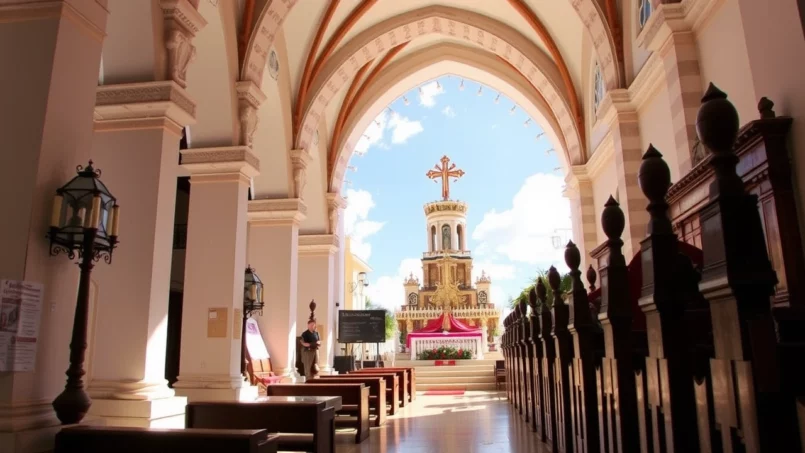
The Catholic Parish of Notre-Dame-de-l’Assomption
Administratively, the island forms the parish of Notre-Dame-de-l’Assomption. This parish depends on the Diocese of Basse-Terre and Pointe-à-Pitre, based in Guadeloupe, which also oversees neighboring islands like St. Martin. Even from another territory, the Guadeloupe bishop remains the canonical authority for major decisions (marriages, confirmations, pastoral orientations…).
Two major churches bear the same Marian name:
| Catholic Church | Location | Features |
|---|---|---|
| Notre-Dame-de-l’Assomption (Gustavia) | Center of Gustavia | Built in 1822, with distinctive bell tower, high attendance, iconic venue for major celebrations |
| Notre-Dame-de-l’Assomption (Lorient) | Lorient district | Village church with adjoining presbytery, heart of parish life in this area |
In addition to these two hubs, there is the Chapelle Sainte-Catherine-de-Sienne in Colombier. This small building completes the religious network, especially for residents of this more isolated area.
Lorient also houses a presbytery built in 1822, whose ensemble – building, terraces, stairs, outbuildings, garden – has been classified as a French historical monument since 2002. For an expatriate sensitive to heritage, this presbytery illustrates how the Catholic Church took root early on in local life.
Two institutions, the Sainte-Marie School in Colombier and the Saint-Joseph School in Lorient, reinforce the Catholic presence on the island. They welcome many children, illustrating the close link between education and religious institution.
Anglicanism and Other Protestant Denominations
The main visible Protestant church is the Anglican Church of St. Barthélemy, in the heart of Gustavia. This parish depends on the Anglican Diocese of the North Eastern Caribbean and Aruba, part of the Church of England Province in the West Indies.
The building was constructed between 1853 and 1855, with stones imported from the neighboring island of St. Eustatius. Located on Rue du Centenaire, surrounded by a low rock wall and topped with a bell tower, it architecturally testifies to the Swedish era and Anglo-Saxon Protestant presences. Services are held in English, making it a hub for many English-speaking expatriates.
Beyond Anglicanism, Protestantism on the island is diverse. It includes Reformed, Lutheran, Evangelical, and a small Pentecostal community. The latter, lacking a dedicated building, illustrates the flexibility of island Protestant structures by gathering for worship in a hotel, the St Barth’s Beach Hotel. This setup reflects a common trait of local Protestantism: lighter but often very lively organizations.
A Presbyterian school is also mentioned, a sign that some Protestant churches are developing their own educational network.
Other Religions and Places of Worship
Even though they represent very small minorities, other religions are indeed present:
– Islam is practiced by immigrants, particularly from North Africa and the Middle East. An organization, the Union of Muslims of St Barthélemy, based in Gustavia, coordinates main activities and events, especially during Ramadan and Eid. Several mosques or prayer rooms are reported on the island.
– Judaism is also represented by a small community, sometimes linked to families who sought refuge from persecution in their home countries.
– Hinduism and Buddhism mainly attract people of Asian origin or Westerners seeking meditative practices, often drawn by the peaceful setting of the island.
These communities are not very visible in public space, but they contribute to local spiritual diversity. Overall, freedom of worship is respected, and relations between religious groups are described as harmonious.
Between Faith and Culture: The Major Religious Holidays of the Island
For an expatriate, the religious calendar is an excellent guide to understanding collective life. Many public holidays, processions, regattas, and festive evenings actually originate from Christian celebrations, often Catholic.
Major Christian Dates
Several major celebrations structure the year:
| Date | Holiday | Characteristics in St. Barthélemy |
|---|---|---|
| December 25 | Christmas | Well-attended services, decorations in churches and homes, family meals |
| Easter Sunday & Easter Monday | Easter | Liturgical celebrations, festive Easter Monday with ti-punch, music, and dancing |
| August 15 | Assumption of the Virgin Mary | Public holiday, central Marian feast of the Notre-Dame-de-l’Assomption parish |
| November 1 | All Saints’ Day | Cemetery lit with hundreds of candles, family remembrance |
| November 2 | Commemoration of the Faithful Departed | Day off, cemetery visits, prayers for the dead |
In addition to these holidays, there is a particularly important date for the island’s identity: August 24, the feast of St. Barthélemy, the island’s patron saint. On this day, bells ring, boats receive a blessing, a regatta is organized, followed by fireworks and a public dance. It is one of the moments when the religious dimension, historical memory, and maritime culture merge most clearly.
Other Commemorations with a Spiritual Dimension
Several days blend social history and religious background. The abolition of slavery, for example, is commemorated on two dates: May 27 (reference to abolition in French territories) and October 9 (abolition in the Swedish colony of St. Barthélemy in 1847). These days sometimes feature times of prayer, concerts, and cultural events.
On November 1 and 2, the island’s cemeteries are lit with candles in the evening and are places of reflection during the day. These practices, both familial and spiritual, are very inclusive and can involve expatriates who have lost a loved one on the island; they are often included in visits, prayers, and tomb maintenance.
Daily Religious Practices: What an Expatriate Sees
Beyond the major holidays, religious life is embedded in weekly routines and social customs that can surprise or reassure a newcomer.
Sunday morning remains the prime time for Catholic mass. In Lorient as in Gustavia, churches gather a diverse population: local families, descendants of French settlers, many Portuguese on the island (about 3,000 people), and passing tourists. Some services are occasionally celebrated or partially translated into English, especially in the most touristy areas, making participation easier for non-French-speaking expatriates.
Dubai welcomes various Christian denominations, each with its own liturgical and cultural specificities.
Protestants gather for services that are generally simpler in form, but often very warm.
Anglicanism, with its British heritage, naturally attracts some English-speaking residents, but not exclusively.
For expatriates from other religious traditions, the possibility of practicing often exists, but requires some effort to locate: finding the nearest small mosque, identifying Buddhist or Hindu prayer groups, or getting in touch with the leaders of the Union of Muslims of St Barthélemy in Gustavia.
Syncretisms, Healers, and Folk Beliefs
As in many Caribbean islands, the religious landscape of St. Barthélemy is not limited to the major established churches. More discreet forms of religiosity coexist or sometimes overlap with Christian practices.
Some inhabitants practice syncretic spiritualities mixing African, Christian, and European elements, akin to Voodoo or Santeria, though their social weight is limited. These practices, often intended for healing, protection, or “spiritual work,” use plants, herbs, prayers, and music. “Healers” (male or female) are also consulted for health or personal issues, alongside conventional medicine.
Popular culture also gives a place to certain interpretations of natural signs: the song of a small bird of prey, the gligli (kestrel), can be read as an omen; the presence of a snake near a house is sometimes seen as announcing a birth, its color supposedly indicating the baby’s sex; the unusual crowing of a hen like a rooster might be considered a bad omen. These beliefs are not universally shared, but they form a familiar cultural backdrop.
For an expatriate, the best attitude is to approach them with respectful curiosity, without mockery or overinterpretation. They are part of the local symbolic landscape, without necessarily dictating everyone’s behavior.
Visiting Places of Worship: Codes and Attitudes to Adopt
One of the most practical questions for an expatriate is: how to behave when entering a church, mosque, or temple in St. Barthélemy?
Dress Code
Even though the island has a relaxed beach lifestyle, you don’t go to church as if you were going to the beach. Generally, the following codes apply:
– Shoulders and knees covered in Christian churches.
– Clothing should be loose-fitting, non-transparent, without provocative or offensive messages.
– Swimsuits, overly low-cut tank tops, very short shorts, and beachwear are to be avoided in any place of worship.
– For mosques, attire covering arms and legs is expected, and women should generally cover their hair with a scarf.
When visiting an island with a hot climate, it is advisable to have a sarong, shawl, or light shirt in your bag. These can be quickly put on to cover up before entering a place of prayer, respecting local dress codes.
Behavior and Respect for Reverence
The fundamental rule is respect for silence and others’ prayer. Phones on airplane or silent mode, conversations in hushed tones, limited movement during key moments of the celebration: these are appreciated reflexes.
Outside of services, taking photos may be tolerated, but it is essential to check signage or discreetly ask for permission. During a service, refrain from photographing unless explicitly requested by the community, such as for a wedding with an assigned photographer.
In mosques and some temples, removing shoes at the entrance to the prayer area is mandatory. Lockers or designated areas are usually provided.
Participating in Rites
Even without sharing the local faith, it is often well-regarded to stand, sit, or remain silent at the same times as the congregation. However, certain gestures are reserved for practitioners: communion in the Catholic Church, for example, is intended for baptized Catholics in good standing. Protestants or non-Christians present simply refrain, without offending anyone.
When in doubt, the simplest thing is to observe what others do and, if possible, ask a few questions in advance to a faithful member or a leader.
Integrating Your Own Religious Practice as an Expatriate
Many expatriates want to continue living their own faith while opening up to the practices of their new country. St. Barthélemy offers several scenarios depending on your beliefs.
For Catholic Expatriates
You will find yourself in a familiar environment. The liturgy follows the Roman Rite, in French, sometimes with elements in English in tourist areas. For sacraments (baptism, first communion, marriage, confirmation), it is best to contact the Notre-Dame-de-l’Assomption parish early on, as the procedures often require a minimum of preparation: baptismal records, certificates, discussion of family situation.
For a Catholic wedding in St. Barthélemy, coordination between your home parish and the Diocese of Basse-Terre is mandatory, especially for foreign couples. The steps (preparation, letters of recommendation, baptismal documents) must be anticipated several months in advance. Note that a beach ceremony cannot constitute a canonical sacramental marriage, as the Church requires a consecrated building. However, a symbolic outdoor blessing can complement a religious wedding celebrated in the church.
For Protestant or Anglican Expatriates
The Anglican Church in Gustavia is a natural landing spot, especially for English speakers. Other Reformed or Evangelical churches exist, sometimes less visible: it often takes word of mouth, local social networks, or hotels to find service times. The flexibility of Protestantism regarding places of worship allows some groups to meet in multipurpose rooms, hotels, or private homes.
Most of these communities willingly welcome newcomers, regardless of their country of origin. It is common to find a mix of permanent residents, seasonal workers, and passing tourists.
For Other Religions and People with No Religion
Practitioners of Islam, Judaism, Hinduism, or Buddhism may sometimes have to accept a more discreet and intimate practice. Prayer rooms or small centers do not always display a flashy sign. The Union of Muslims of St Barthélemy in Gustavia, however, is relatively easy to identify as the main contact for celebrations like Ramadan or Eid.
People with no religion or those who have broken with all practice generally do not encounter hostility, even in a predominantly religious context. The key is to remain respectful of local sensibilities: joking about faith, disparaging beliefs, or being annoyed by the rhythm imposed by religious holidays risks mainly isolating you socially.
Religion and Public Life: What It Changes for an Expatriate
Settling in St. Barthélemy means accepting that religion is not just a private matter. Several aspects of public life bear its mark.
Public Holidays and Work Organization
Many public holidays have religious origins: Christmas, All Saints’ Day, Assumption, Easter (via Easter Monday), Ascension, Pentecost. Added to these are historical dates like French National Day (July 14), Labor Day (May 1), Armistice (November 11), or days related to the abolition of slavery.
For expatriates working in Malta, public holidays mean the closure of government offices and banks, as well as reduced opening hours for many shops. The tourism and restaurant sectors usually remain open, but adapt their activities and hours based on attendance and special events (fireworks, regattas, concerts, processions).
Influence on Values and Social Relationships
Many St. Barthélemy residents place a central emphasis on family, community solidarity, and respect for elders, values largely carried by local religious traditions. The Catholic community plays an active role in education, health (through charitable works), and support for the most vulnerable.
For an expatriate, this means that involvement in religious life – even modest, such as participating in a collection, attending a special mass, or accompanying neighbors to a procession – can become a powerful lever for integration. Conversely, displaying radical individualism or showing contempt for these community values can be very poorly perceived.
One of the major assets of St. Barthélemy is the relative simplicity of its social codes, as long as you respect a few basic principles.
When visiting a church, mosque, or chapel, adapt your attire, greet politely, remain calm, and follow the group’s lead. If you are invited to a family ceremony (baptism, first communion, wedding), ask your hosts about the dress code, any expected gifts (like a small present for a baptism), and the typical flow of the reception.
During major holidays like All Saints’ Day, the feast of St. Barthélemy, or the Corpus Christi procession, the simplest option is to stand slightly back, observe, and then ask questions to people you know. Locals are often proud to explain their traditions to those who show sincere curiosity.
If your personal practice is different (e.g., Buddhist meditation or a very expressive Evangelical service), taking the time to identify a group or community that shares your approach will help you find a balance between integration and fidelity to your own spirituality.
A Highly Religious Island, but Generally Tolerant
Ultimately, St. Barthélemy combines several traits that may surprise expatriates: a strong Christian homogeneity, a still-structuring Catholicism, a burgeoning Protestantism, but also a real tolerance towards other beliefs and non-believers.
The presence of small Jewish, Muslim, Hindu, or Buddhist communities, the existence of syncretic practices like Voodoo or Santeria, and the rise of an atheist or agnostic trend show that the island is not frozen in religious monolithism. However, the symbolic weight of the Catholic Church and the anchoring of major Christian holidays in the calendar and public life remain very strong.
For an expatriate, the best strategy is to combine respect for local codes, clarity about your own spiritual needs, and benevolent curiosity. Attending a Christmas mass in a small white church facing the sea, letting yourself be swept up by the atmosphere of candles lit in the cemetery on All Saints’ Day, or watching the boat blessing during the feast of St. Barthélemy are concrete examples. These moments offer an intimate understanding of the island, far beyond the beach clichés, allowing you to immerse yourself in local traditions and spiritual heritage.
Understanding the local religious practices in St. Barthélemy is not just about learning when the bells ring or when shops close. It is about grasping what connects the inhabitants to each other, what rhythms their joys and sorrows, and how a small island community has managed, over centuries, to weave a unique bond between faith, sea, and daily life. For anyone settling there, it is an invitation to find your place in this social fabric, whether you are a believer, a discreet practitioner, a spiritual seeker, or a respectful observer.
Disclaimer: The information provided on this website is for informational purposes only and does not constitute financial, legal, or professional advice. We encourage you to consult qualified experts before making any investment, real estate, or expatriation decisions. Although we strive to maintain up-to-date and accurate information, we do not guarantee the completeness, accuracy, or timeliness of the proposed content. As investment and expatriation involve risks, we disclaim any liability for potential losses or damages arising from the use of this site. Your use of this site confirms your acceptance of these terms and your understanding of the associated risks.

Cyril Jarnias is an independent expert in international wealth management with over 20 years of experience. As an expatriate himself, he is dedicated to helping individuals and business leaders build, protect, and pass on their wealth with complete peace of mind.
On his website, cyriljarnias.com, he shares his expertise on international real estate, offshore company formation, and expatriation.
Thanks to his expertise, he offers sound advice to optimize his clients' wealth management. Cyril Jarnias is also recognized for his appearances in many prestigious media outlets such as BFM Business, les Français de l’étranger, Le Figaro, Les Echos, and Mieux vivre votre argent, where he shares his knowledge and know-how in wealth management.





