
 Published on and written by Cyril Jarnias
Moving to Botswana means entering a country that is officially secular, yet where religion is pervasive in daily life. For an expat, the issue is not just about finding a worship community where they feel comfortable, but also understanding how faith shapes social relationships, calendars, conversations, dress codes, and even the relationship with the land. This guide offers a practical overview, grounded in local realities, to help you navigate without missteps.
A Secular Country… with a Strong Christian Imprint
The starting point is the legal framework. The Constitution explicitly guarantees freedom of thought, conscience, and religion. Everyone has the right to choose their religion, change it, practice it, and propagate it, whether through worship, teaching, or rites. The state neither imposes an official religion nor mandatory religious instruction, and it is prohibited from discriminating against any citizen based on their beliefs.
Despite institutional neutrality, the public space in Botswana is heavily marked by Christianity. The main public holidays correspond to Christian festivals (Easter, Ascension, Christmas, New Year). These periods, when churches fill up and families gather, illustrate how religion structures social rhythms, including in modern urban settings—something expats often discover.
The numbers reflect this dominance: according to the latest censuses, more than three-quarters of residents identify as Christian. Other estimates range from 70 to 86% Christian, with a dynamic evangelical/Pentecostal core. A minority, around 4 to 5%, explicitly adhere to traditional African religions, while between 7 and 20% of residents declare no religion, depending on the source. Islam represents a small fraction of the population (less than 1% according to recent censuses), as do Hinduism, Baha’i, Buddhism, Sikhism, and Judaism.
In Botswana, although official statistics indicate a Christian majority, actual religious practice is marked by significant syncretism. Many Batswana identify as Christian while continuing to practice, sometimes discreetly, rituals related to ancestors (Badimo) or other elements of traditional religions. This religious landscape is thus officially pluralistic and superficially majority Christian, but remains deeply influenced by an African-style syncretism, where beliefs and practices overlap.
Understanding the Religious Mosaic: From Mission Churches to Pentecostal Worship
One of the first things that strikes newcomers is the abundance of churches, especially in and around Gaborone or Francistown: large cathedrals, modest neighborhood temples, Pentecostal assemblies in industrial areas, independent congregations meeting under tents or in rented halls.
Their strategy often consisted of converting the tribal chiefs (dikgosi) first, on the assumption that the people would follow—which indeed happened in several major Tswana groups.
Missionaries such as Robert Moffat and David Livingstone
Today, Christianity comes in several major groupings:
| Christian Family | Examples of Denominations Present | Dominant Traits for an Expat |
|---|---|---|
| “Historic” Mission Churches | Anglicans, Lutherans, Methodists, UCCSA, Catholics | Structured liturgy, catechesis, strong presence in education |
| Evangelical and Pentecostal Churches | Charismatic assemblies, African Independent Churches, revival movements | Energetic preaching, rhythmic music, emphasis on healing, prophecy, and being “born again” |
| African Independent Churches | Zion Christian Church, various apostolic churches | Blend of Christian symbols and ancestral practices, healing rituals, pilgrimages |
Some statistics thus distinguish between “mission churches”, “Pentecostal churches”, and “independent churches” (of African origin), with the latter drawing mainly from local Black populations. The Roman Catholic Church remains one of the largest organized groups, with a structured diocese and reputable schools.
Alongside the majority religions, Botswana has smaller but well-structured religious communities, including Muslims, Hindus, Baha’is, Buddhists, Sikhs, and a small Jewish community. These groups, often present in major cities like Gaborone and Francistown, typically have a strong expat component or originate from South Asian immigration. The Baha’is in particular have been established in the country since the 1950s.
For an expat, this diversity means two things: on one hand, it’s almost always possible to find a community of your own tradition or something close, though options are more numerous for Christians; on the other hand, genuine pluralism is fairly well accepted in society, with few reported interfaith tensions.
Sundays and Services: What to Expect When Attending Church
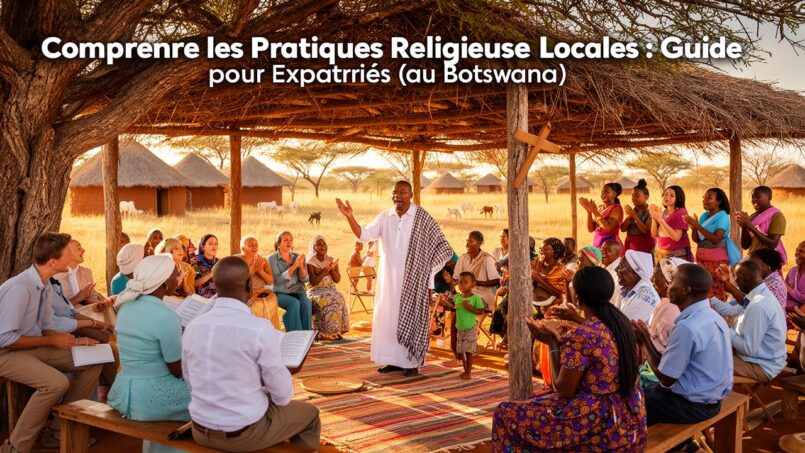
In this context, Sunday remains, for many, an essentially religious day. While commercial activities are legally permitted, the reality is that many people spend a significant part of the day at church. For expats, attending a Sunday service is often a privileged gateway into local society.
A fairly common structure, especially in evangelical churches and some mission communities, involves a block of about two hours. You’ll generally find a large plenary assembly—often called the main worship service, or Mass for Catholics—followed by classes or groups by age or interest: children, teens, young adults, married couples, etc.
The heart of the religious service, characterized by a communal, musical, and inclusive celebration.
Hymns, prayers, sermons given by community members, followed by the distribution of bread and cup.
Songs in Setswana, English, and other languages, supported by energetic choirs and modern instruments.
A warm and inclusive atmosphere, welcoming to newcomers.
Some practical tips are useful to know:
| Aspect of Worship | What an Expat Can Expect |
|---|---|
| Duration | Often around 2 hours, sometimes longer in Pentecostal churches |
| Structure | Praise time, prayer time, sermon, announcements, sometimes testimonies |
| Language | Setswana and English dominate; some churches alternate or translate |
| Dress Code | Rather formal: shirt, dress or long skirt, neat attire |
| Expected Participation | Singing, standing for prayer, greeting neighbors, sometimes coming forward for prayer |
| Children | Age-specific classes from a young age in many churches |
Local studies describe these services as times of renewal and community cohesion, perceived as a “breathing space” in often stressful lives. For an expat, attending a service is not just a religious act: it’s also a way to understand social codes, learn Setswana vocabulary, and build connections.
Islam, Hinduism, Baha’i, Judaism: Small Communities, Strong Structures
Even though Muslims, Hindus, Baha’is, or Jews represent a very small share of the population, their institutions are often well developed, especially in Gaborone.
The Muslim community in Botswana brings together faithful from more than sixty different nationalities.
Hindus are few in number, but several temples exist, notably in Gaborone and a few mining towns. Practices follow the broad lines of Hinduism as lived in Southern Africa: religious festivals, temple rituals, family-centered community life.
Established since the 1950s, the Baha’i community offers study circles, community prayer times, and educational activities for children. It is committed to interfaith dialogue, promoting education, and combating prejudice.
Jews, few in number and mainly concentrated in the capital, do not have a synagogue but organize services in homes or community centers, often with support from rabbis coming from South Africa for the High Holidays. Most are South African or Israeli expats working in agriculture, mining, or services.
For an expat belonging to one of these minorities, it is generally possible to join these structures, provided you make contact in advance. For others, these communities are mainly visible during interfaith speaking events or public gatherings.
Traditional Beliefs: Modimo, the Badimo, and the Land of the Ancestors
To deeply understand religiosity in Botswana, it is not enough to look at Christian or Muslim statistics. Traditional African religions remain alive, sometimes openly practiced, sometimes discreetly integrated into Christian practices.
Among the Tswana, the majority people, the core of the traditional religious vision rests on a Supreme Being, Modimo, often perceived as distant, and on the spirits of the ancestors, the Badimo. The latter are seen as intermediaries between the living and Modimo: they can protect, guide, bless, but also cause misfortune or illness if they feel neglected or offended.
This ancestor-living relationship translates into a series of rituals: libations of traditional beer, invocations by a family head or healer, ritual sacrifice of an animal during major events (marriages, funerals, drought). Specific places—caves, hills, water sources—are considered inhabited by spirits and treated with deep respect. Gorges, sacred hills, or sites adorned with rock paintings are thus central to stories linking creation of the world, ancestors, animals, and rain.
A deep ethical principle, Botho (akin to Ubuntu), permeates these beliefs. Being truly a “person” (motho) implies respecting others, caring for the vulnerable, greeting, showing humility. Religion is not separate from the social: it orders how to speak to elders, share food, resolve conflicts at the kgotla (traditional assembly), and raise children.
For the indigenous Basarwa (San / Bushmen) communities, spirituality is intimately tied to their ancestral land, particularly in the Kalahari Desert. They perceive the landscape as a “book of nature,” where every element (dune, tree, waterhole) is associated with cosmogonic stories, hunting tales, or healing narratives. Ancestors and spirits are considered literally present in the hills, animals, and water sources, illustrating a deep and concrete link between faith and territory.
Being displaced from these lands, as has been the case for some groups during the creation of large nature reserves, therefore has not only an economic or social dimension; it is a deep spiritual wound. For an expat, respecting this sensitivity means, for example, not reducing these populations to mere tourist folklore, and avoiding photographing rituals or sacred sites without consent.
Traditional Practices and Christianity: Coexistence, Tensions, Reconfigurations
This dual anchoring, Christian and traditional, creates a complex religious landscape. Many Batswana call themselves Christians, attend church regularly, but also consult a ngaka (traditional healer) for certain health issues, or organize a ceremony for the ancestors on the occasion of a wedding, birth, or death.
In these rites, the extended family is central. Ancestors are invoked by name, with libations of traditional beer and sharing of a sacrificed animal. The smoke of certain burnt herbs carries prayers and purifies the place. Specific ritual vessels, associated with the Badimo, are often kept and passed down through generations.
This syncretism is not without debate. Some very militant Pentecostal churches, sometimes called “fire churches,” outright condemn ancestral practices, equating them to a form of witchcraft or idolatry. They may require their followers to explicitly renounce any traditional ritual, burn certain objects, or cut ties with healers.
Some African Independent Churches integrate traditional elements into Christianity, such as using holy water in healing rituals, organizing pilgrimages to sacred hills, or practicing dances and trances inspired by ancestral cults. This approach responds to the faithful’s quest for a spirituality that is both biblical and culturally rooted.
For an expat, it is crucial to understand that these practices are neither mere “superstition” nor a simple “survival from the past.” They touch on identity, family memory, and the relationship with nature. Making a harsh judgment about these rituals can be perceived as a direct attack on people’s dignity.
Cultural Codes, Politeness, and the Place of Religion in Interactions
In daily life, religiosity is visible in countless details of social life. For an expat, adopting local politeness codes is often interpreted as a sign of respect for this spiritual dimension.
Greetings, first of all, are central. Not greeting is extremely frowned upon. The basic word in Setswana is “Dumela” for one person, “Dumelang” for a group. It is often followed by “Mma” (Madam) or “Rra” (Sir): “Dumela Mma,” “Dumela Rra.” Replying in Setswana, even with an accent, is always appreciated. Handshakes are common, lighter than in some Western countries, sometimes extended with a characteristic thumb grip. With an elder, it is customary to slightly bow the head, or even discreetly support your wrist with the free hand as a sign of deference.
These greeting rituals are deeply connected to the philosophy of Botho and respect for the Badimo. Honoring the elders is also honoring the ancestors they represent. A moderate tone, absence of shouting or aggressiveness in public, and a certain self-control are valued.
Dress code follows the same logic. The country is conservative, especially in rural areas and religious spaces. For men, long pants and a shirt remain the norm in formal settings (meetings, church, kgotla). For women, skirts below the knee, covered shoulders, and avoiding deep necklines or very tight clothing in villages and places of worship are expected. Batswana tend to dress “dressier” than a visitor would for the same activity, including when going grocery shopping.
The following table summarizes, from a religious and cultural perspective, some typical contexts:
| Situation | Recommended Attire and Attitude for an Expat |
|---|---|
| Christian religious service | Clean, modest clothing, covered shoulders, no short shorts |
| Visiting a mosque | Arms and legs covered, women cover hair, remove shoes |
| Participating in a traditional ritual | Observe discreetly, follow hosts’ instructions, avoid filming without permission |
| Meeting at the kgotla or with a chief | Formal attire, greetings in Setswana, respectful tone |
| Dinner with religious hosts | Arrive on time, offer a small contribution (fruit, tea), accept a little of everything |
Meals are often shared and may begin with a prayer. Hands are washed in bowls provided for this purpose, and sometimes food is eaten only with the right hand, especially in more traditional settings. Refusing food in a ceremonial context is frowned upon; it is better to accept a small portion and stop there.
Sensitive Topics and Red Lines
Freedom of religion guaranteed by law does not mean every debate is welcome at the table. Certain topics are considered sensitive, especially in religious circles: sexuality, homosexuality, abortion, frontal criticism of political authorities or religious leaders.
Botswana law historically criminalized homosexual relations between consenting adults. While the legal framework is evolving, the subject remains very sensitive, particularly in churches like the Anglican Church, which considers some practices incompatible with Scripture while advocating pastoral care. For an expat, it is advisable to approach this topic with great caution, or only broach it within trusted circles, to avoid misunderstandings.
Discussions about traditional religions can also turn sour if framed with disdain. Presenting an ancestral ritual as “witchcraft” or “paganism” will be poorly received, even by Christians who do not participate in it.
Regulation of Religious Communities: Controlled Freedom
On the legal front, religious groups must register as “societies” with the authorities, under the Societies Act. The stated aim is to ensure a certain transparency of organizations and prevent financial abuses or the creation of criminal groups hiding behind a religious veneer. Recent amendments have further strengthened requirements for anti-money laundering.
While registration of major denominations is generally straightforward, the proliferation of small independent churches, especially Pentecostal ones, raises debates. Some are accused of abusive practices (exorbitant donations, promises of miracles for money). Legal proceedings target unregistered churches, and visa restrictions can affect foreign pastors.
Organizations like the Botswana Christian Council or national evangelical platforms defend church autonomy while acknowledging potential abuses. They advocate for specific regulation of the religious sector, distinct from other associations, and for better consultation with the state.
For an expat, this regulatory dimension translates practically into the need to verify the credibility of a community before heavily investing in it, especially if it is very recent and centered on a single charismatic figure. Checking with recognized umbrella bodies, talking to several long-time members, observing financial management or the attitude toward the vulnerable are prudent reflexes.
Education, Social Work, and Interfaith Dialogue
Beyond worship, many religious organizations are involved in education, health, and social work. Historically, several major high schools—now integrated into the public system—were built by Christian missions. In prisons, mosques and churches provide spiritual support and educational activities. Interfaith councils participate in the fight against HIV/AIDS through joint campaigns or coordination platforms called “Faith Sector.”
In public schools, optional religious education is offered. While centered on Christianity, it gradually incorporates elements about other religions present in the country. This evolution, sometimes viewed with suspicion by some Christians, is now moving toward a consensus in favor of education for tolerance. This approach relies on phenomenological methods, aiming to understand religions as they are lived by their adherents, rather than to judge them.
These efforts have a direct impact on daily life: the country does not experience, to date, open conflicts between religious communities. Muslims and Christians, for example, coexist in neighborhoods, work together, and cooperate occasionally. Political authorities regularly meet with representatives of different religious families to discuss issues of common interest.
For an expat, these structures can serve as resources: public lectures, debates, cultural events, volunteer programs are all opportunities to better grasp local spiritualities without being limited to your own microcosm.
Religious Calendar, Public Holidays, and Daily Life
The main Christian-inspired public holidays structure the year and have concrete effects on expats’ lives: offices closed, modified transport, family gatherings. Christmas and Easter are the highlights, with particularly well-attended religious services, sometimes at dawn. Ascension is also a public holiday, which is far from being the case in all secularized societies.
The national Botswana calendar mixes holidays like Labour Day or Botswana Day with patriotic commemorations. Although not strictly religious, these celebrations frequently incorporate references to God and divine blessings in official speeches. The blend of patriotism and piety is characteristic, with ceremonies typically beginning with a prayer, most often Christian, while occasionally including other faiths.
For Muslims, Ramadan and major festivals like Eid are not national holidays but are recognized in practice by companies, which may grant some flexibility to their employees. Specific programs—for example, iftar meals for inmates—are organized in cooperation with prison authorities.
How to Participate Respectfully: Some Practical Tips for Expats
In practice, many expats ask the same questions: What do I do if I’m invited to a service? How should I behave during a traditional ritual? What can or can’t I say about religion at work?
A simple compass is to combine four attitudes: observe, ask, adapt, respect.
When visiting a place of worship or sacred site, such as a church, kgotla, or mosque, it is advisable to observe the gestures of those present: remove shoes, cover your head, or stand at specific moments of prayer. While no perfect mastery of the codes is expected of visitors, showing a willingness to imitate these respectful behaviors is generally very well received.
Then ask: ask a polite question before taking photos, before leaving a ceremony, before refusing a dish or a drink. A simple “Is it okay if…?” can avoid offending ritual or family sensibilities. Batswana are usually happy to explain the meaning of their actions when curiosity is sincere and not condescending.
Adapting your attire and language is essential to show your consideration. Avoid very short clothes in villages or churches, refrain from swearing or speaking casually about intimate topics in a religious context, and prepare a few greetings in Setswana.
Respect, finally, means accepting that some aspects may remain opaque or shocking compared to your own cultural background, without disparaging them. You may not share a belief in the efficacy of ancestral rituals, while still recognizing the depth of attachment involved.
To summarize some useful reflexes when interacting with local religious practices, here is a table:
| Typical Religious Situation | Recommended Reflex for an Expat |
|---|---|
| Invitation to a church service | Accept if possible, arrive on time or early, greet everyone |
| Attending an ancestral ritual | Follow hosts’ instructions, refrain from judging or joking |
| Visiting a declared sacred site (hills, caves) | Inquire about taboos (e.g., no whistling, no swimming), stay discreet |
| Discussing religion with colleagues | Keep a calm tone, avoid aggressive theological debates |
| Encountering beliefs that clash with your own convictions | Choose listening and curiosity over direct confrontation |
Between Modernization and Continuity: A Religious Landscape in Flux
Like many other African countries, Botswana is not immune to major contemporary movements: urbanization, globalization, social media, increased mobility. These dynamics are transforming religious practices. Young people attend “historic” churches less regularly, gravitating toward more dynamic assemblies or simply drifting away from religious institutions. “Prosperity churches” promise material success and miraculous healing. The visibility of religious minorities is growing in cities.
At the same time, there is a partial rehabilitation of certain elements of traditional religions: school curricula reintroducing concepts like Botho or Kagisanyo (harmony), the reappearance of ritual initiations in some communities, and the heritage valorization of sacred sites. Academics, traditional leaders, and Christian religious leaders are reflecting on how to engage with these legacies without falling into rejection or idealization.
For an expat, this shifting situation means that Botswana is neither a homogeneous “Christian country” nor a simple museum of African religions. Identities are being recomposed, debates are lively, boundaries between the religious sphere and the public sphere remain porous. Navigating this space requires nuance.
Conclusion: Making Religious Encounter a Lever for Integration
Understanding local religious practices in Botswana is not merely intellectual curiosity. In a context where faith strongly colors social life, it is a key to integration. Learning to say “Dumela Mma,” “Dumela Rra,” choosing appropriate attire for a Sunday service, accepting to participate—even just once—in a service or family ritual, respecting Christian public holidays while acknowledging the plurality of beliefs: these are gestures that build trust.
This guide presents the main characteristics of the Botswana religious landscape, marked by the predominance of Christianity, the persistence of traditional religions, and the organized presence of minorities. It also emphasizes the importance of politeness and modesty values in interactions, as well as a flexible but effective regulation of the religious sphere by the authorities.
By taking the time to listen, ask questions, and observe, an expat quickly discovers that religion, far from being a topic to avoid, can become a privileged ground for encounter, mutual understanding, and sometimes lasting friendship.
Disclaimer: The information provided on this website is for informational purposes only and does not constitute financial, legal, or professional advice. We encourage you to consult qualified experts before making any investment, real estate, or expatriation decisions. Although we strive to maintain up-to-date and accurate information, we do not guarantee the completeness, accuracy, or timeliness of the proposed content. As investment and expatriation involve risks, we disclaim any liability for potential losses or damages arising from the use of this site. Your use of this site confirms your acceptance of these terms and your understanding of the associated risks.

Cyril Jarnias is an independent expert in international wealth management with over 20 years of experience. As an expatriate himself, he is dedicated to helping individuals and business leaders build, protect, and pass on their wealth with complete peace of mind.
On his website, cyriljarnias.com, he shares his expertise on international real estate, offshore company formation, and expatriation.
Thanks to his expertise, he offers sound advice to optimize his clients' wealth management. Cyril Jarnias is also recognized for his appearances in many prestigious media outlets such as BFM Business, les Français de l’étranger, Le Figaro, Les Echos, and Mieux vivre votre argent, where he shares his knowledge and know-how in wealth management.





