
 Published on and written by Cyril Jarnias
Finding yourself on a 21 km² rock in the middle of the Pacific is a dream for some travelers… and a nightmare for their loved ones. Nauru is tiny, isolated, and for a long time, its connectivity was fragile. Yet today, it is entirely possible to stay in near-constant touch with family, friends, or the office, as long as you understand how the country’s telecoms work, choose the right tools, and anticipate a few pitfalls.
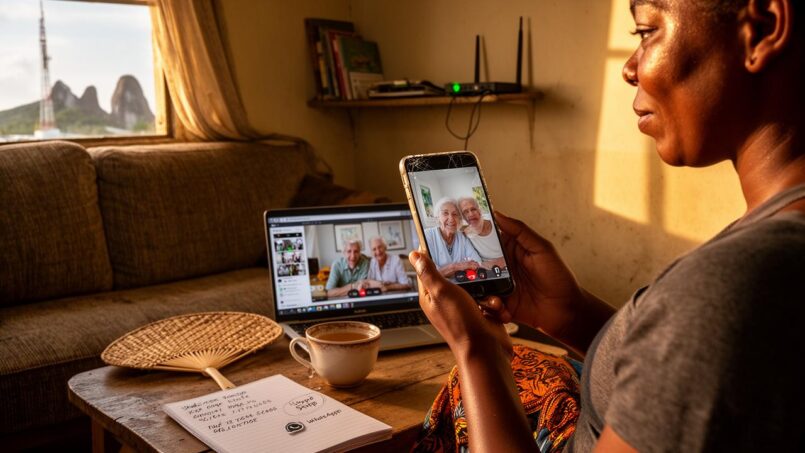
To stay in touch in Nauru without breaking the bank, you have several options: mobile, internet, international calling apps, satellite communication, and postal mail. This article explains how to use each of these methods wisely.
Understanding the Telecom Landscape in Nauru
To plan effectively, you first need to get a sense of what connectivity looks like in one of the world’s most isolated states.
Nauru has about 12,000 residents spread over 21 km². The entire population is considered urban, living along the coastal fringe, while the interior is largely given over to old phosphate mines. This compact geography helps mobile coverage, but isolation complicates international links.
For a long time, the country relied almost entirely on satellites to connect to the rest of the world. The old landline network is largely out of service; Nauruans depend mostly on mobile phones, Wi‑Fi, and a few public access points.
Key Players: Who Does What?
Three names come up consistently when talking about connectivity in Nauru: Digicel, Neotel, and Cenpac, with Starlink now joining the picture as an underlying option.
| Player | Primary Role | Key Features |
|---|---|---|
| Digicel Nauru (Telstra) | Long-standing primary mobile operator | 2G/3G/4G, 7 towers, near-island-wide coverage |
| Neotel (Nauru Telikom) | Public mobile and internet operator | 4G and 5G+ network, first “national” 5G+ network in Oceania (marketing claim) |
| Cenpac (Cenpac Net Inc.) | State internet service provider | Manages .nr, operates the Starlink Community Gateway with SpaceX |
| Nauru Post | National postal and logistics service | Key for regular mail to and from Nauru |
| Starlink (SpaceX) | Satellite internet provider | Individual service + community Gateway at Command Ridge |
Digicel, acquired by Telstra, built most of the mobile network. Neotel, a brand of Nauru Telikom, arrived later with a focus on affordable plans and a 5G+ network. Cenpac, the public operator, manages the national internet domain (.nr) and provides public access via Wi‑Fi hotspots and a cybercafé.
Small Island, Lots of Mobiles
Despite its size, Nauru is very well equipped with mobile devices. The most recent figures show a mobile connection rate that regularly exceeds or nears 100% of the population.
| Indicator (approx.) | Recent Value* |
|---|---|
| Population | ~12,000 residents |
| Active mobile connections (2025) | 11,700 (97.5% of population) |
| Mobile connections (2023) | ~15,300 (≈ 120% of population) |
| Share of “broadband” connections (3G/4G/5G) | ~96.9% |
| Internet usage rate | ≈ 83% of residents |
Numbers vary slightly by source and year, but the trend is clear: nearly everyone has access to mobile and internet.
For travelers or short-term residents, the norm is to use a smartphone connected via 3G, 4G, or 5G, rather than a computer plugged into a fixed internet box.
Coverage: Where Does It Work Well?
Digicel operates seven mobile towers covering the entire island. Quality varies by area, however.
– Very good coverage in the main populated areas, especially Yaren District and all along the coastal road.
– Coverage is sometimes less stable in some interior areas, especially where the mining plateau’s terrain complicates radio range.
– At sea, Digicel mobile coverage reportedly remains usable up to about 12 nautical miles offshore.
According to available measurements, Digicel claims an average voice availability of 99.5%, with a target overall reliability of 98%. In practice, text messages, emails, and social media work well, but video (streaming, video calls) can stutter during peak hours.
Neotel’s 5G+ is a recent deployment, and public data on its coverage is still scarce. It likely targets densely populated areas first.
Internet: From Satellite to Submarine Cable
For international connectivity, Nauru long relied on satellites—first O3b (medium orbit) and more recently Starlink (low orbit). This has boosted speeds while cutting latency.
Starlink, available since 2022‑2023, typically offers speeds of 50–200 Mbps with latency around 50 ms. That’s more than enough for video conferencing, VoIP calls, and sending large files. According to estimates, Starlink accounted for roughly 64% of the island’s internet subscriptions in 2025.
Meanwhile, the East Micronesia Cable (EMC) submarine cable project is moving forward: this cable will connect Nauru to Kiribati and the Federated States of Micronesia. Landing work has already begun, with service expected around 2025–2026. The international fiber, combined with fiber already deployed around three-quarters of the island, promises a major leap in quality: more capacity, more stability, and lower wholesale prices.
For staying in touch with your loved ones, this means the trend is clearly toward faster, more reliable connectivity year after year.
Choosing the Right Solution to Stay Reachable
Now that you have the lay of the land, the main question remains: how, practically, do you communicate from Nauru with the rest of the world, whether by phone, internet, or more traditional means?
Local Mobile vs. Roaming: Which Is Best?
International roaming options for Nauru are limited and, where available, often prohibitively expensive. Many foreign carriers don’t have roaming agreements with Digicel or Neotel. In most cases, the simplest and most cost-effective solution is to buy a local SIM card.
Buying a Digicel or Neotel SIM generally follows the same process:
– Purchase at the main office (usually in Yaren or at the operator’s sales points).
– SIM cost around 10–15 AUD.
– Passport required for registration.
– Activation and initial top-up on the spot, typically within 30–60 minutes.
After activating a SIM in Nauru, you get a local number with a specific operator prefix. For instance, Digicel uses prefixes 556, 557, or 558, while Neotel uses 222, 777, 888, or 999. This local number works for all communications (calls, SMS) and can also be used as a backup number to receive two-factor authentication codes, especially if your usual number doesn’t work on roaming.
Managing Data: How Much Does It Cost?
Plans are almost exclusively prepaid for individuals. Prices, in Australian dollars (the country’s currency), remain high from a European perspective, but are fairly competitive for such an isolated microstate.
Here are some indicative prices observed for Digicel around 2023–2024:
| Prepaid data pack (Digicel, indicative) | Data volume | Validity | Price (AUD) |
|---|---|---|---|
| Short stay pack | 35 GB | 7 days | 40 |
| 2-week pack | 70 GB | 14 days | 70 |
| Monthly pack | 170 GB | 30 days | 140 |
| “Unlimited” home internet | Unlimited (FUP) | 30 days | ≈ 120 |
These offers often include a certain amount of local calls and SMS. For a trip of a few weeks, a 35 or 70 GB pack is more than enough if you prioritize internet-based calls (VoIP, instant messaging) over traditional international calls, which are much more expensive.
Neotel positions itself by focusing on simplicity and lower prices, in response to competitors like Starlink entering the market.
eSIM and Global Solutions: Still Limited
Major traveler eSIM platforms (like Airalo) do not yet offer a dedicated Nauru plan. Some regional Asia-Pacific eSIMs may theoretically include the country, but it’s not guaranteed, and available data suggests a lack of specific options.
For now, it’s best not to rely on an international eSIM for your stay in Nauru, and to plan on buying a local SIM upon arrival.
Making Calls: Traditional Voice or VoIP?
To talk with loved ones back home, there are two main categories of solutions:
– Traditional phone calls, dialing a foreign landline or mobile number from your Nauruan line.
– Internet-based calls (VoIP or apps), where voice travels entirely over data.
Direct international calls from the Nauruan network remain expensive. The smartest and most affordable approach is to use locally purchased data to power international calling apps.
Relying on Calling and Messaging Apps
IP-based calling and encrypted messaging have completely transformed international communication. From Nauru, they are especially appealing because data remains more affordable than traditional international voice minutes.
Free “App‑to‑App” Apps
Some applications never charge per minute, as long as both parties use the same app and have a decent internet connection.
Among the most relevant options:
– WhatsApp: nearly 3 billion users, free audio and video calls between users, encrypted messaging, groups, community features.
– FaceTime: excellent high-quality audio/video calls, but limited to Apple devices and no messaging.
– WeChat: particularly useful if your contacts are in China or heavily connected to that ecosystem.
– Rakuten Viber: free between Viber users, plus Viber Out service for calling landlines/mobiles (paid but cheap).
For daily communication with family in Europe or North America, WhatsApp is usually sufficient. FaceTime is also a practical option if everyone uses an iPhone or Mac.
Apps for Calling Any Number
When you need to reach a family member without a smartphone, a work landline, or customer service, international calling apps become useful. They let you call regular numbers while enjoying much lower rates than traditional operators.
Notable services:
Comparison of apps and services for making low-cost international calls, with different pricing models and benefits.
Very comprehensive solution, well suited for professional use. Rates from $10 USD per user/month, with good international rates.
Doesn’t use pure VoIP but traditional phone infrastructure for better stability. Unlimited plan to 50 countries for $12 USD/month, with very low rates (often < $0.03/min) to India, Mexico, or the UK.
eSIM solution with in-app calls from $0.01 USD/min, no subscription. Especially useful for frequent travelers, covering over 200 countries.
Offers some of the lowest rates for frequent calls. Allows you to get local numbers for certain contacts.
Lets you call landlines and mobiles at often very competitive rates.
Talk360, TELZ, BOSS Revolution, and Skype also offer reliable solutions with rates varying by destination country.
Focus on TELZ: A Concrete Example for Calling To or From Nauru
TELZ illustrates how these services work: download the app for free, verify your number, add credit (by card or PayPal), then call any number, including in Nauru.
Rates are clearly displayed, with sample prices for calling a Nauruan number around:
| Billing currency | Indicative rate to a Nauru number |
|---|---|
| AUD | ≈ 1.843 AUD/min |
| CAD | ≈ 1.693 CAD/min |
| EUR | ≈ 1.043 €/min |
| GBP | ≈ 0.919 £/min |
| USD | ≈ 2.119 USD/min |
These amounts remain high, reflecting the country’s isolation, but they can still be cheaper than some traditional carriers. Other services list rates around $1.5 to $2 USD per minute to Nauru; with $10 USD of credit, you get about 7 minutes of talk time.
For you, based in Nauru with local data:
To call abroad, prioritize low rates to your loved ones’ countries. To be called, suggest they use an app like TELZ, Talk360, or Localphone to reach you on a local landline or mobile number, especially if you’re not always on the same messaging app.
Tips for international communication
Choosing Your App: What Criteria Matter in Nauru?
The choice depends on your profile and your priorities.
– Purely personal use, with already connected friends and family: WhatsApp, FaceTime, Viber, WeChat (for China) are more than enough.
– Professional use or need for a stable number: Google Voice, Vonage, Ooma, Ultatel Hub, etc., with subscriptions from $10–$40 USD per user per month.
– Multi‑country travel: Roamless, Localphone, Skype, which avoid carrying multiple SIMs.
– Need simplicity for less tech‑savvy relatives: Talk360 or TELZ, which work like modern phone cards via an app.
In Nauru, the variable quality of the mobile network should also be a factor: Rebtel (using traditional infrastructure) has shown good performance on unstable 4G, whereas some pure VoIP solutions suffered packet loss.
Satellite, Emergency Messaging, and Extreme Use Cases
For most residents and travelers, the local SIM + internet apps combo will be more than enough. But some situations (sailing, scientific projects, long‑haul trekking, humanitarian work) warrant looking into satellite communications.
Satellite Phones and Hotspots
Several major networks cover the region:
– Iridium: only truly global coverage, including poles.
– Inmarsat: near‑global coverage (excluding polar regions), widely used for professional voice and data.
– Thuraya: no coverage in the Americas, but good coverage across Europe, Africa, and Asia.
– Globalstar: partial coverage depending on continent.
From the open sea off Nauru, an Iridium or Inmarsat phone will work as long as you have a clear horizon. Common models (Iridium 9555, Inmarsat IsatPhone 2, Thuraya XT‑LITE, Globalstar GSP‑1700) support calls, SMS, and sometimes basic data.
Devices like Iridium GO!, BGAN, or nomadic Starlink can create a local Wi‑Fi network connected directly to a satellite. You can sometimes use your smartphone apps (WhatsApp, email, etc.) through them, but speeds and latencies vary widely.
Satellite Messengers: Text and SOS Instead of Voice
For those heading to sea or remote areas around Nauru, satellite messengers like the Garmin inReach Messenger or Spot X offer a useful compromise.
– Garmin inReach Messenger: global coverage via Iridium, text messaging, weather, location sharing, and SOS. Battery life around 28 days with frequent use.
– Spot X: two‑way messaging with physical keyboard, compass, waypoints, SOS. Battery life about 24 hours, partial global coverage via Globalstar.
These devices don’t offer voice, but let you send and receive messages even without mobile coverage, and can trigger an SOS alert through a coordination center.
Rent or Buy: A Question of Frequency of Use
Costs for satellite devices and subscriptions are significant. Hence a clear rule of thumb:
For occasional use (1–2 weeks), renting from specialized companies is recommended. For recurring or long‑term use (more than one consecutive month or more than 6 weeks per year), buying is usually more cost‑effective.
Rental plans start at around $12–$35 USD per day depending on the device and provider, not including communication costs. For subscriptions, basic plans start from $49.95 USD/month (Inmarsat, 10 minutes) or $64.99 USD/month (Iridium, 10 minutes), with more generous options at $74.95 USD/month for 50 minutes, or data plans (Inmarsat, Iridium Certus, Kymeta, KVH, etc.) for maritime or professional users.
For a simple tourist trip to Nauru, these solutions are clearly overkill, unless you plan to sail offshore or stay in an area without mobile coverage.
Staying in Touch via Postal Mail
Despite instant messaging, mail still holds a special place: postcards, packages, official documents. In Nauru, Naoero Postal Services Corporation – Nauru Post – runs the national postal service.
How Does Nauru Post Work?
Nauru Post, established in 2018, handles:
– Domestic mail.
– International mail (letters, parcels).
– Express services (EMS), registered, insured.
– Heavier logistics (air and sea freight).
The postal address is simple: the whole island shares the same postal code NRU68. The official recommendation is to put this code on the line above the country name, for example:
> Recipient’s Name > Island Ring Road > Yaren District > NRU68 > NAURU
For your loved ones writing to you, this format is important: without NRU68, mail may take longer to be sorted correctly.
For international shipments, Nauru Post relies on destination postal networks and regional forwarders, as well as air transport provided notably by Nauru Airlines (connections to Brisbane, Fiji, Kiribati, Palau, etc., with frequencies from once to several times a week depending on routes).
Available Services and Constraints
Nauru Post offers:
– Standard and registered mail.
– Express services via EMS (Express Mail Service).
– Parcel post, air and sea freight.
– Tracking for registered, express, and logistics shipments.
– Proof of delivery for tracked items.
As for restrictions, certain items are prohibited, as everywhere:
– Radioactive materials.
– Banknotes, precious metals, high‑value jewelry in some types of international express shipments (per the lists of the originating operator, e.g., USPS for a parcel from the United States).
Otherwise, standard customs rules apply: content declaration, value, possible duties and taxes upon arrival.
Timelines and Intermediate Solutions
Delivery times depend on many factors: flight frequency, customs clearance, efficiency of partner postal services. Private providers like Postage.to quote theoretical timelines of about 7–10 business days for a letter to Nauru, with tracking and prices starting around $4.99 USD.
To receive items in Nauru bought from sites that don’t ship directly there, freight forwarders like Interparcel, Qwintry, or others offer a solution. They route packages from Australia, the United States, or Europe, usually via a stop in Brisbane.
To stay in touch with your loved ones:
– Encourage sending light letters and parcels via Nauru Post and its partners.
– Use forwarding/logistics services when your loved ones want to send you items unavailable on the island.
– Keep in mind that timelines are longer than for a fiber‑connected country just a few hours’ flight from Europe or North America.
Managing Time Zones: Scheduling Calls Without Mistakes
The most disorienting aspect for your loved ones isn’t always connectivity—it’s the time zone. Nauru is at UTC+12, meaning 12 hours ahead of London in winter, and 16–17 hours ahead of the U.S. East Coast depending on the season.
Time in Nauru: Simple but Extreme
Nauru Time (NRT) is constant year‑round: UTC+12, no daylight saving or seasonal change. The island is near the equator, so sunrise and sunset times vary very little: typical day from about 6 a.m. to 7 p.m., with slight fluctuation.
That’s handy: you never have to worry about a clock change. But it also means you are literally “ahead” of much of the globe.
Examples of Time Differences with Common Countries
| City / Region | Difference from Nauru (NRT) in normal time* |
|---|---|
| Brisbane | Nauru: +2 h |
| Sydney / Melbourne | Nauru: +2 h (or +1 h when DST in Australia) |
| Perth | Nauru: +4 h |
| Auckland (NZ) | Same time or Nauru: −1 h depending on DST |
| Tokyo | Nauru: +3 h |
| Singapore / Beijing | Nauru: +4 h |
| Mumbai | Nauru: +6 h 30 |
| Dubai | Nauru: +8 h |
| Paris / Berlin | Nauru: +10 h (or +11 h in summer time) |
| Johannesburg | Nauru: +10 h |
| London | Nauru: +12 h (approx., depending on BST) |
| New York (EST) | Nauru: +16 to +17 h depending on season |
| Los Angeles (PST) | Nauru: +19 h |
| Honolulu | Nauru: +22 h |
| Suva (Fiji), Tarawa (Kiribati), Majuro | Same time as Nauru (UTC+12) |
*Countries that observe daylight saving will see their difference change; these figures are rough estimates.
Concretely, a video call at 8 p.m. in Nauru roughly coincides with:
– 10 a.m. the same day in Paris (winter time).
– 8 a.m. in London (winter time).
– 4 a.m. in New York (winter time)—not ideal…
– 2 p.m. in Auckland (depending on season).
To maintain regular contact, it’s often useful to pick a “pivot” time window:
– Evening in Nauru (7 p.m.–9 p.m.), which matches morning in Europe.
– Early morning in Nauru (6 a.m.–8 a.m.), to catch late afternoon/evening for loved ones in North America.
Sites like timeanddate.com or scheduling apps (WorldTimeServer, “World Clock” on smartphones) help avoid rough calculations and missed appointments.
Digital Security and Censorship: What You Need to Know
Staying in touch also means protecting your privacy, especially in a territory where governments have, in the past, tried to control access to information.
History of Social Media Blocking
Nauru has previously restricted access to Facebook by asking Digicel—long the sole internet provider—to block certain platforms. Officially, these measures targeted the fight against child pornography, but human rights organizations noted the coincidence with growing criticism over the management of refugee camps on the island (allegations of abuse, violence, drug‑for‑favors trading, etc.).
denounced these restrictions before international bodies, calling them threats to freedom of expression.
Pacific Freedom Forum, Access Now, and several states (UK, Australia, Canada, Timor-Leste)
Today, access to Facebook and other social networks is again available and even widespread (over 8,000 Facebook users in 2024, about 65% of the population). But this episode is a reminder that connectivity in Nauru depends on few players: a political shift can quickly lead to filters or blocks.
Best Practices to Protect Your Communications
Online risks in Nauru are no different from those elsewhere, but two points deserve extra attention:
– The country’s isolation makes incidents (prolonged outages, power failures, sudden political decisions) more impactful on your communication routines.
– The small number of players and the tight‑knit community can amplify privacy concerns.
Useful habits to adopt:
To strengthen the security of your communications and personal data online, adopt these reflexes: prioritize apps with end‑to‑end encryption, such as WhatsApp, Signal, FaceTime (audio/video), or certain Telegram implementations. Limit sharing sensitive information like your exact address, absence schedules, or real‑time itineraries. Always use strong passwords and enable two‑factor authentication where possible. Regularly review the privacy settings on your social media accounts. Finally, remember that anything posted online can be saved, copied, and shared indefinitely, even if you delete it later.
For families, it may be useful to explain to teenagers that carelessly posting photos of an empty house or travel plans can create security and sometimes insurance issues in case of burglary.
Leveraging Social Media to Maintain the Bond
In Nauru, social media is everywhere. Facebook dominates, followed by Facebook Messenger, Instagram, LinkedIn, and, to a lesser extent, X (formerly Twitter). It is estimated that in 2024, about 65.5% of the population has at least one active social media account, nearly 80% of internet users.
This opens several avenues for staying in touch:
– Create a family or friends group on Facebook or WhatsApp to share photos, news, and events.
– Use Messenger for quick chats—high penetration in Nauru.
– Post stories or short videos to show daily life on the island: landscapes, ceremonies, community life.
Nauruan culture, centered on community and respect, is expressed through collective events like festivals, dances, and clan ceremonies. For far‑away loved ones, following these moments live or later on social media helps maintain a strong sense of closeness.
Local content creators already use these tools, sometimes optimizing YouTube retention (retention panels, scheduling posts based on local times, collaborations with foreign creators and influencers). Even without aiming for millions of views, you can apply these principles on an intimate scale: post when your loved ones are awake, structure your videos for easy follow‑through, mix light content with more profound moments.
Anticipating Limits: Weather, Outages, Budget
Finally, staying in touch from Nauru also means accepting some constraints.
– Weather can disrupt satellite signals, especially during heavy rain.
– The power grid isn’t always perfectly stable: a blackout can knock out Wi‑Fi and 4G in some areas.
– The country’s overall capacity remains limited: even with Starlink and soon a submarine cable, the total bandwidth is modest compared to a developed country.
In practice, this means:
To ensure communication continuity for critical missions, plan several backup solutions: SMS, simple audio calls, and if needed, a satellite phone. Avoid heavy video conferencing during network peak hours; instead, schedule important meetings for early morning or late evening. Finally, regularly monitor your mobile data usage to avoid running out on a short‑term plan (7 or 14 days).
Budget‑wise, it can be helpful to set up a “contact plan” with your loved ones:
– Who calls whom, via which channel (WhatsApp, FaceTime, TELZ, etc.)?
– How often (weekly, bi‑weekly)?
– Who covers what costs (data packs, international calling credits)?
Clear organization from the start prevents misunderstandings and unpleasant surprises, especially for families partly funding someone’s stay in Nauru.
In Summary
The tiny Republic of Nauru is no longer the digital “black hole” it used to be after its total telecom blackout in the early 2000s. With the arrival of 4G, then 5G+, Starlink, and soon a submarine cable, connectivity has taken a dramatic leap forward.
To stay in touch with your loved ones from Nauru, the most effective strategy rests on a few pillars:
For efficient and cost‑effective communication in Nauru, buy a local SIM card (Digicel or Neotel) upon arrival to access 3G/4G/5G and prepaid data plans. Prioritize messaging and VoIP apps (WhatsApp, FaceTime, Viber, etc.) to cut costs, especially for international calls. For remote‑area needs, consider renting a satellite phone or messenger for short stays. Use Nauru Post and its partners for mail, following the NRU68 address format. Account for the time zone (UTC+12) when scheduling overseas business calls. Finally, protect your online privacy and be aware of possible access restrictions to certain platforms.
By combining these tools and adapting to the island’s specificities—small, highly mobile‑connected but still fragile in infrastructure—Nauru can become a surprisingly effective base for maintaining strong ties, despite the vast Pacific separating you from your loved ones.
Disclaimer: The information provided on this website is for informational purposes only and does not constitute financial, legal, or professional advice. We encourage you to consult qualified experts before making any investment, real estate, or expatriation decisions. Although we strive to maintain up-to-date and accurate information, we do not guarantee the completeness, accuracy, or timeliness of the proposed content. As investment and expatriation involve risks, we disclaim any liability for potential losses or damages arising from the use of this site. Your use of this site confirms your acceptance of these terms and your understanding of the associated risks.

Cyril Jarnias is an independent expert in international wealth management with over 20 years of experience. As an expatriate himself, he is dedicated to helping individuals and business leaders build, protect, and pass on their wealth with complete peace of mind.
On his website, cyriljarnias.com, he shares his expertise on international real estate, offshore company formation, and expatriation.
Thanks to his expertise, he offers sound advice to optimize his clients' wealth management. Cyril Jarnias is also recognized for his appearances in many prestigious media outlets such as BFM Business, les Français de l’étranger, Le Figaro, Les Echos, and Mieux vivre votre argent, where he shares his knowledge and know-how in wealth management.





