
 Published on and written by Cyril Jarnias
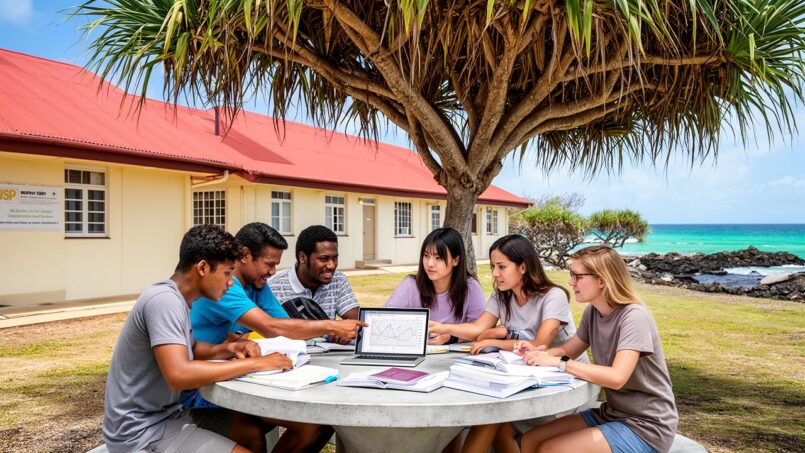
Moving to Nauru to pursue higher education is a very unique undertaking. We are not talking about a major university city, nor a country massively oriented toward academic tourism, but rather a Pacific micro-state where the community is small, resources are limited, and the environment is deeply marked by a century of mining. Yet, it is precisely this singularity that makes Nauru and its University of the South Pacific (USP) campus a distinctive field of study, interesting for certain types of students and researchers.
The academic offerings are provided by the USP. The cost of living, visa procedures, and daily life on an island of 21 km² highly exposed to climate change are essential factors to consider. This resource aims to provide a clear and documented picture for informed decision-making.
The University of the South Pacific in Nauru: A Regional Campus in a Micro‑State
Studying in Nauru first means studying at the local campus of the University of the South Pacific. The USP is a regional public university, jointly owned by twelve Pacific Island states, including Nauru. Its main campuses are in Laucala (Fiji), Alafua (Samoa), and Emalus (Vanuatu), and it has centers in each of its member countries.
Population served by the USP center in Nauru since its opening in the late 1980s.
In Nauru, the campus acts as a “gateway” to this regional network. It allows students to take some courses on-site, access distance learning courses, and benefit from technological infrastructure (USPNet, digital libraries, videoconferencing) that connects this small island to the rest of the Pacific and the international academic world.
A Structured Academic Offering Built Around Major Schools and the College of Foundation Studies
The USP is organized into several major disciplinary schools and a college of foundation studies. Even though not everything is available in person in Nauru, the overall structure sheds light on the options available to students who enroll through the local campus.
The six main schools are:
| School / Faculty | Main Fields Covered |
|---|---|
| School of Accounting, Finance and Economics (SAFE) | Accounting, finance, economics |
| School of Business and Management (SBM) | Management, business, commerce, tourism |
| School of Information Technology, Engineering, Mathematics and Physics (STEMP) | Computer science, AI, engineering, mathematics, physics |
| School of Agriculture, Geography, Environment, Oceans and Natural Sciences (SAGEONS) | Agriculture, geography, environment, oceans, natural sciences |
| School of Law and Social Sciences (SoLaSS) | Law, social sciences, public policy |
| School of Pacific Arts, Communication and Education (SPACE) | Pacific arts, communication, education |
In addition to these schools, there is a College of Foundation Studies, which offers transition programs for students who do not yet meet the requirements for direct entry into a bachelor’s degree. A separate vocational division, Pacific Technical & Further Education (Pacific TAFE), provides technical and continuing education (vocational and further education college).
The University of São Paulo (USP) offers a wide range of degrees, from certificates and technician diplomas up to doctorates. This comprehensive and structured academic offering includes, for example, bachelor’s degrees (baccalaureate), master’s degrees, and doctorates, illustrating the depth and continuity of its training.
| Level | Examples of Programs | Implementation (Indicative) |
|---|---|---|
| Certificate | Certificate in Computing; Certificate in Tourism and Hospitality Management | From the 1990s–2000s |
| Diploma | Diploma in Management Studies; Diploma in Pacific Journalism | Late 1980s–1990s |
| Bachelor’s | Bachelor of Arts; Bachelor of Science; Bachelor of Commerce | Since 1970–2000 |
| Master’s | Master of Business Administration; Master of Laws | From the 1990s–2000s |
| Doctorate | Doctor of Philosophy (PhD) | Since 1970 |
From Nauru, actual access to these programs depends on the combination of on-site courses at the Aiwo campus, distance learning, and, for some, mobility to other USP campuses. The university operates on a semester calendar (generally February–June and August–November), with trimesters running in parallel for some programs and for Pacific TAFE.
What the Nauru Campus Actually Offers
The Nauru campus obviously does not have the scale of major sites like Laucala. However, the facilities remain significant for an island of this size. These include notably:
Discover the modern equipment and services available to support your learning and academic success.
A space with around 30 stations connected to USPNet, providing access to the Internet, online course platforms, and digital resources.
An expanded library offering a collection of physical books and extended access to specialized electronic resources.
Teaching rooms and conference spaces equipped with the latest technologies for interactive and effective instruction.
Audio and video conferencing systems allowing live participation in courses or seminars broadcast from other campuses.
Support services, including Student Learning Support (SLS) with workshops, mentoring, individual appointments, and online help.
In terms of content taught on-site, the campus provides tutorials and in-person classes in several areas:
– Accounting and management, linked to the SAFE and SBM schools;
– Bachelor of Education (Primary), in connection with the SPACE school;
– Early childhood education, English, librarianship, and information sciences;
– Preschool teacher training, nutrition, disability studies;
– Continuing education modules in computing, bookkeeping, ICT, as well as a certificate for community workers.
The EL001 support course is designed for students who need to strengthen their English proficiency, which is the official language of instruction at the USP. This reinforcement is essential for academic success.
For environmental and climate topics, which are particularly relevant in Nauru, the USP also has regional units such as the PaCE-SD (Pacific Centre for Environment and Sustainable Development), which runs a series of weekly scientific seminars on Pacific issues. Even though these activities are mostly held on other campuses, videoconferencing allows the Nauru university community to participate.
A Unique Environmental Context, Both a Laboratory and a Challenge
Choosing to study in Nauru means immersing yourself in a particularly striking physical and ecological environment. The island has a total area of 21 km² and its highest point reaches 61 meters. At first glance, it is not as low-lying as some of its Pacific neighbors, but more than 80% of its interior is now uninhabitable and unsuitable for agriculture, a direct consequence of a century of intensive phosphate mining.
The inland landscape is dominated by sharp limestone pinnacles rising up to 15 meters high, remnants of this mining history. Most of the population, key infrastructure (schools, hospital, airport), and economic activity are concentrated on the narrow coastal strip, which itself is exposed to coastal erosion and sea-level rise.
Climate and Natural Resources
Nauru has a hot and humid tropical climate, with typical temperatures between 22 °C and 35 °C. Climate projections indicate continued warming throughout the 21st century: depending on emission scenarios, the expected average increase by the end of the century ranges from 0.9 °C to 3.0 °C. Eventually, temperatures regularly exceeding 33 °C are expected to become the norm, increasing the risk of heat stress for the population and therefore for students.
Average annual rainfall is around 2,000 mm. Projections indicate an increasing trend in average rainfall, although long-term trends remain highly uncertain. However, it is very likely that the frequency and intensity of extreme weather events, such as heavy rainfall episodes and heatwaves, will increase in the future.
The issue of fresh water is central. Nauru has no permanent rivers or clean surface reserves. The population relies almost entirely on rainwater catchment tanks. Groundwater, affected by salinity and pollution, cannot be used as drinking water. During drought periods, the availability of drinking water drops well below the 50 to 100 liters per person per day recommended by the WHO, with direct effects on health, food security, and the economy.
Sea, Coastline, and Climate Change
Located in the central Pacific, Nauru is not as exposed to tropical cyclones as other islands in the region, but it remains threatened by sea-level rise and storm surges. Projections indicate rising sea levels, intensified swell events, and increased ocean acidification. For a territory where the coastal strip concentrates almost everything, this means growing risk for housing, educational infrastructure, roads, and port facilities.
Added to this is the threat to coral reefs, already subject to bleaching episodes due to warming and acidification. Yet these reefs are essential for biodiversity, coastal protection, and part of the local economy (fishing in particular).
A Degraded Environment, but at the Heart of Public Policy
Nauru’s mining past has left a severely degraded environment. Phosphate mining is identified as the main polluting industry, with massive impacts on over 80% of the territory. Decades of initiatives to rehabilitate these lands have often failed or have only been partially implemented. The customary land tenure system, based on community ownership, further complicates large-scale redevelopment projects.
Faced with these challenges, Nauru has adopted a set of policies, strategies, and laws focused on climate, environment, and sustainable development. These include:
– The Framework for Climate Change and Disaster Risk Reduction, known as RONAdapt, serving as a framework for adaptation and risk reduction;
– The National Sustainable Development Strategy (NSDS) 2019‑2030, which sets a ten-year roadmap around priorities such as food security, water security, energy, health, a healthy environment, and good governance;
– A new law, the Environmental Management and Climate Change Act, adopted in 2020, which notably creates a fund dedicated to coastal protection, wildlife preservation, erosion control, and food security;
– A draft National Adaptation Plan, a national climate change policy, and a series of conditional and unconditional actions (climate-resilient port, 6 MW solar farm, integration of climate into school curricula, etc.).
For a student or researcher in environmental studies, social sciences, or public policy, Nauru thus becomes a very dense field case study: small size, limited resources, heavy dependence on imports, climate vulnerability, and at the same time, ambitious policy arsenal and international partnerships (GCF, ADB, SPREP, UN, etc.).
Cost of Living: A Small Island Economy, High Prices, and Data to Handle with Care
Despite its tiny size, Nauru has a relatively high per capita wealth level by Pacific standards, with an estimated GDP per capita of around 13,000 to 14,000 USD in purchasing power parity. But this apparent wealth coexists with a very high cost of living, characteristic of micro island economies reliant on imports.
Available data on the cost of living in Nauru is heterogeneous and sometimes contradictory, with some international indices themselves acknowledging limited statistical bases. It is therefore prudent to treat these figures as orders of magnitude rather than absolute amounts.
Typical Monthly Expenses
Global estimates describe the following situation:
| Profile | Monthly Expenses (“Low” Estimate) | Monthly Expenses (“High” Estimate) |
|---|---|---|
| Student / single person | Around 733 USD (including housing) in one estimate; 2,665 USD in another | “Tight budget” version around 1,310 USD, “comfortable” version up to 4,965 USD |
| Couple | 1,964 USD (budget) to nearly 7,228 USD (comfort) | 3,928 USD in some sources |
| Family of four | 2,845 USD (budget) to over 10,295 USD (comfort) | 5,650 USD in some estimates |
These very wide ranges reflect several things: the scarcity of reliable data, the impact of exchange rate variations, and the difference between a relatively frugal local lifestyle and an expatriate lifestyle consuming many imported products.
The most significant expense items for a foreign student will remain housing, food, and transportation, plus communication costs (internet, phone) and healthcare.
Housing: A Tight Market and High Rents
The real estate market in Nauru is extremely limited. Most housing for citizens is subsidized by the state, while the supply for foreigners is limited and relatively expensive. Several sources indicate, for example, that a one-bedroom apartment in the “central” area can rent for several hundred to over 1,000 USD per month. Some estimates mention 1,500 USD per month for a one-bedroom in the Yaren district.
This is the number of larger housing units for which average monthly rents are given as an indication.
| Type of Housing | Average Monthly Rent (Order of Magnitude) |
|---|---|
| Modest 1-bedroom apartment | 250–400 USD |
| 1-bedroom apartment “center” or well-located | 350–1,500 USD depending on source and standard |
| 3-bedroom apartment | 480–700 USD (indicative data, sometimes higher in practice) |
In practice, many foreigners in Nauru – including staff from NGOs, international projects, or the USP – rely on local networks and direct agreements with landlords, often with the help of an employer or institution. Hotels or lodges (such as the Od’n Aiwo Hotel or Ewa Lodge) frequently serve as a transitional solution at the start of a stay, while finding more permanent housing.
For a student, proximity to the USP campus and basic services (shops, bus stop if available, etc.) will be a central criterion, especially since public transport options are limited.
Food, Transportation, Services: The Island Effect
Nearly all food is imported, driving up prices. Many accounts describe food and consumer goods as “very expensive.” Basic baskets indicate, for example, prices around 1.5 USD for a liter of milk, just over 1 USD for a kilo of potatoes or onions, and 5 to 10 USD for a kilo of meat or cheese. Meals at restaurants remain reasonable compared to some major cities, but are costly on a local student budget: a bill of 20 to 30 USD per person for a full meal is common.
Public transportation is poorly structured, often requiring the use of taxis, private cars, or walking. Fuel, which is imported, is relatively expensive. Service costs (internet, phone, electricity) are variable and can be high, notably due to the essential air conditioning in a hot and humid climate.
For a student coming to study in Nauru, it is reasonable to plan a generous monthly budget, keeping in mind that part-time job opportunities are scarce, and the margin for “making ends meet” locally is much smaller than in large student cities.
The Academic Framework: Admission Requirements, Academic Support, Language
The USP, including via the Nauru campus, uses English as the language of instruction. To enter a bachelor’s program, students must generally have completed secondary education and meet the entry criteria set by the university (recognized secondary school certificate, or completion of a foundation program).
For a Bachelor of Education, a recognized secondary school diploma (such as A-Levels or regional certificates) is required. For a Master of Education, you must hold a bachelor’s degree in education or a related field.
The Nauru campus offers language support through the EL001 course, as well as free diagnostic tests in English and mathematics, to guide students toward the appropriate levels. Student Learning Support complements this with workshops, mentoring, and individual consultations, on-site or online. This support network is particularly valuable for students coming from educational systems where English is not the main language or where access to higher education is limited.
Scholarships and Funding: Essential Levers to Make the Project Feasible
In a context where average incomes remain modest relative to import costs, scholarships play a central role for students from the region who wish to study at the USP, whether in Nauru or at other campuses.
Several programs specifically target citizens of small Pacific states, including Nauru:
Discover the main funding opportunities for studying in the Pacific region, including through government and institutional programs.
Funded by the Australian government, they generally cover tuition fees, a living allowance, and a round-trip airfare for studies at regional institutions like the USP.
Aimed at students from USP member countries, covering tuition fees and a book allowance.
Offered to citizens of member countries to study within the Commonwealth, covering tuition, living costs, and travel.
Such as the DFAT Equity Scholarships, specifically supporting students from disadvantaged backgrounds.
Exact tuition fees at the USP may vary depending on the faculty and type of program, but sources mention semester fees in the range of 1,200 to 3,200 euros for some courses, plus potential additional costs (extensions, specific materials). Without a scholarship, these amounts, combined with the cost of living, are likely to constitute a major barrier for many foreign students.
Student Visa and Administrative Procedures: A Strict and Highly Regulated System
Nauru applies a strict visa policy. No visas are issued on arrival: it is mandatory to obtain the visa before traveling. For international students, this involves a multi-step process coordinated with Nauruan authorities and the host institution.
The competent ministry is the Department of Immigration, with identified contacts within the directorate (e.g., a Director or Deputy Director of Immigration). The procedure generally involves submitting an application to Immigration or the Ministry of Foreign Affairs, sometimes channeled through an embassy or permanent mission.
For a student visa, a few basic requirements stand out:
To obtain a ‘student pass’ and study in Nauru, you must provide: a full-time admission letter from a recognized institution (such as the USP campus), proof of sufficient financial resources and payment of tuition fees (or a scholarship), health insurance covering the entire stay, a passport valid for at least 3 months after entry. Depending on your situation, a medical certificate, criminal record extract, or parental authorization for minors may be required. Upon arrival, declare the purpose of your visit and report to the immigration office.
Stated processing times vary from a few days to more than a week, but may be longer depending on the workload of the relevant embassies or missions. The authorities reserve the right to request additional documents at any time.
Visa fees for Nauru vary considerably by category, with very high amounts for some types such as the media visa (several thousand Australian dollars). The exact fee for a student visa is not public, so it is crucial to verify information in real time with Nauruan authorities or the USP campus that assists students.
Health, Vulnerability, and Quality of Life: Parameters to Take Seriously
The combination of high heat, humidity, pressure on water resources, and structural vulnerabilities results in a set of health risks that foreign students must anticipate.
The health impacts of climate change described for Nauru are numerous:
Climate change exacerbates several health threats: increased heat stress and dehydration; heightened risks of waterborne diseases and infections linked to insufficient or contaminated drinking water; food vulnerability, with heavy reliance on imports and a risk of malnutrition; as well as risks of vector-borne diseases, respiratory disorders, and mental health issues.
The local healthcare system handles routine needs but remains limited by the country’s small size, significant geographic isolation, and constrained financial and human resources. In this context, comprehensive international health insurance and great caution regarding hydration, diet, and heat protection are not options, but basic conditions for a sustainable study stay.
Daily Life and Cultural Adaptation: A Community Experience, but Little “Classic Campus Life”
With just over 10,000 inhabitants, Nauru offers a very different social environment from large student cities. Society is described as warm and close-knit, with a strong community life where traditional cultural events, gatherings, and village life take precedence over nightlife or “Western-style” leisure activities.
Nauruan culture is based on traditions such as ceremonial gatherings, oral transmission (stories, songs, crafts), and a social organization marked by matrilineal structures. For a foreign student, this can be a rare opportunity to have direct contact with cultural practices that are little exposed to mass globalization.
Nightlife and the availability of cafes, bars, or concert venues are limited. Leisure activities are mainly focused on outdoor pursuits like snorkeling, coastal walks, and participation in community or environmental initiatives. Academic, social, or sporting events may be organized by the USP and other institutions, reflecting the rhythm of a small community.
Adaptation Process
As with any study abroad experience, cultural adaptation goes through several phases: initial euphoria, culture shock, adjustment, then gradual integration. In the case of Nauru, geographic isolation, the strong social proximity (everyone knows everyone), and the relative scarcity of leisure infrastructure can intensify feelings of being out of place or loneliness for some students.
Classic adaptation strategies remain relevant:
For a successful study abroad experience, it is advisable to learn about local customs, social norms, and practices before and after arrival. Learning the basics of the local language is also beneficial, even though English is common at the university. Participating in campus activities, community events, and association projects helps with involvement. It is important to build connections with locals and other students rather than staying only among expatriates. Finally, maintaining a remote connection with your family while creating a “home” on site promotes balance.
The USP support services (international student services, psychosocial support on some campuses) can also be mobilized to cope with adaptation difficulties, although on the Nauru campus these resources are more modest than in large university cities.
Nauru as a Study Field: For Which Profiles and Projects?
Pursuing higher education “in Nauru” clearly does not fit all paths. The country is not an international university hub with dozens of institutions. Most of the structured offering relies on the USP campus, which combines local courses and distance learning.
But for certain profiles, Nauru can be a relevant, even ideal, place to study:
– Students and researchers interested in climate policies of small island states, climate change adaptation, water and energy management in extreme contexts;
– Specialists in social sciences, law, governance, who wish to study the tensions between sovereignty, economic dependence, degraded environments, and international cooperation;
– Future teachers or educators who want to train in a very small community context, with issues of inclusion, disability, multilingualism, and island culture;
– Pacific students who, for family or financial reasons, seek a local solution combining local teaching with access to the vast regional offerings of the USP.
In these cases, the Nauru campus offers immersion in a “real laboratory” where environmental, social, and development issues converge. USP’s on-site and distance courses can then be enriched by field observations, applied projects, or collaborations with local institutions (Ministry of Education, Department of Environment, NGOs).
Successful Study Project in Nauru: Some Practical Points of Reference
Although each path is unique, several elements emerge from the available information and can serve as a preparation checklist.
Academically, it is crucial to:
For a successful enrollment at the University of the South Pacific (USP), it is crucial to: thoroughly understand the university’s structure (schools, programs, study modes such as on-site in Nauru, distance, or mobility to another campus); clarify admission and language requirements (required documents, English proficiency level, possible existence of bridging programs); and obtain precise information on the academic calendar (semester dates, registration periods, tuition fee deadlines, and exam dates) by consulting the official USP guides and calendars, which are authoritative, as the university reserves the right to modify programs and dates.
Financially, it is essential to:
– Estimate the cost of living generously (housing, food, transportation, health, communications) accounting for data uncertainty and currency fluctuations;
– Prioritize exploration of regional and international scholarships: Australia Awards Pacific Scholarships, USP scholarships, Commonwealth scholarships, etc.;
– Plan a financial cushion, as local student work opportunities are rare and average wages are insufficient to compensate for an overly tight budget.
From an administrative and logistical standpoint, it is advisable to: respect deadlines, optimize resources, and ensure communication between teams.
For a study stay at the USP, it is crucial to start visa procedures very early in coordination with the campus and local authorities. Check the validity of your passport, health requirements (medical certificates, vaccinations), and take out health insurance. Also arrange your accommodation well in advance, using university networks, as the offering on standard platforms is very limited.
Finally, on a human level, you must be ready to: be empathetic, listen actively, and adapt to the needs of others.
– Live in a small island environment, with few urban distractions but dense community life;
– Endure a hot and humid climate, with possible water shortages during drought;
– Accept a certain slowness in administrative and logistical processes, inherent to geographic isolation.
Conclusion: A Niche Destination, Demanding but Rich in Learning
Pursuing higher education abroad in Nauru is by no means a “mainstream” choice. The country is tiny, expensive, ecologically fragile, and institutionally complex. The educational offering relies almost exclusively on the campus of the University of the South Pacific, which combines local courses and distance learning.
Despite its constraints, this 21 km² island offers unique academic interest. It allows one to observe on a real scale the effects of climate change, the challenges of environmental rehabilitation after extractive industry, and the tensions between sovereignty and dependence. It also reveals the creativity of public policies and communities in inventing solutions.
For a student or researcher motivated by these themes, ready to live in a setting far removed from giant campuses and major capitals, Nauru can offer a singular, demanding, but deeply formative study experience. The key, before committing, is to consider this destination not as an exotic variant of other Pacific countries, but as a unique case, requiring careful preparation, a solid funding plan, and a great capacity for personal adaptation.
Disclaimer: The information provided on this website is for informational purposes only and does not constitute financial, legal, or professional advice. We encourage you to consult qualified experts before making any investment, real estate, or expatriation decisions. Although we strive to maintain up-to-date and accurate information, we do not guarantee the completeness, accuracy, or timeliness of the proposed content. As investment and expatriation involve risks, we disclaim any liability for potential losses or damages arising from the use of this site. Your use of this site confirms your acceptance of these terms and your understanding of the associated risks.

Cyril Jarnias is an independent expert in international wealth management with over 20 years of experience. As an expatriate himself, he is dedicated to helping individuals and business leaders build, protect, and pass on their wealth with complete peace of mind.
On his website, cyriljarnias.com, he shares his expertise on international real estate, offshore company formation, and expatriation.
Thanks to his expertise, he offers sound advice to optimize his clients' wealth management. Cyril Jarnias is also recognized for his appearances in many prestigious media outlets such as BFM Business, les Français de l’étranger, Le Figaro, Les Echos, and Mieux vivre votre argent, where he shares his knowledge and know-how in wealth management.





