
 Published on and written by Cyril Jarnias
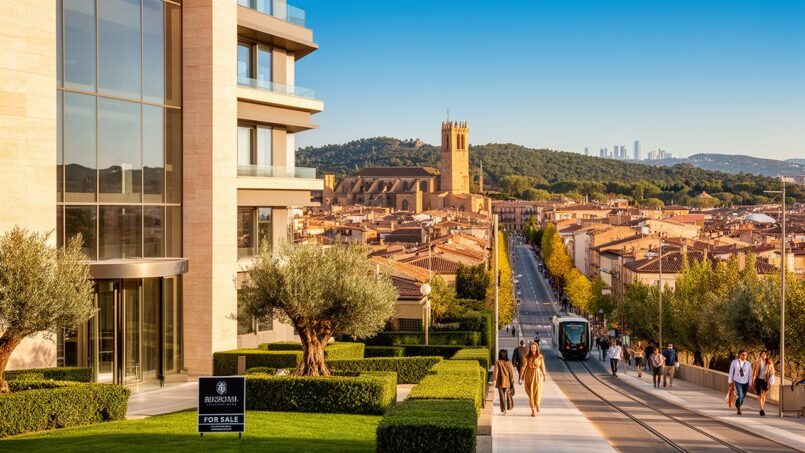
Nestled between the Collserola range and the Serra de Galliners, Sant Cugat del Vallès has established itself as one of the most sought-after real estate markets in the greater Barcelona area. A green, affluent city, very well connected to the Catalan capital and boasting a high-level economic fabric, it attracts wealthy families from Barcelona, expatriate executives, and investors seeking a secure asset.
The real estate market in Sant Cugat del Vallès is recognized as expensive, tight, and selective, but it offers a rare combination of security, liquidity, and appreciation potential. For an investor, the key questions now are the entry price, the choice of neighborhood, the type of property, as well as the tax and regulatory constraints to consider.
A high-end, solid, and structurally tight market
Sant Cugat del Vallès boasts some of the best economic indicators in Spain. The city is considered the wealthiest in Catalonia and the third in Spain by per capita income, with an average disposable income of just over €63,000 per year. It has the lowest unemployment rate in Catalonia, and about 60% of the population holds a university degree. This socioeconomic profile is directly reflected in real estate prices.
The average price per square meter for homes for sale is estimated around €4,800-4,900 at the start of 2026, after years of continuous increases.
At the same time, rents are following a similar dynamic. The average rent stands at around €16.96/m² in January 2026 (€17.32/m² in November 2025), with a peak near €18.3/m² in summer 2025. For a 90 m² apartment, this represents a gross monthly rent of around €1,500 to €1,600, which is confirmed by listings that place the average rent around €1,880–€1,930 per property and €877 for all types (including rooms).
The supply of homes for sale and rent is about 50% lower than a few years ago.
This relative scarcity of supply, combined with solvent and stable demand, explains the market profile: high prices, little room for negotiation (the historical gap between listed price and final price is between 7% and 12%), relatively short marketing times for well-located properties, and new or renovated products that sell “off-plan” at very high prices.
Prices, yields, and property types: what can an investor expect?
For a rental investor, the first question concerns gross yield. In Sant Cugat del Vallès, the average yield is around 3.67% according to market data. This is lower than secondary Spanish metropolises like Valencia, where some neighborhoods exceed 6–7% gross yield, but it is consistent with a highly sought-after premium residential market.
Figures by property type provide a more nuanced view:
| Property Type | Average Purchase Price | Average Monthly Rent | Average Gross Yield |
|---|---|---|---|
| Studio | €200,000 | €880–€1,200 | ≈ 5.25% |
| 1-Bedroom Apartment | €430,000 | €1,500 | ≈ 4.19% |
| 2-Bedroom Apartment | €552,000 | €1,600 | ≈ 3.48% |
| 3-Bedroom Apartment | €655,000 | €2,000 | ≈ 3.66% |
| 4+ Bedroom Apartment | €850,000 | €2,400 | ≈ 3.39% |
Small formats, especially studios, logically offer the best yields, close to 5.25% gross, thanks to relatively high rents relative to the entry ticket. Family apartments of 3–4 bedrooms, despite higher rents (€2,000 to €2,400 per month), are penalized by much higher purchase prices, bringing the yield down to 3.4–3.7%.
The return on investment is on average 27 to 28 years. This timeframe is significant for a cash-flow-focused investor, but remains acceptable in a long-term wealth strategy, particularly thanks to the historical robustness of capital appreciation.
A highly supportive macro and local environment
The appeal of Sant Cugat del Vallès is not limited to its beautiful tree-lined neighborhoods. The city plays a key role in the Barcelona metropolitan economy. It is home to nearly 3,000 SMEs and large groups, as well as a business park hosting over 2,700 companies in high-value-added sectors: healthcare, biotechnology, pharmaceuticals, IT, banking, insurance, engineering. Groups such as Banco Sabadell, HP, Adidas, Catalana Occidente, Boehringer Ingelheim, Ricoh, Epson, Grifols, and Roche have their headquarters or major centers here.
The city of Sant Cugat del Vallès, with approximately 90,000 inhabitants, has over 65,000 jobs within its municipal territory. This makes it one of the main employment hubs in its region. It is integrated into a broader economic network, connected by dense road and rail infrastructure to other industrial and service cities in the Vallès area such as Rubí, Sabadell, Terrassa, and Cerdanyola.
In terms of quality of life, the city boasts more than 8,000 hectares of protected natural areas, a relatively low density across 48 km², recognized air quality, and a network of parks, gardens, bike paths, and hiking trails. Added to this are a lively historic center around the monastery, a market, local shops, an ambitiously renovated shopping center, cinemas, theaters, an auditorium, and a range of high-end restaurants and boutiques.
This locality benefits from a dynamic economic ecosystem, a high quality of life, and recognized safety (ranked among the safest in the metropolitan area). It also offers an excellent educational system, with top international schools and prestigious institutions like ESADE or the School of Architecture. These assets generate sustained demand, particularly from international families and executives, drawn to a residential environment just 20–30 minutes from Barcelona.
Where to invest in Sant Cugat del Vallès? Neighborhood mapping and prices
The municipal territory is structured around several major sectors: the central core (Centre – Estació, Monestir, Sant Domènec, Eixample, Arxius), the residential suburban areas such as Valldoreix, Mira-sol, the greener and more affordable neighborhoods like La Floresta – Les Planes, and new poles such as Can Mates – Volpelleres or Parc Central.
Price differences, both for sale and rent, are considerable from one neighborhood to another.
Comparison of prices per square meter by area
The following data combines several recent sources (late 2025 – early 2026):
| Area / Neighborhood | Sale Price €/m² (range) | Rent €/m²/month (range) | Sector Profile |
|---|---|---|---|
| Parc Central | 5,600–5,792 | 16.47–16.58 | Recent central area, upscale |
| L’Eixample – Torreblanca | 5,462–5,542 | 17.5–17.7 | Dense residential, highly sought after |
| Can Mates – Volpelleres | 5,322–5,396 | 19.87–22.30 | New neighborhood, strong rental yield |
| Coll Favà – Can Magí | 5,165–5,269 | 16.59–16.73 | Family-friendly, with services and green spaces |
| Centre – Estació / Centre | 4,867–5,573 | 18.79–19.50 | Hyper-center, close to FGC station |
| Arxius | 4,565–5,339 | 16.03–16.87 | Recent residential, upscale |
| Golf | 4,513–4,737 | 12.66–12.83 | Proximity to golf clubs, villas and greenery |
| Valldoreix | 3,660–4,108 | 12.80–13.54 | Large houses, more affordable per m² |
| Mira-sol / Mirasol | 3,924–3,965 | ≈ 12.45 | Suburban, family-oriented |
| La Floresta – Les Planes | 3,362–3,364 | 18.73–21.32 | More rural, good rent-to-price ratio |
Several insights emerge. The recent central sectors (Parc Central, L’Eixample – Torreblanca, Can Mates – Volpelleres, Coll Favà – Can Magí, Arxius) concentrate the highest sale prices, often above €5,200/m². In contrast, La Floresta – Les Planes and Valldoreix appear as “entry” zones for investors seeking a lower price per square meter, around €3,300–€3,800/m², at the cost of larger plots and often houses rather than apartments.
Average rent per square meter in the Can Mates – Volpelleres neighborhood in Sant Cugat.
Rising neighborhoods, opportunities, and local risks
Price studies by micro-market also show differentiated dynamics. In Q1 2025, the Can Matas and Torreblanca areas showed values around €5,320–€5,436/m², ranking among the most exclusive. Mirasol, Valldoreix, and Sant Francesc recorded quarterly growth of about 3%, confirming a gradual catch-up in well-located peripheral areas.
Conversely, some neighborhoods experienced slight corrections over the same period, on the order of –2% in Volpelleres, Can Matas, or Arxiu. These micro-declines remain modest and occur within a general context of annual increases, but they may offer interesting entry points for investors willing to arbitrate between prime location and relative discount.
The Centre – Estació sector recorded a price increase of more than 22% between February 2025 and February 2026.
For an investor, these divergences reflect local cycles: areas already very “priced in” and very central where the margin for additional upside may be more limited, sectors in a catch-up phase like Valldoreix or Mirasol that still combine relatively moderate prices per square meter with good appreciation prospects, and very new neighborhoods like Can Mates – Volpelleres where rental demand is strong, driven particularly by expatriate families and students from higher education institutions.
The new home market in Sant Cugat del Vallès is particularly dynamic, even though new homes represent only about 15% of sales, partly due to delays, building permit constraints, and rising construction costs. Several recent programs illustrate the price level and qualitative positioning of the city.
The Estapé 44 residence offers 3 or 4-bedroom apartments with a garden and community pool, starting from €812,000 for 123 m². It stands out with a double A energy label and a façade made of artisan brick and metal panels, meeting the demand for aesthetic, sustainable, and high-performance homes.
Other developments near the monastery, in the Monestir sector, show very high prices, often between €450,000 and €700,000 for 2 to 4-bedroom apartments, with pool, terraces, and underground parking. A project like Dos de Maig 20–22, in the Centre – Estació area, targets 3-bedroom apartments around €702,500 for 115 m² and 4-bedroom units at €860,000 for 145 m², with the simultaneous creation of a public square on the ground floor.
A summary overview of some notable career advancements recently announced.
Advancement based on performance and seniority within the organization.
Move to a new department offering broader prospects.
Evolution to a position with a larger team or managerial budget.
Access to a new profession or area of expertise within the structure.
| Project / Area | Main Typology | Indicative Entry Price | Positioning |
|---|---|---|---|
| Estapé 44 (Sant Domènec) | 3–4 bedrooms, garden, pool | ≈ €812,000 (3-bed, 123 m²) | High-end, Energy A |
| Montserrat 31 (Monestir) | 4 apartments + 2 houses | ≈ €480,000 (apt 91 m²), €675,000 (house 154 m²) | Central upscale |
| Residencial Arrels del Coll | 2–3 bedrooms | ≈ €449,500 (2-bed, 81 m²), €436,500 (3-bed, 96 m²) | City center, sustainable |
| Dos de Maig 20–22 (Centre – Estació) | 3–4 bedrooms | €702,500 (3-bed, 115 m²), €860,000 (4-bed, 145 m²) | Hyper-center, with public square |
| Orient (Monestir) | 2–3 bedrooms | €670,000 (2-bed, 103 m²), €695,000 (3-bed, 141 m²) | Central high-end |
| Cases a Valldoreix | 5-bedroom house | ≈ €2,800,000 (≈ 425 m²) | Luxury detached villa |
The average price of new developments is around €1.26 million, with a range from €436,500 for the smallest units up to nearly €2.9 million for exceptional properties, such as high-end villas or apartments in renovated modernist mansions.
For an investor, positioning in new construction in Sant Cugat del Vallès therefore means accepting a high entry ticket in exchange for clear advantages: high energy standards, rental appeal to an international clientele, ease of management, little renovation work required, and solid resale potential in the medium to long term.
Social housing, cooperatives, and public policy: a context to consider
The municipality and the Generalitat of Catalonia are fully aware of the imbalance between demand and supply, especially for local households. Several public or cooperative projects, partly funded by European funds, aim to create a stock of protected rental housing.
A significant example is the Benet de Moxó program, led by the municipal company Promusa, with financing of €3.8 million from the Catalan Institute of Finance (ICF) and a subsidy of over one million euros from Next Generation funds. The operation plans 35 protected rental homes (25 T3 units of 58 m² interior + 11 m² exterior and 10 T4 units of 74 m² + 30 m² exterior), a 35-space parking lot, and 16 storage rooms, with permanent protection and 26% of the homes reserved for young people.
In the La Floresta neighborhood, the city granted a 75-year surface right to the cooperative Sostre Cívic for the Casas dels Mestres site. This model allows the cooperative to renovate and expand the existing building to create 11 homes and common spaces. The approach includes the participation of future residents in the work as part of assisted self-construction.
These initiatives show that the city is trying to manage and correct some social effects of soaring prices, but they do not change the overall profile of the free market, which remains expensive and dominated by wealthy buyers. For the private investor, they are primarily contextual elements, with two main implications: the increasing strength of rent regulations and heightened scrutiny by authorities on “large landlords.”
Rent regulation: a complex terrain to master
Sant Cugat del Vallès is classified as a “tight market” for rentals, alongside Barcelona, Castelldefels, Sabadell, L’Hospitalet, and other major Catalan cities. This classification triggers the application of a regulatory arsenal aimed at controlling rents.
Catalan law 11/2020 on rent limits, although partially challenged constitutionally, inspired mechanisms adopted at the state level by Law 12/2023 on the right to housing. Since 2024, a state reference index applies in tight areas and conditions the rent ceiling for new leases and renewals.
Since new rules came into effect, rental listings in Sant Cugat del Vallès must mandatorily include: the last rent charged, the reference index (often in €/m²), the landlord’s status (large holder or not), and, if applicable, the calculated state reference. Some large, high-value properties may be declared “exempt” if they are considered luxury homes according to legal thresholds.
Added to this is a new Catalan law that came into force in 2026, which strictly regulates temporary rentals and room rentals. Any contract that meets a housing need is presumed to be an ordinary residential lease, unless it is a genuine tourist rental. For room rentals, the sum of rents per room cannot exceed the maximum permitted rent for the entire home, in tight areas.
To maximize yield through temporary rentals or shared housing, it is imperative to comply with the applicable rent caps. Additionally, the possibilities for revaluation between two leases are restricted, especially for large landlords, making the choice of initial rent and tenant profile particularly strategic.
Acquisition and holding taxes: an entry cost to factor in carefully
Beyond the listed price of the property, investing in Sant Cugat del Vallès involves bearing significant transaction costs. In Spain, and particularly in Catalonia, it is commonly estimated that additional costs represent between 10% and 15% of the purchase price.
For a used (second-hand) property, the key tax is the ITP (Transfer Tax), whose rate in Catalonia is 10% for most transactions, with a progressive scale rising to 11% between €600,000 and €900,000, 12% between €900,000 and €1.5 million, and 13% above that. An exception exists for certain profiles (young people, large families, people with disabilities) buying their primary residence, who may benefit from a reduced rate of 5%.
When buying a new home for €400,000 in Catalonia, taxes (VAT and AJD) can exceed this amount.
Serial investors should also be aware of an important new development: since summer 2025, Catalonia applies an ITP rate of 20% to acquisitions made by “large holders” (entities or individuals holding at least five properties in certain high-demand municipalities, more than ten properties in the region, or more than 1,500 m² of built housing). The purchase of entire residential buildings is also subject to this rate, except in certain cases. In practice, this surcharge greatly increases the cost of building a large residential portfolio in Catalonia.
For a property in Spain, holding it involves an annual local property tax (IBI), calculated on the cadastral value with a rate varying, for example, around 0.75% in Barcelona and generally between 0.4% and 1.1% depending on the region. For non-resident owners, there is an additional annual tax on a notional rental income, even if the property is not rented, at a rate of 19% (EU/EEA residents) or 24% (others), calculated on a percentage of the cadastral value. In the case of renting, the actual income received is taxed at these same rates.
Finally, upon resale, the seller must pay capital gains tax (19–28% depending on the amount for residents, 19% for non-residents) and the municipal tax on the increase in land value (plusvalía).
Financing: conditions for foreign investors
For international investors, access to credit is a key element of the structuring. The main Spanish banks (BBVA, Santander, CaixaBank, Sabadell, Bankinter, Deutsche Bank Spain) finance non-residents, generally up to 50–70% of the property value, with terms of 15 to 25 years and rates slightly higher than those offered to residents.
Obtaining a loan is subject to a global debt-to-income ratio (all loans included) of less than 30–35% of income. Banks require a complete file (pay slips, tax returns, bank statements, credit history from the country of origin, proof of employment or activity, etc.), often needing translation and apostille. The average processing and approval time for credit is 4 to 8 weeks.
The other specificity is that the bank lends based on an official appraisal value (tasación). If this is lower than the purchase price, the investor must cover the difference with more equity. In a market like Sant Cugat del Vallès, where prices are sometimes driven by scarcity, it is not uncommon for the appraisal to be conservative, which must be anticipated.
There is also a private capital market (mortgage-backed loans, often at 50–60% of value, more expensive but faster), useful for more complex structures or less standard profiles, but these products are aimed more at sophisticated investors.
Investment strategies suited to Sant Cugat del Vallès
The market configuration naturally guides the possible strategies.
For a long-term wealth investor, buying a family apartment with 3–4 bedrooms or a house with a garden in a sought-after neighborhood (Centre – Estació, Monestir, Parc Central, Coll Favà – Can Magí, Can Mates – Volpelleres) allows targeting a stable clientele of local or expatriate families, with high rents but moderate yields (3.3–3.7% gross). The value of these assets is supported by land scarcity, quality infrastructure (schools, healthcare, transport, shops), and excellent safety.
A studio purchased at this price can generate a monthly rent of €900 to €1,200, i.e., a gross yield above 5%.
Another strategy is to target neighborhoods offering a better price per square meter / appreciation outlook, such as Valldoreix, Mirasol, or La Floresta – Les Planes. These sectors combine a more “residential” or semi-rural atmosphere, large plots, houses to renovate, and potential for price growth as demand pressure spreads from the center. An opportunistic purchase of a home to modernize can, with good cost control on renovations, generate a nice capital gain upon resale, even if the current rental yield remains modest.
Some wealthy investors target exceptional properties (listed modernist villas, architect-designed houses) in areas like Parc Central – Colomer or Valldoreix. Rents can exceed €10,000–€13,000 per month. This market, which has low liquidity, is very resilient to crises thanks to a highly selective international clientele.
Specific risks and points of vigilance
Investing in Sant Cugat del Vallès is not without risks.
The first is related to the absolute level of prices. A downturn in the Spanish market or a prolonged rise in interest rates could slow growth or even cause local corrections, especially in the most overvalued segments. The price increase over the past decade is already very marked, with the square meter moving from around €2,700 in the mid-2010s to nearly €4,900 in early 2026 according to some series.
The Spanish rental market is subject to strict regulations: rent controls, restrictions on temporary leases, and specific taxes for large landlords. Additionally, eviction procedures in case of non-payment or illegal occupation (the “okupas” phenomenon) can be lengthy. Prudent management is essential, based on rigorous tenant selection, taking out appropriate insurance, and support from solid legal counsel.
The third concerns urban planning and construction legality. In Spain, planning violations “follow” the property, not the owner. Buying a house with an unregistered extension, an illegal pool, or without an occupancy permit can result in very high subsequent costs, or even partial demolitions ordered by the town hall. A rigorous check of licenses, the certificate of habitability, urban planning compliance, and the minutes of the homeowners’ association is essential.
In Catalonia, high transaction costs (double-digit taxes, notary, registration, and legal fees) make a rapid resale (“flip”) strategy poorly suited. The Sant Cugat del Vallès market instead rewards patient investments, with a 10- to 15-year horizon, allowing these initial costs to be absorbed over the long term.
Sant Cugat del Vallès ticks almost all the boxes for a safe real estate investment: robust local economy, high incomes, low unemployment, exceptional quality of life, world-class infrastructure, strong security, proximity to a global metropolis, and a historically rising real estate market. Demand is deep, driven by multiple engines (affluent local families, multinational executives, expats, students at business or architecture schools) and meets a supply constrained by geography, protected natural parks, and regulatory complexity.
The gross rental yield in Catalonia is moderate (3.5–4%), except for small formats. This market requires significant equity, a precise understanding of local and Spanish taxation, a suitable financing strategy, and the systematic assistance of an independent lawyer to secure transactions, due to complex tax and rental rules requiring meticulous preparation.
For the investor seeking a “core” asset in Southern Europe, less volatile than purely tourist markets, aiming more at capital protection and growth than immediate cash flow, investing in real estate in Sant Cugat del Vallès can nevertheless prove to be a particularly relevant choice. The key lies in choosing the neighborhood, the type of property, the rent level compatible with regulations, and the ability to accompany the city over the long term, as it consolidates its place as the most sought-after residential suburb in the Barcelona region.
Disclaimer: The information provided on this website is for informational purposes only and does not constitute financial, legal, or professional advice. We encourage you to consult qualified experts before making any investment, real estate, or expatriation decisions. Although we strive to maintain up-to-date and accurate information, we do not guarantee the completeness, accuracy, or timeliness of the proposed content. As investment and expatriation involve risks, we disclaim any liability for potential losses or damages arising from the use of this site. Your use of this site confirms your acceptance of these terms and your understanding of the associated risks.

Cyril Jarnias is an independent expert in international wealth management with over 20 years of experience. As an expatriate himself, he is dedicated to helping individuals and business leaders build, protect, and pass on their wealth with complete peace of mind.
On his website, cyriljarnias.com, he shares his expertise on international real estate, offshore company formation, and expatriation.
Thanks to his expertise, he offers sound advice to optimize his clients' wealth management. Cyril Jarnias is also recognized for his appearances in many prestigious media outlets such as BFM Business, les Français de l’étranger, Le Figaro, Les Echos, and Mieux vivre votre argent, where he shares his knowledge and know-how in wealth management.





