
 Published on and written by Cyril Jarnias
Setting down roots in Saint Kitts and Nevis means choosing a life to the rhythm of the trade winds, between volcanoes covered in tropical forest and long beaches bathed in turquoise waters. But behind the postcard, a very concrete question comes up for everyone considering moving there: which neighborhood to live in to balance quality of life, budget, safety, and integration within the expat community?
The Federation of Saint Kitts and Nevis attracts a diverse range of expats: retirees, investors through the citizenship program, families seeking peace, medical and veterinary students, remote workers, and tourism entrepreneurs. Their expectations and budgets vary, and the neighborhoods offer distinct lifestyles.
This article provides a thorough overview of the most sought-after areas by expats in Saint Kitts and Nevis, based on available data on the real estate market, cost of living, safety, infrastructure, and the profile of existing communities.
Understanding the playing field: two islands, two vibes
Before diving neighborhood by neighborhood, it’s essential to grasp the overall logic of the federation. Saint Kitts and Nevis is a small nation of about 55,000 people, spread across two volcanic islands separated by a channel roughly three kilometers wide. The two islands share a strong Caribbean culture, a warm tropical climate year-round, appreciated political stability, and an attractive tax system (no income tax, wealth tax, capital gains tax, or inheritance tax).
But in terms of lifestyle, the differences are clear.
Saint Kitts: the livelier island
Saint Kitts concentrates most of the infrastructure: Robert L. Bradshaw International Airport, the capital, Basseterre, the main hospitals, most banks, and the vast majority of shops and services. It’s also where the most developed areas for tourism and real estate investment are found.
The island of Saint Kitts offers a livelier life than Nevis, with a more developed nightlife and more job opportunities in sectors like tourism, construction, or services. It also benefits from a larger and more visible expat community. The most significant high-end real estate projects and the best-structured neighborhoods for expats, such as Frigate Bay or the Southeast Peninsula, are located on Saint Kitts.
Nevis: tranquility, rural charm, and understated luxury
Nevis, smaller, is known for its gentler vibe, limited urbanization, no traffic lights, and an overall feeling of a preserved island. Far from the hustle and bustle of larger Caribbean centers, people come here seeking quiet, village life, beaches largely untouched by mass tourism, and often spacious properties, sometimes set in restored former plantations.
Nevis mainly attracts retirees, remote workers, investors, and nature lovers. The cost of living is generally lower than on Saint Kitts for similar properties, although imported goods remain expensive.
The main draws for expats
Expats are spread across a few well-defined areas, where the best infrastructure, proximity to beaches, and a structured real estate market come together. On Saint Kitts, the trio of Basseterre – Frigate Bay – Southeast Peninsula dominates. On Nevis, Charlestown and the northwest coast concentrate most foreign settlements.
Overview of major expat areas
To quickly locate the main “hotspots”, the table below summarizes their role and dominant profile.
| Area / Neighborhood | Island | General profile for expats |
|---|---|---|
| Basseterre (and surrounding residential areas) | Saint Kitts | Urban center, practical living, more affordable rents |
| Frigate Bay | Saint Kitts | Expat enclave #1, beaches, bars, golf, social life |
| Southeast Peninsula | Saint Kitts | High-end area, luxury villas, very exclusive setting |
| Sandy Point Town | Saint Kitts | Small local town, tight-knit community, lower cost |
| Dieppe Bay Town | Saint Kitts | Wilder side, moderate budgets, village atmosphere |
| Charlestown | Nevis | Small administrative center, historic town ambiance |
| North coast of Nevis (Oualie–Jones Estate) | Nevis | Highest density of expats on Nevis, calm beaches |
| Plantations & hills (Fern Hill, Gingerland, Zetland) | Nevis | Villas with views, serene atmosphere, nature |
From this framework, each neighborhood on its own tells a different story of expat life.
Basseterre and its residential neighborhoods: the choice of convenience
Basseterre, on Saint Kitts, is the only real city in the federation. With its roughly 13,000 inhabitants, its cruise ship port (Port Zante), its colonial buildings around Independence Square and the Treasury Building, it is the economic, administrative, and medical heart of the country.
For an expat, living in Basseterre or just around it means accepting more noise, traffic, and denser urbanization, in exchange for direct access to amenities.
A daily life on foot, or nearly so
Here you’ll find most government offices, the main regional central bank, the federation’s main hospital (Joseph N. France General Hospital), the largest grocery stores, as well as a downtown area bustling with restaurants, cafés, bars, and some nightlife. Those working in administration, finance, healthcare, or services save valuable travel time.
The minimum monthly rent for a one-bedroom apartment outside the city center, allowing significant savings.
Residential neighborhoods around Basseterre
Around Basseterre there is a belt of residential neighborhoods that attract some expats looking for a slightly quieter environment without giving up proximity to the city. Notable examples include Fortlands, Bird Rock, New Road, Mattingley Heights, West Farm, Lime Kiln, Conaree, Shadwell, and Harbour View.
Many of these neighborhoods primarily offer single-family homes and small townhouse complexes, sometimes with views of the sea or hills. Bird Rock, for example, is known for its family-friendly, quiet, and safe character, with relatively easy access to schools and supermarkets. Mattingley Heights or West Farm offer more open views, greenery, and suit those who prefer a more residential environment.
Cost of living and typical budget
Available data gives a rough estimate for daily life in Saint Kitts and Nevis. For a single person, a total monthly budget around $1,300 to $1,400 US is often cited as realistic (housing, food, utilities, transportation), with variations depending on the desired level of comfort. For a family of four, the figure is more like $2,600 to $2,700, excluding international school fees.
For a monthly budget between $1,500 and $2,000, the residential neighborhoods of Basseterre and its surroundings offer a good compromise between comfort and housing cost control.
Advantages and limits for an expat
Living in or around Basseterre allows for a more direct immersion in local life. You feel the rhythm and culture of the country more, far from the often very touristy bubbles. Connections to Nevis (ferry from the port) and internationally (airport a few minutes away) are very convenient.
On the other hand, some parts of the city have higher crime rates, particularly for petty theft or violence linked to local disputes. Expats generally stick to certain safe neighborhoods and avoid walking at night in known sensitive areas. Traffic, relatively modest by big city standards, can nevertheless feel “heavy” for a small island state.
For urban, active profiles, sometimes on professional assignment, Basseterre remains a logical base, but it’s not necessarily where you’ll find most retirees or remote workers seeking peace and quiet.
Frigate Bay: the quintessential expat enclave
If there’s one name that almost systematically comes up among expats in Saint Kitts and Nevis, it’s Frigate Bay. Located on the southeast coast of Saint Kitts, a few minutes from Basseterre, this area has become over the years the main international enclave in the country.
A double waterfront and a beach lifestyle
Frigate Bay owes much to its geography: a bay on the Caribbean Sea side, with calmer waters, and a bay on the Atlantic side, more rugged, frame the neighborhood. Between the two, a dense real estate and tourist offering has developed: beachfront residences, condominiums with pools, individual villas, a few hotels, a casino, restaurants, and a famous strip of beach bars known as “The Strip.”
The Strip is the lively avenue of Frigate Bay, lined with bars, restaurants, and beach clubs. On Friday nights, it becomes particularly festive, resembling a big street party that brings together locals, university students, expats, and tourists. For a newcomer, it’s a handy place to make contacts quickly.
Profile of the expat community
Frigate Bay concentrates the highest number of expats on Saint Kitts. You’ll find retirees drawn by the climate, golf, and proximity to the sea, young professionals working remotely with overseas clients, investors who came via citizenship by investment, and an international student population linked to the medical and veterinary universities on the island.
The whole gives a more cosmopolitan atmosphere than elsewhere in the country. Since English is the official language and everyone speaks it, English-speaking newcomers integrate very quickly. Internet infrastructure here is among the best in the federation, naturally attracting remote workers.
Real estate market and rents
The popularity of Frigate Bay is logically reflected in prices. On the rental market, a furnished one-bedroom apartment in a complex with a pool and modern amenities typically rents between $900 and $1,200 US per month for the most basic options. For a two-bedroom or two-bedroom condo, rents tend to fall in the range of $1,400 to $2,000 monthly. Three-bedroom villas with a private pool and sea view easily go from $3,000 to $6,000 per month, and even more for top-of-the-line properties.
Minimum purchase price in US dollars for a condo in Frigate Bay, depending on size, location, view, and amenities.
A quick comparison helps visualize the gaps between Basseterre and Frigate Bay for rentals.
| Type of housing | Basseterre (approx.) | Frigate Bay (approx.) |
|---|---|---|
| 1 bedroom downtown / nearby residential area | $600–$1,500 USD | $900–$1,200 USD |
| 2 bedroom condo | $1,000–$1,800 USD | $1,400–$2,000 USD |
| 3 bedroom villa with pool | $1,800–$3,500 USD | $3,000–$6,000+ USD |
These estimates show that by choosing Frigate Bay, you accept a noticeable premium compared to more “classic” local options, but you also buy into a structured beachside environment, with all amenities within walking or short driving distance.
Daily advantages
For an expat, the list of advantages is long. You live minutes from the beach, you easily meet other foreigners, restaurants and cafés are plentiful, social life naturally revolves around meetings at beach bars or on the greens of the Royal St. Kitts Golf Club. Infrastructure is recent, the internet network is reliable, and proximity to Basseterre gives quick access to capital city services.
The environment is generally safe and offers a small resort town atmosphere, ideal for families. Children benefit from a lifestyle largely focused on the outdoors. However, the selection of international schools is limited, leading some parents to choose distance learning.
The downsides of Frigate Bay
This success comes at a cost, both literally and figuratively. The cost of living is higher than in less touristy local neighborhoods, not only in terms of housing but also for some services and leisure activities. You might also feel a slight “expat bubble”: if you wish, you can spend a lot of time among foreigners, risking less immersion in the local social fabric.
For profiles very sensitive to budget, or seeking a more authentic anchor, other parts of the island might be more suitable. But for the vast majority of new arrivals wanting a comfortable and socially lively landing spot, Frigate Bay remains the number one address.
Southeast Peninsula and Christophe Harbour: the ultra-high-end
Extending the road from Frigate Bay southward, you enter another dimension of the market: the Southeast Peninsula. Long difficult to access, this strip of land between the Caribbean and the Atlantic has gradually been equipped with road infrastructure and has become the preferred terrain for the most ambitious real estate projects.
Dream villas and luxury resorts
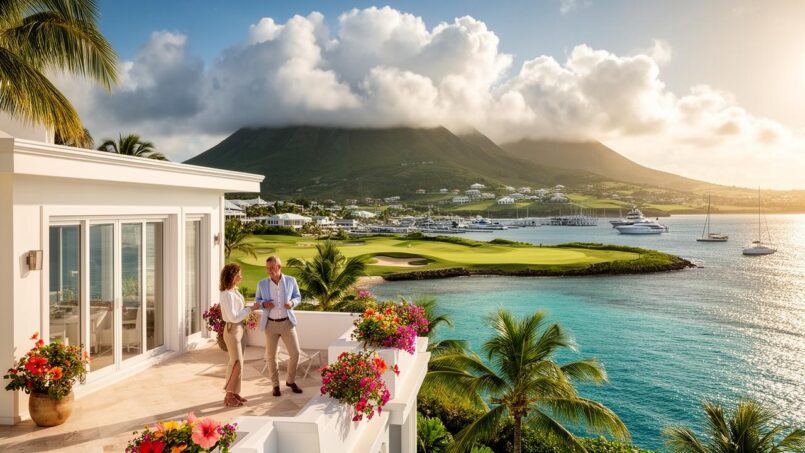
The Southeast Peninsula is characterized by hills plunging into the sea, with a succession of spectacular bays: Cockleshell Bay, Turtle Beach, Timothy Beach, Banana Bay, Majors Bay, Sandy Bank Bay… This is where the most exclusive villas are concentrated, often nestled in gated communities with security, infinity pools, large terraces, and panoramic views of both oceans.
A development project spanning over 2,000 hectares that has significantly boosted the region’s profile.
A marina capable of accommodating superyachts.
A golf course designed by renowned architect Tom Fazio.
Very high-end homes.
The Pavilion, a private beachfront club.
The Park Hyatt, a luxury resort for an affluent international clientele.
Other exclusive developments, like Sundance Ridge, feature custom villas, each with infinity pool and amenities on par with major international second homes.
A market designed for wealthy investors
In this segment, budgets have little to do with standard Frigate Bay rents. Some villas reach several million dollars for purchase. Properties like those at Sundance Ridge are priced in the tens of millions for the most spectacular achievements.
For high-income expats or investors, the country’s prestige real estate sector is eligible for the citizenship by investment program. Properties designed for this program require a minimum investment, a defined holding period (typically seven years for real estate), and can generate rental income when owners are away.
Advantages and trade-offs
Settling in the Southeast Peninsula means buying privacy and serenity rarely found elsewhere in the Caribbean for a country of this size. The beaches are sometimes nearly deserted, the views are breathtaking, construction density remains relatively low, and you live in a world of resorts, marinas, and private clubs.
The trade-off, beyond the high cost, is a relative dependence on a car and a smaller social environment if you don’t make the effort to also frequent Basseterre or Frigate Bay. Daily life here resembles that of an exclusive residential community more than a Caribbean village.
For expats who primarily want a secure, very comfortable pied-à-terre, possibly paired with a passport through CBI, the Southeast Peninsula ticks most boxes. For those seeking above all integration into local society, it’s not necessarily the first choice.
Sandy Point Town and Dieppe Bay: authenticity on the west coast
Moving away from the most touristy areas and international routes, the west coast of Saint Kitts offers other options, more discreet but interesting for certain expat profiles.
Sandy Point Town: the island’s second city
Sandy Point Town, the second largest settlement on Saint Kitts, lies on the west coast. The town maintains a very local character, with a close-knit community, local shops, and a life rhythm dictated by residents’ habits rather than cruise ship traffic. Some Americans have already made it their home, drawn by this small-town vibe and more reasonable housing costs than in the expat enclaves on the south coast.
The proximity of Brimstone Hill Fortress, a UNESCO World Heritage fortified site, adds to the area’s tourist appeal without making it a beach resort in the strict sense. The environment suits expats who want to live close to the local fabric, without completely giving up some conveniences and access to nature (hiking, nearby beaches, marine wildlife observation).
Dieppe Bay Town: nature and quiet
Further north, Dieppe Bay Town stands out for its palm-fringed coastal scenery, a black sand beach, and a very tranquil atmosphere. The cost of living here is generally lower than in urbanized areas like Basseterre. Residents still have access to essential services (health, education, daily shopping) without the drawbacks of urban traffic or high density.
Dieppe Bay mainly attracts expats seeking tranquility and willing to accept more basic infrastructure in exchange for affordable rents and total immersion in local life. Its assets include an uncrowded beach, raw natural landscapes, and a slow pace of life, ideal for nature lovers.
Profiles for whom these towns make sense
For remote workers whose jobs don’t depend on constant contact with major infrastructure, or for retirees seeking a simple life, these west coast towns offer an interesting compromise. You escape the premium of high-end zones while remaining in a safe country where the community is generally welcoming.
On the other hand, for families needing specific private schools, highly specialized medical care, or for expats who enjoy frequent dining out at international restaurants, daily life will require frequent trips back and forth to the island’s more developed hubs.
Nevis: Charlestown, north coast, and hills
Facing Saint Kitts, across the channel, Nevis offers another way of being an expat in the federation. Quieter, less built-up, the island appeals to those who have made the word “tranquility” their priority.
Charlestown: small capital, great gentleness
Charlestown, the small capital with about 1,500 inhabitants, stretches along the west coast of Nevis. Its streets of pastel colonial houses, administrative buildings, a few shops, bars, and restaurants give it more the appearance of a large village than a city.
For an expat, settling in Charlestown means choosing a very slow life, where almost everything is done on foot within a few blocks. Here you’ll find administrative offices, the island’s main hospital (Alexandra Hospital), a museum dedicated to Nevis’s history in Alexander Hamilton’s birthplace, and a small port welcoming the ferry from Saint Kitts.
Rents in this area are generally a bit lower than on Saint Kitts for similar properties, offering an interesting option for mid-range budgets. Additionally, it’s located a very reasonable distance, just a few miles north, from Pinney’s Beach, one of the most beautiful beaches in the Caribbean.
The north coast: Oualie Beach, Jones Estate, and beachfront villas
It’s on the northwest coast of Nevis, between Oualie Beach and Hurricane Hill, that most of the island’s small expat community is concentrated. The reasons are simple: this is where you find the best combination of beaches, tourist accommodations, restaurants, and views of Saint Kitts in the distance.
Oualie Beach offers a very peaceful seaside living environment, with calm waters appreciated by swimmers, kayakers, and snorkelers. Nearby, you’ll find residential complexes like Jones Estate, individual villas, luxury residences with private pools, and long-stay vacation options, particularly in complexes like The Hamilton, properties associated with the Four Seasons Resort Nevis, or villa developments like Fern Hill Estates, set higher up on the island’s slopes.
On this part of the coast, daily life is peaceful, but the dining and leisure options are more developed than elsewhere on Nevis. This attractiveness explains why the majority of expats on the island choose to settle here.
Hills, plantations, and inland villages
Moving away from the shores, Nevis reveals a network of small roads leading to estates planted with palms and tropical woods, often inherited from the sugar era. Many former plantations have been transformed into charming hotels or private residences, with large plots, lush gardens, pools, and beautiful views of the sea or Nevis Peak volcano.
Areas like Fern Hill Estates, Gingerland, or Zetland attract an expat audience even more in search of tranquility. Homes here benefit from cooler air due to altitude and a very green environment. These areas, however, require a vehicle for errands and outings, and you truly live “in the countryside.”
A summary of typical profiles for each area of Nevis helps to better position yourself.
| Area of Nevis | Most compatible expat profile |
|---|---|
| Charlestown | Active retirees, town life enthusiasts, small budgets |
| North coast (Oualie Beach, Jones Estate) | Main expat community, families, remote workers |
| Plantations & hills (Fern Hill, Gingerland, Zetland) | Nature lovers, maximum tranquility, comfortable budgets |
| Eastern and inland villages | Strong local immersion, very few expats, lower costs |
Overall, Nevis appeals more to those who prioritize serenity over activity, and who accept giving up some urban conveniences. In return, the landscapes are superb, beaches rarely crowded, and neighborhood life is very human.
Cost of living, real estate, and taxes: what this means for choosing a neighborhood
The differences between neighborhoods are not just about atmosphere and scenery, but also about purchasing power.
Housing: from $600 to several million
Available data shows a very wide price range. In areas outside expat enclaves – some parts of Basseterre, west coast villages, or interior Nevis – it’s possible to rent small homes from $600 to $800 per month. Approaching sought-after areas (Frigate Bay, north coast of Nevis, Southeast Peninsula), you quickly enter a range of $1,000 to $2,000 for modest-sized apartments, and $3,000 and up for family villas with pools.
For purchases, mentioned prices hover around $5,000 US per square meter in the city center for quality properties, and around $4,000 outside, with buildable land on the waterfront or in highly sought-after areas (central Basseterre, Frigate Bay, south peninsula) ranging between $4,000 and $5,000 per square meter.
The median price of a modest three-bedroom house in the relevant real estate market.
Daily cost of living
The most telling indicator for an expat remains the overall monthly budget. For a single person, many estimates converge on a viable budget between $1,300 and $1,400 US, including housing, while being reasonable on outings and consuming a good portion of local products. A family of four, especially if they use air conditioning and opt for private schools, easily reaches $3,000 to $4,000 monthly.
Basic utilities (water, electricity, garbage, gas) for a medium-sized apartment often run between $150 and $350, depending on air conditioning usage. High-speed internet (8 to 15 Mbps) costs between $50 and $80 per month. A simple lunch can cost $10 to $20, a finer dinner for two at a mid-range restaurant $60 to $80.
To limit your expenses in Saint Kitts, avoid neighborhoods highly popular with expats like Frigate Bay or the Southeast Peninsula, where outings and leisure are costly. Instead, choose a less touristy area for housing and adopt local consumption habits, such as shopping at markets and consuming local products.
Taxation, investment, and citizenship
One of the great attractions of Saint Kitts and Nevis for expat investors remains its tax regime and the possibility of obtaining a passport through the citizenship by investment program. The absence of income tax, wealth tax, inheritance tax, or capital gains tax is a strong argument, especially for high earners or those with significant assets.
For those aiming for citizenship, the choice of neighborhood and property type is not neutral. Only projects approved by the authorities can serve as the basis for a citizenship application through real estate investment. Many of these projects are located in or near the areas already mentioned: resorts on the Southeast Peninsula (Park Hyatt, Christophe Harbour), residences in Frigate Bay, complexes on Nevis (Four Seasons Resort Estates, Hamilton, Nevisian Sunset Condominiums, etc.).
An investor who wants to combine pleasant residence, seasonal rental potential, and program eligibility will therefore, very logically, turn to these neighborhoods already favored by expats and tourists.
Safety, health, education: criteria that strongly influence the choice
Beyond setting and budget, many expats – especially families – have questions about safety, quality of healthcare, and schooling options.
A generally safe country with neighborhood nuances
Safety data places Saint Kitts and Nevis among Caribbean destinations offering a good level of security. International indicators show a moderate Crime Index and a satisfactory Safety Index, with a good perception of safety for getting around during the day, and “average” safety at night.
Crime directly affecting visitors and expats is mostly opportunistic (snatch thefts, burglaries). Violence is concentrated in certain neighborhoods of Basseterre, often linked to local rivalries. In sought-after residential areas (Frigate Bay, Southeast Peninsula, north coast of Nevis, gated communities), the presence of private security and informal neighborhood watch reinforce the sense of safety.
When choosing a neighborhood, expats instinctively lean toward areas where the combination of police/community/private amenities is strongest.
Healthcare and medical infrastructure
Expats have access on Saint Kitts to the large Joseph N. France Hospital in Basseterre, and on Nevis to Alexandra Hospital in Charlestown, as well as a network of clinics and health centers. For most routine care, these facilities are considered sufficient. However, for highly specialized needs, it remains common to travel to Puerto Rico, the United States, or other better-equipped islands.
For expats requiring regular medical follow-up, it is recommended to choose accommodation in Basseterre or in areas easily connected by ferry, such as Charlestown or the north coast of Nevis. This proximity allows quick access to health services and specialists concentrated in the capital.
Education and family life
The federation generally follows a school system inspired by the British model in public schools. The offering of international schools is, however, limited, leading several expat families to turn to homeschooling or online programs.
In terms of living environment, the islands are perceived as a good environment for children growing up outdoors, with abundant nature activities: beaches, hikes up volcanoes, water sports, tropical wildlife observation. The more residential neighborhoods like Bird Rock, West Farm, Frigate Bay, or the north coast of Nevis are particularly suitable for families, offering safety, outdoor spaces, and reasonable proximity to major services.
Which neighborhood for which expat profile?
In light of all these elements, we can see a kind of mental map of Saint Kitts and Nevis as seen by expats. Depending on whether you are a retiree, remote worker, investor, or family, the neighborhoods will have different relevance.
Summary of main matches to better visualize the links between different user profiles and activity areas.
Corresponds mainly to areas of artistic design and visual content development.
Affinity with data, research, and statistical analysis areas.
Linked to development, engineering, and IT solutions areas.
Corresponds to communication, customer support, and team management areas.
| Expat profile | Most suitable neighborhoods |
|---|---|
| Retirees with comfortable budget | Frigate Bay, north coast of Nevis, hills of Nevis |
| Retirees on a tighter budget | Residential Basseterre, Charlestown, Sandy Point, Dieppe Bay |
| Remote workers / digital nomads | Frigate Bay, Basseterre, north coast of Nevis |
| Investors seeking citizenship + return | Southeast Peninsula (Christophe Harbour, Park Hyatt), Frigate Bay, Nevis resorts |
| Families with young children | Frigate Bay, Bird Rock, West Farm, north coast of Nevis |
| Lovers of “authentic” local life | Sandy Point Town, Dieppe Bay, Nevis villages outside tourist areas |
| Very high income, seeking exclusivity | Southeast Peninsula (Sundance Ridge, Christophe Harbour), luxury villas on Nevis |
Each person can then adjust their choice based on more personal factors: tolerance for isolation, importance of nightlife, attachment to the sea, dependence on healthcare, preference for local culture vs. expat environment.
Some practical pointers to refine your choice
Projecting yourself into a neighborhood from afar is always tricky. However, a few best practices emerge for candidates for expatriation to Saint Kitts and Nevis.
Visiting several neighborhoods before signing a long-term lease allows you to feel the differences in atmosphere between Basseterre, Frigate Bay, the Southeast Peninsula, or Nevis. Many future expats first opt for a short-term rental in a very practical area like Frigate Bay or Basseterre, while they explore the island and meet locals and other foreigners.
It’s essential to compare your projected budget with the rental prices in the targeted neighborhood, especially on Saint Kitts where the gaps can be considerable between a modest apartment set back and a modern beachfront condo. In this country where housing is often the main expense, the choice of location directly influences the viability of your relocation project.
Finally, staying informed about ongoing infrastructure and development projects in certain areas – road extensions, new resorts, residential projects – helps anticipate future changes in property values and population density.
In conclusion
The neighborhoods favored by expats in Saint Kitts and Nevis reflect the diversity of reasons for moving there: seeking a retirement in the sun, pursuing a second passport, remote working in a dream setting, wanting to raise a family in a more serene environment, investing in a Caribbean real estate market undergoing rapid change.
On Saint Kitts, Basseterre offers urban convenience, Frigate Bay embodies the beating heart of the expat community, and the Southeast Peninsula attracts wealthy investors with spectacular villas. On Nevis, Charlestown and the north coast offer a gentle way of life, extended by the plantations and remote hills, ideal for a life immersed in nature.
In any case, the choice of neighborhood is not just about sea view or beach proximity. It determines the level of expenses, the degree of integration into the local community, the ease of access to healthcare or services, and the nature of the social relationships you build. Taking the time to understand these nuances, to compare, to exchange with already settled residents, and to confront what you imagine with the reality on the ground is undoubtedly the most decisive step in a successful expatriation project in Saint Kitts and Nevis.
Disclaimer: The information provided on this website is for informational purposes only and does not constitute financial, legal, or professional advice. We encourage you to consult qualified experts before making any investment, real estate, or expatriation decisions. Although we strive to maintain up-to-date and accurate information, we do not guarantee the completeness, accuracy, or timeliness of the proposed content. As investment and expatriation involve risks, we disclaim any liability for potential losses or damages arising from the use of this site. Your use of this site confirms your acceptance of these terms and your understanding of the associated risks.

Cyril Jarnias is an independent expert in international wealth management with over 20 years of experience. As an expatriate himself, he is dedicated to helping individuals and business leaders build, protect, and pass on their wealth with complete peace of mind.
On his website, cyriljarnias.com, he shares his expertise on international real estate, offshore company formation, and expatriation.
Thanks to his expertise, he offers sound advice to optimize his clients' wealth management. Cyril Jarnias is also recognized for his appearances in many prestigious media outlets such as BFM Business, les Français de l’étranger, Le Figaro, Les Echos, and Mieux vivre votre argent, where he shares his knowledge and know-how in wealth management.





