
 Published on and written by Cyril Jarnias
Even though the federation is tiny on a map, getting around St. Kitts and Nevis requires a bit of planning. Between the famous “H Buses,” unmetered taxis, ferries zipping across The Narrows, and a small tourist railway unique in the Caribbean, the options are varied… but rarely standardized. This practical guide gathers essential information to help you understand the system, choose the right mode of transport, and avoid unpleasant surprises—whether you’re stopping over for a few hours or staying several weeks.
Understanding the Transport System
St. Kitts and Nevis is a federation of two islands, St. Kitts and Nevis, linked by the coastal road, bus services, numerous taxis, and several types of boats. Basseterre, the capital of St. Kitts, serves as the main road hub for the island, while Charlestown plays the same role on Nevis. Traffic drives on the left, with a speed limit of 40 km/h (25 mph) in built-up areas and 60 km/h (37 mph) in rural areas.
The total road network is about 320 km (200 miles), with a large proportion of unpaved roads, especially inland. For this reason, taxis and minibuses are the main means of transport for reaching villages, historic plantations, and beaches.
Forms of public transport in the broad sense include: public minibuses (“H Buses”), taxis (often vans), inter-island ferries, fast water taxis, a scenic railway line, and, additionally, rental vehicles, scooters, bicycles, or organized tours.
The “H Buses”: Backbone of Local Transport
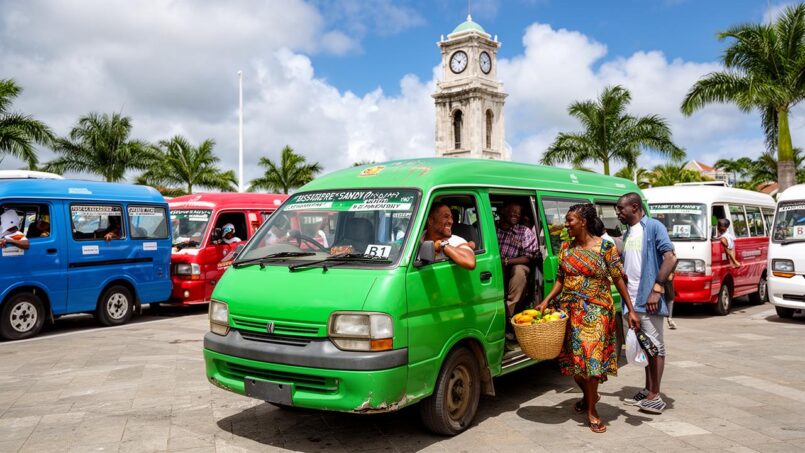
On both islands, the only truly collective and cheap form of transport is the public minibus, locally called the “H Bus.” These vehicles are privately owned but government-licensed, recognizable by their green license plates starting with “H” or “HA.” Many have a name painted on the windshield, adding a touch of Caribbean color, but this doesn’t replace the need to ask the driver for the destination.
How H Buses Work
H Buses primarily run along main roads, serving Basseterre’s suburbs and coastal villages on St. Kitts, as well as Nevis’s ring road. The system is flexible but not very formalized.
There is no real fixed schedule: buses usually depart when the vehicle is deemed full enough, especially from the terminals. They mostly run during the day, with higher frequency in the morning and afternoon, and very limited service in the evening (often until 7 or 8 p.m.) and on Sundays.
Outside Basseterre and Charlestown, bus stops are not strictly fixed. Passengers can wave to board anywhere along the main road and ask to get off almost on demand, as long as the stop is reasonable and safe. For destinations slightly off the main route, drivers sometimes agree to make a detour for a small extra fee at their discretion.
Main Bus Routes on St. Kitts
From Basseterre, five main routes structure the network on St. Kitts, split between two terminals: one for the east and one for the west of the island.
| Main Route | Direction | Departure Point in Basseterre | Area Served |
|---|---|---|---|
| Basseterre – Sandy Point | West | Ferry Terminal | West coast, villages, and Sandy Point |
| Basseterre – Capesterre | West | Ferry Terminal | Western side of the island toward Capesterre |
| Basseterre – St. Peter’s | North | College Street Ghaut | Northern suburbs and St. Peter’s |
| Basseterre – Molyneux | East | Baker’s Corner | East coast and inland villages |
| Basseterre – Saddler’s | East/North | Baker’s Corner | Northeast up to Saddler’s |
An important point for travelers: no public bus goes south to Frigate Bay and the Southeast Peninsula, where most tourist hotels and beaches are concentrated. For these areas, a taxi or rental vehicle becomes essential.
Buses on Nevis
Nevis works differently, with a circular network along the main road that goes around the island. All buses start and end at Charlestown. To find your way:
– Vehicles heading north wait at the southwestern end of D.R. Walwyn Plaza.
– Those heading south line up north of Memorial Square.
On Nevis, minibuses run in both directions along the main road, typically between Newcastle in the north and the Gingerland area in the south. Passengers get on and off by waving at the roadside. The service follows the same logic as St. Kitts: departures occur when the bus is full enough, stops are on demand, frequency is higher during peak hours, and service is scarcer in the evening and on Sundays.
H Bus Fares and Payment System
Fares are quoted in Eastern Caribbean dollars (EC$), the official currency of the federation, pegged to the US dollar at roughly 1 US$ = 2.70 EC$. Payment is in cash, directly to the driver. There are no electronic tickets or credit cards accepted on board.
Historically, the price structure is proportional to distance:
| Distance Traveled | Old Indicative Fare (EC$) |
|---|---|
| Up to 5 miles | 2.50 EC$ |
| 5 to 10 miles | 3.00 EC$ |
| Over 10 miles | 3.75 EC$ |
In response to inflation and rising costs (fuel, maintenance, parts), a new fare scale has been developed by the Traffic Safety and Public Drivers Board, after consultation with driver associations and several ministries. This scale, published on the board’s official website, provides for a maximum increase of 1 EC$ per trip, while maintaining the distance-based logic and introducing adult/child differentials.
A few examples of new official fares for St. Kitts illustrate this adjustment, showing concretely how prices have been modified or revised as part of a regulatory or economic update.
| Route (St. Kitts) | Adult Fare (EC$) | Child Fare (<12 yrs) (EC$) |
|---|---|---|
| Basseterre – Stone Fort (west route) | 3.50 | 1.75 |
| Old Road – Half Way Tree (via Basseterre) | 4.00 | 2.00 |
| Basseterre – Sandy Point | 4.50 | 2.25 |
| Newton Ground – Parsons | 4.75 | 2.50 |
| Basseterre – Cayon (east/north route) | 3.50 | 1.75 |
| Basseterre – Christ Church / Masons / Tabernacle | 4.50 | 2.25 |
| Basseterre – Bellevue / Saddlers / Parsons | 4.75 | 2.50 |
| Basseterre – St. Peter’s | 3.50 | 1.75 |
A surcharge of 2.50 EC$ may be applied for services operating at night, between 11 p.m. and 5 a.m. It is therefore wise to have some local currency on hand, as drivers often cannot make change for large bills and generally only accept cash.
Strengths and Limitations of H Buses for Travelers
Public minibuses are unbeatable in terms of cost and offer a real immersion in local daily life. They work perfectly if you are staying along a well-served route, for example in villages on the west or east coast of St. Kitts, or on the road encircling Nevis.
On the other hand, they require flexibility: approximate schedules, waiting for the bus to fill up, multiple stops, and no service to the main hotel areas in southern St. Kitts. They are poorly suited for bulky luggage, people with reduced mobility, or tight time constraints (organized tour, ferry or flight departure). In these cases, a taxi or private transfer remains the safest option.
Taxis: Flexible, Ubiquitous, But Negotiable
Taxis are the second pillar of transport in St. Kitts and Nevis, and often the first reflex for visitors. Vehicles are mostly Toyota Hi-Ace vans that can carry 10 to 12 passengers, along with some sedans. They are privately owned but licensed, identifiable by their yellow plates starting with “T” or “TA” on St. Kitts, and “N” or “NT” on some sources for Nevis.
How to Spot an Official Taxi and Where to Find One
For safety and insurance reasons, authorities recommend using only licensed taxis. These:
– display a yellow plate with the letter T/TA,
– belong to a recognized association,
– and their drivers hold an approved guide/driver identification card.
The main pick-up points are easy to spot.
| Location | Taxi Rank Position |
|---|---|
| Basseterre (St. Kitts) | The Circus (main rank), Port Zante, near the ferry terminal |
| Robert L. Bradshaw Airport | Dedicated area in front of the terminal |
| Frigate Bay / Marriott | Station near the hotel and beach bars |
| Charlestown (Nevis) | West of D.R. Walwyn Plaza, near the ferry dock |
| Nevis Airport | In front of the terminal |
On St. Kitts, a central number exists for the main Basseterre rank: 466 6999. Elsewhere, bars, restaurants, and hotels are happy to call a taxi for their customers.
Pricing: No Meters, But Official Rates
Taxis are not equipped with meters. Rides are based on rates set by zone and number of passengers (price for 1 to 4 people, extra for additional). The amounts are often quoted in US dollars, though payment in EC$ is generally still possible. The vast majority of drivers work with cash and do not accept credit cards.
The fundamental rule is to confirm the price before getting in, specifying the currency. Although amounts are regulated, they may vary slightly between operators for excursions or customized tours.
Here are some examples of typical fares for 1 to 4 people (in US$):
| Typical Route | Indicative Fare (US$) |
|---|---|
| Airport – Basseterre | 15 |
| Airport – Frigate Bay Marriott | 25 |
| Airport – Park Hyatt | 65 |
| Basseterre – Frigate Bay Marriott | 25 |
| Basseterre – Brimstone Hill Fortress | 60 |
| Basseterre – Caribelle Batik (Romney Manor) | 40 |
| Frigate Bay Marriott – Brimstone Hill Fortress | 65 |
| Basseterre – Cockleshell/Majors Bay | 28 |
| Frigate Bay Marriott – Cockleshell/Majors Bay | 25 |
| Basseterre – South Friars Bay | 25 |
Routes between resorts and tourist sites follow the same logic: fixed price for the group, extra per person beyond four, 50% surcharge after 10 or 11 p.m. (depending on regulations) until 6 a.m.. For airport trips, a luggage surcharge may also be requested.
A tip of around 10% of the fare is customary, especially if the driver helps with luggage, comments on the scenery, or acts as a guide.
For cruise passengers and groups wanting to reach a beach, the shared taxi is the most economical solution. From Port Zante or the ferry terminal, drivers fill their vans for Cockleshell Bay, South Friars, or other beaches, with a per-person fare usually between 10 and 25 US$ depending on distance.
The majority of drivers are also licensed guides. They offer pre-set tours (island panoramic tour, beach-and-visit combo, historical site excursions) or custom itineraries. Prices are negotiated as a flat fee for the duration (often 3 to 5 hours) and the chosen program. This option is more convenient than public buses and more flexible than a standard group tour.
Local Apps and Absence of Uber
There are no international ride-hailing services like Uber or Lyft in St. Kitts and Nevis. However, local solutions are emerging. An app called DROP: SKN Ride allows you to book trips, airport transfers, beach tours, or shopping trips, either instantly or in advance, with a rewards system. Other digital services focus more on information than booking, such as SKN Transit (geared more toward ferries, water taxis, cruise and flight schedules).
Ferries, Sea Bridge, and Water Taxis: Traveling Between the Islands
Going from St. Kitts to Nevis (or vice versa) is almost part of the travel ritual. The stretch of sea separating the two islands, The Narrows, is only about 3 km (1.9 miles) wide, which has fostered a very dense network of maritime shuttles, ranging from large mixed passenger-vehicle ferries to small private speedboats.
The “Classic” Ferry: Basseterre – Charlestown
The main link, used by both locals and visitors, connects the Basseterre terminal, next to Port Zante, to the dock in Charlestown. Several operators share this route, each with its own schedules, crossing times, and fares.
| Boat / Operator | Main Features | Indicative Duration | One-Way Fare (EC$) |
|---|---|---|---|
| Carib Surf / Carib Queen (M&M Transportation Services) | Passenger ferry, early morning departure around 7 a.m. | ~50 min | ~35 |
| Apple Syder (SKN Executive Travel) | Fast boat, departs around 7:30 a.m. from Nevis | ≤ 30 min | ~35 |
| Mark Twain / Sea Hustler (Wesk Agency Ltd.) | Capacity up to 300 passengers and vehicles for Sea Hustler | ~60 min | ~30 |
| Next Edition | Medium-sized vessel (approx. 30 passengers) | ≤ 28 min | ~35 |
In practice, for an adult, the standard one-way ticket is around 25 EC$ (including a 1 EC$ departure tax), or about 8 to 10 US$. Children under 12 generally pay around 15 EC$. Departures run from 7 a.m. to 6 p.m., with at least one boat in each direction almost every hour, but schedules can be affected by weather or commuter volume.
Tickets are purchased at the terminal ticket office, 20 to 30 minutes before departure, in cash only (EC$). No online reservations are possible. It is advisable to arrive early, especially during peak hours (morning and late afternoon), to secure a seat on your desired boat.
The Sea Bridge: Car Ferry
For those traveling with a vehicle, another key player comes into play: the Sea Bridge, a drive-on/drive-off ferry 135 feet long, capable of carrying up to 35 cars in addition to foot passengers. Its crossing runs between Major’s Bay, at the tip of St. Kitts’ Southeast Peninsula, and Cades Bay, on the northwest coast of Nevis.
The trip typically takes between 20 and 30 minutes, with up to six round trips daily in each direction, slightly more frequent on weekends and during peak periods. Fares are structured as follows:
| Type of Passenger | One-Way Fare (EC$) | Approximate Equivalent (US$) |
|---|---|---|
| Foot passenger | 20 | ~8 |
| Car (driver included) | 75 | ~28 |
| Additional vehicle (with passengers) | 75 + 20 per passenger | Variable |
Note that many rental agencies strictly prohibit transporting their vehicles on the Sea Bridge. It is therefore essential to check the terms of your contract before boarding. Additionally, Major’s Bay has only a basic shelter: no services, little shade, and access is via a road that can be rough in some sections. It is best to plan your transfer (taxi or private shuttle) to the dock in advance.
Water Taxis: The Express (and More Expensive) Option
Between the Southeast Peninsula of St. Kitts (around Cockleshell Bay/Reggae Beach and Christophe Harbour marina) and Nevis (Oualie Beach, Four Seasons Pier), water taxis provide fast connections, very popular with resort guests or travelers in a hurry.
The minimum crossing time in minutes for on-demand boats, depending on sea conditions.
| Type of Service | Indicative Fare (US$) | Travel Time |
|---|---|---|
| Single one-way ticket | About 20 per person | 10–15 min |
| Private charter (1–4 people) | About 80 per crossing | 10–15 min |
Several operators share this niche, sometimes with extras like drinks on board:
– Islander Water Sports (Oualie Beach, Nevis – contact Wincent Perkins, +1 869‑662‑7081),
– Blu Waves Water Taxi & Charters (Oualie Beach, contacts +1 869‑663‑1762 / 667‑8351),
– Paradise Sun Charters (contacts +1 869‑667‑6203 / 760‑6244).
Boat reservations are made mainly by phone, WhatsApp, or through hotels. Payments are made locally, usually in cash, sometimes by card depending on the operator. The SKN Transit app lets you check some boat schedules and helps coordinate with other transport.
Regional Ferries and Makana Ferry
Beyond the shuttle between St. Kitts and Nevis, the federation is connected to other islands in the Lesser Antilles by more occasional services. A ferry may occasionally run a day trip to Oranjestad (St. Eustatius). More recently, Makana Ferry has launched a network linking St. Kitts, Saba, Statia (St. Eustatius), and St. Maarten, with departures from a marina next to Port Zante, usually two days a week. These connections are booked online, unlike the local inter-island ferries, and are aimed more at regional travel than daily commutes.
The Scenic Railway: A Tourist Train Rather Than Everyday Transport
St. Kitts has a rare rail treasure in the region: a 29 km (18 mile) narrow-gauge track built in the early 20th century to transport sugar cane to the central factory in Basseterre. Since the end of sugar production, the network has been converted into a tourist attraction under the name St. Kitts Scenic Railway.
Discover the island of St. Kitts aboard a unique panoramic train, combining rail and road for a complete experience.
Travel the island in double-decker cars with an open platform, offering stunning views of the landscape.
Circuit from Sandy Point to Basseterre heading east. Includes about 90 minutes of train travel.
A bus ride from Wingfield Estate and La Vallée Train Depot completes the loop around the island.
Full loop about 3.5 hours to circle the island, combining rail and road.
For visitors, it’s an excellent way to discover the volcanic terrain, cliffs, and former cane fields, but it is not a “practical” mode of transport for getting from point A to point B. Departures are geared toward the tourist clientele, with limited schedules often timed to cruise ship arrivals.
Car Rental, Scooters, and Other Alternatives
For those wanting to explore side roads, more remote viewpoints, or make multiple stops in a day, renting a car is often the most flexible solution. Several local and international companies are present, both at the airport and in Basseterre and Frigate Bay: IAS Auto Rental, Avis, Bullseye, Thrifty/TDC Car Rentals, among others.
Daily rates for a small car generally range from 40 to 100 US$ depending on the season, model, and coverage. To drive, you need:
– a valid driver’s license from your home country,
– and a temporary local permit issued by the police or through the rental agency (about 62.50 EC$ for three months, 125 EC$ for one year).
Driving is on the left on roads that are often narrow, poorly lit, with potholes, unmarked speed bumps, and stray animals. Caution and adherence to speed limits are imperative. Drunk driving is severely punished with heavy fines and prison terms.
Additionally, you can find:
– electric scooters and motorcycles rented by the hour or day,
– a few mountain bike or bicycle rentals, despite the challenging terrain,
– ATV (quad) tours for exploring former plantations or rougher trails.
For a stay centered on a single area (e.g., a resort in southern St. Kitts), taxis may remain more economical than a permanent rental, especially when adding insurance, fuel, and parking.
Accessibility and Constraints for People with Reduced Mobility
The transport network of St. Kitts and Nevis was primarily designed for conventional road traffic and able-bodied residents. Accessibility remains a weak point identified by observers: uneven sidewalks, few ramps at intersections, rare or poorly marked crosswalks, steep and winding roads.
Public buses as well as taxis do not have ramps or special modifications for wheelchairs. Adapted vans are extremely rare and should ideally be booked well in advance. Beaches do not offer amphibious wheelchairs for rent.
Accessibility efforts exist on St. Kitts: the Port Zante cruise terminal is generally accessible with a flat dock and ramps. Some attractions, like the Batik Factory at Romney Manor and part of Brimstone Hill Fortress, have installed ramps, but access to the highest points remains impossible without stairs.
Visitors with reduced mobility will benefit from:
– booking their transfers and excursions in advance, specifying their needs,
– prioritizing organized visits from the cruise terminal or hotel,
– checking in detail the actual accessibility of sites, beyond general mentions.
Safety, Regulations, and Best Practices
From a safety perspective, St. Kitts and Nevis presents a profile comparable to many Caribbean destinations. In terms of transport, the main risks are more related to driving habits, variable road infrastructure, and petty theft in crowded areas.
A few useful pointers for getting around smoothly:
Drive with extra caution at night due to limited lighting, poorly visible obstacles, and the possible presence of animals or pedestrians on the road. Always keep your vehicle doors locked and do not leave valuables in sight inside. For your trips, exclusively use officially licensed taxis, especially after dark. Avoid carrying large amounts of cash or flashy jewelry, particularly during major festivals or street parties. In case of a road accident, contact the police immediately and do not move the vehicles involved until authorities arrive and assess the situation.
On buses and ferries, serious security incidents are rare, but basic vigilance is still warranted in busy terminals: watch your bags, keep important documents on you, and be wary of unofficial taxi offers.
Digital Tools and Real-Time Information
Even though the system remains largely analog (cash payments, few electronic displays, rarely digital bookings), several online resources now help to better plan your trips.
Digital tools and official sources to plan your journeys by sea, air, and land in the archipelago.
App listing ferry and water taxi schedules, flight and cruise info, as well as some taxi and tour services. Ideal for organizing an island-hopping day.
App for booking local trips, offering transfers, beach tours, or school runs.
Follow ferry companies (Carib Surf/Queen, Sea Hustler, Apple Syder) or the “Nevisdm” account for their weekly schedules and last-minute changes.
The Traffic Safety and Public Drivers Board publishes bus fares. SCASPA (St. Christopher Air & Sea Ports Authority) provides information on ship arrivals and port logistics.
For international visitors, a separate app, St Kitts and Nevis e-Border, allows you to manage electronic travel authorizations (eTA) when required, but it pertains more to entry formalities than internal transport.
How to Choose Your Mode of Transport Based on Your Stay
In the end, each type of traveler will benefit from a specific combination of transport modes.
For a beach vacation mainly centered around a resort in Frigate Bay, the Southeast Peninsula, or Nevis, the duo of taxi + water taxi or ferry is often sufficient, possibly supplemented by a guided island tour. H Buses will then play a marginal role.
For an independent trip exploring beaches, villages, and viewpoints at your own pace, renting a car is the most flexible solution. However, you must adapt to driving on the left and the sometimes uneven road conditions. To save on short daytime trips, occasional use of public minibuses is recommended.
For day-tripping cruise passengers, shared taxis, the Scenic Railway, and packaged excursions (panoramic tour, catamaran-beach combo to Nevis, ATV tours) are the simplest way to make the most of a few hours ashore without getting lost in the system’s subtleties.
For an authentic and budget-friendly immersion in St. Kitts and Nevis, H Buses let you experience the archipelago at the local pace. This option suits travelers willing to accept a degree of unpredictability and to allow plenty of time in their schedule.
—
St. Kitts and Nevis has neither a subway nor a tram, but the combination of minibuses, taxis, ferries, water taxis, and the tourist railway forms a coherent puzzle once you understand the rules of the game. By keeping a few simple principles in mind—always confirm the price before getting in, carry cash, check schedules locally, choose licensed services—it becomes fairly easy to get from one beach to another, from a volcano to a fortress, and even from one island to the other, at the Caribbean pace.
Disclaimer: The information provided on this website is for informational purposes only and does not constitute financial, legal, or professional advice. We encourage you to consult qualified experts before making any investment, real estate, or expatriation decisions. Although we strive to maintain up-to-date and accurate information, we do not guarantee the completeness, accuracy, or timeliness of the proposed content. As investment and expatriation involve risks, we disclaim any liability for potential losses or damages arising from the use of this site. Your use of this site confirms your acceptance of these terms and your understanding of the associated risks.

Cyril Jarnias is an independent expert in international wealth management with over 20 years of experience. As an expatriate himself, he is dedicated to helping individuals and business leaders build, protect, and pass on their wealth with complete peace of mind.
On his website, cyriljarnias.com, he shares his expertise on international real estate, offshore company formation, and expatriation.
Thanks to his expertise, he offers sound advice to optimize his clients' wealth management. Cyril Jarnias is also recognized for his appearances in many prestigious media outlets such as BFM Business, les Français de l’étranger, Le Figaro, Les Echos, and Mieux vivre votre argent, where he shares his knowledge and know-how in wealth management.





