
 Published on and written by Cyril Jarnias
Discovering the Marshall Islands means accepting entry into a country where the ocean sets the pace and travel is nothing like that of a major metropolis. No subway, no tram, no structured bus network with posted schedules and numbered stops. Yet, there are indeed ways to get around, whether in the capital Majuro, on the densely populated island of Ebeye, or between the different atolls. This practical guide provides a concrete overview of these modes of transport, with a detailed focus on Ebeye and Kwajalein.
Understanding the Context: An Archipelago Without a “System” of Public Transport
The Marshall Islands consist of 29 coral atolls and five islands scattered across a vast area of the Pacific, with a land area of barely 170 km². In such an environment, imagining a bus or train network on the European model makes no sense. What does not exist:
– no subway
– no tramway
– no urban bus network with fixed schedules
– no trains or railway lines
– no Uber or Lyft-type services
– no “hop-on hop-off” tourist buses
Transport relies on a patchwork of informal or semi-organized solutions: shared taxis, minibuses, occasional shuttles, inter-atoll boats, infrequent domestic flights. For visitors, this means two essential things: you need to plan, and you need to stay flexible. Delays, schedule changes, and cancellations are part of the journey.
Majuro is home to a large share of the country’s population and infrastructure. The atoll is long, with a single main road running east-west between Djarrit (Darrit) and Laura. This is the artery on which almost all vehicles travel.
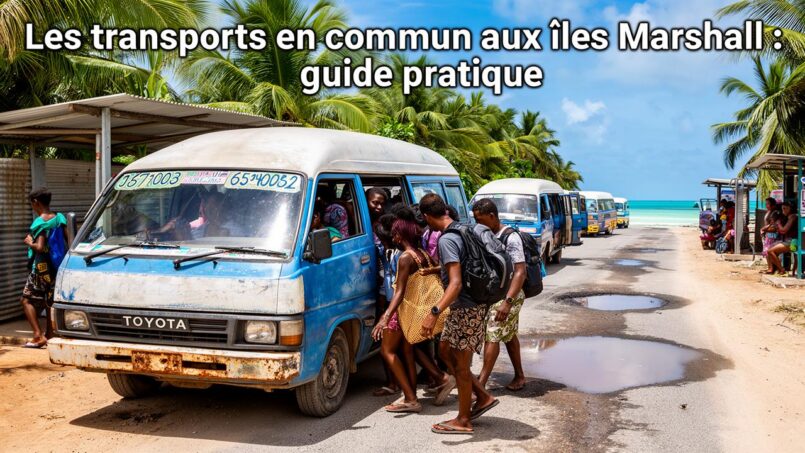
In Majuro, taxis serve as public transport. They operate on a continuous carpooling model: a car goes by, you hail it, you get in with other passengers already on board, and the driver stops as requested along the route.
These taxis are often unmarked private vehicles, sometimes with a simple “taxi” sign on the dashboard. To catch one, simply stand at the side of the main road and wave. Marshallese people typically indicate the number of seats needed by showing the corresponding number of fingers. When a driver flashes their lights or blinks as they pass, it usually means they are already full.
Fares are not officially regulated by the state, but in practice they follow fairly stable ranges depending on distance. The amount is calculated and paid per person, not per trip. Thus, a taxi can pick up and drop off several customers during the same route if their destinations partially overlap.
Here is a summary of the main price ranges observed in the capital:
| Typical Route in Majuro | Indicative Fare per Person (USD) |
|---|---|
| Short trips in the D-U-D area | 0.75 – 1.50 |
| Downtown / Rita area – bridge | ~2 |
| Trip crossing the bridge (depending on distance) | 3 – 5 |
| Short intra-urban trips (other sources) | 1 – 4 |
| Airport → downtown or hotel | 5 – 20 (often ~10–15) |
| DUD → more remote areas | 10 – 15 |
| Trip to Laura | 20 to 35 and up |
The differences in estimates come from the unregulated nature of the system, the exact pick-up/drop-off point, and sometimes the fact that some drivers take advantage of visitors’ unfamiliarity. It is therefore recommended to ask the price before getting in, especially for longer distances (airport, Laura, etc.).
For very short routes in the dense Djarrit–Uliga–Delap area, the taxi is extremely economical: less than a dollar per person most of the time. For long segments like Laura, the bill quickly adds up and becomes less competitive than a bus or rental car.
Majuro taxis are described as generally reliable, but several sources mention incidents of sexual harassment targeting women, either from drivers or other passengers. Authorities and international recommendations advise women and teenage girls to avoid shared taxi rides at night whenever possible, especially alone, and to prefer being dropped off directly in front of their accommodation.
Some useful reflexes:
For safer taxi rides, it is recommended to sit in the back rather than the front of the vehicle. Avoid very crowded taxis after dark. Prefer traveling in groups when possible. If you feel uncomfortable during the ride, immediately ask the driver to let you out.
Minibuses and Informal “Buses”: Cheap but Unpredictable
Alongside taxis, Majuro has an informal network of minibuses that, for the most part, run along the same main artery. They serve markets, schools, and a few major points of interest, stopping on demand. There are no actual designated stops or official schedules; the only rule is that they always come by eventually… at some point.
Fares are low, around $1 to $2 depending on distance traveled. On the flip side, comfort and punctuality leave much to be desired. Minibuses can be full during peak hours, and waiting times vary.
The Majuro–Laura Shuttle: The Near-“Official” Exception
A more structured bus service connects central Majuro to the Laura area, located at the western end of the atoll. It has been described several times as a shuttle departing from the Robert Reimers Hotel (RRE) parking lot, with a ride to Laura Beach Park.
Although not all sources agree on the exact frequency, several elements converge:
| Feature | Detail |
|---|---|
| Main departure point | Robert Reimers Hotel (RRE) parking lot |
| Western end terminus | Laura area / Laura Beach Park |
| Indicated frequency | About 1 departure per hour, sometimes every 2 hours |
| Days of service | Generally 6 days/week (no service on Sunday) |
| Fare per trip | $2 to $2.50 one way |
| Nature of service | Little real regularity, approximate schedule |
For residents, this bus is an affordable way to avoid a taxi for long distances. For visitors wanting to go to Laura Beach, the bus is a financially attractive alternative, as a taxi ride can cost between $16 and $40 round trip, depending on reports and the driver’s willingness to negotiate.
Renting a Car, Scooter, or Bicycle in Majuro
For those who prefer not to rely on random schedules, vehicle rental remains the most flexible option. There are no major international chains; all agencies are local, often linked to hotels or family businesses. You can rent:
Discover our wide range of vehicles, from family models to two-wheelers, to meet all your mobility needs.
Enjoy the comfort and reliability of Japanese sedans, known for their advanced technology and low fuel consumption.
Ideal for families or groups, the minivan offers generous and versatile space for all your trips.
A rugged utility vehicle perfect for work, leisure, or off-road adventures with its large load capacity.
For agile and dynamic mobility in the city or on the road, choose from our selection of motorized two-wheelers.
Opt for an eco-friendly, economical, and health-friendly mode of transport with our bicycles for all uses.
Daily rates are mostly between $60 and $100 for a car, with variations depending on the type of vehicle and the agency. It is advisable to clearly check whether insurance is included, as this is not automatic. Some known rental agencies are associated with hotels like the Marshall Islands Resort or with companies such as G & L Rental Cars, DAR Car Rentals, or Majuro Motors, reachable by phone or email.
Driving is on the right, and a valid national driver’s license is sufficient for a short stay. Road conditions are generally acceptable on the main section, but the pavement is sometimes deteriorated and nighttime lighting is poor. The speed limit is 25 mph, which, combined with light traffic, makes driving fairly relaxed, provided you watch out for animals and pedestrians who may appear on the road.
Getting Around Ebeye: Walking, Biking, Taxis, and Ferries
Ebeye, in Kwajalein Atoll, is one of the most densely populated islands in the Pacific. The land area is tiny and heavily populated, which strongly determines the modes of travel.
Walking and Biking: Kings of Daily Life
On Ebeye, most trips are made simply on foot. The island is compact, distances are short, and roads are limited. Bicycles are the other major star, especially among men and boys. Bicycle rental points are available at modest rates, often by the day.
An important cultural element comes into play here: women are generally not allowed to wear pants or shorts in public, which makes biking poorly compatible with female dress codes. The majority of cyclists are therefore male. For visitors, respecting local modesty rules is strongly advised, notably by wearing clothing that covers the shoulders and knees.
Motorcycle Rental and Motorized Traffic
A few motorcycles or scooters can also be rented on the island, but the small size of the island limits the interest of this type of vehicle to specific uses. With few roads, the need for motorization is much lower than in Majuro.
Local Taxis: Pickups and Dollar Rides
To complement walking and biking, Ebeye has shared taxis. These are most often converted pickup trucks, equipped with benches in the back. These vehicles loop around the island and operate like open minibuses. Passengers get on and off on demand, paying a small fee per trip.
The cost in dollars of a standard trip on Ebeye, a very low fare with no pass or electronic ticketing system.
This type of taxi completely replaces buses, which do not exist on the island. No trains, obviously, are present on Ebeye, and the narrowness of the roads mechanically limits traffic volume.
Road Link to Neighboring Islands: The Ebeye Causeway
North of Ebeye lies a causeway connecting several islets: Loi, Shell, and Gugeegue. This road, completed in the early 1990s, forms an inhabited chain about 10 kilometers long. Taxis from Ebeye can use this road link to serve these neighboring islands, with an additional fare accordingly.
Passage via the Kwajalein causeway may require presenting an ID due to the U.S. military presence and specific access rules in effect in the area.
Infrastructure and Daily Life on Ebeye: Impact on Getting Around
Daily movement on Ebeye is also influenced by the state of its infrastructure. Electricity supply is described as unreliable, with outages that can last several days. Tap water is not recommended for drinking, and internet access, notably via the Unifi wifi service from the National Telecommunications Authority (NTA), is said to be fast but expensive.
NTA offers the sale of phones and prepaid SIM cards for local calls. However, international roaming and international mobile data are not available. Visitors will therefore generally need to purchase a local SIM or use paid wifi. This information is crucial for planning your travels, for example to check ferry schedules or contact a driver.
On the island, the main practical landmarks are clustered around the ferry terminal: the Ebeye Hotel (the island’s only hotel, about a hundred meters south) and La bojie café (about 200 meters north). Accommodation rates – around $110 per night, payable in cash, with a key deposit – reflect the scarcity of supply. There is also a JJJ shopping center where simple snacks can be prepared, a restaurant at the hotel, and a health center.
Peak hours on the island are similar to many places around the world: between 7 a.m. and 9 a.m. in the morning, then between 5 p.m. and 7 p.m. in the late afternoon. Outside these times, traffic is smoother and taxis are more readily available.
Kwajalein, Ebeye, and the Ferry: A Vital Link
Kwajalein Atoll is a strategic hub for the Marshall Islands, both for aviation and maritime travel. It is also marked by the U.S. military presence, which restricts certain access.
Arriving in the Atoll by Plane: Bucholz Army Airfield (KWA)
Ebeye does not have an airport. The aerial entry point to the atoll is Bucholz Army Airfield, on Kwajalein Island, served primarily by United Airlines via its famous “Island Hopper” flight. This flight connects Honolulu to Guam with several stops, including Majuro and Kwajalein. The Honolulu–Kwajalein leg, with a stop in Majuro, takes about seven hours.
Round-trip tickets are well over $1,400, confirming the high cost of air travel in the region. Air Marshall Islands also operates from this airfield, with flights to many atolls in the country. Virtually all foreign visitors heading to Ebeye arrive via this military airfield.
Access to Kwajalein Island itself, however, is controlled: only U.S. military personnel, civilian contractors, and their dependents are allowed. Civilian passengers in transit are routed without staying on the island, to the ferry bound for Ebeye.
Transit Procedure: From Tarmac to Boat
Upon arrival at Bucholz Army Airfield, travelers must undergo a security check conducted by U.S. authorities. Depending on nationality, a visa and/or special permits may be required just for transit to Ebeye. Once this screening is completed, a transport van gathers passengers destined for Ebeye and takes them to the ferry dock.
It is strongly recommended to inquire in advance about visa and document requirements, as failure to do so may result in being denied boarding before the trip.
The Kwajalein–Ebeye Ferry: An Essential “Maritime Bus”
The link between Kwajalein and Ebeye relies on a ferry service essential to the economic and social life of the atoll. Two types of connections coexist:
– a free ferry operated by the U.S. Army for employees and authorized persons
– a paid ferry service, used by other passengers
The main characteristics are as follows:
| Feature | Detail |
|---|---|
| Crossing time | About 20 to 30 minutes |
| Fare (paid ferry) | About $5 to $10 per trip |
| Free U.S. Army ferry | Reserved for employees and authorized travelers |
| Frequency (U.S. Army ferry) | About 10 rotations/day, 6 days/week |
| Main schedule | Very early morning and late afternoon |
| Main users (U.S. ferry) | About 900 Marshallese working on Kwajalein |
For the many residents of Ebeye employed on Kwajalein, this ferry acts as commuter transport similar to a commuter train or suburban rail departing from a big city, but by sea.
For air travel, allow a significant gap between ferry schedules and flight times. It is often necessary to take a ferry well before takeoff, sometimes very early in the morning, to arrive at the airport on time.
Internal Travel on Kwajalein
Kwajalein has neither taxis nor standard car rental for the general public. Walking or biking is encouraged, within a highly regulated framework related to the military use of the island. “Quality of Life” vehicles can be rented by local residents, but this option is not available to transient tourists.
From Ebeye, some sources mention the possibility of renting a car from agencies like Ebeye Car Rentals to drive on Kwajalein, with daily rates between $40 and $80. The trip via the causeway then takes about fifteen minutes. However, given the access restrictions to Kwajalein, this information must absolutely be confirmed with the relevant authorities or a local operator before planning such a trip.
Bicycle rental shops exist on Kwajalein, with rates around $10 per day, which remains the simplest way to get around locally, provided, of course, you are authorized to be there.
Traveling Between Atolls: Scarce Planes, Irregular Boats
Beyond Majuro and Kwajalein Atoll, transport relies almost entirely on maritime links and sparse domestic flights. The remoteness, low population density, and fragile infrastructure make organizing these trips tricky.
Air Marshall Islands: A Fragile Air Network
The national airline Air Marshall Islands serves a good portion of the inhabited atolls, from Majuro and Kwajalein. It notably provides connections, often weekly, to islands like Jaluit, Enewetak, Kili, Ebon, or Bikini, when they are open to visitors.
But flights are:
– infrequent
– expensive (generally between $100 and $300 per one-way ticket, depending on destination)
– prone to cancellations or delays due to weather, maintenance, or runway work
The unofficial nickname “Air Maybe” given by some travelers illustrates this uncertainty well. Before any plan to visit a remote atoll, it is imperative to:
– book in advance
– reconfirm flights by phone a few days before departure
– have a Plan B, or even allow several days of margin in your itinerary
In the atolls, runways are generally short, unpaved, and vulnerable to flooding due to low altitude and exposure to weather. To address this, projects funded by the Asian Development Bank have been implemented. These projects specifically aim to lengthen these runways, strengthen their structure for better resistance, and improve overall aviation safety conditions in these sensitive environments.
Public Boats, Inter-Atoll Ferries, and Charters
Maritime transport is the true backbone of the country. Several players are involved:
– the Marshall Islands Shipping Corporation (MISC), overseen by the Ministry of Transport and Communications
– government vessels known as “field trip ships”
– a few regular ferries on certain routes
– private boats and charters for groups or tourism activities
The “field trip ships” are state-owned boats that serve the outer islands, carrying passengers, food, equipment, and especially copra, a key product of the local economy. They mainly depart from Majuro, from the Uliga dock, and tour several atolls according to planned but rarely strictly adhered-to itineraries.
Schedules are described as “regular but irregular”: in theory, a schedule exists; in practice, it is subject to weather, vessel condition, and logistical needs. It is not uncommon to find yourself stranded on an atoll for several days or weeks longer than planned while waiting for the next passage.
The minimum price in dollars for an inter-atoll ferry link in the Maldives. (Note: This seems a confused line; in the original it was “Maldives” but context is Marshall Islands. Probably a translation error in the original? I’ll keep as is: the original French says “Maldives” incorrectly; but since we need to translate exactly, I’ll keep the same text. Actually the original French has “Maldives” but the context is about Marshall Islands. It might be a mistake. I’ll translate as is: “The minimum price in dollars for an inter-atoll ferry link in the Maldives.” But to be faithful, I’ll put exactly what the French says. The French: “Le prix minimum en dollars pour une liaison en ferry inter-atolls aux Maldives.” So it’s about Maldives, not Marshall Islands? That seems like an error in the original. I’ll keep it exactly.)
Example of a Regular Service: Majuro–Arno
Arno Atoll benefits from a slightly more reliable service than other atolls, with a public boat connecting Majuro several times a week. The most frequently described pattern is as follows:
| Majuro–Arno Maritime Link | Detail |
|---|---|
| Departure port (Majuro) | Dock near the Robert Reimers Hotel |
| Usual departure days | Monday, Wednesday, Friday |
| Approximate departure time | Around 10 a.m. |
| Crossing duration | About 1 hour |
| One-way fare for tourists | About $15 USD |
| Type of passengers | Arno residents + visitors |
For the residents of Arno, this boat is a true public service, indispensable for supplies, medical care, or education. For visitors, it offers an authentic excursion to a nearby atoll that is less urbanized than Majuro.
Dangerous Seas and Imperative Planning
Traveling by boat in the Marshall Islands is not trivial. The period roughly from December to April is marked by stronger currents and risks of significant swell. Storms or storm surges can make certain crossings hazardous or even impossible. Additionally, many reef passes are shallow, poorly marked, and difficult to negotiate, especially at night.
Before embarking, it is advisable: to check that you have all necessary documents, such as your ticket and ID.
– to inquire about sea conditions and weather forecasts
– to check the reputation and equipment of the boat (life jackets, radio, etc.)
– to bring enough water, food, and sun protection
– to anticipate the possibility of being stranded longer than expected
Accessibility and People with Disabilities
The Marshall Islands, like many small island developing states, have a significant gap in terms of accessibility. Transportation infrastructure is not designed to easily accommodate people with reduced mobility or other disabilities.
Taxis lack specific equipment (ramp, wheelchair tie-downs, etc.), buses are often cramped, and sidewalks are virtually nonexistent. Few buildings, including public ones, have ramps or working elevators. Even hospitals can present notable obstacles.
A free, accessible bus funded by an Asian Development Bank COVID-19 assistance grant and managed by MIDPO is currently the only truly accessible transport in the Marshall Islands. It transports people with disabilities to essential services, medical appointments (including cancer screenings for women), and community activities. Fuel is provided by a disability organization, but this service only covers part of the need.
A new building code recently introduced includes accessibility standards for new constructions, which should eventually improve the situation, but the effects will be slow. For now, a traveler with specific needs must exercise a great deal of preparation and patience, inquiring in advance with local authorities, NGOs, and their accommodation.
Practical Tips for Using Transport in the Marshall Islands
In the absence of a structured “system” of public transport, the key to getting around smoothly in the Marshall Islands lies in a few simple principles.
First, accept the unexpected: canceled domestic flights, delayed boats, buses that don’t come at the announced time. It is wise to allow generous margins between connections, especially when an international flight is involved.
Second, prioritize local sources of information: the Marshall Islands Visitors Authority (reachable at +692 625 6482), hotels, rental agencies, and residents are often more aware of actually observed schedules than websites, which are sometimes outdated.
On Majuro Atoll, prioritize shared taxis for short trips, buses or minibuses for destinations like Laura, and renting a car for a full day of exploration. On Ebeye Island, daily travel is effectively done on foot, by bicycle, or using pickup taxis, paying particular attention to peak hours to avoid congestion.
Finally, don’t forget the overall safety context: even though the country is far from dangerous, the lack of sidewalks, limited lighting, the frequency of drunk driving, and weak regulation of services require a certain caution. For emergencies, police, fire, and medical service numbers should be kept handy, and it is sometimes more effective to take a taxi directly to the hospital than to wait for a poorly equipped ambulance.
The transport network is rudimentary and is an integral part of the experience. It relies on shared taxis in Majuro, pickups in Ebeye, ferries in Kwajalein, and a fragile network of domestic flights and public boats. Travel is slow, subject to tides and wind, reminding us that this is above all an ocean country.
Disclaimer: The information provided on this website is for informational purposes only and does not constitute financial, legal, or professional advice. We encourage you to consult qualified experts before making any investment, real estate, or expatriation decisions. Although we strive to maintain up-to-date and accurate information, we do not guarantee the completeness, accuracy, or timeliness of the proposed content. As investment and expatriation involve risks, we disclaim any liability for potential losses or damages arising from the use of this site. Your use of this site confirms your acceptance of these terms and your understanding of the associated risks.

Cyril Jarnias is an independent expert in international wealth management with over 20 years of experience. As an expatriate himself, he is dedicated to helping individuals and business leaders build, protect, and pass on their wealth with complete peace of mind.
On his website, cyriljarnias.com, he shares his expertise on international real estate, offshore company formation, and expatriation.
Thanks to his expertise, he offers sound advice to optimize his clients' wealth management. Cyril Jarnias is also recognized for his appearances in many prestigious media outlets such as BFM Business, les Français de l’étranger, Le Figaro, Les Echos, and Mieux vivre votre argent, where he shares his knowledge and know-how in wealth management.





