
 Published on and written by Cyril Jarnias
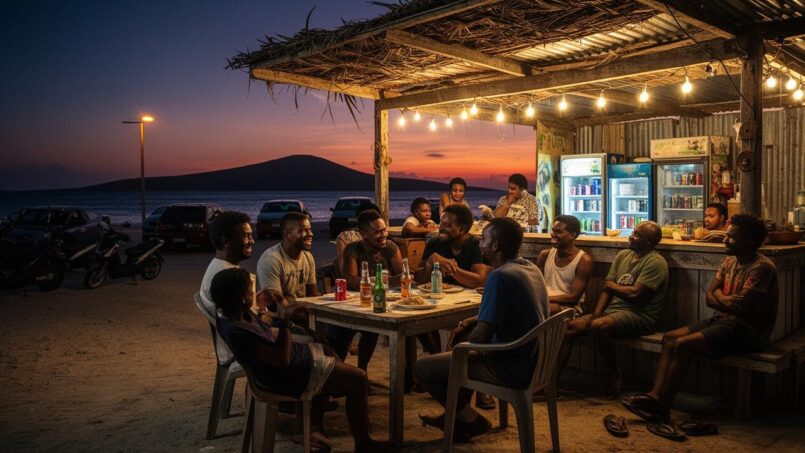
Nauru is nothing like a “Pacific Ibiza.” With barely 10,000 inhabitants, a handful of bars, and minimalist tourist infrastructure, its nightlife is the polar opposite of major beach resort capitals. Yet, once the heat of the day subsides, the island comes alive in its own way: around hotel bars, restaurants run by expats, village parties, major national festivals, and family gatherings that stretch late into the night.
In Nauru, nightlife is characterized by get-togethers, conversations, music, and shared meals, rather than a lively club scene. It’s a unique opportunity to immerse yourself in a very tight-knit island society, where personal relationships are everywhere and you are quickly recognized and included.
Understanding the spirit of nights out in Nauru
Before listing the few spots where you can grab a drink or listen to music, you need to grasp the local context. Nighttime in Nauru is first and foremost social and family-oriented. Nauruans love getting together to eat, chat, watch a game on TV, sing, or dance during major national holidays. Bars play a role, but they are only one piece of the puzzle.
The sale of alcohol is prohibited on Sundays, religious days, and public holidays. Modest dress and respectful behavior are expected. Overt displays of affection, especially between same-sex individuals, should be avoided.
Moreover, authorities have previously issued decrees banning, in certain contexts, gatherings of three or more people, consumption of alcohol in bars or food in restaurants. These measures are not the everyday norm, but they serve as a reminder that the country is not afraid to strictly regulate social life when it deems necessary.
Despite this framework, the general atmosphere remains surprisingly relaxed. Crime is low, the population is welcoming, and nights out revolve more around conviviality than excess. In Nauru, going out at night means seeking an ambiance, more than an accumulation of addresses.
Menen Hotel: the beating heart of the night
The true epicenter of nightlife in Nauru is found in a single complex: the Menen Hotel, sometimes spelled Menem or Meneng. This modern hotel, situated on the waterfront at Anibare, concentrates a good portion of what resembles a nightlife scene: bar, “nightclub,” restaurant, pool, occasionally karaoke, and memorable New Year’s Eve parties.
It’s also where you’ll find the two most established bars in the country, often described as the only true drinking spots: Reef Bar and K‑Bar. For a traveler arriving with the question, “Where do I go out tonight?” the answer is essentially one name: Menen Hotel.
Reef Bar: Nauru’s “nightclub”
Located on the ground floor, in the lobby of the Menen Hotel, Reef Bar is both a hotel bar, a weekend club, and a true social hub. This is where residents, expats, Australian workers or passing islanders, officials, and travelers curious to see how one parties in one of the world’s least visited countries all converge.
The place isn’t huge or flashy, but it ticks the essential boxes: continuous music, satellite TV screens, pool tables, a decent selection of spirits and imported beers, mainly from Australia. Music is present even on quieter weekday evenings, avoiding the waiting-room atmosphere that some island hotel bars are known for.
One detail often surprises visitors: the dress code. Men must wear a collared shirt, and flip-flops are not allowed. In a country where you generally spend the day in shorts and a light t-shirt, this requires a bit of planning. Showing up in a tank top and sandals will likely get you politely turned away.
The highlight of the week is Friday night. This day often coincides with payday for many Nauruans, and Reef Bar becomes the natural gathering spot to celebrate the end of the week. The bar stays open later than usual, until about 1 a.m., and the atmosphere gradually thickens as the evening progresses. Regulars advise arriving early that night to be sure to get a table, especially if you’re traveling in a group.
A bar, its customs: a few practical pointers
Reef Bar functions a bit like an upscale neighborhood club. People come here to:
– watch a match on the satellite screens,
– play pool with colleagues,
– chat with traveling strangers,
– listen to music and sometimes sing during occasional karaoke nights,
– extend a dinner eaten elsewhere.
A few local habits are worth adopting. Striking up a conversation with Nauruan customers is not at all inappropriate; on the contrary, visitors are encouraged to talk, ask for tips about the island, and listen to stories of fishing or sports competitions. It’s often at the Reef Bar counter that you pick up the best anecdotes and tips for the next day.
Bars mainly offer tropical-inspired cocktails and international classics. So-called “local” versions are often creations made from imported ingredients, adapted to residents’ tastes. Although not very sophisticated, they provide an authentic experience of Nauruan nightlife.
Aiming for “happy hour” — when it’s in effect — is a good reflex, because imported alcohol on a remote island is never cheap. Also keep an eye out for announced evenings with live music or karaoke: they give Reef Bar the feel of a small community club where people sing louder than they drink.
K‑Bar: the bar with an ocean view
Upstairs at the Menen Hotel, K‑Bar plays a slightly different tune. People don’t come here just to party, but also for the view: large windows open onto the Pacific Ocean, unobstructed horizon, and a more airy atmosphere. Located on the level of the upper rooms, this bar overlooks Anibare Bay and offers one of the best panoramas for a drink at sunset.
Less of a “nightclub” than Reef Bar, K‑Bar is more like a hotel lounge with a stunning view. It’s the ideal spot to:
– start the evening with an aperitif while watching the waves,
– have a quiet chat away from the louder music downstairs,
– meet some hotel regulars or expats who prefer this more relaxed atmosphere.
A bar’s drink menu is standard (imported beers, international spirits, a few cocktails). Its main draw is its exceptional setting: views of the distant reef break, sometimes a blazing sky at sunset, giving the unique feeling of being literally at the edge of the world.
Menen Hotel: a laboratory of the Nauruan night
Beyond its two bars, the Menen Hotel serves as the backdrop for a good part of the major highlights of contemporary nightlife on the island. New Year’s Eve, for example, often plays out here: countdown by the pool, guests jumping in fully clothed after midnight, groups extending the night by moving from one private party to another.
The hotel also plays a key role in the practical daily routine of nights out. It houses the only ATM on the island, often running low on cash, which forces foresighted travelers to arrive with enough Australian dollars for the entire stay. It’s also a landmark for the few taxis and for private buses you can rent with a driver.
In a country where so many things happen on a small scale, a single establishment can concentrate the role of club, neighborhood bar, official meeting place, and backdrop of modern sociability. The Menen Hotel assumes this role without pretending to be a luxury resort, and it’s precisely this mix of simplicity and centrality that gives Nauruan nightlife its character.
Beyond Menen: restaurants, bars, and evening hangouts
Even though many observers reduce Nauru’s nightlife to Reef Bar, the reality is a bit more nuanced. The island has other places where you can dine late, have a drink, listen to music, or simply enjoy a lively atmosphere.
The landscape remains modest: four establishments are generally considered “real” bars (Menen Hotel, Bayview, Jules on Deck, Od’n Aiwo), along with restaurants and a few kava bars. The majority of eateries serve Chinese cuisine, with about a hundred such restaurants for only two truly Westernized addresses.
To navigate this well, it helps to distinguish between actual bars and restaurants that serve alcohol and can make pleasant evening stops.
Bayview Bar and Restaurant: the safe bet for dinner and drinks
Considered by many visitors to be the best restaurant and bar on the island, Bayview Bar and Restaurant holds a special place in Nauruan social life. Located at Anibare Bay, not far from the Menen Hotel (walkable), it combines three assets: varied Western-inspired cuisine, a real cocktail menu, and a friendly atmosphere that attracts both expats and locals.
The menu stands out in a landscape overwhelmingly dominated by woks and cheap Chinese dishes. Burgers, pizzas, sandwiches, curries, tartares or raw tuna preparations, homemade desserts: the offering is a clear departure from the island’s standard restaurants. Prices remain reasonable, around ten US dollars for a main course, making it a possible choice for both a slightly upscale dinner and a weekday meal.
On the drinks side, Bayview boasts the most extensive cocktail list in the country. You’ll find both “tropical island” blends and classics like Long Island Iced Tea. The wine list is surprisingly extensive for such an isolated island, and they serve beers like Anchor, as well as sweet alcoholic vodka “coolers.”
The Bayview restaurant is designed to offer a pleasant experience, whether you’re in a group or as a couple, thanks to its layout and ambiance.
The first of three main areas, it welcomes guests upon arrival.
The heart of the restaurant, offering a relaxed ambiance with dim lighting.
The third zone, perfect for extending dinner with a few drinks late in the evening.
In practice, many expats have adopted Bayview as their “neighborhood bar.” They meet up after work, sometimes watch a game, celebrate a birthday. For a visitor wanting to meet this small foreign community settled in Nauru, it’s often the most effective address.
Jules on Deck: the local bar geared toward sunset
Jules on Deck holds a unique place. Located beachside in the Nibok district, about a ten-minute drive from the Menen Hotel, this bar is homegrown: it’s the only truly Nauruan establishment among the quartet of listed bars. Its reputation is built on three simple ingredients: a spectacular view at sunset, a relaxed atmosphere with occasional live music, and a house cocktail called “Nauru Sunset.”
For a time, Jules on Deck was considered the best bar in the country: people came to hear local bands, toast among expats, refugees, and residents, and stretch the evening late into the night. Since then, the situation has evolved. The bar tends to open irregularly, mainly for private events or certain weekends, and it doesn’t serve food.
This makes a visit a bit more hit-or-miss, but no less interesting. When Jules on Deck is open, the scene has something very island-like: plastic chairs, cold beers, live music some evenings, families stopping by to say hello, sunset over the sea. Far from the urban club model, it’s the kind of place to end a day of beach or diving, drink in hand, watching the light fade.
To find out the opening hours of Jules on Deck bar, it’s recommended to ask directly at the Menen Hotel or from locals. The establishment offers an authentic and very local experience, illustrating how nightlife in Nauru remains a matter of small circles of insiders rather than an established commercial offering.
Od’n Aiwo Hotel Bar: the downtown bar with pokies
The third player in the small nightlife scene, the bar at the Od’n Aiwo Hotel leans more toward a central pub atmosphere, frequented by workers and some expats. Located in the Aiwo district, in the heart of the island, the hotel itself is known for being more budget-friendly than the Menen and its very central location.
The bar, however, carries a less flattering reputation: it’s often described as the least pleasant of the quartet, with a sometimes gloomy atmosphere, an inconsistent beer supply, and a decor dominated by slot machines (“pokies”), which seem to be the real reason for the place. There’s also a pool table and the option to order a Jägermeister or a beer when supplies allow.
This somewhat bleak picture doesn’t stop the Od’n Aiwo bar from playing a role in certain nights out, especially as part of the famous “pub crawl” that involves touring the island’s bars in one night. Starting here with a beer and a game of pool, before heading to the better views at Jules on Deck and then to Bayview’s kitchen, is among the itineraries described by regulars.
The hotel also houses a renowned Chinese restaurant, particularly for a coconut tuna dish that leaves an impression. For a simple dinner followed by a drink in a rawer atmosphere, it’s an option to consider, especially if you’re already staying in the area.
Kava bars and grog bars: another way to drink at night
Alongside these “classic” bars, Nauru has seen a few establishments specializing in kava — that traditional Pacific drink, with an earthy taste and a mildly sedative effect. A “yellow bar” presented as a kava bar and LGBTQ+ friendly was, for a time, part of some partygoers’ circuit.
These establishments do not serve alcohol but offer bowls of kava, a traditional beverage, in an informal setting. The experience, similar to that in Fiji or Vanuatu, centers on conversation and a slow pace, offering a social ritual distinct from seeking intoxication.
In other districts, places like AIA Grog Bar or Angel Grog Bar are mentioned, but their status fluctuates between real bars, corner stores selling alcohol, and hybrid venues. Again, the best strategy is to chat with locals or your accommodation to know which places are active during your visit.
Restaurants open in the evening and the “after-dinner” vibe
The vast majority of establishments in Nauru serve fairly standardized Chinese cuisine: rice, noodles, sautéed meat, vegetables in sauce. Many also offer beer, rum, or some imported spirits. Even if these tables aren’t technically bars, they are part of the evening life: you dine around 7–8 p.m., talk at length, sometimes listen to music.
Two restaurants stand out as exceptions, however, because they clearly rise above the rest:
– Bayview Bar and Restaurant, already mentioned, for its eclectic cuisine and cocktail menu;
– Anibare Boat Harbour Restaurant, located within the Menen Hotel, serving both Chinese dishes and simple Western fare (burgers, fish-based dishes), with the option to order a rum and coke.
Another restaurant in Anibare, sometimes simply called Anabare Restaurant, has a decent reputation for its Western dishes and drinks, placing it at the border between restaurant and bar. Again, it’s a very casual setting, better suited for a long dinner than a “night out” in the festive sense of the term.
To give an overview, here is a table of some key spots related to nights out in Nauru, as compiled from various accounts:
| Place | Type | Location | Main nighttime features |
|---|---|---|---|
| Reef Bar (Menen Hotel) | Bar / nightclub | Anibare (lobby) | Music, pool, satellite TV, very lively on Fridays |
| K‑Bar (Menen Hotel) | Lounge bar | Anibare (upper floor) | Pacific view, calmer atmosphere |
| Bayview Bar and Restaurant | Bar-restaurant | Anibare Bay | Best Western cuisine, varied cocktails |
| Jules on Deck | Local bar | Nibok (beachfront) | Stunning sunsets, “Nauru Sunset” cocktail |
| Od’n Aiwo Hotel Bar | Bar / pokies | Aiwo (center) | Slot machines, darker atmosphere |
| Kava Bar (“yellow bar”) | Kava bar | Not specified | Kava, LGBTQ+ friendly vibe, no beer |
| Anibare Boat Harbour Restaurant | Restaurant-bar | Menen Hotel, Anibare | Chinese and Western dishes, alcoholic drinks |
Festivals, parties, and community gatherings
Limiting Nauruan nightlife to its bars would miss what gives themost depth to evenings: major national holidays, fishing tournaments, religious celebrations, and family gatherings where people dance, sing, and eat very late.
Key dates that transform the night
Several days mark the calendar and give rise to celebrations that extend after dark.
Independence Day, celebrated on January 31, commemorates independence gained in 1968. The day starts with official ceremonies, speeches, parades, and sports competitions. As the sun goes down, festivities move to villages, with concerts, traditional dances, and large community meals. Fireworks often mark the evening, adding a luminous dimension to these gatherings.
The same day also corresponds to Nauru Day, another major celebration of national identity. Again, dances, songs, and communal meals take center stage. Specialties like Coconut Fish, Ibeon Heaping (a sweet coconut preparation), or other fish and taro dishes fill the buffets, and people eat as much as they talk.
Another highlight, Angam Day, scheduled in the fall, commemorates the demographic survival of the Nauruan people after a period when the population had fallen below 1,500. Festivities include dances like the Bwiama, speeches, and sometimes historical reenactments. Many of these events take place in the late afternoon and continue into the evening: vigils, elders’ stories, group singing.
Constitution Day, in mid-May, adds its parade of friendly competitions: boat races, tug-of-war games, cultural shows, often extending after sunset. Flags are raised in the morning, but conversations and music continue well beyond.
Besides the major national dates, Nauru celebrates National Youth Day, focused on young people’s artistic performances. Events like the Ewa Island fishing tournament in November are also organized, accompanied by food stalls offering local specialties such as Chili Tuna or Stuffed Garfish. Religious holidays like Christmas and New Year’s are also important celebrations.
Christmas, New Year’s, and festive nights
Christmas celebrations revolve around religious services (especially midnight mass on December 24), family meals, and gift exchanges. December 25 is spent with family, around abundant tables: roasted meats, fish, pork wrapped in banana leaves, tropical fruit desserts. Evenings are often quieter in public, but very intense in homes.
New Year’s Eve, on the other hand, lights up the public space more. Fireworks illuminate the coast, particularly on the western side of the island, known for the best views of the displays. At hotels like the Menen, a countdown is held by the pool; some end up jumping in fully clothed, others then head off to join neighborhood parties. According to some accounts, Nauruans like to stretch these festivities through January 2, moving from one meal and party to another.
Instead of paying an entrance fee to a nightclub, nightlife here manifests through spontaneous invitations to share a meal, like a dish of bake (fish cooked in leaves) or babai pudding (made from taro and coconut milk), within a tight social network.
Music, dances, and cultural nights
In these gatherings, music plays an essential role. You’ll hear both traditional songs and more contemporary interpretations. Instruments used include drums, ukuleles, bamboo idiophones, and guitar. Dance is never far behind: Nauruan Haka, frigate dance, dogoropa, or Bwiama follow one another depending on the context.
More targeted festivals, like the Micronesia Musical Festival, add another layer by inviting artists from various neighboring archipelagos (Kiribati, Marshall Islands, Federated States of Micronesia, etc.). Karaoke competitions, concerts, regional TV broadcasts: Nauru then opens up to Pacific rhythms, and the night takes on the air of a big regional show.
These events remain occasional, but they show one thing: when the island vibrates, it first does so to the sound of songs and dances, rather than to the beat of electronic bass.
Nightlife, culture, and hospitality: how to behave
In such a compact environment, any jarring behavior is quickly noticed. Respecting a few unwritten rules improves both the quality of the experience and your relationship with locals.
Dressing modestly is a first reflex, even in the evening. Shorts and t-shirts are acceptable in most contexts, but too much nudity or very revealing clothing can be shocking, especially during religious or community events. At Reef Bar, men must at least wear a collared shirt, otherwise entry will be refused.
The sale of alcohol is prohibited on Sundays and public holidays. Checks are frequent, and penalties for possession of illicit drugs are severe. Authorities may also temporarily ban festive gatherings or public consumption for health or security reasons.
Taking photos of people during parties or at the bar should be done with tact: asking for permission remains the best way not to offend. In general, Nauru values respect for elders, discretion, and a form of public modesty.
That said, Nauruans are often curious about foreigners and happy to share traditions, recipes, family stories. Accepting a shared plate, listening to elders’ tales, taking an interest in songs and dances is worth more than any travel guide.
Building a typical night out in Nauru
For a visitor staying a few days, piecing all these elements together can seem abstract. Concretely, a typical evening might look like this:
First, meet the island quietly in the late afternoon: a walk along Anibare Bay, a swim before sunset, a visit to a viewpoint like Command Ridge or Buada Lagoon. Once the heat subsides, head to Bayview Bar and Restaurant for a dinner that breaks away from the endless fried rice: a burger, raw tuna dish, pizza, curry, washed down with a house cocktail or a local beer.
The conversation stretches over a drink until closing time. If you’re in a “lounge” mood, you can then head back to K‑Bar to finish the night facing the ocean. If instead you want to see what “partying” in Nauru means, head back down to Reef Bar, especially on a Friday night, when the place is hopping. Over conversations, you trade stories with Nauruans, foreign workers, maybe artists who will perform at the next festival.
Another night, try to catch Jules on Deck at sunset, if the bar is open, to discover another face of the night: that of a local bar, designed for residents first. Or let yourself be swept into an invitation to join a village party during a national holiday or a fishing tournament.
Nauru by night: a human-scale laboratory
The peculiarity of nightlife in Nauru lies less in the abundance of places than in their rarity, and the outsized role each address plays. Reef Bar is not just a hotel bar; it’s a mirror where the multiple facets of a changing micro-society meet. Bayview is not just a restaurant; it’s the common table of an expat community and a local middle class seeking novelty. Jules on Deck cannot be reduced to its opening hours; it embodies the possibility of a truly Nauruan bar facing the sea.
Major national holidays, Christmas or New Year’s vigils, regional festivals temporarily transform the island into a livelier night scene, with fireworks, songs, dances, and banquets. But the rest of the time, the Nauruan night remains modest, almost secretive. By taking part, even briefly, you discover another way to “go out”: less about constant spectacle, more anchored in relationships, shared food, stories told by the sea.
Description of nightlife in Nauru
For those who can adapt to this pace, nightlife in Nauru ultimately offers what many more famous destinations have lost: the feeling of participating, if only for one evening, in the life of a small island community that continues to gather, night after night, in the same places, around the same tables.
Disclaimer: The information provided on this website is for informational purposes only and does not constitute financial, legal, or professional advice. We encourage you to consult qualified experts before making any investment, real estate, or expatriation decisions. Although we strive to maintain up-to-date and accurate information, we do not guarantee the completeness, accuracy, or timeliness of the proposed content. As investment and expatriation involve risks, we disclaim any liability for potential losses or damages arising from the use of this site. Your use of this site confirms your acceptance of these terms and your understanding of the associated risks.

Cyril Jarnias is an independent expert in international wealth management with over 20 years of experience. As an expatriate himself, he is dedicated to helping individuals and business leaders build, protect, and pass on their wealth with complete peace of mind.
On his website, cyriljarnias.com, he shares his expertise on international real estate, offshore company formation, and expatriation.
Thanks to his expertise, he offers sound advice to optimize his clients' wealth management. Cyril Jarnias is also recognized for his appearances in many prestigious media outlets such as BFM Business, les Français de l’étranger, Le Figaro, Les Echos, and Mieux vivre votre argent, where he shares his knowledge and know-how in wealth management.





