
 Published on and written by Cyril Jarnias
Buying an Apartment in Montenegro is increasingly attracting French nationals, drawn by the Adriatic, still competitive prices, and a purchase process reputed to be simple for foreigners. However, 2026 also marks a significant regulatory turning point, especially for those hoping to obtain a residence permit through their investment.
This guide provides a step-by-step process adapted for a French audience, based on recent market data and Montenegrin law.
Understanding the Legal Framework for French Buyers
For a French national looking to buy an apartment in Montenegro, the first question is often whether there are specific restrictions for foreigners. The good news is that the country remains one of the most open markets in the region.
In practice, a French person can buy, sell, and rent out real estate in Montenegro under conditions very similar to those for a local citizen. There is no quota of condominiums reserved for nationals, nor a minimum price threshold for simply buying an apartment for residential or rental purposes.
However, certain types of land and zones remain inaccessible to foreign individuals, and the rules become stricter when it comes to residence or tax optimization.
Property Rights for Foreigners
A French national can acquire full ownership of a wide range of properties:
– apartments
– houses and villas
– commercial premises (shops, small hotels, offices, restaurants, etc.)
For these properties, no special authorization, local partner, or company formation is required. The transfer of ownership goes through a standard sales contract (kupoprodajni ugovor), signed before a notary and registered with the cadastre.
The rights attached to this type of property are considered “freehold”: the foreign owner can resell, rent, bequeath, mortgage… almost like a Montenegrin citizen.
Important Restrictions to Know
Montenegrin law does set clear limits. A French national cannot directly buy:
– agricultural land
– forests
– properties located in areas considered strategic or military
– properties classified as cultural monuments of major importance
– land near borders (approximately a one-kilometer border strip)
– certain islands or specially protected sectors
On the coast, many plots are registered as agricultural land despite urbanization. To buy legally, it is mandatory to do so through a Montenegrin company, even one wholly owned by a foreigner.
Company Formation: When and Why?
Forming a company in Montenegro is not necessary to buy a standard apartment. However, it becomes essential if you want to:
– acquire agricultural or forest land
– develop a real estate project (building, complex, etc.)
– buy a large plot of more than 5,000 m²
– structure an intensive tourist rental activity or a mini-hotel
In 2026, European Union nationals can still form companies that may remain “shells” (without real activity). However, a non-European who creates a company must prove each year that they have paid at least €5,000 in taxes and social contributions to renew their status.
For a French national, this tightening therefore mainly targets non-EU competition, without affecting the ability to set up a light structure to hold a property or invest in rentals.
Buying to Live or to Invest: Impact on Residence Permit
Buying an apartment in Montenegro and obtaining a residence permit are two related but distinct matters. It is possible to buy without ever applying for residence, but the reverse is not true: to apply for a permit based on property ownership, you must already be an owner.
The New €150,000 Threshold for Residence
Since 2026, the rule has changed significantly for residence based on property ownership: to hope to obtain a temporary residence permit (privremeni boravak) through an apartment, the tax value of the property must exceed €150,000.
Two elements are essential:
– it is not the price written in the contract that matters, but the value officially assessed by the tax administration (based on the report from the municipality and tax authorities)
– this assessment must be at least equal to €150,000, otherwise the residence application will be rejected
In other words, buying a studio for €100,000 or even a two-bedroom for €140,000 does not block the purchase, but will not allow you to file a residence application based on that property.
Exceptions for EU Nationals
The framework has been tightened for many foreigners, but citizens of the European Union – including the French – benefit from preferential treatment. The new €150,000 threshold for the residence permit through property does not apply to EU nationals, nor to those from certain states such as Norway, Iceland, Liechtenstein, or Switzerland, and their families.
In 2026, a French national can apply for a residence permit as a property owner without the tax value needing to reach €150,000, unlike non-EU buyers.
General Conditions for Residence Permit by Property
Owning an apartment does not automatically guarantee obtaining a residence permit; the administration reviews the application and checks several points:
The applicant must prove possession of approximately €3,650 in a Montenegrin bank account, corresponding to a base of €10 per day for one year.
The residence permit is issued for one year and renewable as long as the owner keeps the property and meets their local tax obligations. It does not automatically grant the right to work; to engage in professional activity or manage a company, another basis is usually required (company formation, employment contract, etc.).
Residence via a Company and the €5,000 Tax Threshold
Another option for a French national: create a Montenegrin company and apply for a residence permit as a director and majority shareholder (more than 51% of shares).
In this case, a new constraint exists for renewal: the company must have paid at least €5,000 in taxes and contributions in the previous year. This mechanism targets purely dormant structures, easily used by some foreigners to obtain documents without real activity.
For a French investor considering structured rental operations (with invoicing, VAT, etc.), this option remains relevant but assumes a certain volume of activity.
Where to Buy: Cities and Neighborhoods Popular with the French
French expats in Montenegro are notably concentrated in Podgorica and Tivat, two cities with more professional opportunities and a greater presence of international companies.
On the coast, the French can also be found in Budva, Kotor, Herceg Novi, Perast, and in certain neighborhoods like Donja Lastva in Tivat, or the Dobrota area in Kotor. These places combine historic charm, waterfront, and strong rental demand.
Overview of Major Investment Zones
Montenegro offers two major real estate worlds: the Adriatic coast – much more expensive but driven by tourism – and the interior of the country, still affordable but less “postcard.”
The table below summarizes some price benchmarks per m² for 2026, across all ranges.
| Zone / City | Average Price Range per m² | Market Profile |
|---|---|---|
| Tivat (Porto Montenegro) | €6,000 – €15,000 | Ultra-luxury, international marina |
| Tivat (Donja Lastva) | €4,000 – €8,000 | Upscale residential, close to sea |
| Kotor – Dobrota | €3,500 – €6,000 | Bay view, very popular with expats |
| Budva (central districts) | €2,700 – €5,000 | Tourist and rental capital |
| Herceg Novi – Igalo | €2,000 – €3,500 | Family resort, more affordable |
| Bar / Ulcinj | €1,100 – €2,500 | More affordable coast |
| Podgorica | < €1,500 on average | Capital, good value for money |
| Northern towns | €900 – €1,900 | Mountains, long-term potential |
On a national average, at the start of 2026, the price per m² is around €2,400 to €2,700, with a huge gap between Porto Montenegro (up to €15,000/m²) and some small northern towns (less than €1,000/m² for apartments).
Focus on a Few French Hotspots
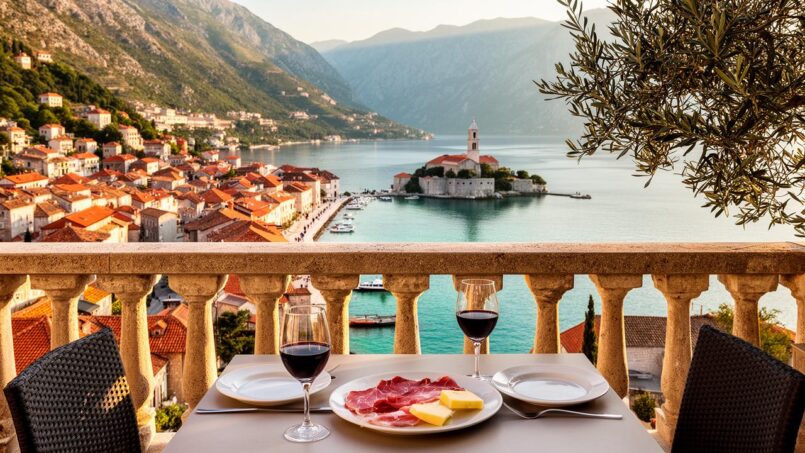
Kotor is one of the country’s postcards: a medieval town listed as a UNESCO World Heritage site, nestled at the end of the bay of the same name. In the Dobrota area, very popular with expats, apartments with sea views and renovated stone houses generally trade between €260,000 and €650,000, at levels of €3,500 to €6,000/m².
Budva, Montenegro’s tourist capital, attracts with its fortified old town, beaches, and nightlife, making it a key hub for seasonal rentals. On the Budva Riviera, standard apartments sell broadly between €1,700 and €3,500/m², luxury developments reach €6,000/m², and high-end villas far exceed this threshold.
Tivat has established itself as a luxury destination thanks to Porto Montenegro, a high-end marina where some apartments reach €6,000 to €15,000/m². Outside this ultra-prime core, neighborhoods like Donja Lastva still offer an excellent living environment, strong rental demand, and prices “only” from €4,000 to €8,000/m².
Montenegro’s capital, Podgorica, is significantly more economical than the coastal resorts, with average real estate prices below €1,500/m² in most districts. It is an attractive option for French buyers looking for a good budget-to-urban-life ratio, without the coastal hustle.
Step 1: Define Your Project and Budget
Before even looking at listings, it is essential to clarify what you are looking for:
– primary residence abroad
– vacation home
– seasonal or annual rental investment
– mixed project (personal use + rental)
This choice influences both the location, the level of quality, the size of the property, and the way of buying (personally, via a company, etc.), not to mention the financing strategy.
Include all ancillary expenses from the start: taxes, notary fees, lawyer fees, renovations, charges, and rental taxation. Budget 5 to 8% of the purchase price to cover these costs (taxes, notary, lawyer, registration, translations).
Example of Overall Budget for an Apartment at €200,000
| Item | Estimated Amount |
|---|---|
| Apartment price | €200,000 |
| Transfer tax (3% if resale) | €6,000 |
| Notary + cadastre registration | €500 – €800 |
| Lawyer (0.5 to 1% of price) | €1,000 – €2,000 |
| Translations and interpreter | €200 – €300 |
| Miscellaneous / contingencies | €500 – €1,000 |
| Total fees excluding price | €8,200 – €10,100 |
For a new development purchased from a developer subject to VAT, the logic changes: there is no 3% transfer tax, but a 21% VAT on the price (generally included in the listed price). Always check, with the help of the agent or lawyer, whether the “public” price is inclusive or exclusive of tax.
Step 2: Choose Your Search Areas
For a French buyer, the temptation is strong to focus on the postcard images of the coast. Yet the coast is also the most expensive part of the country, with prices sometimes 2 to 4 times higher than in Podgorica.
The main options can be summarized as follows:
| Region Type | Main Examples | Typical Prices per m² | Usage Profile |
|---|---|---|---|
| Prime coastal cities | Budva, Kotor, Tivat | €2,700 – €5,000 (or more) | Vacation + short-term rental |
| Mid-range coast | Bar, Ulcinj, Herceg Novi, Petrovac | €1,100 – €3,500 | Family vacations, mid-range budgets |
| Capital and large cities | Podgorica, Nikšić | €700 – €2,250 | Year-round residence, work, students |
| Mountain towns | Kolašin, Žabljak | €1,200 – €1,400 | Skiing, nature, niche rental |
| Rural areas | Interior and less touristy north | €400 – €800 | Long term, speculation, lifestyle |
For a first purchase, many French buyers favor:
Three key areas to invest according to your objectives: setting, profitability, or accessibility.
Ideal for setting and rental potential, includes Kotor, Dobrota, Perast, Tivat, and Herceg Novi.
Choice for seasonal profitability despite higher prices.
Offers a good compromise between cost of living, purchase price, and accessibility.
A piece of advice often given by local professionals: live on site for 6 to 12 months before buying, to truly understand the seasons, nuisances, tourist flows, local habits… and avoid a spur-of-the-moment purchase that may age poorly.
Step 3: Search for a Property and Select the Right Intermediaries
The Montenegrin market is full of online listings, sometimes duplicated, sometimes inaccurate. Experience shows that a mix of digital tools and human contact works best.
Specialized real estate portals allow a first filter by city, property type, and budget. Several sites are widely used by Montenegrin and regional agencies, and many local agencies also have their own platforms.
But the decisive step remains choosing a good agent and an independent lawyer.
Choosing Your Real Estate Agency Wisely
Since the end of 2025, holding a real estate activity license is set to become the norm. This does not guarantee everything, but provides a minimum filter. For a French buyer, language and quality of support are decisive: some agencies based in Budva or Tivat specialize in international clients, with teams speaking English, French, or even Italian or Russian, offering:
We assist you at every step, from property selection to transaction finalization, with support adapted to international investors.
Selection of properties according to your criteria, market analysis, and estimation of maintenance costs.
Organization of visits, sometimes with airport pickup.
Initial legal checks on titles, assistance with opening a bank account and preparing sales documents.
A network of larger agencies, notably in Podgorica, operates within the framework of international brands. The presence of English-speaking teams and partner lawyers is a plus, even if French is not always available.
To avoid disappointments, it is wise to:
– check online client reviews
– ask which languages are spoken internally
– ask precisely which services are included (and who pays the commission)
– demand full transparency on agency fees
In some schemes, the commission is included in the price and paid by the seller; in others, it is shared or charged to the buyer. This point must be clarified before signing anything.
The Lawyer: Key to a Secure Purchase
Using a Montenegrin lawyer specialized in real estate is described as “highly recommended”, without being formally mandatory. Fees often amount to around 0.5 to 1% of the sale price, a reasonable cost given the risks avoided.
The lawyer’s role includes notably: representing and defending clients’ interests in court, providing legal advice, drafting deeds and contracts, and following judicial procedures.
– verifying ownership in the land register (List nepokretnosti)
– checking for any mortgages, easements, disputes, or seizures registered in the cadastre
– confirming that the declared area matches the physical reality
– checking building and occupancy permits (Upotrebna dozvola)
– checking the “legalization” status of an old building or extensions added without a permit
– analyzing the chain of ownership (inheritances, divorces, donations, court decisions)
– preparing or reviewing contracts (preliminary and final)
– monitoring the registration of the sale and tax payments
In practice, the lawyer relies on two essential tools: the cadastral extract (List nepokretnosti) obtained via the eKatastar system, and consulting the Geoportal to verify plot boundaries and access. This groundwork takes, depending on the complexity of the file, from 1 to 14 days.
Step 4: In-Depth Legal Due Diligence
This is the invisible heart of the operation, the one on which the legal security of your investment depends. A large part of the Montenegrin market involves “gray” situations: buildings not fully legalized, undeclared extensions, plots registered as agricultural land, complicated inheritances, etc.
The due diligence process includes several components:
Analyze an up-to-date extract (less than 7 days old) by examining sections A (property and land description), B (owners), and C (charges, mortgages, easements, disputes). Verify that the seller matches the registered owner, study the history of transfers (inheritance, donations, court decisions), and demand a written explanation for any obscure annotation. Ensure that any mortgage will be canceled in coordination with payment. For recent buildings, check building and occupancy permits; for older constructions, verify the legalization status (“gray” properties not regularized complicate resale or registration).
If inconsistencies are detected between the physical reality (walls, fences, terrace, road access) and the cadastral plans, hiring a sworn surveyor is recommended to avoid buying a “lopsided” property where part encroaches on a neighbor’s land or public domain.
At this stage, if the anomalies are too serious, it is sometimes wiser to withdraw, even at the cost of starting a project from scratch.
Step 5: Offer, Preliminary Contract, and Deposit
Once a property is selected and an initial cadastre check done, the French buyer submits a written offer, often subject to satisfactory due diligence. If the seller accepts, the common practice is to use a preliminary contract (predugovor).
This contract, often signed before a notary, sets out: the rights and obligations of the parties.
– the sale price
– the timeline (deadline to sign the final contract)
– the conditions precedent (e.g., mortgage release, loan approval)
– the amount paid as a deposit
The deposit is typically 10% of the price and is paid upon signing the pre-contract. For a new property, this percentage may be reduced through a phased payment plan.
It is essential to know that this deposit is very often non-refundable if the buyer withdraws without a valid reason stipulated in the contract. Conversely, if the seller backs out, they may be required to return the deposit doubled, depending on the clauses and local law.
Step 6: Signing the Final Sales Contract before the Notary
The final contract (kupoprodajni ugovor) is mandatory in Montenegrin. The law requires the signing to take place before a notary, who has a central role:
– verifying the identity of the parties
– ensuring they understand the terms of the contract (with a sworn translator for foreigners)
– checking the contract’s compliance with Montenegrin law
– recording the signatures and authenticating the deed
The cost of oral interpretation per hour during the signing in Montenegro is approximately 50 euros.
Notary fees follow a regulated scale, progressive by price brackets, with a cap of €5,000. For most residential transactions, the fee is around 0.4 to 0.5% of the price, resulting in, for a property of €100,000, about €350 plus 21% VAT, then increasing by about €10 for every additional €15,000 in value beyond €120,000.
Payment of the Price
Virtually all payments are made by bank transfer, from a local or foreign account. The buyer often needs to obtain a local tax identification number (PIB or TIN) before signing the contract, which then allows opening a Montenegrin bank account and simplifying financial flows.
Some banks offer escrow accounts to secure the transaction, where funds are released to the seller only after the transfer of ownership is registered, for an additional fee. Cash payment remains theoretically possible in some private sales, but is less common for large amounts due to anti-money laundering controls.
Step 7: Taxes, Registration, and Transfer of Ownership
Once the final contract is signed and the price paid, the last major step is registering the change of owner with the cadastre, accompanied by payment of the transfer tax (for resales).
Transfer Tax or VAT: Knowing the Difference
For an existing apartment (resale between individuals), the buyer pays a real estate transfer tax of 3% of the agreed price, due within 15 days after signing the deed. In some cases, particularly for more expensive properties, a progressive scale may apply (with higher rates beyond certain thresholds), but for a “standard” apartment up to €150,000, it remains 3%.
When buying a new apartment directly from a developer subject to VAT, the 3% tax does not apply. The price generally includes 21% VAT, remitted by the developer to the state. This VAT weighs heavily on the overall budget, especially for a high-end property.
Registration with the Cadastre
The lawyer or notary usually handles filing the notarized contract and proof of tax payment with the cadastre office (Real Estate Administration). The time for the new owner to appear on the List nepokretnosti is practically 15 to 30 days, sometimes a bit longer depending on local workload.
Once registration is effective, a new certificate of ownership is issued, confirming the apartment is registered in the French buyer’s name. At this point, ownership is legally transferred, even if key handover may have been arranged at signing, depending on the contract.
Step 8: Post-Purchase Formalities and Recurring Costs
After registration, several practical tasks remain:
– transfer the electricity, water, and, if applicable, gas accounts
– register with the municipality for local property tax
– possibly take out home insurance
– if the property is intended for seasonal rental, register with the tourism authorities and set up management (concierge, cleaning, check-in, etc.)
Typical annual property tax amount for an apartment worth €150,000, with a rate varying from 0.25 to 0.5% of its market value.
Annual charges for a seaside apartment – condo fees, maintenance, water, electricity, etc. – are frequently estimated in the range of €1,400 to €3,200 per year, depending on size, services offered (elevator, pool, security), level of finish, and consumption.
Buying Remotely: The Role of the Power of Attorney
For a French person who does not wish to travel physically to Montenegro, the law allows conducting the entire process remotely via a Power of Attorney. This requires:
Example: a French investor signs a power of attorney before a notary in France, gets it apostilled under the Hague Convention, then sends it to Montenegro. Their lawyer or trusted representative can then visit properties, negotiate the price, sign preliminary and final contracts, handle relationships with the notary and cadastre, and carry out bank account opening procedures.
This option is extremely practical but means entrusting a lot of power to an intermediary; the choice of the person – often the lawyer – is therefore critical.
Financing Your Purchase: Local Loan or Own Funds?
Financing is another sensitive point. Several Montenegrin banks grant real estate loans to foreigners, but the conditions are stricter than for residents.
Typical Bank Requirements
Institutions carefully examine:
– the ability to verify income (employee, self-employed, declared rental income)
– any holding of a temporary or permanent residence permit
– the existence of a local bank account and, possibly, employment in Montenegro
For a completely non-resident foreigner with no local ties, obtaining a loan is possible but complex. Banks then impose:
The down payment required for a real estate investment in France by a non-resident often represents 40 to 50% of the property price, or more.
Banks are more open towards:
– foreigners with a residence permit and stable income
– those who can prove a salary or income paid into a Montenegrin account
French buyers often pay cash or combine a large down payment with a small loan to limit the documents required.
Alternatives to Bank Loans
Some developers offer interest-free staggered payment plans, especially on the coast. The typical structure:
– 30% at signing
– 30% during construction
– 40% upon completion
The apartment can sometimes be used before full payment, but full ownership in the cadastre is generally transferred only after full payment of the price. This is therefore a solution to handle with caution, carefully verifying the developer’s solidity and track record.
Buying to Rent: What a French Buyer Must Anticipate
Rental investment logic is very present on the Montenegrin coast. Budva, Kotor, Tivat, Herceg Novi, and Bar show strong seasonal rental potential, with high nightly rates in peak season.
Several parameters must, however, be considered:
Apartments with sea views sell for 30 to 100% more. Residences with services (pool, spa, security) have high maintenance charges. Short-term rental requires official registration and payment of a local tax.
Tax on rental income is based on a flat rate of 15% on rental income, whether short or long term. This is a point to model from the start of your business plan.
On a practical level, it is recommended to have the lawyer check:
– the condominium regulations and building rental rules
– the actual possibility of nightly rentals in the relevant municipality
– the absence of hidden restrictions on platforms like Airbnb or Booking
Common Mistakes to Avoid for a French Buyer
Several pitfalls frequently appear in experience feedback:
Failing to check the structural quality of the building (elevator, insulation, year built), neglecting the legalization of old Yugoslav or 1990s buildings, signing a preliminary contract without clear exit clauses in case of legal problems, underestimating ancillary costs (taxes, notary, translations, renovations), and buying remotely without an independent lawyer are major mistakes to avoid.
For a French buyer, another classic pitfall is projecting French reflexes onto a different legal system. For example, the very active role of the French notary is here divided among notary, lawyer, cadastre, and tax administration. Surrounding yourself with a local professional accustomed to Western European expectations is an essential investment.
Conclusion: A Still Attractive Market, but More Technical in 2026
Montenegro remains, in 2026, a surprisingly open country for foreign buyers, especially Europeans. A French person can acquire an apartment in their own name, without a specific visa, in a process described as simple and relatively fast (one to three months between offer and cadastre registration in most cases).
At the same time, rising prices on the coast, the introduction of a €150,000 threshold for property-based residence (even if it does not directly target EU citizens), and stricter regulation of “shell” companies show that the legislator wants to better filter purely opportunistic profiles.
To take advantage of this market as a French buyer while limiting risks, the roadmap is clear:
– define your project precisely (personal use, rental, mixed)
– target suitable areas for your budget and objectives (Budva, Kotor, Tivat, Herceg Novi, Podgorica, etc.)
– surround yourself with a serious agent and an independent lawyer
– conduct meticulous due diligence via the cadastre, permits, and verification of the property’s “legalization” status
– master the timeline: pre-contract, deposit, final contract, payment, taxes, registration
– anticipate recurring costs (property taxes, charges, maintenance) and potential rental income
With this structured approach, buying an apartment in Montenegro can become for a French person a genuine life or investment strategy, not just a real estate crush on the Adriatic coast.
Have a wealth project or a question? Contact us now to speak with a wealth management expert.
Disclaimer: The information provided on this website is for informational purposes only and does not constitute financial, legal, or professional advice. We encourage you to consult qualified experts before making any investment, real estate, or expatriation decisions. Although we strive to maintain up-to-date and accurate information, we do not guarantee the completeness, accuracy, or timeliness of the proposed content. As investment and expatriation involve risks, we disclaim any liability for potential losses or damages arising from the use of this site. Your use of this site confirms your acceptance of these terms and your understanding of the associated risks.

Cyril Jarnias is an independent expert in international wealth management with over 20 years of experience. As an expatriate himself, he is dedicated to helping individuals and business leaders build, protect, and pass on their wealth with complete peace of mind.
On his website, cyriljarnias.com, he shares his expertise on international real estate, offshore company formation, and expatriation.
Thanks to his expertise, he offers sound advice to optimize his clients' wealth management. Cyril Jarnias is also recognized for his appearances in many prestigious media outlets such as BFM Business, les Français de l’étranger, Le Figaro, Les Echos, and Mieux vivre votre argent, where he shares his knowledge and know-how in wealth management.





