
 Published on and written by Cyril Jarnias
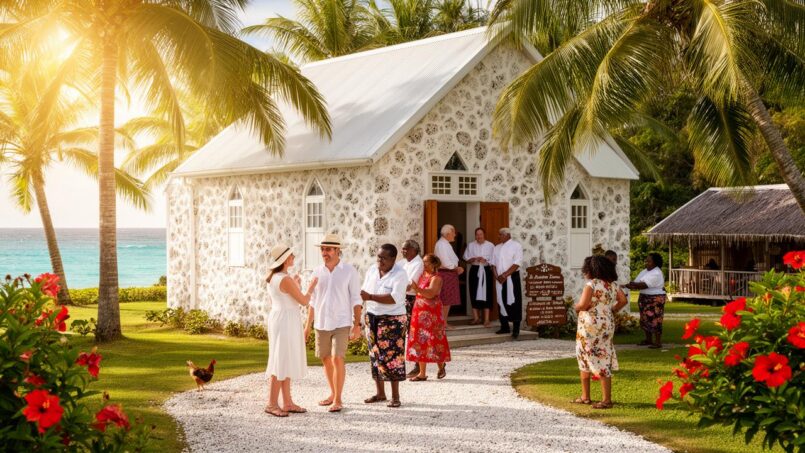
Settling in Niue means entering a world where faith isn’t just for Sunday morning and where social life revolves largely around the church and the village. For an expatriate, understanding local religious practices isn’t just an exercise in cultural curiosity: it’s the key to living in harmony with neighbors, avoiding faux pas, and, above all, being truly accepted into the community.
In Niue, religion, customs, and daily life are closely intertwined. For people coming to live and work here, understanding this cultural and religious landscape is essential, as it directly influences the lifestyle and day-to-day social interactions.
A “Christian Country”: The Place of Religion in Society
In Niue, the term “Christian nation” is anything but an abstract phrase. The vast majority of the population identifies as Christian, and the numbers speak for themselves: according to various sources, between approximately 95% and 98% of residents identify as Christian. Non-believers or people with no religion remain a small minority.
The church is not just a place of worship, but a hub of social life. Ceremonies, community projects, material mutual aid, many collective decisions go through religious structures. The idea that “Niue is a land given by God” for all Niueans permeates discussions about national identity and responsibility towards the island and family lands.
Discourse on national identity in Niue
In this context, it’s useful to keep in mind that even if religious practice varies from person to person, the Christian reference point remains the implicit norm in conversations, celebrations, and community decisions.
Diversity of Churches, Unity of a Christian Society
Several Christian denominations coexist on the island, but one clearly dominates: Ekalesia Niue, the Congregational Christian Church of Niue, stemming from the Reformed tradition and missions of the London Missionary Society in the 19th century. According to recent censuses, about 60% of residents are affiliated with it. Other churches are also well established: the Church of Jesus Christ of Latter-day Saints (Mormons), the Catholic Church, Jehovah’s Witnesses, the Seventh-day Adventist Church, and a few other Protestant groups.
The table summarizes the main religious affiliations according to four different statistical sources.
| Christian Denomination | Share of Population (estimated ranges) |
|---|---|
| Ekalesia Niue (Congregational Christian) | ~61–67% |
| Mormons (Church of Jesus Christ of LDS) | ~8–10% |
| Catholic Church | ~7–10% |
| Jehovah’s Witnesses | ~2–3% |
| Seventh-day Adventists | ~1–1.5% |
| Other Protestant / Christian Churches | ~3–8% |
| No religion / Atheists / Not stated | ~7–10% |
For an expatriate, this plurality mainly means that almost all Niueans have a religious affiliation, even if actual practice may be more or less regular. In practice, the most visible divide is not between denominations, but between the highly structuring Christian culture and the small minority of people without religion.
A Brief Historical Look Back: Why Faith Structures Life So Much in Niue
To understand the centrality of religion today, we need to go back to the arrival of Christian missions. The first European missionaries reached Niue around 1830, under the auspices of the London Missionary Society. The beginnings were difficult: the population was reluctant, and conversion attempts failed.
In 1846, the return to Niue of Nukai Peniamina, a catechist trained in Samoa, marked a turning point. Thanks to his local roots and training, he converted his home village of Mutalau. He was aided by chiefs who protected him in the fortification of Taue i Fupiu, still visible today. This initial conversion allowed Christianity to spread rapidly across the island.
By the time the first resident pastor, George Lawes, arrived in 1861, an overwhelming majority of the population already claimed to be Christian: only a few inhabitants were not. Christianity gradually became the official religion, and the Congregational Christian Church of Niue organized itself with the support of missionaries.
This missionary past is still celebrated today through a major public holiday: Peniamina Gospel Day, commemorating the introduction of the Gospel to the island. This religious day, integrated into the official calendar, symbolizes how deeply faith is part of Niue’s political and collective history.
Between Christianity and Ancient Beliefs: A Hybrid Religious Universe
Even though nearly all residents identify as Christian, elements of the old Niuean religion persist. Before the arrival of missions, Niueans believed in a supernatural world populated by “aitu,” the spirits of ancestors, capable of watching over and punishing the living.
Today, these beliefs survive to varying degrees. Certain ritual practices related to death and “sensitive” places bear witness to this continuity. For example, when a death occurs, a “fono”, a form of sacred prohibition, may be placed on the affected location. This is often signaled by coconut fronds tied around an area: entering is strictly forbidden.
For an expatriate, the syncretism between Christianity and ancestral beliefs primarily manifests in paying special attention to places considered spiritually charged.
– never cross a perimeter marked by coconut fronds (fono);
– respect burial sites, which are very common in villages, sometimes even behind family homes;
– avoid any casual attitude towards ancestors or the dead.
The Niuean conception of the person is holistic: body, spirit, emotions, and mind are seen as closely intertwined. This holistic view also permeates how faith is lived daily: religion does not concern only a “private sphere,” but the balance of the group and the land.
Sunday, a Sacred Day: What This Means in Practice
In Niue, Sunday is a true pivot of the week. It is devoted to worship, rest, and family. For an expatriate, this is probably the most immediately visible religious dimension, as it changes the rhythm of practical life.
Sunday Schedule
Most churches hold two services on Sunday: one in the morning, generally around 9 am or 10 am, and another in the afternoon, often around 3 pm or 4 pm. In some villages, times vary: for example, the Ekalesia Niue church in Tuapa has a service at 9 am and another at 5 pm.
The following table summarizes some typical worship times:
| Church / Denomination | Location | Main Worship Day | Typical Times |
|---|---|---|---|
| Ekalesia Niue (several villages) | 13 villages | Sunday | 10 am & 4 pm (Tuapa: 9 am & 5 pm) |
| Apostolic Church | Halaika, Alofi South | Sunday | 10:30 am |
| Catholic Mission | Houme, Alofi North | Sunday | 10 am |
| Jehovah’s Witnesses | Makihi, Mutalau | Sunday | 10 am |
| Church of Jesus Christ of LDS | Opaahi, Alofi South | Sunday | 9:30 am |
| Seventh-day Adventist Church | Makaheheke, Alofi North | Saturday | 11 am (or late morning) |
For a newcomer, attending a few services in different villages is an excellent way to grasp the diversity of communities and, above all, to understand how much singing, prayer, and speaking structure collective life.
Sunday Restrictions: What Is Allowed or Not
Sunday rules go beyond just attending church. The guiding idea is that this day is devoted to God and family. This translates into a set of practices that expatriates are expected to respect:
On Sunday, most residents avoid work, and professional activities are reduced to the bare minimum. Fishing, diving, and boating are prohibited. Swimming near village greens and churches is forbidden. Using sea tracks near places of worship during service is frowned upon. Tourism, swimming, or walking are still possible as long as you move away from villages and church areas. Some restaurants may open in the evening, but most shops remain closed.
For an expatriate used to seeing the weekend as a time for intense leisure, these Sunday constraints may seem restrictive. Yet they are at the heart of the Niuean conception of a good life: Sunday is a time for slowing down, reflection, and family cohesion. Aligning with this rhythm is a much-appreciated sign of respect.
Going to Church in Niue: Dress Codes and Attitudes
One of the most recommended experiences for anyone settling in Niue is to attend a Sunday service. The singing, fervor, and welcome given to visitors make it a often memorable moment. However, etiquette is strict, especially regarding clothing and behavior.
How to Dress for a Religious Service
The general rule is modesty and respect. For Niueans, presenting oneself properly at church is a way to honor God, but also to show respect for the community and for oneself.
In practice:
– Knees must be covered for both men and women.
– Men typically wear a collared shirt and long pants.
– Women favor a skirt or dress at knee-length or longer, paired with a top covering the shoulders and chest.
– For women, wearing a hat is traditionally a sign of respect; for female visitors, it is appreciated but not required.
Tips on choosing clothing colors for religious services, especially for expatriates.
Reserved for certain specific religious functions or meanings for locals. It is best for an expatriate to avoid wearing an all-white outfit to church.
Wearing a white garment among other colors in an outfit is generally fine and acceptable.
Beyond worship, the simple rule is: away from the beach or isolated swimming areas, cover up. Swimwear is not worn in town or in villages; it should be covered with a long t-shirt or a pareu (sarong). Walking shirtless or in overly revealing clothing in public spaces is considered disrespectful.
Behavior in Church and During Service
The expected attitude during a religious service is one of calm and respect. Some guidelines for an expatriate:
To attend a religious service while respecting local customs, it is recommended to arrive on time, or even early, as a late, noisy arrival attracts attention. Sit where you are directed, as some rows may be reserved. Maintain silence during prayers and sermons. Avoid taking photos inside during the service; discreet photography is tolerated outside, before or after. Finally, it is well-regarded to contribute to the offering with a donation, even a modest one, to show your support for the community.
The service almost always begins and ends with a prayer. More broadly, many public events (meetings, ceremonies, large meals) also open and close with a prayer, often led by a minister, elder, or senior figure. When a family hosts you at home, it is not uncommon for them to propose ending the gathering with a blessing: accepting this gesture respectfully is a sign of respect.
Greeting, Visiting, Sharing: Social Etiquette with a Strong Spiritual Dimension
Daily life in Niue is deeply communal. The villages – 14 in number – function as small entities where everyone knows everyone else. Neighborly relations, extended family ties (magafaoa), and church interactions are closely intertwined.
Greeting, the First Sign of Respect
The usual greeting is “Fakaalofa lahi atu,” which can be accompanied by a handshake and sometimes a slight bow of the head. Not greeting people you pass, especially in your own village or on the roads, is perceived as coldness or disdain.
On the roads, it is common to wave at every vehicle, cyclist, or pedestrian you pass. This gesture is not insignificant: it embodies the concept of “fakalofa,” a core value representing love, care for others, respect, and generosity.
Visiting a Home: The Culture of Gifts and Sharing
Going to someone’s home in Niue is not a casual act: it means entering their family space, often with a strong spiritual dimension. It is expected that you bring a small gift, such as fruit, a cooked dish, flowers, or another form of food. Arriving empty-handed can be interpreted as a lack of consideration.
Another important point: when a meal is served, sharing it is considered a sign of goodwill and mutual respect. Refusing to taste what is offered is sometimes poorly perceived, because food also symbolizes the commitment to “work together” and maintain good relations. You don’t have to finish everything, but at least try a bit of each dish.
Respect for Elders and Meetings
Niuean society is strongly marked by respect for elders. Elderly people, family heads, and religious figures (pastors, elders, matapule) hold a special status. During a meeting or event, avoid:
– speaking louder than them or interrupting them;
– walking noisily or passing in front of them without apologizing.
If you need to pass in front of someone seated or speak while others are talking, it is polite to use the phrase “tulou” (meaning excuse me) while making a slight bow.
Many community gatherings, even if not explicitly religious, retain a spiritual dimension: opening prayer, blessing of food, invocation of God’s protection over the village or event. As an expatriate, adopting a reverent attitude during these moments is essential, even if you are not a believer.
Land, Sea, and the Sacred: What an Expatriate Should Know
In Niue, the relationship to the land and sea is deeply marked by faith and traditions. Notions of land ownership, natural resources, and taboos are not only legal, but also spiritual.
Respecting Land Rights and Prohibitions (Fono)
All land belongs to someone. Picking fruit, gathering plants, or taking natural resources without the owner’s permission is frowned upon and sometimes directly against customs and law. Additionally, certain areas or plots are temporarily or permanently off-limits due to a “fono,” often related to a serious event (like a death) or ritual use.
A fono, signaled by coconut fronds, prohibits entry into a plot. Crossing it constitutes a serious act of disrespect towards the family, ancestors, and God.
The Sea, “Vaka,” and Fishing Seasons
Traditional canoes, called “vaka,” sometimes seen at the end of coastal paths, should not be touched. They belong to fishermen, often with strong symbolic and economic significance. If you encounter a fisherman in a vaka in a cove where you intended to swim, always ask for their permission before entering the water nearby.
Some beaches or sea access points are temporarily closed during the kaloama (goatfish) fishing season. These closures, dictated by respect for traditional fishing methods and community agreements, carry cultural, practical, and symbolic weight. It is imperative to strictly follow the signs and local indications.
Finally, it is illegal to swim with whales without going through a licensed operator. Beyond the regulation, this rule reflects a sensitivity towards these animals and their environment, seen as part of a creation entrusted by God.
Religious Life and Major Life Ceremonies
Religion is omnipresent in life’s major events: birth, coming of age, marriage, death. For an expatriate, being invited to one of these ceremonies is both an honor and a very deep immersion into local culture.
Rites of Passage: Hair, Ears, and Gifts
For boys, a hair-cutting ceremony (pakoti rouru or tama hui) marks the transition to adolescence. The hair, often left to grow since birth, is divided into locks, and each family member or guest cuts a lock in turn. In exchange, they give a contribution (atinga), usually financial, intended to support the young person’s future (education, projects, etc.). A feast follows, illustrating the value of generosity and reciprocity.
For girls, an ear-piercing ceremony plays a similar role of symbolic transition. Here again, gifts and abundant meals seal bonds between families, friends, and community.
Weddings, Funerals, and Spiritual Dimension
Weddings are often large celebrations where religious commitment and gift-giving obligations intertwine: pastoral blessing, long series of speeches, dances, distribution of large quantities of food and alcohol. The presence of alcoholic drinks at parties may be surprising given the strongly Christian character of society, but it is part of the markers of hospitality and being a “good host.” Some men even associate their Niuean identity with the ability to offer – and consume – large amounts of food and drink.
Mourning has a strong religious and customary dimension. Historically, the period of lamentation (tagi) for important people could last several tens of days, with extreme gestures such as women shaving their heads. Today, these practices are often shorter or symbolic, but prayer vigils, hymns, and church services remain central. It is also common for the deceased to be buried on family property, for example behind the house, thus integrating a spiritual dimension into domestic life.
For an expatriate, attending a wedding or funeral involves:
– dressing very respectfully, often more formally than usual;
– bringing a gift (money, food, presents) according to the customs of the group concerned;
– staying attentive to the hierarchy of speakers and the role of matapule (traditional orators) and religious leaders.
The Church as a Social Network and Integration Hub for Expatriates
In Niue, regularly attending a religious service is not just about personal faith. For an expatriate, it is also one of the most effective ways to build lasting bonds with locals.
The church serves as :
The village green is much more than just a physical space; it is the beating heart of community life, fulfilling several essential social functions.
A meeting place where the whole village regularly gathers to exchange and share common moments.
A space where announcements, event invitations, and calls for community projects circulate.
A mutual aid system that mobilizes in case of illness, birth, death, or economic difficulties.
By going there regularly, greeting people, and accepting invitations to share a meal after the service, you cross a major barrier: that of being seen as a “passing tourist.” Eventually, you will be perceived as part of the village community, even if you maintain your own religious tradition or lack of faith.
General Attire and Behavior in Public: Extensions of Religious Morality
The dress code outside of worship times is also influenced by local Christian values. An adult is expected to dress modestly: no nudity, no swimwear in villages and Alofi, no shirtless cycling. Swimwear is reserved for swimming areas, and one covers up with a long t-shirt or pareu to move around.
These norms are not just aesthetic conventions; they refer to a certain conception of modesty and respect for oneself and others, inherited both from Christian missions and older Polynesian values.
Dress norms in Polynesia
The same principles are reflected in other behaviors:
– Do not raise your voice in meetings, do not interrupt.
– Do not appear boisterous or intoxicated in inappropriate contexts.
– Always ask for permission before photographing people or sites with strong cultural or religious significance.
Religion and Public Holidays: When the Civil Calendar is Also Spiritual
Several official public holidays are directly rooted in religious events. In addition to Christmas, Easter, and the major Christian holidays shared with the rest of the world, Niue celebrates days specifically tied to its spiritual history, such as Peniamina Gospel Day.
This public holiday commemorates October 26, 1846, the date of Peniamina’s return to Niue after his training in Samoa, marking the beginning of the island’s conversion. It is celebrated with religious services, speeches, and cultural events. For Niueans, this event symbolizes the end of divisions and wars between clans, unifying the population under one faith.
Other celebrations, like the Village Show Days or the arts and culture festival, readily mix religious and cultural dimensions: blessing of harvests, prayers for the success of activities, Christian-inspired hymns alongside traditional dances.
What an Expatriate Should Remember to Live Peacefully with Their Faith – or Non-Faith
Living in Niue does not necessarily mean adopting the local Christian faith. Niueans understand that foreigners may be of other religions or non-believers, and the Constitution guarantees freedom of religion. But social integration requires accepting that Christianity structures rhythms, norms, and major collective benchmarks.
In summary, for an expatriate:
Religion is a central pillar of identity, not a mere private choice. It is important to respect Sunday rules, even if they differ from your habits, and to adopt modest clothing in villages and at church. Be available to participate in services or prayers during events. Strictly respect areas under customary authority (fono), burial sites, traditional canoes (vaka), and regulated sea access. Adopt a respectful attitude towards elders, pastors, and traditional orators. Use local greetings and practice the custom of bringing a small gift when visiting.
The key, ultimately, lies in a central concept of Niuean culture: “fakalofa”. This word encapsulates love, generosity, respect, and care for others. By putting it into practice in your daily relationships – whether at church, the market, by the roadside, or at village celebrations – you will discover that Niue’s religious practices, far from being a constraint, can become a powerful vector of friendship and mutual understanding.
Disclaimer: The information provided on this website is for informational purposes only and does not constitute financial, legal, or professional advice. We encourage you to consult qualified experts before making any investment, real estate, or expatriation decisions. Although we strive to maintain up-to-date and accurate information, we do not guarantee the completeness, accuracy, or timeliness of the proposed content. As investment and expatriation involve risks, we disclaim any liability for potential losses or damages arising from the use of this site. Your use of this site confirms your acceptance of these terms and your understanding of the associated risks.

Cyril Jarnias is an independent expert in international wealth management with over 20 years of experience. As an expatriate himself, he is dedicated to helping individuals and business leaders build, protect, and pass on their wealth with complete peace of mind.
On his website, cyriljarnias.com, he shares his expertise on international real estate, offshore company formation, and expatriation.
Thanks to his expertise, he offers sound advice to optimize his clients' wealth management. Cyril Jarnias is also recognized for his appearances in many prestigious media outlets such as BFM Business, les Français de l’étranger, Le Figaro, Les Echos, and Mieux vivre votre argent, where he shares his knowledge and know-how in wealth management.





