
 Published on and written by Cyril Jarnias
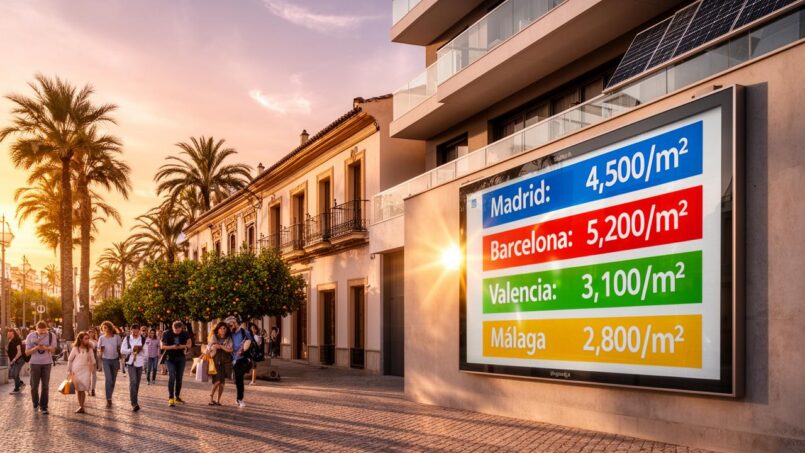
The Spanish residential market has taken off since 2021, and 2025 marked a new all-time high. In 2026, prices continue to climb, but at a slightly more moderate pace. In this context, gaps between the major metropolises are widening. Madrid now overtakes Barcelona in price per square meter, Valencia remains significantly more affordable despite a recent surge, while Malaga is emerging as the rising star of the Mediterranean.
This block has a dual purpose: to understand the positioning of Madrid, Barcelona, Valencia, and Malaga in the Spanish real estate upswing, and to provide clear comparative tables to help you decide between these cities in 2026, whether you are an investor, a potential expatriate, or a residential buyer.
A Spanish market generally in a controlled overheated state
Before zooming in on each city, it’s essential to keep the national backdrop in mind. Real estate prices in Spain rose by about 12 to 15% in 2025 according to various indices (up to 15.35% per Idealista in the third quarter), then again by around 12.9% year-on-year in the first quarter of 2026 per the INE. The national average price now stands between 2,000 and 2,500 €/m² depending on the source and property type, with a level close to 2,517 €/m² observed in the third quarter of 2025.
New homes sell for almost 50% more than existing properties: about 2,712 €/m² for new construction versus 1,815 €/m² for resale. However, resales account for more than 90% of transactions. This gap illustrates a market where construction struggles to keep up with demand.
S&P forecasts a rise in real estate prices of up to +9.3% in 2026 at the national level.
The macroeconomic backdrop remains supportive: GDP growth around 2% expected in 2026, a solid labor market, positive migration flows, interest rates back toward 2% for the main benchmark (12-month Euribor), and household incomes rising in real terms—that is, faster than inflation.
Within this framework, the four cities of interest show different trajectories but share a common point: a severe shortage of housing relative to demand, which fuels price increases.
Madrid: the locomotive, more expensive and more dynamic
Madrid has become the tightest market in Spain in just a few years. Prices have jumped about 50% since the end of 2021 according to property register data: from 3,641 €/m² to nearly 5,283 €/m² at the end of 2025, with a further acceleration of more than 17% in 2025 alone. Other databases (RelocateIQ, local studies) confirm this range, citing an average city price around 5,080–5,380 €/m², and even 6,800 €/m² for some calculations including the most expensive neighborhoods.
In the fourth quarter of 2025, a market report places the average price at 4,883 €/m² for the city, up about 20.9% year-over-year. Another study (Gloval) observes an average value of 5,078 €/m² in September 2025, up 19% year-over-year. In other words, regardless of the source, Madrid leads the pack.
Price levels and market structure
The current situation can be summarized with a summary table.
| Key indicator (2025–2026) | Approximate value in Madrid |
|---|---|
| Average city price (existing + new) | 4,800–5,400 €/m² |
| Observed price Q4 2025 (city) | 4,883 €/m² |
| Estimated price April 2026 (portals) | ~5,300–5,400 €/m² |
| 90 m² apartment in city | ≈ 532,260 € |
| 90 m² apartment in typical suburb (Alcalá de Henares) | ≈ 246,960 € |
| 1-bed resale range (city) | 241,000–359,000 € |
| Annual price growth (2025) | ≈ +17 to +21% depending on period |
| Forecast growth 2026 | ≈ +4.5 to +6% |
The internal hierarchy is very pronounced. In the hyper-central neighborhoods and the most prestigious northern axes (Salamanca, Chamberí, Retiro, Chamartín), prices easily exceed 7,000 €/m², with peaks around 11,000 €/m² for certain luxury segments. In the more popular outskirts (Carabanchel, Vallecas, Usera), entry-level starts around 2,300–3,000 €/m².
The average price of a 100 m² apartment in the city exceeds €680,000, compared to about €507,000 in Barcelona.
Supply-demand tension and structural deficit
Madrid alone accounts for a large share of the national housing deficit: the Bank of Spain estimates that the capital and its functional area are short of more than 200,000 homes (about 203,700 units). In Spain’s major urban areas (Madrid, Barcelona, Valencia, Malaga, Alicante, Murcia), the number of households is growing about 2.5 times faster than the stock of new housing, with an overall gap of more than 50% between households created and homes built.
Sale prices are 10 to 15% above wages on a national average, but this premium is more pronounced in Madrid due to a housing shortage in high-demand areas, unlike the 2007-2008 bubble which was based on overbuilding.
Rental market and yields
On the rental side, Madrid has become the most expensive city in Spain in 2026, with rents around 23.4 €/m²/month for the city, meaning over €1,300 for a one-bedroom in the city center. RelocateIQ data shows a furnished one-bedroom range of €1,180 to €1,630 per month depending on the neighborhood, with annual rental growth close to 13.5%, well above that of Barcelona.
Despite this level, gross yields remain relatively modest for an investor buying at market price: around 4.7% on average according to several sources, while Valencia exceeds 7–8%. Madrid is therefore typically a capital appreciation market more than a maximum rental yield one.
Barcelona: expensive, heavily regulated, but less explosive than Madrid
For a long time, Barcelona was the benchmark for high prices in mainland Spain. It has been overtaken by Madrid in recent years. Between end of 2021 and end of 2025, its prices rose about 16% (from €4,125/m² to €4,800/m²), three times slower than the capital, where the increase approached 50%.
Average prices in the city now range between €4,500 and €4,800/m², with variations by source: a Q4 2025 report places them at €4,270/m² (+8.3% year-on-year), other databases (RelocateIQ, notarial statistics) cite €4,500–€4,800/m². In terms of rents, Barcelona remains very expensive, but the latest data even shows a slight correction over one year.
Price levels and direct comparison with Madrid
The following table summarizes the main orders of magnitude observed in 2025–2026.
| Key indicator | Madrid | Barcelona |
|---|---|---|
| Average city price (approx. 2025–2026) | €5,080–€5,380/m² | €4,530–€4,800/m² |
| Price Q4 2025 (Tinsa/Gloval study) | €4,883/m² | €4,270/m² |
| Price “registrar” end of 2025 | €5,283/m² | €4,800/m² |
| 90 m² apartment in city (average) | ≈ €431,500–€532,000 (depending on source) | ≈ €380,000–€463,000 |
| Annual growth 2025 | ≈ +17–21% | ≈ +7–10% |
| Forecast growth 2026 | ≈ +4.5–6% | ≈ +2.5–5.5% |
The most sought-after neighborhoods – Eixample, Sarrià–Sant Gervasi, upper Gràcia, some parts of renovated Ciutat Vella – range between €6,000 and €7,500/m², with a ceiling around €7,800/m² in the premium sectors of Sarrià–Sant Gervasi. At the other end, districts like Nou Barris or Sant Andreu remain below €3,000/m², making them rare pockets still “affordable” in a very tight metropolis.
Common savings on the purchase of a family three-bedroom in Barcelona compared to Madrid, for a similar size.
A regulated market with signs of moderation
Barcelona’s specificities lie less in the absolute price level than in the regulatory density: limitation of tourist licenses, rent controls, restrictions on new tourist residences, strong urban planning constraints. These measures curb both speculation and part of the traditional rental investment, which helps temper price increases compared to Madrid.
In 2026, rental growth in Barcelona is slowing with a decline of about –6% year-on-year, although the level remains high at €22.5/m²/month. On the sales side, prices are rising by 4 to 5% over the year, an annual increase of +10.4% lower than Madrid’s (+17%).
The market remains tight, however: nearly 17% of listings see price reductions during the marketing period, a high rate but within the norm for major Spanish metropolises (Madrid reaches 18–20% of discounted listings).
Taxation and yields
Another major difference for a buyer: transaction taxes. The transfer tax (ITP) reaches 10% in Catalonia, compared to only 6% in Madrid. Total acquisition costs (notary fees, duties, intermediaries) thus run around 12–15% of the property price in Barcelona, versus 10–12% in the capital. For an investor, this simple differential immediately cuts into net profitability.
Gross yields are among the lowest in Spain: around 2% to 3% in certain central segments if buying at full price. Barcelona offers more of a bet on long-term appreciation than on generous rental cash flow, especially since the tightening of rent control policies.
Valencia: strong price increase, but still a “good value for money”
Valencia is the classic example of a city that, starting from a lower base, has experienced a spectacular catch-up but remains, in 2026, much cheaper than Madrid or Barcelona. The most recent data show impressive price increases: about +17.5% year-on-year in the fourth quarter of 2025 for the city, and up to +19.1% for the entire Valencian Community in the first quarter of 2026, among the fastest growth rates in the country.
In the city, average prices range between €2,600 and €2,700/m² according to notarial or appraisal sources (€2,639/m² in Q4 2025, around €2,510–€2,636/m² for other studies). Listing portals, which tend to reflect asking prices rather than signed prices, indicated about €3,340/m² in February 2026, i.e., 25% above the national average (≈ €2,673/m² at the same date). This confirms a dynamic clearly above the Spanish average.
Price map within the city
Valencia is very heterogeneous. Centrally chic neighborhoods (L’Eixample, Ciutat Vella, Pla del Real) far exceed €4,000/m², while peripheral zones remain below €2,600/m². The table below illustrates these differences.
| Valencia district (2026, Idealista data) | Approximate average price |
|---|---|
| L’Eixample | ≈ €4,978/m² |
| Ciutat Vella | ≈ €4,736/m² |
| Pla del Real | ≈ €4,536/m² |
| Extramurs | ≈ €3,622/m² |
| Poblats Marítims (Cabanyal, etc.) | ≈ €3,000–€3,400/m² (strong increase) |
| Campanar, Quatre Carreres (many new builds) | ≈ €3,000–€3,600/m² |
| Patraix | ≈ €2,600–€2,900/m² (but +23.8%/year) |
| L’Olivereta | ≈ €2,540/m² |
| Benicalap | ≈ €2,614/m² |
| Rascanya | ≈ €2,312/m² (among the cheapest) |
In some neighborhoods like Patraix, annual increases approach 24%. Pla del Real has jumped more than 22% year-on-year to now exceed €4,500/m². Poblats Marítims (including Cabanyal) shows growth close to 20%, a sign of accelerated gentrification, fueled by urban renewal and the arrival of foreign teleworkers.
Relative affordability and rental yields
Even after these surges, Valencia remains significantly more affordable than Madrid or Barcelona. A mid-range 90 m² in the city can still be found for around €230,000–€250,000. For a budget of €300,000, the range of options is much wider than in Catalonia or the capital.
On the investment side, the city stands out with significantly higher gross yields, around 7–8% on average, compared to less than 5% in Madrid and sometimes 2–3% in Barcelona. Rental demand remains very strong, driven by migration flows, the arrival of teleworkers and students, and a municipal policy that more strictly regulates tourist rentals, keeping part of the stock in long-term renting.
A market with a housing shortage
Valencia does not escape the great Spanish equation: too many households for too few homes. The Valencian Community suffers from a structural deficit of nearly 100,000 homes, a large share of which is in the regional capital and its immediate periphery. Inventory of properties for sale dropped nearly 30% in a few months between end of 2023 and mid-2024, from about 5,560 to 4,000 listings.
Only 10 to 15% of properties for sale are recent constructions, concentrated in the Quatre Carreres, Campanar, and Patraix neighborhoods. Historic centers like Ciutat Vella, Pla del Real, and El Pla del Remei are nearly frozen by heritage constraints, reducing available supply and driving up prices as soon as a quality property becomes available.
Local taxation: an additional argument
The Valencian Community has decided to make resales a bit more attractive starting June 1, 2026. The transfer tax (ITP) on existing properties drops from 10% to 9% for the portion up to €1M. Beyond that, a surtax of 11% applies on the amount exceeding this threshold. Concretely, a buyer of a €400,000 apartment saves about €4,000 in duties compared to the previous situation. Existing reduced rates (3–6%) for young buyers, large families, or subsidized housing remain unchanged.
New homes remain subject to VAT at 10%, unaffected by this reform. But for the investor or primary residence buyer on the second-hand market, Valencia gains an additional advantage over Barcelona, where the ITP remains at 10%.
Malaga: the coastal star, above the national average
Malaga, at the helm of the Costa del Sol, illustrates another facet of the Spanish real estate boom: the fusion of a dynamic regional metropolis, a global tourist hub, and a preferred destination for foreigners. The market literally exploded in 2024–2025, with price increases between 12 and 20% depending on the segment and source.
In 2025, the average price per square meter in the province of Malaga reached about €2,697/m², up 13.4% year-on-year, while in the city itself asking prices climbed to around €3,600–€3,700/m². In March 2026, Idealista recorded an asking price of about €3,720/m² for the city and €4,106/m² for the entire province.
Orders of magnitude in Malaga
Available data allow us to sketch the following profile.
| Key indicator (Malaga 2025–2026) | Approximate value |
|---|---|
| Average signed price in city (early 2026) | ≈ €3,050/m² |
| Average asking price in city (early 2026) | ≈ €3,650–€3,800/m² |
| Average provincial price (Q4 2025, Costa del Sol) | €2,697/m² |
| Average asking price province (March 2026) | ≈ €4,106/m² |
| Annual city price change (2025–2026) | +11 to +13% |
| Annual provincial price change (Costa del Sol) | +14 to +16% |
| Typical price for 90 m² apartment (city) | ≈ €275,000 |
| Most frequent purchase range | €200,000–€600,000 |
| Average gross rental yield | ≈ 4.6–5.2% |
| Forecast increase 2026 (city) | +6 to +9% |
| Forecast increase 2026 (province) | +7 to +10% |
Prices have exceeded their 2008 nominal levels: pre-crisis peaks in the city were around €3,400/m² in asking prices; they now sit above €3,600–€3,800/m², and even more in some sectors. In certain parts of the Costa del Sol, notably Marbella, Estepona, or Benahavís, current prices range between €4,000 and €6,000/m², sometimes more in ultra-premium locations.
Scarce supply, global demand
The Malaga phenomenon rests on a combination of elements hard to replicate: climate, air accessibility, the rise of teleworking, the development of a tech hub (Malaga TechPark), sustained population growth, and above all a constant influx of foreign buyers. In 2025, nearly 43% of transactions in the province were made by non-residents, more than double the national average. In certain micro-areas, the share of international buyers exceeds 50%.
About 4,700 active sale listings were recorded in the city at the beginning of 2026 for nearly 600,000 inhabitants, a historically low volume.
Very tight rental market
Rents are also soaring. At the provincial level, average rents exceed €17/m²/month, placing Malaga just behind Madrid, the Balearic Islands, and Barcelona among the most expensive provinces. In the city, estimates speak of rents around €15.8–€16/m²/month, with extremely low vacancy rates.
In emerging neighborhoods of Málaga like Bailén-Miraflores or Churriana, gross yields can reach up to 7%, with strong appreciation potential.
Outlook: normalization, not explosion
After two years of double-digit increases, most analysts expect a “normalization” of price growth in Malaga in 2026. The most cautious scenarios still mention +3–4%, the most optimistic up to +10–12%. The consensus is rather around +5–7% for the city and +7–10% for the entire province.
In the medium term, over 5 years, several projections speak of a cumulative increase of 25 to 35%, which would bring the average signed price to around €3,800–€4,100/m². Over 10 years, some scenarios go as high as +55–75%, with average prices between €4,700 and €5,300/m². These figures assume no major macroeconomic shock or abrupt reversal of foreign demand.
Comparative table: Madrid, Barcelona, Valencia, Malaga
To put the discussed data into perspective, it is useful to bring together the main price indicators and growth rates for 2025–2026. The figures below come from the studies and databases mentioned in the report (INE, registries, portals, private analyses) and are given as indicative; exact values may vary slightly from one source to another.
Comparison of average prices and annual increases
| City (2025–2026) | Approximate average price €/m² (city) | Price of 90 m² apartment (order of magnitude) | Recent annual increase (2025) | Forecast increase 2026 |
|---|---|---|---|---|
| Madrid | €4,800–€5,400/m² | €430,000–€530,000 | +17–21% | +4.5 to +6% |
| Barcelona | €4,500–€4,800/m² | €380,000–€460,000 | +7–10% | +2.5 to +5.5% |
| Valencia | €2,600–€2,700/m² (≈ €3,340/m² asking price) | €230,000–€250,000 | +15–20% | +4 to +7% (city), +3 to +7% region |
| Malaga | €3,000–€3,700/m² (≈ €4,100/m² province asking price) | ≈ €275,000 | +11–16% | +5 to +9% (city), +7 to +10% province |
This table highlights four realities:
Analysis of the main Spanish cities from a real estate investment perspective: prices, dynamics, and rental profitability
Most expensive market for purchase and most dynamic in recent increases. Limited rental yields and very high entry tickets.
Prices still high but less explosive growth, slowed by regulation. Generally low conventional rental profitability.
Most affordable city of the group with the strongest recent increases and the best rental yields.
Price level between Barcelona and Valencia. Strong upward pressure and attractive investment profile thanks to international demand, tourism, and teleworking.
Summary comparison of rents and yields
Even though detailed rental data vary by source, some major trends can be identified.
| City | Approximate average rent €/m²/month (city) | One-bedroom center rent (range) | Estimated average gross yield |
|---|---|---|---|
| Madrid | ≈ €23–24/m² | €1,180–€1,630/month | ≈ 4.5–5% |
| Barcelona | ≈ €22–23/m² | €1,320–€1,870/month | ≈ 2–3.5% (depending on neighborhood) |
| Valencia | ≈ €12–14/m² (order of magnitude) | significantly below the major capitals | ≈ 7–8% |
| Malaga | ≈ €16–17/m² (province) | high level in center and coast | ≈ 4.6–5.2% (more in some neighborhoods) |
Madrid and Barcelona remain the most expensive for a tenant but do not necessarily offer the best yields to an investor buying today. Valencia, with still moderate purchase prices and rising rents, mechanically offers higher gross profitability. Malaga, thanks to tourism and demand for second homes, occupies a very favorable intermediate position.
How to decide between Madrid, Barcelona, Valencia, and Malaga in 2026?
Based on this data, the choice of a city largely depends on the profile and objective of the buyer.
Madrid: a bet on capital growth and market depth
For an investor primarily seeking institutional security, the depth of a large market, and the prospect of long-term appreciation, Madrid is the natural candidate. The local economy is the strongest in the country, domestic and international demand is abundant, and new supply remains limited in the city center.
The trade-off is clear: a very high entry cost, average rental yields, and increased sensitivity to affordability issues: prices are already well above what local incomes would theoretically allow, which could slow increases in the medium term even if scenarios of a sharp correction remain unlikely.
Barcelona: quality of life, mature market, but regulated
Barcelona remains a global city with exceptional quality of life, both touristy, cultural, and economic. In 2026, its prices are lower than Madrid’s but still very high compared to the rest of Spain. The presence of stricter regulations on tourist rentals and conventional rents limits both certain speculative excesses and gross profitability.
This option is more suited to a buyer who prioritizes personal use (primary or secondary residence), a long-term horizon, and a wealth preservation strategy, rather than an investor seeking quick returns.
Valencia: the price / yield / quality of life compromise
Valencia combines several advantages: prices still significantly lower than Madrid and Barcelona, very strong price dynamics in recent years, high rental yields, and a quality of life praised by many international rankings.
Supply constraints and the housing deficit should maintain price increases, albeit at a slower pace, while the ITP reduction on resales in 2026 attracts investors and young households, reinforced by the influx of teleworkers, students, and expats.
For an intermediate investor, willing to accept a less liquid market than Madrid but more rewarding, Valencia appears as a very relevant trade-off over a multi-year horizon.
Malaga: the safe bet on the Mediterranean coast
Finally, Malaga, with its pivotal role on the Costa del Sol, combines local economic dynamism, a constant influx of tourists and foreign residents, and very strong rental demand, both for traditional renting and for medium stays (teleworking) or vacations.
Prices have already risen a lot, far exceeding the national average and surpassing their previous 2008 peaks, but outlook remains bullish for 2026 and beyond. Supply will remain constrained, especially on the coast, while international demand shows no sign of waning. For an investor willing to accept a seasonal component in income and ready to manage the regulatory risk on tourist rentals, Malaga and its neighboring municipalities constitute a solid long-term bet.
Conclusion: a market that is expensive, segmented, and still promising
In 2026, the Spanish residential real estate market is in a paradoxical phase: prices are at an all-time high, sometimes 10 to 15% above what local incomes allow, yet the main analytical instruments converge toward continued increases, driven by a structural housing deficit, interest rates that have become moderate again, economic growth above the European average, and robust migration flows.
Madrid illustrates a capital metropolis with dazzling growth; Barcelona embodies a highly regulated global city; Valencia represents a large regional city catching up; Malaga is an international coastal city, intersecting tourism, teleworking, and investment.
The key message for 2026 is less “where are prices lowest?” than “where is the combination of current price / market dynamics / taxation / rental yield / holding horizon best suited to my profile?”. In light of available data, none of these cities points to a significant short-term decline. The debate revolves more around the pace of increase and the strength of long-term fundamentals than the question of a hypothetical widespread correction.
In all cases, a detailed reading of neighborhoods, local policies (taxation, rent control, tourist licenses), and the evolution of interest rates remains essential to turn this 2026 snapshot into a real purchase or investment strategy.
A wealth project or a question? Contact us now to speak with a wealth management expert.
Disclaimer: The information provided on this website is for informational purposes only and does not constitute financial, legal, or professional advice. We encourage you to consult qualified experts before making any investment, real estate, or expatriation decisions. Although we strive to maintain up-to-date and accurate information, we do not guarantee the completeness, accuracy, or timeliness of the proposed content. As investment and expatriation involve risks, we disclaim any liability for potential losses or damages arising from the use of this site. Your use of this site confirms your acceptance of these terms and your understanding of the associated risks.

Cyril Jarnias is an independent expert in international wealth management with over 20 years of experience. As an expatriate himself, he is dedicated to helping individuals and business leaders build, protect, and pass on their wealth with complete peace of mind.
On his website, cyriljarnias.com, he shares his expertise on international real estate, offshore company formation, and expatriation.
Thanks to his expertise, he offers sound advice to optimize his clients' wealth management. Cyril Jarnias is also recognized for his appearances in many prestigious media outlets such as BFM Business, les Français de l’étranger, Le Figaro, Les Echos, and Mieux vivre votre argent, where he shares his knowledge and know-how in wealth management.





