
 Published on and written by Cyril Jarnias
In Cameroon, sport is not just entertainment: it is a common language, a driver of social cohesion, and a real lever for development. In villages as in big cities, people play, run, climb, wrestle, and paddle. Modern disciplines coexist with an impressive heritage of traditional sports, and everyone can find an activity suited to them, whether for competition, health, or the simple pleasure of sharing a collective moment.
This article offers a detailed overview of the most popular sports to practice in Cameroon, blending major national disciplines, emerging sports, and traditional practices deeply rooted in the culture.
Football, the backbone of the sports landscape
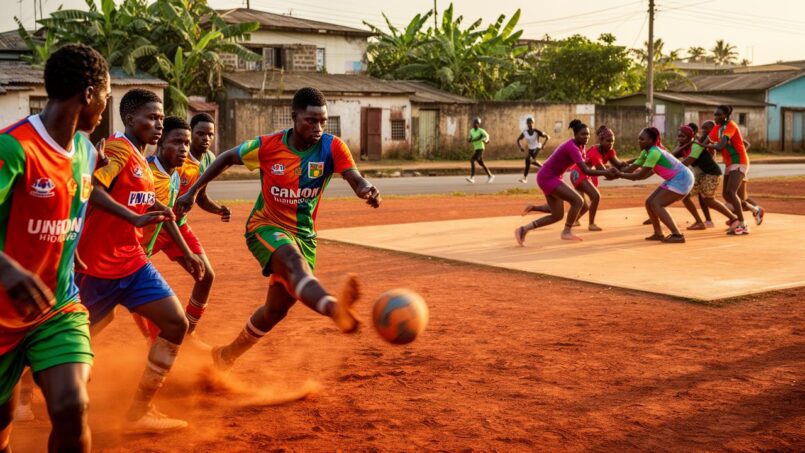
Football is by far the most popular sport to practice in Cameroon. It is often described as a “way of life” as much as a game. Whether it’s a sandy field chalked out in a village or a modern grass pitch in a big city, the round ball is everywhere.
Practically every village has its own field, and matches between rival villages are events in their own right, followed by enthusiastic crowds. It is estimated that about two million people play football in the country, not counting the countless fans who simply participate as supporters.
Playing football: from schoolyards to academies
From primary school onward, children are introduced to football through physical education, and later through competitions organized by the National Federation of School and University Sports (FENASCO). In secondary school, inter-school tournaments structure the practice, and at university, the University Games make football one of the major attractions.
Alongside school, a network of training centers and academies has developed. Structures like the Kadji Sports Academy and the École de Football des Brasseries du Cameroun (EFBC), both in Douala, have become benchmarks. They offer comprehensive support including physical preparation, technical work, academic monitoring, and sometimes boarding accommodation.
There are also many neighborhood schools or independent academies, such as Best Stars Academy, Azur Star Yaoundé, Academy Foot of Douala, Fundesport, Semences Olympique, Coton Sport, and Njalla Quan. Some have already sent players to European clubs, highlighting Cameroon’s role as a major exporter of talent.
To better visualize the scale of football and other sports, we can compare the orders of magnitude of registered players or enthusiasts:
| Sport | Approximate number of participants / enthusiasts |
|---|---|
| Football | 2,000,000 |
| Athletics | 1,000,000 |
| Cycling | 500,000 |
| Basketball | 300,000 |
| Golf | 100,000 |
| Wrestling (traditional & modern) | 150,000 |
| Cricket | 50,000 |
| Baseball | 40,000 |
| Softball | 30,000 |
| Rugby union | 20,000 (including ~3,000 structured players) |
| Handball | 25,000 |
These figures clearly show the weight of football, but also the growing diversity of practiced disciplines.
The Lions’ dream and everyday practice
The popularity of football is also explained by the aura of the national team, the “Indomitable Lions.” Five continental titles, a World Cup run to the quarterfinals in 1990, an Olympic gold medal in Sydney in 2000: these exploits fuel the imagination of young people who, on a dusty field, already see themselves as Roger Milla or Samuel Eto’o.
The Brasseries Football School academy illustrates the link between local training and European success. Its demanding model combines schooling, life discipline, and intensive training over several years. This structure serves as a concrete example, showing young people that a professional career in Europe is accessible and thus encouraging more serious and regular football practice.
In parallel, initiatives like Petrichor Football Association in Yaoundé experiment with inclusive associative models, working with existing academies, offering coach training, and opening clear pathways for young people, including girls. For an amateur practitioner, this means more tournaments, supervised sessions, and bridges between informal play and structured competition.
Traditional sports: a unique sporting identity
The strength of Cameroon’s sports landscape also lies in the vitality of its traditional sports. Wrestling, canoe races, tug-of-war, competitive dances, horse races: these activities are at the heart of social life in many regions and remain accessible to anyone who wants to try them.
Traditional wrestling, from Pala-Pala to village tournaments
Wrestling is undoubtedly the most iconic traditional sport. It is found, in various forms, in almost every village. In some communities, it is part of initiation rites, ceremonies, or conflict resolution. Ethnic groups like the Bakweri or Duala have, for centuries, integrated wrestling into their rituals and festivals.
Practiced by the Bakweri around Mount Cameroon, Pala-Pala wrestling is an important cultural marker. Tournaments take place in the dry season on a cleared area, in front of dignitaries and the village. Wrestlers, men and sometimes women, wear a cloth around the waist and rudimentary protections. Choosing an opponent before the fight adds a tactical and symbolic dimension.
Beyond technique, Pala-Pala is a space for socialization, tension resolution, and leader selection. Legend has it that a major conflict opposed two villages at the end of the 19th century after the death of a great champion, proof of the social importance of this practice. Today, research is dedicated to it, particularly looking at how modernization and Western influence are transforming this traditional wrestling.
Practiced in various forms throughout the country, traditional wrestling is a complete sport that engages the whole body. It is easy to practice, provided you have an open space. Beyond the sporting aspect, it is a powerful vector of social cohesion, especially during festivities that bring together several villages.
Canoe races, tug-of-war, and strength games
Along the coasts and in riverine areas, canoe races remain very popular. Villages challenge each other by lining up brightly colored boats, maneuvered by perfectly synchronized teams of rowers. The practice requires strength, coordination, and a deep knowledge of the waters. It is an intense sport but accessible to local populations, who often have canoes for fishing and transport.
Canoe competitions are especially highlighted during major cultural events, such as the Ngondo festival among the Sawa people, where races are accompanied by rituals, dance, and spiritual ceremonies. For a practitioner, getting involved in a canoe team means both physical training and entering the heart of a living cultural heritage.
This sport only requires a sturdy rope and two teams. Easy to organize during festivals or tournaments, it develops team spirit and a sense of collectivity beyond just muscular effort.
In hunting regions, there are also shooting competitions organized before the start of hunting seasons. These competitions, though more specialized, are tied to a very concrete relationship with territory and subsistence.
Horse races and dance competitions
In the North, where cattle breeding strongly marks the social landscape, horse races hold a special place, especially among the Fulani. Mounting and training a horse requires time, resources, and specific know-how, but these competitions remain highlights of community life, combining prestige, spectacle, and athletic performance.
At the opposite end of the spectrum in terms of movement, dance competitions in the Northwest region offer another face of sport: that of endurance, coordination, and bodily expression. Here, physical practice is intimately linked to music and cultural symbolism. Participating in these competitions means working on physical fitness while perpetuating a collective art.
Modern disciplines on the rise
While football dominates and traditional sports remain alive, many modern disciplines are developing strongly in Cameroon. Some are gaining ground in schools and universities, others are attracting an adult audience looking for new sporting experiences.
Basketball: the youth’s rebound
Introduced in the 1960s, basketball has gradually won over young Cameroonians. Today, it is estimated that there are about 300,000 players, including clubs, school and university teams, and more informal forms on urban playgrounds.
It is a particularly attractive sport for those who dream of following in the footsteps of figures like Joel Embiid or Pascal Siakam, who have become global references in the NBA. For practitioners, basketball offers a complete activity, combining explosiveness, skill, coordination, and tactical sense. It requires little equipment other than a ball and a hoop, which explains the multiplication of courts in neighborhoods and within school facilities.
National competitions structure this practice, while scouting programs and links with American universities or European clubs open up prospects for the best players. For the vast majority of players, however, basketball remains primarily a regular leisure activity, ideal for developing endurance, agility, and team spirit.
Athletics and mountain running: from the stadium to the slopes of Mount Cameroon
Athletics, which appeared around the same time as basketball, brings together nearly one million enthusiasts in various forms: sprints, middle-distance, jumps, throws, race walking, as well as marathons and mountain races.
Distance in kilometers of the ‘Race of Hope’, the iconic race organized every year on the slopes of Mount Cameroon.
For a practitioner, Cameroon offers an exceptional playground: plains, plateaus, makeshift tracks, mountain trails. Running is financially accessible, requiring little more than a pair of shoes, and adapts to all levels: from health jogging to high-level competition. Figures like Françoise Mbango Etone, two-time Olympic champion in triple jump, have shown that the country can produce athletes at the world summit, which stimulates practice.
Cycling: from leisure to competition
Cycling is gaining ground, both as a sport and as a leisure activity. There are about 500,000 enthusiasts, whether riding in the city, on country roads, or on hilly routes around major cities. The diversity of the terrain makes Cameroon an ideal place to take up road cycling or mountain biking.
The Tour du Cameroun is the flagship event attracting local and international teams. This competition strengthens the appeal of cycling and offers amateurs concrete goals: improve, participate in organized rides, or follow the stages as an informed spectator.
Rugby, handball, volleyball: team sports on the rise
Among the team sports on the rise, rugby union holds a special place. Arriving later, around the turn of the 2000s, it has about 20,000 enthusiasts, including some 3,000 structured players in about fifteen clubs. The contact nature, strategic dimension, and image conveyed by major international competitions like the Rugby World Cup or the Six Nations Tournament appeal to a segment of youth.
Handball has about 25,000 players in school and university settings in Cameroon.
Volleyball, meanwhile, has structured itself around an active national federation. The Cameroon Volleyball Cup, as well as club competitions, stimulate practice among both men and women. Well-identified women’s teams – FAP, Nyong, Kelle, Bafia Volleyball Evolution, Club Efoulan – testify to the rise of women’s volleyball, recently boosted by notable continental performances.
To summarize the appeal of these team sports:
| Team sport | Strengths for practice in Cameroon |
|---|---|
| Rugby union | Team spirit, contact, strategy, inspiration from world competitions |
| Handball | Fast pace, suited to gyms, very present in schools |
| Volleyball | Mixed gender, accessibility, regular competitions, strong women’s dynamic |
| Basketball | Strong international image, little equipment, many urban courts |
| Football | Ubiquitous, even basic infrastructure, very strong ties to national culture |
Combat sports and martial arts: boxing, judo, taekwondo…
Combat sports also occupy a growing place. Boxing benefits from an old tradition and a structured federation. The successes of Cameroonian boxers and fighters on the international stage – from the Olympic ring to MMA cages with figures like Francis Ngannou – maintain strong enthusiasm. In many cities, boxing or combat gyms offer training, both for competition and for fitness.
Martial arts like judo or taekwondo are also developing rapidly. For practitioners, these disciplines offer a learning framework centered on self-control, respect, discipline, and self-defense. They are gradually being integrated into school programs or extracurricular activities, which facilitates access.
Water sports, mountain, and outdoor activities
Cameroon’s geography, between the Atlantic coastline, volcanic mountains, plains, and forests, opens up a vast field of outdoor activities for amateur athletes and tourists alike.
Hiking, climbing, and mountaineering on Mount Cameroon
Mount Cameroon, the country’s highest peak, attracts not only runners of the Race of Hope, but also hikers, climbers, and mountaineering enthusiasts. The ascent is a physical challenge that increasingly appeals to local and foreign sportspeople.
Beyond Mount Cameroon, many massifs and hills, especially near big cities like Buea or Yaoundé, are suitable for hiking. However, this practice faces accessibility constraints such as narrow roads, infrequent transport, and travel costs. Studies indicate that distance and transport cost are determining factors in the frequency of visits to these leisure sites.
Nevertheless, mountain walking and climbing remain activities on the rise, ideal for those seeking a mix of sport, nature, and discovery.
Swimming, canoeing, and water gliding
Water activities are also well represented. Swimming, especially in urban areas with public or private pools, is a complete and very popular sport, both for health and relaxation. In some neighborhoods like Etoug-ebe in Yaoundé, pools have been integrated into sports complexes accessible to the public, facilitating learning and regular practice.
In coastal and riverine areas, canoeing is not just for competitions. It is also practiced as a leisure activity: outings, regular training, or sporting events for youth. “Water gliding,” in its various forms, is gaining visibility, though it remains marginal outside major activity hubs.
Golf: a growing practice
Golf, long seen as reserved for an elite, is gradually taking root in the sports landscape. Courses exist in Yaoundé, Tiko, and Kribi and attract several thousand players each year. The number of golf enthusiasts is estimated at around 100,000, although there is not yet a structured professional league.
For practitioners, this discipline combines technical skill, concentration, and walking over long distances. Clubs organize tournaments and introductory sessions, allowing new audiences to try golf, thanks in part to improved infrastructure and outreach policies.
Emerging sports: cricket, baseball, softball, rugby
Since the 1990s and 2000s, several Anglo-Saxon sports have made a notable breakthrough.
Cricket, supported by the Cameroon Cricket Federation, is winning over more and more young people, with about 50,000 enthusiasts. Local clubs organize tournaments and introductory sessions, often in school and university settings.
Estimated total enthusiasts for baseball and softball in Cameroon, disciplines growing quietly but steadily.
In all these sports, the move toward mass participation involves creating suitable fields, training coaches, and establishing regular competitions. The model is often the same: start with school or university activities, then gradually structure civilian clubs open to a wider audience.
Practicing a sport in Cameroon: infrastructure and access issues
While the passion for sport is strong, everyday practice still faces a central reality: the lack of sufficient and well-distributed infrastructure.
Many stadiums, fields, or gyms remain below the standards needed to regularly host high-level competitions. Some major historic clubs still lack modern training centers commensurate with their prestige. For emerging sports, the absence of dedicated fields is an obvious obstacle to increasing the number of participants.
Public policies recognize sport as a health, education, and development issue. Several laws govern these activities, and infrastructure construction is a priority, with projects like the multi-sport complexes in Bamenda or Kousseri. These spaces aim to be accessible to women, youth, and vulnerable groups, and may include multimedia centers to enhance digital skills.
In neighborhoods, some facilities already combine several types of equipment: swimming pools, basketball courts, athletics tracks, etc. These initiatives facilitate access to diverse practice, beyond just football.
To appreciate the challenges related to access to sports leisure sites, several studies have highlighted the weight of three main factors: distance, time, and travel cost. When transport becomes too expensive or too long, attendance drops. This argues for a strategy of tight territorial coverage: multiplying small local facilities rather than concentrating all resources in a few large, distant facilities.
Practicing a sport in Cameroon is not just about maintaining physical fitness or seeking performance. National policies increasingly associate sport with educational, civic, and social cohesion goals.
In schools and universities, competitions organized by FENASCO and other structures do more than select champions: they also serve to instill a sense of collectivity, respect for rules, and managing both victory and defeat. Support programs, led by organizations like JumpStart Academy Africa, now integrate sport-inspired modules into their leadership and entrepreneurship training for youth.
In crisis-affected regions, projects use sport as a tool for reconciliation. For instance, “peace tournaments” or inclusive “royal” football competitions bring together young people from different communities. These initiatives foster dialogue, offer a positive alternative to idleness, and help ease tensions.
Veteran football clubs, very active throughout the country, show in another way how sports practice extends beyond youth. These groups of retired players organize friendly matches, tournaments, charity activities, and contribute to local tourism and economic dynamism. For many former athletes, these clubs are a way to stay active and pass on their passion.
Choosing your sport in Cameroon: practical questions
For those who want to take up a sport or diversify their activities, Cameroon offers a particularly wide range. The choice will mainly depend on a few simple criteria: environment (urban, rural, coastal, mountainous), access to infrastructure, budget, desired level of competition, and personal preference.
In cities like Yaoundé or Douala, a practitioner will easily have access to:
– neighborhood football and basketball fields;
– gyms for handball, volleyball, or martial arts;
– fitness and boxing centers;
– public or private swimming pools;
– specialized clubs (golf, cricket, rugby, etc.).
In villages, traditional sports activities like football, wrestling, tug-of-war, canoe races, as well as local forms of sport dance or shooting competitions, remain dominant. These contexts allow these sports to retain their strength and conviviality.
For nature lovers, hiking, outdoor running, road cycling or mountain biking, and ascending Mount Cameroon represent prime options, which require more organization (equipment, safety, transport), but offer a unique experience.
Finally, combat sports and martial arts appeal to those seeking both an intense physical activity and a structuring framework on the mental and social levels.
Toward an even more sporting future
Cameroon is at a turning point in its sports history. On one hand, it can draw on an immense symbolic capital, forged by the exploits of the Indomitable Lions, Olympic athletes, and champions in various disciplines. On the other, it faces real challenges: insufficient infrastructure, uneven development of practices across regions, and the need for coach training and competition structuring.
Cameroon offers a great variety of sports activities rooted in its culture, from football on dusty fields to traditional sports like Pala-Pala wrestling, climbing Mount Cameroon, learning rugby, and participating in canoe races during festivals.
The future development of infrastructure, increased recognition of traditional sports, and expansion of educational programs around physical activity could further strengthen this dynamic. In this context, practicing a sport in Cameroon means both taking care of oneself, participating in a collective history, and contributing, on one’s own scale, to keeping alive a sports heritage of incredible diversity.
Disclaimer: The information provided on this website is for informational purposes only and does not constitute financial, legal, or professional advice. We encourage you to consult qualified experts before making any investment, real estate, or expatriation decisions. Although we strive to maintain up-to-date and accurate information, we do not guarantee the completeness, accuracy, or timeliness of the proposed content. As investment and expatriation involve risks, we disclaim any liability for potential losses or damages arising from the use of this site. Your use of this site confirms your acceptance of these terms and your understanding of the associated risks.

Cyril Jarnias is an independent expert in international wealth management with over 20 years of experience. As an expatriate himself, he is dedicated to helping individuals and business leaders build, protect, and pass on their wealth with complete peace of mind.
On his website, cyriljarnias.com, he shares his expertise on international real estate, offshore company formation, and expatriation.
Thanks to his expertise, he offers sound advice to optimize his clients' wealth management. Cyril Jarnias is also recognized for his appearances in many prestigious media outlets such as BFM Business, les Français de l’étranger, Le Figaro, Les Echos, and Mieux vivre votre argent, where he shares his knowledge and know-how in wealth management.





