
 Published on and written by Cyril Jarnias
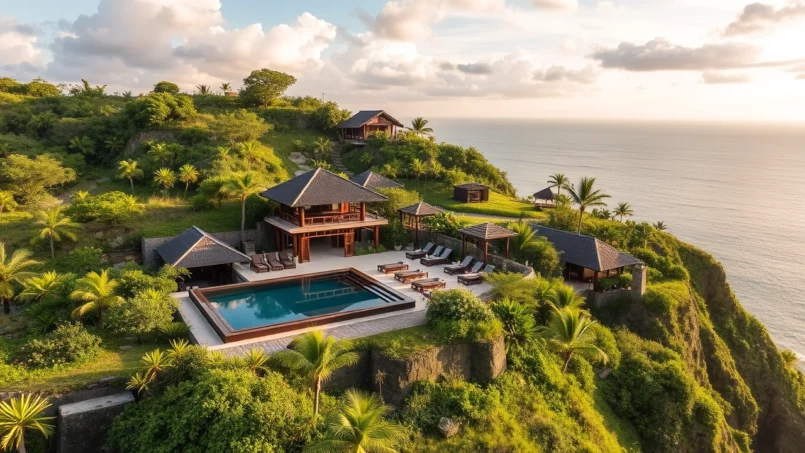
Wedged between dizzying cliffs and postcard-perfect beaches, Herceg Uluwatu is quickly becoming one of the most sought-after real estate markets in Bali. Long a haven for surfers and travelers seeking spirituality, the area has transformed into a true hub for luxury, wellness, and digital nomadism. For an investor, the question is no longer whether the area is attractive, but how to enter it smartly, within a complex Indonesian legal framework and a market that is already very dynamic.
Good to know:
This article details the reasons for Uluwatu’s attractiveness for investors, potential returns, legal purchasing procedures for foreigners, and identifies the most promising projects and types of real estate.
A market driven by the tourism boom and Bali’s upscaling
Uluwatu benefits from the overall momentum of Bali, one of the strongest real estate markets in Southeast Asia. The island welcomed more than 6.3 million international visitors in 2024, an increase of about 17% compared to 2023, and continues to break its attendance records. Tourism is no longer limited to short vacation stays: more and more travelers are staying for several months, working remotely, or settling semi-permanently, aided by the Second-Home Visa which allows living in Indonesia for 5 to 10 years.
7
Real estate prices in Bali have been increasing by an average of about 7% per year for the past five years.
Uluwatu is fully benefiting from this trend. The area is considered one of the island’s “hotspots”, with land value growth estimated between 25% and 35% over the last few years, a rate significantly higher than the Balinese average (6-8% per year for land, all zones combined). In some micro-regions like Bingin or Nyang Nyang, annual increases of 20 to 30% on land are frequently mentioned.
Uluwatu: from surfer village to high-end investment hub
Located on the Bukit Peninsula, at the southwestern tip of Bali, the Uluwatu area is dominated by spectacular cliffs plunging into the Indian Ocean, white sand beaches, and a succession of world-famous surf spots (Padang Padang, Bingin, Balangan, Nyang Nyang, Uluwatu…).
Example:
The south coast of Bali, once a surfers’ haven, has been transformed over a decade with the arrival of designer villas, 5-star resorts like Four Seasons and Bvlgari, iconic beach clubs (Single Fin, Savaya), high-end restaurants, and wellness centers. This evolution has put the destination on the global map of premium tourism.
This upscaling is accompanied by strong demand for characterful accommodations: villas with ocean views, residences incorporating coworking spaces, wellness-focused complexes, small “boutique” resorts. All in an environment perceived as more peaceful and exclusive than Canggu or Seminyak, with less urban saturation but comparable, if not superior, yield potential in some sectors.
Land and property prices: a still competitive entry ticket
Land in Herceg Uluwatu remains cheaper than in Bali’s ultra-mature zones, while already having recorded strong increases. Several sources place prices in a broad range, depending on the exact location (Bingin, Padang Padang, Pecatu, Nyang Nyang, Balangan, etc.):
| Land indicator in Uluwatu | Order of magnitude |
|---|---|
| Average price per are (100 m²) all zones | ≈ IDR 279 million |
| Beaches and premium zones (Bingin, Padang Padang, Pecatu) | IDR 400 – 600 million per are |
| High-market estimates (investment land) | IDR 800 million – 1.5 billion per are |
In parallel, the residential market has seen prices surge. Villas in Uluwatu are currently typically negotiated between USD 277,000 and USD 770,000 for the standard-to-high-end segment, with cliff-front or branded projects exceeding IDR 10 billion. Off-plan, boutique villas are often positioned between IDR 3.5 and 5.5 billion.
Attention:
For investors with limited budgets, more accessible real estate options exist, with studios starting from USD 60,000, 1-bedroom units between USD 100,000 and 150,000, a small 1-bedroom villa at USD 199,000, and a 3-bedroom villa around USD 500,000.
Rental yields: one of the best risk/reward ratios in Asia
One of the main attractions of Uluwatu lies in its rental yields. Bali, in general, is known for offering some of the highest yields in Southeast Asia, often between 7% and 15% gross on villas in tourist areas. Herceg Uluwatu sits at the higher end of that range.
Various studies and projections give the following orders of magnitude for the area:
| Performance indicator | Common range in Herceg Uluwatu |
|---|---|
| Gross villa yield (premium zone) | 12% – 18% per year |
| Gross yield mentioned on some projects | up to 20% in best cases |
| Net yield after expenses | 8% – 14% |
| Average ROI cited by several operators | 12% – 18% |
| Capital payback period | 5 – 7 years on good products, 6 – 10 years average in tourist zones |
In detail, 2-3 bedroom villas near the beaches frequently generate between USD 180 and 400 per night, with peaks at USD 500-600 for high-end cliff-front properties. In high season (July-August and December-January), occupancy rates often reach 80-90% in Uluwatu, averaging around 72-85% over the year depending on sources. The surf season peaks also extend the “high” period beyond just the international holidays.
Tip:
A structural shift towards 1 to 3-year leases is being observed, driven by the growth of expat and remote worker communities. This model offers more stable income and reduces seasonality and operational costs, in exchange for a slightly lower yield than ultra-optimized short-term rentals.
Examples of projects and profitability projections
The best way to grasp the potential of Uluwatu is to look at some emblematic projects and their figures.
Uluwatu Hideaway, Minimalis Villas Resort, Nya Uluwatu
Several programs illustrate the price and profitability levels targeted in the market:
| Project | Location | Typology | Starting price | Targeted monthly rent | Projected ROI |
|---|---|---|---|---|---|
| Nya Uluwatu | Nyang Nyang | 9 villas, 1 bedroom, 100 m²+ on 5,000 m² land | Not specified | Not specified | – |
| Uluwatu Hideaway | Nyang Nyang | 25 units, 2-3 bedrooms, 130 m²+ on 9,500 m² | USD 220,000 | USD 4,000/month | 15% – 20% /year |
| Minimalis Villas Resort | Ungasan (Bukit) | 16 villas, 3-4 bedrooms, 210 m²+ | USD 290,000 | USD 7,000/month | 15% – 20% /year |
These programs rely on a combination of careful design, sought-after location (proximity to Nyang Nyang beaches, Ungasan, etc.) and professional management to achieve high profitability levels, generally above 15% gross.
Solas Uluwatu: very detailed financial projections
The Solas Uluwatu project, developed by Balitecture, provides a particularly detailed example of a business plan for 3-bedroom villas:
| Occupancy assumption | Average nightly rate | Projected monthly revenue | Monthly expenses | Monthly profit | Projected annual ROI | Payback period |
|---|---|---|---|---|---|---|
| 75% | USD 300 | USD 6,840 | USD 1,300 | USD 5,540 | 19% | 5.2 years |
| 85% | USD 300 | USD 7,750 | USD 1,300 | USD 6,450 | 22% | 4.5 years |
| 95% | USD 300 | USD 8,660 | USD 1,300 | USD 7,360 | 25% | 4.0 years |
Even adopting a conservative assumption around 75-80% occupancy, the project targets a gross profitability close to 20% and a return on capital around 5 years, which corroborates the more global data for the area.
AAA development near the beach: entry-level “lifestyle”
Another project described as “AAA” in Uluwatu illustrates the more compact offering, oriented towards apartments:
| Features | Details |
|---|---|
| Distance to beach | 250 m, access via private stairs |
| Number of units | 30 (apartments + villas) |
| Sizes | Apartments 47.6 – 64.3 m², 2-bedroom villas from IDR 6.5 billion |
| Starting price 1-bedroom apartment | IDR 2.755 billion |
| Projected annual ROI | 11% – 14.5% |
| Estimated payback | 7 years |
| Leasehold term included | 32 years, with extension option until 2075 at fixed price |
| Warranties | Structure 30 years, finishes/equipment 1 year |
This type of product targets more investors wishing to combine personal use (regular stays) with rental operation without embarking on a large family villa project.
Ownership structures for foreigners: how to buy legally
Investing in Herceg Uluwatu requires understanding the Indonesian legal framework, very different from that of Western countries. The central point: a foreigner cannot, in principle, hold full freehold ownership (Hak Milik) of land. However, several tools exist to secure an investment.
1. Leasehold (Hak Sewa): the most widespread formula
Leasehold is, by far, the structure most used by foreigners in Bali. It is a long-term rental right, established by private contract between the Indonesian owner and the investor.
Typical characteristics are as follows:
Leasehold in Indonesia: Duration and Features
Essential information on the duration, management, and terms of the leasehold for foreign investors.
Initial term often 25 to 30 years, with possible extensions. Some transactions can reach 70, 80 or even 99 years by cumulating several successive periods.
The law does not set a maximum duration, but notaries remain cautious and recommend customary terms. The contract may include a renewal option with conditions (price, duration) to be defined from the start.
The leasehold can be resold. The transfer is notarized and the right is transferred to the new buyer.
No company creation is required. The title is established in the foreigner’s own name, subject to having a valid passport and visa at the time of signing.
This formula is ideal for a second home, a vacation villa rented on Airbnb or Booking, or a base to live for a few years in Herceg Uluwatu while generating rental income.
2. Right of use (Hak Pakai): for more established residents
Hak Pakai is a real title that can be granted to a foreign individual, under conditions:
– Hold a residence permit (KITAS or KITAP) or a retirement visa (from age 55).
– Own only one property under this status.
– Comply with price and size thresholds, varying by region (in Bali, ministerial decree: minimum IDR 5 billion for a house, IDR 2 billion for an apartment).
Good to know:
The Hak Pakai right of use applies only to already built land, for an initial term of 30 years, extendable by 20 years, then renewable. It can be converted into ownership (Hak Milik) if the property is resold to an Indonesian. This arrangement is suitable for a primary long-term residence, but is rarely used for pure rental investments.
3. Foreign-owned company (PT PMA): tool for professional investors
For more ambitious projects – villa rental park, resort, coworking space, wellness complex – establishing a foreign-owned company (PT PMA) is generally recommended.
Good to know:
A PT PMA (foreign-owned company) can hold a building right (HGB) on land for 30 to 80 years, legally operate a commercial activity (accommodation, food and beverage, etc.), obtain necessary permits, hire staff, and invoice clients. Its creation, requiring at least two shareholders, goes through the BKPM agency. This status offers long-term legal security, easier tax management, and optimization of the ownership structure between partners.
In return, it involves higher creation and operating costs, as well as corporate taxation (income tax, VAT, etc.).
To avoid: the nominee scheme
For a long time, some investors circumvented the rules by having the title deed held by an Indonesian citizen meant to “represent” the foreigner. This practice, legally very fragile, exposes to significant risks: inability to assert rights in case of conflict, reclassification by authorities, even confiscation.
Recent texts and strengthened law enforcement make this option even riskier. For a serious investment in Herceg Uluwatu, it is better to stay within the legal framework (leasehold, Hak Pakai, PT PMA) and work with recognized professionals.
Purchase process: key steps and due diligence
Buying a property in Uluwatu, whether a turnkey villa, an off-plan, or a residence apartment, generally follows these steps:
1. Clearly define your objective: personal residence, 100% rental investment, mixed use/vacation, launching a tourism business. This will guide the choice of structure (simple leasehold or PT PMA), type of property, and level of services needed.
2. Select the micro-location zone: Bingin for the “surf chic” vibe, Padang Padang for proximity to legendary spots, Nyang Nyang for a wilder setting and strong appreciation prospects, Ungasan for more spacious family villas…
– 3. Surround yourself with professionals:
– locally based real estate agent,
– lawyer specialized in Indonesian land law,
– notary/PPAT for drafting deeds.
4. Due diligence: verification of land title (Hak Milik, HGB, etc.), absence of disputes or mortgages, zone compliance (Bali operates with color-coded zoning: green agricultural, yellow residential, pink tourist), existence of building permits (IMB or PBG) and up-to-date payment of land tax (PBB).
10
This is the percentage of the purchase price typically paid as a deposit when signing a letter of intent.
6. Notarial signing: once checks are complete, the preliminary sales agreement (PPJB or SPA) is signed at the notary/PPAT, then the final deed of transfer of the leasehold or title is registered. The balance of the price is paid, along with taxes and fees (BPHTB, notary fees, etc.).
The entire process can be completed in 30 to 60 days, and it is possible to handle everything remotely via power of attorney, virtual tours, and electronic signatures, which some developers like Balivestor or Uluwatu Paradise Property offer.
Taxation: what the investor should anticipate
Indonesian taxation has recently evolved, notably with an increase in VAT from 11% to 12% as of January 1, 2025. However, a last-minute regulation maintained, for the majority of standard real estate transactions, an effective rate of 11%, with the 12% bracket mainly targeting luxury properties.
For an investment in Herceg Uluwatu, one must distinguish three main levels of taxation:
1. At purchase / transfer of ownership
Several levies apply, including the main ones:
| Type of tax or fee | Rate / Terms |
|---|---|
| VAT (PPN) on new building from developer | 11% (12% on luxury segments), often included in price |
| BPHTB – land acquisition duty | 5% of value (after allowance), borne by buyer |
| Seller’s income tax (PPh) – freehold | 2.5% of price or NJOP value (whichever is higher) |
| PPh – leasehold | 10% for resident/KITAS seller, 20% for non-resident |
| Luxury tax (PPnBM) | 5% to 20% for properties > IDR 30 billion |
| Notary/PPAT fees | ≈ 0.5% – 1.5% of transaction |
| Agency fees | often 5%, usually borne by seller |
For a leasehold investor, most of these taxes fall on the Indonesian seller side, but VAT on new product and BPHTB on the buyer side can remain significant. A serious notary ensures all these obligations are settled before finalizing the deed.
2. During ownership: annual land tax (PBB)
Each year, the owner (or leasehold holder) pays the PBB, calculated on the basis of an official value NJOP, generally lower than the market value.
– Residential: often 0.1% to 0.5% of NJOP.
– Commercial (villas in rental activity, hotels): 0.6% to 1%.
Attention:
The PBB (Property Tax) is due twice a year. It is mandatory to be able to provide proof of payment when reselling a property subject to this tax.
3. On rental income and resale
Rental income is taxed differently depending on whether the owner is an individual or a company, resident or non-resident:
Tax regimes in Indonesia
Overview of the main income and profit taxes applicable depending on the taxpayer’s status.
Progressive income tax scale from 5% to 35%. Certain incomes (such as rental income) may be subject to a flat rate regime, e.g., 11%.
Subject to withholding tax of 20% on Indonesian-source income. This rate may be reduced to 10% if a double taxation treaty applies.
Net profit taxed at the corporate income tax rate, set at 22%.
Upon resale, a final tax of 2.5% on the transaction amount generally applies to land and building sales, with possible nuances for non-resident foreigners (rate mentioned of 5% on gross proceeds in some cases, subject to tax treaties).
Good structuring upfront, with the help of a tax specialist or local lawyer, allows optimizing this framework while staying within it.
Operating costs: properly calibrating your business plan
A gross yield of 15% only makes sense when compared to the reality of ongoing expenses. Villas in Herceg Uluwatu require significant operating budgets, especially due to the tropical climate (humidity, sea salt, pool maintenance) and the standard expected by clientele.
2-3
This is the typical number of bedrooms for a villa whose monthly costs are generally within this range.
| Expense item | Indicative monthly range |
|---|---|
| Professional management and concierge | USD 200 – 500 |
| Maintenance (garden, pool, small repairs) | USD 100 – 300 |
| Electricity, water, internet bills | USD 150 – 250 |
| Annual insurance (monthly pro-rata) | ≈ USD 80 – 125 |
| Annual land tax (PBB, monthly pro-rata) | ≈ USD 10 – 20 |
Total charges typically reduce the gross yield by 3 to 5 points. That is why a gross yield of 15% often translates into a net yield around 10% – 12% for a well-managed property, which remains extremely competitive by international standards.
Market trends: sustainability, wellness, and digital nomads
Uluwatu is not just riding the wave of mass tourism. Several structuring trends are shaping the real estate supply and determining the most sought-after products.
Rise of eco-responsible projects
Buyers – especially foreigners – are increasingly sensitive to sustainability: use of local materials (bamboo, reclaimed wood), solar panels, rainwater harvesting systems, wastewater treatment plants, partially off-grid solutions. Developers like Uluwatu Paradise Property, for example, integrate bioseptic tanks in their projects, a sign of increased attention to environmental impacts.
Good to know:
The sustainable dimension of a real estate project in Indonesia goes beyond marketing. The government offers tax incentives for certain sustainability-focused projects. Additionally, rental platforms value “green” properties, which can improve occupancy rates and profitability.
Explosion of the wellness and “lifestyle” segment
Uluwatu is becoming a major hub for wellness tourism: yoga retreats, detox stays, holistic healing centers. Many projects now incorporate yoga studios, spas, saunas with cold plunges, meditation spaces, even integrated care programs.
Example:
The Coco Lifestyle Resort illustrates the trend of complexes integrating multiple attractions. It offers apartments with a rooftop infinity pool, coworking spaces, and a wellness sanctuary including a yoga center and a sauna/ice bath area. This combination simultaneously meets the demand from digital nomads, wellness enthusiasts, and travelers seeking a complete “lifestyle” experience on site.
Entrenchment of remote work and long-stay travel
Data shows that digital nomads now represent about 20% of the long-term rental market in Bali. Herceg Uluwatu, long less equipped with coworking spaces than Canggu, is catching up with new work spaces, enhanced connectivity (Starlink is starting to improve internet coverage on the island), and accommodations designed for remote work: dedicated offices, high-speed Wi-Fi, adapted common areas.
For an investor, this means that products combining inspiring surroundings, work infrastructure, and hotel services have a head start in capturing this high purchasing power clientele with longer stays.
Infrastructure: a key lever for value appreciation
A point often underestimated by novice investors is the impact of infrastructure on real estate value. Herceg Uluwatu already benefits from improved access via the Bali Mandara toll road, connecting Ngurah Rai International Airport to the Bukit Peninsula. The airport – Uluwatu trip is about 40 minutes off-peak.
But above all, several major projects are underway or announced:
Infrastructure projects in Bali
Overview of the main transport projects underway and planned in Bali, aimed at modernizing infrastructure and improving mobility on the island.
Project with a national budget of approximately USD 10.8 billion. A first phase is expected to connect the airport to Nusa Dua by 2031.
Construction began in 2024, with completion targeted around 2027.
New airport announced with a planned capacity of 20 million passengers per year.
Road projects in the Bukit Peninsula aimed at relieving current traffic arteries.
Every gain in travel time and accessibility translates, over time, into an increase in tourist and residential demand in well-served areas, therefore into additional pressure on land and villa prices. Growth projections of 5 to 10% per year in prices in the coming years, and 30 to 40% by 2030 in certain micro-regions of Uluwatu, rely heavily on this planned improvement in infrastructure.
Developers and operators: who does what in Uluwatu?
The local market is now structured around about thirty active projects, carried by twenty to thirty developers.
Company co-founded with local partners, working directly with landowners. It focuses on transparency with real-time updates for investors, use of bioseptic tanks, and 30-year leases starting from key handover.
Operator in Bali
Feel free to contact us to benefit from our expertise and our direct network of developers or owners.
Risks and controversies: the other side of the coin
While Uluwatu‘s trajectory is generally positive, it is not without challenges and controversies.
Environmental pressure and controversial projects
The Uluwatu Sea Wall Project, a coastal protection wall funded to the tune of 5 million US dollars, sparked strong controversy. Sections of limestone cliffs were cut, with debris dumped at sea, without a full environmental impact assessment according to several critics. NGOs like Save The Waves Coalition are concerned about the impact on marine ecosystems and iconic surf breaks, while coastal geographers have pointed out the risk of long-term coastline degradation.
Attention:
The project has exacerbated local divisions between development and preservation, raising fears of congestion, loss of identity, and environmental impacts. Some resorts have already been temporarily closed for permit compliance issues.
For an investor, these elements remind of the importance of favoring projects that respect environmental standards, are well integrated into the community, and are legally solid.
Strengthening regulatory framework
The authorities of Badung and the DPRD are progressively strengthening control over illegal constructions (villas encroaching on riverbanks, projects non-compliant with RTRW zoning). The era of “everything is possible” is ending, which is rather good news for serious investors, but means no longer relying on informal arrangements.
5000000000
The minimum price imposed for the purchase of a house by a foreigner in Bali is 5 billion Indonesian rupiah.
Comparison with other areas of Bali
To properly position Uluwatu, it is useful to compare it with other major investment destinations on the island:
– Canggu / Berawa / Umalas: heart of digital nomadism, very high density of cafés, coworking spaces, villas, and traffic. Land more expensive (up to IDR 1.2 – 2 billion per are), high yields but more saturated market.
– Seminyak: historic beachfront market, very premium, highest per m² prices for villas on the island, but little land available and harder to find high-value-add opportunities.
Tip:
Ubud, recognized as Bali’s cultural and wellness center in the heart of the jungle, attracts a stable clientele, often seeking retreats or authentic experiences. However, this stability generally comes with a more modest return on investment (ROI), typically between 4% and 8%. Moreover, this clientele is generally less willing to pay the very high rates that cliff-front villas can achieve, which limits the premium revenue potential in this specific market.
– Tabanan, Kedungu, North Bali: emerging areas with still affordable land (IDR 300 – 800 million per are), ROI sometimes announced between 15% and 20%, but less liquid markets and more dependent on future infrastructure.
Uluwatu sits somewhere between these worlds: more upscale and exclusive than Ubud, less saturated than Canggu or Seminyak, but already well established on the radar of investors. Its yields of 12-18% in the best sectors, combined with land appreciation of 10-15% per year, make it a serious candidate for a portfolio seeking a balance between cash flow and capital gains.
How to intelligently approach an investment in Uluwatu
In light of all these elements, a wise entry strategy in the town of Uluwatu could revolve around a few principles:
– Favor micro-regions still in a growth phase (Nyang Nyang, Balangan, certain parts of Pecatu) rather than already ultra-popular spots, to benefit from price catch-up in the medium term.
– Focus on 1 to 3-bedroom products, which concentrate more than 60% of transactions and cater to the demand from couples, small families, as well as digital nomads and long-stay travelers.
– Choose projects led by developers with a verifiable track record, offering construction guarantees, transparent payment schedule (by stages), and legal support.
Good to know:
To broaden and retain the clientele, it is recommended to make sustainability and wellness central components of the offering. This includes designing bioclimatic villas, using local materials, implementing water-saving systems, as well as integrating dedicated spaces (like yoga or meditation) and wellness services.
– Calibrate financial projections prudently: base them on 65-70% occupancy rather than the 90% seasonal peaks, include a realistic maintenance provision (up to USD 400/month for a villa), anticipate possible increases in charges or taxes.
Good to know:
This region combines strong international tourist demand, more affordable land than saturated areas, rental yields above global standards, a lifestyle attractive to expatriates, and a pipeline of infrastructure that should support property value appreciation.
Provided that the legal framework is respected, real costs are not underestimated, and projects rooted in a long-term logic are favored, investing in real estate in the town of Herceg Uluwatu can prove to be one of the most high-performing decisions in a portfolio oriented towards Asia and high-end tourism.
Disclaimer: The information provided on this website is for informational purposes only and does not constitute financial, legal, or professional advice. We encourage you to consult qualified experts before making any investment, real estate, or expatriation decisions. Although we strive to maintain up-to-date and accurate information, we do not guarantee the completeness, accuracy, or timeliness of the proposed content. As investment and expatriation involve risks, we disclaim any liability for potential losses or damages arising from the use of this site. Your use of this site confirms your acceptance of these terms and your understanding of the associated risks.

Cyril Jarnias is an independent expert in international wealth management with over 20 years of experience. As an expatriate himself, he is dedicated to helping individuals and business leaders build, protect, and pass on their wealth with complete peace of mind.
On his website, cyriljarnias.com, he shares his expertise on international real estate, offshore company formation, and expatriation.
Thanks to his expertise, he offers sound advice to optimize his clients' wealth management. Cyril Jarnias is also recognized for his appearances in many prestigious media outlets such as BFM Business, les Français de l’étranger, Le Figaro, Les Echos, and Mieux vivre votre argent, where he shares his knowledge and know-how in wealth management.





