
 Published on and written by Cyril Jarnias
Nusa Penida is not a district of Bali, nor a simple day trip: it is a full-fledged island, southeast of Bali, quickly becoming one of the most promising real estate markets in Indonesia. With its dizzying cliff landscapes, turquoise waters, still-wild beaches, a tourism boom fueled by social media, massive infrastructure projects, and an official “green and smart island” strategy, all the ingredients are in place to attract investors who missed the boat in Canggu or Seminyak.
Good to know:
Investing in Nusa Penida means navigating a strict legal framework for foreigners, still-incomplete infrastructure, strong environmental constraints, and a market where prices are rising rapidly. Thorough analysis is essential before any financial commitment.
Nusa Penida: A Young Market, But Already Strategic
Nusa Penida, an island in the Klungkung regency, long remained the quiet little sister of Bali. In just a few years, it has gone from being a peaceful retreat to a global destination, propelled by viral spots like Kelingking Beach, Broken Beach, and Crystal Bay.
Example:
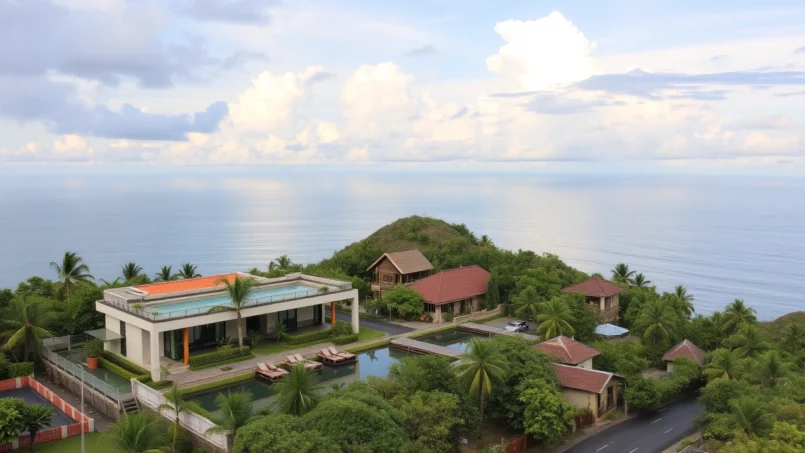
The island of Nusa Penida, off the coast of Bali, stands out for its drier climate, spectacular cliffs, crystal-clear waters, and sacred temples. It is renowned for world-class dive sites like Manta Point or Toya Pakeh, and offers a wilder, more serene atmosphere than mainland Bali. This unspoiled setting attracts not only tourists and divers but also a new wave of investors, expats, and digital nomads.
The Nusa Penida real estate market is thus described as rapidly growing, with “intact” potential and long-term prospects considered very promising. On average, prices remain 30 to 40% lower than in Canggu or Seminyak for comparable land, even as demand surges. In other words: the island is at the stage Bali was several years ago, with a “window of entry” that is narrowing but still open.
Booming Tourism: The Engine of Real Estate
The real estate dynamic in Nusa Penida is first and foremost a story of tourism. Kelingking Beach welcomes more than 5,000 visitors per day, and up to 7,000 tourists can land on the island daily during peak season. Visitor numbers have increased by over 150% since 2019 and are expected to double again by 2026.
90
The occupancy rate for top vacation rental villas can reach nearly 90% during peak season.
The island is no longer just a quick stop from Sanur: it now attracts travelers who stay several nights, diving enthusiasts, as well as a wealthier audience sensitive to environmental issues. This shift generates a massive need for quality accommodations, restaurants, beach clubs, ecolodges, leisure services, and infrastructure, which directly translates into rising real estate demand.
A Market with Rapidly Rising but Still Affordable Prices
Compiled market data shows that prices in Nusa Penida are rising quickly, but from a level still accessible compared to Bali hotspots. The annual increase in land values is estimated at 15–20%, with some plots having doubled in a year.
To get a clearer picture, it’s helpful to look at some price benchmarks.
General Price Ranges
In 2024, several sets of figures emerge for Nusa Penida:
| Type of property / indicator | Indicative amount |
|---|---|
| Land – overall range | 500 million to 3 billion IDR |
| Villa – overall range | 300 million to 10 billion IDR |
| Average house price | 300 million IDR (~18,300 USD) |
| Average land price | 100 million IDR (~6,100 USD) |
| Average house price per m² | 10 million IDR/m² (~610 USD/m²) |
| Average land price per m² | 2.5 million IDR/m² (~153 USD/m²) |
| Average house rent (annual) | 100 million IDR (~6,100 USD) |
These averages hide strong disparities depending on location, view, accessibility, and proximity to iconic spots.
Price per Are by Zone
The local market often talks in “ares” (100 m²). Depending on the area, the average observed prices are as follows:
| Sector of Nusa Penida | Average price per are (100 m²) |
|---|---|
| Crystal Bay | 10,000 – 20,000 USD |
| Toyapakeh / Toya Pakeh | 8,000 – 15,000 USD |
| Atuh Beach | 5,000 – 12,000 USD |
| Rural hinterlands | 3,000 – 6,000 USD |
Residential land by the sea or near the seafront can start around 300–500 million IDR (20,000–33,000 USD) per are, and climb well beyond 1.5 billion IDR for premium plots. By comparison, an are in Canggu often exceeds 50,000 USD.
Concrete Listing Examples
Several listings illustrate the breadth of the price range:
| Reference / description | Area | Unit price |
|---|---|---|
| “RF7524” | 500 m² | 300,000,000 IDR / are |
| “RF8713” | 600 m² | 551,000,000 IDR / are |
| “BHI702” | 8,500 m² | 65,000,000 IDR / are |
| “RF8039” | 25,800 m² | 61,500,000 IDR / are |
| Land 5 ares with view of Kelingking Beach | 500 m² | 2,500,000,000 IDR for 5 ares |
| “SMOKY 1” (Southwest, near Broken Beach) | 450 ares | 120,000,000 IDR / are (sale) |
| “SAKTI 1” (West, sea view, 15 min from port) | 80 ares | 4.5 million IDR / are / year (lease) |
These differences stem as much from location as from the state of access (road), the presence of electricity and water, and especially zoning which determines what can be built.
Where to Invest in Nusa Penida: Focus on High-Potential Zones
The value of a property on the island is largely correlated with its location. Some areas stand out distinctly.
Crystal Bay, Toyapakeh, and the Northwest Corridor
Crystal Bay is one of the busiest bays, ideal for waterfront projects, beach restaurants, clubs, or villa complexes with quick sea access. Toyapakeh, near the main ports in the northwest, already concentrates many accommodations, dive centers, and services.
Caution:
The corridor connecting the ports (Toya Pakeh, Buyuk, Sampalan) to the main spots concentrates the island’s tourist activity and the majority of Airbnb listings. This area shows prices closest to those of Bali and offers the most immediate rental returns.
Kelingking, Broken Beach, and the Southwest
The southwest, home to Kelingking Beach, Angel’s Billabong, and Broken Beach, attracts crowds of visitors and is seeing large projects multiply. Land like “SMOKY 1,” near Broken Beach, illustrates the appetite for large plots to be developed into villa complexes, resorts, or ecolodges.
The planned 182-meter glass cable car at Kelingking (currently suspended for environmental and safety reasons) also shows heavy investor interest in this area—and the potential tensions between development and preservation.
Atuh Beach, Suwehan, and the East Coast
The northeast and southeast, particularly around Atuh Beach and Suwehan Beach, still offer more moderate prices, with land suitable for building quiet villas and resorts, often with spectacular views but less developed road access.
Tip:
The recent opening of the Sampalan port is boosting development towards the east of the island, creating a new growth corridor. This emerging area offers the advantage of plots whose prices remain relatively affordable.
The Rural Interior: The Long-Term Option
The rural hinterlands offer the cheapest land. They are suitable for agriculture, more modest residences, or eco-tourism projects integrated into nature. Prices can be 3,000 to 6,000 USD per are, with strong appreciation potential as infrastructure (roads, water, electricity) expands inland.
Land or Villa: Two Very Different Investment Strategies
Investing in Nusa Penida can involve buying raw land or villas (ready-built or off-plan). Each option has its advantages and constraints.
Betting on Land: A Wager on Appreciation
Acquiring raw land remains the most affordable way to enter the market.
The main advantages are clear. The entry price is significantly lower than a built villa, especially for large areas. Flexibility is maximal: you can let the land appreciate, or develop later according to demand (villas, commercial, ecolodges, etc.). Future scarcity works in favor of early movers: as developable land becomes rarer, well-located offerings gain value, sometimes very quickly.
Good to know:
This approach carries several key risks: zoning rules are increasingly strict and variable, some land is not or hardly developable (especially in green or protected areas), obtaining building permits may become more restrictive and costly, existing infrastructure (roads, water, electricity) may be insufficient and significantly increase costs, and finally, land generates no income until it is built upon or leased.
Before any land acquisition, it is essential to understand the zoning system used in Bali and applied to Nusa Penida.
Zoning: A Non-Negotiable Point
The Balinese zoning scheme is based on a color code that limits possible uses:
| Zone Color | Main Permitted Use |
|---|---|
| Green | Agricultural only, no construction |
| Yellow | Residential and small commercial activity |
| Pink | Tourism (hotels, resorts, rental villas) |
| Orange | Mixed residential/commercial |
| Red | Commerce and services |
| Dark Brown | Industrial |
For a tourism investment (villas, hotels, beach club), only land in pink zones or, in some cases, yellow/orange zones are of interest. Buying in a green zone means betting on a hypothetical regulatory change, with a real risk of project blockage.
Local Klungkung regulations and planning schemes (RTRW) must be verified with authorities or via tools like the Batara map. The golden rule: never rely solely on a seller’s word; obtain official confirmation.
Investing in a Villa: Immediate Income and Faster ROI
The other approach is to buy an existing villa or an off-plan project. In a market where the supply of quality villas is still limited compared to booming tourism demand, this strategy has several advantages.
8-12
Projected annual gross rental yields for well-located villas on Nusa Penida.
Structured projects like “condo-hotels” or managed resorts, such as certain eco-luxury programs, announce targeted yields of around 15% per year, through leaseback and integrated management structures. Examples like Blue Sarin or CROSS Celesta Nusa Penida illustrate this positioning, with entry tickets starting at around 890 million IDR for some products, and leases extending up to 80 years.
In return, villas involve higher and recurring costs. Maintenance, management, staff costs, wear and tear from the marine climate, platform promotion, rental management commissions must all be factored in. The villa market can also become competitive in the most touristy areas, requiring differentiation through quality, architecture, view, or the experience offered.
Rental Yields and Airbnb Data: What the Numbers Say
To assess the potential of Nusa Penida, it’s useful to look at compiled data on short-term rentals.
A performance breakdown shows very clear gaps between the best listings and the rest of the market.
| Performance Segment (Airbnb) | Average Gross Monthly Revenue | Average Occupancy Rate | ADR (Average Nightly Rate) |
|---|---|---|---|
| Top 10% | ≥ 4,073 USD | ≥ 65% | ≥ 282 USD |
| Top 25% | ≥ 1,968 USD | ≥ 45% | ≥ 172 USD |
| Median | ~ 703 USD | ~ 26% | ~ 97 USD |
| Bottom 25% | ~ 266 USD | ~ 15% | ~ 54 USD |
The best-performing properties—often well-located, well-managed, and properly photographed—stand out clearly. They demonstrate that in strategic locations (Toyapakeh, Crystal Bay, Sakti, proximity to main spots), it is possible to rival yields seen in the best areas of Bali.
Seasonal Trends
Average evolution of key indicators over a typical year, highlighting the impact of seasons.
Generally quieter period with reduced activity. Ideal time for planning and maintenance.
Gradual restart of activity. Notable increase in demand and initiated projects.
Peak annual activity. High demand, sustained pace, and crucial period for results.
Sustained activity stabilizing after the summer peak. Key period for project finalization and reviews.
| Period | Average Monthly Revenue | Average Occupancy | Average ADR |
|---|---|---|---|
| High season (July-Sept.) | ~ 2,422 USD | ~ 41% | ~ 144 USD |
| Shoulder season | ~ 720 USD | ~ 17% | ~ 142 USD |
| Low season (March, April, Dec.) | ~ 0 USD (for some listings) | ~ 0% for the least active | ~ 152 USD (prices sometimes maintained) |
These figures show that an investor must factor in a strong seasonal effect and aim to maximize the high season with a tailored pricing policy, while accepting slower periods. Professional management (calendar, dynamic pricing, marketing) becomes a major lever to smooth income.
Legal Framework: How a Foreigner Can Hold Property in Nusa Penida
The main pitfall for a foreign investor in Indonesia is legal: the Basic Agrarian Law (Law No. 5 of 1960) reserves full land ownership (Hak Milik) for Indonesian citizens only. Foreigners therefore cannot be title owners of land in Hak Milik in Nusa Penida.
However, several legal structures allow control and exploitation of a property without direct full ownership.
The Main Families of Land Rights
Four types of rights dominate the Indonesian real estate landscape:
| Title | Possible Holder | Typical Duration | Main Use |
|---|---|---|---|
| Hak Milik (ownership) | Indonesian citizens only | Unlimited | Full ownership |
| Hak Sewa (Leasehold) | Foreigners/legal entities | Contractual (25–30 years, extendable) | Right to lease and use |
| Hak Pakai (Right of Use) | Foreigners / PT PMA | 30 years + extensions (up to 80 years) | Primary residential use |
| Hak Guna Bangunan (HGB) | Legal entities (PT PMA…) | 30 years + extensions (up to 80 years) | Right to build and operate |
Leasehold (Hak Sewa): The Simplest Path
For an individual foreigner, the most common and simplest form is the long-term lease (Hak Sewa). Essentially, it involves leasing land or a villa for 25 to 30 years, with written extension options that can bring the total duration to 70–80 years.
The lease grants a right of use and ownership of all constructions and improvements made during the contract period. The land legally remains the property of an Indonesian.
Good to know:
Investing in leasehold in Bali offers a lower entry ticket (from around 80,000 USD), a quick acquisition process, and clear taxation (10% tax on the lease value borne by the lessor). However, the property’s value decreases mechanically as the lease end approaches if its extension is not secured.
Hak Pakai: For Residential Use in Your Own Name
A foreigner holding a residency permit (KITAS or KITAP, or a retirement visa over 55) can obtain a right of use (Hak Pakai) on an already-built plot. This title, initially 30 years, can be extended to reach up to 80 years total.
It is nevertheless subject to size and value caps, and limited to one property per person. Moreover, it is intended for residential use, not massive short-term rental business. This is an interesting solution for those who want a villa in their name without a corporate structure, but less suited to large commercial projects.
PT PMA + HGB: The Structure for “Playing in the Big Leagues”
For larger-scale projects (resort, villa complex, beach club, commercial ecolodge), the most robust option is the creation of a foreign-owned company (PT PMA). This company, duly registered with BKPM, can hold a building right (HGB) on land, initially for 30 years with possible extensions up to 80 years.
Good to know:
Creating a PT PMA (foreign capital company) in Indonesia involves strict requirements: a minimum paid-up capital of around 10 billion IDR (630,000 USD), at least two shareholders, a director, as well as reporting, accounting, and tax compliance obligations. In return, it allows legally conducting commercial activities, renting properties, employing local and foreign staff, and can facilitate obtaining residency permits for directors.
“Nominee” Arrangements: To Be Avoided
Once widespread, arrangements using an Indonesian as a “nominal” owner to circumvent the prohibition on Hak Milik are now clearly illegal and unprotected. The Investment Law (Law No. 25 of 2007) renders them null and void. In practice, the investor can lose their investment overnight with no real recourse.
All serious sources insist: absolutely avoid “nominee” agreements, even if they promise apparent simplicity or lower cost.
Purchase Procedure: The Key Steps
Whether it’s a lease or a right held via a PT PMA, the process follows a few essential steps.
After negotiation and acceptance of an offer, the buyer chooses a notary (PPAT) who will act as a trusted third party. A deposit—often between 10 and 25% of the price—is then placed in an escrow account. The notary initiates due diligence: verification of the land certificate, absence of disputes or mortgages, zoning check, environmental constraints (important in Nusa Penida, an ecologically sensitive area).
Good to know:
For any construction, a PBG permit is required. For tourist rentals (e.g., Pondok Wisata), a specific license is necessary. Once checks are done, the notary drafts the final deed (lease or title transfer), registers it with BPN, and handles payment of applicable taxes (BPHTB, leasehold levies, etc.).
Notary fees generally range between 1 and 2.5% of the transaction amount, sometimes negotiable for large deals. To this are added agency commissions (often around 5%) if a real estate intermediary was involved.
Costs, Taxation, and Financing: What to Anticipate
Beyond the price of the property itself, several expense items must be included in a realistic budget.
Acquisition taxes mainly include the Land and Building Acquisition Duty (BPHTB), around 5% of the declared value, as well as capital gains taxes on the seller’s side. In the case of a lease, it is the lessor who bears a withholding of around 10% on the declared contract value (or 20% if they don’t have a tax number).
Tip:
Each year, a land and building tax (PBB) is due, calculated on the cadastral value. Although generally moderate, it can become significant for large areas. Also budget for maintenance costs, management fees, as well as personnel and energy costs. Regarding financing, Indonesian banks rarely grant loans to foreigners. It is therefore prudent to plan for personal funding or use a financial institution from your home country.
As a broader benchmark, estimates for Bali indicate that operating expenses reduce gross yields by 3 to 5 percentage points. A reasonable net yield target is around 8–12% in the best cases, for well-managed and well-located properties.
Infrastructure and Major Projects: What Will Change the Game
Nusa Penida still lags behind Bali in infrastructure, but the trajectory is very clear: the provincial government and Klungkung regency are openly betting on the island as a showcase for sustainable tourism.
A “Masterplan Pembangunan Nusa Penida 2025–2035” has been developed, with a vision of a “green and smart tourism island”. Two main pillars guide this plan: the creation of conservation corridors and the goal of 100% renewable energy independence by 2030.
30
A ring road of approximately 30 km is planned around the island, with a design already validated.
A massive energy transition is also in preparation. Analyses mention a potential of over 3,200 MW of renewable energy (mainly ground-mounted solar, plus some rooftop solar and biomass) on Nusa Penida. An investment of around 100 million USD is envisioned to completely wean the island off diesel plants, as part of the “Bali Net-Zero 2045” goal. Smart micro-grid pilots are planned, with support from the state, state-owned enterprises (PLN), and dedicated funds.
Good to know:
The island of Nusa Penida is already well connected to Bali by fast boats (30 to 40 minute trips from Sanur and Kusamba, with dozens of daily departures). Projects are underway to further improve access, with studies for a second port in Sanur and a “sea taxi” service directly from the airport to areas like Uluwatu and Jimbaran. These developments support land and property values in the medium term.
Environment, Sustainability, and Risks: A Delicate Balance
If Nusa Penida has become so attractive, it is primarily due to its unspoiled character: intact cliffs, clear waters, marine life, a bird sanctuary shared with Nusa Lembongan and Nusa Ceningan, and a marine protected area of over 20,000 hectares.
This beauty, however, creates constraints for investors. Many areas are subject to strict conservation rules, and some plots, despite a fabulous view, are not developable or only with great difficulty, due to incompatibility with spatial plans or failure to meet environmental impact assessments.
Caution:
The Kelingking glass elevator project, although funded and advanced, was suspended by provincial authorities for non-compliance with procedures: incomplete environmental permits, zoning violations, and landslide risks in a protected area. This example demonstrates that ignoring regulations and underestimating ecological issues can lead to a total project freeze, or even mandatory dismantling.
Renewable energy projects themselves are debated: some ground-mounted solar parks are in tension with protected forest areas. The official direction remains that of sustainable tourism, inspired by the Balinese principle of Tri Hita Karana (harmony between man, nature, and the spiritual), with measures such as visitor quotas, eco-tickets, and conservation taxes.
Good to know:
Integrating eco-responsible criteria from the project design stage (sober materials, water management, solar energy, wastewater treatment, waste sorting) is not only an ethical choice but also a competitive advantage and a factor of sustainability for the investor.
Local Community: A Partner, Not a Backdrop
The success of a real estate investment in Nusa Penida is not only about numbers. The island has a strong cultural identity, daily rituals, powerful temples, and close-knit communities centered around banjars (village organizations).
Example:
Projects that import a model disconnected from the local fabric often encounter resistance (permit difficulties, opposition, tensions). Conversely, those that involve locals (local hiring, local sourcing, respect for customs, community support) benefit from better acceptance and a positive reputation.
Beyond the relational aspect, there is also the economic interest: the more development benefits residents (jobs, training, markets for local products), the more stable and attractive the overall ecosystem becomes. On an island where tourism now creates sustainable jobs, responsible real estate can become a powerful lever for shared development.
Getting Support: Agencies, Developers, and Specialized Advisors
The Nusa Penida market attracts many intermediaries, from the most serious to the most opportunistic. Some firms stand out for their proven experience in the region or Bali, good knowledge of Indonesian law, and already delivered projects.
Key Players for Investing in Bali and Nusa Penida
Main agencies, developers, and consulting firms assisting foreign investors in Balinese real estate.
In a market where illegal schemes still exist, surrounding yourself with a lawyer specialized in Indonesian real estate law, a recognized PPAT notary, and a reliable local agent is not a luxury, but a basic precaution.
Feel free to contact us to benefit from our direct network of promoters and owners.
How to Concretely Approach an Investment in Nusa Penida
For a foreign investor looking to get into real estate in the city of Nusa Penida, a few main lines of action emerge.
The first is to clarify your objective: are you primarily seeking long-term appreciation via land, regular rental income via a villa, a mix of both, or a commercial project (resort, ecolodge, beach club)? This answer will determine the type of title (Leasehold, Hak Pakai, PT PMA + HGB), budget, level of legal complexity, and acceptable risk profile.
Good to know:
Choosing the location must consider several key factors to attract the target clientele and optimize occupancy. Evaluate proximity to ports, access to beaches and dive sites, road quality, view offered, ambient noise level, and the future development potential of the sector. These parameters directly influence the property’s value and its ability to be profitable in both high and low seasons.
The third step is land and regulatory due diligence. Land certificate, zoning, environmental status, existence of easements or local disputes, quality of access, and presence of utilities: none of these elements should be taken lightly. The example of projects halted due to non-compliance shows that “turning a blind eye” is not an option.
10 to 20
Difference in occupancy points between a property managed in a DIY fashion and one entrusted to a professional operator, according to experiences in Bali.
Nusa Penida vs. Bali: Complement or Alternative?
Stepping back, the island positions itself today as a “new frontier” for those who feel that certain parts of Bali have reached a high level of saturation, both in terms of tourism and prices.
Good to know:
Main advantages are still low prices, strong property appreciation, high development potential, and a positioning on sustainable tourism supported by the state. Risks include a young market, dependence on tourism, incomplete infrastructure, a fragile environment, and changing regulations.
For a patient investor, ready to do their homework, get proper guidance, and think of their project in line with the “green & smart island” vision promoted by the authorities, real estate in the city of Nusa Penida offers a rare opportunity: to participate in the rise of a destination still under construction, rather than trying to carve a path in an already saturated market.
Disclaimer: The information provided on this website is for informational purposes only and does not constitute financial, legal, or professional advice. We encourage you to consult qualified experts before making any investment, real estate, or expatriation decisions. Although we strive to maintain up-to-date and accurate information, we do not guarantee the completeness, accuracy, or timeliness of the proposed content. As investment and expatriation involve risks, we disclaim any liability for potential losses or damages arising from the use of this site. Your use of this site confirms your acceptance of these terms and your understanding of the associated risks.

Cyril Jarnias is an independent expert in international wealth management with over 20 years of experience. As an expatriate himself, he is dedicated to helping individuals and business leaders build, protect, and pass on their wealth with complete peace of mind.
On his website, cyriljarnias.com, he shares his expertise on international real estate, offshore company formation, and expatriation.
Thanks to his expertise, he offers sound advice to optimize his clients' wealth management. Cyril Jarnias is also recognized for his appearances in many prestigious media outlets such as BFM Business, les Français de l’étranger, Le Figaro, Les Echos, and Mieux vivre votre argent, where he shares his knowledge and know-how in wealth management.





