
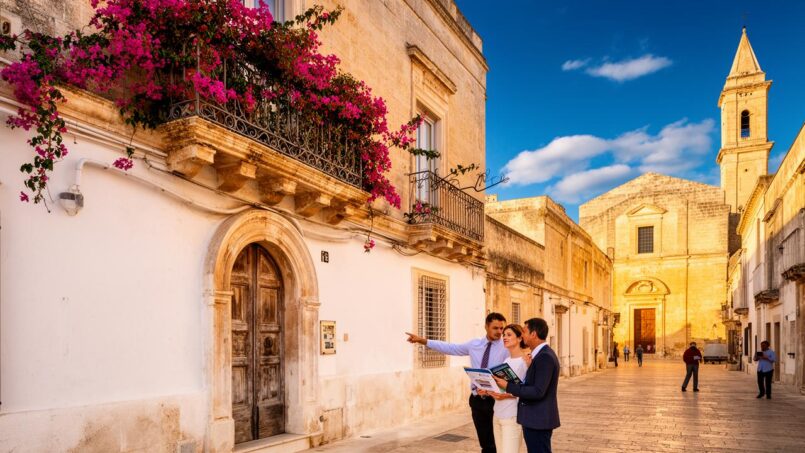
 Published on and written by Cyril Jarnias
Cerignola is not yet a “star” of real estate magazines like Ostuni or Monopoli. Yet this town in the Apulia region, in the province of Foggia, is beginning to attract the attention of investors looking for yield, still affordable prices, and a market less saturated than coastal destinations. Between a lively historic center, urban development projects, a rising rental market, and a fairly favorable national tax system, the town offers an interesting playing field for those who can read the numbers… and Italian regulations.
Cerignola’s potential rests on a stable residential market, supported by a constant population, a local economy, and still affordable real estate prices at the regional and national level, rather than on fleeting tourism development.
Cerignola in Apulia: Context, Population, and Real Estate Positioning
Cerignola is located in Apulia, a region in southern Italy increasingly popular with international investors. Where towns like Ostuni, Monopoli, Polignano a Mare, or Lecce show sharply rising prices, Cerignola remains, for now, behind in terms of appreciation, making it a potential “laggard” market.
The municipality covers nearly 594 km² with about 57,000 residents. Density is around 96 inhabitants per km², which for Italy remains moderate. The age pyramid shows a relatively young population for the Mezzogiorno, with an average age around 41–42 years and a median age of about 36 years. In 2025, projections indicate just over 10,000 minors, about 36,000 adults aged 18–64, and more than 10,000 seniors.
Population peak recorded in Cerignola in the early 2000s, illustrating the area’s demographic stability.
The social fabric is marked by a declining average family size (from 2.63 people in 2022 to 2.57 at end of 2024), more living space per inhabitant (from 23 m² per person in 1991 to over 32 m² in 2011), and a steady rise in education levels, especially among 25–64 year olds. This paints a residential real estate market where demand is diversifying: young couples, smaller families, single elderly people, and a significant share of foreigners (about 5.2% of the population in 2023).
A Real Estate Market Still Cheap by Italian Standards
The price figures confirm that Cerignola is, for now, a cheap town in the Italian landscape.
Price Levels in Cerignola
Several sources converge on a price level between €1,000 and €1,200/m² for residential properties, with some variations depending on property type and neighborhood.
| Indicator (sale) | Approximate Value |
|---|---|
| Average listed price (April 2025) | €1,149/m² |
| Average OMI price (2025) | €1,016/m² |
| Recent observed range (min–max, last 2 years) | €1,100 – €1,154/m² |
| Average apartment price (source 1) | €1,210/m² |
| Average apartment price (source 2) | €1,143/m² |
| Average house/villa price | €1,018/m² |
| Overall commune range | €220 – €2,064/m² |
| OMI range by zone | €775 – €1,320/m² |
These levels should be compared with the Apulia regional average (about €1,438/m²) and the coastal hotspots, where some areas like Polignano a Mare or Vieste far exceed €2,000/m². Cerignola therefore sits at the low end of the regional range, offering a moderate entry point.
Compared to other Italian towns of similar size (50,000–100,000 inhabitants), such as Viareggio which represents an expensive market, Cerignola falls into the category of still very affordable towns, thus illustrating the diversity of costs within the same demographic bracket.
Recent Price Trends
Detailed analysis shows a market that is not collapsing, far from it. In fact, we see:
– average sale price slightly up over 12 months (some series report +3.6% between 2024 and 2025);
– OMI price up about 4.26% year-over-year;
– a recent low around €1,100/m² at the end of 2023, followed by a recovery to €1,154/m² by end of 2024.
This is typically a phase of measured recovery, in line with what we see nationally: moderate growth, highly differentiated by area, with more pressure in large metropolitan areas and more modest increases in medium-sized towns.
Neighborhoods with Very Different Investment Profiles
Even within Cerignola, price gaps between neighborhoods are marked. For an investor, these differences are crucial for balancing yield, liquidity, and appreciation potential.
Historic Center and Hypercenter: The Core of Value
The center, around Piazza Duomo and the Garibaldi, Moro, Bari, Puglie axes, concentrates the town’s real estate value. This is also the area with the main heritage assets: Terra Vecchia (the medieval core), the ancient Roman grain pits (Piano delle Fosse), the Chiesa Madre, the Duomo Tonti, the Torre Alemanna, and most commercial life.
| Central Area | Sale Price €/m² | Rent €/m²/month |
|---|---|---|
| P.zza Duomo, Garibaldi, Moro, Bari, Puglie | €1,667 | €9.11 |
| V. Veneto, S. Antonio, Borsellino, S. Domenico | €1,239 | €7.00 |
This is significantly above the municipal average. That’s logical: supply is more limited, demand is stronger, and urban attractiveness (shops, services, heritage) reinforces the value of these addresses. Listings also highlight that the “central zone” is described as sought after and particularly suitable for investment.
A 170 m² apartment with historic character was fully renovated and positioned on the shared office market for medical professions. This case illustrates a “prime local” positioning thanks to its architectural charm, independence, generous volumes, and conversion to a high-value tertiary use.
Intermediate Sectors and Residential Areas
Moving out of the hypercenter, some sectors offer an interesting compromise between purchase price and rent level.
| Intermediate Zone | Sale Price €/m² | Rent €/m²/month |
|---|---|---|
| Viale Usa, Urss, Venezia, Dei Mille, Levante, Ponente, Via Napoli, Maria Ausiliatrice | €904 | €5.14 |
| Fornaci, Dei Pini, Ulivi, Mestre, Plebiscito | €879 | €4.21 |
Here we see much lower price levels, but rents are still reasonable for a local clientele. For a yield-oriented investor, these neighborhoods can prove more interesting than the hypercenter, which is more of a bet on appreciation and liquidity.
Periphery and External Zones: Speculating for the Long Term
| Peripheral Zone | Sale Price €/m² | Rent €/m²/month |
|---|---|---|
| External zone, Viale Ponente, Levante, Maria Ausiliatrice | €668 | €2.80 |
Here, purchase prices are particularly low, but rents follow the same trend. These are clearly zones for very long-term investors, possibly linked to future urban planning or redevelopment projects.
Property Types: From Small Studios to Large Historic Apartments
The structure of supply in Cerignola is quite rich, from the renovated studio to large houses or warehouses, with very different profitability profiles.
Apartments: The Heart of the Market
Average prices by apartment type show a relatively low entry ticket.
| Apartment Type (sale) | Approximate Average Price |
|---|---|
| Studio | €85,000 – €91,000 |
| 1-bedroom | €92,000 – €96,000 |
| 2-bedroom | €108,000 |
| 3-bedroom | €125,000 – €126,000 |
| 4-bedroom | €140,000 |
On the rental side, still for apartments:
| Apartment Type (rental) | Average Monthly Rent |
|---|---|
| Studio | ~ €280 |
| 1-bedroom | ~ €443 |
| 2-bedroom | ~ €551 |
| 3-bedroom | ~ €680 |
| 4-bedroom | ~ €849 |
These amounts correspond roughly to an average level of about €8.5/m² per month in March 2025, an increase of more than 30% in one year compared to €6.3/m² in May 2024. So we see tangible rental pressure, in a context where sale prices are not skyrocketing. This mechanically favors rental yields.
Gross annual yield generated by a 1-bedroom purchased for €95,000 and rented at €440 per month.
One should also keep in mind the dynamics demonstrated by major Italian cities: smaller units generally show the best yields and highest occupancy rates (national data show that studios in Rome San Lorenzo or Bologna Centro Storico peak at over 6% gross yield, with 98% occupancy). In Cerignola, without a massive university market or mass tourism, percentages will be less spectacular, but the logic remains the same: small units rent more easily.
Houses, Villas, and Large Homes
For houses, prices rise quickly with size:
| House (sale) | Approximate Average Price |
|---|---|
| 3-bedroom | €160,000 |
| 4-bedroom | €219,000 – €221,000 |
| 5-bedroom | €255,000 – €265,000 |
| 6-bedroom | €290,000 – €304,000 |
| 7-bedroom | €366,000 |
Rents quoted for these large houses are often high (€2,000 or more per month for 5–7 bedrooms), but these figures should be treated with caution: they may be atypical listings or very premium properties. In practice, this segment is harder to fill continuously and appeals to a narrower clientele.
For a private investor, large real estate spaces are better suited to a strategy of subdivision (creating several rental units) or conversion (transformation into offices, medical practices, co-living, or serviced residences) than to simple single-family rental.
Ancillary Properties: Garages, Commercial Spaces, Warehouses
The square meter prices for non-residential typologies are another asset of Cerignola.
| Typology | Sale Price €/m² | Rent €/m²/month |
|---|---|---|
| Shops / retail | €1,480 | €8.00 |
| Offices | €1,250 | €7.33 |
| Residential “civil” | €995 | €4.30 |
| Residential “economic” | €780 | €3.50 |
| Garages / parking spaces | €740 | €3.90 |
| Warehouses | €700 | €3.67 |
| Industrial sheds | €500 | €2.00 |
| Workshops | €450 | €2.00 |
For a diversification-oriented investor, these assets can complement a residential portfolio and offer interesting cashflows, especially garages (structural demand, low vacancy) and small shops on the busiest streets.
Rental Demand Growing Fast, But Airbnb Still Fragile
Cerignola’s rental market shows clear signals of pressure on long-term rents, while the short-term rental segment remains very fragile.
Traditional Rentals: Rents Rising Quickly
In March 2025, the average asking rent reached €8.52/m² per month, compared to €6.32/m² in May 2024, an increase of nearly 35% in less than a year. Over two years, the low point was €5/m² in June 2023, and the peak was €8.52/m² in March 2025.
Rental in Italy is under pressure because many households are giving up or delaying home purchases due to high prices and credit conditions, which strengthens demand for rental properties.
In the most central areas of Cerignola, rent can exceed €9/m², which, combined with purchase prices below €1,700/m², allows targeting reasonable gross yields, though without reaching the levels of large university cities.
Short-Term Rentals: A Risky Market
Airbnb data for Cerignola calls for caution:
– about 29 active listings as of April 2024;
– median occupancy rate: 43%;
– average daily rate: €66;
– average annual revenue per host: €11,000;
– about 157 booked nights per year.
An occupancy rate of 43% is considered a risk threshold for a short-term rental investment. Indeed, the town is not a major tourist hotspot like Polignano a Mare or Gallipoli. Its visitor flow is more limited, seasonal, and often consists of domestic, business, or transit tourism.
For an investor, Airbnb in Cerignola cannot be the main pillar of a business plan. It should rather be seen as a complement (e.g., traditional rental with a few short-term weeks in high season), or reserved for very specific properties: a charming apartment in Terra Vecchia, a design loft with spa (like the “Maioliche Apartment” example), or a house with a pool targeting a regional audience.
Urban Projects and Development Dynamics: Signals to Watch
Beyond price and rent figures, a savvy investor always looks at the town’s trajectory: what infrastructure is coming? What projects are underway? What public policies are in place?
The “Area Grandi Eventi” Project: A Future Hub of Attractiveness
The municipality of Cerignola has launched a call for projects, based on the project finance mechanism provided for by Legislative Decree 36/2023. Objective: to concession the design and management of an “Area Grandi Eventi”, a zone dedicated to major events.
The idea is to establish this hub on private land, with a development master plan that can accommodate:
– the new weekly market (relocation of the current one);
– commercial activities;
– food and beverage;
– fairs;
– entertainment and light leisure;
– various ancillary services.
In concrete terms, the municipality is looking for a private “promoter” whose project will maximize public interest, in a logic of urban regeneration and territorial enhancement. This type of initiative can change the game for certain sectors: improved flows, emergence of new commercial centralities, gradual increase in land value near the area in question.
The municipality
For an investor, this means two things:
– stay informed about the exact location chosen for this Area Grandi Eventi;
– anticipate the redevelopment effects on surrounding neighborhoods (new commercial demand, need for housing for workers and operators, etc.).
A Territory Also Betting on Renewable Energy
The presence of a planned solar photovoltaic park, the “Cerignola-Pellegrini Solar PV Park”, with a planned capacity of over 60 MW, testifies to an energy and industrial dynamic. This project, at the authorization stage, shows that the area is in line with national energy transition strategies, which can, in the long run, strengthen local employment and economic attractiveness.
Social Policies and Cohesion: A More Stable Environment for Landlords
The territory of Cerignola has also implemented a highly structured 2022–2024 Zone Plan, focused on integrating social policies: childhood, families, poverty reduction, inclusion, support for the elderly or dependent, strengthening the third sector, etc.
For an investor, these actions do not generate direct profitability but aim to stabilize the social fabric, manage vulnerabilities, and strengthen services. In the medium term, a territory that manages poverty, dependency, access to services, and inclusion better produces a more regular and predictable rental market, as well as a healthier economic climate.
Potential Yields: Where Does Cerignola Stand in the Italian Landscape?
Nationally, 2024 figures indicate an average gross rental yield of around 7% in Italy, all markets combined, with wide disparities. Neighborhoods like San Lorenzo in Rome or the Centro Storico in Bologna show over 6% gross on studios, while central Milan falls to just 3.2% on large high-end apartments.
In Cerignola, potential gross yields fall rather in a mid-range, with one advantage: much lower entry prices.
If we take realistic orders of magnitude:
– apartment in an intermediate zone, purchased at €1,000/m²;
– surface area of 60 m², i.e., €60,000 investment excluding fees;
– average rent around €8/m², i.e., €480/month, €5,760/year.
The gross yield of a rental investment in Lyon can be around 9.6%. However, to obtain the net yield, you must deduct notary fees, possible renovation work, taxes, and vacancy periods. Thus, the net yield generally falls between 4% and 6%, depending on the quality of management, the chosen tax regime, and the level of expenses. This yield remains competitive compared to major metropolitan areas where prices per m² often exceed €3,000.
The key in Cerignola is therefore to:
– buy at or below neighborhood averages;
– target properties sought by local demand (1–2 bedroom, renovated or easily renovable, good connections, close to services);
– avoid properties that are too specific, hard to rent, or heavily dependent on tourism, which remains limited.
Regulations, Taxation, and Renovation: The Rules of the Game to Master
Investing in Italy requires a good grasp of the regulatory framework, especially in a town with a historic center like Cerignola.
Building and Renovation Permits
In Italy, the distinction between minor works, major renovation, and structural transformation is fundamental:
– “edilizia libera” (painting, minor repairs, changing tiles without altering levels, replacing fixtures without moving plumbing, etc.) does not require a permit;
– a CILA (Comunicazione Inizio Lavori Asseverata) is required for interior work that does not affect the structure: light interior redistribution, replacement of systems without modifying load-bearing structures, etc.;
– a SCIA (Segnalazione Certificata di Inizio Attività) is required for heavier work: modification of load-bearing walls, creation/enlargement of openings, roof modification, change in interior volume;
– a Permesso di Costruire is necessary for any increase in volume, creation of an annex, pool, extension, or major facade transformation.
In historic centers (Zone A) – which includes Terra Vecchia or part of Addolorata – the Soprintendenza (Superintendence) may need to give its approval, even for modest exterior interventions (facades, shutters, tiles, plasters). The time to obtain a full building permit can then exceed 6 months.
Before any purchase or renovation project, it is essential to take the time to plan. This means clearly defining your needs, establishing a realistic budget, comparing available options, and informing yourself about the regulations in force. Good preparation helps avoid unpleasant surprises, cost overruns, and unsuitable choices, thus ensuring the success and sustainability of the project.
– have a surveyor or architect check the urban and cadastral compliance of the property;
– regularize any past undeclared work (using a “sanatoria”);
– clarify any protection regime (historic building, protected area, etc.).
Renovation Costs: Plan Generously
Renovation costs in Italy vary by region, but national ranges provide a useful guideline:
| Type of Renovation | Indicative Cost €/m² |
|---|---|
| Light (cosmetic) | €300 – €500/m² |
| Medium (systems, redistribution) | €800 – €1,200/m² |
| Heavy (structural) | €1,200 – €1,800/m² |
| Full restoration of a “near-ruin” | €1,500 – €2,500/m² |
These amounts include labor, materials, technical fees, and administrative procedures. In Cerignola, the cost may be slightly lower than these national averages, but prudence dictates keeping a margin of 30 to 50% above the initial quotes, as unpleasant surprises (structure, networks, compliance) are common in older properties, especially in historic centers.
Real Estate Taxation and Rentals: What You Need to Know in 2026
The Italian tax framework is generally favorable for investors who rent out their property, provided they choose the right regime.
IMU applies to second homes and properties owned by non-residents, with a variable municipal rate (about 0.4% to 1.06%). TARI is due by the occupant, but the owner must declare the start of occupancy within 90 days. Rental income is taxable either under the progressive IRPEF scale (with deductions) or under the “cedolare secca”, a simplified flat tax.
In 2026, the “cedolare secca” remains extremely attractive for traditional rentals (residential contracts):
– 21% flat tax on rents (without deduction of expenses);
– 10% in certain cases of “controlled rent” leases (contratti a canone concordato);
– no registration or stamp duties on these leases.
For short-term rentals (less than 30 days), the 2026 Finance Act maintains a rate of 21% for the first property rented short-term, but raises it to 26% for the second, while lowering the threshold above which the activity is deemed professional: beyond two properties rented short-term, the owner is presumed to be an “entrepreneur”, with the obligation to open a Partita IVA and move out of the cedolare secca regime to a BIC (business income) regime.
In Cerignola, investing in short-term rentals like Airbnb is already considered risky. This situation makes traditional rental more attractive, especially for foreign investors seeking simple asset management with predictable income.
Buying as a Foreigner: Procedures and Costs
For non-Italians, purchase conditions are fairly flexible:
– EU and EEA citizens buy without restriction;
– nationals from countries like the United States, the United Kingdom, Canada, Australia, Switzerland can buy thanks to the principle of reciprocity;
– it is essential to obtain a Codice Fiscale (Italian tax number) and generally open a local bank account.
The purchase procedure follows a classic pattern:
– written purchase offer;
– preliminary contract (contratto preliminare) with payment of a deposit (often 10–30% of the price), protected by the “caparra confirmatoria” mechanism (double restitution if the seller backs out, loss of deposit if the buyer does);
– final deed (rogito) before a notary, who registers the sale and taxes.
Ancillary costs generally range between 7% and 18% of the purchase price, combining:
– registration taxes (2% of the cadastral value for a primary residence, 9% otherwise, on existing properties);
– VAT where applicable (4%, 10%, or 22% depending on property type and use for new builds);
– notary (about 1–2.5%);
– agent (2–4% per party, plus VAT);
– lawyer or advisor (1–2% on average).
For a property in Cerignola around €100,000, it is wise to budget at least €10,000 to €15,000 in additional costs, excluding renovation work.
Relevant Investment Strategies in Cerignola
Given all these elements, what strategies emerge for an investor in Cerignola?
1. Long-Term Residential in Central or Intermediate Areas
This is the most straightforward and coherent strategy with the town’s profile:
– purchase of a 1–2 bedroom apartment between €70,000 and €130,000 depending on size and neighborhood;
– long-term rental to local households, possibly with cedolare secca at 21%;
– priority to central sectors (P.zza Duomo, Garibaldi, S. Antonio, etc.) for appreciation, or intermediate zones (Viale Usa, Via Napoli…) to maximize yield.
This approach allows benefiting from the rapid rent increases observed, while being exposed to a gradual rise in resale value, driven by the overall Apulia trend and the North–South price differential.
2. Renovation of an Older Property in the Historic Center
The presence of Terra Vecchia, Addolorata, and a still lively old center opens another field: purchase of a property to renovate in the historic center, to reposition it in a more qualitative niche:
Discover our tailored rental offers, designed to meet the demanding needs of an affluent local clientele and professionals.
Aimed at an affluent local clientele or liberal professions, for a refined and elegant living environment.
A flexible solution combining residential comfort and professional workspace, ideal for self-employed workers.
Premium year-round rental, with possibilities for mixed formulas adapted to medium and long stays.
The key here is to properly frame the renovation budget and heritage constraints. Costs can quickly escalate, but the price per m² gaps between a raw property and a high-end renovated one are significant in Italian historic centers. The national trend clearly points to a premium of 15–20% (at a minimum) for energy-efficient homes, which reinforces the logic of an ambitious renovation.
3. Diversification via Garages, Shops, or Small Offices
With moderate square meter prices for garages, shops, and offices, it is possible to build a mixed portfolio:
– garage in town at €700–750/m², rented at €3.9/m²/month;
– small commercial space on a busy street (€1,480/m², €8/m²/month);
– office in a well-served tertiary area (€1,250/m², €7.33/m²/month).
Accumulating several small real estate assets helps smooth the risk of rental vacancy and benefit from the diversity of local demand, especially from shopkeepers, artisans, and liberal professionals.
4. “Opportunistic” Positioning Around Major Projects
The development of the Area Grandi Eventi and possible changes around the redevelopment of certain sectors (especially those currently undervalued) offer opportunities for more patient investors:
– identifying land or sheds near the future event zone or axes undergoing transformation;
– conversion to neighborhood retail, food and beverage, or event-related services;
– buying homes ahead of redevelopment to benefit from future price increases.
This strategy requires close monitoring of local planning and a long holding horizon.
Specific Risks in Cerignola (And How to Limit Them)
As with any real estate investment, Cerignola is not without risks.
Investing in medium-sized towns presents distinct challenges: lower liquidity with potentially long resale times, dependence on local demand without the support of international tourism, increased regulatory risk in older neighborhoods, and contrasted social dynamics despite ambitious social policies.
To reduce these risks, a few reflexes are essential:
– priority targeting of the most sought-after areas, where rental and resale times remain reasonable;
– in-depth technical and legal audit before purchase (urban compliance, absence of illegal work, verification of outstanding charges and taxes);
– systematic use of local professionals (surveyor, architect, lawyer) independent from the selling agency;
– a prudent business plan, without assuming unrealistic price increases or high tourist occupancy rates.
Cerignola: A Relative Value Strategy in Southern Italy
On the scale of Italy, and even more so of Apulia, Cerignola represents a bet on “relative value”:
– the town remains heavily discounted compared to the region’s star markets;
– rents are rising faster than sale prices;
– demographic structure and local economic anchoring support stable residential demand;
– development projects and structured social policy gradually improve the living environment.
For an investor with a medium-to-long-term horizon, looking for a market where the entry ticket remains low, rental yields can prove attractive provided neighborhoods and property types are carefully selected.
Cerignola is aimed at investors interested in the traditional Italian residential market, made up of families, small owners, and local professionals. With square meter prices around €1,000–€1,200, it offers significant room to create value, but is not suited for speculation or quick returns via mass seasonal rentals.
For those who accept this logic and surround themselves with the right professionals, investing in real estate in Cerignola can become a relevant component of a broader strategy for exposure to Southern Italy, complementing possible assets in metropolitan areas or more famous coastal destinations.
A wealth project or a question? Contact us now to speak with a wealth management expert.
Disclaimer: The information provided on this website is for informational purposes only and does not constitute financial, legal, or professional advice. We encourage you to consult qualified experts before making any investment, real estate, or expatriation decisions. Although we strive to maintain up-to-date and accurate information, we do not guarantee the completeness, accuracy, or timeliness of the proposed content. As investment and expatriation involve risks, we disclaim any liability for potential losses or damages arising from the use of this site. Your use of this site confirms your acceptance of these terms and your understanding of the associated risks.

Cyril Jarnias is an independent expert in international wealth management with over 20 years of experience. As an expatriate himself, he is dedicated to helping individuals and business leaders build, protect, and pass on their wealth with complete peace of mind.
On his website, cyriljarnias.com, he shares his expertise on international real estate, offshore company formation, and expatriation.
Thanks to his expertise, he offers sound advice to optimize his clients' wealth management. Cyril Jarnias is also recognized for his appearances in many prestigious media outlets such as BFM Business, les Français de l’étranger, Le Figaro, Les Echos, and Mieux vivre votre argent, where he shares his knowledge and know-how in wealth management.





