
 Published on and written by Cyril Jarnias
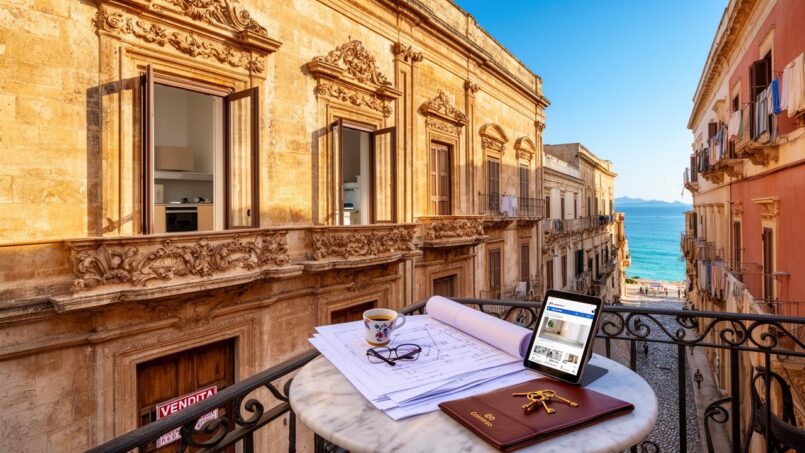
Trapani is attracting more and more investors looking to combine seaside living, an environment that is still authentic, and high returns. Far from the sky-high prices of Rome, Florence, or even Palermo, this city on the western tip of Sicily offers a price-to-yield ratio that is hard to match in Italy, with a market still largely under the radar.
This article details for a French-speaking investor the prices per sqm, returns by property type, and comparison with the rest of Sicily. It also covers taxation, holding costs, rental potential (long-term and short-term), and the impact of major infrastructure projects on medium-term prospects.
A still very affordable coastal market
Trapani combines a historic center of honey-colored stone, a waterfront facing the Egadi Islands, and a hinterland of traditional villages. Despite these tourist assets, prices remain well below the Italian average.
In the city, the average asking price is around 928 to 950 € per sqm, with a median of about 1,000 € per sqm for apartments, and just over 2,100 € per sqm for houses. At the provincial level, the average reaches about 1,169 € per sqm, very close to the Sicilian regional average (around 1,168 € per sqm).
Trapani vs. rest of Sicily: an interesting discount
At the regional level, the province of Trapani sits in the low average of Sicilian prices. To place Trapani within the regional landscape:
| Sicilian province | Average sale price €/sqm | Average rent €/sqm/month |
|---|---|---|
| Trapani | 1,169 | 6.40 |
| Palermo | 1,310 | 8.80 |
| Catania | 1,143 | 8.87 |
| Syracuse | 1,218 | 8.91 |
| Messina | 1,234 | 8.15 |
| Ragusa | 1,034 | 6.38 |
| Agrigento | 844 | 6.20 |
| Caltanissetta | 635 | 5.07 |
| Enna | 743 | 5.02 |
You can immediately see that Palermo, Messina, or Syracuse cost more per sqm, without necessarily offering superior returns. Trapani sits in an interesting niche: relatively low prices, rents that hold up well, and above all a tourism market on the rise.
The Sicilian province shows marked real estate disparities. Highly sought-after seaside towns such as San Vito Lo Capo or Pantelleria reach price levels close to “premium” destinations. Conversely, inland villages remain extremely cheap.
| Municipality (province of Trapani) | Sale €/sqm | Rent €/sqm/month |
|---|---|---|
| Trapani | 928 | 7.27 |
| Castellammare del Golfo | 1,971 | 7.96 |
| San Vito Lo Capo | 2,696 | 12.15 |
| Favignana | 3,162 | 6.04 |
| Pantelleria | 2,951 | 11.78 |
| Mazara del Vallo | 815 | 5.75 |
| Marsala | 1,019 | 6.17 |
| Castelvetrano | 758 | 3.77 |
| Gibellina | 269 | 5.03 |
For an investor, this means it is possible to arbitrage between:
– expensive but very liquid tourist areas (San Vito Lo Capo, Favignana, Pantelleria)
– balanced urban markets like Trapani or Marsala
– very “value” segments in the interior, with prices sometimes below 500 € per sqm
Rental yields well above the Italian average
One of Trapani’s major attractions lies in its returns. Aggregated data indicates that a rental apartment in the city generates an average gross yield of 8.48%, with peaks up to about 9.13% depending on the neighborhood. It takes about 15.8 years of rent to amortize the average purchase price, which is short by European standards.
At the provincial level, the average yield remains high, around 7.69%, with a payback period of 16.7 years.
Returns by property size: the kingdom of small units
As in the rest of Sicily, the highest returns are found on small units (studios and one-bedrooms). In Trapani, we observe:
| Property type (city of Trapani) | Average price (€) | Average monthly rent (€) | Average gross yield |
|---|---|---|---|
| Studio | 42,500 | 480 | 13.41% |
| 1 bedroom (1BR) | 56,500 | 550 | 11.68% |
| 2 bedrooms (2BR) | 58,000 | 400 | 8.28% |
| 3 bedrooms (3BR) | 85,000 | 650 | 9.18% |
| 4 bedrooms and more | 115,000 | 560 | 5.84% |
We find exactly the classic pattern of the Sicilian market: small units show spectacular yields, while large apartments see their yield compress. This is explained by purchase prices that rise faster than rents as the surface area increases.
At the provincial level, the trend is similar, although average yields are slightly lower due to some more residential areas:
| Property type (province) | Average price (€) | Average monthly rent (€) | Average gross yield |
|---|---|---|---|
| Studio | 43,000 | 420 | 11.85% |
| 1 bedroom | 60,000 | 400 | 8.00% |
| 2 bedrooms | 72,000 | 500 | 8.33% |
| 3 bedrooms | 85,000 | 600 | 8.47% |
| 4 bedrooms and more | 110,000 | 550 | 6.00% |
For the investor, the rational strategy, as a first approach, is therefore to target studios and small one-bedrooms in the most sought-after areas, either for long-term rental or tourist furnished accommodation.
City center vs. outskirts: price gaps to exploit
Indicators such as the “price-to-rent ratio” and yield by zone show that the immediate outskirts of Trapani offer a slight additional yield compared to the hyper-center.
| Location | Price/rent (ratio) | Gross yield |
|---|---|---|
| City center | 14.05 years | 7.12% |
| Outside center | 13.04 years | 7.67% |
In other words, buying slightly outside the historic heart allows you to pay less per sqm while collecting rents that are not necessarily much lower, mechanically boosting the yield.
Median monthly rent for a 3-bedroom apartment in the city center, compared to €500 on the outskirts.
A rental market under increasing pressure
Rent per square meter figures confirm that Trapani is tightening on the rental side. In the city, the average rent reaches €7.27 per sqm per month, a 7.54% increase year-on-year. This is not only higher than the provincial average (€6.35/sqm) but also close to the regional average, even though sale prices remain lower.
Rental demand is supported by three main pillars: the local population, seasonal workers in the tourism sector, and a growing flow of visitors.
Across Sicily, average rents are around €8.3 to €8.4/sqm. Trapani thus remains slightly below in absolute terms, but the increase is significantly faster: some sources mention a rise close to 12% year-on-year in small coastal towns like Trapani, compared to 6% on average regionally.
Trapani in the Italian context: yields higher than the North
In Italy, the average gross rental yield is around 7.25%. Sicily stands out with yields generally between 8.5% and 9.5% for apartments, compared to 4% to 6% in the major metropolitan areas of the North like Rome (around 7.05%) or Milan (around 5.19%).
The city of Trapani has an average rental yield of 8.48% in urban areas, placing it at the high end of the national range. Even higher yields, around 9 to 10%, are observable in certain neighborhoods and for specific formats such as studios or small houses under 100 sqm.
Concretely, most apartment investors in Sicily can expect a net yield (after current expenses, local taxes, management) in the order of 5% to 7%, which remains very competitive in Western Europe.
Costs to anticipate: fees, maintenance, local taxes
To avoid being blinded by impressive gross yields, one must incorporate typical holding costs in Sicily.
Condo fees generally represent 6% to 10% of the annual rent. For an apartment rented for €6,000 per year, you can therefore anticipate €360 to €600 in owner fees.
Routine maintenance of an apartment runs between 0.7% and 1% of the property’s value each year. On a property worth €90,000, this represents about €600 to €1,000 per year for items like painting, some plumbing repairs, or air conditioning maintenance.
The property tax rate (IMU) for an investment property, expressed as a percentage of the market value, set by each municipality.
Added to this are:
– landlord insurance (around €150 to €300 per year)
– possible property management fees: 8% to 12% of rents collected for long-term rentals, and rather 15% to 25% for a turnkey seasonal rental
Overall, going from a gross yield to a net yield often means subtracting 2 to 3 percentage points. In a typical scenario in Trapani, a 9% gross yield would translate into 6% to 7% net for an investor who does little delegation, and rather 5% to 6% net if they outsource management.
Long-term or short-term rental: which strategy in Trapani?
The crucial question for an investor remains the choice of rental model. Trapani sits at the crossroads of two markets:
– a classic residential market with affordable rents (a one-bedroom around €300–350, a three-bedroom around €500–600)
– a tourist market taking shape, driven by proximity to the Egadi Islands, the village of Erice, the Zingaro Nature Reserve, and events like the Cous Cous Fest in San Vito Lo Capo
The advantages of long-term rental
Long-term rental in Trapani remains the simplest option to manage and the most straightforward in terms of taxation.
The fundamental indicators are solid: an average payback period of 15.8 years, a favorable price/rent ratio, and yields ranging from 7% to 10% gross depending on the size of the property.
For a studio bought for €42,500 and rented for €480 per month, this gives about €5,760 in annual rents, i.e., over 13% gross yield. Even after deducting the running costs mentioned above, you remain above 8% to 9% net in a well-managed scenario.
The Italian tax system offers the “cedolare secca,” an option for individual landlords that allows taxing rents at a flat rate of 21% (or 10% for certain agreed-upon rents), instead of including them in the progressive income tax. This mechanism, also available to non-residents for their Italian rental income, simplifies the estimation of net yield.
The potential and limits of short-term rental
On the short-term side, figures are more mixed, as they vary by source. AirROI data for the period February 2025 – January 2026 mentions an average nightly rate of about $115, an occupancy rate of 37.5%, and a median annual revenue around $9,649.
On this basis, a “median” property in Trapani generates about $981 in monthly income, i.e., just under $12,000 per year, in a context where regulations are considered “high” for tourist furnished rentals.
Other data, from Airbtics, paints a more optimistic picture: about 223 nights booked per year, an occupancy rate of 61%, an average nightly rate of €82, and an average annual income close to €18,000. The typical monthly revenue would then be around €1,545.
The profitability of a tourist rental in Trapani, Sicily, varies according to several criteria. For a property located in the historic center, on the waterfront, or near the port giving access to the Egadi Islands, the appeal is stronger. Optimal management, including professional photos, a dynamic pricing policy adjusted to demand, and partnerships with local players (such as tour operators or restaurants), is also decisive for success.
Nevertheless, note:
– strong seasonality, with a peak in August, followed by good levels in July and September, where typical monthly revenue can exceed $2,000
– a low season (January, February, December) significantly weaker, with monthly revenues around $700
During peak season, the top 10% of listings exceed $2,500 per month, with occupancy rates above 70% and nightly rates of over $180–190. For this high-end segment, annual gross profitability can easily exceed 10% if the purchase price remains contained.
A stricter regulatory environment
However, a key element must be factored in: Italian regulations on short-term rentals are tightening. At the national level, debates revolve around setting a maximum number of properties rentable short-term before reclassification as a commercial activity, and a flat tax rate of 26% on tourist rental income, with the 21% rate maintained for a single property per owner.
Virtually all tourist furnished rental listings in Trapani are already licensed, reflecting a strict regulatory framework.
For an investor, this means it is imperative:
– to check current local regulations (declaration to the municipality, tourist identification code, minimum number of nights, etc.)
– to anticipate potentially heavier taxation on multi-property tourist rentals (beyond one or two properties, possible switch to professional status)
– to precisely calculate management costs, often higher than for long-term rentals (15–25% commission to a specialized manager is not unusual)
In this context, a hybrid strategy, combining tourist rental in high season and medium or long-term rental in low season (students, digital nomads, temporary workers), is beginning to develop in Trapani. It helps smooth out seasonality while capitalizing on high summer rates.
The micro-markets of the province: where to look for the best opportunities?
The province of Trapani forms a patchwork of micro-markets with different dynamics.
Some municipalities show impressive yields, like Campobello di Mazara, Custonaci, Misiliscemi, or Mazara del Vallo, while others are more heritage markets where you pay for the scenery more than the yield.
| Municipality (province) | Average yield | Average annual income (€) |
|---|---|---|
| Mazara del Vallo | 13.09% | 7,800 |
| Castelvetrano | 12.32% | 6,000 |
| Misiliscemi | 11.78% | 9,480 |
| Custonaci | 18.87% | 15,600 |
| Campobello di Mazara | 35.75% | 26,200 |
| Trapani (city) | 8.48% | 6,000 |
| Marsala | 6.53% | 6,000 |
| Erice | 6.60% | 6,000 |
| San Vito Lo Capo | 5.78% | 9,600 |
| Castellammare del Golfo | 6.13% | 7,200 |
Some figures seem almost unrealistic (like the 35.75% of Campobello di Mazara), and they must be interpreted with caution: they could be snapshots from very high seasonal rents related to very low prices per sqm, or effects of low transaction volume. They indicate, however, that by venturing off the beaten path, the province holds pockets of very high profitability.
Average price per square meter in Custonaci, offering an interesting compromise between affordability and rental yield.
At the other end of the spectrum, San Vito Lo Capo and Castellammare del Golfo show very high prices per sqm, driven by sustained international tourist demand. These are more heritage markets, where the average gross yield is moderate (6–7%) but the expectation of long-term appreciation is greater, especially with a view to resale to foreigners.
Infrastructure and urban planning: projects that support value
Another fundamental element for an investor is the trajectory of infrastructure and urban renewal. From this perspective, Trapani is engaged in a significant investment cycle.
Rail network: return of the direct Palermo–Trapani train
The project to reopen the Palermo–Trapani via Milo railway line, suspended since 2013, is fully funded with national and European funds (recovery plan). It provides for complete electrification of the line, modernization of infrastructure, and even a future direct rail connection to Trapani–Birgi airport.
For the city of Trapani, this means:
– better access from Palermo, the main regional metropolis
– increased attractiveness for travelers who prefer the train
– medium-term revaluation of neighborhoods near the station and new infrastructure
Value premium enjoyed by properties located near modernized stations or high-speed lines in Italy.
Port, roads, and “last mile”
The port of Trapani is undergoing a vast redevelopment plan: upgrading quays, creating a nearly one-kilometer port waterfront, a new 300-meter quay, dredging to accommodate more traffic.
This transformation is accompanied by a strategic road project called the “ultimo miglio” (last mile), which aims to improve accessibility between the port, the industrial zone, and the highway network, with funding of over €17 million. It notably includes new interchanges, roundabouts, and structures to smooth goods and passenger flows.
For real estate, this translates into: an increase in property prices, growing demand for housing, and diversification of investments.
Development works lead to improved accessibility of industrial and logistics areas, which can influence the value of commercial premises and nearby housing. At the same time, they enable an upgrade of the urban waterfront, making it more attractive for both primary residences and seasonal rentals.
The municipality of Trapani is also deploying a massive program of urban regeneration and renovation of public buildings, for a total amount exceeding €80 million. Among the most significant components:
– rehabilitation of nursery and primary schools
– renovation of gyms, creation of bike paths, restoration of historic palaces (like Palazzo Lucatelli or Palazzo D’Ali)
– improvement of public lighting and green spaces
– major social housing projects and neighborhood redevelopment, such as the PINQUA program in the Cappuccinelli district, or the conversion of a former school into 24 moderate-rent apartments on the northern waterfront
These initiatives enhance quality of life, reduce vacancy in some degraded sectors, and improve the city’s image, all factors that support residential and tourist demand.
Taxation of investment in Trapani: what to factor in
The tax rules applicable to Trapani are those of Italy, with no special treatment for foreigners. However, the investor must anticipate several layers of taxation: at purchase, during ownership, and on rental income.
At purchase: between 4% and 10% in most cases
The main acquisition cost items are:
– registration tax (imposta di registro) or VAT (IVA), depending on whether you buy from an individual or a developer
– cadastral and mortgage taxes (generally €50 each if registration tax applies, or €200 each if VAT applies)
– notary fees (about 1% to 2.5% of the price)
– real estate agency commission (often 2% to 4% of the price, +22% VAT, shared or not between seller and buyer)
For a standard investment property purchased from an individual, the registration tax amounts to 9% of the cadastral value.
In the case of a new property purchased from a developer, you switch to a VAT regime of 10% (22% for luxury categories), which mechanically increases total costs. In this scenario, acquisition costs can represent 15% to over 20% of the price if you add the agent’s commission and possible credit fees.
During ownership: local taxes and fees
In addition to the IMU already mentioned (0.3% to 0.7% of the property’s value for an average investment property), the investor will have to pay the waste tax (TARI), calculated based on surface area and municipal rates.
The IMU + TARI sum constitutes the bulk of ownership taxation for a non-resident. This is far from some countries where the property tax represents 1.5% to 2% of the property’s value each year, which helps maintain attractive net yields.
On income: choosing between flat tax and progressive scale
For rental income, two main regimes are possible:
Two main tax regimes apply to rental income for property owners in Italy.
Flat tax of 21% on gross rents for free-market contracts, or 10% for certain rent-controlled leases in designated areas.
Inclusion in the progressive income tax (IRPEF), with brackets up to over 40%, allowing deduction of certain expenses.
For a non-resident investor, the cedolare secca is generally the simplest and most predictable solution, especially when holding one or two properties. For short-term rentals, a similar regime exists, though with the prospect of a rate raised to 26% on the second seasonal property rented out, and reclassification as a commercial activity beyond two properties.
In case of resale, capital gains on real estate are taxed at 26% if the property is sold less than five years after purchase. Beyond five years of ownership, the capital gain is exempt. Properties received through inheritance are also exempt from this tax.
Typical profile of a profitable investment in Trapani
In summary, several configurations stand out as particularly effective for a French-speaking investor in Trapani:
Discover three rental investment strategies tailored to the Sicilian market, with gross yields potentially reaching 13%.
Acquisition between €40,000 and €70,000. Long-term rental at €400 to €600/month. Targeted gross yield: 10% to 13%. Net yield: 6% to 8%.
Acquisition between €70,000 and €120,000. Mixed rental: long-term in winter (digital nomads) and medium-term in summer (tourists). Potential annual revenue > €10,000–€15,000.
Targeting municipalities like Custonaci or Misiliscemi to maximize gross yield. Resale market potentially less liquid.
In all cases, the key remains the fine selection of the micro-location: some streets in the historic center of Trapani are already trading between €1,200 and €1,400 per sqm (Via Marsala, Via Pantelleria, Via Torrearsa, etc.), which remains reasonable for locations highly sought after by tourists, but assumes buying at the right price to preserve profitability.
A market still in a catching-up phase
Recent price trends show that, despite some years of stagnation, Trapani is slowly recovering. Over the last twelve months, houses have gained about 2.7% and apartments 0.3%, while over four years apartments have only declined 4.4%. Across Sicily, forecasts point to average annual price growth of 2% to 3%, with 4% to 6% in the most dynamic micro-markets (attractive tourist and urban neighborhoods).
In several areas, rent increases outpace purchase price rises. This dynamic improves the price/rent ratio, resulting in more attractive yields for new real estate investors.
This situation makes Trapani a “cash-flow” market rather than a purely speculative one: the investor buys first for rental profitability, with moderate but probable capital appreciation over 5 to 10 years, especially in neighborhoods that directly benefit from public investments (rail reopening, waterfront redevelopment, heritage renovation).
What to remember before investing in Trapani
Investing in real estate in Trapani means betting on an Italian coastal destination still largely undervalued, where prices remain low, rents hold up well, and yields clearly surpass those of the major northern cities.
Strengths:
– an average price around €900–€1,000 per sqm in the city, far below Palermo, Catania, or Syracuse
– gross yields often between 8% and 10%, with peaks above 11%–13% on small units
– solid rental demand, driven by residents, workers, and growing tourism
– a favorable infrastructure context (return of the direct train, port modernization, major urban renewal programs)
– relatively moderate ownership taxation, which leaves attractive net yields intact
Points of caution:
Seasonal rental in Italy is subject to stricter regulations, with licensing requirements and caps. Strong seasonality requires an adapted pricing strategy. Professional support (notary, lawyer, etc.) is essential to navigate administrative procedures and secure property titles.
For an investor looking for a mix of cash-flow, heritage enjoyment (possibility of personal use a few weeks per year), and exposure to a Mediterranean tourism market still in a catching-up phase, Trapani ticks many boxes. Provided you carefully select the location, calibrate the property format (preference for small units), and precisely anticipate costs, Trapani real estate can be a very performing brick in a diversified portfolio.
A wealth project or a question? Contact us now to speak with a wealth management expert.
Disclaimer: The information provided on this website is for informational purposes only and does not constitute financial, legal, or professional advice. We encourage you to consult qualified experts before making any investment, real estate, or expatriation decisions. Although we strive to maintain up-to-date and accurate information, we do not guarantee the completeness, accuracy, or timeliness of the proposed content. As investment and expatriation involve risks, we disclaim any liability for potential losses or damages arising from the use of this site. Your use of this site confirms your acceptance of these terms and your understanding of the associated risks.

Cyril Jarnias is an independent expert in international wealth management with over 20 years of experience. As an expatriate himself, he is dedicated to helping individuals and business leaders build, protect, and pass on their wealth with complete peace of mind.
On his website, cyriljarnias.com, he shares his expertise on international real estate, offshore company formation, and expatriation.
Thanks to his expertise, he offers sound advice to optimize his clients' wealth management. Cyril Jarnias is also recognized for his appearances in many prestigious media outlets such as BFM Business, les Français de l’étranger, Le Figaro, Les Echos, and Mieux vivre votre argent, where he shares his knowledge and know-how in wealth management.





