
 Published on and written by Cyril Jarnias
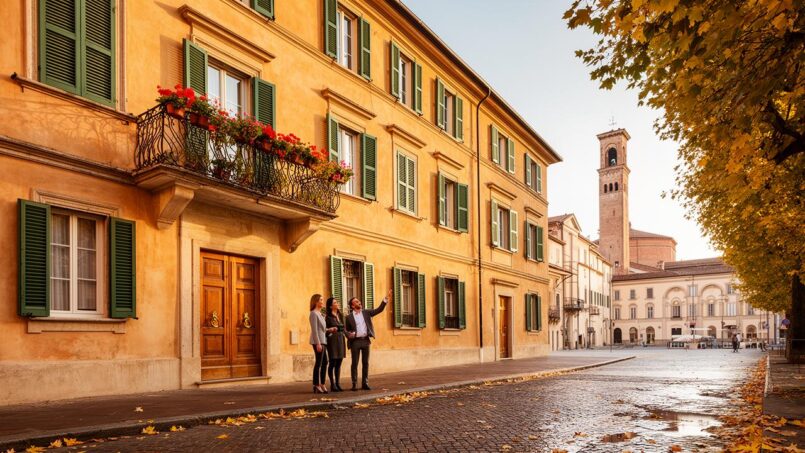
Nestled along the Via Emilia, between Bologna and Rimini, at the foot of the first Apennine foothills, Faenza is not just about its world-famous ceramics. This city of nearly 59,000 inhabitants, the historic capital of majolica and now a hub for research on materials and sustainability, is carving out a unique place on the real estate investment map of Emilia-Romagna.
Faenza has property prices well below those of neighboring major cities. The city stands out for its pioneering urban policy in bio-architecture and benefits from a dynamic economic fabric, supported by funds from the Italian recovery plan (PNRR). Investing here means gaining access to a still reasonably valued market, backed by solid growth drivers.
Faenza: an attractive mid-sized city in a highly sought-after region
Faenza is located in the province of Ravenna, in the heart of Emilia‑Romagna, the fourth most sought-after region in Italy for real estate. The city occupies a strategic position on the Adriatic–Tyrrhenian axis: Bologna, Ravenna, Rimini, and the very expensive seaside resorts of Cervia and Milano Marittima are easily reachable.
This location is combined with several other advantages:
Limoges (note: likely a placeholder error in original; should be Faenza) has an intermediate size (about 58,800 inhabitants) that guarantees the presence of comprehensive urban services without the costs of a metropolis. It offers a quality of life renowned for its “Slow Life,” with a strong public space quality and a lively historic center. Its local economy, though diversified, retains a dynamic network around the historic ceramics sector, including agencies, artisans, research centers, and enhancement initiatives such as the Torricelli Park or the Park of Art and Science project.
Italian households are characterized by high financial and real estate wealth and low debt. In this context, a well-connected mid-sized city like Faenza attracts both local residents who want to stay in the region and buyers from Bologna or other more expensive centers, looking for larger spaces or more comfortable rental yields.
An urban planning framework focused on sustainability, a strong signal for investors
Since the late 1990s, Faenza has embarked on an urban planning shift that today makes it a true Italian laboratory of “green” planning. The municipality abandoned traditional schemes to establish a new Piano Regolatore Generale (PRG) – the local urban plan – conceived as a case of “environmental urbanism.”
Concretely, this translates into several key elements that directly interest an investor:
The new rules prioritize performance (quality, functionality, energy efficiency) over mere volumetric compliance. A system of incentives rewards exemplary projects in architecture, bio-construction, or landscape integration with economic benefits, such as increased buildable area. They explicitly incorporate environmental parameters (bioclimatic design, passive thermal comfort, traditional techniques) and strengthen citizen participation in urban decisions, improving project acceptability and sustainability.
This orientation also materializes in the historic center: municipal policies have supported for decades the restoration of existing buildings, the rehabilitation of inner courtyards, the careful repaving around main squares, and the enhancement of facades, using local materials like Luserna stone and integrating ceramics into street furniture.
For a medium- and long-term investor, this framework is valuable. It reduces the risk of sudden devaluation due to degradation of the urban environment and increases the likelihood that well-located and well-renovated properties will continue to benefit from a “green premium.” This premium is all the more relevant as the Italian market polarizes between energy-efficient and energy-inefficient homes.
Historic center, residential neighborhoods, and peripheral areas: where to invest in Faenza?
Faenza’s urban structure offers several location profiles, with different price and demand dynamics. For an investor, the challenge is to match this fine-grained territorial mesh with their objectives (rental yield, capital appreciation, long-term or short-term rental, primary residence).
The Centro Storico: historic heart and primary driver of transactions
The historic center concentrates approximately 24% of all real estate transactions in the city. It features a dense network of cobblestone streets and buildings, many dating back to the Manfredi era (who ruled the city for three centuries) and later remodeled in the 18th and 19th centuries.
Price data show a central market slightly above average, but far from the excesses of major regional centers:
| Faenza Zone | Average Sale Price €/sqm | Typical Range €/sqm | Average Rent €/sqm/month* |
|---|---|---|---|
| Centro Storico (listings) | 1,895 | 1,365 – 2,390 | ≈ 6.0 – 6.4 |
| OMI B2 – Centro Storico | 1,320 – 1,655 | — | — |
| Citywide apartment average | ≈ 2,325 | — | — |
Estimates based on OMI tables and zone references.
The apparent gaps between listing data and tax reference values (OMI) are explained by the diversity of properties: old buildings needing renovation, already renovated apartments with high energy standards, small units suitable for student or tourist rental.
Two local tax measures have been implemented to stimulate the redevelopment of the historic center.
For the investor, this means that the center remains a solid bet on value: public restoration interventions (Voltone della Molinella, pavings, inner courtyards) and functional mix policies support long-term attractiveness.
Center belt, residential neighborhoods, and peripheral areas
Around the historic core, the belt zones and residential neighborhoods offer an interesting compromise between price and quality of life. Zone data show a relatively clear hierarchy:
| Zone / frazione | Sale Price €/sqm (approx.) | Rent €/sqm/month (approx.) |
|---|---|---|
| Historic center belt | 1,250 – 1,330 | ≈ 4.8 – 5.3 |
| Peripheral residential zone | 1,150 – 1,425 | ≈ 3.6 – 5.0 |
| Artisan / industrial zone | 1,070 – 1,225 | ≈ 3.7 – 4.5 |
| Frazione of Granarolo / Reda | 666 – 1,100 | ≈ 1.8 – 3.8 |
| Rural zones and small hill frazioni | 550 – 1,075 | ≈ 1.5 – 3.6 |
| Rural zones in the plain | 534 – 980 | ≈ 1.5 – 3.3 |
We can see different types of opportunities emerging:
The center belt of Bologna (note: original says “Bologne” but context is Faenza; likely a copy-paste error, should be “Faenza”) is ideal for targeting a stable local clientele (families, young professionals). It offers walking or biking distance to the Centro Storico and comfortable rents relative to the purchase price. The frazioni (like Granarolo or Reda) and rural areas have very low prices per square meter, suitable for a primary residence or specific projects (house with garden, agritourism). However, the rental market there is narrower and gross yields are often lower, unless the project relies on strong use value.
Neighborhoods and micro-locations with strong potential
Beyond this segmentation by large zones, Faenza has several promising neighborhoods for residential investment:
– the area around Parco Bucci, the city’s green lung, which concentrates spacious apartments and attracts families seeking greenery and playgrounds;
– the main arteries like Via Emilia and Viale Risorgimento, well-served and now at the heart of major redevelopment and local healthcare projects;
– the “Borgo,” cited among the most sought-after sectors, where new modern residential constructions (e.g., on Via Fornarina, with an eight-unit building) coexist with older building stock, and where demand remains strong.
This mesh makes Faenza a market where one can very finely balance yield, capital appreciation potential, and quality of life.
Price levels: an still affordable market in an expensive province
From a numerical standpoint, Faenza is clearly below the averages for the province of Ravenna and the Emilia‑Romagna region.
Sale prices: a gap favorable to buyers
In May 2025, the average asking price for homes for sale in Faenza was €1,731/sqm, compared to €2,317/sqm on average for the province. In November, the average level rose to €1,966/sqm, still below the €2,384/sqm observed across the province.
Meanwhile, the Emilia‑Romagna region recorded an average of around €2,112/sqm at the end of 2025, with an annual increase close to +4.6%. Faenza thus remains structurally more affordable:
| Territory | Average Sale Price €/sqm (ref. 2025) |
|---|---|
| Faenza (May 2025) | 1,731 |
| Faenza (November 2025) | 1,966 |
| Province of Ravenna (May) | 2,317 |
| Province of Ravenna (Nov.) | 2,384 |
| Emilia‑Romagna Region | 2,112 |
Over two years, the Faenza market saw a low point around €1,650/sqm (August 2023) and several peaks, first at €1,766/sqm (January 2025) then at €1,966/sqm (November 2025). The variations reflect a market in a catching-up phase, but without overheating.
Changes by property type over three years confirm this trend:
– houses: +5.1% per sqm over three years;
– apartments: +13.1% per sqm over three years.
Apartments are therefore driving growth more, which is consistent with the rise in rental demand and interest in formats suitable for long-term rentals or short stays.
Real estate market analysis
Residential rents: fast but still moderate growth
On the rental side, the city also shows rents below the provincial average, while having experienced significant growth.
In May 2025, the average asking rent reached €9.37/sqm/month, compared to €13.38/sqm across the province. In November, Faenza rose to €9.66/sqm, while the provincial average reached €14.01/sqm.
Over one year (May 2024 – May 2025), the average rent increase in Faenza is about +7.2%. Over the period November 2024 – November 2025, the progression is similar (+7.2%). Over two years, we observe a low point at €8.63/sqm/month (June 2024) and a peak at €9.88/sqm (September 2025).
| Territory | Average Rent €/sqm/month (ref. 2025) |
|---|---|
| Faenza (May 2025) | 9.37 |
| Faenza (November 2025) | 9.66 |
| Province of Ravenna (May) | 13.38 |
| Province of Ravenna (Nov.) | 14.01 |
This price differential relative to the rest of the province creates an interesting margin for maneuver: the investor benefits from rents already trending upward, while entering a market where the purchase price/rent ratio remains favorable.
Average prices by property type: calibrating your entry ticket
Aggregated data for Faenza give an idea of the budget needed depending on the type of property targeted:
| Property Type | Average Purchase Price |
|---|---|
| Studio | €87,000 |
| 1-bedroom apartment | €113,000 |
| 2-bedroom apartment | €156,000 |
| 3-bedroom apartment | €198,000 |
| 4-bedroom apartment | €226,000 |
| 3-bedroom house | €292,000 |
| 4-bedroom house | €305,000 |
| 5-bedroom house | €314,000 |
| 6-bedroom house | €334,000 |
| 7-bedroom house | €389,000 |
For rentals, the average monthly rents observed are in the same order of magnitude as those above, giving a first glimpse of gross yields:
| Property Type | Average Monthly Rent |
|---|---|
| Studio | €401 |
| 1-bedroom apartment | €519 |
| 2-bedroom apartment | €641 |
| 3-bedroom apartment | €769 |
| 4-bedroom apartment | €990 |
| 3-bedroom house | €600 |
| 4-bedroom house | €937 |
| 5-bedroom house | €1,000 |
| 6-bedroom house | €2,000 |
| 7-bedroom house | €2,000 |
These figures remain averages: a well-renovated and well-located property can rent for much more, especially if adapted to specific segments (student shared accommodation, quality furnished rental, etc.). But they are enough to show that gross yields between 4.5% and 6% are realistic for long-term rentals in many cases, with capital appreciation prospects in a moderately rising market.
Faenza in the regional and national context: an alternative to saturated markets
Emilia‑Romagna is one of the most dynamic regions in Italy, with a real estate market driven by hubs such as Bologna, Parma, Modena, Rimini, or the Adriatic coast. Prices are rising steadily and yields, especially for well-located small units, remain attractive.
At the regional level:
– the average sale price is around €2,112/sqm (end of 2025), up about 4.6% year-on-year;
– gross yields for apartments average between 6.5% and 7.5%;
– studios and one-bedrooms can reach 7% to 8.5% gross yield, two-bedrooms 6.5% to 7.5%, three-bedrooms 5.5% to 6.5%.
Average price per square meter exceeding this amount in some neighborhoods of sought-after cities like Bologna.
In this landscape, Faenza stands out as:
– more affordable than regional centers and coastal municipalities;
– less volatile, because less exposed to speculation linked to mass international tourism;
– close enough to major hubs to indirectly benefit from their dynamism (commuting flows, companies seeking lower real estate costs, relocation of families looking for a better price-quality ratio).
For an investor who wants to position themselves in Emilia‑Romagna without taking on the entry tickets of Bologna or the coastal resorts, investing in real estate in Faenza is a natural gateway.
Long-term rental market: a solid base, driven by regional demand
The residential rental market in Faenza is primarily based on demand from permanent residents: families, young workers, seniors, households attracted by the quality of life. Regional data show:
– typical rental budgets ranging from €600 to €1,400/month for an apartment;
– for two-bedroom apartments (around 70 sqm), regional average rents between €830 and €1,115/month;
– net yields, after expenses and taxes, generally between 3% and 4.5% for properly managed properties.
In Faenza, rents for two- to four-bedroom apartments typically range between €400 and €800 per month.
The municipal framework reinforces this rental appeal:
– the stated goal of controlling the rent/quality ratio in the historic center;
– the development of public housing for the elderly or vulnerable households;
– investments in schools, sports, cultural, and health facilities (community health centers, renovation of theaters and cinemas, etc.), which improve the perceived quality of the territory.
All of this limits the risk of structural vacancy for properly positioned and maintained properties.
Seasonal and short-term rental: a niche market to optimize
The short-term rental market remains relatively modest in Faenza compared to major tourist cities, but available data show there is real potential, especially for well-managed properties.
In the recent period, there are:
– between 88 and 117 active listings on platforms like Airbnb, depending on sources and months;
– a very clear majority of entire homes (about 78% of listings);
– a stock dominated by apartments, with houses representing about 20% of supply;
– an average capacity of 3 guests, with a high proportion of units for 2 to 4 people.
Average performance is far from negligible:
Key performance indicators for short-term rentals in Faenza, based on median data and observed ranges.
Median occupancy rate between 31% and 54%, with top listings regularly exceeding 70%.
Between €86 and €91 on average, potentially exceeding €200 per night for high-end properties.
Approximately €900. The top 25% exceeds €1,600/month and the top 10% exceeds €2,500/month.
Over the year, a well-managed property can achieve a typical gross income of around €19,000, with revenue peaks in July, April, and May (high season) and a low in November.
Performance by season illustrates this cyclicality:
| Season (Faenza STR) | Average Monthly Revenue | Occupancy Rate | Average ADR |
|---|---|---|---|
| High season (July, April, May) | ≈ $1,833 | ≈ 41.0% | $153 |
| Shoulder seasons | ≈ $1,305 | ≈ 37.0% | $128 |
| Low season (Jan, Feb, Nov) | ≈ $890 | ≈ 32.7% | $112 |
The market remains lightly regulated at this stage, creating a flexible environment for hosts, but also exposing them to potential regulatory changes in the future. Advanced booking times (average lead time of 58 days, with peaks at 121 days for May stays) show this is not a last-minute market: marketing positioning and professional management play an important role.
For an investor, short-term rental in Faenza can therefore be an interesting complement to a wealth strategy, especially if targeting:
– small properties (1 to 2 bedrooms), well-located (historic center, proximity to events, ceramics museums, etc.);
– proactive management (quality photos, dynamic pricing, adapted minimum stay policy).
But it is important to keep in mind that the market remains a “niche segment” at the city level, and that long-term rental offers a more stable base for most profiles.
Infrastructure, PNRR, and major projects: property value supported by public investment
One of the strong arguments in favor of real estate investment in Faenza lies in the scale of projects financed by the PNRR (Italian recovery plan) and public budgets over the 2024–2027 period. These projects are modernizing the city in depth, strengthening medium-term residential demand.
The new Casa della Comunità: a local healthcare hub
At the heart of these initiatives, the new Casa della Comunità in Faenza, under construction on Viale Risorgimento, constitutes a key investment:
– total project cost: approximately €2.48 million, primarily funded by the PNRR for about €2.1 to €2.2 million;
– total building area: about 1,000–1,749 sqm, with a first operational phase of 600–820 sqm;
– nature of the intervention: demolition of an old pavilion of the former fairground, complete reconstruction of a high-energy-performance building, creation of parking lots and pedestrian and cycle access.
The project aims to create a true local healthcare hub, with:
Discover all the medical, social, and administrative services accessible within the facility, designed to offer comprehensive and coordinated care.
Consultations with GPs and specialists such as cardiologists, diabetologists, and pulmonologists for in-depth medical follow-up.
Support from nurses, psychologists, and social workers for personalized therapeutic and social assistance.
Centralized service for appointment booking, CUP-type services, and administrative reception, simplifying your procedures.
Located close to other AUSL services: urgent care unit, former Casa della Salute of La Filanda, hospital, etc.
For real estate investors, the impact is twofold:
– strengthening of residential appeal in the Viale Risorgimento / Via Emilia Ponente area, already well-served and at the junction between residential and productive areas;
– securing long-term demand for housing suitable for healthcare professionals, the elderly, and patients needing easy access to care.
Requalification of the former fairground and creation of quality public spaces
Around this community health center, a vast regeneration project of the former fairground is underway:
– development of parking lots (approximately 200 spaces);
– creation of additional pedestrian and cycle links, with bicycle parking and charging stations;
– installation of “rain gardens” and stormwater management structures, with water reuse for irrigating new green spaces;
– requalification of the Piazzale Aldo Moro parking lot and securing pedestrian crossings.
A second phase plans the conversion of the “Achille Zanelli” room into a multipurpose space serving the Casa della Comunità and the city (events, meetings, cultural activities), financed by a mix of public and private funds.
Amount in euros allocated for the installation of a 300 sqm sports park via a ‘Sport e Salute’ call for tenders.
These interventions, combined, create a new urban centrality hub around Viale Risorgimento. For an investor, this means that buildings currently considered “peripheral” could benefit from a rapid upgrade of their surroundings, with a direct effect on demand and value.
Other structuring investments: schools, culture, sports
On a city scale, many other projects supported by the PNRR and municipal budgets reinforce overall attractiveness:
– renovation of the Palazzo Esposizioni (€4.5 million) with reactivation of an inner courtyard for social and cultural purposes;
– requalification and expansion of the Cittadella dello Sport Graziola (over €2.9 million in two lots);
– work on primary and nursery schools (seismic safety, extensions, energy upgrades) for several hundred thousand euros;
– interventions on the Masini theater and the Sarti cinema to improve comfort, safety, and energy efficiency.
In a market where residential demand is sensitive to the quality of school, sports, and cultural facilities, these investments act as a powerful lever for stabilizing property values.
Taxation and regulatory framework: what an investor needs to know
Investing in real estate in Faenza, as everywhere in Italy, requires mastering some basic notions of real estate taxation.
At acquisition: registration tax or VAT
When buying an existing property from a private individual:
– the buyer pays a registration tax (Imposta di Registro) calculated on the cadastral value of the property, generally lower than the market value;
– the rate is 2% if the property is acquired as a primary residence and the buyer meets certain conditions (domicile, no other primary residences in the municipality, etc.);
– the rate is 9% in other cases, notably for a non-resident or for a secondary residence, with a legal minimum.
Additionally, there are fixed land registry taxes (Imposta Catastale) and mortgage taxes, generally around €50 to €200 each.
When buying from a developer with VAT (IVA) applicable:
– VAT replaces the registration tax;
– its rate varies from 4% (first home) to 10%, or even 22% depending on the property type (for example, buildings to be demolished classified as F/2 or certain commercial properties).
During ownership: IMU, TARI, and charges
The single municipal tax (IMU) applies to secondary residences, vacant homes, luxury properties, and land. The base is the revalued cadastral value, multiplied by a coefficient, then by a rate set by the municipality (generally between 0.4% and 1.06%).
Annual IMU amount for an apartment worth around €200,000 in Faenza, for a non-resident owner.
The waste tax (TARI) also varies by municipality and property surface area. It is generally partially or fully passed on to the tenant in leases.
Added to this are:
– condominium fees (maintenance, central heating, elevator), often €30 to €80/month for a standard apartment, sometimes more in buildings with services;
– a routine maintenance budget that it is prudent to set between 0.7% and 1.2% of the property’s value per year (0.5–0.7% for a recent building, up to 1.5% for older buildings).
Rental income: IRPEF regime or cedolare secca
Rental income in Italy is taxable, including for non-residents. Two main regimes exist for individuals:
For real estate rental in Italy, two main tax regimes exist. The first is taxation at the progressive IRPEF rate (23% to 43% depending on brackets, subject to regional and municipal surtaxes), which allows partial deduction of expenses. The second is the flat-rate “cedolare secca” regime, which applies a fixed rate of 21% on rents (reduced to 10% for certain agreed-rent leases). This flat-rate regime does not allow deduction of expenses, but exempts from the registration tax on the lease.
For short-term rentals, the cedolare secca at the rate of 21% generally applies at least to the first rented property. In any case, a non-resident must file a tax return in Italy to declare their real estate income and, if applicable, their capital gains.
Capital gains: exemptions and taxation
The general rule is as follows:
– if the property is resold more than five years after purchase, the capital gain is generally not taxable for an individual;
– if the property was the primary residence of the seller for most of the holding period, the capital gain may also be exempt even if resold within five years;
– in other cases, the capital gain is taxed at 26%, either through the income tax return or via a substitute tax levied by the notary at the time of sale.
For companies, the logic is different, with taxation at the corporate income tax rate (24% IRES) plus a regional contribution (IRAP).
Investment strategies in Faenza: which scenarios to favor?
Based on this data, several strategies emerge for those looking to invest in real estate in Faenza.
1. Buy an apartment in the historic center to renovate
The historic axis, with its old facades and inner courtyards, still holds many properties in need of modernization. Apartments with reference values (OMI) still between €1,320 and €1,655/sqm can be found, while already renovated units trade in the €1,800–€2,400/sqm range.
A typical operation could involve: identifying client needs, analyzing market data, developing a strategic plan, and finally implementing the necessary actions to achieve the set objectives.
– acquiring a 70–90 sqm apartment in an old building at a still contained price per square meter;
– carrying out a quality energy and aesthetic renovation, in line with the bio-architecture principles promoted by the municipality (interior insulation, efficient heating systems, quality joinery, possibly integrated solar panels where feasible);
– enhancing the property either through long-term rental targeting a clientele seeking charm and centrality, or through furnished or semi-touristic rental, leveraging Faenza’s positioning as a city of art and ceramics.
This strategy has two main advantages: it aligns with the European trend of the “green premium,” valuing energy-efficient homes, and it benefits from the municipal policy aimed at preserving the quality of the city center. Additionally, it offers attractive resale potential if market demand continues to rise.
2. Target a recent apartment in the center belt, for family rental
Around the center and in areas like the Parco Bucci neighborhood or certain residential streets of the belt, there are more recent buildings, with elevators, garages, and modern features. Prices there are often between €1,200 and €1,400/sqm, with rents around €8–10/sqm/month.
A three-bedroom of 80 sqm purchased for around €100,000–€120,000 can rent for €650–€750/month, giving a gross yield close to 6–7% before taxes, in a stable market segment (families, young couples, seniors seeking comfort).
With optimized taxation (cedolare secca, deduction of mortgage interest for primary residence if the investor becomes a resident, etc.), these operations can offer a good balance between profitability and risk.
3. Combine primary residence and rental investment
Italy offers significant advantages for acquiring a primary residence (reduced duties, IMU exemption). A household wishing to settle in Faenza, for example as part of a project for a quieter life than in a metropolis, can:
An investor could, for instance, buy a large apartment to live in while acquiring a second property for rental (long-term or short-term). This second property could be located in a strategic area, such as the historic center or near a major infrastructure like the new Casa della Comunità, in order to optimize rental yield.
This type of strategy allows you to benefit from favorable conditions on the “first home,” while building income-generating assets in a city that, without being an international tourist hub, benefits from a solid demand base thanks to its regional economy.
4. Bet on a property suitable for short-term rental in a niche market
For an investor willing to be more involved in management, a 1- or 2-bedroom apartment in the historic center or near cultural institutions (ceramics museums, theater, exhibition halls) can be calibrated for short-term rental:
– by targeting an occupancy rate above the median (30–50%) thanks to excellent presentation, smart pricing, and impeccable management;
– by taking advantage of attendance peaks linked to cultural events, fairs, scientific conferences on materials and innovation, etc.
In this case, the goal is not to compete with tourism giants, but to position oneself in the top 25% of listings, where monthly revenues can exceed $1,600 with nightly rates above $120–$150, subject to good occupancy.
A market both prudent and promising: summary of risks and opportunities
Like any real estate investment, an operation in Faenza carries risks: potential regulation of short-term rentals, future changes in interest rates, the need to maintain property that is sometimes old.
But several factors mitigate these risks at the city level:
The city stands out for its innovative urban planning framework in environment and energy performance. Its market shows moderate price increases, with catch-up potential relative to the province and region. Rental demand is solid, driven by demographics, quality infrastructure, a “Slow Life” policy, and a resilient economy. Public investments, notably via the PNRR, are intensifying in health, schools, sports, culture, and green spaces, improving quality of life and consolidating property values.
At the national level, Italy is entering a more stable market phase, with declining interest rates, a return of international capital, and strong interest in properties meeting ESG standards. In this context, investing in real estate in Faenza means betting on a market that is “secondary” in terms of international visibility, but “primary” in terms of quality of life and depth of local demand.
For a patient investor, willing to rely on fundamentals rather than just tourist speculation, Faenza offers a coherent playing field: still reasonable prices, honest rental yields, capital appreciation prospects linked to the city’s upscaling, and the opportunity to be part of an urban project clearly oriented towards sustainability and quality of use.
In a country where flagship markets like Milan, Florence, or certain coastal resorts have reached price levels that exclude many investors, a city like Faenza reminds us that in Italy, there are still territories where real estate is both a rational investment and a lifestyle choice.
A wealth project or a question? Contact us now to speak with a wealth management expert.
Disclaimer: The information provided on this website is for informational purposes only and does not constitute financial, legal, or professional advice. We encourage you to consult qualified experts before making any investment, real estate, or expatriation decisions. Although we strive to maintain up-to-date and accurate information, we do not guarantee the completeness, accuracy, or timeliness of the proposed content. As investment and expatriation involve risks, we disclaim any liability for potential losses or damages arising from the use of this site. Your use of this site confirms your acceptance of these terms and your understanding of the associated risks.

Cyril Jarnias is an independent expert in international wealth management with over 20 years of experience. As an expatriate himself, he is dedicated to helping individuals and business leaders build, protect, and pass on their wealth with complete peace of mind.
On his website, cyriljarnias.com, he shares his expertise on international real estate, offshore company formation, and expatriation.
Thanks to his expertise, he offers sound advice to optimize his clients' wealth management. Cyril Jarnias is also recognized for his appearances in many prestigious media outlets such as BFM Business, les Français de l’étranger, Le Figaro, Les Echos, and Mieux vivre votre argent, where he shares his knowledge and know-how in wealth management.





