
 Published on and written by Cyril Jarnias
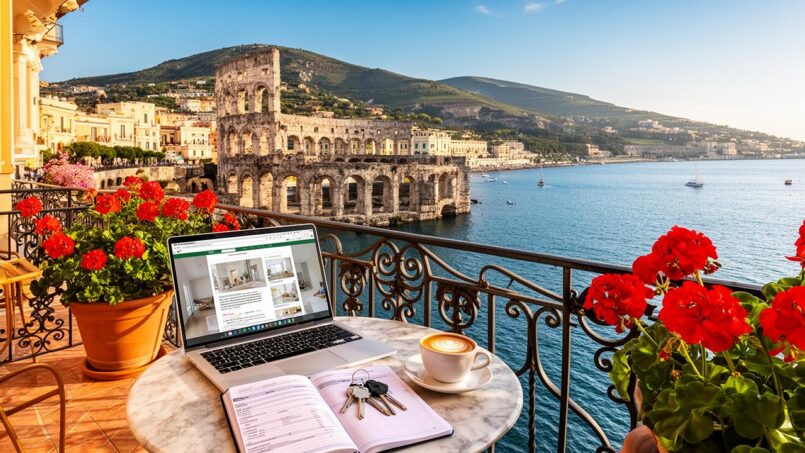
Pozzuoli is increasingly catching the eye of real estate investors. This coastal town on the edge of the Bay of Naples, at the heart of the Campi Flegrei, combines advantages rarely found together in one place: immediate proximity to Naples, a coastline undergoing redevelopment, strong tourist flows, massive urban projects, and a market still significantly cheaper than Naples’ premium neighborhoods. But it also sits in one of the most closely monitored volcanic areas in Europe, with a very real natural risk that weighs on any asset decision.
Investing in Pozzuoli is neither an obvious opportunity nor a bet to be systematically ruled out. It requires an in-depth study of economic data, an understanding of urban development dynamics, and a realistic assessment of the risks related to the area’s volcanic and seismic activity.
A real estate market halfway between Naples and seaside resorts
Pozzuoli directly benefits from the real estate pressure of the Naples metropolitan area. Prices in the city of Naples, especially in sought-after neighborhoods like Vomero or Posillipo, are soaring. Vomero, for example, shows values exceeding €4,200/m², driven by very strong demand, proximity to the center, high-end services, and sea views.
Average price per square meter expected in Campania by 2026, a value lower than many other Italian regions.
In this landscape, Pozzuoli sits in an interesting equilibrium zone: more expensive than many southern cities, significantly cheaper than regional capitals, with rising demand pressure.
Price levels: where does Pozzuoli stand?
The most recent data show that in January 2025, the average asking price for a home in Pozzuoli was around €2,496/m², with very moderate variation over two years: a peak near €2,540/m² and a low around €2,465/m². This represents a relatively stable market, with no bubble or collapse.
For rents, the average was about €10.61/m² per month, with a slight annual increase. Variations remain contained, but the trend is more clearly upward for rentals than for sales, which is rather favorable for investors.
The table below summarizes roughly Pozzuoli’s position within the Italian landscape:
| Area / City | Average Sale Price (€/m²) | Comment |
|---|---|---|
| Milan | ~4,111 | Premium market, strong growth |
| Florence | ~3,337 | Well above national average |
| Rome | ~2,986 | Capital, strong demand |
| Tuscany (region) | ~2,640 | Highly tourist region |
| Campania (region) | ~1,959 | Includes Naples and Pozzuoli |
| Pozzuoli (municipal average) | ~2,496 | Below premium Naples, above region |
We can see that Pozzuoli sits slightly above the regional average, reflecting its status as a major center of the Campi Flegrei, with coastline, ancient heritage, and good connection to Naples.
Highly contrasting micro-markets by neighborhood
Talking about “prices in Pozzuoli” only makes sense if you drill down to the neighborhood level. The city is a patchwork of very different areas, ranging from the sought-after waterfront to the large public housing complexes of Monterusciello, passing through more affordable sectors like Agnano or Licola.
The figures from January 2025 for some key areas are revealing:
| Pozzuoli Area | Sale (€/m²) | Rent (€/m²/month) |
|---|---|---|
| Lucrino | 2,991 | 11.13 |
| Porto | 2,826 | 12.72 |
| Arco Felice | 2,863 | 12.13 |
| Lungomare | 2,668 | 11.33 |
| Pozzuoli Alta | 2,765 | 9.94 |
| Anfiteatro | 2,681 | 10.87 |
| Via Campana, Cigliano | 2,279 | 7.51 |
| Località la Schiana, Damiani | 2,020 | 8.76 |
| Licola, Cuma | 1,749 | 9.21 |
| Monterusciello | 1,835 | 8.66 |
| Località Toiano, Sotto il Monte | 1,773 | 10.61 |
| Agnano | 1,511 | 8.51 |
Several lessons emerge from this table.
The coastal sectors of Pozzuoli, such as Porto, Lungomare, Lucrino, and Arco Felice, illustrate a dynamic real estate market where sale prices and rents are high. The Porto neighborhood, notably, has the highest average rent at €12.72/m²/month. This valuation is explained by its double attractiveness: immediate proximity to the ferry port serving the islands of Ischia, Procida, and Capri, and its integration into the city’s historic center.
Lucrino stands out with the highest price per square meter for purchases, while also performing well in rentals. This is typically a seaside and residential area interesting for investments targeting upper-middle classes or second homes.
The neighborhoods of Agnano, Monterusciello, and Licola offer the lowest entry prices for real estate purchases in Pozzuoli. They represent an opportunity for value-add strategies or for investors on a limited budget, but come with a less valued urban environment and a stronger perception of risk.
Finally, Via Campana – Cigliano shows a unique combination: intermediate sale prices, but the lowest rent per square meter. This type of profile may typically suit lower-income tenants with long-term leases, but risks dragging net profitability down if expenses remain high.
Focus on Monterusciello: from disadvantaged neighborhood to urban laboratory
Monterusciello well illustrates the ambivalence of Pozzuoli. This large public housing district, built in the 1980s to relocate families evacuated due to bradyseism, has long been characterized by low average income, high unemployment, and large unused brownfields.
Yet, the 2025 figures show a change in tone. In July 2025, the average asking price reached about €1,861/m², up nearly 4.9% year on year. The average rent was around €8.09/m², up 2% year on year. Over two years, variations range between €1,750 and €1,880/m², a sign of a slow build-up rather than brutal speculation.
A structuring urban project aiming to transform public spaces into a productive agro-urban landscape based on permaculture.
Conversion of around thirty hectares of public spaces into productive agricultural land.
Implementation of permaculture principles to create a sustainable agricultural ecosystem.
Development of a new landscape model integrating agriculture in an urban setting.
Boosting the local economy by supporting the creation of entrepreneurial activities.
Giving a positive identity and new purpose to the Monterusciello district.
Project funded under the European “Urban Innovative Actions” program.
The activation of an Agro Urban Center, the establishment of an “Agro Urbana Consulta” and the involvement of a wide range of local stakeholders testify to a real desire to pull Monterusciello out of its marginality. For an investor, this means two things: on one hand, the prospect of a gradual repositioning of the neighborhood; on the other, a long time horizon and a social risk not to be underestimated.
The changing coastline: urban projects and impact on value
Pozzuoli’s potential largely lies in its waterfront and its place in the “reconquest” of the Phlegraean coast. A general masterplan for the coastline plans to transform former industrial wastelands into mixed-use residential, tourist, and commercial neighborhoods, with a large coastal park and increased openness to the sea.
Plans over 140,000 m² of built surfaces, integrating housing, a hotel, a sailing club with marina, and a public green space about 80 meters wide along the coast. The whole must meet an environmental certification protocol (GBC Quartieri), which clearly places this future neighborhood in the category of highly sought-after “ESG-friendly” operations.
Project “Pozzuoli XXI”
This dynamic is part of a broader framework of works. A series of major regional projects, totaling €565 million, aims to improve bathing water quality, restore the Averno and Lucrino lakes, and rehabilitate the coastline from Pozzuoli to Baia Domizia. A tunnel connecting the Naples ring road to the port of Pozzuoli has already been inaugurated, reducing surface traffic and easing both tourist and commercial access.
For an investor, these infrastructure projects are far from trivial. Economic literature regularly shows that the arrival of a new train station, a tunnel, or a road axis leads to a rise in real estate prices nearby, sometimes on the order of 10% or more, with an especially strong impact in previously poorly served areas. The effect is reinforced when these developments are accompanied by new living or office hubs.
The corollary is that construction periods can temporarily degrade perceived value (nuisances, construction sites, local complaints). But history shows that values generally recover and exceed their pre-construction level a few years after completion.
A still liquid market with a wide range of products
The available inventory in Pozzuoli remains substantial. A recent count shows nearly 496 houses and apartments for sale, with a starting price around €39,000 for the most “economical” properties. In total, over 550 properties are listed as “bargain” in the municipality, highlighting a very wide range from ruins needing renovation to small studios and panoramic villas with gardens and pools.
Concrete examples abound:
Overview of different property categories available in the area, from luxury villas to investment opportunities.
Large villa with a 100 m² pool, 600 m² terrace, and 1,500 m² garden. Enjoy panoramic views stretching to Capri.
Located in residential parks (Parco Russo, Caruso, Le Muse) with concierge services, green spaces, beach access, and sometimes sea views.
Small studios of 20 to 30 m², ideal for vacation homes or B&B projects. Located in the city center or facing the church of San Raffaele.
Terraced houses or independent villas in Licola, Toiano, Solfatara, or Monterusciello. Offer large outdoor spaces, but may require urban regularization.
Properties sold at auction, particularly in Licola mare or in small buildings. Sometimes present very attractive starting bids, below €80,000.
This abundance is a double-edged sword. On one hand, it allows you to calibrate your investment: rental studio, family apartment, sea-view villa, ruin to rebuild for resale, etc. On the other hand, it requires tight due diligence, especially regarding urban planning and cadastral compliance, any potential construction abuses, or the legal solidity of the title (inheritance, co-ownership, seizures).
Rental profitability: between traditional rental and short-term stays
The interest of an investment is not measured solely by the purchase price: it is the combination of price – rent – expenses that determines profitability. In this regard, the province of Naples generally shows gross yields that are rather attractive compared to the Italian average.
At the provincial level, studios and one-bedroom apartments offer an average yield above 10% gross (about €600 rent for €70,000 purchase price for some segments), while large apartments cap around 5.3%. The entire province averages around 7.18% gross yield, with a “payback” of about twenty years.
Estimated average rental yield in Pozzuoli, above the Italian average of 4.7%.
The short-term rental option: a lever, but not a sure thing
As in the rest of Italy, the market for tourist rentals like Airbnb has exploded. There are over 200 active listings in Pozzuoli, with strong summer seasonality. The median occupancy rate is around 47%, or about 172 nights per year, with an average daily rate close to €80–90. This leads to an estimated average annual income of about €13,000, or €1,100 per month.
An occupancy rate of 47% is considered “risky” for a purely short-stay investment, as it assumes aggressive pricing management, marketing, and reviews to avoid falling below the break-even threshold. Nevertheless, some very well-positioned listings (seafront, historic center, Lucrino, near the port) achieve occupancy rates of 70% or more, which radically changes profitability.
National data indicates that short-term rentals can generate monthly cash flow about twice that of long-term rentals. However, this model involves higher operating costs (cleaning, management, platforms, tourist tax) and carries a non-negligible regulatory risk.
Pozzuoli already applies local rules described as “strict”: mandatory registration, possible zoning rules, taxes, limitation on the number of licenses per host. Italy is moving toward increased regulation of short-term rentals in high-pressure tourist areas, under pressure from residents and municipalities.
In this context, it is often safer to build your economic model on a traditional rental scenario and consider tourist rental as a bonus or a transitional phase, especially in neighborhoods near the port, Rione Terra, or the Lungomare promenade.
A rather favorable Italian macroeconomic framework
The national environment works in investors’ favor. After a period of rising rates, Italy enters 2026 with a prospect of monetary easing, improved financing conditions, and a real estate market that has already begun its “repricing.” Investment volumes in 2025 reached about €12.5 billion, with a clear recovery and a strong presence of foreign capital (nearly 60%).
This is the average growth forecast for residential prices in Italy in 2026.
Campania and Naples benefit from this dynamic, but remain cheaper than the major northern markets. For an investor, this means catch-up potential over the long term, while offering more accessible entry tickets.
Foreign investors: access conditions and basic taxation
For a non-resident, buying in Pozzuoli follows the same rules as elsewhere in Italy. Citizens of the European Union, the European Economic Area, or the United Kingdom can buy without restriction. For nationals of third countries, it is necessary to check whether a reciprocity agreement exists between Italy and the country of origin, a condition without which the notary cannot register the deed.
To buy a property in Italy, obtaining a codice fiscale (Italian tax code) in advance is mandatory. This code is needed to sign the preliminary agreement, open an Italian bank account, and appear before the notary for the final deed. The standard procedure includes three steps: a written purchase offer with a small deposit, then signing the preliminary contract (compromesso) with a payment of 10 to 20% of the price, and finally signing the final deed (rogito) at the notary’s office. The total time between offer and final deed is generally 2 to 6 months.
Acquisition costs are around 8–15% of the price, including taxes, notary, agency, and possible financing fees. For a second home, the registration tax is 9% of the cadastral value (valore catastale), often lower than the market price. For a “prima casa” (primary residence), the rate drops to 2% under certain conditions.
Taxation of rental income
Rental income can be taxed either under the progressive IRPEF scale (23–43%) or via the flat-rate “cedolare secca” regime (generally 21%, reduced to 10% in certain agreed-upon areas). For short-term rentals, recent law has tightened the rules: beyond two properties in tourist rental, the activity is presumed to be entrepreneurial and falls under business income, with VAT and accounting obligations.
Capital gains on the resale of a property are generally taxed at 26% if the sale occurs within five years of acquisition. However, this tax does not apply if the property was used as a primary residence for most of that period. Beyond five years of ownership, the capital gain is most often exempt from tax.
Volcanic and seismic risk: the elephant in the room
It’s impossible to talk about real estate investment in Pozzuoli without addressing the geological context. The town lies at the heart of the Campi Flegrei caldera, one of the most monitored volcanic complexes in the world. The phenomenon of bradyseism — these slow ground oscillations, with phases of uplift then subsidence — is recurrent there.
The area has experienced several major crises in the 20th century, notably in the 1970s and 1980s, which caused a ground uplift of over three meters and the complete evacuation of the historic center of Rione Terra. Even today, instruments record a gradual uplift, about 1 to 2 cm per year on average, with more marked recent peaks: over 30 cm in a year and a half, more than one meter cumulatively over the last decade.
Earthquakes in the area, generally below magnitude 2, have recently reached magnitudes of 4 to 4.6, felt throughout the region. The Italian civil protection maintains the alert level at ‘yellow,’ activating heightened monitoring without triggering automatic evacuation.
Detailed emergency plans
Authorities have developed evacuation plans for the “red zone” (exposed to pyroclastic flows) which notably covers Pozzuoli, Bacoli, Monte di Procida, Quarto, and some neighborhoods of Naples such as Bagnoli. Nearly 500,000 people are potentially affected. The estimated time for a complete evacuation is 72 hours from the start of the alarm phase.
A specific plan has been adopted for the intervention area affected by bradyseism, covering Pozzuoli, Bacoli, and part of Naples. It includes launching building vulnerability assessment campaigns through systematic visual inspections and mapping of the most fragile blocks. A significant budget is allocated to strengthening buildings, both private and public.
Concretely, for an investor, this means several things:
– you must accept the idea of an extreme risk, certainly unlikely in the short term, but potentially catastrophic in the event of an eruption or major earthquake;
– the value of a property can be impacted by risk perceptions, insurance premiums, or even construction restrictions or obligations to meet seismic standards;
– emergency plans and information obligations will evolve over time, requiring active monitoring.
Some analysts, very cautious, simply recommend avoiding any real estate investment in the Naples region for these reasons. Others consider that the probability of a cataclysmic event within the time horizon of a standard investment remains low, and that the return/risk ratio can still be acceptable for a well-informed and sophisticated investor profile.
How to integrate this risk into an investment strategy?
Volcanic risk is by nature non-diversifiable at the local level: if a major event occurs, the entire Pozzuoli market (and a good part of the Naples metropolitan area) is affected. The only rational way to integrate it is to consider it as a systemic risk specific to this area.
Several approaches are possible.
Adopt a short- to medium-term horizon, betting on revaluation driven by infrastructure works, coastal projects, and the upscaling of certain neighborhoods, then cashing out after 7–10 years. This strategy assumes being reactive if scientific signals or political decisions harden.
It is recommended to allocate only a limited part of your capital to Pozzuoli, an exposed area, and to place the bulk in less risky Italian regions, such as certain areas of Emilia-Romagna, inland Veneto, or rural Tuscany.
Focus on properties with a strong price/quality ratio, preferably already compliant with structural standards, to limit the risk of sudden depreciation in case of new seismic regulations or usage restrictions.
Favor assets that remain monetizable in several scenarios: an apartment that can be rented year-round to local tenants, switched to tourist rental, or even resold to other investors on a metropolitan scale.
Which property profiles should you favor in Pozzuoli?
In this complex context, certain segments appear better positioned than others.
Small units (studios, one/two-bedroom apartments) in the city center, near the port, the waterfront, or the Cumana and metro stations, concentrate the best combination of potential occupancy, resale liquidity, and gross yield. National data show that, in almost all Italian neighborhoods, it is these units that display the best yields, the shortest re-rental times, and the highest occupancy rates.
Apartments in secure residential parks (Parco Caruso, Parco Le Muse, Parco Bognar, etc.), offering parking, green spaces, and sometimes private beach access, target a more solvent clientele sensitive to comfort and security, which can stabilize rents in the long term.
Properties with sea or lake views (such as in Lucrino, Via Napoli, on Lake Averno, or the heights of Solfatara) can enhance their heritage appeal. Particular vigilance is required regarding the structural quality of buildings and local geological risks.
Heavy renovation operations (ruins, large apartments to subdivide, houses to restructure) can generate interesting capital gains if carried out with good cost control and perfect mastery of urban planning permits, in a context where Italy encourages energy and structural renovation through various tax bonuses.
Conversely, large family apartments that are inefficient in terms of rentable square meters or properties in micro-zones combining low rent, poor connectivity, and high urban fragility risk being less attractive, especially if vacancy rates increase.
Entry strategy: where and how to position yourself?
Faced with a changing market and an atypical natural risk, the key is hyper-selectivity.
The neighborhoods with strong rental and tourist demand such as Porto, Lungomare, Rione Terra, Lucrino, or Arco Felice can suit a strategy oriented toward yield and capital gain, especially if you manage to acquire below the median price (after negotiation, properties needing refreshing, forced sales, auctions).
Areas undergoing redevelopment, such as Monterusciello, may suit ‘value-add’ or institutional investors interested in agro-city projects, energy renovation of public housing (e.g., 29 buildings transformed into ‘nearly zero emission buildings’), and European funding. These areas offer a lower entry point but present a more uncertain investment horizon.
More peripheral sectors like Licola, Cuma, or certain parts of Via Campana allow combining moderate purchase prices with decent rents, provided you carefully target micro-neighborhoods best connected to transport (Cumana, tunnel, roads).
Beyond neighborhood selection, particular importance must be given to due diligence: checking urban planning compliance, absence of disputes, structural inspection by a surveyor, analysis of the seismic vulnerability map, and the property’s position within different risk zones (red zone, intervention area, etc.).
By way of conclusion: a market of opportunities for savvy investors
Investing in real estate in Pozzuoli means accepting to step outside conventional frameworks. The city combines attractive fundamentals — a coastline in transformation, proximity to Naples, prices still reasonable, massive urban projects, decent rental yields — with an exceptional natural risk, unique in Europe for its intensity and complexity.
For a simple and predictable investment with good returns, other Italian markets are recommended. However, Pozzuoli offers a unique return/outlook potential on the Campanian coast for opportunistic investors willing to study civil protection plans and geographically diversify their portfolio.
The condition is to leave nothing to chance: work with solid professionals (notary, lawyer, surveyor), master the tax rules, lucidly integrate volcanic risk, and favor assets that will remain relevant regardless of market — and geological — fluctuations.
An estate project or a question? Contact us now to discuss with a wealth management expert.
Disclaimer: The information provided on this website is for informational purposes only and does not constitute financial, legal, or professional advice. We encourage you to consult qualified experts before making any investment, real estate, or expatriation decisions. Although we strive to maintain up-to-date and accurate information, we do not guarantee the completeness, accuracy, or timeliness of the proposed content. As investment and expatriation involve risks, we disclaim any liability for potential losses or damages arising from the use of this site. Your use of this site confirms your acceptance of these terms and your understanding of the associated risks.

Cyril Jarnias is an independent expert in international wealth management with over 20 years of experience. As an expatriate himself, he is dedicated to helping individuals and business leaders build, protect, and pass on their wealth with complete peace of mind.
On his website, cyriljarnias.com, he shares his expertise on international real estate, offshore company formation, and expatriation.
Thanks to his expertise, he offers sound advice to optimize his clients' wealth management. Cyril Jarnias is also recognized for his appearances in many prestigious media outlets such as BFM Business, les Français de l’étranger, Le Figaro, Les Echos, and Mieux vivre votre argent, where he shares his knowledge and know-how in wealth management.





