
 Published on and written by Cyril Jarnias
Traveling around Puerto Rico without renting a car is entirely possible, provided you understand how the different transportation networks work. The island is vast – approximately 160 km long by 55 km wide – and cars remain dominant once you leave the major cities. But around the capital San Juan, as well as between the mainland and the neighboring islands of Vieques and Culebra, public transportation options are much more extensive than one might imagine.
This guide synthesizes essential information from official plans (2045/2050 multimodal plans, 2023‑2026 transportation programs, plan for vulnerable populations) and operators (AMA buses, Tren Urbano, ferries, carros públicos, taxis, shuttles). It provides a clear overview of public transit options, costs, and tips for traveling in a more accessible, economical, and enjoyable way.
Understanding Puerto Rico’s Transportation System
Puerto Rico’s transportation network is the result of layered public policies, agencies, federal funding, and local initiatives. For the user, this translates into a multi‑stakeholder system, sometimes fragmented, but where several tools converge towards one goal: facilitating travel within the San Juan metropolitan area and offering minimal solutions elsewhere.
Who Manages What?
Several agencies share responsibilities:
Overview of the main public agencies responsible for planning, managing, and operating transportation systems on the island.
Sets the broad transportation strategy for Puerto Rico.
Plans projects and manages the federal 5310 program for seniors and people with disabilities.
Operates the main urban bus network in the San Juan metropolitan area.
Oversees the integrated transportation system, including the Tren Urbano (San Juan metro).
Supervises major ferry services, notably to the islands of Vieques and Culebra.
Coordinates metropolitan-scale transportation planning for all of Puerto Rico.
Additionally, U.S. federal authorities (Federal Transit Administration, Federal Highway Administration) fund a large part of the investments, through laws like the FAST Act or the Bipartisan Infrastructure Law.
For the user, the main consequence is simple: unsurprisingly, the best public transportation offering is concentrated in the greater San Juan region, classified as a Transportation Management Area (TMA), while the rest of the island relies on lighter, often semi‑informal solutions.
A Highly Motorized Island, But Strong Social Needs
Despite a dense and good-quality road network compared to the rest of the Caribbean, a significant portion of the population is considered “transportation disadvantaged”: seniors, people with disabilities, low‑income households. Puerto Rico has about 3.23 million inhabitants (2023 estimate), many of whom do not own a car or can no longer drive.
The authorities have developed a coordinated public transportation and human services plan (CPT‑HSTP). Its goal is to identify system gaps, improve accessibility, and better coordinate the services of public, private, and non‑profit operators for vulnerable populations. This plan is updated at least every four years and aligns with the Multimodal Long Range Transportation Plan 2050, which prioritizes access for seniors, people with disabilities, and economically fragile communities.
This social context explains why public transportation, even if limited, plays a crucial role on the island, well beyond just tourism concerns.
Getting Around the San Juan Metropolitan Area
The heart of Puerto Rico’s public transportation system is the San Juan metropolis, which notably includes San Juan, Guaynabo, Bayamón, Carolina, Cataño, and Toa Baja. This is where you’ll find the Tren Urbano, the AMA bus network, and several complementary services (bay ferries, carros públicos, taxis, Uber, micromobility).
The Tren Urbano: The Metropolis’s Rail Backbone
The Tren Urbano is Puerto Rico’s only metro and the first rapid transit system in the Caribbean. It is an automated heavy rail line of 17.2 km, with 16 stations, connecting the municipalities of Bayamón, Guaynabo, and San Juan.
What the Tren Urbano Does… and What It Doesn’t
The line runs from Bayamón in the west to Sagrado Corazón in Santurce. Along the way, it serves major hubs: the financial district of Hato Rey, the University of Puerto Rico at Río Piedras, the Centro Médico hospital complex, several important residential areas (Cupey, Torrimar, Jardines, etc.).
However, several important limitations exist for travelers:
– the metro does not serve Old San Juan, Condado, Isla Verde, or Luis Muñoz Marín International Airport (SJU) directly;
– many dense suburbs like Cataño, Carolina, Trujillo Alto, or Toa Baja are not connected to the line;
– the line remains a single route, with no network.
As a result: for a visitor staying by the sea, the Tren Urbano is mainly useful for quickly reaching office districts, shopping malls, universities, or residential areas, but not the iconic tourist attractions.
Schedule, Frequency, and Cost
The service characteristics are clear:
– operates every day, generally from 5:30 AM to 11:30 PM (later start on weekends, around 6:00 AM);
– frequency of about 8 minutes during peak hours, then 10 to 16 minutes during off‑peak hours;
– total end‑to‑end travel time: about 30 minutes.
The standard fare for a single ride is $1.50. Discounts apply:
Reduced fare of $0.75 for students, people aged 60‑74, Medicare beneficiaries, people with disabilities, or when transferring from/to an AMA bus.
Several unlimited passes exist, particularly interesting for extended stays in the capital:
| Tren Urbano Pass | Price (USD) | Typical Use |
|---|---|---|
| Single Ride | 1.50 | One‑off trip |
| Reduced Fare (eligible) | 0.75 | Seniors, students, people with disabilities |
| 1‑Day Pass | 5.00 | Full day of sightseeing in the metropolis |
| 7‑Day Pass | 15.00 | One‑week urban stay |
| 30‑Day Pass | 50.00 | Residents, long stays with co‑living or remote work |
| 90‑Day Pass | 90.00 | Regular daily use |
Since March 2024, the service has even been temporarily free while the entire fare collection system is renewed (replacement of 81 vending machines, new automated fare gates), which boosted ridership (about 2.3 million riders between March and mid‑September 2024). The free service is set to end when the new payment solution is fully operational.
Payment and Modernization: Moving Towards Contactless
The authorities have chosen a path very similar to other major North American cities: the widespread adoption of contactless payment. Ultimately, travelers will be able to pay for their trips:
– with a contactless bank card (Visa, Mastercard, etc.);
– via digital wallets (Apple Pay, Google Pay, Samsung Pay, smartwatches);
– with a new smart card like a rechargeable pass;
– or with a paper ticket featuring a QR code.
A fare capping system has also been announced: beyond a certain number of rides in a day or week, the user stops paying for additional trips and automatically benefits from the equivalent of a pass, without having to buy it in advance. A way to ensure no one pays more than the required minimum.
For a traveler, this means that eventually, it will be possible to use the same contactless bank card on the Tren Urbano and, gradually, on AMA buses, without worrying about cash reloads.
AMA Buses: The Street‑Level Backbone
While the Tren Urbano structures major flows, the bus network of the Autoridad Metropolitana de Autobuses (AMA) remains the true mobility safety net of the metropolis. It serves San Juan, Guaynabo, Bayamón, Carolina, Cataño, Toa Baja, Trujillo Alto, and Loíza, essentially the entire metropolitan area.
A Dense Network… But an Irregular One
The AMA operates about 32 regular bus lines, supplemented by lines managed under contract by private operators (First Transit). Four main types of lines are distinguished:
The Île-de-France region classifies its roadways into three main categories to organize travel. **Express** routes (like the E20, E30, or E40) are designed to quickly connect major hubs, often using the highway network. **Trunk** routes (such as the T3 or T5) structure the main traffic arteries at the regional level. Finally, **circulation** and **distribution** routes serve to irrigate and connect neighborhoods at a more local scale.
The basic schedules are as follows:
– Monday to Friday: 5:00 AM – 9:00 PM;
– Saturdays and holidays: 6:00 AM – 8:00 PM;
– only a few lines (E30, E40, T3) operate on Sundays.
Buses are air‑conditioned, but frequency can be very variable, delays are frequent, and information is unreliable. Many sources report a lack of strict adherence to published schedules. Buses are often crowded during peak hours, and service is less frequent on weekends.
Fares and Transfers
A ride on an AMA bus costs $0.75 at the standard fare. Express lines like the E20 and E30 charge $2.00 per ride. Seniors, students, and people with disabilities may be eligible for discounts, similar to those on the Tren Urbano.
The strength of the system is the free transfer with the metro: if you tap within a two‑hour window between an AMA bus and the Tren Urbano (or vice versa), you do not pay another full fare. This is the basis for true intermodality, although, in practice, information and coordination could be improved.
To summarize basic costs in the metropolis:
| Mode / Pass | Indicative Fare (USD) | Key Notes |
|---|---|---|
| AMA Bus – Single Ride | 0.75 | Exact fare, no change given |
| AMA Bus Express (E20, E30…) | 2.00 | Faster, uses highways |
| Tren Urbano – Single Ride | 1.50 | Free bus transfers within a 2‑hour window |
| Tren Urbano – 1‑Day Pass | 5.00 | Good for a day of intensive sightseeing |
| Ferry Cataño ↔ Old San Juan | 0.50 per crossing | Operated under the Puerto Rico Ferry / AcuaExpreso brand |
Accessibility and Limitations
In the metropolis, AMA buses and the Tren Urbano are subject to U.S. ADA legislation and must be accessible (ramp, wheelchair spaces, audio/visual announcements). In practice, not all lines yet have a 100% accessible fleet, and some older buses are problematic.
Furthermore, it’s important to note a few constraints:
Large luggage is not allowed on board (only small carry‑on bags are tolerated). Schedules are hard to predict: use the official AMA app or Moovit for real‑time tracking. As service is concentrated during the day, plan for a taxi or ride‑hail service for late‑night travel.
Urban Ferries: Crossing the Bay in Minutes
Within the metropolitan area itself, water is an integral part of the network. The San Juan Bay ferries notably connect Old San Juan to Cataño, on the other side of the bay. The crossing takes about 12 minutes, for a fare of just $0.50, with very regular departures (approximately every hour depending on the time slot).
This service, which operates under the AcuaExpreso or Puerto Rico Ferry brand depending on the source, is heavily used by workers living in Cataño and employed in San Juan. For visitors, it’s a very economical way to admire the fortified silhouette of the old town and El Morro fort from the sea.
The San Juan‑side terminal is located at Pier 2 of the cruise port, immediately adjacent to urban bus terminals. On the Cataño side, you can easily reach the waterfront, restaurants, and the starting point for the walk to the famous Casa Bacardí distillery (also accessible by private boat).
Old San Juan: Walking, Ferries, and (Sometimes) Trolley
The historic old center of San Juan is best explored on foot. Its cobblestone streets, concentrated in an area of about seven city blocks, allow you to walk to most major sites.
A free trolley has long complemented this offering, with several circuits connecting main landmarks; it was not a guided tour but a local shuttle. According to sources, the service is currently suspended, although it was recently operating with extended hours (generally 7:00 AM to 7:00 PM on weekdays). It’s therefore advisable to check on‑site or with the tourism office if the shuttle has resumed.
In any case, the combination of walking + AMA bus + ferry remains the most economical way to explore the old city and the bay area.
Carros Públicos and Inter‑City Transport
Outside the central areas of San Juan, structured public transportation offerings quickly diminish. This is where a typically Puerto Rican mode comes into play: carros públicos, sometimes simply called _públicos_.
A Semi‑Informal Network Covering Almost the Entire Island
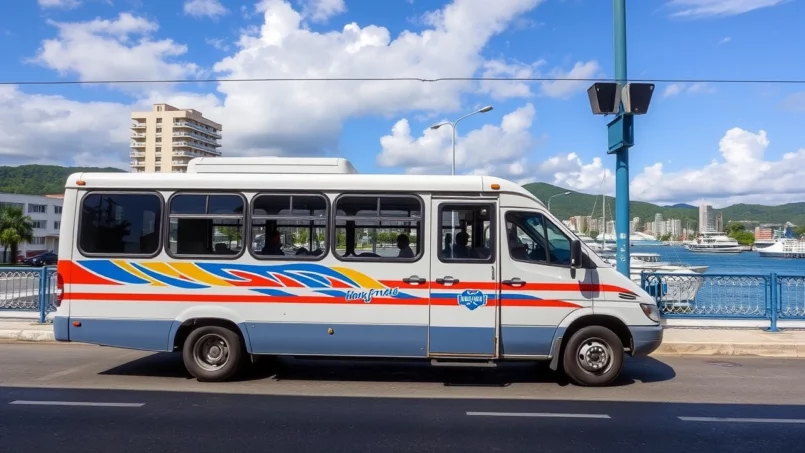
Carros públicos are shared minibuses or vans, identifiable by their yellow license plates bearing the word “Público.” They run on predefined routes but according to a very different logic than a classic bus: they wait until sufficiently full before departing, stop on request, and operate mainly during daylight hours.
According to official data, the system still recently included:
– over 3,000 authorized vehicles;
– nearly 500 different routes;
– about 130,000 passengers per day.
Each town generally has a carros públicos terminal, often located near the central square. That’s where you go to find a vehicle heading to your desired destination.
Advantages and Limitations for the Visitor
For a traveler with time and a minimum of Spanish, públicos can be an extremely economical option for covering longer distances. For example, a trip from San Juan to Ponce by público costs around $15.
However, they have several major drawbacks:
– no official schedules: departures depend on vehicle occupancy;
– very little information accessible online, no centralized app;
– variable comfort;
– operation limited to daylight hours (virtually no nighttime service).
Nevertheless, they remain a pillar of daily mobility for thousands of residents, especially students and seniors, where conventional inter‑city bus service is almost non‑existent.
Ferries to Vieques, Culebra, and Beyond
Puerto Rico is not just the main island. Two inhabited islands, Vieques and Culebra, are integral parts of the territory and rely on ferries for most connections. On a larger scale, ferries also connect Puerto Rico to the Dominican Republic.
Ceiba – Vieques – Culebra Ferries
From the port of Ceiba, on the east coast (about a 25‑minute drive south of Fajardo), ferries operate several times a day to:
– Vieques (about a 30‑minute crossing);
– Culebra (about a 45‑minute crossing).
This is the standard fare in dollars for a round‑trip ferry ticket to Vieques or Culebra, a very attractive price.
However, to obtain these preferential fares, Culebra residents must register both with the municipality and with the operator Puerto Rico Ferry. Visitors pay a higher price but still well below the cost of flying.
To facilitate your ferry travel, download the City Experiences app. It allows you to purchase tickets, check schedules, receive service alerts, and track vessel positions in real‑time. This feature is particularly valuable during hurricane season, from June to November, when some crossings may be delayed or canceled.
San Juan – Cataño Ferry
As mentioned earlier, the San Juan ↔ Cataño connection is both a daily transport mode and a low‑cost mini‑cruise in the heart of San Juan Bay. The 12‑minute trip costs about $0.50, and departures are frequent during peak hours.
International Ferries to the Dominican Republic
For longer journeys, the company Ferries del Caribe connects San Juan’s Pan American terminal to Santo Domingo (Dominican Republic) several times a week. This service is used both by tourists extending their cruise and by residents traveling in the region.
Taxis, Ride‑Hailing, and Car Rentals
Even with a good public transit network in the metropolis, there are still situations where a taxi, ride‑hail service, or rental car are essential: late airport arrival, excursion to a remote beach, nighttime transfer, stay in a rural area…
Taxis: Fare Zones and Flat Rates
In San Juan, the white “tourist taxis” marked Taxi Turístico apply flat rates by zone from Luis Muñoz Marín International Airport (SJU). The city has been divided into sectors:
– Zone 1: the airport itself;
– Zone 2: hotels and resorts in Isla Verde;
– Zone 3: Condado, Miramar, Ocean Park, Santurce;
– Zone 4: Old San Juan, cruise terminals, Puerta de Tierra;
– Zone 5: convention center, Isla Grande airport, associated hotels.
Fares are fixed and are per taxi, not per person. From the airport (zone 1), for example:
| Taxi Trip from SJU (zone 1) | Destination (zone) | Flat Rate (USD) | Notes |
|---|---|---|---|
| SJU → Isla Verde | Zone 2 | 12.00 | + $3 “airport” surcharge |
| SJU → Condado / Miramar | Zone 3 | 17.00 | + $1 per bag, + possible tolls |
| SJU → Old San Juan | Zone 4 | 21.00 | Rate also valid from cruise piers |
| SJU → Convention Center | Zone 5 | 17.00 |
Additional charges typically include:
– a $3 “airport” surcharge;
– $1 per bag;
– $2 for groups of more than 5 people;
– a possible nighttime surcharge (about $1 from 10:00 PM to 6:00 AM);
– highway tolls, charged to the passenger.
Outside tourist zones, some taxis use a meter (minimum charge of about $1.75, then billed per mile and waiting time). However, it is recommended to negotiate the price before getting in and to ask for a receipt.
Uber and Other Ride‑Hailing Services
Platforms like Uber or Lyft are widely available in San Juan and other major urban areas (notably the north and east of the island). They offer:
– transparent, upfront pricing;
– real‑time vehicle tracking in the app;
– often lower costs than traditional taxis on some routes (e.g., Santurce → airport estimated at about $8 via Uber vs. $20 by taxi).
However, under pressure from taxi groups, authorities have restricted ride‑hailing access to certain strategic locations: depending on the period and current regulations, ride‑hailing services may not be allowed to pick up or drop off customers directly at the airport or in specific hotels. It is advisable to check the instructions in the app and, if necessary, walk a few minutes to an authorized pickup point.
Outside major urban areas, ride‑hailing availability is very limited, if not non‑existent.
Car Rental: Maximum Flexibility… and Constraints
As soon as you want to explore the island in depth – remote beaches, mountains of the Cordillera, forests like El Yunque, cities like Ponce or Mayagüez – renting a car becomes almost essential. Major international rental companies (Hertz, Avis/Budget, Enterprise, Alamo, Thrifty, National, etc.) are present at San Juan Airport, sometimes with very competitive rates (in low season, you can find deals around $20/day, excluding insurance).
It’s important to keep a few key elements in mind to fully understand and apply the information presented.
– a U.S. or Canadian driver’s license is accepted; U.S. nationals do not need an international license;
– most rentals require a minimum age of 25 (sometimes possible from 21 with a surcharge);
– vehicles are equipped with an AutoExpreso electronic toll system, with amounts later billed to the renter;
– parking can be difficult and expensive in historic centers (Old San Juan, downtown Ponce), with lots easily costing $20 to $28 per day in the capital;
– some rental companies prohibit taking their vehicles on ferries to Vieques or Culebra.
Traffic drives on the right, speed limits are in miles per hour, and the maximum speed is generally 55 mph on most roads, with some highway sections at 65–70 mph. Main roads (PR‑1, PR‑2, PR‑22, PR‑52…) are in good condition, but many secondary roads suffer from potholes, landslides, and damaged guardrails, especially after hurricanes.
Accessibility and Services for Vulnerable Populations
Puerto Rico is striving to make its transportation network more inclusive, notably through federal funding dedicated to mobility for seniors and people with disabilities (Section 5310 program).
A Legal Framework and Dedicated Plans
The Puerto Rico Highway and Transportation Authority has developed a Coordinated Public Transit‑Human Services Plan that identifies the needs of vulnerable populations and system gaps:
– lack of service in rural areas;
– insufficient accessible vehicles (ramp, wheelchair space, securement);
– deficiencies in street infrastructure (sidewalks, shelters, street furniture);
– lack of public information on existing services and available funding;
– insufficient coordination between public, private, and non‑profit operators.
Several actions are planned to effectively address the identified needs.
Acquisition of better‑equipped vehicles and driver training for improved operations.
Strengthening safety measures to protect users and property.
Awareness campaigns and creation of digital tools (websites, apps).
Establishment of multi‑stakeholder coordination committees and strengthening program management capacity.
On‑the‑Ground Actors: Municipalities, Non‑Profits, Clinics
Beyond major networks like the Tren Urbano or AMA, a constellation of public, private, and non‑profit organizations provides daily targeted transportation:
– municipalities (Arecibo, Bayamón, Caguas, Carolina, Cataño, Arroyo, Barceloneta…);
– organizations like Acción Social de PR, disability associations, geriatric centers, clinics (COSSMA, Centro Geriátrico La Milagrosa, etc.).
These services, partially funded by federal grants, organize transportation to:
– medical appointments;
– senior day centers;
– supermarkets, banks, government offices;
– social or recreational activities.
These services often operate by reservation and use smaller vehicles, better suited to narrow streets or hard‑to‑reach areas than large buses. Designed primarily as a social safety net for residents, they remain largely invisible to tourists.
Private Accessible Transportation
For travelers with specific accessibility needs, several private companies offer wheelchair‑accessible shuttles and vans, ADA‑compliant. Among them:
– Island Mobility: accessible shuttles and vans (capacity for 1 wheelchair and 4‑10 passengers), airport transfers, hotels, cruises, events, private residences, “Meet & Greet” service at San Juan Airport, service animals accepted;
– Go Puerto Rico Shuttle: fleet of accessible vans and buses, licenses issued by the Public Service Commission, possibility of Meet & Greet at the airport;
– Equipos Pro Impedidos: also offers adapted vehicle rentals.
Companies like Rico Sun Tours also offer private airport transfers in accessible vans, accommodating up to six passengers.
Finally, equipment rental specialists (Cloud of Goods, Special Needs Group / Special Needs at Sea) deliver wheelchairs, scooters, power chairs directly to the Port of San Juan or SJU Airport.
Walking, Biking, Gliding: Soft Mobility in the Capital
Puerto Rico’s long‑term planning emphasizes the concept of Complete Streets: streets designed for all users (pedestrians, cyclists, public transit, cars). Several initiatives have already emerged, particularly in the San Juan–Carolina area.
Walking: Old San Juan, Condado, and the Waterfront
Old San Juan remains the prime example of a neighborhood where you can do everything on foot. Within a small area, you can access most monuments, plazas, and museums. The Paseo de la Princesa promenade, running along the sea at the foot of the city walls, is a classic, with views of the bay and El Morro fort.
A continuous coastal walkway, with pedestrian and bike sections, connects Condado to the old city. From neighborhoods like Santurce, it is possible to walk to the beaches of Condado or Ocean Park, while being mindful of the heat and sun.
Biking: Bike Lanes Between San Juan and Carolina
San Juan has about 18 miles (nearly 30 km) of protected bike lanes, notably along the axis connecting the capital to Carolina, passing through the coastal areas of Isla Verde and Piñones. A car‑free greenway connects the Condado Lagoon to Old San Juan, runs along the walls of El Morro, and ends at the Paseo de la Princesa.
Several companies offer bike rentals (classic, electric, road, mountain) by the day, with hotel delivery services like San Juan Bike Rentals. Electric scooters are also available via free‑floating apps such as Bird or Lime.
Outside the metropolis, however, road cycling is still considered dangerous, due to the combination of dense traffic + variable road conditions + sometimes aggressive driving. It is imperative to wear a helmet and remain extremely vigilant.
How to Plan Your Trips and Avoid Surprises
One recurring criticism of public transportation in Puerto Rico concerns the lack of clear, up‑to‑date information. Bus maps are hard to find, schedules are not always followed, and passenger information systems are still under development.
A few tips to work around these difficulties:
For efficient travel, install the **official AMA bus tracking app** to know the real‑time position of buses. Use multimodal apps like **Moovit** or **Google Maps** (transit mode) to generate routes combining bus, metro, walking, and sometimes ferry. Check **service alerts** for ferries (Puerto Rico Ferry / City Experiences app), especially during hurricane season. Finally, allow **extra time** for travel during peak hours, particularly in the San Juan area between 7‑9 AM and 4‑7 PM.
It’s also recommended to always have:
– small bills and exact change, essential for paying buses that require the exact amount;
– a portable charger to keep your phone operational (navigation, ride‑hailing, e‑tickets);
– a reusable water bottle to handle the heat, especially if combining walking and public transit.
What’s Still Missing… and What’s in the Works
Despite progress, official plans highlight numerous gaps:
– rural areas with virtually no regular service;
– poor coordination between public services, carros públicos, and non‑profit initiatives;
– insufficient pedestrian infrastructure around bus stops (sidewalks, shelters, lighting);
– deficient information on existing services and possible financial assistance.
From a visitor’s perspective, this means that outside major urban centers and ferry/flight routes, it’s difficult to rely solely on public transportation. The winning model often remains a combination:
To get around Puerto Rico, prioritize public transit (Tren Urbano, AMA buses, ferries, walking) for urban trips. Opt for a taxi or ride‑hail service for specific transfers, especially at night or with luggage. Finally, to explore beyond the metropolitan area, renting a car is recommended.
Looking ahead, several projects are on the table:
– potential extension of the Tren Urbano towards the northeast, with stations considered for the convention center district (Distrito T‑Mobile) and Old San Juan;
– study of longer extensions towards Carolina and Caguas;
– streetcar projects connecting Sagrado Corazón to Old San Juan and, eventually, to the airport;
– trials of Mobility as a Service (MaaS) solutions in the eastern region, integrating buses, ferries, micro‑transit, and micromobility into a single app.
The implementation of these projects will, however, depend on the island’s budgetary capacity, still marked by the debt crisis and the massive costs of post‑hurricane reconstruction.
In Summary: Which Mode for Which Purpose?
Without turning this guide into a list, we can outline a few practical pointers based on the most common situations:
To stay in San Juan without a car, combine walking, AMA buses, Tren Urbano, the Cataño ferry, and occasionally taxis/Uber. A Tren Urbano 1‑ or 7‑day pass is advantageous if you’re staying near a station. To reach Vieques or Culebra on a budget, take the ferry from Ceiba (planning the road trip to the port) and book online via the dedicated app. To explore the rest of the island (Ponce, El Yunque, west coast, Ruta Panorámica), renting a car or booking tours that include transportation from San Juan is recommended. Carros públicos are a backup option for the more adventurous and Spanish‑speaking. For travelers with reduced mobility, prioritize the San Juan area, the Tren Urbano + AMA network, major hotel chains, and, if needed, private adapted transportation (Island Mobility, Go Puerto Rico Shuttle, Equipos Pro Impedidos), while also taking advantage of ferries and explicitly accessible sites.
Puerto Rico does not yet offer a homogeneous public transportation network across the entire island, but by understanding the logic of the different modes and planning a little, it is entirely possible to travel in a more sustainable, economical way, and often with a perspective closer to local life than from behind a rental car windshield.
Disclaimer: The information provided on this website is for informational purposes only and does not constitute financial, legal, or professional advice. We encourage you to consult qualified experts before making any investment, real estate, or expatriation decisions. Although we strive to maintain up-to-date and accurate information, we do not guarantee the completeness, accuracy, or timeliness of the proposed content. As investment and expatriation involve risks, we disclaim any liability for potential losses or damages arising from the use of this site. Your use of this site confirms your acceptance of these terms and your understanding of the associated risks.

Cyril Jarnias is an independent expert in international wealth management with over 20 years of experience. As an expatriate himself, he is dedicated to helping individuals and business leaders build, protect, and pass on their wealth with complete peace of mind.
On his website, cyriljarnias.com, he shares his expertise on international real estate, offshore company formation, and expatriation.
Thanks to his expertise, he offers sound advice to optimize his clients' wealth management. Cyril Jarnias is also recognized for his appearances in many prestigious media outlets such as BFM Business, les Français de l’étranger, Le Figaro, Les Echos, and Mieux vivre votre argent, where he shares his knowledge and know-how in wealth management.





