
 Published on and written by Cyril Jarnias
Getting around Cameroon, especially in major cities like Douala and Yaoundé, can seem confusing at first. Uneven road network, a predominantly informal supply, overcrowded shared taxis, ubiquitous motorcycle taxis, intercity trains and buses, and Bus Rapid Transit projects in the pipeline: the picture is complex, but far from illogical. This practical guide offers a detailed dive into public transportation in Cameroon, explaining how it works, how much it costs, what projects are underway, and how to travel while minimizing risks.
Understanding the transportation landscape in Cameroon
Cameroon has been structured around the road. About 90% of passenger and freight movement takes place via the road network, whether for urban or intercity trips. Other modes—rail, aviation, maritime or river transport—exist but remain a minority in the daily mobility of the population.
This dominance of the road can be explained by several factors. The country experienced rapid urbanization without equivalent development of structured public transit. In large urban areas, the formal supply (city buses, suburban rail) covers a very small share of needs. The consequence is simple: it is the informal services (shared taxis, motorcycle taxis, unregulated minibuses) that handle most trips.
Cameroonian authorities have developed a new strategic framework to modernize the entire transport sector (roads, public transit, rail, aviation, ports). This plan aims for more efficient, safer, and greener mobility, with the goal of making the country an emerging nation by 2035.
To better set the context, it is useful to compare the share of the main modes in the two largest metropolitan areas.
| City | Walking | Taxis (shared) | Motorcycle taxis | Formal buses | Private car |
|---|---|---|---|---|---|
| Yaoundé | ~33% | ~40% | ~12% | ~5% | ~10% |
| Douala | ≥33% | significant | ~40% | <1% | ~5% |
In both cities, walking accounts for at least one-third of trips, despite scarce sidewalks and unsafe pedestrian crossings. Private car use remains a minority, while taxis and motorcycles concentrate most of the demand.
Yellow taxis: the backbone of urban transport
In large cities, yellow taxis are everywhere. They are the most visible and widely used form of public transportation, especially in Douala and Yaoundé. Most operate in shared mode, with some important nuances to understand.
The dominant model is the collective taxi, often called “taxi commun” or collective taxi. The principle is simple: the taxi follows a more or less fixed route along major thoroughfares and picks up passengers as long as there is space. A single vehicle can thus carry people who do not have exactly the same destination but are heading in the same general direction.
A standard sedan can carry up to 11 people, including children, under certain overcrowded conditions.
Base fares are regulated by the state and driver unions. After several increases linked to rising fuel prices, the reference scale for urban areas has been revised. For standard shared taxi trips, indicative amounts are around 350 FCFA during the day and 400 FCFA at night in many cities, although in practice, many classic trips are still charged in a range of 250 to 500 FCFA per person depending on distance and city. These prices usually cover only one segment; to cross the entire city, one often takes several taxis.
| Type of urban ride (shared taxis) | Indicative day fare | Indicative night fare |
|---|---|---|
| Short intra-neighborhood trip | 250–300 FCFA | 300–350 FCFA |
| Standard trip (zone to zone) | ~350 FCFA (reference) | ~400 FCFA (reference) |
Negotiation remains central to the system. Even with an official rate card, the price depends on the exact route, the time of day, congestion, and even the weather. Before getting in, it is common to shout your destination through the open window; the driver honks or nods if they accept, sometimes announcing the fare. Newcomers may face attempts at overcharging, especially when getting off intercity buses or leaving stations.
It is essential to carry small denominations (coins or bills of 500 to 1000 FCFA) for everyday payments, especially for transportation. Drivers often claim to have no change, making transactions with large bills complicated.
“Taxi dépôt”: private, more expensive but more direct
Alongside the shared taxi, the “taxi dépôt” refers to exclusive use of the vehicle. In this case, you pay not for a seat, but for the entire car for a specific trip, without picking up other passengers along the way.
Fares are obviously higher, but the service offers several advantages: comfort (you sit normally, without being squeezed), speed (direct route without multiple stops), and greater safety, especially at night or with luggage. Typical ranges are from about 1,000 to 3,000 FCFA within the city, depending on distance and time, with regulated amounts for certain uses (such as “dépôt” rental at 3,000 FCFA per day and 3,500 FCFA at night after the latest revisions).
For airport–city center transfers, the fare is often around 5,000 FCFA or more. It is essential to firmly agree on the price with the driver before starting the trip.
| Urban taxi service | Typical price range | Comment |
|---|---|---|
| Shared taxi (single ride) | 250–500 FCFA / person | Zone fares, non-direct route |
| Taxi dépôt (urban trip) | 1,000–3,000 FCFA | Exclusive, fast, negotiated |
| Taxi dépôt airport–center | ≈ 5,000 FCFA and up | Depending on distance and time |
How to use a taxi practically and safely
The practical operation is more about local culture than written rules. Rather than using addresses, people mention intersections, markets, large buildings (hospitals, ministries, gas stations). City maps are of little use to drivers; visual landmarks are what matter.
At major intersections, spontaneous queues form according to directions. Everyone calls out to taxis by shouting their destination. Vehicles come and go along main thoroughfares, somewhat like buses on implicit lines.
During the day, the shared taxi is generally acceptable in terms of safety, though keeping in mind the risks of pickpocketing. At night, recommendations converge: prefer a private taxi, ideally booked through a hotel, restaurant, or via an app, and avoid cars already occupied by multiple strangers.
Motorcycle taxis: fast, ubiquitous… and very risky
Motorcycle taxis—often called “bendskins,” “motos,” or “okadas”—have become, in a few decades, a pillar of urban and peri-urban travel. Their rise accelerated in the late 1990s, against a backdrop of economic crisis, deteriorating roads, and massive unemployment among young graduates.
Today, there are about 35,000 motorcycle taxis in Yaoundé and nearly 50,000 in Douala. They account for over 12% of household trips in Yaoundé and more than a third in Douala. However, in Douala, seven out of ten traffic accidents reportedly involve a motorcycle taxi. In 2020, five district hospitals in the city recorded 326 injuries and 91 deaths related to this mode of transport. Reference hospitals in Douala and Yaoundé even have dedicated units for motorcycle accident victims.
The reasons for this success are clear. Motorcycles weave through traffic jams, reach enclaved neighborhoods where neither taxis nor buses go, and drastically reduce travel times. For short distances, they are often cheaper than a taxi if traveling alone, and certainly much faster. They are always available, gathered near markets, offices, and bus stops.
Safety is the main weakness. Helmet use is rare, the bikes are often in poor condition, and the roads are degraded, especially during the rainy season. Aggressive driving and dangerous practices, such as the prohibited transport of multiple passengers including children, are common.
Studies show that users have developed their own strategies to limit risks: choosing a seat based on the size or age of other passengers, talking with the driver to encourage more cautious driving, relying on religious faith. These “techniques” are not enough to compensate for the structural exposure to danger.
Clearly, for a visitor, the motorcycle taxi should be approached with great caution. It is often the most effective way to save time, but at the cost of a much higher accident risk than other modes. Many international recommendations advise against this mode for tourists.
Urban buses: still a marginal presence
Unlike other African capitals, Yaoundé and Douala do not yet have highly structured urban bus networks covering the entire urban area. The landscape is marked by a succession of public and private initiatives, often financially fragile.
In Douala, several formal operators exist, but their modal share remains below 1% of trips. Urban buses carry about 30 million passengers per year, compared to 45 million for shared taxis. Typical operating hours are from 5 a.m. to 10 p.m., with peaks from 6 a.m. to 9 a.m. in the morning and 4 p.m. to 7 p.m. in the evening.
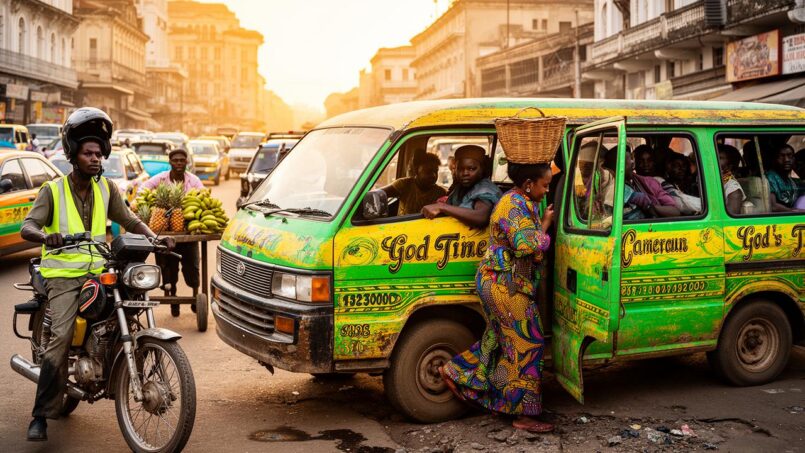
Formal transport in Yaoundé is provided by STECY, which succeeded the former company ‘Le Bus’. It operates several lines, including to the airport, and uses a ‘Tap & Go’ magnetic card payment system, rechargeable at newsstands. However, this supply remains insufficient for the estimated 8 million daily trips. Informal minibuses, often old, overcrowded vans, complement connections between the center and the periphery, but operate without regulation or dedicated infrastructure.
The public sector has also attempted to structure urban transport through national companies like SOTUC (Société de Transport Urbain du Cameroun), which holds a monopoly in Douala and Yaoundé. In practice, SOTUC carries only about 5% of urban passengers, due to poor management and a catastrophic financial situation, with over $100 million in debt and nearly $48 million in negative equity. This fragility has reinforced the weight of informal offerings.
Despite certain limitations, urban buses offer significant benefits, and their future rests on key modernization axes.
An extremely affordable per-trip price, essential for users.
Sometimes air-conditioned, and safety conditions superior to two-wheelers.
A key mode of transport for low-income populations.
Renewal and improvement of vehicles for more efficient service.
Development of dedicated infrastructure to ease traffic flow.
Harmonization of ticketing systems and development of digital services for users.
BRT in Douala and Yaoundé: the revolution ahead
Faced with congestion and the inefficiency of systems dominated by motorcycles and taxis, the priority for major Cameroonian cities today is the development of Bus Rapid Transit (BRT) corridors. These bus systems running on dedicated lanes, with built stations and modern ticketing, are intended to form the backbone of future public transportation.
Douala: a structuring BRT network
In Douala, a large-scale BRT project is underway as part of the Douala Urban Mobility Project (PMUD), financed by the World Bank for about $500 million. One of the flagship components is the construction of BRT lines totaling 28 km, with 48 stations spaced approximately 500 meters apart. Five major intermodal exchange hubs are planned at former strategic sites such as the old customs headquarters, Ndokoti, PK14, Nelson Mandela, and Yassa.
The overall transport project is estimated at just over 335 billion FCFA.
A specific component concerns feeder roads. A first phase of 12.5 km is underway, with a budget of about 4.7 billion FCFA, including road rehabilitation, drainage, street lighting, traffic lights, and reorganization of networks (electricity, water, telecoms). Ultimately, the total length of these roads could reach 80 km, compared to 26 km initially planned, in order to better connect neighborhoods to BRT stations.
The expected benefits are significant: approximately 13% reduction in daily travel times, reduction in greenhouse gas emissions, and improved accessibility to essential services. Analyses show, for example, that the share of the population able to reach a public hospital in under 45 minutes would increase from 43% to 58%, and that 45,000 more young people could reach a university campus in under three-quarters of an hour. The impacts on women, who represent 84% of trips to markets, are also notable: 9% more women would have access to a market in under 45 minutes.
Yaoundé: BRT and “MoVe Yaoundé”
The capital is not lagging behind. Yaoundé has a Sustainable Urban Mobility Plan (SUMP) adopted in 2019, which identifies as a priority the establishment of BRT corridors, combined with a reorganization of informal transport and improvements to walking. The plan aims for a 40% reduction in travel times citywide and a 10% reduction in CO₂ emissions compared to a no-action scenario.
This 22 km pilot section should carry up to 43,000 passengers per day in the first phase.
This project is part of the “MoVe Yaoundé” initiative, supported by the European Union, France, and Germany, for a total amount of about 4.4 billion FCFA. It also includes the redevelopment of downtown roads, the professionalization of informal operators, and the development of hubs like Mvan, Elig Effa, or Elig Edzoa under the “Yaoundé Cœur de Ville” program.
International financing (World Bank, AFD, EU, GIZ, etc.) plays a determining role in the feasibility of these projects. The challenge now is to move from studies to implementation, providing cities with the necessary technical and institutional capacities.
Traveling between cities: bus or train?
Outside major urban areas, most intercity travel is done either by bus, by “bush taxis” (intercity taxis or minibuses), or by train where available.
The Douala–Yaoundé axis: the backbone
The Douala–Yaoundé link, roughly 230–240 km long, is the busiest corridor in the country. Numerous bus companies operate on this route (Finexs Voyages, General Express, Global Voyages, Touristiques Express, Musango Bus Services, etc.), offering “standard,” VIP, and even VVIP class services.
Fares have been regularly adjusted in recent years. On standard services, the ticket price increased from 3,000 to 3,500 FCFA, then to 4,000 FCFA in 2024. Upper classes, for some operators, hover around 4,500 FCFA for economy, 6,500 FCFA for VIP, 7,500 FCFA for VVIP, according to fare revision announcements. On other routes operated by Musango, one still sees “standard” Douala–Yaoundé tickets at 3,500 FCFA and VIP tickets at 8,000 FCFA, a sign of strong heterogeneity in supply.
| Intercity bus route (examples) | Class | Indicative fare (FCFA) |
|---|---|---|
| Douala – Yaoundé | Standard | 3,500 – 4,000 |
| Douala – Yaoundé | VIP | 6,500 – 8,000 |
| Yaoundé – Buea / Limbe | Standard | 5,000 |
| Yaoundé – Buea / Limbe | VIP | 8,000 – 10,000 |
| Bafoussam – Buea | Standard | 5,000 |
| Douala – Bamenda | Standard | 6,000 |
| Douala – Bamenda | VIP | 6,500 |
The law sets a base fare for intercity coach trips at 16 FCFA per kilometer for adults over 21 (previously 14 FCFA). Youth aged 11 to 21 pay 10 FCFA/km, children aged 8 to 10 and people with reduced mobility pay 8 FCFA/km, and children under 8 travel free. But in practice, most agencies apply “per trip” prices according to industry custom and competition, more or less in line with Ministry of Commerce approvals.
Tickets can be purchased on the day at travel agencies (private bus stations). However, for highly demanded routes or VIP class, it is wise to book a day or two in advance, especially during peak periods (holidays, vacations, long weekends). Online platforms like Travada allow you to reserve your seat on several routes (Yaoundé, Douala, Bamenda, Buea, Limbe, Bafoussam, etc.), with payment via mobile money (MTN, Orange) and real-time notifications of delays or cancellations.
The train: a safer option on certain routes
The rail network, operated by Camrail, connects the cities of Douala and Yaoundé to the north of the country (Ngaoundéré) and also serves regional routes (Belabo – Ngaoundéré, Douala – Kumba). This mode remains a minority in terms of market share, but it constitutes an interesting option in terms of road safety, especially on long distances.
On the Douala–Yaoundé route, two types of trains are available: fast Express and slower omnibus. TRANSCAM I Express trains (185/186) offer two classes: First (10,000 FCFA one-way, 17,000 FCFA round trip) and Premium/Second (6,000 FCFA one-way, 11,000 FCFA round trip). Omnibus trains (181/184) are more economical at 3,000 FCFA one-way. Travel time is generally between 4h45 and 5h.
To the north, the Yaoundé–Ngaoundéré link (TRANSCAM II, trains 191/192) operates as an overnight train, with second-class cars (10,000 FCFA), first class (17,000 FCFA), and sleeper cars with compartments of 4 bunks (25,000 FCFA) or 2 bunks (28,000 FCFA). Travel time is around 12 to 14 hours, and a dining car is usually available.
| Rail line | Class / Service | One-way fare (FCFA) |
|---|---|---|
| Douala – Yaoundé (Express) | First class | 10,000 |
| Douala – Yaoundé (Express) | Premium / Second | 6,000 |
| Douala – Yaoundé (Omnibus) | Second | 3,000 |
| Yaoundé – Ngaoundéré | Second | 10,000 |
| Yaoundé – Ngaoundéré | First | 17,000 |
| Yaoundé – Ngaoundéré | Sleeper (4 bunks) | 25,000 |
| Yaoundé – Ngaoundéré | Sleeper (2 bunks) | 28,000 |
| Ngaoundéré – Belabo | Second | 4,200 |
The train offers appreciable comfort for long journeys and avoids road-related risks (potholes, stray animals, driver fatigue, nighttime insecurity). However, it remains exposed to other constraints: breakdowns, delays, or rare tragedies like the Eseka disaster in 2016—still very present in memories and a major blow to the rail image.
Safety, insecurity, and risky roads
The safety issue is not limited to traffic accidents. In certain regions, general insecurity on the roads weighs heavily on mobility. This is particularly the case in the Northwest, Southwest, and Far North, marked by politico-security crises.
A study reveals that 78% of people consider public transport unsafe in the region, with 65% having experienced a recent incident. Routes like Bamenda-Kumbo or Bamenda-Wum are perceived as very dangerous, due to acts by armed groups, kidnappings, robberies, and checkpoints. The catastrophic state of roads, such as the Bamenda-Wum road passable only by motorcycle, worsens the situation.
Regionally, 81.5% of reported incidents are related to checkpoints, and 73% to frequent passenger checks, sometimes accompanied by extortion. In these contexts, measures such as establishing secure travel zones, using advanced surveillance systems, or mobile alert devices have been recommended.
Even outside conflict zones, major road axes like Yaoundé–Douala or Bafoussam–Douala present a high accident risk, due to aggressive driving, dangerous overtaking, overloaded trucks, poor road surfaces, and inadequate nighttime lighting. It is recommended to limit nighttime travel, choose reliable operators, and avoid overloaded or poorly maintained vehicles.
The weight of digital: apps, ticketing, and carpooling
Despite the importance of the informal sector, Cameroonian mobility is not immune to the rise of digital technology. Several categories of tools are gradually changing practices.
First, navigation apps like Google Maps, Waze, or Maps.me now make it possible to find your way around the city and anticipate traffic conditions. Downloading offline maps is especially useful in areas with limited internet coverage. Real-time information reported by users via Waze, for example, helps avoid certain traffic jams or high-risk areas.
In large cities like Douala and Yaoundé, apps such as Bolt, Gozem, or Yango allow you to book rides. They offer an upfront price, GPS tracking of the trip, and cash or electronic payment. These services meet a need for fare transparency and better traceability.
Finally, digital technology is penetrating the intercity transport sector. Solutions like Travada allow you to book a bus ticket on national routes, choosing the schedule, seat type (standard or VIP), and paying via mobile money. Intercity carpooling platforms are also developing, with a system where drivers offer seats in their car on a given route, providing an alternative that is sometimes more comfortable and more flexible than buses or shared taxis.
These innovations do not yet replace traditional circuits, but they constitute an important complement, especially for people familiar with digital tools.
For a country where GDP per capita remains modest, transport costs weigh heavily on household budgets. In Yaoundé, taxi expenses represent more than 15% of income for one in four people. A monthly public transport pass in major cities can be around 10,000 FCFA (about 15–17 euros), which remains substantial for many households.
The choice of transport mode depends mainly on budget. The wealthier favor private cars, ride-hailing services, and air travel. The majority opt for shared taxis, motorcycles, and standard buses, despite the drawbacks. The most modest rely mainly on walking, minibuses, and motorcycles, often in difficult conditions and with long waits.
In this context, the success of future BRT systems, modernized urban buses, and digital services will largely depend on their pricing. Fare capping mechanisms already exist for certain groups (students, people with disabilities), with specific discounts on peri-urban and university transport, but their reach remains limited. More broadly, the question is whether it is possible to offer a large-scale, reliable, and financially sustainable service without causing costs to skyrocket for users or public authorities.
How to get around practically, city by city
Even though each region has its specificities, a few main lines emerge for understanding public transportation in Cameroon.
In Douala, most urban trips are made by motorcycle and shared yellow taxi. Urban buses form a complementary but minority offering, while major axes (Ndokoti, Bonaberi, PK14, Yassa) concentrate a significant share of flows. The future BRT is expected to strongly structure these movements. Traffic jams are particularly dense during peak hours, and crossing the city can take a very long time.
In Yaoundé, walking is made difficult by the hilly topography. Shared taxis are the dominant mode of transport, while motorcycles are very present in the periphery. The supply is complemented by the STECY bus network and informal minibuses, but their modal share remains well below that of taxis. Urban planning, particularly around hubs like Mvan or Elig Effa, road redevelopment, and the planned arrival of a BRT (Bus Rapid Transit) are key elements for transforming the mobility system in the long term.
In secondary cities (Bafoussam, Bamenda, Buea, Limbe, etc.), the palette consists mainly of motorcycle taxis, shared taxis, and minibuses, with a more limited supply of intercity buses to regional or national capitals. National roads are sometimes decent, sometimes in very poor condition, especially during the rainy season, when some routes become muddy and nearly impassable for cars.
Toward a more integrated and more sustainable system?
Looking at the bigger picture, public transportation in Cameroon is at a pivotal moment. On one hand, a massive informal system, flexible, adaptable to demand but unsafe, polluting, and difficult to regulate. On the other, a stated desire to build structured networks (BRT, modernized urban buses), strengthen rail for long distances, improve roads, and deploy digital solutions (electronic ticketing, real-time passenger information, integrated payments).
Recent public policies favor urban mobility through national and local plans (SUMP), investments in road maintenance and major projects, and international cooperation. They also progressively integrate informal services through driver training, structuring them into cooperatives, contractualization, and fleet renewal, rather than through elimination.
The future of public transportation in Cameroon will also depend on the ability to better protect users. Reducing the 30 annual road deaths per 100,000 inhabitants, securing sensitive routes in the Northwest and Far North, combating extortion and abusive checks, making bus and taxi zones safer against theft: these are as many priority tasks to ensure that mobility is no longer synonymous with risk.
To get around Cameroon, you currently have to work with a hybrid transport system. Prioritize shared taxis and motorcycle taxis for short, quick trips, urban or intercity buses when they are well identified, the train for long distances on equipped lines, and ride-hailing services/digital platforms when safety or predictability is a priority. The future arrival of BRT projects and mobility plans will transform the landscape. In the meantime, knowing both the formal and informal rules remains the best way to get around efficiently while minimizing risks.
Disclaimer: The information provided on this website is for informational purposes only and does not constitute financial, legal, or professional advice. We encourage you to consult qualified experts before making any investment, real estate, or expatriation decisions. Although we strive to maintain up-to-date and accurate information, we do not guarantee the completeness, accuracy, or timeliness of the proposed content. As investment and expatriation involve risks, we disclaim any liability for potential losses or damages arising from the use of this site. Your use of this site confirms your acceptance of these terms and your understanding of the associated risks.

Cyril Jarnias is an independent expert in international wealth management with over 20 years of experience. As an expatriate himself, he is dedicated to helping individuals and business leaders build, protect, and pass on their wealth with complete peace of mind.
On his website, cyriljarnias.com, he shares his expertise on international real estate, offshore company formation, and expatriation.
Thanks to his expertise, he offers sound advice to optimize his clients' wealth management. Cyril Jarnias is also recognized for his appearances in many prestigious media outlets such as BFM Business, les Français de l’étranger, Le Figaro, Les Echos, and Mieux vivre votre argent, where he shares his knowledge and know-how in wealth management.





