
 Published on and written by Cyril Jarnias
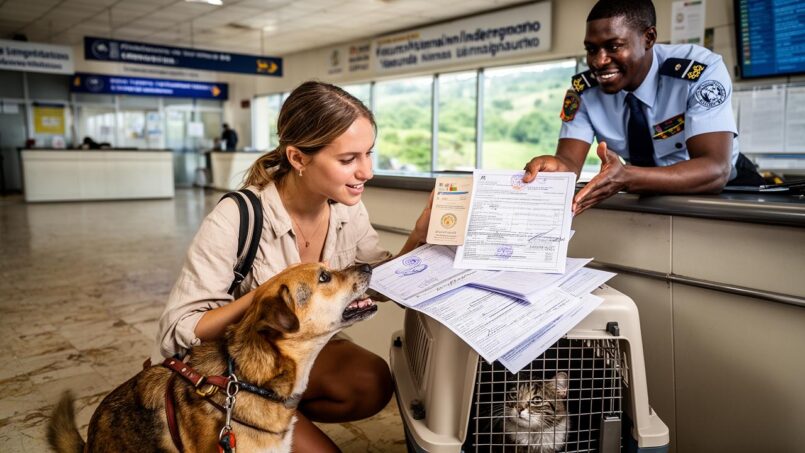
Moving to Cameroon with your dog or cat is possible, provided you plan ahead. From veterinary paperwork, airline requirements, and the local realities of care, housing, and food, an expatriation project with an animal cannot be improvised. Import rules are generally straightforward, but a mistake in a vaccine date or a missing document can be enough to have a dog held up at the airport.
Good to know:
For a successful stay with your pet in Cameroon, it is essential to comply with legal entry requirements, prepare the flight well, and research local resources (veterinarians, food, housing) to ensure their adaptation and well-being on the ground.
Understanding the Legal Framework for Entering Cameroon with an Animal
Cameroon does not impose systematic quarantine for dogs and cats that meet health requirements. However, these rules are strict on two points: identification and rabies vaccination, supplemented by an official health certificate.
Animals Concerned and Special Cases
The regulations described primarily target dogs and cats, including assistance and service dogs. Emotional support animals are generally treated as regular pets, not as service animals.
Hybrids resulting from recent crosses with wild species are subject to stricter controls. Thus, wolf-type dogs, Savannah cats, and Bengal cats can only enter Cameroon if they are at least of the 5th generation from the wild ancestor. In practice, this requires very detailed pedigrees; for most expatriates, this amounts to a near-prohibition.
For other species (birds, reptiles, amphibians, rodents, rabbits, tropical fish, etc.), Cameroon applies different rules: rabies vaccination is not required, but an import permit and a health certificate are still necessary. It is also necessary to check whether the species is protected by CITES, particularly for certain parrots or tortoises.
The country does not publish an official list of banned dog breeds. Theoretically, all dog and cat breeds are allowed, but animals considered dangerous or exotic may be subject to case-by-case restrictions, and owners remain legally responsible for their animal’s behavior.
Identification: The Role of the Microchip
Cameroon strongly recommends identification by microchip. Specialized sources mention two approaches:
– In several detailed procedures, the microchip is described as mandatory.
– Other guides mention a strong recommendation, but not a formal requirement.
Attention:
A 15-digit microchip conforming to ISO standards 11784 or 11785 (Annex A) is considered essential.
1. Authorities in many countries require the microchip for return after a stay in Cameroon, as the country is classified as high-risk for rabies.
2. Without electronic identification, it is very difficult to prove that a vaccination certificate corresponds to the animal presented.
3. In case of escape, the chances of finding an unidentified animal drop drastically.
The microchip must be implanted by a veterinarian, a veterinary clinic, or duly trained personnel. All documents (health certificate, passport, vaccination record) must mention the microchip number. Ideally, also register your pet in an identification database and keep proof of registration.
As a supplement, a tag with your name, a local number, and an international number remains useful, especially in an environment where electronic identification is not yet widespread.
Rabies Vaccination: The Cornerstone of the File
In Cameroon, all dogs and cats over three months old must be vaccinated against rabies to enter the territory. The validity conditions are precise:
– the vaccine must have been administered at least 30 days before arrival;
– it must have been given no more than 12 months before entry.
Three-year vaccines, common in Europe or North America, are only accepted if the injection was given less than one year ago. In other words, if your vaccine is “valid until 2026” but was given in 2023, it will be refused in 2026 for entry into Cameroon: a new injection will be required within the 12 months preceding the trip.
Proof can take several forms:
– a rabies vaccination certificate signed and stamped by the veterinarian;
– an official vaccination record or booklet;
– a European pet passport, for travelers coming from the EU.
Tip:
An antibody titer test (rabies serology) or an exemption letter from a veterinarian never replaces a valid rabies vaccination for regulatory purposes. Only an official vaccination certificate, attesting to an injection with an approved vaccine, is accepted for international travel or to comply with the law.
Other Vaccinations: Strongly Recommended
Cameroon does not require other vaccinations for animal entry, but specialized organizations recommend updating the core vaccines according to the species.
For dogs, the following are advised:
– Distemper;
– Infectious hepatitis (Adenovirus);
– Parvovirus;
– Leptospirosis.
For cats, it is prudent to vaccinate against:
– Feline viral rhinotracheitis (FVR);
– Calicivirus;
– Panleukopenia.
These vaccines are not required at the border, but they protect against diseases that are often harder to manage in a veterinary care system that is less dense than in Western countries.
All these injections can be recorded on the international health certificate to facilitate review by Cameroonian authorities.
Health Certificate: The Key Document
The “passport” for Cameroon is not a single document stamped by the country, but a file based on an official health certificate. The main principles are consistent:
– it must be issued in the country of origin by an authorized veterinarian;
– it must be established shortly before departure: according to sources, “less than 48 hours,” “within the week preceding travel,” or “a few days before departure”; to be safe, many veterinarians aim for a period of 2 to 5 days;
– it must then be endorsed/validated by the competent public veterinary authority (ministry, inspection service, USDA/CFIA for North America, departmental veterinary directorate in France, etc.).
This certificate must include:
Example:
To legally transport a pet to another country, an official veterinary certificate is required. This document must imperatively contain: the owner’s identity and contact information; detailed travel itinerary (country of departure, destination, and any transit points); a precise description of the animal (species, breed, sex, date of birth, color, distinctive marks, and microchip number); the complete vaccination history (dates, vaccine type, batch number) and parasite treatments; as well as a clear statement from the veterinarian certifying that the animal is in good health, fit for travel, and does not originate from a rabies risk area.
In several countries, this certificate follows a very strict model (USDA, CFIA, UK or French authorities). Any correction must be made without erasing (no “white-out”), by hand, dated and countersigned, or the certificate must be reissued.
Once completed by the attending veterinarian, the document must be endorsed by the health authority (official stamp, blue ink signature, page numbering, etc.). Without this validation, many Cameroonian border veterinary services consider the certificate non-compliant.
Import Permit and Taxes
For dogs and cats accompanying their owner for personal purposes, no import permit is required. The situation is different for other species, which must in principle obtain prior authorization from the competent ministry.
Upon arrival, travelers may be subject to a tax of approximately 5,000 XAF (CFA francs) per animal, payable to customs. This amount, relatively modest, may vary depending on regulatory changes, but it remains an expense to anticipate.
Quarantine: Not Automatic, but Possible
Officially, Cameroon does not impose a mandatory quarantine period when all documents are in order and the animal appears healthy upon inspection. However, the texts are very clear about penalties for non-compliance:
– if a document is missing or a vaccine is not valid, the animal may:
– be placed in quarantine, if facilities exist;
– be returned to the country of origin;
– in extreme cases, be subject to euthanasia decided by the veterinary authorities.
In all cases, all costs (quarantine, care, return transport, even euthanasia) are borne by the owner. Hence the importance of double-checking every date, every signature, and every microchip number before boarding the plane.
Traveling to Cameroon with an Animal: What Airlines Provide
To reach Cameroon, most expatriates use major European, African, or Middle Eastern airlines. Policies vary from one carrier to another, but some constants emerge.
Accepted Animals and Weight Limits
Generally, airlines distinguish three transport modes:
– In the cabin: for small dogs and cats whose weight (animal + carrier) usually remains under 7–8 kg;
– In the hold as checked baggage: for heavier animals traveling in the pressurized cargo hold;
– As freight (cargo): when the animal exceeds weight or size limits, or when the destination country’s regulations require it.
Many carriers limit one animal per passenger in the cabin, with a total number of animals per flight. Reservations must be made in advance, often at least 48 to 72 hours before departure, and confirmed again close to the flight.
Good to know:
Policies vary by airline: KLM only accepts dogs and cats, while Corsair also accepts some rodents and birds but no longer accepts ferrets. Fish and other cold-blooded animals are generally only transported via specialized freight.
Brachycephalic breeds (French bulldogs, pugs, Shih Tzus, some boxers, etc.) are often not accepted in the hold due to increased respiratory risk. They may be allowed in the cabin if total weight and dimensions permit.
Cabin Travel Conditions
The most common rules for an animal in the cabin include:
– the animal must remain in its carrier or crate for the entire flight;
– the container must be:
– soft-sided or rigid depending on the airline;
– well-ventilated and leak-proof;
– of dimensions strictly compatible with the space under the seat (e.g., 46 × 28 × 24 cm in a typical policy);
– the total weight (animal + carrier) generally does not exceed 8 kg;
– the animal must have a minimum age (often 8 to 15 weeks).
Attention:
Passengers traveling with an animal cannot occupy certain seats, particularly emergency exit rows, bulkhead rows, and, depending on the aircraft, certain seats in forward cabins. Rules vary by airline, so it is imperative to check the applicable restrictions for each specific flight.
The presence of a small dog or cat in the cabin is almost always charged via a separate “pet fee” from baggage.
Transport in the Hold or as Freight
For animals that are too heavy or too large for the cabin, the hold is the most common option. Crates must meet IATA standards: rigid, without wheels, large enough for the animal to stand, turn around, and lie down naturally, and well-ventilated on three to four sides depending on the route.
Typical limits are:
– total weight (animal + crate) of approximately 45–50 kg for transport as checked baggage;
– beyond that, the animal must travel via the airline’s cargo service.
-7
Minimum ground temperature threshold below which many carriers impose a seasonal embargo on air freight.
In practice, the main principles to follow are:
– book animal transport well in advance;
– check with the airline:
– the maximum crate dimensions allowed;
– breeds prohibited in the hold;
– temperature thresholds;
– required documents (health certificate, non-sedation affidavit, etc.);
– present all original documents at the check-in counter on the day.
Sedation: Not Recommended
Airlines and IATA, supported by veterinary organizations, strongly advise against sedation or tranquilization of animals for air travel. Under sedation, dogs and cats handle pressure and temperature variations less well and may experience balance or respiratory issues.
If a veterinarian nevertheless deems sedation necessary, it must be documented in writing on the certificate, including the product name and dose. Some airlines may still refuse the animal if it has been sedated.
Rabies, Health Risks, and Return Travel Requirements
A point often underestimated by expatriates: Cameroon is classified by the World Organisation for Animal Health (WOAH) as a high-risk country for rabies. This changes the situation for a potential return to Europe, North America, or other regions with strict regulations.
Rabies Titer Test: Not Required for Entry, but Crucial for Exit
To enter Cameroon, no serological rabies test (antibody titer) is required. However, several destination countries require this test for any animal that has stayed in a high-risk country.
Good to know:
The reference test for rabies is the FAVN (Fluorescent Antibody Virus Neutralisation), also called RNATT (Rabies Neutralising Antibody Titre Test).
– blood sample taken at least 30 days after the rabies vaccination;
– analysis in an approved laboratory, with a result ≥ 0.5 IU/mL;
– in many countries, a waiting period after the result (often 3 months) before entry is authorized.
Good to know:
If you plan a future return to Europe, it is advisable to perform the rabies antibody titer test before leaving the European Union and to keep the laboratory report carefully. A positive test done before departure and recorded on the health passport may, in some cases, exempt you from the usual three-month waiting period for return.
Parasite Treatments: Optional for Cameroon, Sometimes Mandatory Elsewhere
To enter Cameroon, internal (deworming) and external (flea, tick) treatments are not mandatory, but strongly recommended, ideally administered within 30 days before arrival. The veterinarian can record them on the certificate or a separate sheet.
However, for a return to certain countries (notably within the EU for dogs), a specific treatment against Echinococcus multilocularis is required, within a precise timeframe before entry. Anticipating these requirements as early as the expatriation preparation limits unpleasant surprises at the time of return.
Arrival Procedure in Cameroon: What to Expect at the Airport
The two main air entry points are Douala International Airport and Yaoundé International Airport. The typical arrival process is as follows.
Document Check and Health Inspection
Upon disembarkation, after the police area, travelers transporting animals must report to the veterinary and customs services. The animal is:
Good to know:
Upon entry into the territory, a pet must be identified (by microchip reading), visually examined by a professional, and its certificates must be checked. These documents include the official health certificate, proof of rabies vaccination, as well as the passport or any other permit required for species other than dogs and cats.
If the animal appears in good health and the documents are complete, entry is validated, any tax is paid, and the owner can leave with their companion.
If there is doubt about the animal’s health status (severe lameness, neurological symptoms, marked respiratory issues), authorities may require a more thorough examination at the owner’s expense. If a zoonotic risk is suspected, stricter measures (quarantine, isolation) may be imposed.
In Case of Non-Compliance
When vaccination dates do not meet the required timelines, the health certificate has not been validated by the competent authority, or a required permit is missing for a particular species, several scenarios are possible:
Attention:
In case of non-compliance with import requirements, several measures may be applied: quarantine of the animal (if facilities exist and the situation allows), return to the country of departure or another country accepting the animal, or, in extreme cases of serious non-compliance or suspicion of rabies, euthanasia.
In all these cases, international and national regulations clearly state that all costs are borne by the importer.
Settling in Cameroon with an Animal: Care, Culture, and Safety
Succeeding at the arrival is not enough; daily life must also be considered. Cameroon offers a contrasting landscape: a sometimes very utilitarian culture regarding animals, a veterinary sector that is improving, but infrastructure (dog parks, shelters, specialized services) is still limited.
Local Pet Culture
In many African societies, dogs are primarily guardians or hunters, rather than family members. Animals may be perceived as “dirty” or vectors of disease, and it is not common to let a dog sleep at the foot of the bed.
In Cameroon, attitudes are varied:
– in cities, particularly among middle and upper classes, a “Western-style” culture of pet dogs and cats is developing, with a rise in commercial pet food and regular veterinary care;
– in other circles, the stray or semi-stray dog, fed on leftovers and rarely vaccinated, remains the norm.
For an expatriate, the challenge is twofold:
Tip:
When out and about, it is crucial to respect local sensitivities by avoiding letting your dog roam free if it might scare neighbors. If needed, calmly explain that the animal is vaccinated, without ever forcing contact. At the same time, protect your pet by considering specific risks: the presence of unvaccinated street dogs, which may attack or transmit diseases, and the risk of theft, sometimes high for certain breeds considered “prestigious.”
Veterinary Structures and Local Initiatives
The network of veterinary clinics is expanding, particularly in the major cities. For example:
– clinics dedicated to companion animals, offering general medicine, surgery, behavior, grooming, boarding, and assistance with travel document preparation;
– smaller facilities, sometimes focused on livestock but capable of handling basic emergencies for dogs and cats.
Veterinarians must be registered with the National Order of Veterinarians of Cameroon and possess a practice certificate. It is advisable to verify the qualifications of the chosen clinic (display of diplomas, registration with the Order, word-of-mouth from other expats).
NGOs like OIPA Cameroon also carry out field actions:
Mobile Veterinary Services
The first mobile veterinary clinic in the country provides essential care directly in urban and rural areas, combining medical interventions with community awareness.
Consultations & Medical Care
Provision of veterinary consultations and basic medical treatments directly in the field, close to animals and their owners.
Spay/Neuter Campaigns
Implementation of sterilization programs to contribute to sustainable management of animal populations and improve their welfare.
Working Animal Care
Programs dedicated to working donkeys and horses, aimed at preserving their health and traction capacity, crucial for communities.
Street Dog Protection
Medical care and targeted actions to improve the health and well-being of stray dogs in the areas served.
Community Education
Awareness and training of owners and communities on good practices for animal care and welfare.
These initiatives show that sensitivity to animal welfare is progressing, even if the legal framework and resources remain below those of richer countries.
Rabies Risk and Bite Management
A strengthened surveillance study conducted in the Western region between 2014 and 2016 illustrates the scale of the problem:
– of 1,402 recorded animal exposures, about 77.6% were due to dogs;
– only 12.6% of the animals involved were reported as vaccinated against rabies.
The authors conclude there is a massive underreporting of cases and difficulties in accessing post-exposure prophylaxis (PEP) for humans. In other words, even for a well-informed expatriate, Cameroon remains a high-risk country for rabies.
The practical implications are clear:
– never let your dog or cat roam freely;
– avoid contact with street dogs;
– consult a doctor promptly if bitten, deeply scratched, or if a wound is licked, even if your animal is vaccinated.
For people who will stay long-term in rural areas or handle animals (veterinarians, volunteers, highly exposed children), pre-exposure rabies vaccination for humans may be relevant, depending on health authority recommendations.
Pet Food in Cameroon: Between Local Market and Imports
The question of food is central in an expatriation. Can you find quality kibble in Cameroon? Do you need to import everything in your luggage?
A Growing Pet Food Market
Market studies indicate that the pet food sector in Cameroon is growing strongly. Its value, estimated at USD 35 million in retail in 2014, is expected to reach approximately USD 61.5 million by 2024, representing a compound annual growth rate of about 4.2%.
The major trends dominating the global market are also found:
– increasing demand for clean label products, with more natural ingredients, fewer artificial additives, and traceable raw materials;
– an upgrade towards premium products, often inspired by human food standards;
– the integration of “superfoods” (chia, algae, broccoli, kale, etc.) in some formulas.
Detailed analyses show:
Segmentation of the Pet Product Market
Analysis of the main segmentation axes that structure the pet product market.
Segmentation by Product Type
Dry food, wet food, and treats, specifically for dogs, cats, and other small pets (rodents, birds, fish).
Segmentation by Price Range
Distribution into three main segments: economy (mass), mid-range, and premium.
Segmentation by Distribution Channel
Mass retail (supermarkets, hypermarkets), specialized pet stores, and neighborhood grocery stores or small retailers.
Prices and Availability in Stores
Major retailers present in Cameroon already offer varied ranges. Pet supplies and pet food are available in CFA francs, for example:
| Product (example) | Weight / Volume | Approximate Unit Price |
|---|---|---|
| Kibble for sterilized cat with salmon (international brand) | 1.5 kg | ~ 8,050 CFA |
| Kibble for adult cat with salmon (another brand) | 2.0 kg | ~ 4,025 CFA |
| Dog pâté 300 g | 0.3 kg | ~ 2,050 CFA |
| Dog treats 30 g | 0.03 kg | ~ 890 CFA |
Prices vary depending on the brand, origin (imported or not), positioning (entry-level vs premium), and exchange rate fluctuations. Also keep in mind that not all stores carry all brands; it is recommended to call ahead to check availability.
Good to know:
Many major international premium brands (like Royal Canin, Hill’s, Orijen, or Acana) are not systematically available at all distributors. Sourcing them may sometimes require specialized importers or ad hoc orders, with no guarantee of regular and continuous supply.
Feed for Livestock and Raw Materials
Trade data also shows the existence of a dense network of suppliers of raw materials and livestock feed: soybean meal, corn, palm kernel meal, fishmeal, alfalfa hay, etc. These products are not directly intended for pets but indicate the abundance of ingredients available for someone wishing to cook themselves or supplement industrial food (rice, animal proteins, local vegetables).
However, improvising a balanced “homemade” ration is not simple. For dogs or cats with specific needs (kidney failure, allergies, obesity), it remains safer to rely on veterinary or premium imported diets, even if it means stocking up on a few bags in advance.
Finding Accommodation with a Pet in Cameroon: Finding Pet-Friendly Housing
The question of housing is another key aspect of expatriation. Good news: there is a real supply of pet-friendly housing in major cities.
Where to Look and What Types of Properties?
Several general platforms list “pet-friendly” rentals in Cameroon, particularly in Douala, Yaoundé, but also in Kribi, Limbe, or some inland cities.
You can find: the necessary elements for a good understanding of the subject.
– furnished studios and apartments;
– townhouses;
– villas with gardens;
– residences with services (24-hour security, cleaning, etc.).
Listings often explicitly state “animals accepted” or “pets welcome”. The most frequently cited neighborhoods in major cities include:
| City | Neighborhoods and areas where pet-friendly rentals can be found |
|---|---|
| Douala | Bonapriso, Bonanjo, Bali, Bonamoussadi, Logpom, Kotto, Akwa, Deido, Makepe, Logbessou, Yassa, Bessengue |
| Yaoundé | Bastos, Emana, Odza / Ekoumdoum, Nkomo-Maetur, Nlongkak, areas near the Golf Club |
| Other | Kribi (near the beach and Lobé Falls), Limbe, Edéa, Dschang, Nkongsamba |
Comfort levels range from budget to high-end, sometimes including air conditioning, fiber optic or Starlink connection, generator, well or borehole, or even swimming pool.
Indicative Price Levels
Monthly rents or nightly rates can vary greatly, but some order of magnitude emerges:
| Type of Housing | Location (examples) | Indicative Price |
|---|---|---|
| Simple studio in Douala | Peripheral neighborhoods | 90,000 – 120,000 XAF / month |
| 2–3 room apartment in Douala (Bonamoussadi) | Popular urban area | ~ 250,000 XAF / month |
| High-end apartment in Douala (Bonapriso) | Upscale neighborhood | ~ 800,000 XAF / month |
| Room or small studio in Yaoundé | Various neighborhoods | 25,000 – 220,000 XAF / month |
| Pet-friendly vacation rental | Douala, Yaoundé, Kribi | from ~ 9–20 € / night |
Some hosts offer discounts for long stays (e.g., -12% from 7 nights, -25% beyond 28 nights). You should also budget for utilities (prepaid electricity, water, security) sometimes separate from the rent.
Negotiating and Living with a Pet in a Rental
Even if a listing mentions “animals accepted”, several precautions are necessary:
Tip:
Before the animal arrives, it is crucial to clarify several points with the landlord: the type of animal (dog, cat), its size, and the number of animals allowed. Also discuss specific rules, such as access to the garden, any prohibition on leaving the animal alone outside, and restricted areas (pool, certain common spaces). To secure this agreement, it is essential to include a written clause in the lease that explicitly states the pet authorization.
Some landlords, unaccustomed to seeing dogs living indoors, may worry about potential damage or neighbor complaints. Showing photos of a well-behaved animal, providing references from previous landlords, or offering to cover any necessary repairs at the end of the lease can facilitate negotiation.
Practical Tips for Preparing Your Expatriation with a Pet to Cameroon
Beyond regulatory obligations, a few good practices help secure the entire project.
Building the Health Retro-Planning
Ideally, start preparing the file several months before departure. A typical schedule might look like this:
– 1. D-6 to D-4 months:
– update the microchip if necessary;
– (optional but recommended) first FAVN rabies titer test if you plan a return to a strictly regulated area.
2. D-3 to D-1 month:
– rabies vaccine booster at a date that respects the 30-day to 12-month window before entry into Cameroon;
– boosters for other recommended vaccines (Distemper, Parvo, etc.).
3. D-30 to D-5 days:
– visit to the veterinarian for a clinical examination;
– application of internal and external parasite treatments (if desired);
– issuance of the health certificate.
4. D-5 to D-2 days:
– validation of the certificate by the official veterinary authority (stamp, signature);
– verification of document compliance with the airline’s requirements.
5. Day D:
– early arrival at the airport;
– presentation of documents at check-in, with a duplicate if possible.
Managing Transits and Returns
If your itinerary includes stopovers, each country crossed may apply its own rules, even for simple transit. A stopover at a European Union airport, for example, may require a specific transit certificate. It is therefore crucial to:
Attention:
Before traveling with an animal, it is imperative to: check the entry rules for each transit country, and ensure the airline accepts to transport the animal for the entire journey, as one segment may be operated by a partner with different rules.
For the future return from Cameroon, plan ahead now:
– the requirements of your home country (rabies titer test, waiting period, parasite treatments, etc.);
– the need to have a new health certificate validated by Cameroonian veterinary authorities at the time of departure.
Protecting Your Pet in Its New Environment
Once settled in Cameroon:
Good to know:
Identify a regular veterinarian and an emergency clinic within the first few weeks. Rigorously maintain parasite prevention against fleas and ticks, which are common in this climate. To prevent roaming, walk your dog on a leash and secure all openings in your home for cats, especially during the adjustment period.
In the absence of dedicated dog parks, if possible, favor lightly frequented open spaces early in the morning or late in the day, while remaining vigilant about street dogs.
Sizing What to Bring
Depending on your pet’s dependence on certain products, it may be advisable to:
– travel with a supply of kibble or therapeutic food covering the first few weeks, while identifying reliable local sources;
– bring an emergency kit (antiseptics, bandages, common medications, parasite preventives) put together with your veterinarian’s help.
Highly specialized products (veterinary diets for kidney failure, complex allergies, etc.) may be hard to find; it is better to have a safety margin in case of stock shortage.
Summary
Expatriating a pet to Cameroon is based on a clear foundation: microchip, rabies vaccination administered between 30 days and 12 months before arrival, and an official health certificate recently issued and validated by the authorities in the country of origin. Once these pillars are secured, the journey will depend on each airline’s specific policies.
Good to know:
Thailand presents a high risk of rabies and has many stray dogs, with imperfect health surveillance. However, the pet product market is growing, qualified veterinarians can be found in major cities, there is a supply of pet-friendly housing, and associative initiatives are gradually improving animal welfare.
By carefully preparing your procedures, respecting the local culture, and protecting your companion from health risks and everyday dangers, it is entirely possible to successfully expatriate to Cameroon with your dog or cat, without sacrificing their comfort or safety.

Cyril Jarnias is an independent expert in international wealth management with over 20 years of experience. As an expatriate himself, he is dedicated to helping individuals and business leaders build, protect, and pass on their wealth with complete peace of mind.
On his website, cyriljarnias.com, he shares his expertise on international real estate, offshore company formation, and expatriation.
Thanks to his expertise, he offers sound advice to optimize his clients' wealth management. Cyril Jarnias is also recognized for his appearances in many prestigious media outlets such as BFM Business, les Français de l’étranger, Le Figaro, Les Echos, and Mieux vivre votre argent, where he shares his knowledge and know-how in wealth management.





