
 Published on and written by Cyril Jarnias
Obtaining or renewing a Cameroonian passport has nothing in common with the old manual procedure. Since the introduction of the biometric passport and the Passcam portal, everything is now done in three highly structured steps. This guide details, step by step, how to obtain the country’s passport in Cameroon or from abroad, what documents to prepare, where to pay, whom to contact in case of a problem, and which pitfalls to avoid to prevent your application from being rejected.
Understanding the New Biometric Passport System
The Cameroonian passport is now entirely managed by the Délégation Générale à la Sûreté Nationale (DGSN / GDNS). It is this administration that centralizes all applications, produces the booklets in Yaoundé, and then sends them to embassies and high commissions.
The procedure, whether you are in Cameroon or abroad, comprises three phases: 1) online pre-enrollment, 2) in-person enrollment with fingerprint and photo capture, and 3) passport collection, often done by mail for residents abroad.
The Cameroonian biometric passport is valid for five years. It cannot be extended with a simple stamp: once it expires, a new booklet must be requested. Authorities recommend starting the application at least six months before the expiration date to avoid emergencies and travel interruptions.
The table below summarizes the key features of the document and the application process.
| Key Element | Officially Applied Detail |
|---|---|
| Competent Authority | Délégation Générale à la Sûreté Nationale (DGSN / GDNS) |
| Document Type | Biometric passport (ordinary, service, diplomatic) |
| Validity Period | 5 years |
| Renewal | New booklet, no extension possible |
| Number of Steps | 3: online pre-enrollment, physical enrollment, collection |
| Production Location | Yaoundé (National Passport Production Center) |
| Technical Production Time | Approximately 48 hours after DGSN validation of the file |
| Average Time Before Receipt | About 2 weeks to 1 month depending on the diplomatic mission |
| Passport Cost | 110,000 CFA francs (stamp duty paid online) |
Step 1: Online Pre-Enrollment on Passcam
The application always begins online, even if you live in Douala, Garoua, or Maroua. No physical submission is accepted without first creating a file on the official portal.
The reference address is the DGSN website, accessible via the links passcam.cm or dgsn.cm. The dedicated space is called the “Electronic Pre-Enrollment Portal for the Cameroonian Passport“.
Once on the platform, you must first create an account by providing an email address and a phone number. A one-time password is sent to secure the connection. It is advisable to use, when possible, a Cameroonian number registered in the applicant’s name, as this same contact will be used for SMS notifications when the passport is produced.
The online application form is comprehensive and covers identity, parents, civil status, profession, and reason for application. A specific field is dedicated to the National Identity Card (CNI) number. If you do not have a CNI, select the “Blank” option from the dropdown menu to avoid any blockage in the process.
When all sections are filled in, the portal moves to the passport fee payment page. The amount is fixed at 110,000 CFA francs and is paid exclusively online, directly on the DGSN website. There is no stamp duty payment at the embassy or police station; amounts paid on-site relate to other services (legalization, consular card).
Payment methods are varied to accommodate both residents and the diaspora. Bank cards (Visa, MasterCard) are accepted, as well as several mobile payment solutions or aggregators present in the sub-region. The table below summarizes these options.
| Payment Element | Available Methods |
|---|---|
| Passport Fee Amount | 110,000 CFA francs |
| Payment Location | Online only at passcam.cm / dgsn.cm |
| Accepted Cards | Debit/credit card (Visa, MasterCard) |
| Mobile Money and Similar | MTN Mobile Money, Orange Money, Yoomee, Yup |
| Payment Aggregators | Express Union, Maviance Cameroon Limited |
| If Card Is Declined | Contact your bank first, then Passcam support ([email protected]) |
| Proof of Payment | Electronic receipt to save and print if possible |
After payment, the portal displays a confirmation message and generates a pre-enrollment form in PDF. This document includes a barcode and a file number starting with “PO-” (e.g., PO-2022…). It must be downloaded, saved, and printed for the rest of the process.
After choosing the date and time, you must select the location for fingerprint capture. In Cameroon, this is done at a designated police station. From abroad, you must go to a Cameroonian embassy, high commission, or consulate general.
During some periods, no slots may be immediately available. In that case, the platform offers registration in a “General Queue”. The file is then saved, but without a specific appointment. You will then need to request a date by email, either directly from DGSN via [email protected], or via the consular address provided for the mission in question (e.g., [email protected] for Ottawa).
The pre-enrollment ends when the applicant has both their PDF form with barcode and a confirmed appointment or, failing that, a registration in the general queue that they must convert into a firm appointment by email.
Step 2: Physical Enrollment and Biometric Data Collection
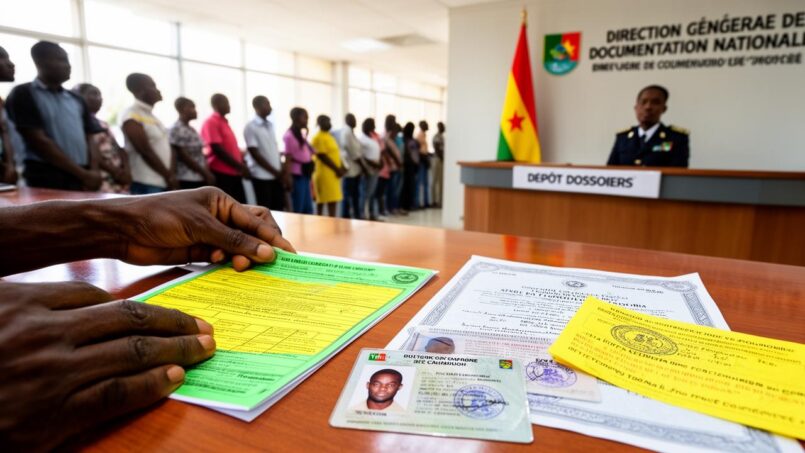
Once the date is confirmed, the applicant must be present in person. No passport application can be sent by mail or handled entirely online. The reason is simple: physical enrollment serves to verify identity and collect biometric data (photo, fingerprints, height) that will be integrated into the document’s chip.
This appointment takes place, depending on the case, at a designated police station in Cameroon or at a diplomatic mission for those residing abroad. Entry is strictly controlled. Authorities only allow access to individuals with a confirmed appointment, except for those accompanying minors or persons with disabilities.
For security reasons, large luggage, suitcases, and electronic devices (phones, laptops, tablets) are often prohibited inside the embassy or high commission premises. The applicant must also respect the schedule: arriving a few minutes early is tolerated, but a delay of more than half an hour may result in refusal of service and the need to reschedule.
The enrollment itself can take several hours. In some embassies, the average duration is announced at around four hours from reception, document verification, counter processing, photo and fingerprint capture, to final receipt issuance.
Documents to Gather Before the Appointment
The success of the appointment depends mainly on the quality of the file presented. An incomplete file, with missing originals or unlegalized copies, is rejected on the spot. It will not be possible to “complete” it by email afterward; you will need to reschedule and return with a complete folder.
The basic file always includes a set of civil status documents, identity documents, proof of residence, and, if living abroad, a consular card. The table below summarizes the main documents consistently required.
| Document Category | Examples of Required Documents |
|---|---|
| Appointment Proofs | Printed pre-enrollment form (with barcode and PO number), copy of appointment confirmation |
| National Identity | Previous Cameroonian passport (original + copy of identity page), CNI if available (front and back, original + copy) |
| Civil Status | Cameroonian birth extract or certificate (original + photocopy), possibly certified copy and certificate of conformity/existence of stub |
| Residency Status Abroad | Residence card, work permit, visa, student ID, I-20 or DS-2019 forms, depending on country of residence |
| Professional Situation | Diploma, employment contract and recent pay slip, student ID with enrollment certificate |
| Marital Status | Marriage certificate for married women (and divorce decrees or spouse’s death certificate if applicable) |
| Possible Additional Items | Driver’s license, local ID card, or any other available identity document |
| Consular Card (Diaspora) | Valid consular card or application file (form, photos, fee payment) |
When the applicant has lost their birth certificate, the rules are stricter. Two scenarios are provided. Either they obtain a supplementary judgment and a new birth certificate in Cameroon through a reconstruction procedure. Or, in certain configurations, they produce a certified copy of the existing certificate accompanied by a certificate of conformity and existence of the stub issued by the town hall or civil status center, both dated less than three months.
In case of loss or theft of your passport, you must provide a police report detailing the circumstances. A simple case number is not accepted. This concrete document, issued by the unit where the report was made, must be attached to your application, along with all available information about the old passport (number, date and place of issue).
The Consular Card, a Key Piece for the Diaspora
For any Cameroonian submitting an application at an embassy, high commission, or consulate, the consular card has become a central element of the file. It is considered mandatory for a renewal abroad, including for minors. Parents must also attach their own consular card to their children’s files.
Obtaining the Cameroonian national identity card from abroad follows a digital procedure. For instance, for nationals residing in Canada, the application is entirely conducted online via the dedicated portal of the High Commission of Cameroon in Ottawa. In other countries of residence, the procedure may be mixed: the application form is first downloaded from the website of the competent embassy or consulate, then must be printed, completed, and physically submitted at the diplomatic mission’s counter.
To put together a consular card file, generally two color passport photos on a white background, proof of residence in the host country, and payment of a specific fee are required. In the United States jurisdiction, this fee is set at $54.54, to be paid by money order or cash according to the chancery’s instructions. In Canada, the announced amount is 35 Canadian dollars. Each photocopy of an official document to be legalized incurs additional fees (e.g., $2.73 per page in the United States).
Specifics for Minors: Authorization and Mandatory Presence
From the Cameroonian authorities’ perspective, a “minor” in the context of the passport remains any person under 21 years of age. This threshold is important because it determines both the requirement for a legalized parental authorization and the obligation to be accompanied during enrollment.
A child, even a newborn, must appear in person for fingerprint and photo capture. Representation by an uncle, friend, or relative still in the country is not permitted, unless a very strictly regulated power of attorney has been issued for a Cameroonian citizen and duly legalized by the police or a diplomatic mission.
For any minor, a signed and legalized parental authorization is mandatory. If the parents reside in different countries or are unable to appear, the document must be authenticated in the country of issue and accompanied by a certified copy of their identity documents.
In some cases, notably for married minors, a certified marriage certificate may substitute for parental authorization, but these situations remain specific and must be closely reviewed with the relevant diplomatic mission.
On the consular card side, the rule also applies to children: they must have their own consular registration, and the parents’ cards are added to the file as reference documents.
Managing a Lost, Stolen, or Very Old Passport
Lost or stolen Cameroonian passport does not prevent a new application, but the processing follows the same path as a regular renewal, with a few additional documents. The applicant must provide an official loss declaration, made to the police in the location where the document disappeared. Authorities expect a written report, not a simple attestation indicating that a case number has been opened.
To facilitate verification of your file by the DGSN in Yaoundé, it is important to provide all known information about your old passport, including its number, date of issue, and place of issue.
When the last passport dates back more than fifteen years, some missions report that the application is treated as a new issuance rather than a simple renewal. In practice, this means special attention will be paid to civil status and identity documents, with thorough checks to ensure the data entered on the portal matches the national records.
Passport Photo: A Detail That Can Block the Entire File
Even though most photos for the biometric passport are now taken directly during enrollment, image requirements remain strict. Many applications are delayed or put on hold due to a photo deemed non-compliant: poorly centered face, inappropriate expression, faulty lighting, or visible digital retouching.
Authorities require color photographs on a plain white or light gray background, without harsh shadows. The face must be forward-facing, looking at the camera, with mouth closed and a neutral expression (no exaggerated smile). Eyes must be fully visible, not obscured by hair. Wearing glasses is generally prohibited, unless justified by a medical certificate.
For children, the same rigor applies, although some tolerance is allowed regarding full eye opening for infants. The essential guideline is that only the child appears in the photo, without a parent’s arm supporting them or any visible object in the background.
In some cases (notably for the consular card or other related formalities), paper photos are still requested, often four biometric format 4 cm x 5 cm, while leaving each mission to specify the exact format.
Enrollment Procedure: Checks, Biometrics, and Receipt
On the day of the appointment, the consular or police officer begins by checking the printed form (with the barcode and PO number) and the appointment confirmation letter. They then review each document in the file, verifying originals and comparing the copies provided.
All required photocopies must be made in advance. Diplomatic missions do not offer on-site reproduction services and remind that any copy to be legalized must be accompanied by the corresponding original. In some countries, these legalizations are charged per unit, with payment orders to be made out to the embassy or high commission.
Once the documents are verified, you will be directed to a station for biometric capture. This includes taking your digital photo according to international standards, recording your fingerprints, and measuring your height. This step also serves to officially attest to your physical presence and confirm your identity with the Cameroonian authorities.
At the end of the process, an enrollment receipt is issued. It generally indicates the collection location, sometimes an indicative timeframe, and, in embassies that require return by mail, instructions for preparing prepaid envelopes. Keeping this receipt is crucial: it will be required if you wish to receive the passport by mail or in case of a dispute.
Step 3: Passport Production and Collection
After enrollment, the file is sent to Yaoundé, where it is reviewed by the DGSN services. From a purely technical standpoint, the physical production of the passport can be completed in less than 48 hours once the file is validated. However, the overall time for the applicant depends on the transport of passport batches to diplomatic missions and their internal organization.
In practice, several consular posts announce an average availability between two weeks and one month after enrollment. At the High Commission in Canada, passport return is mentioned as two to three weeks. In London, collection is generally possible within two weeks of production, but some files may take longer depending on workload. At some embassies, such as in Washington, it is prudent to allow about a month.
When your passport arrives at the enrollment center, the Passcam system sends a notification by SMS or email from the sender “passcam”. This message may sometimes end up in secondary tabs of your mailbox (like Promotions or Notifications). If you receive nothing after the announced time, it is advisable to search directly for the term “passcam” in your mailbox.
Depending on the jurisdiction, two methods exist for collecting the document. In some countries, collection is done only by mail: the embassy no longer hands over passports in person at the counter. You must then prepare a package containing your old passport (for cancellation), the original enrollment receipt, and a written, legalized request authorizing the shipment of the new passport. This package is sent to the mission in a prepaid, trackable envelope, inside which you place a second envelope, also prepaid and traceable, that the embassy will use to return the new passport to the applicant’s home address.
Passport collection can be done in person, according to very specific hours communicated by the administration (e.g., Monday to Wednesday from 4:00 PM to 4:30 PM). Some authorities publish the list of available passports on their website. Electronic activation of the document is mandatory and must be performed at the enrollment site itself. It is therefore impossible to collect the passport in another country or through an intermediary in Cameroon if the application was submitted abroad.
If the holder delays too long, the document is returned to the DGSN. The rule is clear: a passport not collected within six months of being made available goes back to Yaoundé, and the holder must then contact the Border Police Directorate directly to inquire about recovery options.
Why and How Can an Application Be Rejected?
Despite digitization and increased checks, applications continue to be rejected each week. When the DGSN rejects a file, the applicant receives an email sent by the Passcam system, usually a few days after the physical enrollment.
Rejections are mostly due to identity conflicts, which occur when the information provided (surnames, first names, date of birth, parentage) does not match that in national databases or previous identity documents. Material errors and discrepancies between the birth certificate, national identity card, and former passports are also common causes.
Material errors concern rather the absence of required documents, unlegalized copies, failure to present a parental authorization for a minor, or insufficient proof of residence in the country of residence. A non-compliant photo, whether in terms of framing or expression, can also be enough to block processing.
If you receive a rejection notification, it is useless to contact the embassy. The official procedure is to write directly to the Directorate General of National Security (DGSN) by email at [email protected]. The subject line must clearly mention the word “rejet”. The body of the email should be concise and include essential information: the file number (format PO-XXXX), a clear description of the problem, the applicant‘s full contact details, and, if applicable, proof of payment or regularization.
Once the cause is identified, the DGSN may authorize the reopening of the file and the repetition of certain steps, especially biometric capture if necessary. In these cases, the applicant must follow the received instructions exactly, otherwise a completely new application may be required.
Special Case: Traveling Urgently Without a Valid Passport
Sometimes a Cameroonian is forced to return home while their passport is expired, lost, or being processed. To avoid a complete standstill, regulations provide for the possibility of issuing a specific travel document, called a Cameroonian Laissez-Passer or travel document for Cameroon.
This document has a very limited purpose: to allow travel to Cameroon. It does not authorize travel to other countries, nor does it serve as a substitute passport for re-entering the country of residence. Once in Cameroon, the holder must complete the renewal or first-time passport application procedures before being able to legally leave.
Fee set by diplomatic missions for a travel document or visa in the United States, payable by money order.
Again, authorities remind that you should not buy plane tickets based on hypothetical promises from third parties claiming to be able to “expedite” the procedure for a fee. Such practices are prohibited by Cameroonian regulations and can even harm the processing of the application.
Role of Embassies and High Commissions: Powers and Limits
For Cameroonians abroad, diplomatic missions play a frontline role, but their room for maneuver is limited on certain key points. They are responsible for receiving applicants, verifying files, legalizing copies, capturing biometric data, and handing over passports received from Yaoundé. However, they do not control the technical aspects of the Passcam portal or the final decision of the DGSN.
In case of payment problem, appointment error, computer bug, or to reschedule a missed appointment (especially beyond the 8 working day deadline), the only recognized contact is the Passcam support service, to be reached at: [email protected].
Diplomatic posts have also reorganized themselves to align with the centralized system. In Canada, for example, appointment requests are no longer made via the high commission’s website but only through the DGSN portal. The “general queue” option then requires sending an email to the dedicated consular address to obtain a date, which is generally no longer modifiable afterward.
Practical Tips for a Smooth Application
Throughout the implementation of this new system, some recommendations consistently emerge from authorities and users who have already gone through the process. First, it is wise to gather all necessary documents before even logging into Passcam. This avoids approximate entries and limits potential discrepancies between forms and supporting documents.
For the passport procedure, it is essential to use a stable email address and phone number that are checked regularly, because availability notifications are digital only. An active Cameroonian phone number registered in the applicant’s name is also recommended to facilitate Mobile Money payments, whether you are in Cameroon or abroad with the help of a relative.
Anticipating deadlines is also essential. Appointments in some capitals are sometimes booked several months in advance, while the shipment of passport batches from Yaoundé experiences variations in frequency. Renewing your passport six months before expiration remains a reasonable safety margin, especially if you plan trips requiring a visa.
No embassy recognizes a “facilitator” to speed up the passport process for a commission. Using such channels can result in the permanent blocking of your file.
Finally, until the new passport is in hand, it is strongly advised not to make final travel commitments. Authorities repeat that deadlines cannot be compressed based on individual departure dates, and no one-day processing option exists for Cameroonian passports.
Obtaining the Country’s Passport in Cameroon: A Demanding but Clear Procedure
The introduction of the biometric passport and online pre-enrollment has profoundly changed how to obtain the country’s passport in Cameroon. The process is longer on paper, but it is structured, traceable, and less dependent on local practices of each police station or embassy. From entering data on Passcam to collecting the document, everything now relies on the consistency of civil status information, the physical presence of the applicant, and strict adherence to DGSN instructions.
The process is strict: a missing or non-compliant document (parental authorization, consular card, birth certificate) can invalidate the application. To avoid this, you must carefully follow each step, check the documents, monitor your emails, and respect deadlines. This rigor makes it possible to obtain the passport within a reasonable time, regardless of the approved consular post (Yaoundé, Washington, Ottawa, London, etc.).
The key therefore remains preparation: understanding the role of the Passcam portal, anticipating legalization needs, securing your online payment, and never losing sight of the fact that the real decision center is at the DGSN. From there, obtaining the country’s passport in Cameroon becomes primarily a matter of method and rigor.
Disclaimer: The information provided on this website is for informational purposes only and does not constitute financial, legal, or professional advice. We encourage you to consult qualified experts before making any investment, real estate, or expatriation decisions. Although we strive to maintain up-to-date and accurate information, we do not guarantee the completeness, accuracy, or timeliness of the proposed content. As investment and expatriation involve risks, we disclaim any liability for potential losses or damages arising from the use of this site. Your use of this site confirms your acceptance of these terms and your understanding of the associated risks.

Cyril Jarnias is an independent expert in international wealth management with over 20 years of experience. As an expatriate himself, he is dedicated to helping individuals and business leaders build, protect, and pass on their wealth with complete peace of mind.
On his website, cyriljarnias.com, he shares his expertise on international real estate, offshore company formation, and expatriation.
Thanks to his expertise, he offers sound advice to optimize his clients' wealth management. Cyril Jarnias is also recognized for his appearances in many prestigious media outlets such as BFM Business, les Français de l’étranger, Le Figaro, Les Echos, and Mieux vivre votre argent, where he shares his knowledge and know-how in wealth management.





