
 Published on and written by Cyril Jarnias
Leaving your country to live in the Marshall Islands is much more than a change of tropical scenery. This small republic of atolls in the heart of the Pacific combines a very community-oriented society, a culture deeply marked by tradition, and a fragile environment threatened by rising sea levels. For a future expatriate, understanding these cultural differences in advance is not a luxury, but a condition for success, both in daily life and at work.
Good to know:
In the Marshall Islands, the individual is always part of a collective framework (extended family, clan, community), governing communication, work, conflict management, time, and money. Applying Western reflexes focused on efficiency, urgency, or individualism without adaptation quickly leads to misunderstandings.
A Society of Clans, Matrilineality, and Hierarchy
For a newcomer, one of the major culture shocks is the role of the extended family and clan in social life. Marshallese society is traditionally matrilineal: basic belonging, identity, and land rights are passed down through the mother. The connection to the land comes through the bwij, or clans, which collectively own parcels of land called wato. Being “from somewhere” primarily means belonging to a bwij, and this belonging determines rights, duties, protection, and reputation.
Example:
Traditional Marshallese society is structured in a multi-level hierarchical system. At the top are the paramount chiefs, the *Iroij*, especially the *iroij laplap* who were once considered nearly sacred. The middle level is occupied by the clan chiefs, the *Alap*, responsible for overseeing land and daily activities. Finally, the base of the social pyramid is made up of the *Rijerbal*, the workers who perform essential tasks such as farming, fishing, construction, and maintenance.
One cannot understand daily life without integrating this social hierarchy and the importance of rank, age, and lineage. In practice, this means an expatriate must learn to show visible respect to older people, community leaders, and, where relevant, traditional figures.
Respect for Elders and Rank
In everyday interactions, respect is shown through specific gestures. You slightly lower your head when greeting an elder, avoid standing over someone older or of higher rank, never step over the legs of a seated or lying person, and let important people speak first.
Tip:
In the Marshall Islands, the correct use of titles (religious, traditional, professional) is paramount and is a sign of respect, especially in professional or community contexts. Avoid using only first names. Conversely, immediately using informal language, making overly direct jokes, or publicly challenging an older person’s or elder’s opinion can be considered a serious offense, even if not expressed openly.
This is far from a culture that outsources the care of the elderly. Sending a parent to a specialized facility is considered shameful; it is the family’s responsibility to care for its elders. For an expatriate, this means that a colleague’s availability for their parents, grandparents, aunts, and uncles will come before many other things, and this may sometimes result in last-minute absences, beginning with a simple: “I have to help the family.”
The Central Place of Community, Sharing, and Reciprocity
In the Marshall Islands, security does not rely on savings, insurance, or long-term planning, but on a dense network of reciprocal relationships. The concept of jowi — mutual aid and cooperation — permeates the entire society. The ideal is not individual success, but the ability to maintain harmonious ties and respond to the needs of the group.
In this system, the Western notion of personal goals, career, or “life plan” within the nuclear family alone is relatively foreign. What matters is not separating from the group to achieve fulfillment, but proving that you know how to give, share, and participate.
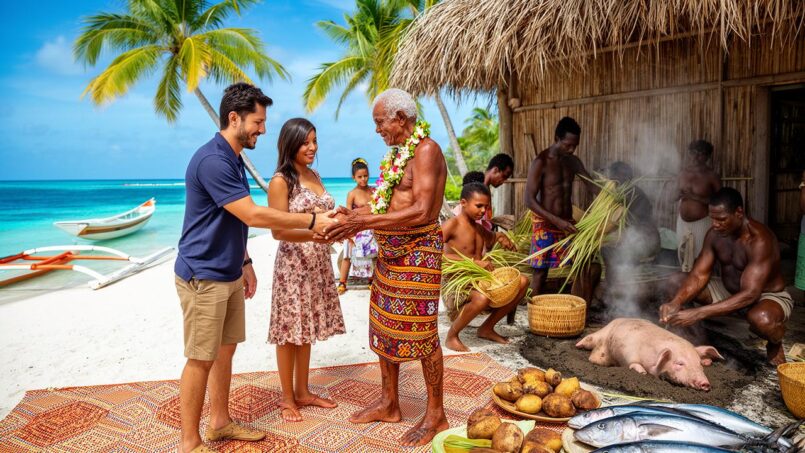
Sharing food, money, and possessions, even when resources are limited, is a basic cultural reflex. A home-cooked meal may be spontaneously offered to people passing by. For an expatriate, refusing an offer or not reciprocating help can be seen as a lack of respect.
Cultural reflex of sharing in an expatriation context
What This Means in an Expatriate’s Daily Life
Settling in the Marshall Islands means accepting that some participation in this system of gifts and counter-gifts will be expected of you. Bringing food when visiting, offering a small gift to a welcoming family, showing up for a community event—these are all gestures that integrate you. Conversely, staying shut in at home, strictly limiting invitations, or managing your life purely “Western-style” risks reinforcing distance.
Attention:
The kemem, a first-birthday feast, involves the entire family and social network. Guests should expect significant preparations, lots of food, lengthy festivities, and a hierarchical protocol for serving. It is advisable to bring a modest gift and participate without trying to organize, respecting local customs.
Indirect, Narrative, and Highly Coded Communication
Expatriates used to direct, quick, and factual exchanges must prepare to change gears. In the Marshall Islands, the primary goal of communication is to preserve harmony and social bonds, not to “say things” at all costs. Saying no directly, openly criticizing, or contradicting a superior in public are behaviors largely avoided.
You must therefore get used to a rather indirect form of language, where what is left unsaid, silences, smiles, and anecdotal detours count as much as words.
Bwebwenato: When Storytelling Trumps Short Answers
The oral tradition, called bwebwenato, holds an essential place. Stories, songs, and legends convey the group’s memory, knowledge of navigation, fishing, weather, and moral values. In exchanges, including professional ones, this preference for narrative is found: to explain a situation, one will recount a past episode or a similar experience rather than answer in three points.
Good to know:
In some cultural contexts, long, detailed stories including family or community histories are not digressions. They serve to build trust, reference a precedent, or indirectly set a moral framework, avoiding direct confrontation. This approach may surprise those accustomed to concise summaries.
Indirect, But Not Vague
Indirect does not mean no message. A prolonged silence can mean disagreement, discomfort, or a need to think. A polite smile accompanied by a “maybe” can mask a refusal. A slight raising of the head or a simple “hmm” can signal agreement. Attentive listening to tonal nuances, pauses, and body language becomes essential.
Example:
A junior employee, reluctant to openly criticize a project proposed by their superior, expresses reservations outside official meetings or by using a story that illustrates the risks without directly naming the manager’s decision. For an expatriate manager, it is crucial to know how to decode these signals, ask open-ended questions, and create informal dialogue spaces to prevent potentially serious misunderstandings.
Religion, Modesty, and Codes of Public Behavior
The Marshall Islands are overwhelmingly Christian. Sunday is largely devoted to worship, and churches play a major social role. Pastors and religious leaders are respected figures, often involved in conflict mediation and major family events.
This strong religiosity comes with a conservative view of dress and behavior in public. In the capital Majuro as well as in villages, wearing clothing deemed too “revealing” is criticized, even for foreigners.
Good to know:
Women generally wear long, light dresses covering shoulders and knees, and men wear pants or long shorts with a shirt. Revealing clothing (bikinis, mini-shorts, low-cut tank tops, tight dresses) is frowned upon outside the few tourist areas. Modest attire is especially expected in church, at ceremonies, and in outer island villages.
Public displays of affection between men and women are generally poorly viewed. On the other hand, seeing two women holding hands is nothing suspicious; it is a simple sign of friendship. Understanding this difference avoids certain misinterpretations when coming from cultures where mixing is freer and the man-woman distance is less coded.
The Home, a Sacred Space: Shoes, Seats, and Gestures to Avoid
The home is not just a private space; it is a place marked by implicit rules of respect. You always remove your shoes before entering a home, so using easy-to-remove shoes is very practical. You knock gently — knocking loudly is perceived as extremely aggressive — and wait to be invited in.
Attention:
Once inside, you should not sit just anywhere: sleeping mats (Jackie) are not seats for visitors, and the place of the head of the family or an elder is often predetermined. It is wise to ask, “Where may I sit?” You must absolutely avoid stepping over the legs or body of a seated or lying person, a gesture considered very disrespectful.
The head is considered a sacred part of the body. Touching an adult’s head, or even a child’s, is not trivial and can be taken badly, especially if the person has a high rank. When in doubt, refrain from this gesture of affection, though common in other cultures.
Food Offered: Say Yes, or at Least Pretend
Offering food to a guest, a passerby, or a colleague is a central act of hospitality. Refusing a dish can be interpreted as a rejection of the person or the group. Even if you have little appetite, it is better to accept a small portion, taste it, and thank them, rather than giving a flat no.
Etiquette During Group Meals
Social conventions to observe during shared meals, especially in a community or religious setting.
Wait for the Signal
It is customary to wait for the person in charge (often a pastor) to begin serving before serving yourself.
The Last Portion
It is frowned upon to take the last portion without first offering it to others, especially an older person.
Adapt by Observing
These rules are often implicit; observing and aligning with the behavior of other diners is generally the best approach.
Time, Work, and “Island Time”: The Logic of the Present
For an expatriate from an environment where punctuality to the minute and six-month planning are the norm, time management in the Marshall Islands can be a source of frustration. People often speak of “island time” to describe this flexibility: being 10 to 15 minutes late is not unusual; a meeting may be moved at the last minute if a family obligation, religious ceremony, or community event arises.
Good to know:
Although punctuality is respected in administrative and business settings, cultural priorities—such as responding to a relative’s needs, preparing a *kemem* (traditional celebration), or attending a funeral—often take precedence over a pre-set schedule.
To secure professional projects, it is therefore helpful to build in margins, anticipate possible delays, and avoid staking everything on a single key meeting supposedly starting on time. An expatriate who arrives punctually sends a sign of respect but must accept that the rest of the group follows a different rhythm.
Professional Life: Hierarchy, Consensus, and Avoided Conflict
At work, community and hierarchical values remain very present. Decisions generally come from the top, whether from ministries, directors, or traditional chieftaincies involved in a project. However, the search for consensus and consultation with elders or community leaders also play an important role.
A foreign manager who is too directive, highly critical, or focused on individual evaluation will have little chance of being followed, even if no one openly contradicts them. The management styles that work best combine clear expectations, listening, visible respect for traditional hierarchies, and valuing the collective.
The Difficulty of Saying “No”
In an environment where harmony is prioritized, refusing outright is difficult. People will often prefer vague formulas, temporal responses (“maybe later,” “we’ll see”), or simple silence. This applies to deadline requests, invitations, and also to more sensitive topics like accepting or not accepting a procedural change.
Good to know:
For an expatriate manager or project leader, it is crucial to foster relaxed discussion spaces where the team feels free to express doubts. Important feedback often emerges outside official meetings, during informal conversations, shared meals, or home visits. Considering these moments as part of the job is essential.
Family Obligations as a Structuring Variable
The standard work week is around 40 hours over five days, but family and community obligations regularly interfere. Weddings, funerals, celebrations, and religious ceremonies can mobilize an employee for several days. A supervisor who is inflexible or harshly penalizes such absences will encounter strong incomprehension.
Good to know:
For an expatriate, respecting local priorities, staying informed about the community calendar, and avoiding scheduling important meetings during major local events helps earn valuable trust capital.
Language, Bilingualism, and the Language Barrier
Two official languages coexist: Marshallese and English. In urban centers like Majuro or Ebeye, a significant portion of the population speaks English, especially in administration, business, and tourism. But a non-negligible proportion of residents, particularly on the outer islands, has little or no command of English.
Good to know:
Marshallese is a complex Austronesian language with a specific structure, vowels, and pronouns (distinguishing singular, dual, trial, and plural), as well as phonological rules difficult for non-natives. Although English is often used by expatriates, learning the basics of Marshallese is highly recommended for real integration.
| Marshallese Expression | Approximate English Meaning | Primary Use |
|---|---|---|
| Yokwe / Iakwe | Hello / Goodbye / Love | General greeting |
| Komol tata | Thank you very much | Emphatic thanks |
| Jowi | Cooperation, mutual aid | Cultural concept, sometimes greetings |
| Ijōkwe | Respectful greeting (especially for elders) | Formal encounter or to an elder |
Some long-term residency statuses even require proficiency in Marshallese, highlighting the importance placed on language for integration. Nevertheless, the use of English as the language of instruction from primary school and the massive presence of English-language content reinforce its prestigious status, especially among young people. This tension between preserving Marshallese and the appeal of English is part of the cultural landscape the expatriate discovers.
Cost of Living, Sharing, and Perception of Money
The cost of living in the Marshall Islands is significantly higher than the global average, largely because the archipelago is heavily dependent on imports for food, consumer goods, and some services. Price indices show the country ranks among the most expensive in the region, even though living in Majuro remains about 40% less expensive than many US cities for a comparable standard of living.
Good to know:
For expatriates, especially those with an international salary, it is tempting to find everything cheap compared to their home country. However, one must keep in mind that the local average salary is much lower. Displaying a much higher lifestyle, frequenting only expensive establishments, and cutting oneself off from local customs can create a social gap with Marshallese colleagues.
Within Marshallese families, the logic of sharing resources blurs the line between “my money” and “the clan’s money.” A person who earns a good living is expected to help parents, cousins, aunts, and uncles in need. An expatriate in a mixed couple must anticipate this dimension: their income will often be perceived as a resource of the extended group, not strictly a marital asset.
Health, Beliefs, and Seeking Care
The healthcare system combines public facilities and some private services, with two main hospitals in Majuro and Ebeye, and a network of dispensaries on outer islands. Medical resources remain limited, with evacuations abroad common for serious conditions.
Good to know:
For expatriates, a notable cultural difference is the coexistence of modern medicine with traditional practices, such as herbal remedies, rituals, or spiritual explanations (sorcery, hexes). These practices persist in some families, where people may try traditional treatments before seeing a doctor, or not mention them to a Western caregiver for fear of being judged.
In care relationships, the same logic of respect, hierarchy, and indirect communication applies. A Marshallese patient will not always directly say they did not understand a medical explanation or cannot afford a treatment. They may nod out of politeness while not following prescriptions. Expatriates working in healthcare must therefore learn to ask open-ended questions, verify real understanding, and account for family obligations and cultural codes (e.g., not touching the head without warning, respecting modesty).
Education, Children, and the View of Childhood
The education system, largely modeled on the American system, coexists with a very community-based view of childhood. Primary school is compulsory, but access to secondary school remains limited by entrance exams, and not all young people continue their studies. Those who fail may turn to traditional activities like copra farming, fishing, or family chores.
For many families, educational responsibility rests not only on parents, but on the entire clan. Children may live with aunts or uncles to attend school on another atoll, or be primarily raised by grandparents. Authority is thus not concentrated in the parental duo, but diffused throughout the family network.
Expatriate teachers, very present in international schools and some private institutions, often face these norms. A student who does not turn in an assignment on time may have been involved in an essential ceremony; a parent who does not show up for a scheduled meeting may be held up by community obligations. Interpreting these behaviors through the lens of strict educational “negligence” would be a mistake; it is rather a manifestation of a different hierarchy of priorities.
Environment, Climate, and Relationship to the Land
Living in the Marshall Islands also means experiencing environmental vulnerability daily. Low-lying atolls, land just a few meters above sea level, erosion, flooding from exceptional tides, salinization of freshwater lenses, impacts from droughts or cyclones: these realities are not abstractions. They influence how residents perceive their future, their connection to the territory, and their relationship to the outside world.
Good to know:
Despite climate threats, the vast majority of Marshallese reject emigration as a solution, affirming a deep bond with their country, their lands, and their lagoons. This will to stay and adapt underpins a strong political discourse on climate justice, carried by Marshallese leaders and artists internationally.
For an expatriate, this context may seem paradoxical: while some experts predict that certain islands could become uninhabitable before the end of the century, many Marshallese continue to plan, invest, and celebrate as if the future will unfold right here. Understanding this tension — between climate urgency and the refusal to disappear — is crucial to avoid approaching environmental discussions with a fatalism deemed insulting.
Expatriate in the Marshall Islands: Between Integration and Self-Preservation
Coming to live in the Marshall Islands is not settling into a timeless “tropical paradise,” but joining a complex society, crossed by contradictions between tradition and modernity, climate pressure and the will to survive, American influence and the assertion of a distinct identity.
Expatriating here means accepting:
– that community will often take precedence over the individual project,
– that respect for elders, chiefs, and pastors is not up for debate,
– that conflicts are not resolved with scathing emails or shouting meetings,
– that you learn to say things differently, more gently, more slowly.
It is also an opportunity to discover a refined maritime culture, an art of navigation and cooperation, a generosity that persists despite poverty, a humor and a love of song and storytelling that turn ordinary evenings into unforgettable moments of sharing.
To succeed in this expatriation, it is not enough to master visa formalities or find housing in Majuro. You must gradually learn the codes of a society where you exist only through others, where you feel constantly watched, where a simple mistake in seating or refusing food can leave a lasting mark on the collective memory.
This decentering can be unsettling. It is also, for those who accept it, a rare experience: that of discovering, in a remote archipelago, another way of thinking about time, social bonds, family, responsibility, and dignity in the face of storms — both climatic and cultural.

Cyril Jarnias is an independent expert in international wealth management with over 20 years of experience. As an expatriate himself, he is dedicated to helping individuals and business leaders build, protect, and pass on their wealth with complete peace of mind.
On his website, cyriljarnias.com, he shares his expertise on international real estate, offshore company formation, and expatriation.
Thanks to his expertise, he offers sound advice to optimize his clients' wealth management. Cyril Jarnias is also recognized for his appearances in many prestigious media outlets such as BFM Business, les Français de l’étranger, Le Figaro, Les Echos, and Mieux vivre votre argent, where he shares his knowledge and know-how in wealth management.





