
 Published on and written by Cyril Jarnias
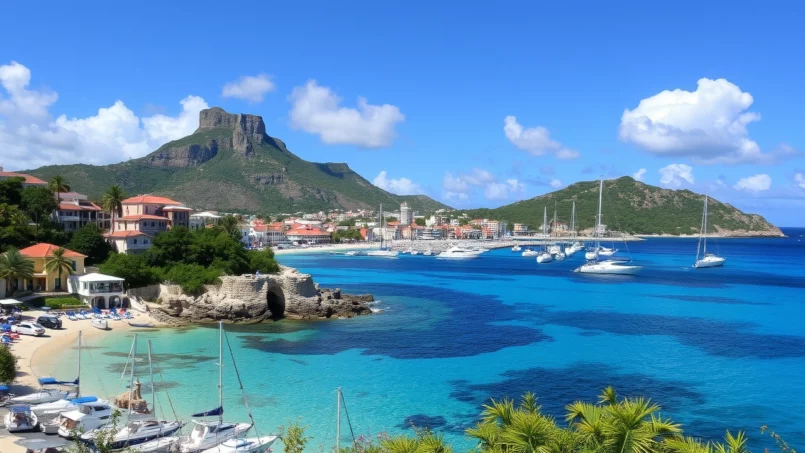
Moving to Saint Barthélemy is a dream. White sand beaches, turquoise water, luxury villas, a chic yet relaxed vibe, and very favorable taxation… On paper, everything looks like paradise for wealthy expats. But behind the postcard image lies a tiny, isolated territory, vulnerable to hurricanes, with a staggering cost of living and strained infrastructure.
Good to know:
This article provides a comprehensive analysis of the economic, tax, social, and technical aspects to consider for an expatriation project to Saint Barthélemy, presenting a balanced overview of the advantages and challenges.
A French micro-territory in the heart of the Caribbean
Saint Barthélemy is a French overseas collectivity, located in the Lesser Antilles, northeast of the Caribbean Sea. With an area of about 24–25 km² and a volcanic terrain of hills and valleys, the island is one of the smallest in the Caribbean basin. Its highest point, Morne du Vitet, reaches 286 meters.
10000–11000
The island’s population is between 10,000 and 11,000 inhabitants, spread across about forty neighborhoods.
Saint Barthélemy has a special institutional status: as an overseas collectivity governed by Article 74 of the French Constitution, it manages key powers such as taxation, urban planning, the environment, and energy. This framework provides significant local autonomy while ensuring the legal stability of the French and European whole.
An exceptional living environment… and extremely exclusive
The first obvious advantage of expatriating to Saint Barthélemy is the quality of life. The island combines spectacular natural surroundings, a rare level of safety, high-end services, and an atmosphere that is both cosmopolitan and village-like.
Postcard-perfect climate and landscapes
The climate is tropical maritime, with average temperatures between 25°C and 32°C year-round, and sea temperatures around 27°C. The so-called “dry” season generally runs from December to May, while the wet and hurricane season goes from June to November, with peak rainfall between September and November.
Beaches are everywhere, about twenty in number (Shell Beach, Saline, Gouverneur, Flamands, Saint Jean, Colombier, Lorient, Toiny…). Some, like Colombier, are only accessible on foot or by boat, reinforcing the feeling of idyllic isolation. Coral reefs encircle part of the coastline, forming calm lagoons appreciated by families and water sports enthusiasts alike.
Caution:
The island has established five marine reserves and protected areas, fostering the return of threatened species such as green turtles, leatherback turtles, and certain reef sharks. This environmental commitment is a major asset for expats sensitive to ecology.
Near-exemplary safety
Saint Barthélemy is considered extremely safe. The small size of the territory, the general wealth of the population, and French control over police and justice contribute to a very low crime rate, incomparable with many Caribbean destinations. For families, retirees, or wealthy entrepreneurs, this factor weighs heavily in the balance.
Even quality-of-life indicators, such as infant mortality or internet access, are at a good regional average: for example, it is estimated that 71.3% of the population has internet access, more than in some comparable neighboring territories.
A chic but human-scale social life
The island is a playground for celebrities, yacht owners, international entrepreneurs, and very wealthy clientele, especially during the high season (Christmas, New Year, major nautical events like the St. Barts Bucket or Les Voiles). There are over 70 restaurants, ranging from beachside shacks to gourmet tables, as well as an impressive number of luxury boutiques (Hermès, Louis Vuitton, Cartier, Bulgari, among others).
Example:
Saint Barthélemy is described as a “big village” where the community is tight-knit and residents know each other. Expats who settle permanently eventually run into the same people at the market, port, or hiking trails. This closeness fosters a strong sense of belonging, but can also be a constraint for those seeking the anonymity of big cities.
A French environment… in the Caribbean
Another significant advantage: living in Saint Barthélemy means benefiting from the French institutional and legal framework. The civil law system, the presence of a French-standard hospital, public and private schools, modern road infrastructure and digital networks provide a rare comfort in the region.
However, the island remains outside certain European mechanisms (it is classified as an overseas country and territory – OCT – and not an outermost region for the EU), which gives it significant fiscal leeway while retaining France’s legal and political protection.
Cost of living: a paradise reserved for very high incomes
If the quality of life is remarkable, it comes at a steep price. Saint Barthélemy ranks among the territories with the highest cost of living in the world, well above the Caribbean average… and even major North American or European metropolises.
Monthly expenses that skyrocket
All studies converge: living in Saint Barthélemy requires very comfortable incomes, even for a “normal” lifestyle. Budget estimates indicate that a single person should aim for at least €3,000 per month to cover expenses excluding rent in a frugal scenario, and more like €4,000 to €5,000 to live comfortably. For a couple, the recommended threshold is around €4,000 minimum, and for a family of four, a “comfortable” level easily exceeds €12,000 per month, including housing.
International comparisons show that current expenses (excluding housing) are significantly higher than in most Northern countries. For example, an aggregated cost-of-living study gives orders of magnitude like these (in dollars) for a single person:
| Profile | Location | Monthly “average” budget with rent | “Frugal” budget with rent | “Luxury” budget with rent |
|---|---|---|---|---|
| Single person | Saint Barthélemy | ~$7,900 | ~$3,862 | ~$14,335 |
| Single person | Average “other cities” | ~$8,085 | ~$4,110 | ~$14,890 |
Even a “budget” version remains out of reach for many standard incomes. The situation is even more pronounced for families, whose budgets quickly exceed $14,000 per month with rent in a classic setting, and can climb beyond $25,000 per month in a very comfortable mode.
Rent, real estate purchase: an extraordinary market
Housing is the most explosive expense item. Saint Barthélemy is one of the most expensive real estate markets in the world. Supply is extremely scarce, land limited, demand very wealthy: a explosive cocktail.
20000
The monthly rent for high-end family villas can exceed this amount in Monaco.
Acquisition figures confirm this trend:
| Property type | Indicative purchase range | Approximate average price per m² |
|---|---|---|
| 1-bedroom apartment | €300,000 – €400,000 | ~€11,000/m² |
| 2-bedroom apartment | €400,000 – €600,000 | ~€11,000/m² |
| 2-bedroom house | €800,000 – €1.5M | ~€14,500/m² |
| Small 2-bedroom villa with pool | ~€4.5M | Highly variable |
| Luxury villas / large properties | Several million to €30M+ | Ultra-prime market |
In some sought-after areas, like certain streets in Gustavia, historic villas can exceed €40,000/m², with even higher peaks for iconic properties.
The positive side for an expat investor: there are no restrictions on purchase for foreigners, no annual property tax, and the market has shown impressive resilience, even during global crises. But for an employee expat who came “just” to live in the sun, real estate represents a massive hurdle, especially as building permits become rarer and the collectivity strictly limits development to preserve the natural environment.
Food, restaurants, daily expenses
Another consequence of isolation and the luxury positioning: practically all food and most consumer goods are imported, leading to shelf prices significantly higher than in mainland France.
30
Commonly observed increase for many products compared to mainland France.
| Basic product | Average price in Saint Barthélemy |
|---|---|
| Milk (1 L) | ~€1.50 |
| Bread (500 g) | ~€2.50 |
| Rice (1 kg) | ~€3 |
| Eggs (12) | ~€4 |
| Chicken (1 kg) | ~€10 |
| Fresh fish (1 kg) | €15–€30 |
| Pack of 20 cigarettes | €9–€10 |
Monthly food budgets reflect these levels:
| Location | Average monthly grocery budget* |
|---|---|
| Saint Barthélemy | ~$1,150 |
| Average other cities | ~$950 |
*per person, data in dollars
At restaurants, a simple meal at an inexpensive establishment runs around €20–€30, and a full meal for two at a mid-range restaurant ranges between €80 and €100. Gourmet addresses and trendy beach clubs can go much higher, especially in high season.
Transport, utilities, leisure: everything is more expensive
The lack of structured public transport is another financial parameter. Daily life relies on cars, scooters, or quads, with narrow and sometimes congested roads. Taxis exist but remain expensive, while car rentals are frequent but also costly.
Monthly transport expenses, even modest ones, add up:
| Expense items | Monthly range (Saint Barthélemy, $) |
|---|---|
| Transport (fuel, taxi, etc.) | $40 – $350 (average ~$150) |
| Electricity | $80 – $250 (average ~$150) |
| Water | $80 – $180 (average ~$125) |
| Internet | $85 – $145 (average ~$115) |
| Gym membership | $95 – $240 (average ~$160) |
| Outings / social activities | $72 – $880 (average ~$280) |
| Health insurance | $220 – $980 (average ~$580) |
For leisure, the offering is abundant: water sports (surfing, sailing, diving, kitesurfing, kayaking), tennis, hiking, boat trips, outdoor cinema, music festivals… But most organized activities come at a high cost, in line with the destination’s upscale image.
Exceptional taxation… but demanding and complex
One of the major arguments for moving to Saint Barthélemy, especially for high-income earners and significant wealth holders, remains its extremely favorable taxation – provided certain conditions are met and a long-term commitment is made.
Zero income tax for stable residents
The collectivity has its own tax legislation, distinct from mainland France. For individuals who establish their tax domicile on the island and reside there habitually for at least five years, the regime is spectacular:
– no local income tax;
– no wealth tax on real estate located in Saint Barthélemy;
– no inheritance or gift taxes on assets located on the island, in certain family configurations;
– no annual property tax on real estate;
– no local VAT.
Tip:
A resident with more than five years of genuine roots in Saint Barthélemy can receive high income, including rental income from real estate properties, without being subject to the collectivity’s income tax. This situation combines the advantages of a French legal environment with a very high level of asset protection.
This framework logically attracts entrepreneurs, investors, wealthy retirees, crypto-asset holders, and large property owners, provided they accept the constraints of island life and the cost of living.
A less favorable regime for newcomers and non-residents
This idyllic picture, however, has several caveats. First, new arrivals who have not yet completed five years of residence remain, in principle, subject to French mainland tax law for their worldwide income, except in specific situations. The change of tax domicile must be real, justified, and lasting, under penalty of challenge.
Second, non-residents who buy property on the island face capital gains tax rules on resale, with variable rates depending on residency:
| Non-resident seller profile | Real estate capital gains tax rate |
|---|---|
| Resident of a European country (excluding France) | ~16% |
| French tax resident | ~27% to 33% depending on sources |
| Non-EU resident | ~33% |
For residents of the collectivity, capital gains on real estate are generally taxed at a rate close to 20%, with a system of increasing allowances based on holding period. Full exemption may be obtained for the primary residence, after a long ownership period.
Good to know:
Even when residing abroad, certain French social contributions (CSG/CRDS) may apply to your investment income, and tax treaties have limits. US citizens, for example, remain subject to US tax (IRS), FATCA, and the obligation to report their foreign financial accounts.
A highly regulated framework, far from a “secret tax haven”
Contrary to the easy image of a “secret tax haven”, Saint Barthélemy is a territory fully integrated into international transparency standards: application of the OECD standard (CRS), FATCA for the United States, reinforced anti-money laundering obligations for banks, notaries, and legal professionals.
There is no “citizenship by investment” program or fast track to French nationality through real estate purchase. Access to tax resident status is based on classic criteria: habitual residence, center of economic interests, duration of stay, etc.
To fully benefit from tax advantages without risk, guidance from tax specialists and lawyers specialized in the collectivity is highly recommended. The slightest misinterpretation can have significant consequences, especially for those coming from countries with high tax pressure or strict reporting standards.
Job market: real opportunities, but very targeted
Working in Saint Barthélemy without being a rentier or investor is not impossible, but requires flexibility, an excellent profile, and good preparation.
An economy focused on high-end tourism
The economy rests almost entirely on a triptych:
– luxury tourism and yachting (about 68% of GDP);
– construction and civil engineering (about 24%) to meet the needs for villas, hotels, residences;
– public and administrative services (about 8%).
Agriculture and fishing represent only a tiny share (0.3%). The island imports virtually all its food, energy, and most manufactured goods.
This structure results in a job market highly polarized around a few sectors: hospitality, restaurants, leisure, retail, transport, construction, and personal services. Local platforms list positions such as DJ, beach club server, chef, dishwasher, shop assistant, driver, refrigeration technician, plumber, electrician, administrative and financial manager, real estate agent, auto technician, or architect.
High salaries but eroded by the cost of living
Salaries are generally higher than the French average, especially in sectors related to luxury tourism, but the gap with the cost of living remains unfavorable for the average employee.
Indicative salary levels
A few indicative salary levels in euros illustrate the situation.
Entry-level salary
The monthly gross salary for a junior profile can start around €2,000 to €2,500, depending on the region and sector.
Experienced salary
With a few years of experience, compensation can range between €3,000 and €4,000 gross per month.
Senior / expert salary
For a senior or expert profile, salaries can reach €5,000 to €6,000 gross monthly, or even higher in some cases.
| Position | Typical monthly gross salary |
|---|---|
| Hotel director | ~€4,000 |
| Head chef | €3,500 – €4,500 |
| Restaurant employee | €1,800 – €2,200 |
| Diving instructor | €2,000 – €3,000 |
On paper, some ratios seem positive: cost-of-living analyses show that, for a single person, the average local salary (around $4,000) can exceed the “frugal” budget excluding rent by 17% to over 100%. But as soon as market-rate rent is included, purchasing power drops sharply. Many seasonal or permanent employees then settle for modest, shared, or employer-provided housing.
Access conditions: language, visas, competition
For an expat, several obstacles quickly arise.
Good to know:
Fluency in French is essential for most jobs. Knowledge of English is a major asset, even a necessity in sectors like hospitality, restaurants, or luxury retail. For many skilled positions (e.g., art gallery director, hotel management), French/English bilingualism is explicitly required.
Then, the right to work: European Union citizens can settle and work freely. In contrast, non-Europeans must obtain a long-stay visa or work permit through French authorities, with paperwork, proof of resources, sometimes a prior employment contract, and administrative delays. For a local employer, hiring a non-European therefore involves additional steps, which often limits non-EU hiring to highly qualified or very specific profiles.
Finally, competition: the island already attracts many workers from Guadeloupe, Saint Martin, Portugal, or Brazil, particularly in construction and services. Jobs are therefore contested, and candidates are expected to arrive with strong motivation, excellent presentation, great flexibility in hours (seasonality, long hours in high season), and ideally, a housing solution.
Healthcare, education, services: good but limited offerings
The small size of the territory is also reflected in public service offerings: present, but without the depth and diversity of a large city.
Healthcare: good level, but frequent medical evacuations
The island has a small hospital, the Centre Hospitalier de Bruyn in Gustavia, with about twenty beds (medicine, surgery, medium-term care), a 24/7 emergency department, a laboratory, radiology imaging, and a hospital pharmacy. Private practices and a few clinics complete the system, with general practitioners, dentists, physiotherapists, osteopaths, dermatologists, etc. Two main pharmacies meet everyday needs.
The standard of care is considered good for a territory of this size, but limitations quickly appear: for advanced cardiology, oncology, neurosurgery, complex orthopedics, or other major specialties, patients must be evacuated to Guadeloupe, Martinique, Saint Martin, Puerto Rico, the United States, or mainland France. Medical evacuations by air are frequent… and costly for those without good insurance.
400-600
Monthly premiums for international health insurance for expats can easily approach this amount in dollars for adequate coverage.
Education: local schools, but no university
The education system, attached to the Academy of Guadeloupe, includes public nursery and primary schools, as well as a non-selective high school. Instruction is mainly in French, with progressive use of foreign languages. Private institutions exist but at high costs, which can weigh on expat family budgets.
However, the island has no university. Teenagers wishing to pursue higher education must leave, most often to mainland France, other French territories, or abroad. For a family considering a long-term settlement, this student mobility requirement must be anticipated both financially and psychologically.
Infrastructure: rapid modernization, but structural fragility
On the surface, Saint Barthélemy offers a remarkable level of infrastructure for its size: paved roads, a world-class marina, an airport (admittedly with a very short runway), water and electricity networks, fiber optic deployment, high-speed internet in many areas, shared optical loop projects, improving mobile coverage, etc.
Caution:
Technical reality reveals that the island is exposed to multiple natural risks (hurricanes, heavy swells, landslides, earthquakes, tsunamis), making its network infrastructure (submarine cables, fiber, power lines, mobile antennas) highly vulnerable to extreme weather events.
On the electricity side, production is almost exclusively provided by a diesel thermal power plant with about 36 MW capacity, with an aging engine fleet, some of which need replacement. Electricity consumption is increasing, with peaks of nearly 19–20 MW in high season. Production costs, indexed to oil, are volatile, and the system suffers from frequent outages, voltage issues, and heavy dependence on fuel imports. Significant efforts have been made since Hurricane Irma to bury networks, install backup generators, and plan an energy transition, but vulnerability remains real.
Caution:
Potable water, mainly from desalination and rainwater harvesting, can be compromised by siltation of seawater intakes during heavy swells. This forces the implementation of limited emergency distributions, revealing the fragility of a small territory dependent on a single plant.
Telecommunications rely on two submarine cables, a radio link, a satellite network, fiber optics being rolled out, and a mobile network partly powered by backup generators. The interdependence with electricity is critical: a prolonged outage can bring down the mobile network very quickly, sometimes in less than an hour without power.
For an expat, this means accepting a certain instability: power outages, fluctuating internet in some areas, temporary damage after a hurricane, dependence on limited resources. High-end villas and hotels often have private generators and water reserves, but at the cost of nuisances (noise, odors) and additional expenses.
Isolation, climate vulnerability, and the limitations of a small territory
Beyond the idyllic aspect, living in Saint Barthélemy means physically accepting insularity.
Constraining air and sea access
Gustaf III Airport, famous for its short runway and spectacular topography, only handles regional flights. Most travelers transit through Saint Martin (Princess Juliana Airport) or Guadeloupe, before boarding small aircraft. No direct flights exist from North America or Europe. In bad weather or crisis, connections can be disrupted, complicating urgent travel.
Ferries connect the island to Saint Martin and a few other neighbors, but here again, swells, hurricanes, and technical issues can disrupt service.
Vulnerability to hurricanes and external shocks
Hurricane Irma in 2017, even though the island recovered relatively quickly thanks to its level of wealth and the sturdiness of constructions, reminded everyone of the Caribbean’s climatic reality. Ripped-off roofs, destroyed networks, prolonged outages, complicated medical evacuations: no expat can ignore this risk.
Good to know:
The collectivity has implemented a Territorial Safeguard Plan, a Territorial Operations Center, and has strengthened building standards and crisis plans. However, its small size, heavy dependence on fossil fuels and imports, and exposure to extreme weather events constitute major structural vulnerabilities.
An inevitably limited social and cultural space
For some, the charm of Saint Barthélemy lies in its small size, its village spirit, its insularity. For others, especially after a few years, this same characteristic can become a drawback: a feeling of going in circles, lack of cultural diversity beyond the “French-Caribbean luxury” prism, difficulty maintaining a rich social life outside the tourist season.
Good to know:
In Saint Barthélemy, the population is small and predominantly wealthy. Expats, especially non-working spouses and families with teenagers, may struggle to find their place, between local immersion and expatriate community life, with risks of isolation or feelings of not belonging.
Advantages and disadvantages: who is Saint Barthélemy really for?
By cross-referencing all these dimensions – cost, taxation, quality of life, risks, infrastructure, job market – a fairly clear picture emerges.
Profiles for whom the island is particularly attractive
The big winners of the Saint Barthélemy model are:
Profiles eligible for residency in Saint Barthélemy
Discover the main profiles of individuals who can consider settling in Saint Barthélemy to benefit from its living environment and tax advantages.
Entrepreneurs & Investors
Professionals with high and recurring incomes, ready to settle for at least five years to fully benefit from local taxation.
Owners of luxury villas
Seeking to combine personal use and rental income in a lucrative market, with the reassuring legal framework of French law.
Wealthy retirees
Prioritizing climate, safety, and environment, while optimizing their inheritance tax situation for a costly lifestyle.
Qualified niche professionals
Experts in luxury tourism, high-end construction, or rare technical services, able to negotiate attractive conditions.
For these profiles, the advantages are considerable: exceptional natural environment, safety, political stability, no income tax after five years, no property tax, high legal protection, proximity to the rest of the Caribbean for yachting, a small but influential international community.
Profiles for whom expatriation may be more difficult
Conversely, several categories should exercise caution:
Tip:
Several profiles may find settling in Saint Barthélemy particularly challenging: “average” employees or young professionals without capital, who risk seeing most of their income absorbed by housing and daily life; large families with school-aged children, for whom private education costs, the cost of living, the lack of a local university, and isolation can be a challenge; non-Europeans without a very solid project or local sponsor, facing visa hurdles, scarce jobs, and setup costs; and finally, people attached to a rich cultural life, highly specialized medical care, or big-city energy, who may feel frustration and boredom after a few years.
To these profiles, we must add all those who see the island as a simple “tax shelter” without a genuine life project or real roots: the legal framework and residency duration requirements make this bet fragile, even risky in the face of tax authorities in their home country.
Conclusion: a demanding paradise, more selective than it appears
Expatriation and Saint Barthélemy go very well together… as long as one understands that this “paradise” is one of the most expensive, most regulated, and most vulnerable in the world. The island offers a unique combination of luxury, safety, preserved nature, and favorable taxation, but at the cost of a staggering cost of living, total dependence on imports, strained infrastructure, and an irreducible hurricane risk.
For those with comfortable financial means, the ability to commit long-term, a real desire to integrate into a small community, and a lucid acceptance of island constraints, Saint Barthélemy can become an exceptional place to live, even a top-tier asset and tax advantage.
For others, it is better to see the island as what it primarily is: a place to gravitate around – for vacations, to own a second home, to work a few seasons – rather than a place for permanent settlement. In any case, expatriation to Saint Barthélemy is not improvised: it is prepared, calculated, and lived with full awareness of that subtle balance between Caribbean dream and material realities.

Cyril Jarnias is an independent expert in international wealth management with over 20 years of experience. As an expatriate himself, he is dedicated to helping individuals and business leaders build, protect, and pass on their wealth with complete peace of mind.
On his website, cyriljarnias.com, he shares his expertise on international real estate, offshore company formation, and expatriation.
Thanks to his expertise, he offers sound advice to optimize his clients' wealth management. Cyril Jarnias is also recognized for his appearances in many prestigious media outlets such as BFM Business, les Français de l’étranger, Le Figaro, Les Echos, and Mieux vivre votre argent, where he shares his knowledge and know-how in wealth management.





