
 Published on and written by Cyril Jarnias
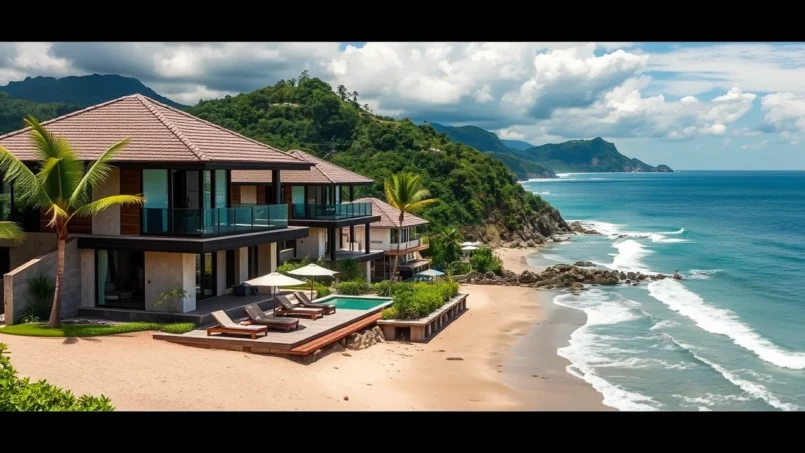
Canggu is no longer the quiet little fishing village it was just a few years ago. This stretch of coast in southwestern Bali has transformed into a veritable lifestyle capital of the island, a haunt for surfers, a headquarters for digital nomads, and a playground for real estate investors. With rental yields among the highest in Southeast Asia, near-uninterrupted rental demand, and an impressive pipeline of infrastructure, investing in real estate in the city of Canggu attracts both individuals and more structured funds.
Despite the hype, the Canggu real estate market presents challenges: restrictive Indonesian laws on land ownership for foreigners, saturation in the 2-3 bedroom villa segment with pool, traffic issues, and regulatory pressure on short-term rentals. For a viable investment, a thorough analysis of data, regulations, and market trends is essential.
From Surf Village to “Premium” Real Estate Market
In just a few years, Canggu has gone from being a quiet surf spot to one of the most dynamic real estate markets in Bali. Between 2018 and 2024, the area experienced a development boom: upscale villas, boutique hotels, restaurants, coworking spaces, beach clubs, and yoga centers. This rapid urbanization has been accompanied by soaring prices.
The average price of villas in Bali increased by approximately $163,000 in one year, rising from $321,000 in early 2024 to nearly $484,000 in early 2025.
This growth is not solely explained by the influx of tourists. Canggu has become a year-round living hub for an international community of remote workers, entrepreneurs, expatriate families, and investors. The Badung region, which includes Canggu, concentrates nearly half of all real estate investor interest in Bali (approximately 48.2%) and offers returns about 5 percentage points higher than those in Jakarta.
Yields, Rents, and Profitability: What the Numbers Say
Bali is regularly cited as one of the most lucrative markets in Southeast Asia, and Canggu is clearly at the top of the range. The available data allows us to draw a fairly precise framework of the expected financial performance.
Rental Yields and ROI
Across Bali, the average return on real estate investment is between 10% and 15% per year, combining rental income and potential capital appreciation. In some optimistic cases, total returns (rent + capital appreciation) can reach up to 20-25% per year in the best locations.
In tourist areas like Canggu, we observe:
– gross yields on villas generally ranging between 7% and 15% of the purchase price,
– net yields around 10-12% for well-managed properties,
– on some very high-performing projects or villas, net yields can reach between 10% and 16% per year.
For 1-2 bedroom villas, rental yield is generally between 8% and 10%, with stable value appreciation. Models designed for groups (families, digital nomads) are often the most profitable, as they attract both leisure travelers and remote-working professionals.
The following numerical examples give an order of magnitude of profitability in Canggu:
| Example Villa Investment in Canggu | Amount Invested | Estimated Annual Net Income | Estimated Net ROI | Capital Payback Period |
|---|---|---|---|---|
| 3-bedroom villa | $279,000 | $30,054 | 10.8% | 9.3 years |
| Villa (average budget) | $400,000 | $30,054 | 7.5% | 13.3 years |
| Villa (upper segment) | $500,000 | $38,794 | 7.8% | 12.9 years |
Many investors recover their investment in 6 to 10 years depending on location, management, and rental strategy (short, medium, or long stay).
Rental Levels in Canggu
Canggu’s strength lies in a deep rental market across several segments: daily rentals like Airbnb, monthly stays, and leases for several months or even years for expats and digital nomads. The income ranges are telling.
For 2-3 bedroom villas:
– in high season, monthly income frequently ranges between $3,000 and $6,000,
– in low season, it tends to fall between $1,800 and $3,500.
For 1-bedroom properties:
– high season: about $1,500 to $3,000 per month,
– low season: $800 to $1,800 per month.
For daily rentals like Airbnb, aggregated data shows:
| Type / Size of Property in Canggu | Average Nightly Rate (ADR) | Median Monthly Revenue | Top 10% Monthly Revenue |
|---|---|---|---|
| 1-bedroom villa | ~$135-$197 | – | – |
| 2-bedroom villa | ~$182-$198 | – | – |
| 3-bedroom villa | ~$209-$294 | – | – |
| 4-bedroom villa | ~$365-$470 | – | – |
| Median Airbnb listing | ~$134 per night | ~$1,846 | – |
| Top 10% Airbnb listings | ≥$452 per night | >$7,622 | >$7,622 |
Beyond short stays, the long-stay demand is massive. Monthly rents are generally structured as follows:
| Type of Accommodation (Canggu) | Current Monthly Rent |
|---|---|
| Coliving with coworking spaces | $600-$1,200 |
| Modern apartment | $800-$1,500 |
| Private villa (1-3 bedrooms) | $1,000-$2,500 |
| 1-bedroom studio in central Canggu | ~$1,615 |
Long-term rents are typically 30 to 50% lower than the income generated by nightly bookings, but they offer greater stability and reduce management costs.
Occupancy Rates: A Market Rarely Empty
Rental performance depends as much on the rental rate as on the occupancy rate. Here again, Canggu stands out.
Some well-located villas in Canggu achieve a record occupancy rate of 91.6%.
Airbnb data shows a more granular reality: the median listing hovers around 46% occupancy, while the top 10% exceeds 86%. This illustrates the gap between standard properties, which are numerous and highly competitive, and well-managed “signature” properties that significantly pull the average up.
Overall, across all villa sizes in Canggu, rates remain between 60% and 67%, including large 6-bedroom villas that still achieve around 60% occupancy, despite high rates.
How Much Does a Property Cost in Canggu?
Prices in Canggu vary widely depending on the exact location (proximity to beach, rice field views, road access), the type of title (leasehold or company structure), land size, and build quality. Nevertheless, several useful benchmarks can be identified.
Prices by Property Type
Based on aggregated data, the market can be summarized as follows:
| Property Type in Canggu | Indicative Price Range |
|---|---|
| 1-bedroom apartment (entry-level) | ≥$100,000 |
| Small villa (1-2 bedrooms, Bali) | ~$100,000-$200,000 (on the island, often higher in central Canggu) |
| Modern 2-bedroom villa, Canggu | From ~$250,000 (leasehold) |
| “Mid-size” villas Canggu (3-5 bedrooms) | ~$300,000 to >$1 million |
| New villas near Batu Bolong/Berawa | ~$500,000 to $1.5 million |
| Branded residences | ~$200,000 to $1 million |
Prices per square meter reflect this tension: in Canggu, figures often range from $2,500 to $3,500 per m², with peaks at $6,000 in prime areas and up to $8,000 in the most sought-after beachfront locations.
Indicative data in rupiah gives another perspective:
| Property Type (Canggu, indicative) | Average Purchase Price | Average Price per m² (approx.) |
|---|---|---|
| House | ~4.3 billion IDR (~$270,900) | ~27.4 million IDR/m² (~$1,726/m²) |
| Apartment | ~2.2 billion IDR (~$138,600) | ~45.4 million IDR/m² (~$2,860/m²) |
| Commercial space | ~4.3 billion IDR | ~27.1 million IDR/m² |
| Land | ~1.5 billion IDR (~$94,500) | ~2.6 million IDR/m² (~$164/m² – excluding prime zones) |
Land Prices and Examples Under $200,000
The entry ticket for land reflects the intensity of demand very well. In the most sought-after areas of Canggu (and Bali more broadly), land prices start around $1,000/m² and can climb to $2,000/m². Some IDR figures for prime land mention up to 30 million IDR per m² in the most demanded zones.
In the greater Canggu area and its surroundings, land in emerging sectors like Seseh, Tumbak Bayuh, Kedungu, Padonan, or Babakan often trades between $300 and $800/m².
Examples of properties under $200,000 illustrate this “opportunity” segment:
| Example Asset in “Greater Canggu” | Location | Indicative Price |
|---|---|---|
| 2-bedroom villa | Tumbak Bayuh | ~$169-$185,000 |
| Modern 2-bedroom villa | Seseh | ~$190,000 |
| 2-bedroom villa (more distant land) | Tumbak Bayuh / Padonan | <$200,000 |
These properties, often on leasehold, still perform well in terms of occupancy thanks to the combination of year-round tourism and long-term tenants, even if they don’t benefit from the “Batu Bolong” or “Berawa” address.
Understanding Canggu’s Key Neighborhoods
To invest effectively, it’s not enough to choose “Canggu” on a map: each sub-area has its own customer profile, prices, and growth potential.
Batu Bolong and Echo Beach: The Trendy Heart
Batu Bolong and Echo Beach form the historic core of Canggu’s “hipster-surf” wave. Here you’ll find Old Man’s, surf shops, bustling bars and restaurants, and designer boutiques. Echo Beach’s waves are among the most famous in Bali.
From a real estate perspective, this is a very dense area, with a spectrum ranging from simple guesthouses to luxury villas with pools and integrated coworking spaces. Prices here are among the highest in Canggu, and available land is very limited, which is slowly pushing new developments further inland.
Key strengths and drawbacks to consider for an Airbnb investment in a lively neighborhood.
Maximum visibility on Airbnb, high occupancy rate, and the potential for high nightly rates for well-designed properties.
Exposure to noise, often congested traffic, and a very high entry cost (initial investment).
Berawa: The Family / Lifestyle Compromise
Berawa is considered one of the most promising sectors for a mixed family + digital nomad clientele. It features Berawa Beach, Finns Recreation Club, numerous international schools and nurseries, gyms, trendy cafés, and restaurants. The setting is a bit more “livable” on a daily basis than Batu Bolong, especially for families.
Villas here command high prices, especially those with remaining rice field views or within walking distance of the beach. Yields are solid, with occupancy driven by stays of 1 to 3 months.
Pererenan: The “Next” Canggu
Pererenan is often described as the “Canggu of 5 years ago”: quieter, less dense, but increasingly equipped with cafés, restaurants, and yoga studios. The black sand beaches are very popular with surfers, and rice field views are still abundant.
The real estate sector, undergoing rapid change, is often cited as the next economic hotspot with anticipated growth of 10 to 15% per year. This dynamic is driven by the rise of projects focused on ecology and sustainable architecture. At the same time, sometimes stricter regulations aimed at preventing over-density help increase the value of well-established properties.
Padonan, Tumbak Bayuh, Babakan: The High-Potential Hinterland
Slightly set back from the coast, these areas offer more space, more accessible prices, and a more local atmosphere. They remain just minutes by scooter from the beaches of Berawa or Pererenan. Cafés, gyms, and colivings are already emerging here.
For an investor, this is typically a “growth” zone: lower entry ticket, significant capital appreciation potential as infrastructure (roads, lighting, internet, transport) improves. These locations are also very popular with long-stayers seeking tranquility while staying close to the action.
Coliving, Villas, Apartments, Land: Choosing Your Asset Type
Canggu’s strength lies in the diversity of available real estate products, each with its own risk and return profile.
Villas: The Star Product (But Competitive)
Villas remain the preferred vehicle for foreign investors in Bali. In Canggu, nearly all high-yield offerings are based on villas with pools, ranging from 1 to 5 bedrooms, often managed as mini-hotels by specialized companies (Gravity Bali, Bukit Vista, etc.).
Market data indicates, however, that the 2-3 bedroom villa with pool segment is now saturated: numerous listings on Airbnb, sometimes standardized design, increasing difficulty in standing out. Villas that truly perform generally combine:
– a strong location (walking distance to beach or clear view),
– a clear concept (eco-villa, “workation” villa with dedicated office, family villa),
– distinctive design (architecture, decoration, outdoor spaces),
– professional management, with polished digital marketing and hotel-like service.
Apartments and Condo-Villas: Lower Entry Tickets
For more contained budgets, apartments offer an interesting entry point. A well-located 1-bedroom starts above $100,000, with monthly rents around $800-$1,500 depending on the level of amenities. “Condo-villas,” small independent houses with common resort-style services, sometimes start around $80,000 on the island.
The net return for investors in housing formats for digital nomads, when management is pooled and projects are well-calibrated.
Boutique Hotels, Colivings, and Commercial Spaces
The other side of Canggu is its fabric of commercial spaces catering to tourism and remote workers: cafés, restaurants, coworking spaces, shops, small hotels. Examples include:
Discover targeted and profitable real estate investments in promising sectors of the island.
Invest in commercial spaces dedicated to work, such as a 360 m² space within a complex like The Umalas Signature.
Capitalize on the dynamic Berawa neighborhood with established, revenue-generating restaurants.
Opt for boutique hotels with around ten rooms, located just minutes from Balinese beaches.
These assets require a more entrepreneurial approach (commercial operation, marketing, team management), but can generate attractive returns, often around 9-10% for well-positioned businesses, as illustrated by the case of a family investing in a food and beverage space in Canggu and achieving a yield of approximately 9.2%.
Land and Off-Plan Projects
Finally, purchasing land for future development remains a strong strategy, especially in areas where infrastructure is just arriving (widened roads, new shuttles, improved internet). Studies show, for example, that after road widening between Canggu and Seseh, some land went from about $300/m² to over $500/m² in less than two years.
Well-designed off-plan projects (villas or apartments) sometimes offer yield guarantees (e.g., an aparthotel in Canggu advertising a guaranteed ROI of 10%) and projected value increases of up to 40% over a few years in some Pererenan developments.
Fees, Taxes, and Operating Costs
Canggu’s flattering gross yields must be put into perspective with operating expenses and local taxation.
Villa Operating Costs
Market data shows that in practice, operating expenses eat up 45 to 50% of gross rental income. These costs include:
– staff salaries (cleaning, gardening, security): $150 to $500/month,
– routine maintenance (painting, repairs, pool): $1,000 to $3,000/year,
– electricity, water, internet: $100 to $300/month (fiber internet between 250,000 and 1 million IDR),
– property management fees: 10% of revenue for monthly rentals, 20% for nightly rentals,
– platform commissions (Airbnb, Booking, etc.): 4 to 9%,
– community contributions (banjar): 50,000 to 250,000 IDR/month.
Experts recommend setting aside 2 to 4% of annual rental income for recurring maintenance, in order to maintain high standards and avoid damage that could tank online review scores.
Taxes on Purchase and Ownership
Upon acquisition, the investor generally pays:
Purchasing a property in Indonesia involves several additional costs on top of the purchase price. Notably, you need to budget for the acquisition tax (BPHTB) at 5% of the taxable value, as well as notary fees (PPAT) generally representing 1% to 2.5% of the price (often around 1%). For new properties, a VAT of 11% may apply to certain transactions. Finally, land registry fees and legal fees should be added, representing between 0.5% and 1.5% of the transaction amount.
During ownership, the annual property tax remains relatively low, around 0.5% of the official value (“PBB”), although a luxury tax of 10-20% may apply to very high-end properties. Rental income is taxed at 10% if the rental is operated through a licensed company, or at 20% if the owner rents directly.
For foreign investors, it is also necessary to consider tax treaties between Indonesia and their country of residence (Australia, United Kingdom, etc.) to avoid double taxation.
How Can a Foreigner Legally Invest in Canggu?
The key point to understand is simple: a foreigner cannot hold full freehold title (“Hak Milik”) in Indonesia. To invest in Canggu, several perfectly legal structures exist, each with its own constraints.
Leasehold (Hak Sewa): The Most Common
Leasehold, or emphyteutic lease, involves renting land or a property for a long term (often 25-30 years, sometimes more, up to 80-99 years via successive extensions). The foreign investor holds a right of use, construction, and resale of the lease rights, but not ownership of the land.
Important characteristics:
– no limit on the number of leases held by a foreigner,
– no systematic registration with the cadastre, but a strong notarial deed,
– the need to clearly negotiate extension conditions (cost, duration, indexation),
– significant value discount if the lease end approaches without a guarantee of extension.
This mechanism suffices for the majority of villas operated as rentals in Canggu.
Right to Use (Hak Pakai): For Residential Use
Hak Pakai is a title registered in a foreigner’s name, but it is reserved for residential use (not for hotels or direct tourist rentals) and imposes:
– holding a residence permit (KITAS, KITAP, or retirement visa),
– limitation to one property per person under Hak Pakai,
– the existence of a building (not bare land),
– a maximum area generally around 2,000 m² (5,000 m² with exemption).
The initial term is 30 years, extendable by 20 years, with the possibility of renewal.
Right to Build (HGB) via a PT PMA Company
For operating properties with commercial intent (short-term rental villas, hotels, resorts), the preferred structure remains the foreign-owned company (PT PMA), which can hold a Right to Build (Hak Guna Bangunan) on land located in tourist or commercial zones.
Key points:
The legal entity, not the individual, holds the permit (HGB). The theoretical minimum investment is about $700,000 ($250,000 paid-in), but practices may vary. The company is subject to reporting, tax, and accounting obligations. Directors can obtain an investor visa (Investor KITAS). It is possible to multiply projects and conduct legal rental activities.
This is the structure suited for a professional investor looking to manage multiple villas or a boutique hotel.
What to Avoid
Using an Indonesian “nominee” to hold a Hak Milik title on behalf of a foreigner remains a common but risky practice. Legally, the name on the title is the owner, and no private agreement is sufficient to fully secure the foreign buyer in the event of a dispute. Specialists recommend avoiding this arrangement in favor of compliant solutions (leasehold, Hak Pakai, PT PMA).
Infrastructure: The Real Hidden Driver of Appreciation
Part of Canggu’s potential is explained by the combined effects of ongoing local and regional infrastructure deployment.
Local Improvements in Canggu
In recent years, Canggu has seen:
– the widening of many roads,
– the introduction of shuttle and local bus services,
– the creation or renovation of sidewalks and bike lanes,
– the development of new parks, public spaces, and sports areas.
Studies quantify the impact of these improvements:
| Type of Infrastructure Improvement | Estimated Increase in Rental Value | Estimated Increase in Resale Value |
|---|---|---|
| Road and accessibility improvements | Up to +15% | Up to +20% |
| Extension of public transport (buses, shuttles) | +10-18% | +12-22% |
| Creation of parks and recreational facilities | +8-12% | +10-15% |
| Improvement of pedestrian pathways (walkways, sidewalks) | +8-10% within an 800m radius | – |
In other words, being near a new park, a renovated thoroughfare, or a shuttle stop can, within a few years, make the difference between a simple good deal and an excellent capital gain.
Major Bali-Wide Projects
Beyond Canggu, the island is experiencing a wave of massive investments:
An overview of major transport and communication development projects underway and upcoming on the island of Bali.
Light rail transit project linking Ngurah Rai Airport to Kuta, Seminyak, Legian, and Canggu.
Metro project combining underground and elevated sections to serve the airport, Kuta, Seminyak, and Canggu.
Construction of a 96 km toll road connecting western Bali to the Badung region.
Extension of the current international airport with a new terminal and runway lengthening.
Future international airport in Buleleng regency, with a planned capacity of 32 million passengers per year.
Deployment of Starlink service and improvement of internet connectivity in village areas.
These projects, envisioned for 2025-2030, further strengthen Canggu’s centrality within the Balinese network: better accessibility for tourists and residents alike, redistribution of land pressure towards areas still considered “peripheral” today (Tabanan, Seseh, Kedungu, north Canggu).
Underlying Trends: Digital Nomads, Ecology, Regulation
Investing in Canggu is not just about monitoring prices per square meter. Three major trends are shaping this market for the coming decade.
The Weight of Digital Nomads and Long Stays
Bali welcomed approximately 6.3 million international visitors in 2024, and forecasts rise to 6.5 million for 2025. But beyond volume, the nature of stays is evolving. Canggu has become one of the global hubs for digital nomads:
– the average length of stay reaches about 29 days,
– nearly 20% of Bali’s long-term rental market is fueled by digital nomads,
– many properties are filled with bookings of 31 to 90 days, and over 30% of properties accumulate more than 181 booking days per year.
This clientele is primarily looking for:
– excellent internet connection (fiber, Starlink),
– a workspace (dedicated desk, integrated coworking),
– proximity to cafés, gyms, yoga studios,
– a relatively quiet yet connected social environment.
Coliving properties with integrated coworking spaces can achieve net yields in this above-average range.
The Rise of Eco-Villas and Sustainable Architecture
Demand for eco-responsible properties is clear: more than a third of buyers value homes equipped with solar panels, and nearly half of real estate agents report increasing demand for low environmental impact properties.
In Canggu and especially Pererenan, we see a proliferation of:
– villas built with sustainable materials (bamboo, reclaimed wood, local stone),
– rainwater harvesting and greywater recycling systems,
– green roofs, natural ventilation, and passive solar shading,
– projects aiming for certification like LEED or GBCI.
Opting for ethical choices in short-term rentals can increase rental appeal, reduce operating costs (energy and water), and target a wealthier clientele willing to pay a higher premium for a stay aligned with their values.
Rental Regulation and Risk of Saturation
Balinese authorities are aware of the risks associated with over-tourism and overdevelopment, especially in Canggu and Seminyak. Strong signals have already been sent:
– limitation or partial freeze on new hotel and villa permits in saturated areas,
– open discussions on stricter regulation of short-term rentals,
– growing concerns about water, waste, and traffic congestion.
For the investor, this means that the “all Airbnb” approach in the heart of Batu Bolong, without consideration for positioning or sustainability, is no longer an obvious strategy. Properties that are:
– legally structured (via PT PMA, appropriate licenses),
– well integrated into the local fabric (respect for banjar, ceremonies, neighbors),
– oriented towards medium/long stays rather than purely mass tourism,
will likely be the ones that fare best in a more regulated environment.
Concrete Investment Strategies in Canggu
By cross-referencing all this data, several approaches emerge for an investor looking to position themselves thoughtfully.
1. Family or Group Villa in Prime Zone
Target: families on vacation, groups of friends, teams on “workation”.
Typical locations: Berawa, Batu Bolong, Echo Beach (or slightly inland).
Winning characteristics:
– minimum 3-4 bedrooms, pool, large common areas,
– office or quiet workspace,
– distinctive design, hotel-like services (cleaning, chef on request),
– management entrusted to a recognized operator.
Potential: net yields around 8-12% with high occupancy (>80% over the year) and strong liquidity upon resale, at the cost of a high entry ticket.
2. Coliving / Aparthotel for Digital Nomads
Target: solo or couple remote workers, stays of 1 to 6 months.
Coliving spaces are often located near popular coworking spaces like BWork, Tropical Nomad, or Dojo Bali. They are generally found in quiet areas, while still being within reach of cafés and amenities.
Winning characteristics:
– rooms or studios with convivial common areas,
– integrated coworking or partnership with a nearby space,
– very high-speed internet, backup generator,
– community management (events, yoga classes, etc.).
Potential: very stable occupancy throughout the year, little seasonality, and yields in the high end of the market, provided the project is managed as a business, not just as a passive investment.
3. Bet on Emerging Zones (Padonan, Tumbak Bayuh, Seseh)
Target: investors with a 5-10 year horizon, seeking land appreciation.
Approach:
Development of an innovative real estate product combining comfort, sustainability, and affordability, ideal for long stays.
Purchase of a villa or land located just 10-15 minutes by car from the beach.
Creation of an eco-responsible product, specially designed and optimized for long stays.
Strategic alignment of the project with new development axes: roads and transport networks.
Potential: a combination of decent rental yields (6-8% net) and potentially above-average capital gains (10-15% per year in some years) as the zone “catches up” with central Canggu.
4. Commercial Strategy: Restaurant, Coworking, Boutique Hotel
Target: investors-entrepreneurs ready to get involved in day-to-day operations.
Assets:
– food and beverage space in Berawa or Batu Bolong,
– medium-sized coworking space in Umalas or Berawa,
– small boutique hotel 1-3 minutes’ walk from a beach.
Potential: yields around 9-10%, but much more correlated to the quality of operations (concept, marketing, HR management) than solely to real estate market dynamics.
Conclusion: Canggu – A Sustainable Opportunity or a Fleeting Eldorado?
The numbers are clear: investing in real estate in the city of Canggu can offer some of the most attractive yields in the region, with a rare combination of:
– value growth (about 8% per year in recent years for the area),
– double-digit net rental yields in the best cases,
– solid demand driven by tourism, digital nomads, and expats,
– continuously improving infrastructure and a long-term development vision.
Canggu is no longer a hidden gem but a market watched by authorities and professional investors. Success now depends on the quality of decision-making, rather than simply being present on the ground.
– choosing the right neighborhood based on the target clientele,
– selecting a sound legal structure (well-drafted leasehold, PT PMA, Hak Pakai),
– clear product differentiation (design, ecology, services, positioning),
– professional management respectful of the local context.
In summary, Canggu is not an automatic eldorado, but a sophisticated market. For those who take the time to understand its mechanics — yields, costs, Indonesian law, urban planning, new infrastructure — it still offers, and likely will for several years, an exceptionally opportunity-rich investment landscape.
Disclaimer: The information provided on this website is for informational purposes only and does not constitute financial, legal, or professional advice. We encourage you to consult qualified experts before making any investment, real estate, or expatriation decisions. Although we strive to maintain up-to-date and accurate information, we do not guarantee the completeness, accuracy, or timeliness of the proposed content. As investment and expatriation involve risks, we disclaim any liability for potential losses or damages arising from the use of this site. Your use of this site confirms your acceptance of these terms and your understanding of the associated risks.

Cyril Jarnias is an independent expert in international wealth management with over 20 years of experience. As an expatriate himself, he is dedicated to helping individuals and business leaders build, protect, and pass on their wealth with complete peace of mind.
On his website, cyriljarnias.com, he shares his expertise on international real estate, offshore company formation, and expatriation.
Thanks to his expertise, he offers sound advice to optimize his clients' wealth management. Cyril Jarnias is also recognized for his appearances in many prestigious media outlets such as BFM Business, les Français de l’étranger, Le Figaro, Les Echos, and Mieux vivre votre argent, where he shares his knowledge and know-how in wealth management.





